Antarctica Cruise Prices By Cabin: Triple Share To Suite
 By Oleg G.
The gap between a quad-share berth and a balcony suite on an Antarctica cruise can run to tens of thousands of dollars. Here is what each cabin category costs, per ship, and what the step up buys.
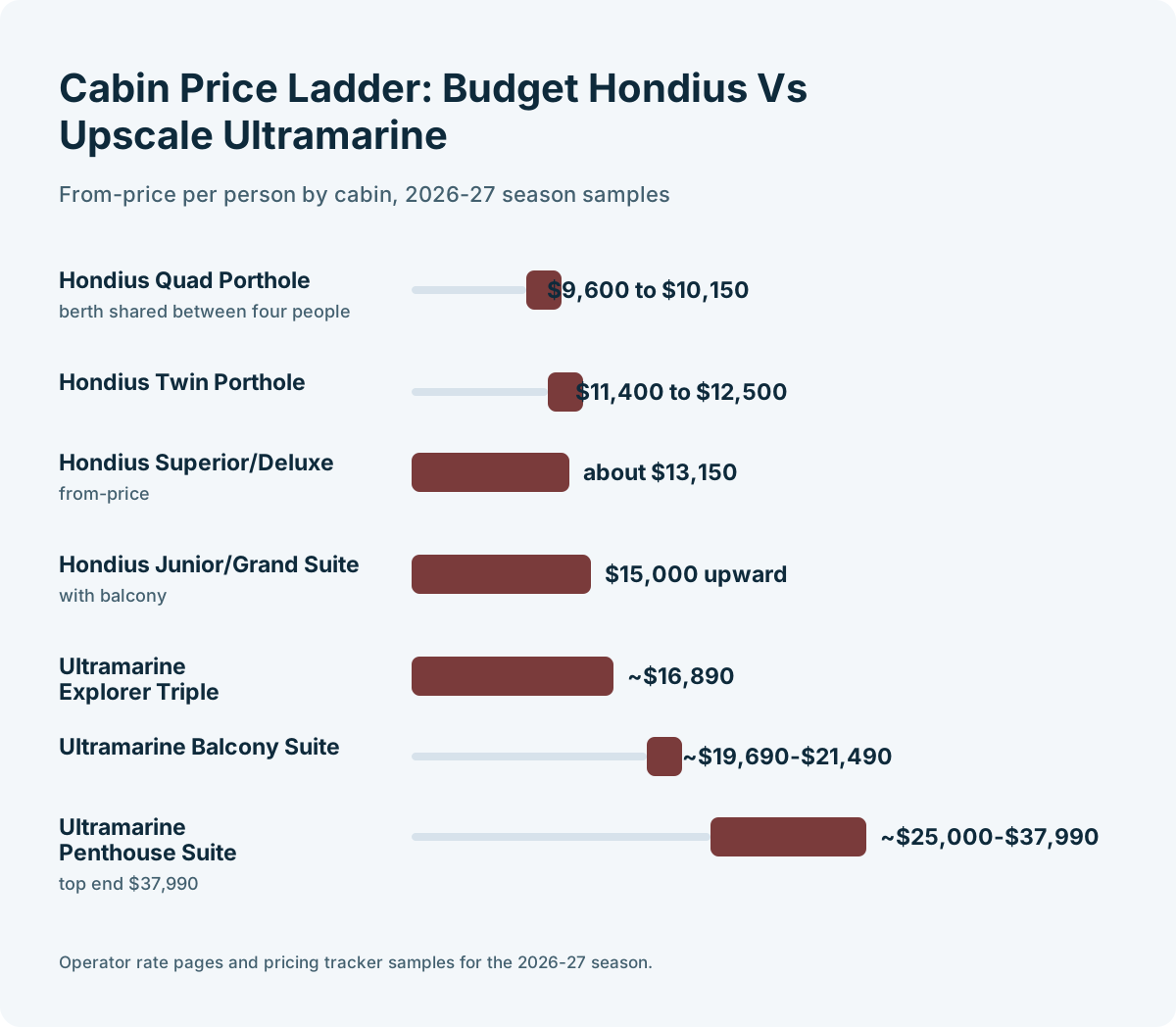
Quick answer: Quad and triple share cabins on budget expedition ships start around $9,600 to $10,150 per berth on Hondius, while superior, deluxe and suite categories on the same ship run from roughly $13,150 to over $15,000. On upscale ships like Ultramarine, suites reach $25,000 to $37,990. Single supplements typically add 40 to 100 percent.
How Much Does Each Cabin Category Cost On An Antarctica Cruise?
On a budget expedition ship such as Oceanwide's Hondius, a quadruple porthole berth runs roughly $9,600 to $10,150 per person, a twin porthole about $11,400 to $12,500, a superior or deluxe cabin from about $13,150, and a junior or grand suite with balcony from around $15,000 upward. On upscale ships the ladder starts higher: Ultramarine's Explorer triple is around $16,890, and its penthouse-level suites reach $37,990.
The cabin you pick is one of the biggest levers on the price of an Antarctica cruise. The same voyage can carry a spread of thousands of dollars between the cheapest shared berth and the top suite. Our main cost guide covers the all-in budget picture; this page stays inside the cabin, category by category.
The figures below come from 2026-27 season samples collected from operator rates pages and pricing trackers. They are from-prices per person, twin share unless noted, and they shift with promotions, so treat them as the shape of the ladder rather than a quote.
| Ship (operator) | Entry category | Mid category | Top category |
|---|---|---|---|
| Hondius (Oceanwide) | Quad porthole ~$9,600–$10,150 | Twin window ~$12,500+ | Junior/grand suite ~$15,000+ |
| Ultramarine (Quark) | Explorer triple ~$16,890 | Balcony suite ~$19,690–$21,490 | Penthouse suite ~$25,000–$37,990 |
| Greg Mortimer / Sylvia Earle (Aurora) | Twin share samples from ~$13,195 | Twin samples up to ~$17,006 (category not stated) | Suites higher, not detailed in samples |
| World Navigator (Atlas) | Twin from ~$13,499 (Dec 2026 sample) | Balcony categories higher | Suites higher still |
| Silver Endeavour (Silversea) | Veranda suite from ~$15,400+ (Feb sample) | Mid suites higher | Grand/owner suites highest |
| National Geographic Endurance / Resolution (Lindblad) | 12-day from ~$19,000 | Balcony categories above that | Up to ~$30,205 at holiday peaks |
The ladder also moves with the calendar. One 2026-27 price sample shows an 11-day Hondius sailing in March from about $6,900 per person, a November 13-day voyage on G Adventures' Expedition from about $7,279, a December 12-day Polar Latitudes departure from about $9,937, and a February 11-day Silver Cloud sailing from about $15,400. Those are entry-cabin figures in each case, which means the month you choose can shift the whole ladder. That is why the two decisions belong together rather than in sequence.
One pattern worth noticing: on Hondius, moving from a quad to a suite adds roughly half again to the fare, while on Ultramarine the top suites run more than double the Explorer triple. On Silversea or Lindblad, the entry category already sits at the level of a suite elsewhere, so the decision is less about money and more about cabin size and view. If you are weighing two ships rather than two cabins, the free cabin price consultation can pull live categories on both in one pass.
What Does Each Step Up In Cabin Actually Buy?
Stepping up a category buys three things: more space, a better window, and sometimes a genuine balcony. A quad porthole on Hondius is roughly 15 to 16 square metres shared between four people; a superior is 20 to 23 square metres for two; the grand suite adds a private balcony at 26.7 square metres. Beyond the top balcony tier, extra money buys suites, tubs and occasionally butler service, not more Antarctica.
The expedition itself does not change with your cabin. Everyone on a 170-passenger ship like Hondius rides the same Zodiacs, lands at the same sites under the same IAATO 100-passenger-ashore rule, and hears the same lectures. The operator's own cabin pages lay out the differences plainly: berth count, window type, floor area. When I was researching every option for this site, the surprise was how little of the fare the "experience" part varies compared with the bed part.
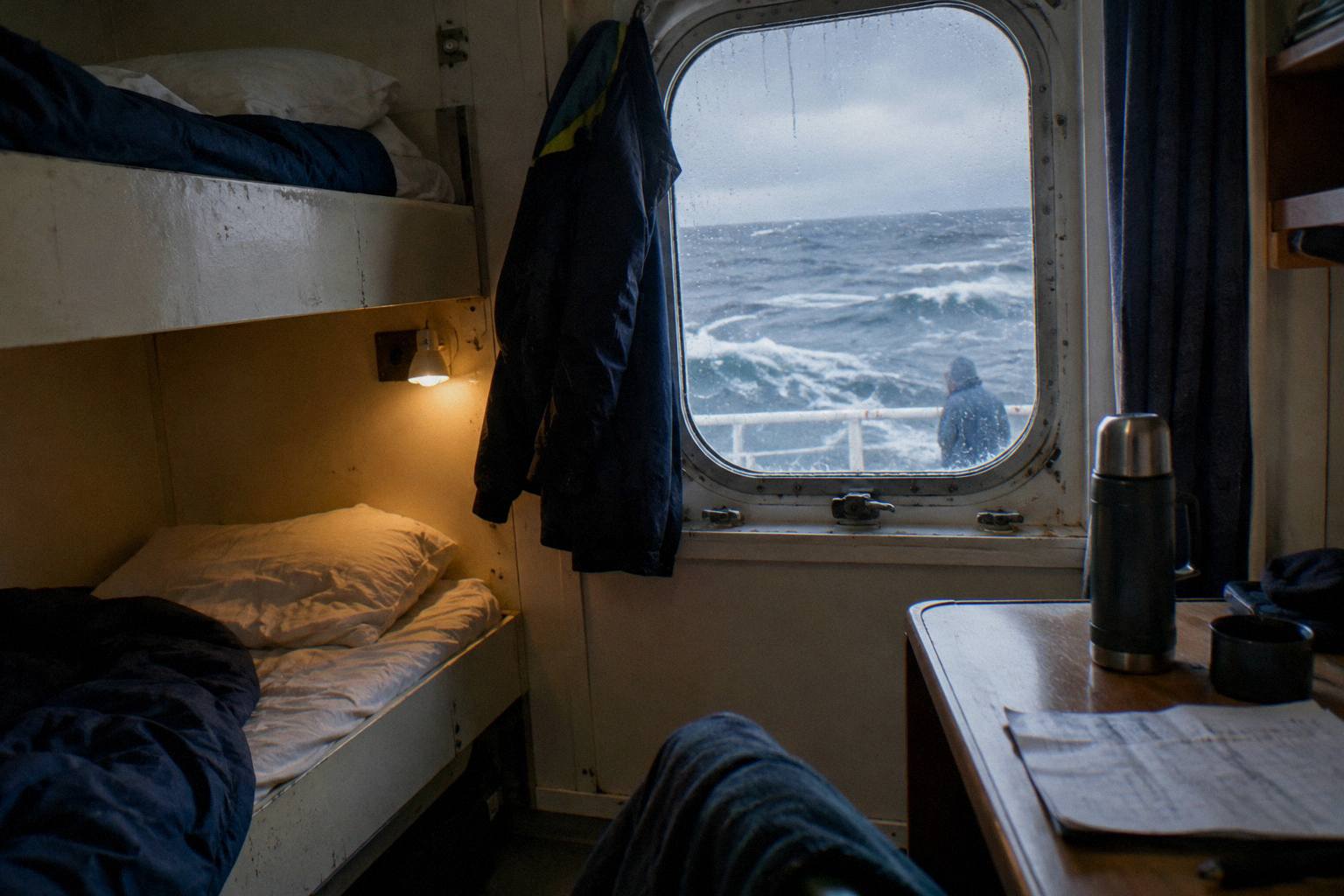
Floor areas make the ladder concrete. Oceanwide's cabin pages list the Hondius quad at roughly 15.3 to 16 square metres and the grand suite at 26.7; on Ortelius, quads run 12.4 to 14.1 square metres and twin window cabins 17.5 to 17.7; on Plancius, the quad is 12 square metres and the superior 21 to 23. Those numbers explain the price gaps better than the category names do. On the older ships you are paying for space the hull genuinely has.
A practical way to price the ladder is cost per amenity. The jump from a twin porthole to a twin window on the same ship is usually a few hundred to a thousand dollars, and it buys daylight in the cabin. The jump from a window to a private balcony on ships that have them, such as the Aurora pair or Quark's balcony suites, is larger, often several thousand dollars, and it buys a private outdoor spot, useful on a scenic cruising day but less so when you are out on landings. The top suites add square metres and bathroom luxury that you will enjoy mainly during Drake Passage crossings.
Where the step up genuinely pays is on longer voyages. On a 20-plus-day Falklands, South Georgia and Antarctica combination, the cabin becomes a home for three weeks, and the price per night of a balcony starts to look reasonable against a short hotel stay. On a 10-day Peninsula run, you may spend so little waking time in the cabin that the entry category is the rational buy, and the money saved funds flights, insurance and gear. The free voyage consultation is a good place to test that trade-off against real dates.
Are Triple And Quad Share Cabins Worth The Savings?
Yes, if the ship is right and you accept the trade. A quad berth on Hondius at roughly $9,600 to $10,150 saves roughly $1,800 to $2,400 per person against a twin porthole, and share cabins are the cheapest legitimate way onto the water. The costs are privacy, locker space and the reality of sharing a small room with strangers for the length of the voyage. G Adventures, for one, waives the supplement when you share with a same-gender traveller.
Share cabins exist mainly on the small-ship budget lines. Oceanwide builds its pricing around them: the quad porthole categories on Hondius, Ortelius and Plancius are the entry point for the whole fleet, and published samples put the multi-occupancy range at roughly $7,050 to $9,600 across the season. G Adventures takes the same approach on the Expedition, and its terms waive the single supplement when a same-gender roommate is matched in a twin or triple. Aurora takes a different route, selling dedicated solo staterooms at no supplement on some sailings instead.
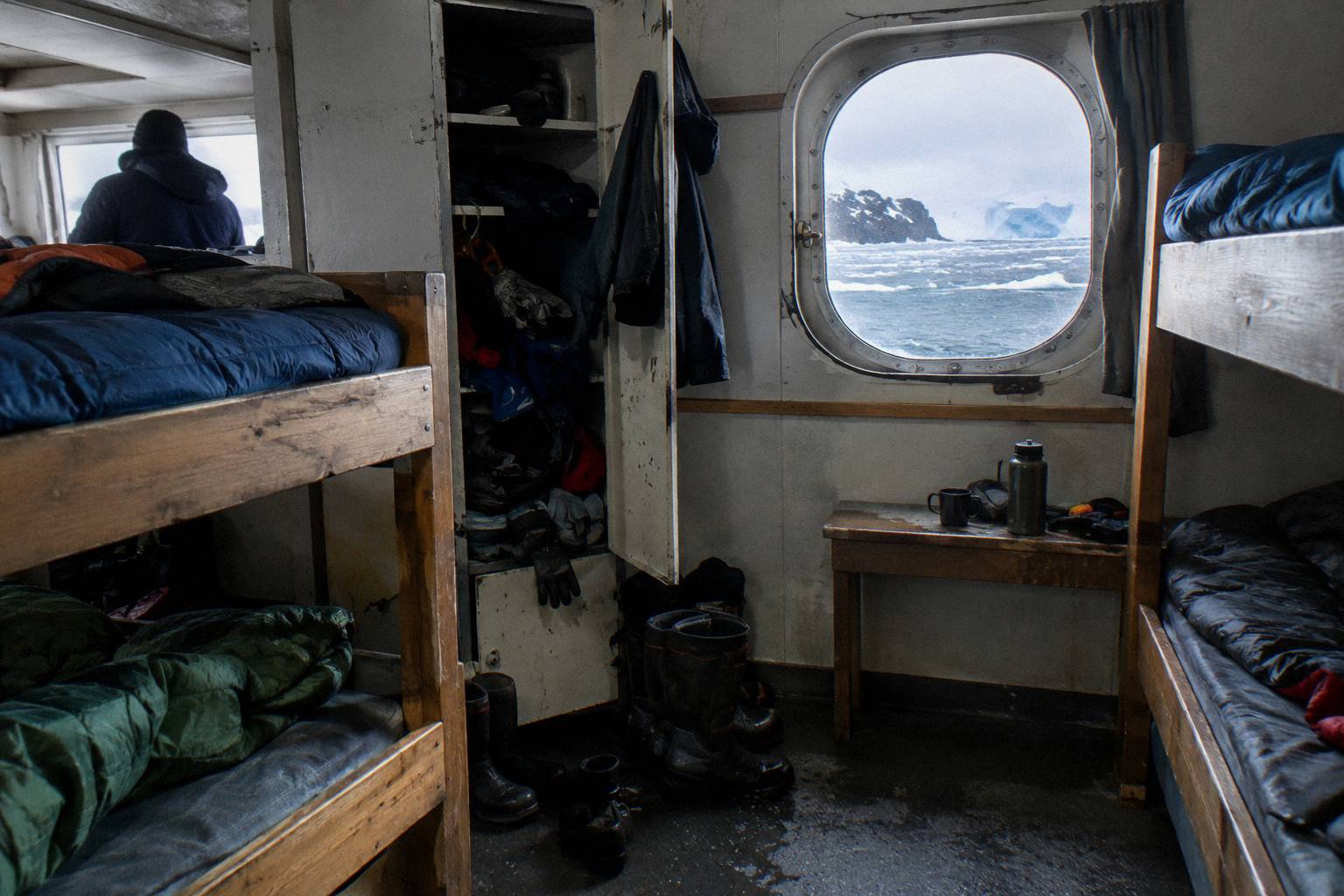
Pricing samples from the same trackers show where entry cabins sit across the fleet. A November 13-day Expedition sailing on G Adventures samples from about $7,279, and an 11-day Ocean Nova voyage in the same month from about $8,463, both entry-cabin figures. Poseidon's Sea Spirit sells its triple suite on a New Year Peninsula voyage from about $11,156 upward, a reminder that a "triple" on a 114-passenger all-suite ship is a different product from a quad berth on a 108-passenger workhorse. Check what the category actually contains before comparing prices across ships.
The honest case against a share cabin is the Drake Passage. Two days of rough seas in a small cabin with three strangers tests both seasickness and sociology. The honest case for it is arithmetic: the savings against a twin window can cover a return flight to Buenos Aires with change. Solo travellers should read our solo travel guide before deciding, because the share-versus-supplement decision is the single biggest cost fork a single traveller faces.
Hondius is the ship that does share cabins best in this roster: a 2019 build, Polar Class 6, 170 passengers in 80 cabins, with a quad category that undercuts its own twin porthole cabins by around $1,800 or more. The Hondius guide page covers the ship in full.
For most share-cabin shoppers the shortlist comes down to Hondius or its fleetmates, with the choice riding on dates and which categories still hold berths. That is a moving target, and the from-price you see and the berth you can actually book are not always the same thing.
How Much Extra Is A Balcony Or Suite?
On ships that offer them, a private balcony typically adds several thousand dollars over a comparable window cabin, and a suite adds more. On Ultramarine, balcony-level categories sample around $19,690 to $21,490 against an Explorer triple at $16,890, with deluxe, terrace and penthouse suites running $25,000 to $37,990. On Lindblad's National Geographic pair, 12-day fares run from about $19,000 up to $30,205 at holiday peaks.
The balcony premium is not uniform across the fleet, because not every ship has balconies to sell. On Oceanwide's Hondius, balconies sit in the suite categories, so the premium is really a suite premium. Quark's Ultramarine and Ocean Explorer, Aurora's Greg Mortimer and Sylvia Earle, and the luxury lines sell balconies as a broad mid-tier. On Sea Spirit, Poseidon's 114-passenger ship, some suites carry private balconies while the classic categories do not, an in-fleet split worth checking before you assume a category name means a private outside space.
Aurora's pair shows how the mid-tier balcony market works. The operator's ship page for Greg Mortimer puts balconies on 85 percent of its staterooms, with twin-share samples on the 12-day Peninsula programme from roughly $13,195 to $17,006 depending on date and category, and dedicated solo balcony staterooms in categories A, B and C at no single supplement. Seabourn takes the all-suite idea further: both expedition ships carry 132 oceanfront veranda suites, every one with a balcony, so there is no window-only tier at all.
The luxury tier changes the question rather than answering it. On Silver Endeavour, every suite has a balcony, so the entry veranda category at roughly $15,400 in a February sample is already the "balcony cabin", and the ladder above it is about size and service. Silversea's ship page lists suite categories from Classic Veranda up to Owner's Suite, all balconied. The same is true on Seabourn's expedition ships: when the cheapest cabin is a suite, the cabin decision stops being a cost decision.
| Tier | Typical ships | What the top fare buys | Sample 2026-27 from-price |
|---|---|---|---|
| Small-ship budget | Hondius, Ortelius, Plancius, Sea Spirit, Expedition | Suites, with a private balcony on Hondius's Grand Suite | From ~$7,800 (Hondius voyage from-price) |
| Standard expedition | Lindblad NG pair, Swan Hellenic, HX mid-fleet | Balcony categories, bundled extras on some lines | From ~$11,900 (Voyage to Antarctica) |
| Upscale expedition | Ultramarine, Aurora pair, Atlas pair | All-balcony fleets, activity platforms | From ~$12,236 (Quark voyage-level) |
| Luxury | Silver Endeavour, Ponant fleet, Seabourn pair | All-suite, all-balcony, butler service | Silver Endeavour fare needs a consultation |
Note the fare structure on that table: Quark's from-price is voyage-level and shared across Ultramarine, Ocean Explorer and World Voyager, so it is not a ship-exclusive figure, and Silver Endeavour's current fare is not published here, so a live number needs a consultation rather than a guess.
What About Solo Travellers And Single Supplements?
Travelling alone typically adds 40 to 100 percent to the twin-share fare, depending on ship, cabin and date. The workarounds are real: G Adventures waives the supplement when a same-gender roommate is matched, Oceanwide sells share berths, and Aurora offers dedicated solo staterooms, including solo balcony categories on Greg Mortimer and Sylvia Earle, at no supplement on select sailings. HX has waived the solo supplement on some bookings within six months of departure.
The supplement is the least loved number in expedition pricing, because fares are priced per person on a twin-share basis. Aurora's ships carry dedicated solo balcony staterooms in categories A, B and C priced without a supplement, up to ten per sailing. Lindblad's National Geographic Endurance lists dedicated solo cabins in categories SA and SB with balcony options, per one season listing. The budget answer remains the share berth.
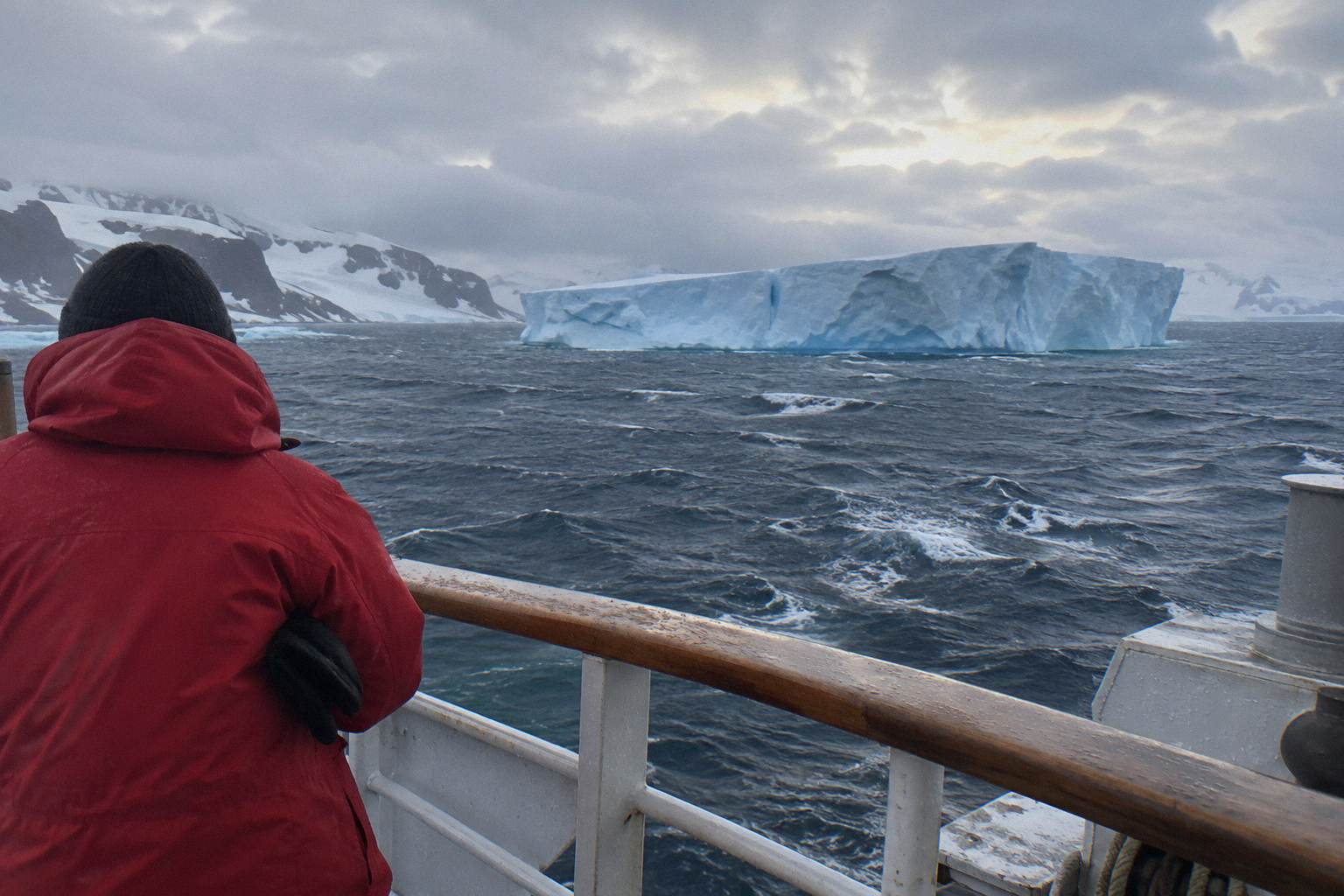
For a sense of scale, published supplement bands run from 25 percent extra up to 1.5 to 2 times the twin rate, and one 2026-27 cost guide names Silversea and Ponant among the lines that waive it on select sailings. At the top of that band a solo traveller pays close to double the per-person fare, while a matched quad berth on a budget ship stays in four figures per berth. That is the widest gap in this entire article, and it is why the share-versus-supplement decision deserves ten minutes of real thought rather than a default. If you are weighing solo balcony categories against a supplement on a specific sailing, check solo cabin availability free before committing either way.
How Do You Check Live Cabin Prices Before Booking?
Start with the operator's own dates-and-rates page for the ship and season, then sanity-check the category ladder against a second source, because promotions move from-prices month to month. Confirm the figures are per person, double occupancy, note the exact cabin category code, and compare what is bundled: parkas, boots, drinks, gratuities and charter flights vary by line and can shift the real gap between two quotes by thousands.
Cabin-level pricing is the most volatile layer of an already volatile market. Early-booking offers for the 2026-27 and 2027-28 seasons commonly run 10 to 30 percent off, with select unsold sailings reported at up to 40 percent. A from-price you read in October can be gone by the time you decide, which is why this article deliberately prints sample ranges rather than promises.
Timing shapes what you will be quoted. Peak December sailings are the ones that book 18 or more months ahead, according to one season cost guide, while last-minute discounts do exist but come with limited cabin choice. Every cabin figure quoted across Cruises In Antarctica comes from operator rate pages or published price trackers, and none of it is a live quote.
The checklist for comparing two cabin quotes is short but non-negotiable. Confirm both figures are per person on a double-occupancy basis. Write down the exact category name and code, because "deluxe" means different things on different ships. Check the single-supplement policy for your cabin. Check whether gratuities are included or suggested, and whether kayaking or camping costs extra, since add-ons like G Adventures' kayaking at roughly $1,099 or camping at $399 sit outside the base fare. Then read the cancellation and deposit terms side by side; Quark's terms, for example, call for a 25 percent deposit with final payment 150 days before Day 1, while Oceanwide takes 20 percent with the balance due 60 days before departure.
| Check | Why it changes the real price |
|---|---|
| Occupancy basis | A "from" price is almost always per person, double occupancy; solo figures differ |
| Exact category code | Same names cover different sizes, windows and deck positions across lines |
| Inclusions | Parka, boot loan, drinks, gratuities, charter flights, hotel nights |
| Activity add-ons | Kayaking, camping, helicopter or paddling often cost extra |
| Deposit and cancellation terms | 20 to 25 percent deposits are standard; penalties escalate near departure |
| Insurance minimums | Operators require evacuation cover, typically $100,000 to $500,000 |
Because the cabin ladder differs so much between ships, a side-by-side of three ships that actually operate share cabins, mid-tier balcony ships and all-suite luxury is the fastest way to see where your budget lands. The table below puts the featured ships from this article next to each other.
| Ship | Class | Passengers | Ice class | From, per person | Voyage length | Departs from |
|---|---|---|---|---|---|---|
| HondiusOceanwide Expeditions | Small-Ship Budget | 170 | Polar Class 6 | from $7,800 | 11 to 19 days | Ushuaia |
| Greg MortimerAurora Expeditions | Upscale Expedition | 130 | – | from $19,521 | 12 to 26 days | Ushuaia |
| Silver EndeavourSilversea | Luxury | 220 | PC6 | – | 6 to 13 days | King George Island, Puerto Williams |
Whichever cabin you lean toward, the decision usually comes down to two or three real sailings on real dates, and that is exactly what the free consultation is for: it checks live cabin availability and current pricing across operators, with no obligation to book anything.
Common Questions About Antarctica Cruise Cabin Prices
How much is a quad share cabin on an Antarctica cruise?
On Oceanwide's Hondius, a quadruple porthole berth samples at roughly $9,600 to $10,150 per person for 2026-27 Peninsula departures, and across the budget fleet multi-occupancy berths sample in the $7,050 to $9,600 range. It is the cheapest legitimate way to sail, trading privacy and space for roughly $1,800 or more in savings against a twin porthole.
How much extra does a balcony cost on an Antarctica cruise?
On ships that sell balconies as a mid-tier, the premium over a comparable window cabin typically runs several thousand dollars per person. On Quark's Ultramarine, balcony-level categories sample around $19,690 to $21,490 against an Explorer triple at $16,890. On luxury ships such as Silver Endeavour, every suite has a balcony, so there is no separate balcony premium to pay.
Do I pay double travelling solo on an Antarctica cruise?
Published supplement bands run from 25 percent extra up to 1.5 to 2 times the twin-share fare, so double is the ceiling, not the norm. Workarounds include same-gender roommate matching with no supplement on G Adventures, share berths on Oceanwide, dedicated no-supplement solo staterooms on Aurora's Greg Mortimer and Sylvia Earle, and waived supplements on select Silversea and Ponant departures.
Are suite fares on Antarctica cruises worth it?
Suites buy space, bathroom luxury and sometimes butler service, not more landings: everyone aboard rides the same Zodiacs under the same IAATO rules. They pay off most on long voyages, 20-plus day combinations where the cabin is home for weeks, and matter least on short 10-day Peninsula runs where you are ashore or in the lounge most waking hours.
Which cabin category is best value on an Antarctica cruise?
On budget ships, the twin window is often the sweet spot: full daylight in the cabin at a mid-ladder price, well below balcony money. On upscale and luxury ships where balconies are standard, the entry veranda category is usually the value pick, since the expedition programme is identical in every cabin.
Do Antarctica cruise cabin prices include flights and drinks?
It varies by operator and cabin, which is why quote comparison matters. Budget lines typically include meals, Zodiacs and lectures but exclude flights, alcohol and gratuities, while luxury lines bundle drinks, gratuities and Wi-Fi. Some packages add charter flights or hotel nights; always confirm inclusions for your exact cabin before comparing fares.
More Cost And Booking
 Cruise CostA per-person price ladder from $7,050 berths to $32,320 luxury voyages, with what fares include and what they quietly leave out.Read the guide
 Cheap Antarctica CruisesThe honest floor for Antarctica fares, which ships carry it, and what it costs all-in.Read the guide
 Last-Minute DealsDo last-minute Antarctica berths still exist, and what do they really save?Read the guide
 What Is IncludedWhat an Antarctica fare really covers, operator by operator, plus the hidden costs with published amounts.Read the guide