Antarctica Cruise Prices By Month: When Fares Are Lowest
 By Oleg G.
An 11-day Peninsula sailing in March 2027 is listed from about $6,900 per person. A 12-day Christmas departure is listed from $30,205. The gap between them is almost entirely the calendar, and this guide shows where every month of the season falls in between.
Quick answer: Antarctica fares are lowest in November and March and highest from late December through January. Published 2026-27 examples run from about $6,900 per person for an 11-day March sailing on Hondius to $30,205 for a December 22 Lindblad departure. Shoulder months commonly list 20 percent or more below peak weeks.
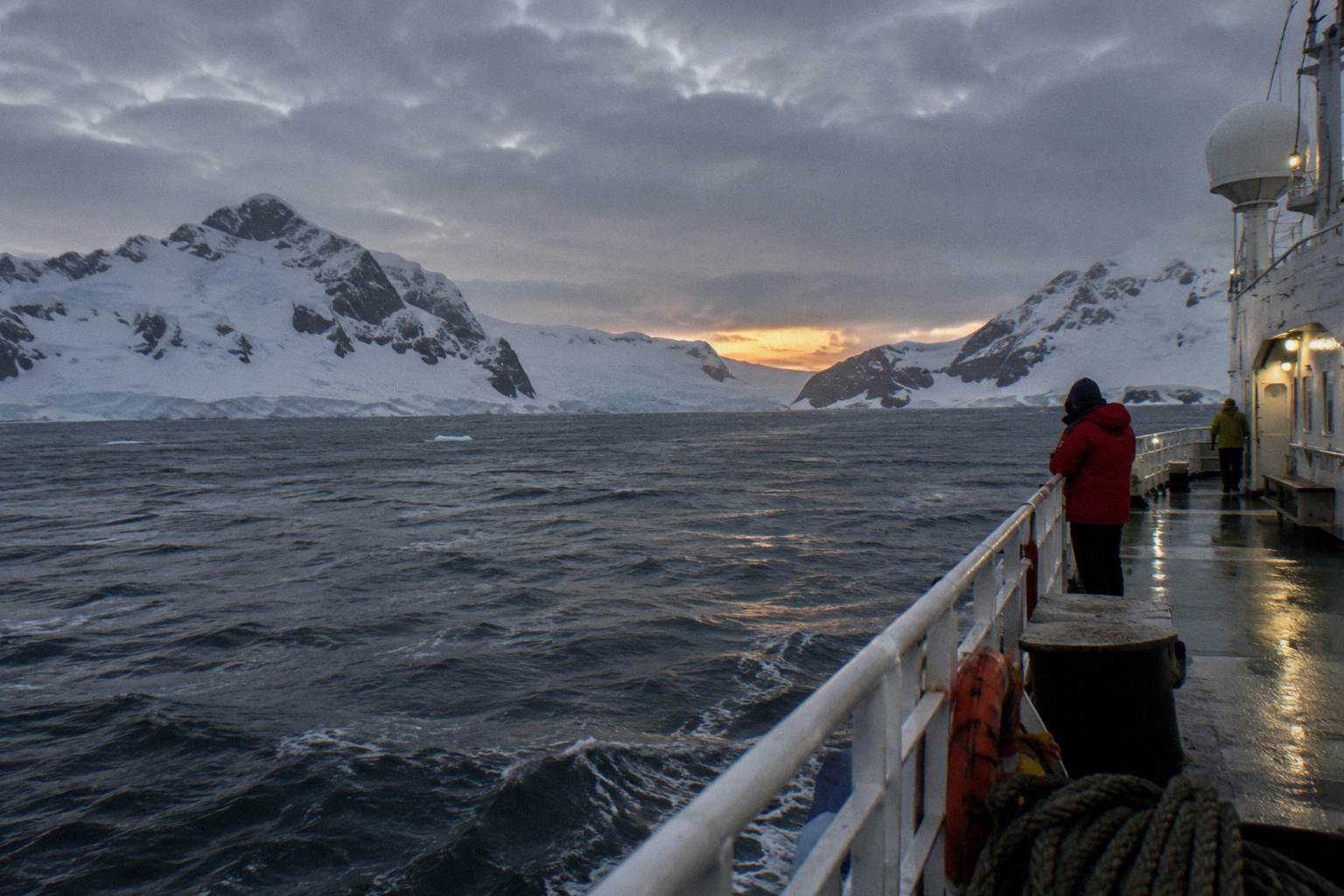
An 11-day Antarctic Peninsula voyage aboard Hondius is listed from about $6,900 per person for a March 7, 2027 departure. A 12-day Voyage to Antarctica aboard National Geographic Endurance, sailing December 22, 2026, is listed from $30,205 per person. Same stretch of coastline, same hundred-passenger landing rules, and a gap of more than four times the price. Most of that gap comes down to one decision: which month you sail in.
This guide lays out Antarctica cruise prices by month for the 2026-27 season, using only published example fares: operator listings, the published from-prices on this site's ship roster, and season cost guides. Every expedition cruise fare moves with promotions, cabin category and how early you book, so treat each number here as an example of a pattern rather than a quote. The pattern: shoulder months sit at the bottom, midsummer at the top, and the holiday weeks in a band of their own.
How Much Does An Antarctica Cruise Cost In Each Month?
Published 2026-27 fares run from about $6,900 per person for an 11-day March Peninsula sailing to $30,205 for a 12-day Christmas departure. November and March anchor the bottom of the range, December and January the top, and February sits between them at mid to high prices. One example fare for each month of the season sits in the table below.
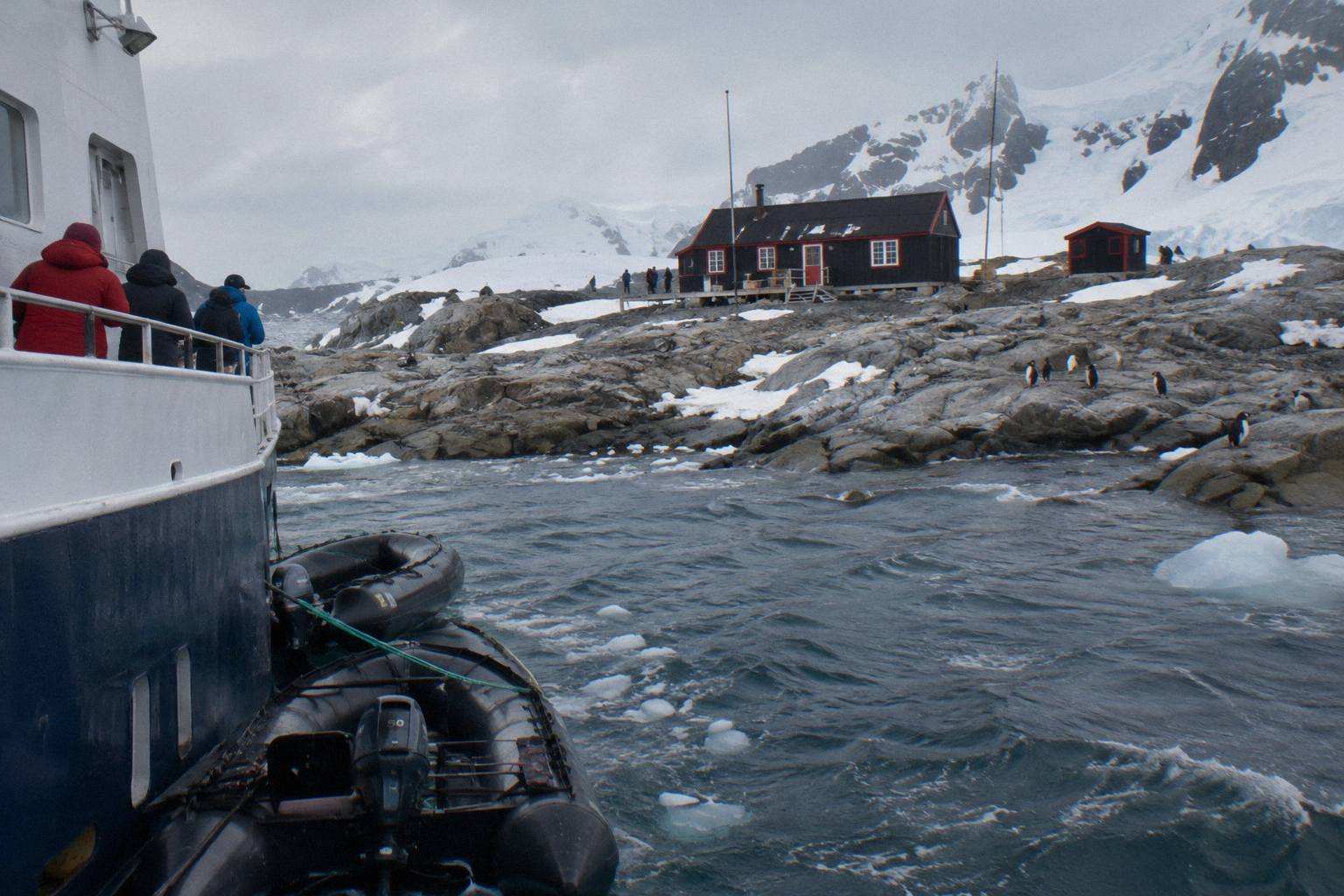
All fares below are per person, generally on a twin-share basis, and drawn from operator pages and a 2026-27 season price listing. They are starting fares, which usually means the least desirable cabin on the least in-demand date of that month. A useful cross-check comes from the roster itself: the lowest published from-fares for Peninsula voyages include Plancius at $7,050, the G Adventures Expedition at a reported $7,439, Sea Spirit at $8,846, the Lindblad ships at $11,900, Atlas World Navigator at $12,150, the three Quark ships at $12,236 on shared voyage-level pricing, Ponant's L'Austral at $18,700 and Aurora's Greg Mortimer at $19,521. Where a month's example sits against those floors tells you a lot about how hard that month is priced.
| Month | Example fare (per person) | Ship, voyage and length | What the month gives you |
|---|---|---|---|
| November | from about $7,279 | Expedition (G Adventures), 13-day Peninsula voyage departing November 11, 2026 | Shoulder pricing, pristine snow, penguin courtship, more sea ice |
| December | from about $9,937 | Discoverer (Polar Latitudes), 12-day Peninsula voyage departing December 8, 2026 | Longest daylight, chicks hatching late in the month, holiday premium after mid-December |
| January | from about $8,024 | Expedition (G Adventures), 11-day Peninsula voyage, January to March 2027 range | Warmest month, peak demand, chicks being fed |
| February | from about $15,400 | Silver Cloud (Silversea), 11-day voyage departing February 2, 2027 | Peak whale numbers, least sea ice, best Circle crossing odds |
| March | from about $6,900 | Hondius (Oceanwide), 11-day voyage departing March 7, 2027 | Shoulder pricing, strong whale activity, fledging chicks |
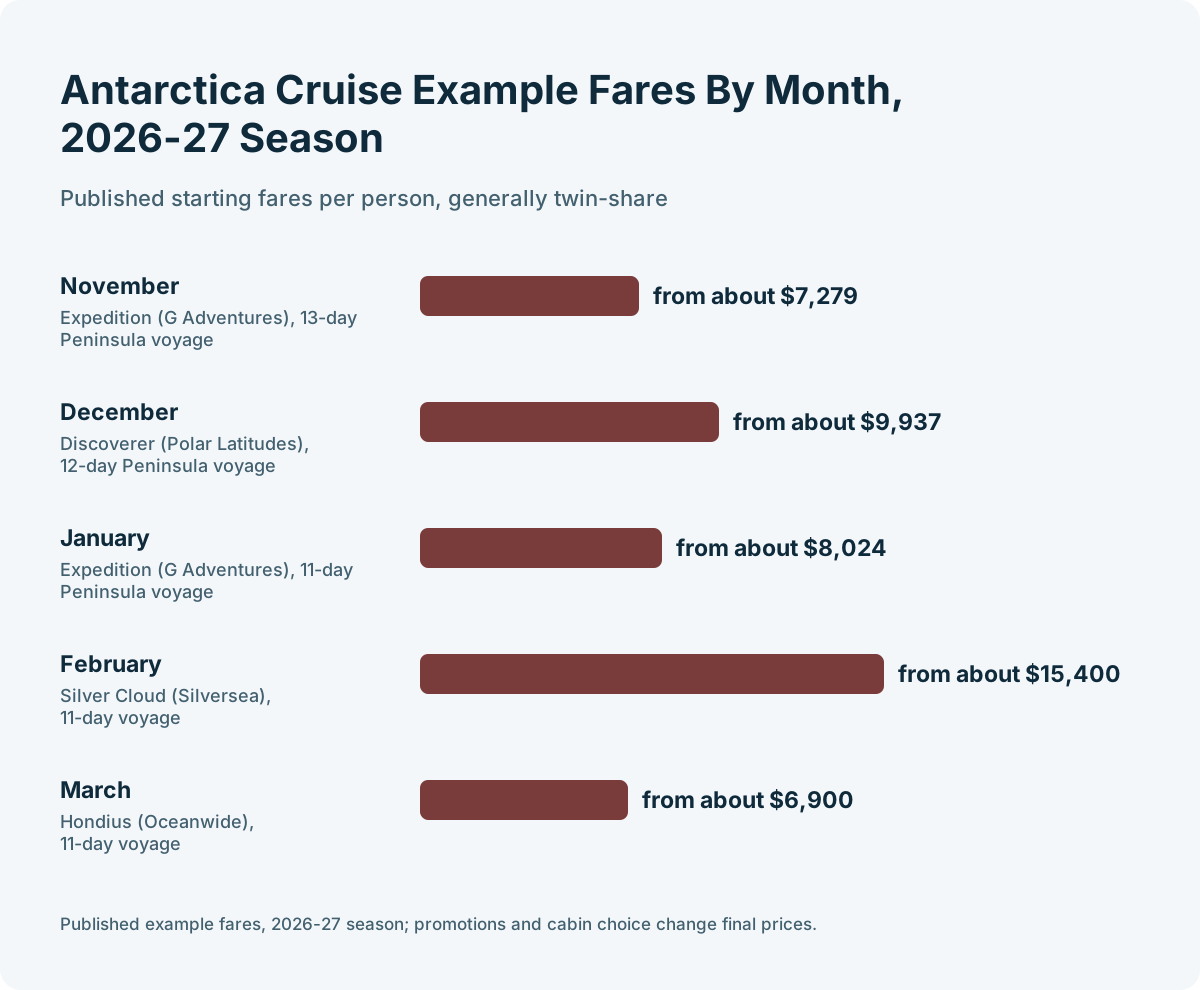
Two caveats apply to every row. First, the cheapest fare in a cheap month is not the same product as the cheapest fare in an expensive one: the March Hondius fare is a starting berth on a budget ship, while the February Silversea fare is a luxury-suite voyage with a different inclusion list. Second, promotions distort single snapshots. One 2026 cost guide reports early-booking offers commonly reaching 10 to 30 percent off, and one deals tracker reports last-minute reductions of 25 to 60 percent on select departures, so the same sailing can be listed at very different numbers a few months apart.
If your dates are flexible, the calendar is one of the biggest levers you hold. Before locking a month in, it can help to compare fares across the whole season with someone who watches these listings week to week; the consultation on this site is free and carries no obligation.
Why December And January Cost The Most
December and January peak because demand does: daylight stretches past 20 hours near the solstice, penguin chicks hatch and draw the season's biggest crowds, and the Christmas and New Year weeks carry the highest fares of all. A December 22 Lindblad departure lists from $30,205, and holiday-week examples run thousands above comparable early-December sailings.
The Antarctic Treaty Secretariat notes that roughly 98 percent of tourism voyages happen in the Peninsula region during the seven-month austral summer from October to April, and the traffic inside that window is far from even. IAATO counted 85,195 landed visitors in the 2025-26 season according to its published season statistics, and January is the busiest month for ships and landings. Operators price accordingly, with a clear premium on the holiday weeks.
The holiday premium is visible in specific departures. One season price listing shows National Geographic Endurance's December 22, 2026 Voyage to Antarctica from $30,205 per person, against $11,900 as the ship's standard starting fare for the same 12-day route. Polar Latitudes lists two festive sailings on Ocean Victory: Christmas Season in Antarctica, December 18 to 28, 2026, from $13,895, and the New Year's Antarctic Circle Crossing, December 27 to January 8, from $22,195. Poseidon's Sea Spirit runs a New Year Peninsula voyage from roughly $11,156 in a triple suite, and Ocean Albatros has a December 12 departure listed from about $12,406.
| Departure window | Dates | Ship and voyage | Listed from-price (per person) |
|---|---|---|---|
| Christmas | December 22, 2026 | National Geographic Endurance, Voyage to Antarctica, 12 days | $30,205 |
| Christmas | December 18 to 28, 2026 | Ocean Victory, Christmas Season in Antarctica, 11 days | $13,895 |
| New Year | December 27, 2026 to January 8, 2027 | Ocean Victory, New Year's Antarctic Circle Crossing, 13 days | $22,195 |
| New Year | December 28, 2026 to January 8, 2027 | Sea Spirit, New Year Peninsula voyage, 11 to 12 days | about $11,156 (triple suite) |
| Early December | December 8, 2026 | Discoverer, 12-day Peninsula voyage | about $9,937 |
Read the table as a slope rather than a menu: fares climb as December runs toward Christmas. On these examples, a December 8 sailing lists from about $9,937 against $30,205 for the December 22 Endurance departure, though the ships differ.
How Much You Save In November Or March
November and March commonly list 20 percent or more below peak months, and the published examples bear it out: about $7,279 for a 13-day November sailing and about $6,900 for an 11-day March voyage on Hondius. The trade-offs are real, though: more sea ice and fewer whales in November, colder days and emptying colonies in March.
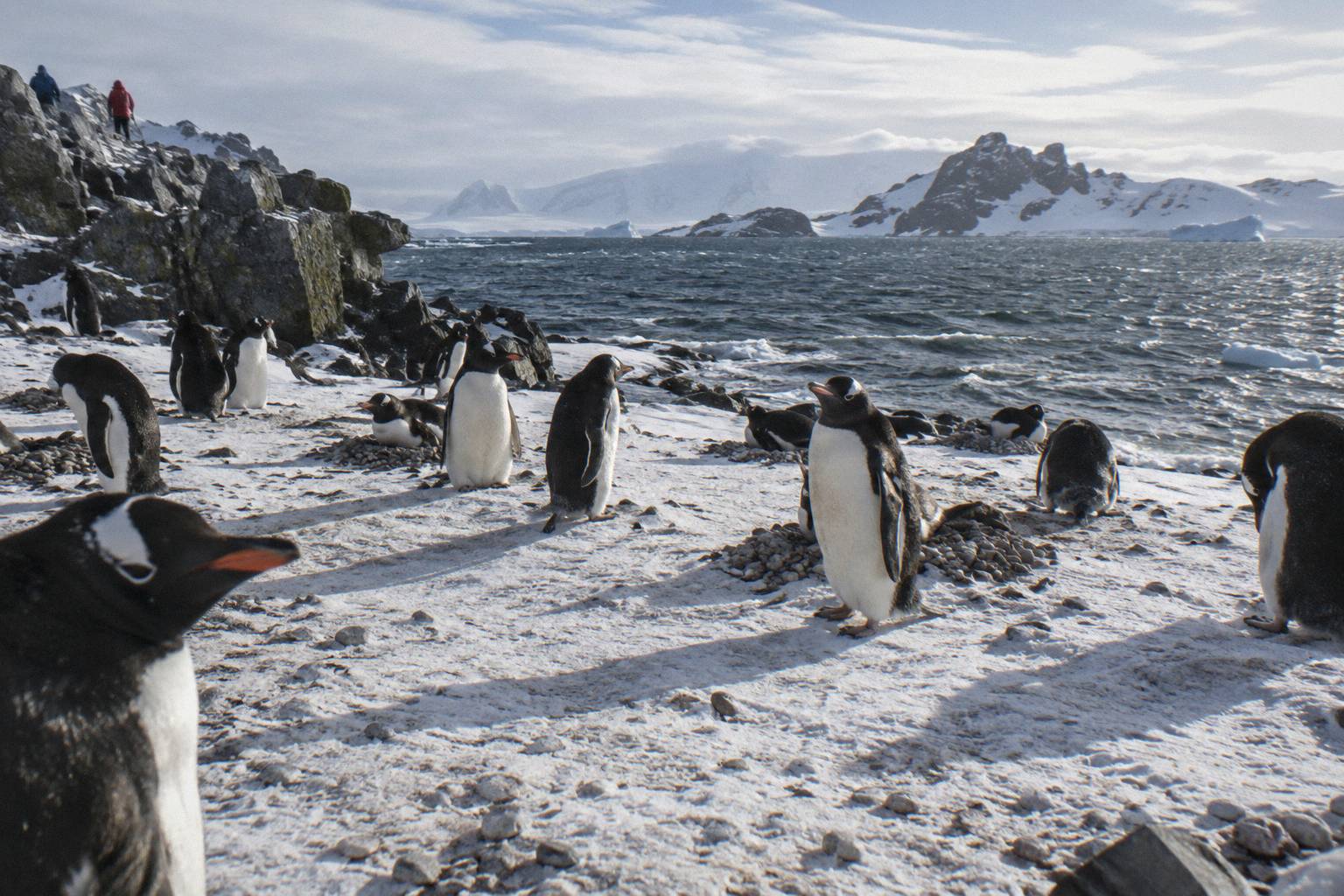
November is the season's opening act, and the pricing reflects what you get. Penguins are courting and building nests, snow on the landing sites is at its deepest and most pristine, and ship traffic is lighter than at peak. The costs are equally concrete: some landing sites may still be snowed in or ice-blocked, whales are less abundant because the migration is still underway, and Peninsula lows run around -2 to -4°C. For a traveller whose priority is landscape photography rather than wildlife volume, that trade can be a bargain. For someone set on whales, it is the wrong month at any price.
March is the mirror image. Whale activity stays strong, with humpbacks, minkes and orcas feeding in krill-rich waters, penguin chicks are fledging and learning to swim, and operators discount to fill berths as the season winds down. One listing shows late-March Hondius and Ortelius departures carrying advantage fares around 25 percent off. The days are shorter, the light is lower and more dramatic for photography, and the colonies are messier and emptier as the birds leave. You give up the peak-season spectacle and get the lowest fares of the year in exchange.
The honest summary of both shoulder months is that they are cheaper because they are objectively less in demand, not because operators are being generous. If the savings matter to your budget and the compromises do not spoil the trip you imagined, they are the best value in Antarctic travel. If you would come home disappointed by missing whales or a snowed-in landing, pay for February instead; a cheaper voyage you regret is not a saving. That is a genuinely personal call, and it is the kind of question a free season-planning consultation is built to settle before you put a deposit down.
How Cabin Category Changes The Price On The Same Ship
Cabin category moves the fare more than most travellers expect, sometimes more than the month does. On Hondius, sample fares run from roughly $9,600 in a quad porthole to $15,000 and up for a junior or grand suite with a private balcony. On Ultramarine, promotional samples run from about $16,890 in an Explorer triple to roughly $37,990 for the top suites.
The month tables above quote starting fares, and starting fares mean shared or inside berths. Climb the cabin ladder on a single ship and a single date and the price can double or triple before you change anything else about the voyage. Oceanwide's own cabin listings for Hondius illustrate the ladder clearly, and the pattern repeats across every operator in the roster.
| Cabin category (Hondius) | Sample fare range (per person) | What you get |
|---|---|---|
| Quadruple porthole | about $9,600 to $10,150 | Two portholes, four berths, roughly 15 to 16 m² |
| Twin porthole | about $11,400 to $12,500 | Two portholes, two single beds |
| Twin window | about $12,500 and up | Window or two windows, two single beds |
| Superior or Twin Deluxe | about $13,150 and up | More space, double bed options on Superior |
| Junior or Grand Suite with balcony | about $15,000 and up | Double bed, sitting space, private balcony on the Grand Suite |
The budget ships keep the floor of this ladder low. Plancius carries the lowest from-fare on the entire roster, $7,050 per person, drawn from seven Peninsula departures across the 2026-27 schedule on the operator's Antarctica cruise listing. The ship is a converted Dutch navy oceanographic vessel rebuilt for passengers in 2009, carries 108 guests in 50 cabins, and its quadruple and twin porthole categories are the reason its entry price undercuts almost everything else afloat. You are buying landings, lectures and Zodiac time, not balcony space, and for many travellers that is exactly the right purchase.
Plancius does not stand alone at the budget end. Ortelius, a 1989 former Russian research vessel, lists from $7,800, and Hondius, the newest and largest of the trio at 170 guests with Polar Class 6, also lists from $7,800. All three sail from Ushuaia, all three run the classic 10 to 13-day Peninsula routes alongside longer Falklands and South Georgia combinations, and all three appear repeatedly in the cheapest rows of every month table on this page. Set side by side, the differences between them come down to build year, ice class and cabin style rather than price tier.
| Ship | Class | Passengers | Ice class | From, per person | Voyage length | Departs from |
|---|---|---|---|---|---|---|
| PlanciusOceanwide Expeditions | Small-Ship Budget | 108 | 1D | from $7,050 | 10 to 33 days | Ushuaia |
| OrteliusOceanwide Expeditions | Small-Ship Budget | 108 | UL1 | from $7,800 | 11 to 25 days | Ushuaia |
| HondiusOceanwide Expeditions | Small-Ship Budget | 170 | Polar Class 6 | from $7,800 | 11 to 19 days | Ushuaia |
The practical lesson for month-based planning is that cabin category and calendar interact. A quad berth in March on a budget ship can cost less than a third of a suite in December on a luxury ship, for the same continent and largely the same landing sites. If your goal is simply to stand on the Peninsula, the cheap end of the ladder in a cheap month is the most efficient combination in Antarctic travel.
Which Month Gives The Best Value For Your Trip
Best value depends on what you want from the voyage, not on the calendar alone. March pairs the lowest published fares with strong whale activity. November pairs low prices with pristine snow and courtship, at the cost of more ice and fewer whales. February costs more but delivers peak whales and the best odds for a Circle crossing.
Two years of comparing these fares left me with one plain impression: the month matters more than the ship. A traveller who fixes the month first and then shops ships has more room to save than one who falls for a ship and accepts whatever date is left. Each month has its own guide on this site if you want to go deeper than price: Antarctica in November covers the early-season ice and courtship trade-offs, Antarctica in December explains the solstice daylight and the holiday premium, Antarctica in January covers the warmest, busiest weeks, Antarctica in February makes the case for whales and Circle crossings, and Antarctica in March details the end-of-season discounts.
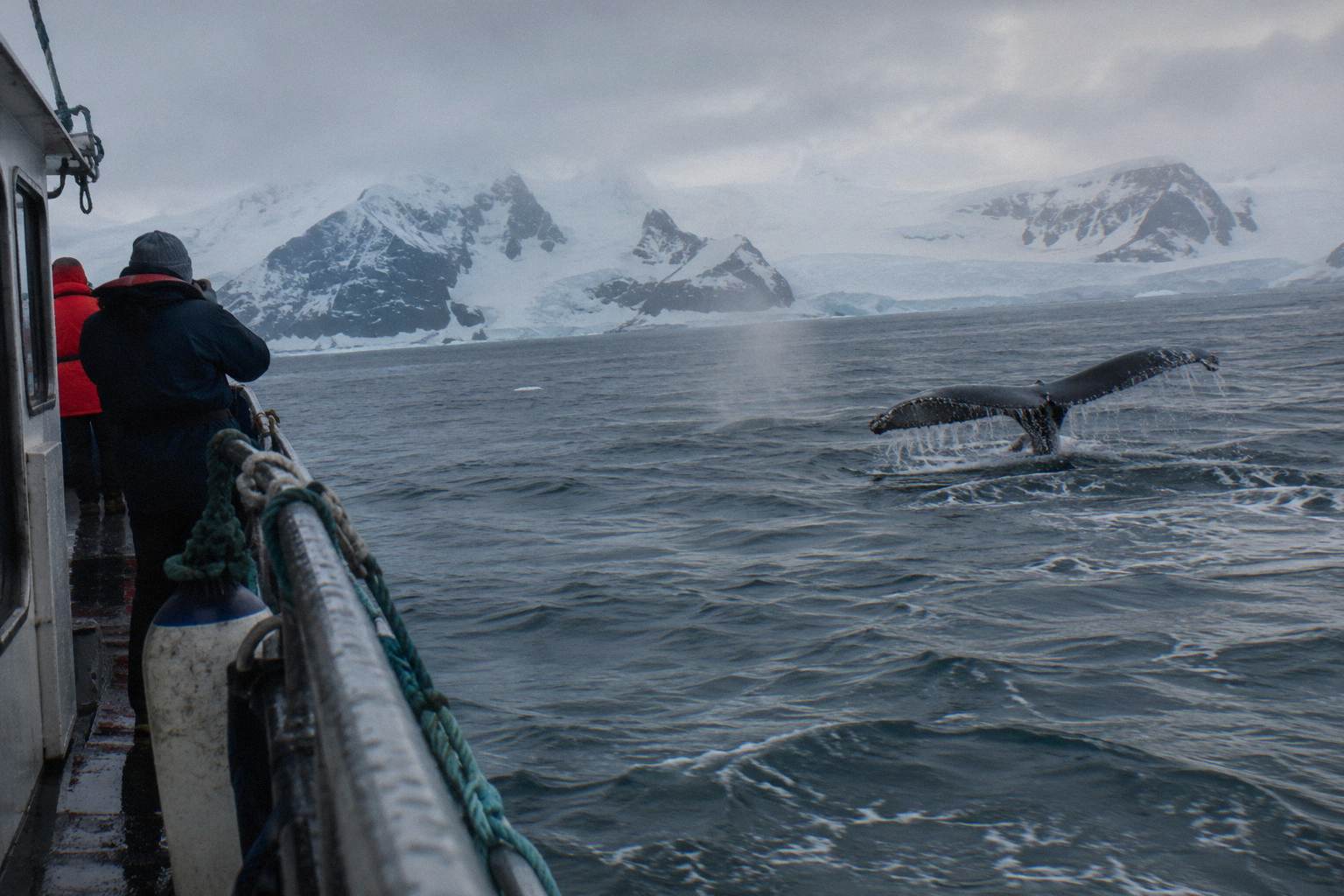
Match the month to your single strongest priority. For whales, February is the pick in published season guidance, with numbers peaking and sea ice at its minimum, and the February example fare of about $15,400 on Silver Cloud sits mid-range. For penguin chicks at foot, January is the month, and it is priced accordingly. For the lowest possible fare, March wins on the published numbers, with November close behind. For a Circle crossing attempt, late January through February gives the best ice odds, and the New Year Circle-crossing departure lists from $22,195 against $13,895 for the Christmas sailing that precedes it.
The season overviews on Cruises In Antarctica run from October through April if your dates stretch beyond the five months priced here, though the fare examples here concentrate on November through March, when the expedition fleet is actually in the Peninsula.
Ways To Pay Less At Any Point Of The Season
You can cut the fare in any month: early-booking offers commonly reach 10 to 30 percent off, quad and triple berths drop the per-person price on budget ships, last-minute reductions of 25 to 60 percent are reported on select departures, and sailing the Drake both ways costs less than flying over it.
None of these levers requires luck, only planning. The earliest one is timing your booking rather than your voyage: operators release the following season's departures 12 to 18 months ahead, and one 2026 cost guide reports early-booking offers of 10 to 30 percent off, with some promotions on unsold inventory reaching higher. Peak December sailings are the exception, since booking guides report they fill 18 or more months ahead, so if your heart is set on midsummer, early is the only cheap way to do it.
| Lever | What published data shows | Example |
|---|---|---|
| Sail in November or March | Shoulder months list 20 percent or more below peak | 11-day Hondius voyage departing March 7, 2027, from about $6,900 |
| Book early | Early-booking offers commonly 10 to 30 percent off | 2026-27 and 2027-28 season releases, 12 to 18 months ahead |
| Share a quad or triple | Multi-berth cabins carry the lowest per-person fares | Plancius from $7,050; Hondius quad samples about $9,600 |
| Chase last-minute | 25 to 60 percent off reported on select departures | One deals tracker lists HX November and December 2026 sailings; G Adventures offered 35 percent off a November 2026 departure |
| Sail rather than fly | Fly-the-Drake adds about $2,000 to $5,000 over comparable sailing voyages | Charter flight cost on fly-cruise itineraries |
Last-minute deserves its own caution, because it is the lever most likely to backfire. The discounts are real, with one tracker reporting 25 to 60 percent off select 2026-27 departures and Ushuaia agencies moving unsold berths at short notice, but availability and cabin choice are limited, the deepest cuts sit in November and March rather than the weeks you probably pictured, and one cost guide notes that last-minute deals are uncommon for peak December sailings. You are trading certainty for a discount, and for a once-in-a-lifetime trip many travellers should not make that trade. If you do want to try, decide in advance what ship class and month you will accept and what you will walk away from.
Whichever levers you pull, remember that the fare is only part of the bill. One 2026 cost guide puts the realistic all-in budget for a mid-range 10 to 12-day Peninsula trip, fare plus flights, gear, tips and insurance, at $12,000 to $25,000 per person, with recommended tips averaging about $16 per person per day. A cheap fare on a ship that excludes drinks, gratuities and gear can cost more all-in than a higher fare on a line that bundles them. If you would like that arithmetic done across a few candidate voyages before you commit, you can get the numbers checked for free through this site's consultation, with no obligation attached.
Common Questions About Antarctica Cruise Prices By Month
What is the cheapest month for an Antarctica cruise?
March, with November close behind. A published 2026-27 example lists an 11-day Hondius Peninsula voyage departing March 7, 2027 from about $6,900 per person, and a 13-day November sailing on the G Adventures Expedition from about $7,279. Shoulder months commonly list 20 percent or more below peak December and January fares.
Why are December and January Antarctica cruises so expensive?
Demand peaks: daylight runs past 20 hours near the solstice, penguin chicks hatch, and the Christmas and New Year weeks draw the highest fares of the season. National Geographic Endurance's December 22, 2026 departure lists from $30,205 per person, against $11,900 as the standard starting fare for the same 12-day route.
Do Antarctica cruise prices drop for last-minute bookings?
Sometimes. One deals tracker reports 25 to 60 percent off select 2026-27 departures, and a G Adventures November 2026 departure was offered at 35 percent off. The catches are limited availability, restricted cabin choice, discounts concentrated in November and March, and rarity on peak December sailings, which booking guides report fill 18 or more months ahead.
How much does an Antarctica cruise cost in February?
February sits mid to high. A published example lists an 11-day Silver Cloud voyage departing February 2, 2027 at about $15,400 per person. You are paying for peak whale numbers, the season's least sea ice and the best odds for an Antarctic Circle crossing.
How far ahead should I book an Antarctica cruise?
Booking guides recommend 12 to 18 months for popular departures, and longer for peak December and January dates. Early booking also captures the early-booking offers that one 2026 cost guide reports at a common 10 to 30 percent off, released when the following season's schedule opens.
More Cost And Booking
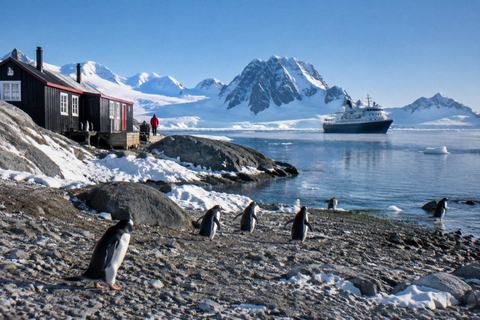 Cruise CostA per-person price ladder from $7,050 berths to $32,320 luxury voyages, with what fares include and what they quietly leave out.Read the guide
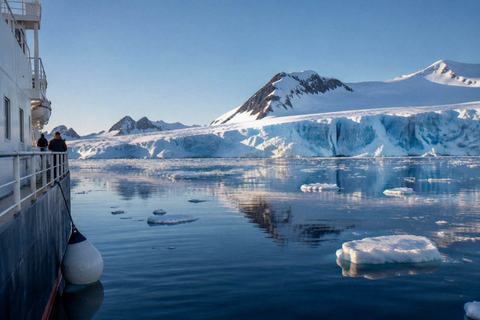 Cheap Antarctica CruisesThe honest floor for Antarctica fares, which ships carry it, and what it costs all-in.Read the guide
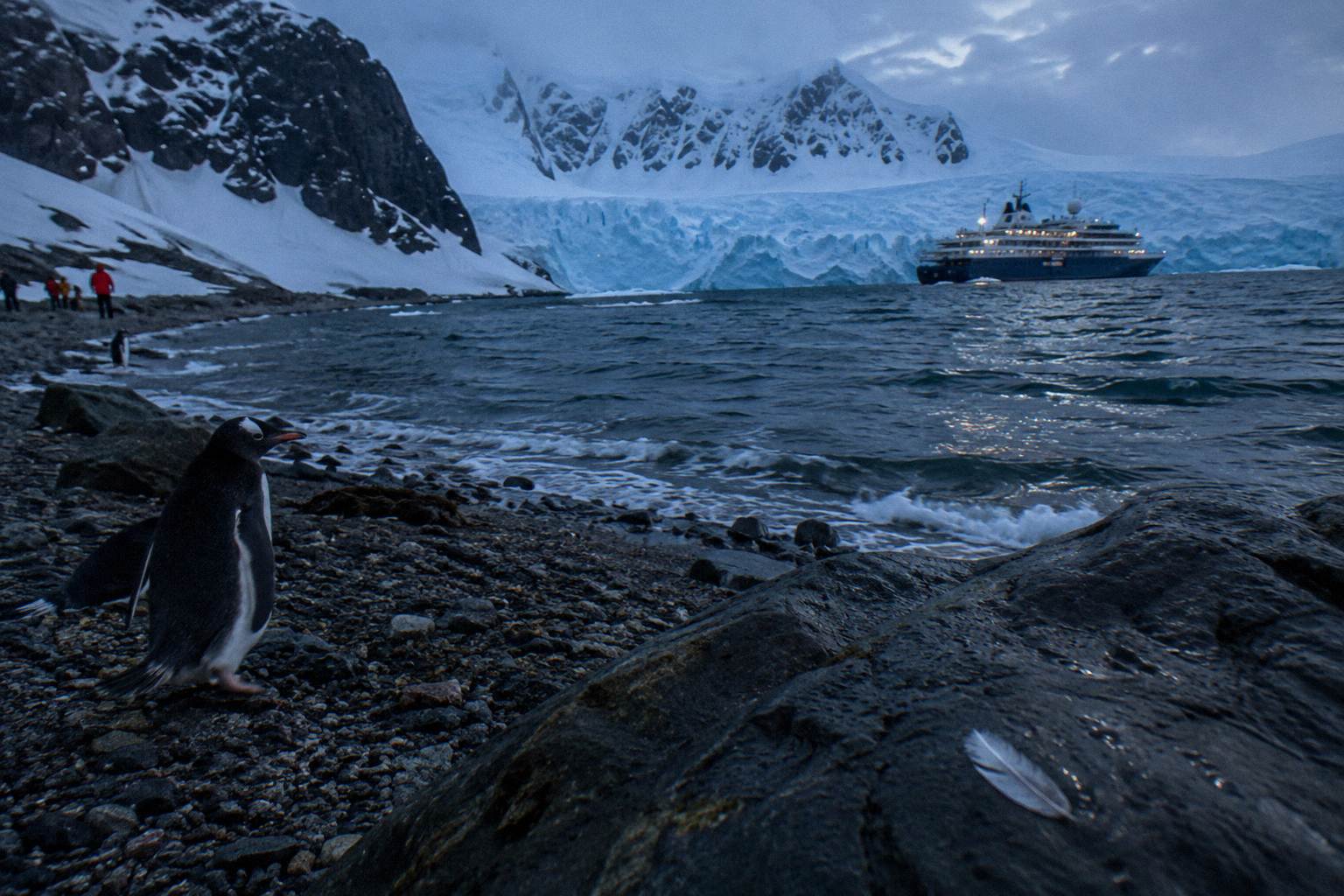 Last-Minute DealsDo last-minute Antarctica berths still exist, and what do they really save?Read the guide
 What Is IncludedWhat an Antarctica fare really covers, operator by operator, plus the hidden costs with published amounts.Read the guide