World Voyager Antarctica Cruise: Ship Review, Cabins And Itineraries
 By Oleg G.
World Voyager joined the Quark Expeditions fleet for the 2026-27 Antarctic season, an all-balcony ship carrying 168 guests. This review covers what the operator publishes: cabins, ice class, itineraries, fares and who the vessel suits.
Quick answer: World Voyager is Quark Expeditions' all-balcony 168-guest ship, sailing its first Antarctic season with Quark in 2026-27 from Buenos Aires and Ushuaia. Ice Class 1B, 126 metres, 18 Zodiacs, fares from $12,236 per person on Quark's 11-day Antarctic Explorer voyage, with a parka and loan boots included.
World Voyager At A Glance
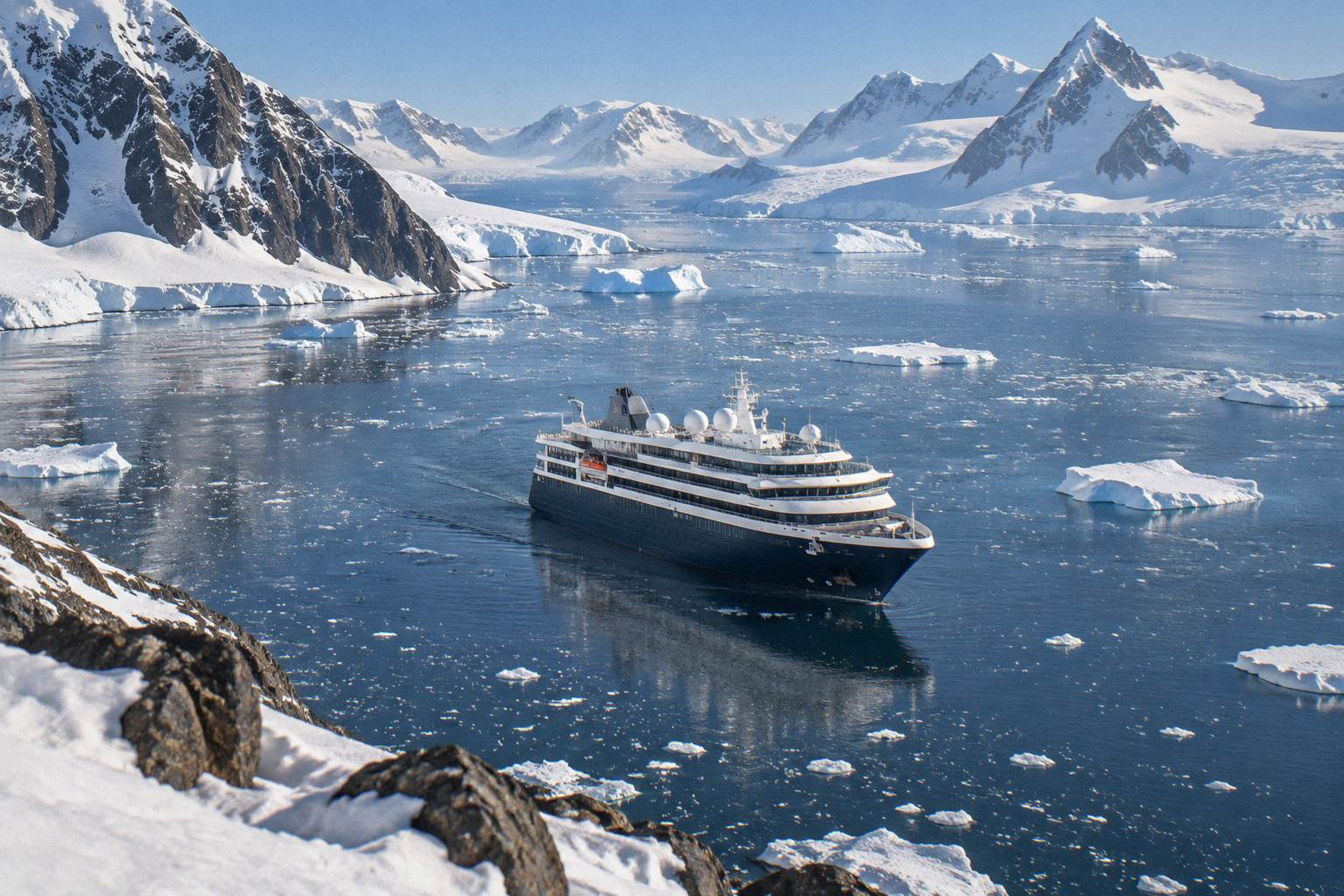
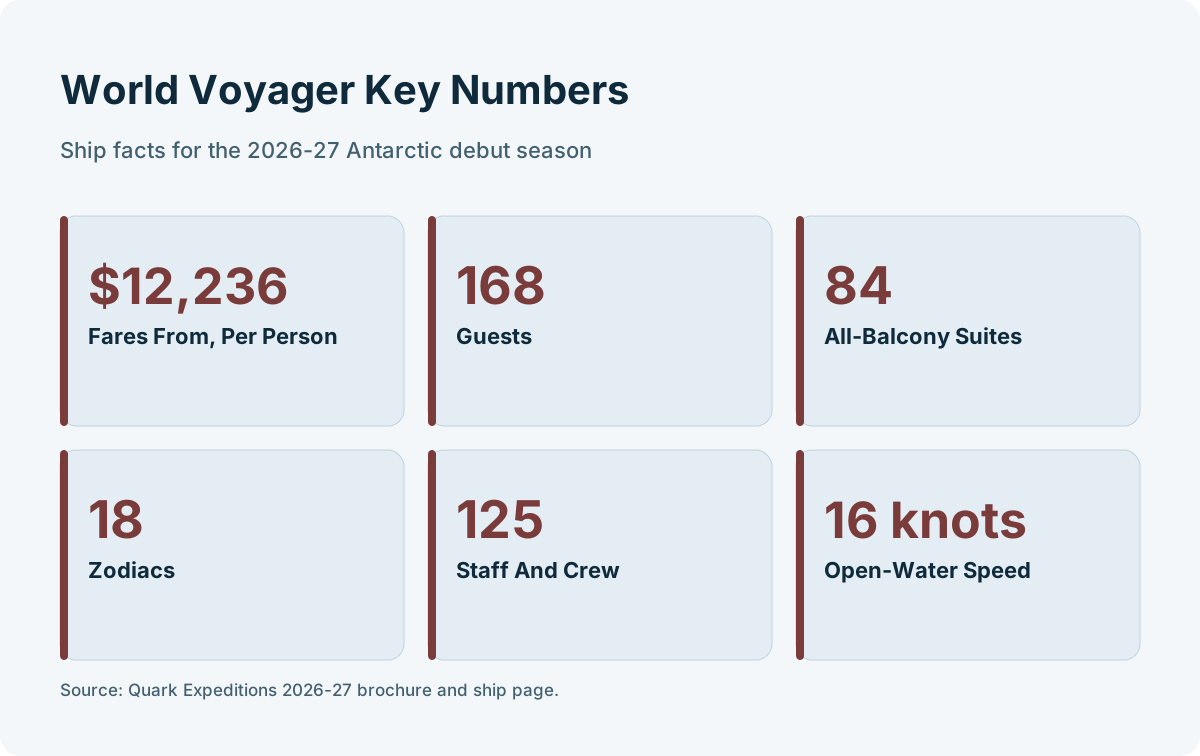
World Voyager is a 168-guest, all-balcony expedition ship making its Antarctic debut with Quark Expeditions in 2026-27, sailing from Buenos Aires and Ushuaia. The 126-metre, Ice Class 1B vessel carries 84 suites across five categories, 18 Zodiacs, 125 crew and a 16-knot open-water speed, with Antarctic Explorer fares starting from $12,236 per person.
The vessel is not new steel, but it is new to this operator. Delivered by the West Sea shipyard in Viana do Castelo, Portugal, on 3 November 2020 to its first owner as a 200-passenger polar expedition ship, it now sails for Quark at 168 guests. Quark's 2026-27 brochure calls this the ship's debut season with the company. Quark does not print the build year on its ship page, and it does not describe any passenger refit for the charter, so the 2020 delivery date from the yard is the firm marker of the ship's age.
For context on the fleet it joined, World Voyager sits between two stablemates with different characters. Ultramarine, reviewed in our Ultramarine ship profile, is the helicopter platform with a 1A+ ice class and 199 guests. Ocean Explorer, covered in our Ocean Explorer ship profile, is the smallest of the three at 138 guests with an X-BOW hull. World Voyager is the comfort pick of the trio: every suite has a balcony of some kind, and it is the one Quark sells with a heated outdoor pool.
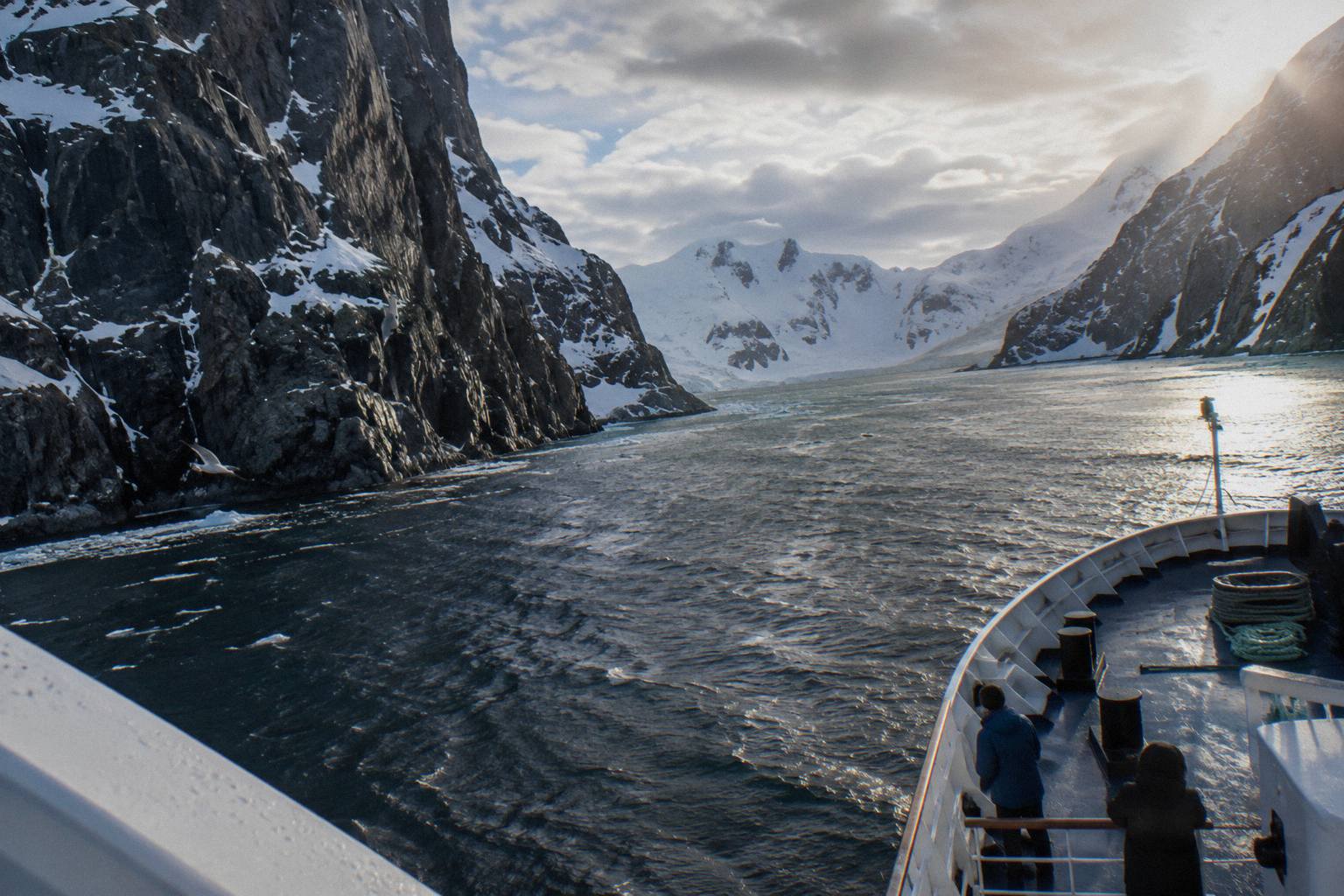
Quark positions the ship as upscale expedition, and the onboard list backs that up: a spa, a sauna, two Jacuzzis, a heated outdoor pool on Deck 7, an outdoor running track, a gym on Deck 4 and a presentation theatre. There is also a Science Hub on Deck 4. What the ship does not have is equally worth knowing: no helicopters, no X-BOW, no guest submarine and no Zodiac hangar.
Cabins And Balconies On World Voyager
Every suite on World Voyager is sold as an all-balcony cabin by the operator, with 84 suites in five categories carrying 168 guests served by 125 staff and crew. The mix runs from 24 Infinity Suites at 25 square metres with floor-to-ceiling Juliet balconies, through 50 Veranda Suites at 20 square metres featuring five-square-metre walk-out balconies, up to four Owner's Suites at 34 square metres.
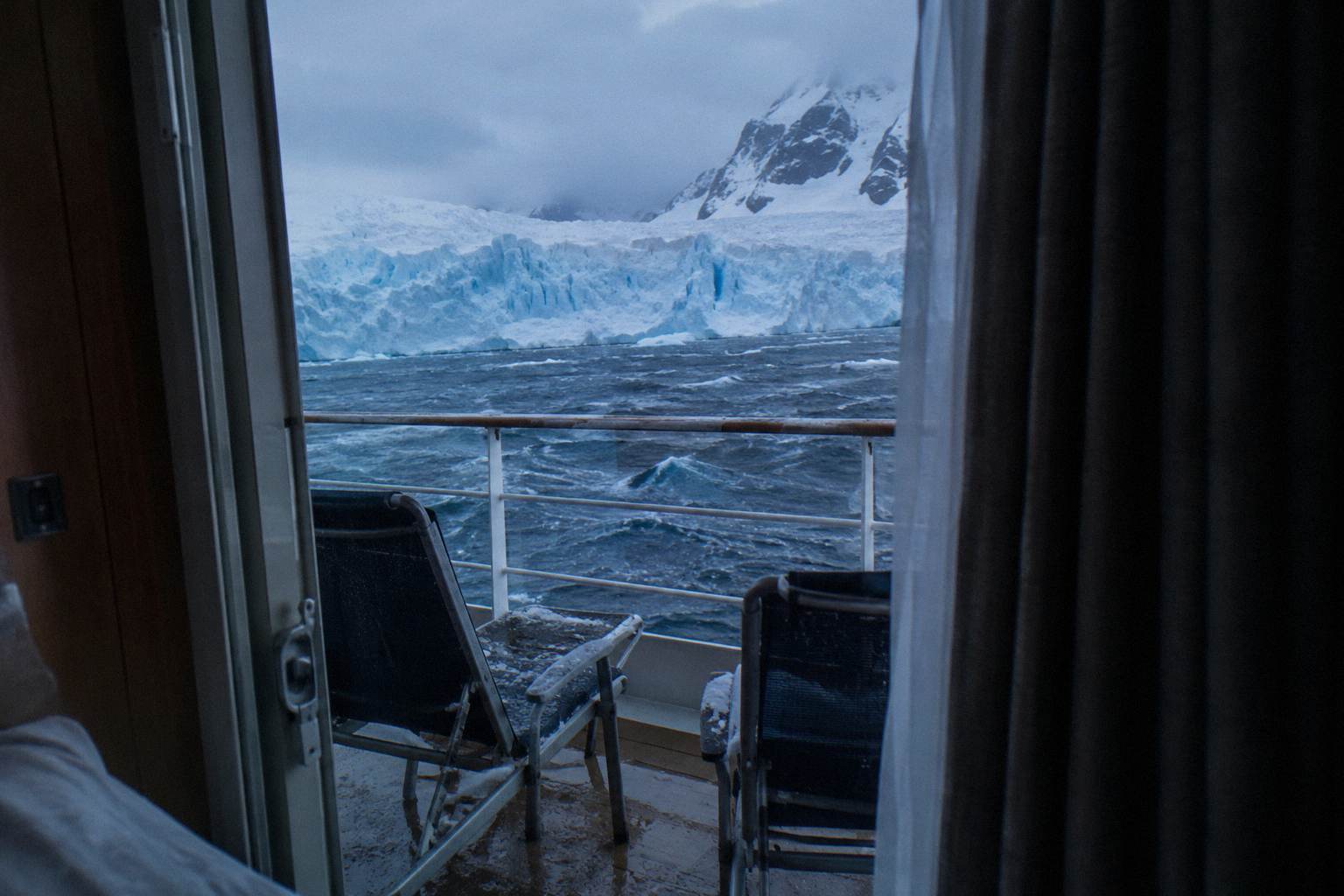
That distinction matters more in Antarctica than on a Mediterranean sailing. Quark's own copy says most suites have a walk-out balcony, which means the 24 Infinity Suites on Decks 5 and 6 open to a Juliet-style expanse of glass rather than a step-outside terrace. Balconies are also frequently locked in rough seas on any Drake Passage crossing, and wind, cold and spray limit their usable hours in Antarctica. Paying a large premium purely for a walk-out veranda on this route deserves a hard second look; our longer treatment of the question is in the guide on whether a balcony cabin is worth it in Antarctica.
| Suite category | Approx. size | Balcony type | Cabins |
|---|---|---|---|
| Infinity Suite | 25 m² | Floor-to-ceiling Juliet balcony | 24 |
| Veranda Suite | 20 m² | 5 m² walk-out balcony | 50 |
| Superior Suite | 25 m² | Balcony (walk-out on most) | 4 |
| Deluxe Suite | 32 m² | Balcony (walk-out on most) | 2 |
| Owner's Suite | 34 m² | Balcony (walk-out on most) | 4 |
Quark lists 125 staff and crew for 168 guests, a similar balance to Ocean Explorer (105 for 138) and Ultramarine (140 for 199). There is no solo-cabin category in the published five-category list, unlike Ultramarine's six Solo Panorama suites, and no triple-share category either; solo travellers should expect a single supplement unless a promotion waives it. If you are travelling alone, the choice of ship and cabin policy can swing the total cost by thousands of dollars, and it is a fair question to put to a free Antarctica cruise consultation before committing.
Quark lists a restaurant and lounges on World Voyager, without the named second venue that Ultramarine has in Bistro 487 alongside its Balena Restaurant. The 2026-27 brochure lists meals, snacks, soft drinks and juices, select beer, wine and cocktails during bar service and dinner, and coffee, tea and cocoa as included. Quark does not advertise balcony breakfasts or a specialty restaurant on this ship, so do not plan around them.
Ice Class, Size And Seaworthiness
World Voyager is a 126-metre, Ice Class 1B ship rated for medium-difficult ice conditions of roughly 0.6 metres of level ice, cruising at 16 knots in open water, which places it a step below Ocean Explorer's 1A and Ultramarine's 1A+ with PC6; for standard Antarctic Peninsula summer voyages all three classes visit the same landing sites, and the difference matters mostly on remote itineraries into heavier pack ice.
Quark publishes no Polar Class number for the ship, only "Ice Class 1B," so treat any PC6 claim you see elsewhere with caution. The helicopter emperor-penguin voyages to Snow Hill run on Ultramarine, which carries the helicopters, not on World Voyager.
Seakeeping on the Drake Passage is a legitimate question for a buyer shortlisting ships. The ship's beam of 19 metres and 126-metre length put it between Ocean Explorer at 104.4 metres and Ultramarine at 128 metres, and it carries two Rolls-Royce hybrid-electric engines. Quark does not publish stabilizer details for World Voyager, so ask before booking if zero-speed fins matter to you. Modern expedition ships generally pair weather routing with stabilizers to manage Drake motion, and conditions on the crossing vary widely regardless of hull. The Drake Passage crossing guide covers the timing and what to expect.

The expedition hardware is straightforward: 18 Zodiacs and no internal hangar. Ultramarine's internal hangar with four embarkation points speeds boarding in bad weather; on World Voyager, launching is a more conventional process. Kayaking, paddling and stand-up paddleboarding are paid options on departures where they run, not standing ship features.
| Ship | Guests | Length | Ice class | Zodiacs | Signature features |
|---|---|---|---|---|---|
| World Voyager | 168 | 126 m | 1B | 18 | All-balcony suites, heated pool, Science Hub |
| Ocean Explorer | 138 | 104.4 m | 1A, PC6 | 15 | X-BOW, two-story library, two Jacuzzis |
| Ultramarine | 199 | 128 m | 1A+, PC6 | 20 | Two helicopters, internal Zodiac hangar |
2026-27 Itineraries, Ports And Fares
World Voyager's published 2026-27 Antarctic products are Antarctic Explorer at 11 days from Buenos Aires, Antarctic Express: Sail South, Fly North at 10 days from Buenos Aires to Punta Arenas, and Crossing the Circle at 14 days from Buenos Aires. Antarctic Explorer is published from $12,236 per person, and the fly-sail Antarctic Express on 24 November 2026 started at $18,590 in an Infinity Suite.
The dated 24 November Antarctic Express departure shows the cabin ladder clearly. On the 24 November to 3 December 2026 sailing, 10 days from Buenos Aires to Punta Arenas, brochure prices including the charter-flight-and-hotel package line of $795 were: Infinity Suite $18,590, Veranda Suite $19,490, Superior Suite $25,090, Deluxe Suite $26,990 and Owner's Suite $28,790. A five percent reduction was also shown, bringing the Infinity Suite to $17,701, and every category on that date has sold out, which tells you how early the fly-sail products fill. The same itinerary runs again from 4 to 13 February 2027.
| Voyage | Length | Route | Published fare detail |
|---|---|---|---|
| Antarctic Explorer | 11 days | Buenos Aires roundtrip, charter flight to Ushuaia | From $12,236 pp; one dated row is 18-28 Dec 2026 |
| Antarctic Express: Sail South, Fly North | 10 days | Buenos Aires to Punta Arenas | 24 Nov 2026: Infinity $18,590, Veranda $19,490, Owner's $28,790 |
| Antarctic Peninsula: Crossing the Circle | 14 days | Buenos Aires | One 2026-27 departure; discounted lead-ins of $27,571, $21,621 and $20,336 |
Quark prints three discounted Crossing the Circle lead-ins without tying each one to a cabin, so treat them as the shape of the fare ladder rather than a quote. Note also that fly-sail products cost more than the classic sailing on this route: the charter flight over the Drake and the hotel night are real costs, and Quark's own pricing reflects that. Whether to fly or sail the Drake is the single biggest fork in planning an Antarctica cruise, and it is worth weighing with free advice on flying versus sailing before you choose a direction.
Sailing The Drake Versus Flying One Way
The Sail South, Fly North format deserves a closer look, because it is the product most people misread. You still sail the Drake Passage once, southbound from the Argentine side, which takes roughly two days. The return is a charter flight of about two hours from King George Island in the South Shetlands to Punta Arenas in Chile, so the second crossing disappears from the trip. That is the real thing you pay for: two fewer sea days and half the seasickness exposure, not extra time at the landing sites. The catch is weather. A flight off King George Island needs a flyable window, and a low cloud base can hold the group on the ship or ashore until it clears, so leave slack in any onward booking from Punta Arenas.
The classic Antarctic Explorer is the opposite trade. It runs Buenos Aires to Buenos Aires over 11 days, with the charter flight to Ushuaia and one Buenos Aires hotel night inside the package, and it crosses the Drake both ways. That costs about four days of sea transit in total, but it is also where the lowest World Voyager fare sits, from $12,236 against $18,590 for the cheapest November Express cabin. For a couple that gap is more than $12,000, which buys a lot of seasickness tablets.
Crossing the Circle is the stretch option. At 14 days from Buenos Aires it adds the time needed to push south past 66 degrees, weather and ice allowing, and Quark schedules a single World Voyager departure of it in 2026-27. With only one date on offer, it is the itinerary to decide on first if it appeals, because there is no second chance later in the season.
Booking terms are the same across Quark's fleet: per the operator's terms effective June 2026, a 25 percent deposit applies if booked 151 or more days before Day 1, full payment is due 150 days out, and 100 percent is payable if you book inside 150 days. Anyone holding dates for this ship should read those numbers carefully against their insurance policy, and our guide to deposits and payment deadlines compares operators side by side.
What The Fare Includes
Quark's 2026-27 fare on World Voyager includes a parka to keep, loan muck boots, all meals, select beer, wine and cocktails, basic Wi-Fi, taxes and port charges, Zodiac landings and the full lecture programme. Gratuities are excluded and voluntary, paid at the guest's discretion. On Buenos Aires departures, one pre-expedition hotel night and the group charter flight between Buenos Aires and Ushuaia come inside the charter-flight-and-hotel package line; the transfer from the Buenos Aires airport to that hotel is not included, and neither is international airfare to the gateway city.
The gear question saves real money and luggage weight. The parka is yours to keep; the boots are not, they are loaned for the voyage and returned. Kayaking, paddling and stand-up paddleboarding are paid options where offered. Quark prices those add-ons per departure, so budget from the voyage's dates-and-rates listing rather than assuming. A fuller breakdown of what operators bundle and what they leave out sits in our guide to what an Antarctica cruise includes.
Wi-Fi is listed as basic and included, which on Quark ships means one device at a time with browsing and messaging-app use; premium data packages are sold onboard. If staying connected matters to you, the fuller picture, including how Starlink has changed polar connectivity, is in our Antarctica cruise Wi-Fi guide. Across the Cruises In Antarctica ship profiles, the gap between basic and premium tiers is now the main variable rather than whether a connection exists at all.
World Voyager Versus Ocean Explorer And Ultramarine
Against Ocean Explorer and Ultramarine, World Voyager trades expedition hardware for space and balconies: Ice Class 1B versus their 1A and 1A+, and 84 all-balcony suites versus Ocean Explorer's "almost all" veranda cabins and Ultramarine's 64 balcony suites out of 102. It also carries a heated outdoor pool, which Quark does not advertise on either rival, so the comparison comes down to ship character as much as price.
For the head-to-head detail, see our Ocean Explorer versus World Voyager comparison.
| Ship | Class | Passengers | Ice class | From, per person | Voyage length | Departs from |
|---|---|---|---|---|---|---|
| World VoyagerQuark Expeditions | Upscale Expedition | 168 | 1B | from $12,236 | 8 to 14 days | Buenos Aires, Ushuaia, Punta Arenas |
| Ocean ExplorerQuark Expeditions | Upscale Expedition | 138 | 1A, PC6 | from $12,236 | 8 to 20 days | Ushuaia, Buenos Aires, Punta Arenas |
| UltramarineQuark Expeditions | Upscale Expedition | 199 | 1A+, PC6 | from $12,236 | 12 to 14 days | Buenos Aires, Ushuaia |
The decision usually resolves along three lines. If helicopters are the reason you are paying Quark money, only Ultramarine carries them, two twin-engine Airbus H145s on two helidecks, and its 1A+ PC6 hull opens the remote helicopter itineraries. If you want the smallest ship, Ocean Explorer's 138 guests are the fewest of the three, and it is the only one with an X-BOW hull. If you want the most balcony access and the fullest amenity deck, World Voyager is the pick: the only all-balcony ship of the trio, with a heated outdoor pool, two jacuzzis and an outdoor running track.
One caveat on fairness: Quark does not publish a build year for World Voyager or Ocean Explorer, so the yard delivery dates, 2020 and 2021, are the best age guide. A buyer weighing these three against each other, or against Lindblad and Aurora vessels at similar fares, is exactly the case a free consultation on choosing the right ship was built for.
Who World Voyager Suits, And Who Should Look Elsewhere
World Voyager suits travellers who want an upscale, all-balcony ship for a classic Antarctic Peninsula voyage at Quark's shared from-fare of $12,236, delivering outside access in every suite, a real pool, Jacuzzi and sauna stack, and a genuine Science Hub. It suits people less well if their priorities are helicopters, the smallest possible ship, or the lowest possible price, and three honest alternatives follow for those buyers.
Buyers chasing the helicopter itineraries, the Snow Hill emperor quest or the heaviest ice should move to Ultramarine, accepting 199 guests and higher fares on those specialised products. Buyers who want the minimum passenger count should look at Ocean Explorer or, outside Quark entirely, at ships of 100 guests or fewer, where the whole ship can be ashore at once under the IAATO 100-passenger rule. Buyers at the value end should look outside the upscale tier altogether: Oceanwide's Plancius and Ortelius, 108 guests each, list Antarctic Peninsula from-fares from $7,050 and $7,800 respectively, a full tier below any Quark product.
Families and solo travellers have specific reasons to pause. The ship's cabin list has no triple category and no dedicated solo cabins, and Quark does not publish a minimum age on its World Voyager page. Meanwhile Viking's expedition ships run adults-only at 18 plus, a cleaner fit for travellers who want no children aboard. These edge cases are where a short conversation saves a wrong booking, and the consultation this site offers is free, with the hand-off going to a vetted expedition-cruise agency partner only if you want one.
Common Questions About World Voyager
How much does a World Voyager Antarctica cruise cost?
Quark's from-fare for the 11-day Antarctic Explorer voyage is $12,236 per person. On the dated 24 November 2026 Antarctic Express sailing, brochure fares ran from $18,590 in an Infinity Suite to $28,790 in an Owner's Suite, including the charter-flight-and-hotel package line of $795.
Is World Voyager an all-balcony ship?
Yes, in Quark's own wording. All 84 suites are sold as all-balcony: 50 Veranda Suites plus the suite categories have walk-out balconies on most, while the 24 Infinity Suites have a floor-to-ceiling Juliet balcony rather than a terrace.
What ice class does World Voyager have?
Ice Class 1B, per the operator's ship page. No Polar Class number is published for this hull. That places it a step below Ocean Explorer (1A, PC6) and Ultramarine (1A+, PC6) within Quark's own fleet, which matters mainly on remote, ice-heavy itineraries rather than the classic Peninsula route.
Is World Voyager a new ship?
The hull was delivered on 3 November 2020 by the West Sea yard in Portugal to its first owner, but 2026-27 is its debut season with Quark Expeditions, which sells it at 168 guests. Quark does not print a build year on its own ship page.
Does the fare include flights and a hotel?
On Buenos Aires departures, one pre-expedition hotel night and the group charter flight between Buenos Aires and Ushuaia are included in the charter-flight-and-hotel package line. International flights to Buenos Aires and the airport-to-hotel transfer in Buenos Aires are not included.
Should I choose World Voyager or Ultramarine?
Choose Ultramarine for the helicopter programmes, the higher ice class and the internal Zodiac hangar. Choose World Voyager for the all-balcony cabin list, the heated pool and spa deck, and a slightly smaller guest count, 168 versus 199. Ultramarine's helicopter voyages cost more, so compare the specific departure fares.
More Antarctic Ship Profiles
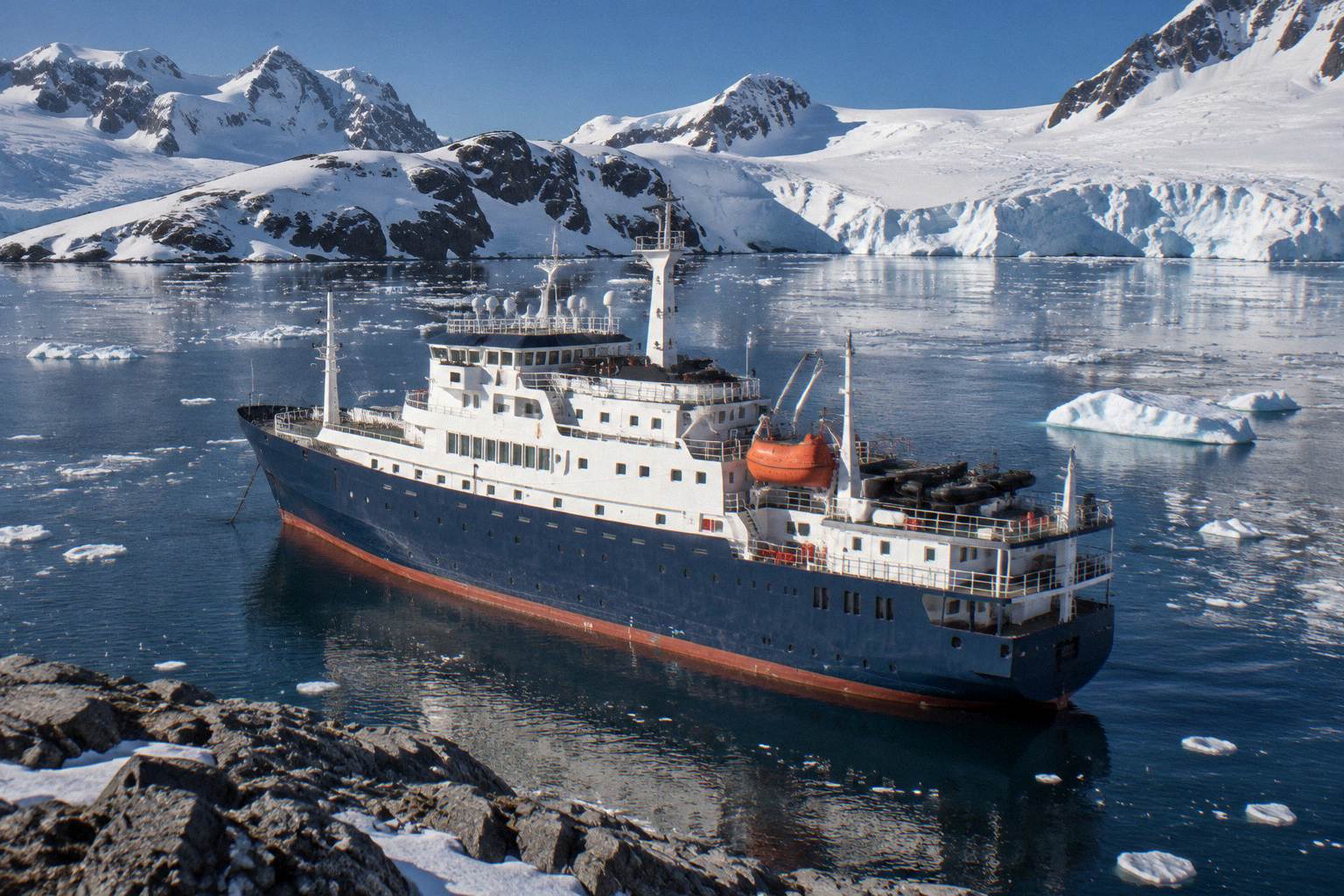 MV Plancius ReviewA no-balcony, 108-guest expedition ship with straightforward cabins, strong ice handling for its age, and Oceanwide's activity-focused Basecamp voyages.Read the guide
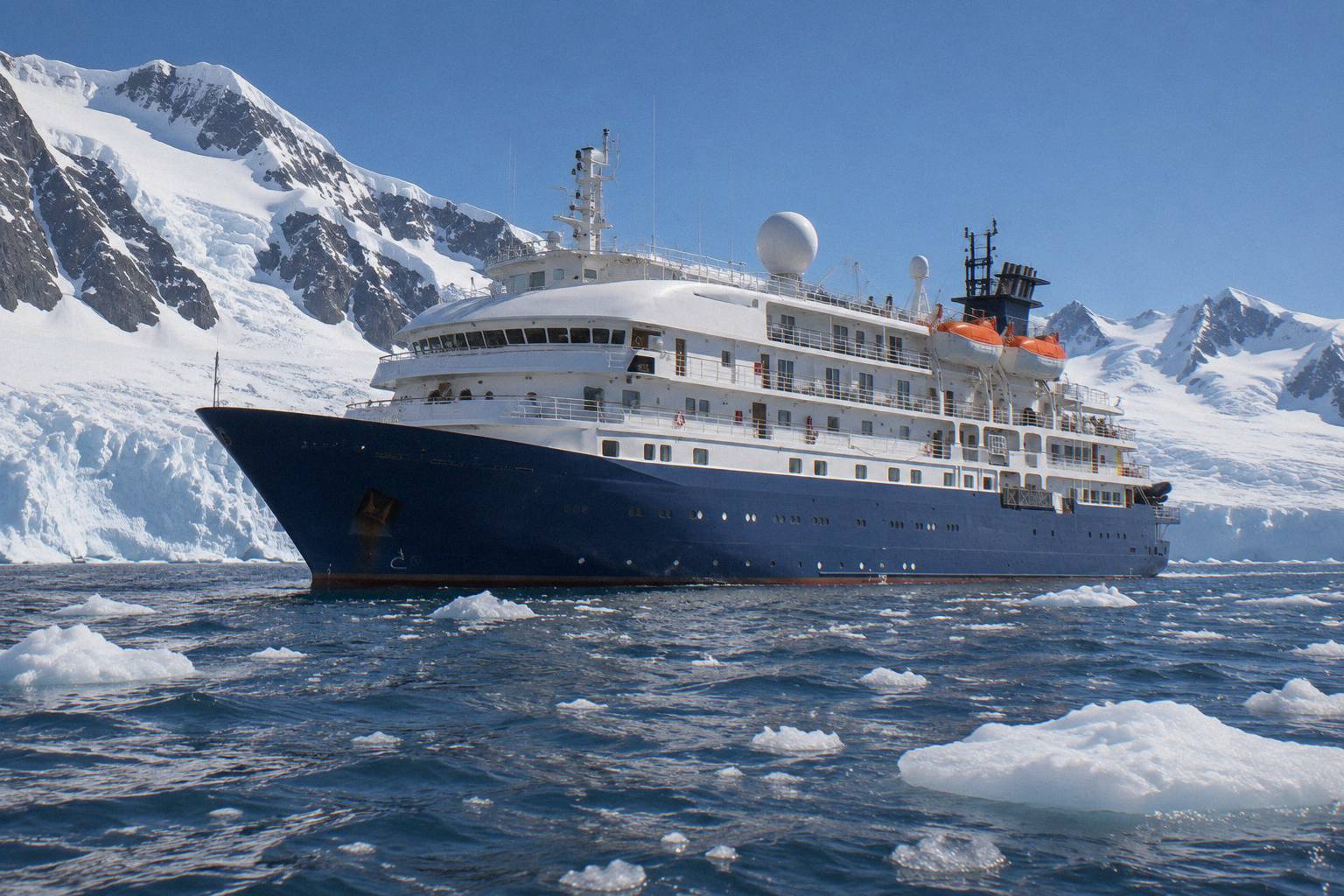 Sea Spirit ReviewPoseidon's 114-guest Sea Spirit reviewed: cabins, fares, itineraries and who it suits.Read the guide
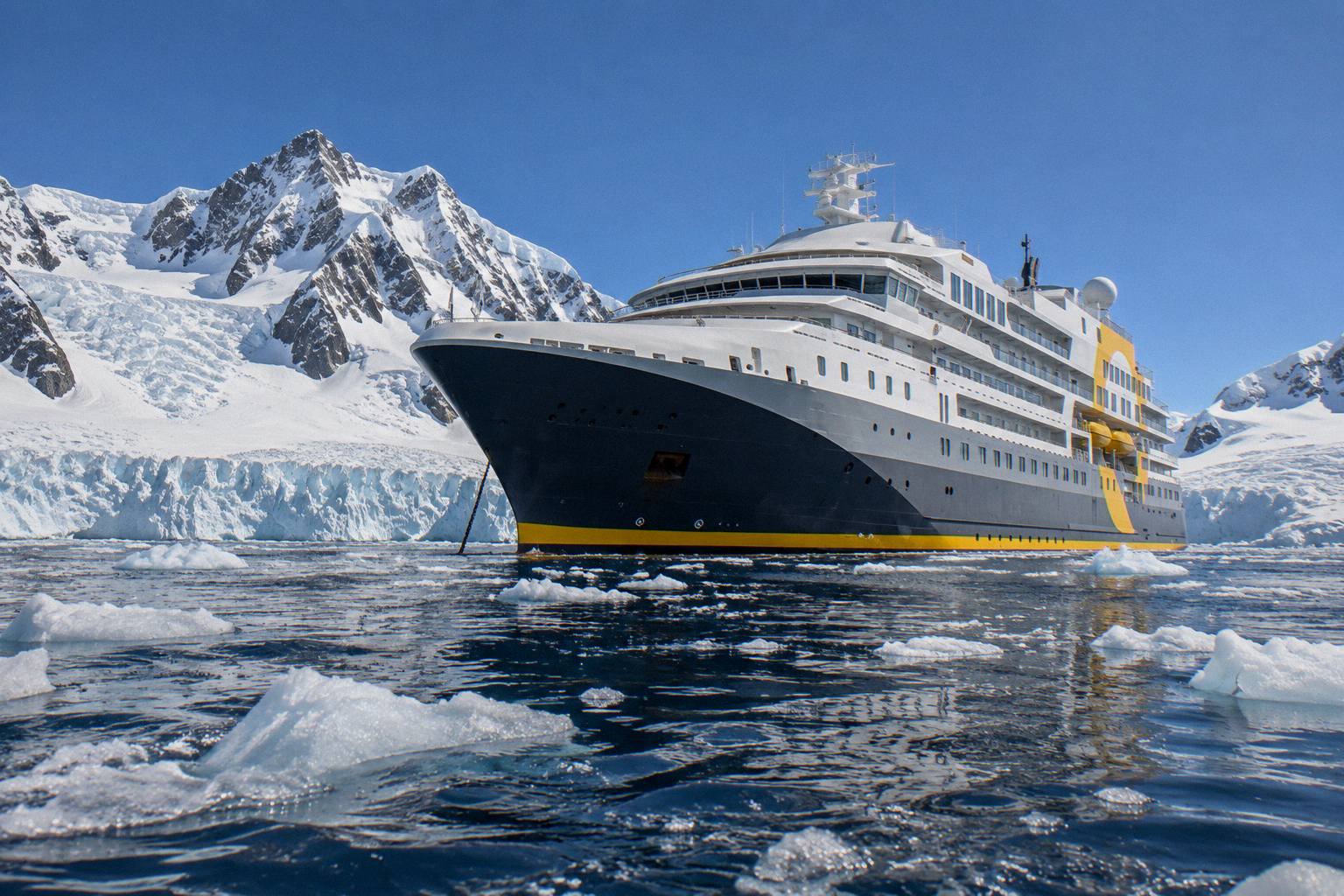 Ultramarine ReviewQuark's helicopter flagship reviewed: cabins, dining, itineraries and fares.Read the guide
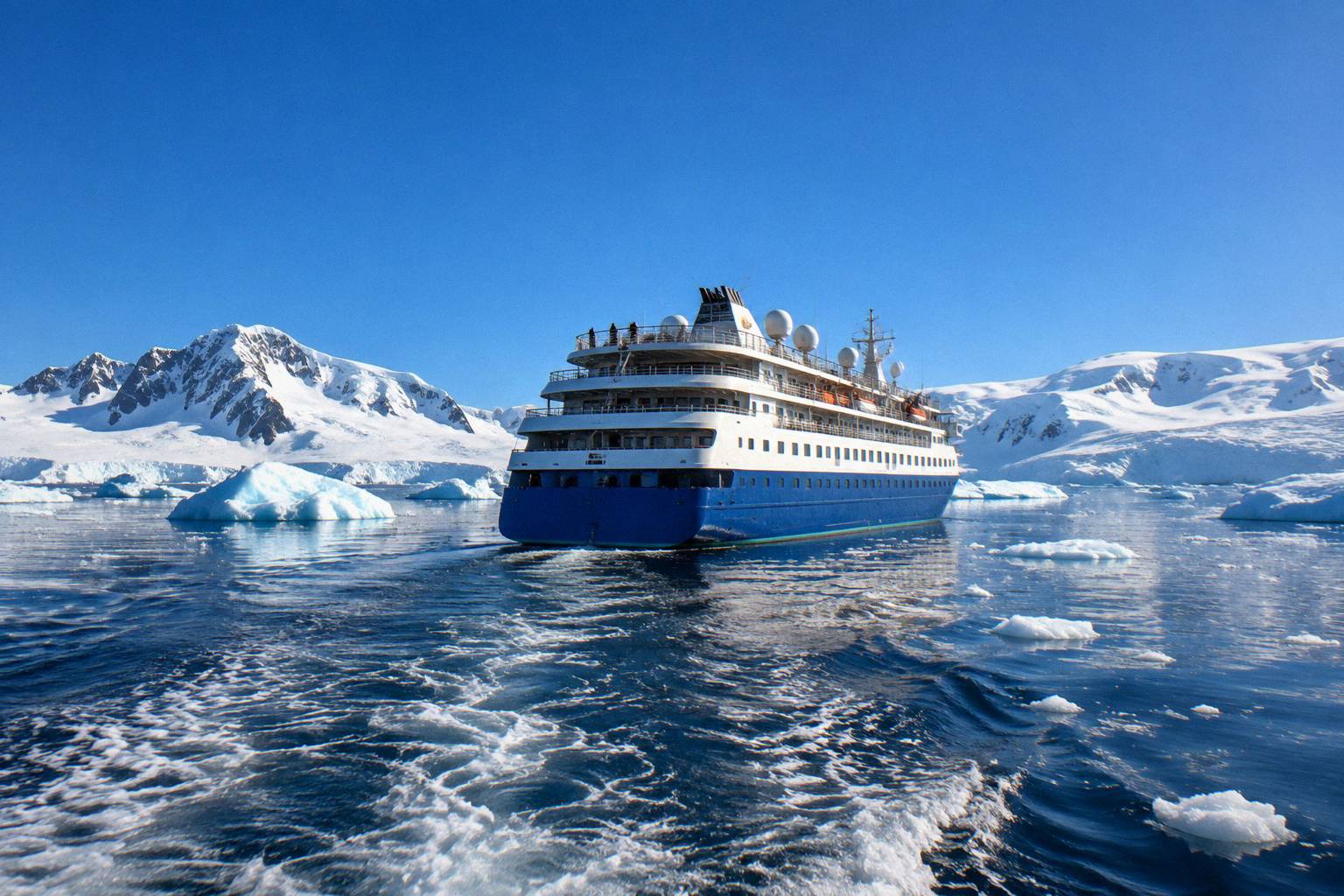 Ocean ExplorerQuark's 138-guest X-BOW ship reviewed: cabins, ice class, itineraries and fares.Read the guide