Drake Passage Crossing: What To Expect On An Antarctica Cruise
 By Oleg G.
Every Antarctica cruise sailing from Ushuaia crosses the Drake Passage, the notorious stretch of Southern Ocean between Cape Horn and the Antarctic Peninsula. Here is what the crossing involves, how long it takes, and how to decide between sailing it and flying over it.
Quick answer: A Drake Passage crossing takes roughly two days each way: Quark Expeditions' own guidance says 18-24 hours in optimal conditions and 36-48 hours in rougher seas. Around 70 percent of crossings are calm enough to be called Drake Lake. The alternative is a roughly two-hour charter flight from Punta Arenas to King George Island, which adds cost but removes the open-ocean transit.
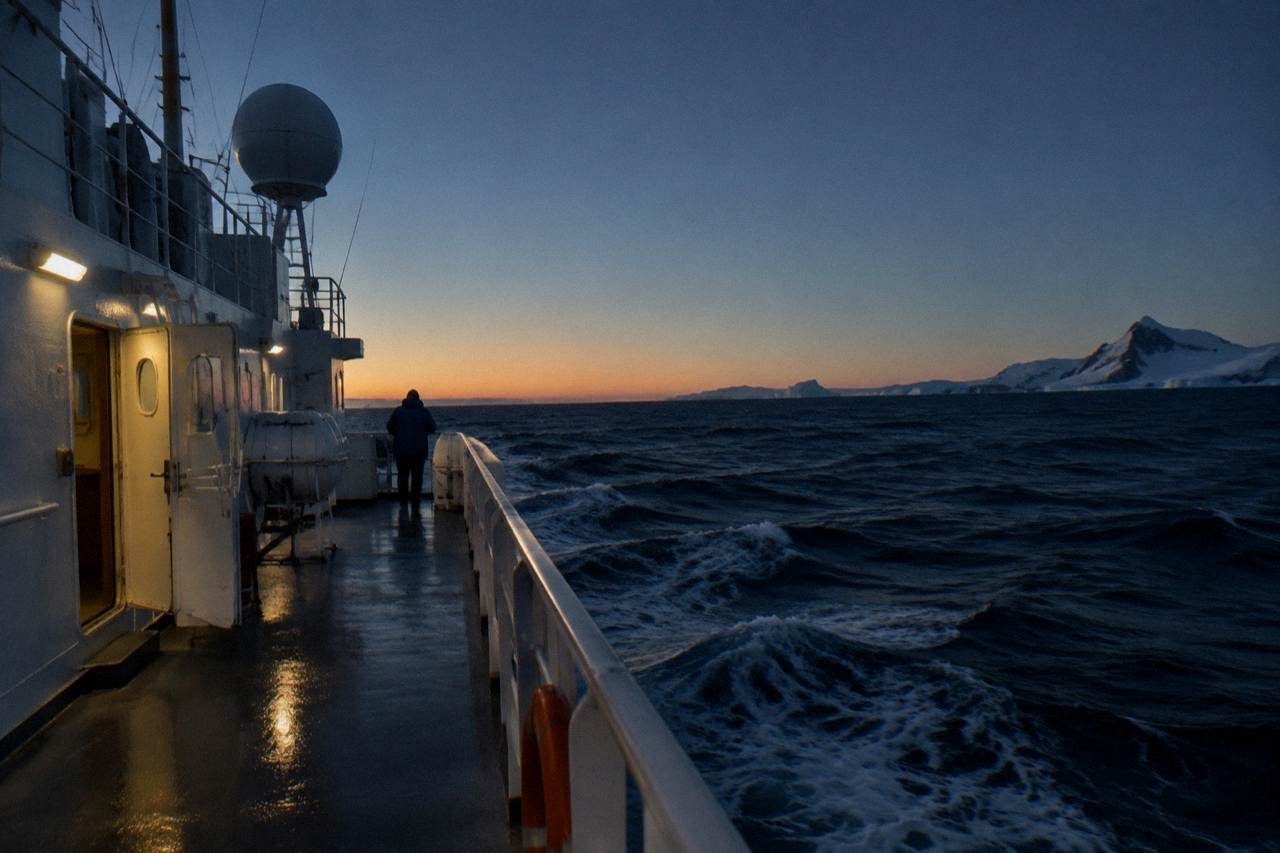
The Drake Passage is the stretch of Southern Ocean between South America's Cape Horn and the South Shetland Islands at the tip of the Antarctic Peninsula, a wide expanse of open water with no land to break the swell. Every conventional Antarctica cruise from Ushuaia crosses it twice, once southbound and once northbound, which is why the crossing appears in almost every planning question about this trip. It is also the single biggest fork in the road when booking: sail the passage on an expedition ship, or fly over it on a charter to King George Island.
The passage has a reputation that partly outruns the reality. It can be genuinely rough, and it can be glassy calm, and neither outcome is guaranteed on any given departure. What is predictable is the structure: about two days at sea in each direction, filled with lectures, bird watching from the deck, biosecurity preparation and, on many ships, a growing sense of anticipation as the first icebergs appear on the horizon. This guide covers the duration, the conditions, the on-board routine, the fly-cruise alternative and how to prepare, based on operator guidance and the current season's facts.
What Is The Drake Passage Crossing Like?
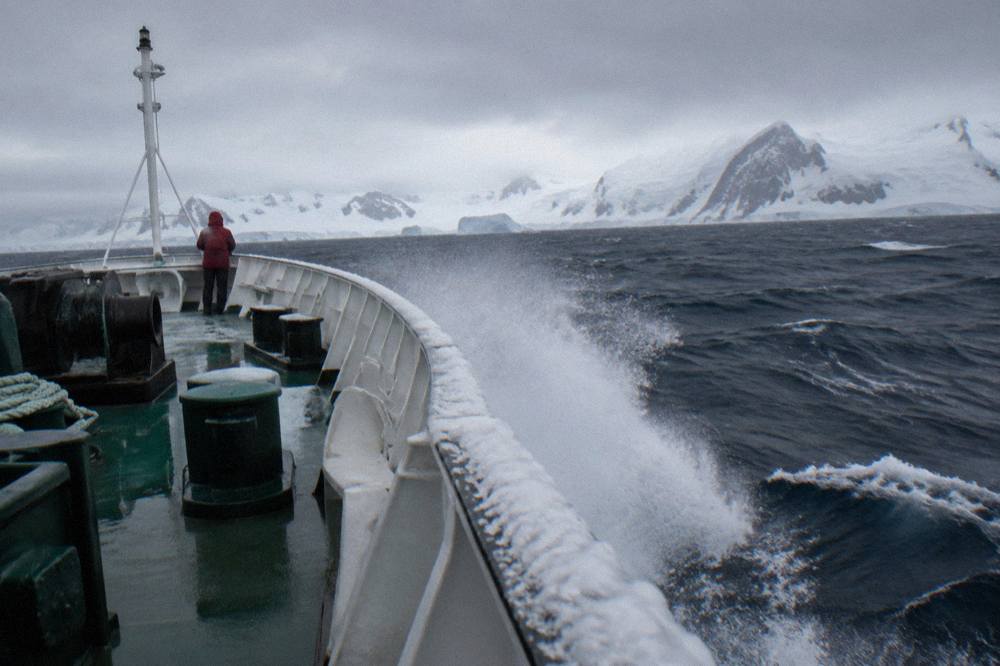
The crossing is roughly two days of open-ocean transit in each direction, spent on a ship built for exactly this water, with the schedule filled by the expedition team rather than left empty. Conditions swing between calm and lively, and the same voyage can deliver both on the southbound and northbound legs, so lectures, meals and deck time fill both days regardless.
The passage earned its reputation honestly. There is no continent or island chain between South America and Antarctica to slow the Southern Ocean's current, so the water stacks up into long swells that can run for great distances. A commonly cited split, reported by Geographical magazine, is that the rough "Drake Shake" occurs around 30 percent of the time while the calmer "Drake Lake" occurs around 70 percent. Neither figure is a forecast for your specific sailing, but it does mean the odds favour a manageable crossing rather than a brutal one.
Modern expedition ships are designed around this, and they are the reason the crossing is a routine event rather than an ordeal. Vessels like the Hondius, built in 2019 and classed Polar Class 6, and the Ocean Explorer, with ice class 1A, are purpose-built polar platforms with stabilizers, deep hulls and weather routing that lets the captain pick the most comfortable line. The Antarctic Treaty Secretariat notes that about 98 percent of all tourism voyages occur in the Antarctic Peninsula region during the austral summer, and nearly all of those from Ushuaia pass through this body of water.
If the open-ocean leg is the part of the trip you are least sure about, talk through your crossing options free before committing to a ship or a route.
How Long Does The Drake Passage Crossing Take?
Expect about two days in each direction. According to Quark Expeditions' own sailing-versus-flying guidance, passages take 18-24 hours in optimal conditions and extend to 36-48 hours in rougher seas. That is an operator source describing its own voyages, so treat it as typical rather than guaranteed, since the actual time depends on weather, sea state, the captain's course and vessel speed.
On a classic 11- or 12-day Peninsula cruise, roughly four of those days are Drake transit and the rest are landings and time in the ice. Quasar Expeditions makes the same point in its own Drake Passage guide: the exact hours vary with weather, sea state, the captain's course and the vessel's speed, which is why no operator will promise a fixed arrival time.
The variation is real but bounded. In one reported crossing with following winds, a ship completed the passage in about a day rather than the usual two, meeting a maximum wave of about 11 feet, according to Luxury Travel Advisor. At the other end, a slow passage against head seas can stretch toward 48 hours. The expedition team will usually announce the expected timing once the ship clears the Beagle Channel, and the daily program adjusts around it.
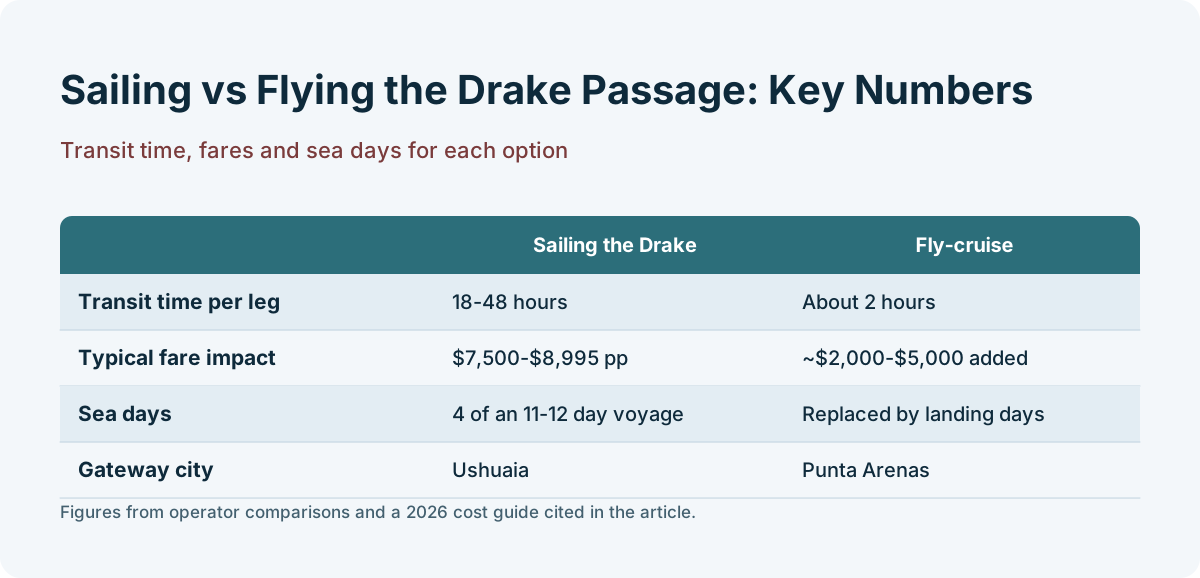
The duration is the main thing fly-cruise itineraries remove. A charter flight from Punta Arenas or Puerto Williams to King George Island takes roughly 1.5 to 2.5 hours, according to operator comparisons, and eliminates up to four days of sea transit across the whole round trip. That time saving is the entire trade-off in a sentence: the sailing voyage spends it at sea, the fly-cruise spends it in Antarctica.
For a deeper look at the timing question, see our companion piece on how long a Drake Passage crossing takes.
Drake Lake Or Drake Shake: How Rough Is It Really?
Most crossings are calmer than the folklore suggests: around 70 percent are described as Drake Lake conditions and around 30 percent as the Drake Shake, per Geographical's reporting. Typical swells average 3-5 meters, with severe documented conditions reaching far higher. The same ship, on the same voyage, can experience a flat southbound leg and a lively northbound one, or the reverse, and no month within the season is reliably better or worse.
The numbers behind the reputation come from the monitoring that follows this water closely. Pole to Pole documents typical Drake swells at 3-5 meters (10-16 feet), with severe conditions reaching 13-15 meters (42-49 feet) in documented observations. CruiseNews.io reports average wave heights of about 13-16 feet with storm waves capable of approximately 49 feet. Those severe figures are the exceptions that made the passage famous, not the norm.
Antarctica Travel Group and Terra Nova Expeditions both report that no single month is significantly better or worse for crossings, though the December-to-February summer generally offers more stable windows. Booking a specific month to dodge the Shake does not work; preparing for a range of conditions does.
Ship design has moved the comfort needle too. Poseidon Expeditions details how its Sea Spirit carries modern retractable fin stabilizers, retrofitted in 2019, that reduce roll both underway and at anchor, and AFAR reports that newer expedition ships carry zero-speed stabilizers, some 50 percent larger than standard, alongside advanced weather routing. If you are prone to motion sensitivity, our guide to Drake Shake seasickness and how to handle it goes into remedies in detail.
What Do You Actually Do On Board During The Crossing?
The two crossing days are the busiest sea days of the voyage: lectures, mandatory briefings, biosecurity preparation, outer-deck bird watching and the first sightings of ice. The expedition team treats the passage as the warm-up act, and the schedule reflects it, with a typical day running from an early breakfast through three or four presentations, hours on deck with hot drinks, and an evening recap before dinner.
The bird life alone justifies the deck time. Wandering albatross, black-browed albatross, giant petrels and cape pigeons follow expedition ships through the passage for much of the crossing, and the onboard naturalists usually set up on the top deck to help identify them. For many travellers this is the first time watching true oceanic seabirds at close range, and it is a genuine highlight rather than a consolation prize.
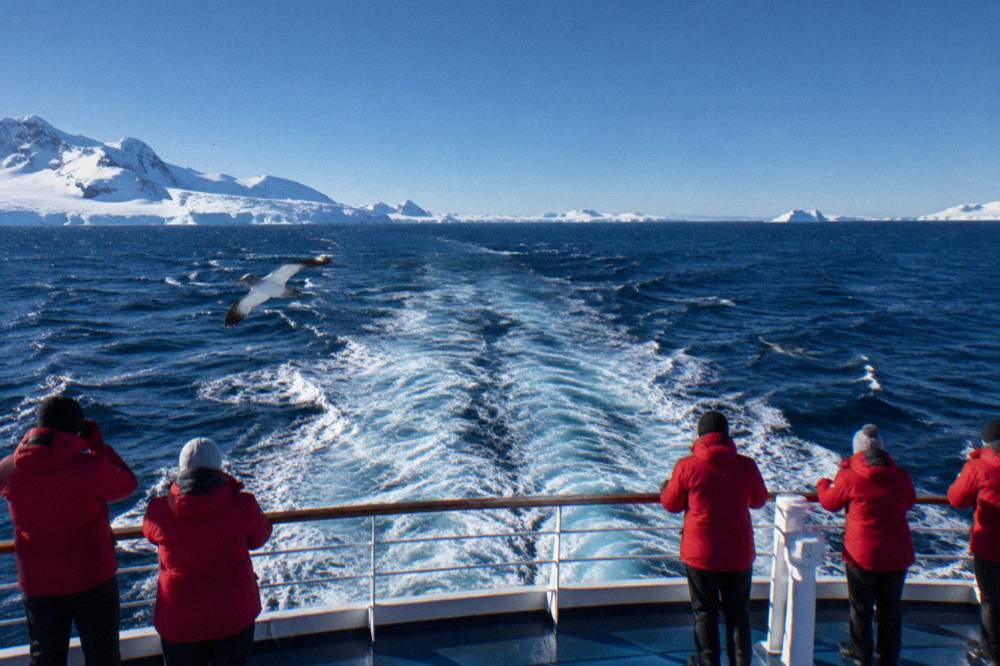
The practical sessions matter as much as the wildlife ones. IAATO's visitor guidance requires travellers to carefully wash boots and clean all equipment, including clothes, bags, tripods, tents and walking sticks, before bringing them to Antarctica, and again between sites. The crossing is when that biosecurity vacuum session happens, along with the Zodiac briefing, the landing-protocol talk and the lifeboat drill. By the time the first landing is announced, everyone on board knows the routine.
There is also the simple pleasure of a ship at sea. Cabins, lounges, saunas and libraries are all open, the bar does a steady trade, and the pace is genuinely slow. Sea days like these are part of what makes the arrival feel earned: the continent is not something you simply step off a plane into. That said, plenty of travellers would rather spend those days among icebergs, which is exactly what the fly-cruise option sells.
Sailing Or Flying The Drake: Which Should You Choose?
Sailing costs less and is weather-tolerant but spends about four days in transit; flying saves those days and avoids the swell, but adds roughly $2,000-$5,000 per person over comparable sailing voyages and is itself weather-dependent. Neither is objectively better. The right answer depends on your budget, your schedule, your motion tolerance and how much the sea days themselves appeal to you.
The comparison in numbers:
| Factor | Sailing the Drake | Fly-cruise |
|---|---|---|
| Transit time | Roughly 2 days each way, 18-48 hours per leg | About 2 hours by charter flight each way |
| Typical fare impact | Entry-level berths on Drake-crossing voyages begin around $7,500-$8,995 pp for 10-11 day Peninsula trips | Typically adds ~$2,000-$5,000 over comparable sailing voyages |
| Weather dependency | Ship sails in nearly all conditions; timing shifts | Flights to King George Island can be delayed by weather |
| Sea days | 4 of an 11-12 day voyage | Replaced by extra landing days |
| Gateway city | Ushuaia | Punta Arenas |
| Vessels | Most of the expedition fleet | Antarctica21's Magellan Explorer and Magellan Discoverer, plus fly options from other lines |
Fly-cruise itineraries typically add roughly $2,000-$5,000 over comparable sailing voyages due to charter flights, per multiple operator comparisons. One 2026 cost guide reports Quark's Antarctic Express fly-the-Drake product starting from $17,591 per person for an 8-day departure, against Antarctic Explorer sailings from $12,236. The trade is money and schedule certainty for sea days removed.
The fly option has its own weather exposure. Charter flights into King George Island's small airstrip can be delayed when conditions close in, and operators build buffer days into their itineraries for exactly that reason. Antarctica21's Classic Antarctica air-cruise runs 8 days and 7 nights with a roughly two-hour charter flight, a pre-flight briefing and a required hotel stay in Punta Arenas, with its ships Magellan Explorer and Magellan Discoverer both operating from that gateway. Sailing, by contrast, is almost never cancelled: the ship simply adjusts its course and timing.
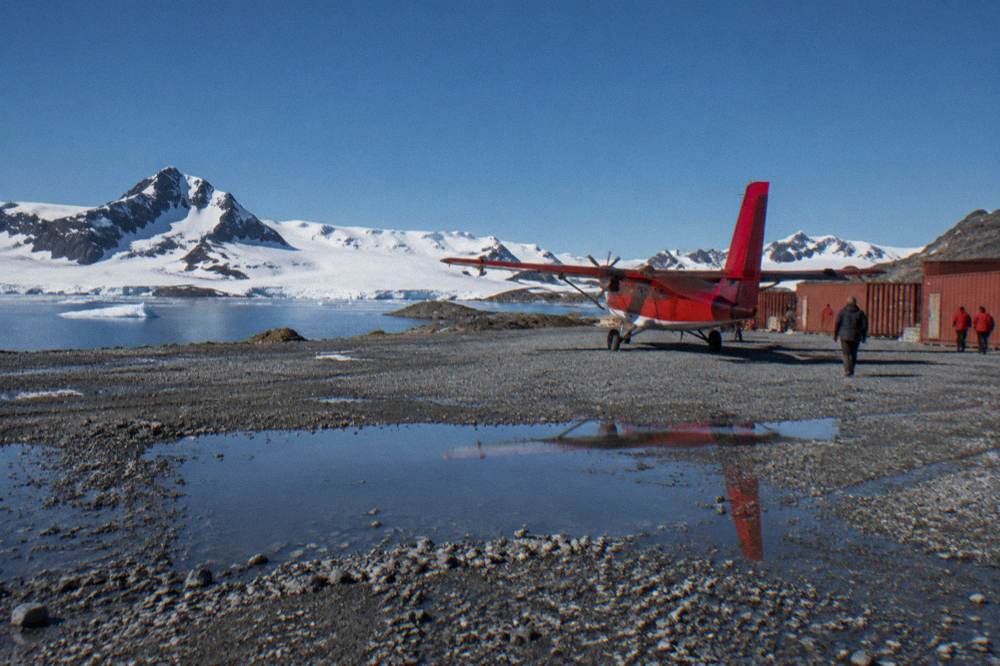
If you want the full breakdown of that trade-off, our fly-the-Drake versus sailing guide covers it, and the blog piece on whether flying or cruising is cheaper runs the numbers. When the choice is genuinely close for your dates and budget, a free consultation on crossing options can put both itineraries side by side.
Which Ships Cross The Drake Passage?
Almost every expedition ship sailing from Ushuaia crosses the Drake, from 90-berth budget vessels to 200-guest upscale platforms; the practical differences are passenger count, ice class and on-board comfort during the transit. The crossing is where a ship's design earns its keep, so hull, stabilizers and passenger load are worth checking before booking any Peninsula voyage, and they vary more between vessels than the route itself does.
Three representative options across the spectrum:
| Ship | Class | Passengers | Ice class | From, per person | Voyage length | Departs from |
|---|---|---|---|---|---|---|
| HondiusOceanwide Expeditions | Small-Ship Budget | 170 | Polar Class 6 | from $7,800 | 11 to 19 days | Ushuaia |
| Ocean ExplorerQuark Expeditions | Upscale Expedition | 138 | 1A, PC6 | from $12,236 | 8 to 20 days | Ushuaia, Buenos Aires, Punta Arenas |
| Magellan ExplorerAntarctica21 | Fly-Cruise | 96 (88 in Antarctica) | LR PC6 | from $13,795 | 8 days | Punta Arenas (fly) to King George Island |
The Hondius, operated by Oceanwide Expeditions, is the featured pick for a classic crossing. Built in 2019 and the first-registered Polar Class 6 vessel in the world in the operator's own wording, she carries 170 guests in 80 cabins, sails from Ushuaia on 11, 13 and 19 day voyages, and has Peninsula departures from $7,800 per person. She is a small-ship budget option that behaves like a modern polar vessel, and the crossing days are programmed with the same lecture and biosecurity routine as the premium lines. You can read more in our Hondius Antarctica guide.
At the upscale end, Quark Expeditions' Ocean Explorer carries 138 guests with ice class 1A, sails 8 to 20 day voyages from Ushuaia, and shares Quark's voyage-level fares, which start at $12,236 per person for the Antarctic Explorer itinerary, a fare also listed for the World Voyager and Ultramarine. And at the fly-cruise end, Antarctica21's Magellan Explorer carries 88 guests on air-cruises from $13,795 per person, flying passengers from Punta Arenas to King George Island and skipping the crossing entirely. Our Magellan Explorer guide covers that product in detail.
The class differences matter most during the passage itself. A ship carrying 170 guests feels very different in a swell from one carrying 490, and IAATO's rules mean only ships with 500 or fewer passengers may make landings at all, with a maximum of 100 passengers ashore from a vessel at any one time and a minimum 1:20 guide-to-visitor ratio during landings. The smaller the vessel, the faster everyone rotates through landing opportunities once the Peninsula is reached, and the calmer the ship tends to feel socially during the transit.
Hour By Hour: What A Typical Crossing Day Looks Like
A crossing day runs on a fixed rhythm: breakfast, a morning lecture, deck time, lunch, an afternoon lecture or workshop, more deck time, the daily recap, dinner and an evening program, repeated for roughly two days. The expedition team publishes the schedule the night before, and the only real decision each day is how much of it to attend, which is why the days pass faster than travellers expect.
Here is how a representative day stacks up:
| Time | What is happening |
|---|---|
| 07:30-09:00 | Breakfast service; open seating, no fixed times |
| 09:30 | Morning lecture: typically wildlife, history or photography |
| 11:00 | Deck hours: seabird watching from the outer decks, hot drinks available |
| 12:30 | Lunch, usually buffet on crossing days |
| 14:30 | Afternoon session: biosecurity boot wash, Zodiac and landing briefings |
| 16:00 | Free time: library, sauna, nap, or bridge visits on some ships |
| 17:30 | Optional presentation or documentary |
| 18:30 | Daily recap: next day's plan, first-icebergs watch announced if close |
| 19:30 | Dinner, full service |
| 21:00 | Evening: bar, quiz, or quiet decks under a long twilight |
The first icebergs are the emotional turning point of the southbound crossing. Sometime on the second day, usually in the afternoon or evening, the lookouts call them in, and the deck fills with people in parkas watching white shapes the size of buildings drift past. After that the South Shetland Islands appear, and the ship's program shifts from sea mode to expedition mode overnight.
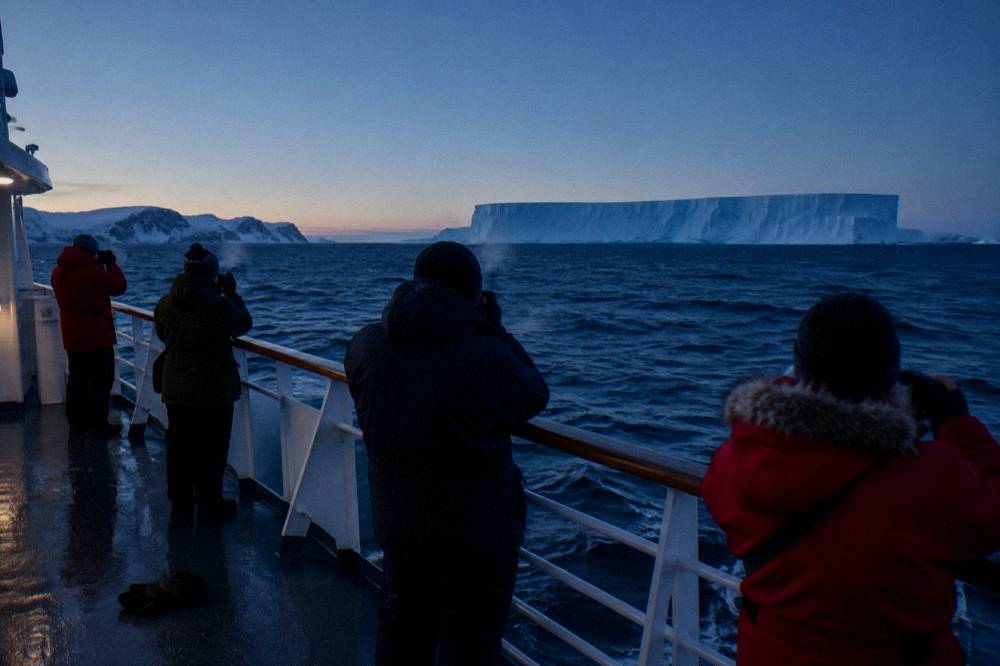
The northbound crossing runs on the same rhythm in reverse, but the mood is different: the photos are taken, the checklist is done, and most of the ship sleeps better knowing what the passage actually feels like. Many travellers report the return leg is easier, partly because of acquired sea legs and partly because the anticipation is gone.
How To Prepare For The Crossing
Preparation is mostly about motion management and time buffers: pack remedies before you board, book at least one pre-cruise night in Ushuaia, and arrange travel insurance with medical evacuation cover, which most operators require rather than merely suggest. None of this is exotic, but each item is the kind of thing that is awkward to fix once the ship has sailed, and each one protects a trip that cost five figures.
The practical checklist:
| Preparation | Why it matters |
|---|---|
| Motion remedies | Stock seasickness medication, acupressure bands or patches before boarding; the ship's doctor can help but choices are limited at sea |
| Arrive a day early | Ushuaia hotel occupancy ran about 80 percent in January 2026 amid heavy cruise traffic; a one-night buffer, ideally two, protects against flight delays on the Buenos Aires-Ushuaia corridor |
| Insurance with evac cover | Operators impose high medical evacuation minimums, for example Quark $500k, Ponant $250k and Lindblad $150k, plus trip-cost cancellation cover |
| Layered clothing for decks | Deck bird watching means wind; base layers plus the expedition parka most operators provide |
| Break in your boots | Loaner boots arrive on board; walk in your own footwear beforehand |
| Buffer on the way home | The northbound crossing can stretch; do not book a same-day international connection from Buenos Aires |
The insurance point deserves emphasis. Travel insurance with medical evacuation is required or recommended by most operators and is not included in base fares, and proof is often required pre-departure or at check-in. Our Antarctica travel insurance guide covers the minimums line by line.
The buffer point matters on the fly-cruise side too. Polar Latitudes, for example, requires its fly-cruise guests to arrive at a designated Punta Arenas hotel by 14:00 the day before the charter flight, with a strict 20 kg checked baggage limit on the King George Island leg. Sailing from Ushuaia is more forgiving of a delayed domestic flight, but only if you have a spare night in hand.
Is The Drake Passage Actually Dangerous?
For a modern expedition cruise, no: the passage is uncomfortable far more often than it is dangerous, and the ships that cross it are built, crewed and routed for exactly this water. Serious incidents are rare and notable precisely because they are rare, though two recent events, the Viking Polaris wave strike of November 2022 and the Clelia II engine trouble of October 2025, show the passage can still demand respect.
The detail behind those two events is worth knowing. The Viking Polaris was struck by a breaking wave southeast of Cape Horn in November 2022, shattering seven stateroom windows, with one passenger killed and eight injured, an event that reshaped how several lines configure cabin glazing on the passage. In October 2025 the Clelia II lost power in one engine in heavy weather with 50-knot winds and 7-8 meter waves and was assisted while limping toward Ushuaia before regaining mobility.
Those events are also the exceptions across thousands of routine crossings each season. Expedition ships carry ice-strengthened or Polar Class hulls, experienced bridge crews and full weather routing, and the captain's single biggest tool is simply choosing when and how to cross. Our longer treatment of the question, is the Drake Passage dangerous, weighs the record in detail, and the blog piece on whether ships have sunk in the Drake Passage covers the historical cases.
The honest framing is this: the Drake Passage is a demanding body of water that occasionally reminds everyone why it has a reputation, and it is crossed routinely, multiple times a week, by ships full of ordinary travellers in their seventies. If you can handle a rough ferry crossing, you can almost certainly handle a typical Drake leg, and the odds say you will get a calm one.
Making The Final Call On Your Crossing
Sail the Drake if the budget is fixed and the sea days appeal to you; fly if the schedule is tight or the swell is a genuine concern. The premium for flying typically runs $2,000-$5,000 per person over a comparable sailing voyage, and the sailing option spends roughly four of its days at sea, so the choice usually resolves itself once those two numbers meet your calendar and your wallet.
The decision comes down to three questions. How much does the budget flex, given the fly-cruise premium noted above? How many days do you have, given that sailing spends four of them at sea? And do the sea days sound like a waste or like part of the point? Travellers who answer budget first tend to sail; travellers who answer schedule first tend to fly; and travellers who answer the third question with genuine enthusiasm for open ocean should sail regardless of the other two.
If you are still weighing the two, get help choosing your crossing style through a free consultation with a vetted expedition-cruise agency partner. It costs nothing, carries no obligation, and the practical difference between a sailing voyage on a ship like the Hondius and a fly-cruise on the Magellan Explorer is exactly the kind of comparison a specialist can run quickly against your dates.
Common Questions About The Drake Passage Crossing
How Long Does The Drake Passage Crossing Take?
About two days each way. Quark Expeditions' guidance says 18-24 hours in optimal conditions and 36-48 hours in rougher seas, so a round trip on a classic Peninsula cruise spends roughly four days in transit.
Is The Drake Passage Always Rough?
No. Around 70 percent of crossings are calm enough to be called Drake Lake and about 30 percent are the rougher Drake Shake, according to Geographical's reporting. No month within the season is reliably calmer than another.
Can You Avoid Crossing The Drake Passage?
Yes, by booking a fly-cruise. A charter flight from Punta Arenas to King George Island takes roughly two hours and replaces the sea crossing entirely, typically adding $2,000-$5,000 per person over a comparable sailing voyage.
What Do You Do On The Ship During The Crossing?
Lectures, seabird watching from the deck, biosecurity and Zodiac briefings, meals, and free time. The expedition team programs both crossing days fully, and the first icebergs usually appear on the second day southbound.
Is The Drake Passage Dangerous For Cruise Ships?
Modern expedition ships cross it routinely and it is uncomfortable far more often than it is dangerous. Serious incidents are rare, though the Viking Polaris wave strike in November 2022 and the Clelia II engine trouble in October 2025 show the passage can demand respect.
Which Side Of The Ship Is Better For The Drake Crossing?
There is no better side: the ship's course changes through the passage and swell direction shifts with it. Choose a cabin for its deck and comfort features rather than its side, and spend crossing time on the open decks instead.