Deception Island On An Antarctica Cruise: Landing Guide
 By Oleg G.
Deception Island is a drowned volcano whose collapsed caldera forms a natural harbour, and it is one of the most-visited stops on an Antarctic Peninsula cruise. This guide covers the landing sites, the itineraries that call there, and the caveats that decide whether you step ashore.
Quick answer: Deception Island is a flooded caldera in the South Shetland Islands that many Antarctic Peninsula cruises visit, with Whalers Bay and Telefon Bay the known landing sites. A ship enters through the narrow Neptune's Bellows channel, and landings follow IAATO rules: max 100 passengers ashore at a time, one vessel per site. Weather and swell regularly cancel calls.
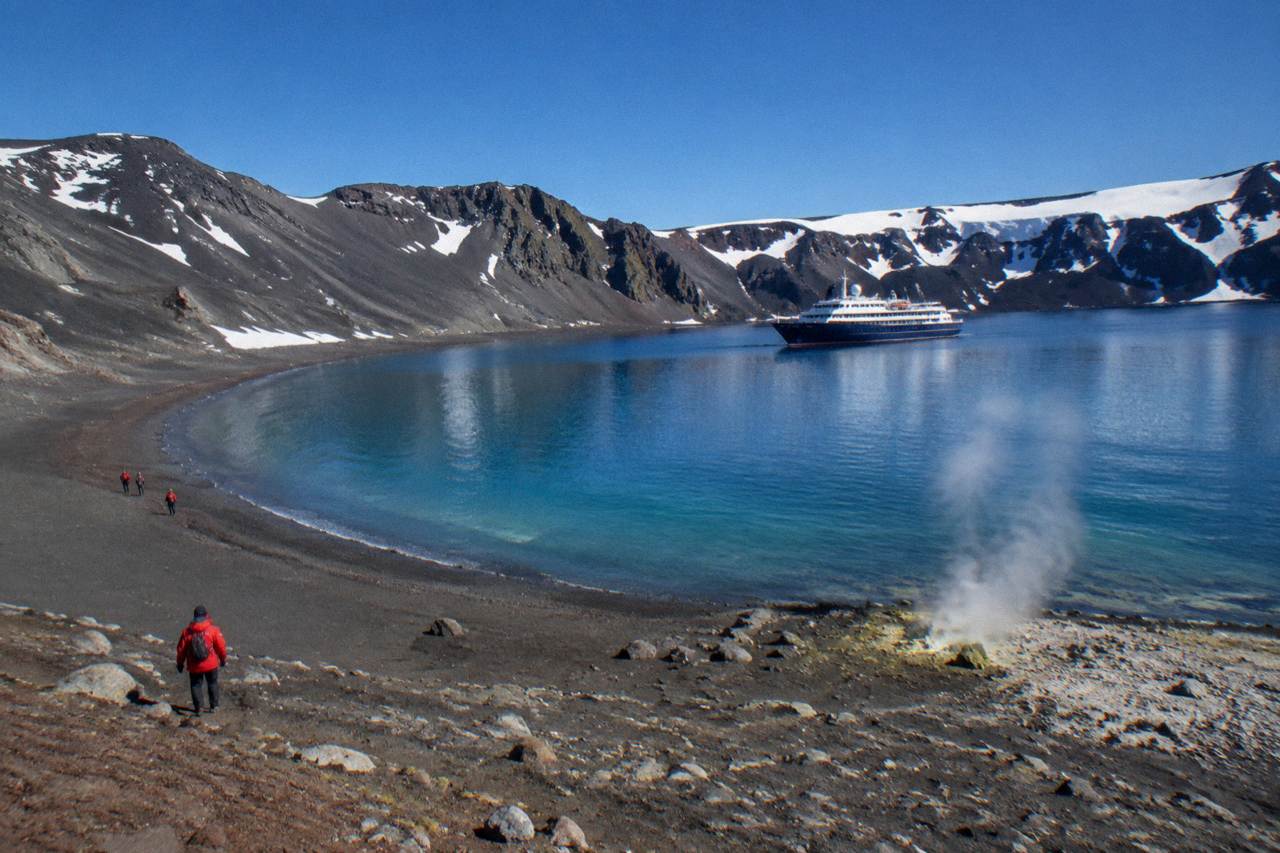
Deception Island is the collapsed, water-filled cone of an active volcano, and a cruise ship can sail straight into the middle of it. The island sits among the South Shetland Islands off the Antarctic Peninsula, and a narrow, rock-walled channel called Neptune's Bellows is the only way in. Once inside, the ship anchors in a sheltered bay ringed by dark volcanic sand, abandoned whaling stations and ash-dark ground shaped by past eruptions. It is a strange, memorable stop, and it appears on many Antarctic Peninsula expedition cruise itineraries, though no call is ever guaranteed.
This guide covers what Deception Island actually is, how a landing works, what you see at Whalers Bay and Telefon Bay, which voyages call there, and the weather and access caveats that decide whether your day happens. If you are still weighing whether the expedition cruise price is worth it, that is a separate question from which stops you get, and both deserve their own answer before you put money down.
What Is Deception Island And Why Does A Cruise Sail Into A Volcano?
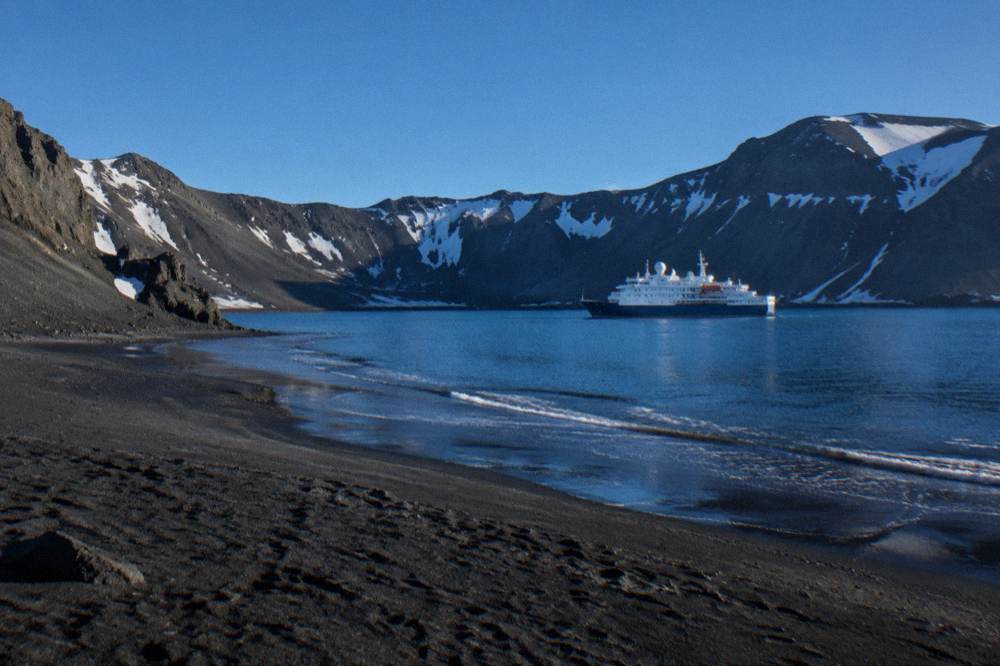
Deception Island is a ring-shaped island off the west coast of the Antarctic Peninsula: the flooded caldera of a volcano that has erupted in modern times. The caldera's seawater-filled centre, called Port Foster, is deep and sheltered enough that expedition cruise ships enter through a narrow gap in the crater wall, Neptune's Bellows, and anchor inside a volcano. Very few cruise destinations anywhere let a ship do this.
The island is a broken ring of crater wall, and the caldera's inner harbour, Port Foster, is one of the safest anchorages in the South Shetlands. The catch is the entrance. Neptune's Bellows is a narrow passage with a shoal sitting in the middle of the channel, so navigation is a genuine piece of seamanship even in calm weather. The name is not decoration: ships have scraped the walls, and the wreck of a whale catcher near the entrance stands as a permanent reminder.
The volcano has erupted in modern times: past eruptions destroyed research stations on the island and buried the whaling station at Whalers Bay under ash and mud. The ground in places is still warm, and the island is monitored. For a cruise passenger this history is part of the appeal: this is one Antarctic landing where you walk a beach that a volcano remade in recent memory, and the landscape shows it.
The island's place in Antarctic tourism is well established. The Antarctic Treaty site guidelines list Whalers Bay and Baily Head among the frequently visited locations with current or updated approach rules, and IAATO's site coordination system means only one vessel visits a landing site at a time. The Antarctic Treaty System's tourism overview notes that roughly 98 percent of all tourism voyages occur in the Antarctic Peninsula region during the austral summer, and Deception Island sits squarely inside that zone.
How Does A Deception Island Landing Actually Work?
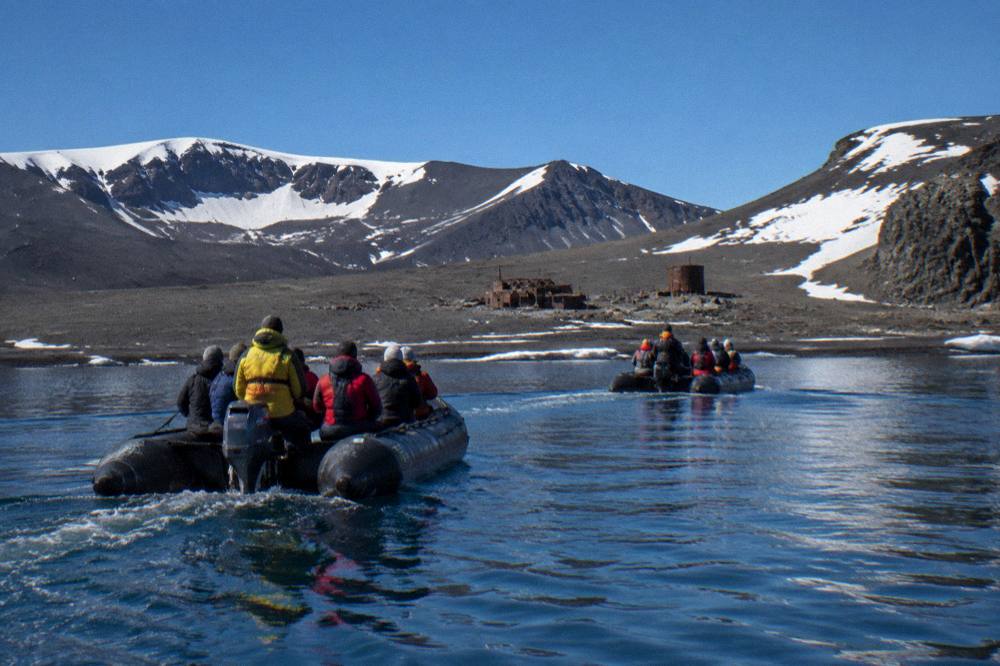
Your ship anchors inside Port Foster, Zodiacs are launched from the inner harbour, and you go ashore in groups capped by IAATO rules: a maximum of 100 passengers from a vessel may be ashore at any one time, with a minimum 1:20 guide-to-visitor ratio. On a ship carrying 170 guests, half the ship lands while the other half waits or cruises the shoreline, then they swap.
The landing itself is usually at Whalers Bay, a long stretch of dark sand inside the caldera. There is no jetty: you step from the Zodiac into shallow surf onto the beach, and the crew manages the flow. Before anyone lands, biosecurity rules apply: boots and equipment must be washed and cleaned before you come to Antarctica, and cleaned again between sites, per the IAATO visitor guidelines.
Wildlife rules matter here as much as anywhere. Visitors keep at least 5 metres from wildlife on land, and greater distances where site guidance requires it, which at Baily Head, the large chinstrap penguin colony on the island's outside coast, is a serious constraint. Baily Head is a harder landing in any case: it faces the open ocean, the swell on the outside of the island is often too big, and many calls that make it into Port Foster never attempt it. If your heart is set on penguins rather than history, plan around the Peninsula's other landing sites rather than around this one island.
One practical point shapes the whole day: the landing depends on the Bellows. If swell or wind makes the channel unsafe, the ship simply does not enter, and the day becomes a scenic pass or gets replaced with another site. Expedition teams carry alternates for exactly this reason, so treat Deception Island as a strong possibility on the itineraries that list it, never a certainty. Voyages differ in how much schedule slack they leave for exactly this kind of day, and that slack is worth asking about before you commit to a ship.
Whalers Bay: What You Actually See Ashore
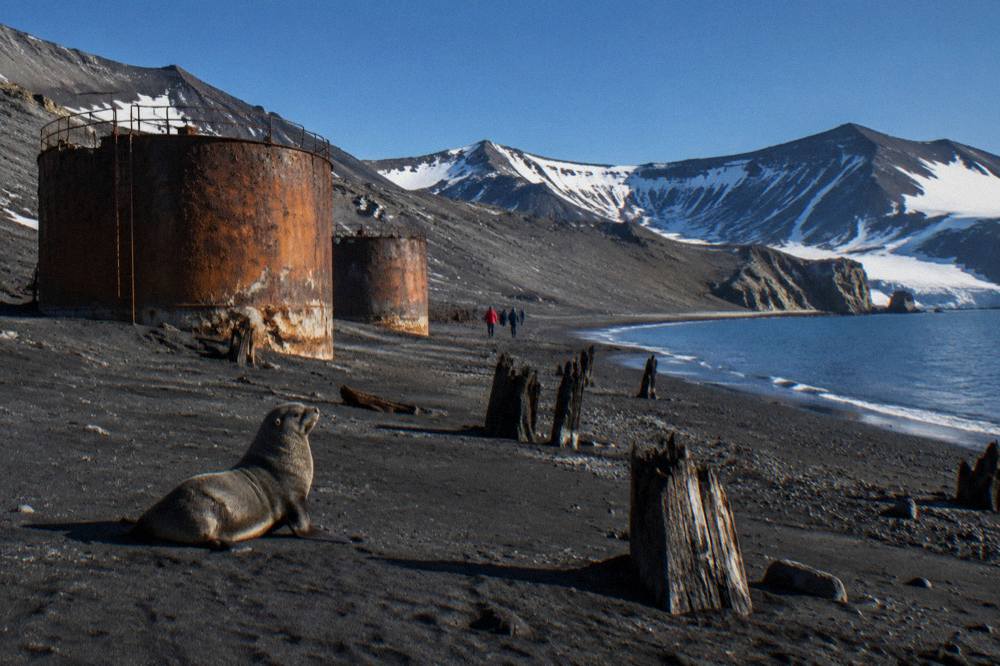
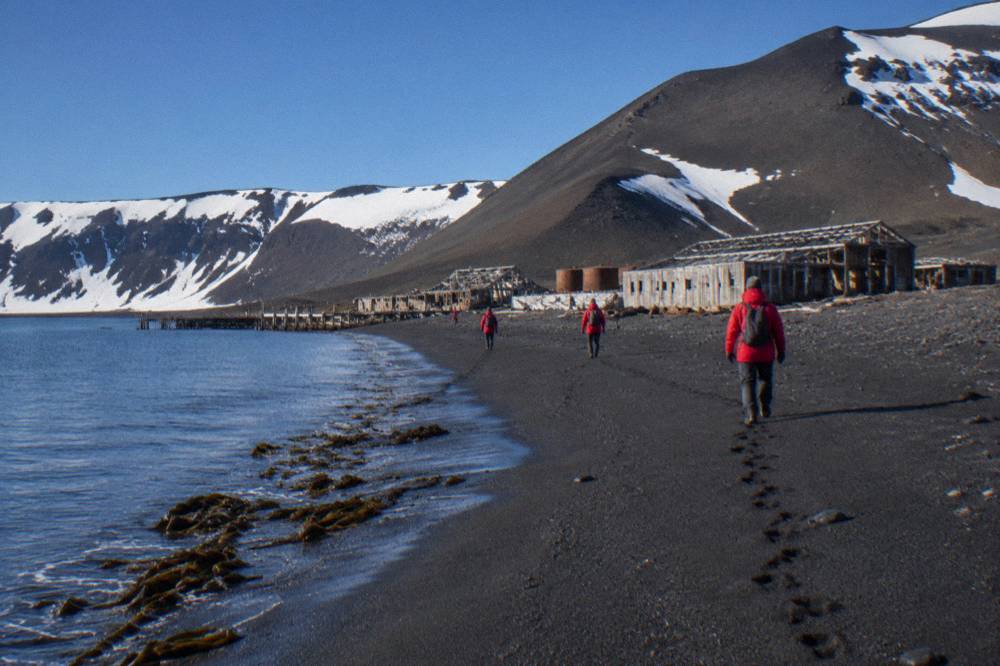
Whalers Bay is the main landing inside the caldera: a black-sand beach holding the rusting remains of an old whaling station, a cemetery, aircraft hangar ruins from an early aerial survey project, and whale bones half-buried in ash. A past eruption buried much of it, so what you walk among is a ruin inside a ruin, with fur seals often hauled out between the buildings.
The whaling station operated in the era of industrial whaling, when the island's natural harbour made it a busy anchorage in the Southern Ocean. Whales were processed here in industrial numbers, and the station faded as the industry moved to factory ships. What remains are the whale oil tanks, the collapsed boilers, the cemetery with its tilted graves, and the bones. It is the most human landing in the Peninsula: everywhere else you look at nature, here you look at what people left behind.
The hangar is a favourite stop. It was built for an early aerial survey of the continent, and its skeleton still stands against the hillside. Guides walk you through the site in small groups, and because the structures are fragile and partly protected, you stay on established paths. Fur seals and the occasional elephant seal use the beach, so the 5-metre rule is in force even among the ruins.
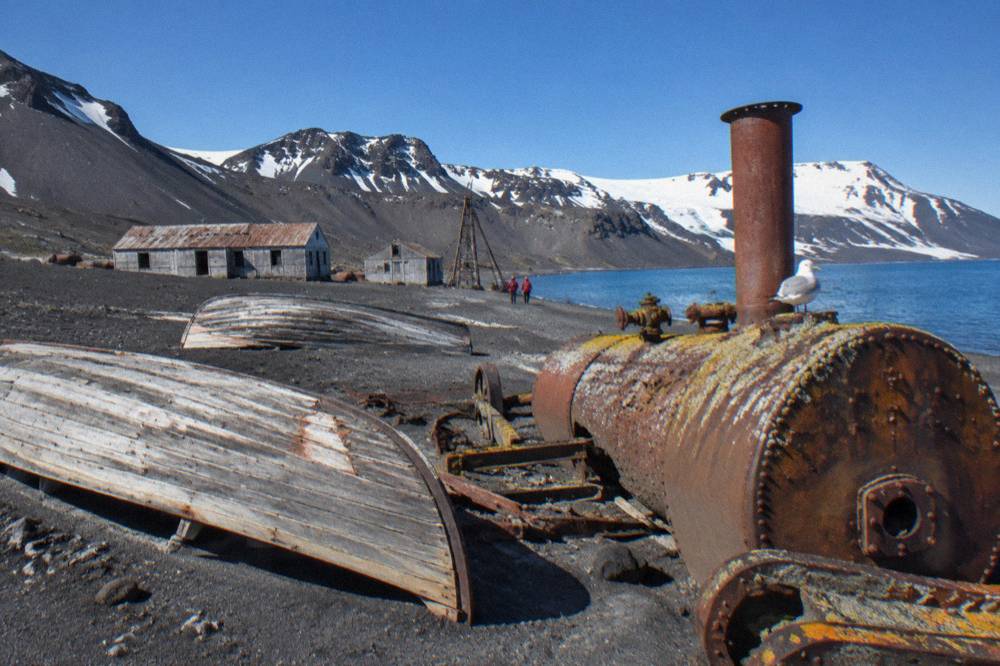
Some itineraries also offer the polar plunge at Whalers Bay, one of the few places in Antarctica where the water is warmed slightly by geothermal activity, though in practice the swim is cold like any other and the steam you sometimes see along the shore is the volcano's reminder, not a hot spring you bathe in. Whether you swim or not, the walk past the cemetery to the far end of the beach, with the ship at anchor in the caldera behind you, is one of the signature photographs of an Antarctic cruise.
Telefon Bay And The Island's Other Landing Sites
Telefon Bay is the island's second known landing, on the caldera's northern shore, where eruptions have left fresh craters and a barren moonscape of ash and lava. It is a geology landing rather than a history one: no buildings, minimal wildlife, and a short walk to a crater rim. Baily Head, the outside-coast chinstrap colony, is the third site but is frequently ruled out by swell.
Telefon Bay is named after a wrecked whaling vessel whose remains once lay here. The draw is the volcanic terrain: past eruptions punched new craters into this part of the island, and the walk takes you over ash slopes that look more like Iceland than the Antarctica of postcards. Guides use it to explain the island's eruption history, and it is often the alternative when Whalers Bay is crowded or conditions favour the northern shore.
| Landing site | Location | What you see | Access notes |
|---|---|---|---|
| Whalers Bay | Inside caldera, south shore | Whaling station ruins, cemetery, hangar, whale bones | Main landing, sheltered, used most often |
| Telefon Bay | Inside caldera, north shore | Fresh volcanic craters, ash and lava terrain | Geology walk, used as an alternative |
| Baily Head | Outside east coast | Large chinstrap penguin colony | Exposed to swell, frequently cancelled |
Baily Head deserves its reputation but not your confidence. The colony is a large chinstrap rookery, and the landing beach is a narrow surf zone that only works in genuinely calm conditions. IAATO's site guidelines for Baily Head set approach distances and capacity limits for exactly this reason. In a week of Peninsula cruising you may get Whalers Bay twice and Baily Head never, so if penguins are your priority, plan the voyage around the Antarctic Peninsula cruise as a whole rather than around one island.
Which Antarctica Itineraries Include Deception Island?
Deception Island appears on classic Peninsula itineraries, which typically allocate four to six days for landings across the South Shetland Islands and the western Peninsula. Because the island sits in the South Shetlands, it is reachable on short sailings from Ushuaia as well as longer Falklands and South Georgia combinations, and fly-cruise voyages can include it when their ship days reach the island group.
The typical pattern is straightforward. A ship leaving Ushuaia spends about two days crossing the Drake Passage, and the South Shetlands, including Deception Island, are the first landfall area. From there the cruise works down the western Peninsula towards the Lemaire Channel and Paradise Bay, then returns. Operator listings for 2026 departures show classic Peninsula voyages building in this order, which is why Deception Island is often one of the first big landing days of a trip.
| Itinerary type | Typical length | Deception Island fit |
|---|---|---|
| Classic Peninsula sailing from Ushuaia | 10 to 12 days | First landing area after the Drake crossing, often attempted |
| Fly-cruise from Punta Arenas | 8 days | Included when the ship days reach the South Shetlands |
| Peninsula plus Antarctic Circle | 12 to 14 days | Same South Shetland window, with a southern extension |
| Falklands, South Georgia and Peninsula | 20 to 23 days | Peninsula segment can include the island |
The choice between these shapes is the single biggest decision after you commit to Antarctica at all: more days costs more money but buys more landing chances, and the shorter fly-cruise trades sea days for a fixed flight schedule. If you are torn between a classic sailing and a fly-cruise, a free consultation on your itinerary options will map both against your dates and budget.
The routes and sites data shows the pattern clearly: classic Peninsula itineraries allocate four to six landing days across the South Shetlands and western Peninsula, while the longer Falklands, South Georgia and Peninsula combinations run 20 to 23 days and reach the same island group late in the voyage. Fly-cruise options, which skip the Drake Passage with a roughly two-hour charter flight to King George Island, save up to four days of sea transit and can still reach Deception Island on their ship days, as the fly the Drake guide explains in detail.
Which Ships Visit Deception Island?
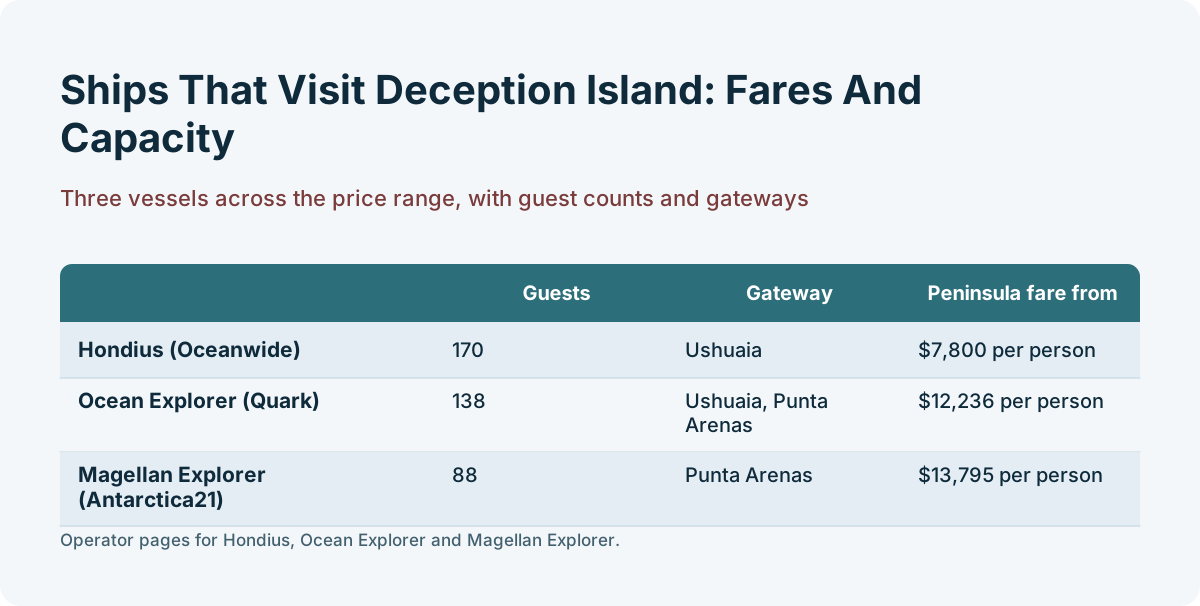
Any IAATO expedition cruise ship working the Peninsula can call at Deception Island, since it is a standard South Shetland site, and the choice that matters is ship size and style: smaller vessels land faster under the 100-passenger cap, while larger ships rotate groups. Three examples from different tiers show the range: Hondius from Oceanwide, Ocean Explorer with Quark, and Magellan Explorer with Antarctica21's fly-cruise model.
Hondius is a good example of the value end. The Oceanwide Expeditions page lists it as a 170-guest, Polar Class 6 vessel sailing from Ushuaia on 11 to 19-day Antarctic voyages, with Peninsula departures from $7,800 per person. At 170 passengers it lands in two rotations under the IAATO cap, and its budget-tier fares make it one of the more accessible ways to build a Deception Island call into a classic Peninsula cruise.
Ocean Explorer sits a tier up. The Quark Expeditions page lists it as a 138-passenger upscale expedition ship sailing from Ushuaia, Buenos Aires and Punta Arenas on voyages from 8 to 20 days, with Peninsula fares from $12,236 per person. Note that Quark's fares are voyage-level and shared across its ships, including Ultramarine and World Voyager, so the fare belongs to the itinerary rather than to one vessel. Under 138 guests, the whole ship can land in two quick rotations, and Quark's helicopter-equipped fleet-mate Ultramarine gives the operator options this island's weather rewards.
Magellan Explorer represents the fly-cruise route. Antarctica21 lists it as an 88-guest, Polar Class 6 ship built in 2019, running 8-day Classic Antarctica air-cruises from Punta Arenas with a charter flight to King George Island, from $13,795 per person. At 88 guests, everyone lands together, no rotation needed, and the fly-cruise model trades the Drake crossing for a fixed flight schedule, which the Drake Passage crossing guide weighs in full.
| Ship | Class | Passengers | Ice class | From, per person | Voyage length | Departs from |
|---|---|---|---|---|---|---|
| HondiusOceanwide Expeditions | Small-Ship Budget | 170 | Polar Class 6 | from $7,800 | 11 to 19 days | Ushuaia |
| Ocean ExplorerQuark Expeditions | Upscale Expedition | 138 | 1A, PC6 | from $12,236 | 8 to 20 days | Ushuaia, Buenos Aires, Punta Arenas |
| Magellan ExplorerAntarctica21 | Fly-Cruise | 96 (88 in Antarctica) | LR PC6 | from $13,795 | 8 days | Punta Arenas (fly) to King George Island |
| Ship | Operator | Guests | Gateway | Peninsula fare from |
|---|---|---|---|---|
| Hondius | Oceanwide Expeditions | 170 | Ushuaia | $7,800 pp |
| Ocean Explorer | Quark Expeditions | 138 | Ushuaia, Punta Arenas | $12,236 pp (voyage-level fare) |
| Magellan Explorer | Antarctica21 | 88 | Punta Arenas (fly) | $13,795 pp |
These three cruise options land on the same island under the same rules; what changes is how you get there, how fast the landing rotates, and what the voyage costs. A bigger ship brings more onboard comfort and often more cabin categories, a smaller one brings speed at the beach and a tighter social circle, and the fly-cruise brings schedule certainty everywhere except the weather. None of these differences decides whether the island itself cooperates on the day.
When Should You Sail To Reach Deception Island?
The Antarctic cruise season runs mid-October to mid-March, and Deception Island is visitable throughout. Early season brings maximum snow and courting penguins, December to January brings hatching chicks and the first humpback whales, and February to March peaks for whale watching and photography. No single month is reliably calmer for the island's landings; conditions stay unpredictable all season.
The season data is consistent across operator sources. November on the Peninsula can drop to around -5°C with penguins in courtship and nest-building mode, while January to March commonly runs 0 to 3°C with near-24-hour daylight. Penguin chicks typically begin hatching mid-December, most channels become ice-free by January, and whale sightings increase from mid-January onward. For Deception Island specifically, the outside-coast sites like Baily Head are marginally more likely to work later in the season when swell patterns settle, but there is no source that promises this, and the honest answer is that any landing is a coin the weather flips on the day.
| Month window | Conditions and wildlife | Notes for Deception Island |
|---|---|---|
| October to November | Maximum snow, courting penguins, sea ice breakup | Landing possible, outside sites rarely work |
| December to January | Chicks hatching, channels ice-free, whales returning | Peak season, busiest sites |
| February to March | Peak whale activity, molting penguins, warmer light | Good photography window |
Peak December sailings are the ones that book furthest ahead, sometimes 18 or more months out, and last-minute discounts exist but are limited in availability and cabin choice, per one cost guide. If your dates are fixed around a specific month, that is a decision worth making early, and a free consultation on dates and ships can tell you which operators still hold space in your window.
What Could Cancel Your Deception Island Landing?
Three things stop a call: swell and wind at Neptune's Bellows, which can close the entrance; gust conditions inside the caldera that make Zodiac operations unsafe; and site congestion or guidelines, since only one vessel may visit a site at a time. No operator guarantees the landing, and a good itinerary treats it as one of several possible South Shetland stops.
The Bellows is the gatekeeper. The channel is narrow, it has a rock in the middle, and the wind funnels through it. Even when the ship gets inside, Port Foster is known for gusts that pour down the caldera walls, and Zodiac driving in a gusty anchorage is a go or no-go call the captain and expedition leader make on the morning itself. This is normal Antarctic cruising, not a sign of a bad operator.
The second constraint is regulatory and it protects the site. IAATO's coordination means one ship per site at a time, 100 passengers ashore maximum, and site guidelines, updated through Resolution 3 (2026) at the most recent Antarctic Treaty meeting, set approach distances and capacities for frequently visited locations including Whalers Bay and Baily Head. A regulatory overview of Antarctic cruising notes these updates cover temporal restrictions and boundaries too, so some sites have time windows as well as headcount limits.
The practical advice is to pick a voyage with more South Shetland and Peninsula days than you think you need. A 10 to 12-day classic sailing gives the expedition team slack: if Deception Island closes, they reroute to another site, and you still land that day. A tightly scheduled short fly-cruise has less slack, which is the honest trade-off for skipping the Drake. If losing one specific island would ruin the trip for you, say so when you plan, and get free help choosing a voyage that stacks the odds with extra landing days.
Planning Notes Before You Book A Deception Island Voyage
Book a Peninsula itinerary with four to six landing days, arrive at your gateway a night or two early, carry insurance with high medical evacuation cover, and treat the island as a highlight rather than a guarantee. Operators commonly require evacuation cover with minimums that vary by line, and weather buffers in Ushuaia or Punta Arenas protect the one flight or sailing day your whole trip depends on.
The logistics files are blunt about arrival buffers: pre-cruise arrival of at least one, ideally two nights is recommended in Ushuaia, because the Buenos Aires to Ushuaia corridor is weather-prone and the port city reached roughly 80 percent hotel occupancy in January 2026 during a season that saw more than 43,720 cruise passengers. Fly-cruise passengers face their own version: Polar Latitudes requires guests to be in Punta Arenas by early afternoon the day before the charter flight, with a strict 20 kg checked baggage limit on the flight to King George Island.
Insurance minimums are real and checked. Major operators impose high medical evacuation minimums, with figures such as $500k, $250k and $150k reported across lines in an operator comparison, plus full trip-cost cancellation cover, and proof is often required before departure. The Antarctica travel insurance guide covers this in full; here it matters because a cancelled landing day is the mild end of what insurance exists for.
Gear is simpler than people fear. Most expedition cruise operators provide a complimentary parka, often yours to keep, and loan waterproof boots, so your packing centres on layers and a good outer shell. For Deception Island specifically, bring footwear you can walk on wet black sand in, and expect ash: it gets into everything, which is part of the fun.
One note on the numbers in this guide: the ship and fare figures come from operator pages, and they move with promotions and cabin category, so treat them as a planning floor rather than a quote.
Common Questions About Deception Island On An Antarctica Cruise
Can You Land On Deception Island On An Antarctica Cruise?
Yes, when conditions allow. Whalers Bay is the main landing inside the caldera and Telefon Bay is the second known site, with landings capped at 100 passengers ashore at a time under IAATO rules. The entrance through Neptune's Bellows and the wind inside the caldera can close the call on any given day.
Is Deception Island An Active Volcano?
Yes. The volcano has erupted in modern times, destroying research stations and burying the Whalers Bay whaling station in ash. The ground in places remains warm, and the island is monitored, though no eruption has interrupted tourism.
Which Cruise Itineraries Visit Deception Island?
Classic Peninsula sailings from Ushuaia, which typically spend four to six landing days across the South Shetland Islands and western Peninsula, are the most common, since the island sits in the South Shetlands near the first landfall after the Drake crossing. Fly-cruise voyages and longer Falklands and South Georgia combinations can also include it.
Can You Swim At Deception Island?
Many expedition cruises offer the polar plunge at Whalers Bay, and the island is known for geothermal activity, but the swim is a cold one like any Antarctic plunge. The warm ground and occasional steam along the shore are the volcano's signature, not a bathable hot spring.
Is Deception Island Guaranteed On A Peninsula Cruise?
No. The landing depends on safe passage through Neptune's Bellows, workable conditions for Zodiac operations inside Port Foster, and site availability under IAATO's one-vessel-per-site coordination. Expedition teams carry alternative sites, so a closed call becomes a different landing rather than a lost day.
Do You See Penguins At Deception Island?
Whalers Bay has fur seals and occasional elephant seals rather than big penguin colonies. The major chinstrap rookery is at Baily Head on the exposed outside coast, which is frequently ruled out by swell, so plan your penguin expectations around the Peninsula's other landing sites.