Best Antarctica Landing Sites: Paradise Bay, Port Lockroy, Lemaire
 By Oleg G.
The itinerary name says Antarctic Peninsula, but what you actually buy is a set of landing sites. This guide covers the sites that appear most often on 2026-27 voyage schedules, the rules that govern every landing, and how to read a route so you know what you are really getting.
Quick answer: The most frequently visited landing sites are Paradise Bay, Port Lockroy, Neko Harbour, Half Moon Island and Whalers Bay on Deception Island, with the Lemaire Channel as a scenic cruise rather than a landing. IAATO rules cap landings at 100 passengers ashore at a time from any vessel, and ships carrying more than 500 passengers cannot land at all.
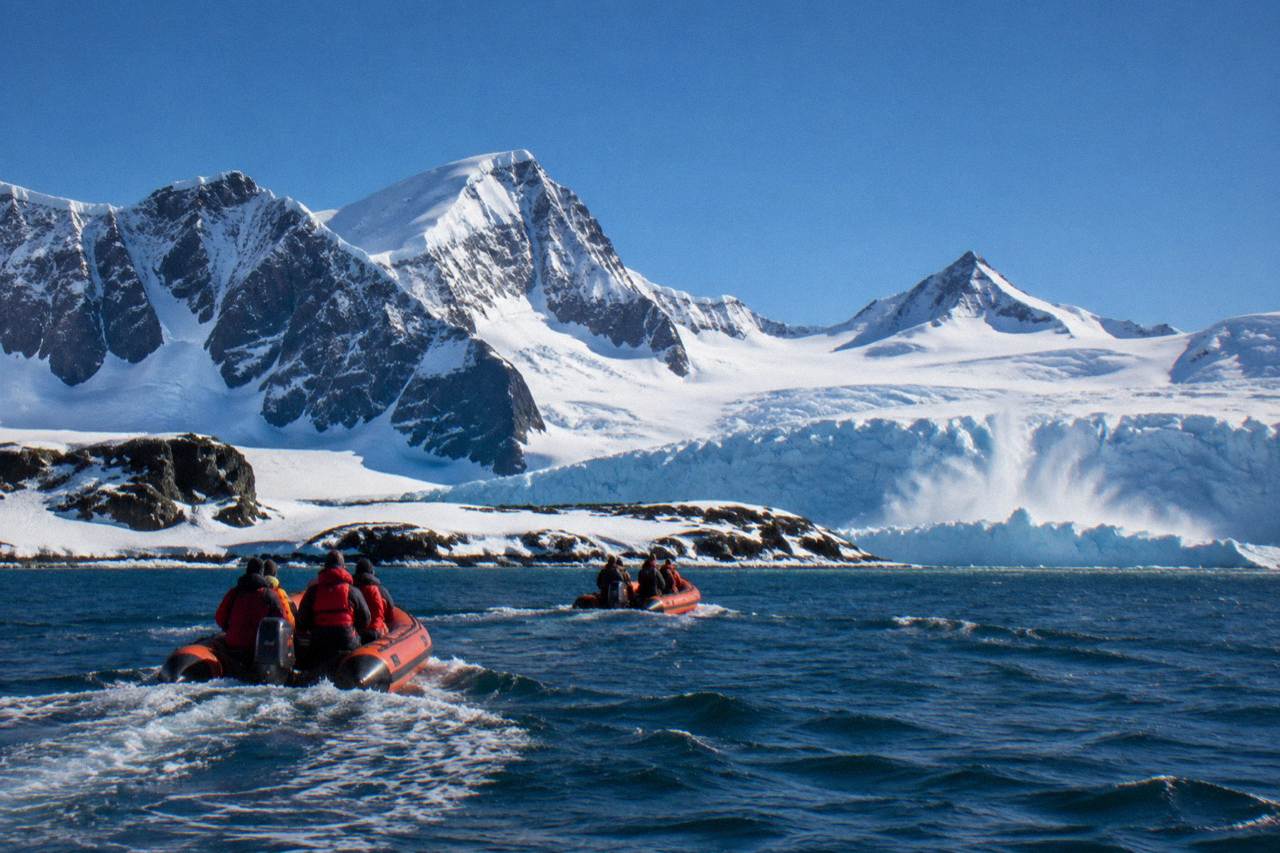
The brochure promises Antarctica, but the fine print is a list of places with names like Paradise Bay, Port Lockroy and Neko Harbour. Those landing sites are what a voyage actually delivers: every day of an expedition cruise is built around where the ship can put you ashore, and two itineraries that both say Antarctic Peninsula can differ enormously in what you will stand on and watch. This guide walks through the sites that appear most often on 2026-27 schedules, the IAATO rules that quietly decide whether a landing happens at all, and how to read a route before you commit to a specific expedition cruise. The ship matters as much as the route, so our comparison of HX's hybrid expedition ships is a good next read.
What Are The Best Landing Sites In Antarctica?
There is no single best landing site, because conditions decide on the day, but the names that recur across operator schedules are Paradise Bay, Port Lockroy, Neko Harbour, Half Moon Island and Whalers Bay on Deception Island, with the Lemaire Channel as a scenic cruise rather than a landing. Roughly 98 percent of all tourism voyages concentrate on the Antarctic Peninsula, so these sites carry most of the season's traffic.
The first thing to understand is that no landing is guaranteed. Wind, swell, ice and the presence of another vessel at the same site can all scrub a planned stop, and expedition teams hold alternatives ready for exactly that reason. A captain who cannot land at Neko Harbour will usually try a nearby bay instead, so the site list on an itinerary is a set of intentions, not a contract. What you can judge is the quality of the neighbourhood: a voyage that plans four to six days in the South Shetland Islands and the western Peninsula simply has more shots at good landings than a shorter one.
The second thing is that landing sites differ in kind, not just in scenery. Port Lockroy is a historic base with a post office and a gentoo colony; Whalers Bay holds the ruins of a whaling station inside a flooded volcanic caldera; Neko Harbour and Paradise Bay are continental landings, the ones that let you say you stood on the Antarctic continent itself rather than an offshore island. Many travellers care about that distinction more than they expect to.
A good way to sanity-check any itinerary is to count planned days on the Peninsula versus days in transit. Classic Peninsula voyages typically allocate four to six days for landings and Zodiac cruising in the South Shetlands and the western Peninsula, which is enough for a half-dozen distinct sites if weather cooperates. If you want the fuller picture of how those voyages are structured, the Antarctic Peninsula cruise guide breaks down the standard routes day by day.
Paradise Bay: The Classic Continental Landing
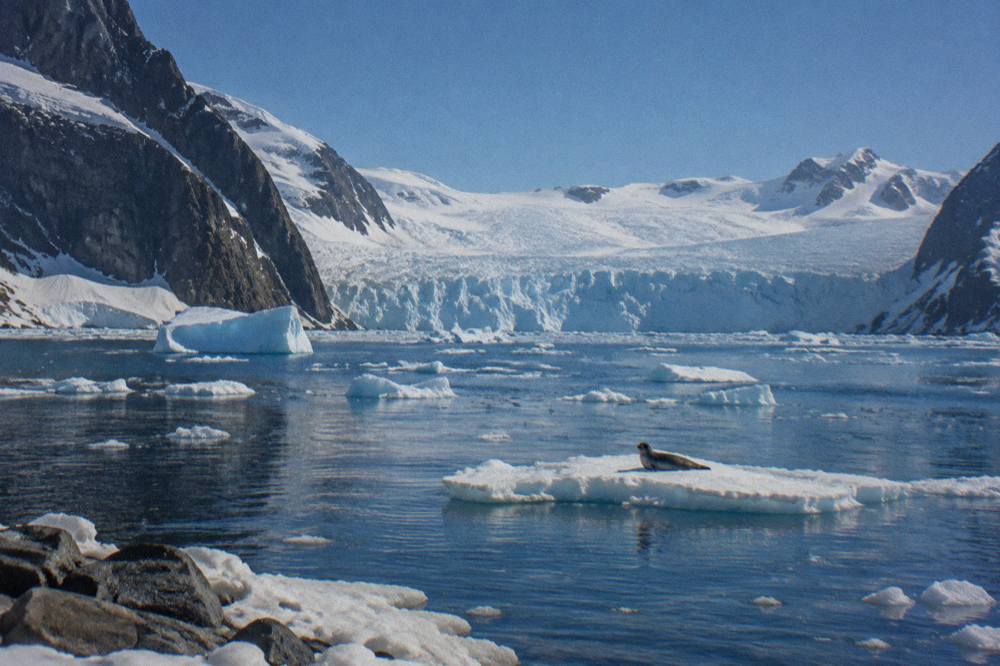
Paradise Bay, on the western Peninsula southwest of the Lemaire approach, is one of the sites most often described as the quintessential Antarctic landing: a steep-walled bay with glaciers calving into calm water, a gentoo colony on one shore and an Argentine research refuge at the head of the bay. It is a continental landing, and it is a frequent highlight of classic Peninsula expedition cruises.
The setting is what people remember. Ice cliffs rise straight out of deep water, and Zodiacs cruise between small icebergs that have calved off the glacier front. The landing itself is usually short and simple, and the surrounding water is one of the better places on the western Peninsula to watch from a kayak or a Zodiac as ice shifts and seabirds work the shallows. Because the bay is enclosed, it can stay landable on days when exposed sites on the outer coast are blowing out, which is one reason expedition leaders like it as a fallback as well as a destination.
Wildlife at Paradise Bay is modest rather than spectacular: gentoo penguins, occasional seals hauled out on ice, and seabirds overhead. The draw is the landscape and the continental footing. If penguins are your priority, Port Lockroy and Half Moon Island below both outperform Paradise Bay on sheer penguin numbers, and the timing of your voyage matters as much as the site list for what you will see standing on the beach.
One practical note: because Paradise Bay sits deeper into the Peninsula than the South Shetland sites, reaching it usually means the ship has already committed to the Gerlache Strait region. That favours itineraries of ten days or more. On shorter voyages the ship may not have time to push this far south, which is a real difference between a nine-day and a twelve-day expedition cruise even when both are marketed with identical language.
Port Lockroy: Penguins, A Post Office And A Museum
Port Lockroy, on Goudier Island in the Neumayer Channel, pairs a restored British base with a large gentoo penguin colony: the buildings house a museum, a gift shop and a small post office, which makes it one of the few Antarctic landings with a built-in souvenir. It is a small island, so visits are tightly managed and groups rotate quickly ashore.
The base is operated by the UK Antarctic Heritage Trust, which has been running a multi-year structural conservation project at the site, with major floor and roof reinforcement work entering its second year in the 2026 season. Visitors land among the gentoos, browse the museum in the original base buildings, and can post a card home carrying a Port Lockroy stamp. The penguins here are habituated to people within the managed visitor area, and the colony surrounds the buildings through the short summer season.
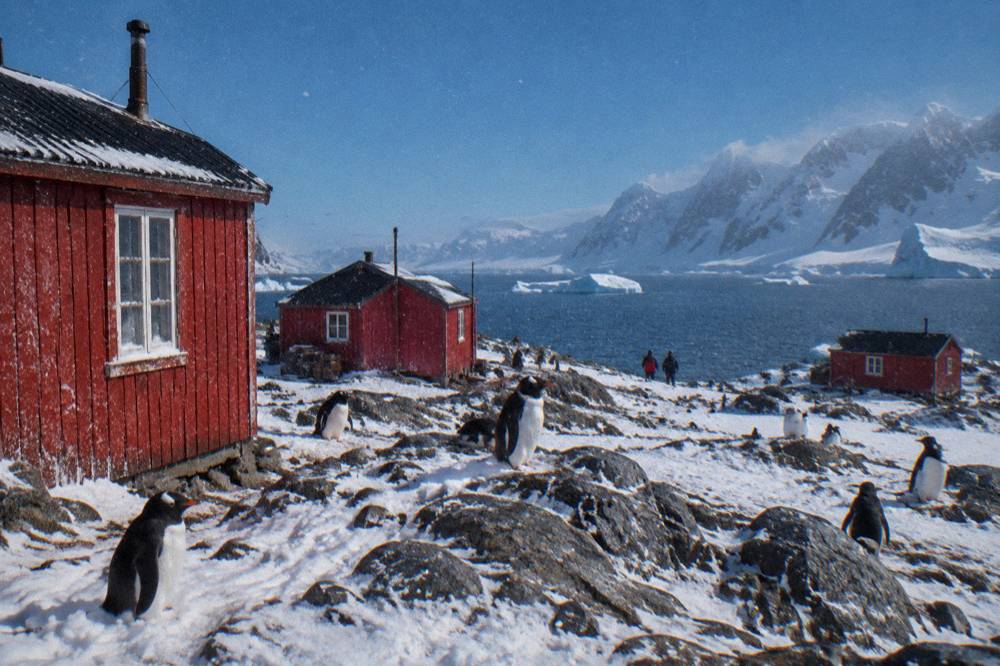
The landing is easy, the site is compact, and time ashore is short because groups rotate quickly. Some seasoned travellers find it the most commercial hour of their voyage; others consider a stamped card posted from Antarctica worth the queue. Both reactions are common, and neither is wrong. What is worth knowing before you book is that Port Lockroy appears on a large share of classic Peninsula itineraries, so if it appeals to you, almost any standard route from Ushuaia will attempt it. Port Lockroy also carries current, recently updated ATCM and IAATO site guidelines, alongside the other sites in this guide.
If you are starting to weigh a specific voyage against another and want help reading the route, a free consultation on landing priorities is the quickest way to get an unbiased read on which itineraries actually deliver the sites you care about.
Neko Harbour And The Lemaire Channel
Neko Harbour, on the western Peninsula, is the other classic continental landing: a gentoo colony on a small rocky spit below a hanging glacier, with a steep walk up a snow slope for a view over the bay. The Lemaire Channel nearby is not a landing at all but a narrow passage of cliffs and glaciers between islands, and ships cruise it slowly rather than stopping.
The two often appear on the same day, because the channel sits close to the Neumayer and Gerlache approaches. A ship that anchors at Neko in the morning and threads the Lemaire in evening light delivers the kind of day that sells Antarctic voyages in the first place. The landing at Neko involves a short Zodiac run and a beach that can hold surge, so it is attempted when conditions are calm, and the walk uphill is optional but rewarding.
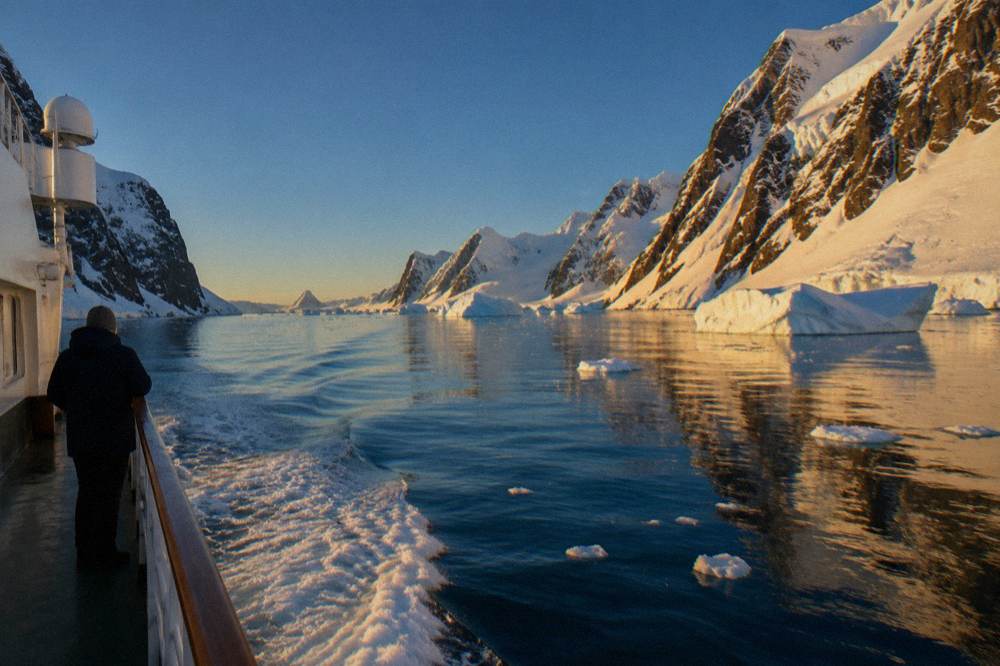
The Lemaire Channel deserves its reputation even though you never step ashore. Cliffs rise on both sides, icebergs funnel through the passage, and the ship slows to a crawl. Whale sightings in the channel and the bays around it pick up from mid-January onward as krill draws humpbacks back to the coast after the sea ice recedes. On the question of timing, the best time to visit Antarctica guide covers the month-by-month trade-offs in detail; the short version is that December and January combine chick hatching with the most reliable access to these southern sites.
Half Moon Island And Deception Island
Half Moon Island, in the South Shetlands, is a small crescent-shaped island with a chinstrap penguin colony, often reached on the first or second day after the Drake crossing. Deception Island is a flooded volcanic caldera entered through a gap in the crater wall called Neptune's Bellows, with the abandoned whaling station of Whalers Bay and the large chinstrap colony of Baily Head on its outer coast.
Half Moon Island works as an early-voyage confidence builder: the landing is sheltered, the chinstraps are vocal and busy, and Weddell seals sometimes haul out on the beach. Because it sits close to the standard Drake crossing track, it is a first stop on many itineraries and a common site for the first landing of a voyage, before the ship pushes south toward the Gerlache.
Deception Island is the more unusual stop. Sailing through Neptune's Bellows, a narrow break in the crater wall, into a caldera is genuinely cinematic, and Whalers Bay holds rusting tanks, boilers and the remains of a whaling station wrecked by volcanic eruptions. There is also a geothermal beach where, on some landings, operators offer a brief swim in water warmed by volcanic activity. Baily Head, on the outside of the island, hosts a large chinstrap colony, though its exposed surf makes landing there possible only in calmer conditions.
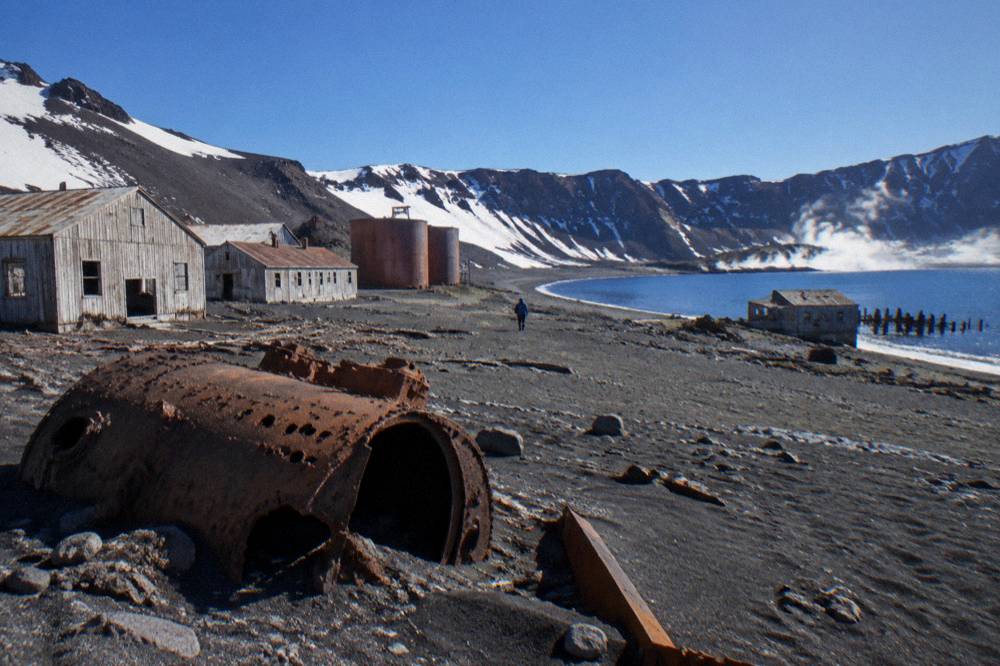
Both Whalers Bay and Baily Head carry current or recently updated ATCM and IAATO site guidelines, alongside Half Moon Island, Neko Harbour and Port Lockroy, which is a useful signal: these are the sites the regulatory bodies expect to see the most traffic at in 2026-27. If you are still deciding how to reach this region at all, the Drake Passage crossing guide explains the sailing options and timing.
The Rules That Shape Every Landing
Three IAATO and Antarctic Treaty rules decide most of what happens ashore: no vessel carrying more than 500 passengers may make landings at all, a maximum of 100 passengers from any vessel may be ashore at one time unless site guidance requires fewer, and landings require a minimum 1:20 guide-to-visitor ratio. Visitors must also keep at least 5 metres from wildlife, and only one ship may visit a site at any one time.
These rules come from the ATCM General Visitor Guidelines and IAATO standards, and they have direct consequences for which expedition cruise you should book. The 500-passenger rule is why large cruise ships offer Antarctica only as a scenic cruise past, with no landings: if you want to stand on the continent, you need a ship under that threshold, and in practice the ships that land most often carry far fewer than 500. The 100-ashore cap is why small ships land faster and more smoothly: a ship carrying 100 guests or fewer can put everyone ashore at once, vessels in the 130 to 200 range land in two quick rotations, and larger ships must split landings into more groups and shorten each group's time on the ground.
| Rule | What it says | What it means for your voyage |
|---|---|---|
| 500-passenger landing ban | Vessels with more than 500 passengers shall not make landings in Antarctica | Large cruise ships offer scenic cruising only, with no shore time |
| 100 ashore at a time | A maximum of 100 passengers from a vessel may be ashore at any one time, unless site guidance requires fewer | Ships up to about 200 guests land everyone in two rotations at most |
| 1:20 guide ratio | A minimum of one actively guiding staff member per 20 visitors during landings | Every landing group moves with guides alongside it |
| One ship per site | Only one vessel may visit a site at any one time | Expedition teams coordinate, and plans sometimes swap on the day |
| 5 metre wildlife distance | Keep at least 5 metres from wildlife on land or ice, more where species or site guidance requires | The penguins set the pace, not you |
| Biosecurity between sites | Boots, clothes, bags and equipment must be cleaned before Antarctica and again between sites | Boot-wash and vacuum stations at the gangway are routine |
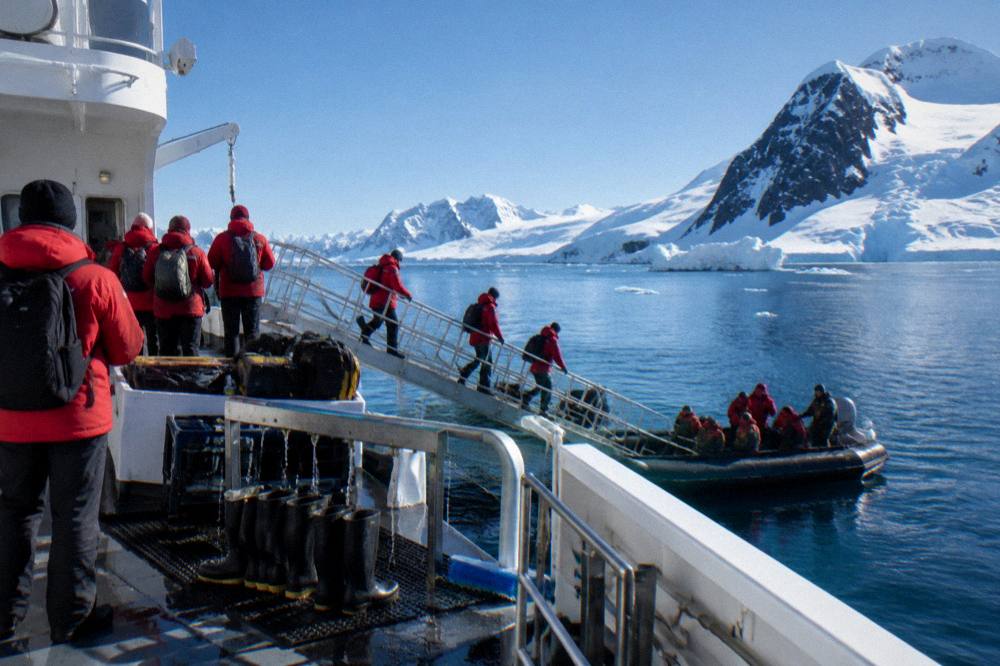
The one-ship-per-site rule is why operators coordinate through a scheduler, and why your expedition leader sometimes swaps the day's plan: if another vessel is already committed to a site, your ship goes to its alternative. Biosecurity matters too. Boots and equipment must be carefully washed and cleaned before you bring them to Antarctica, and cleaned again between sites, which is why every expedition ship runs a boot-wash station at the gangway and a vacuum station for your outerwear before every landing. It also explains why guest count is the first number worth checking on any ship review: it is the clearest predictor of how much time you will actually spend standing on shore rather than waiting for your rotation.
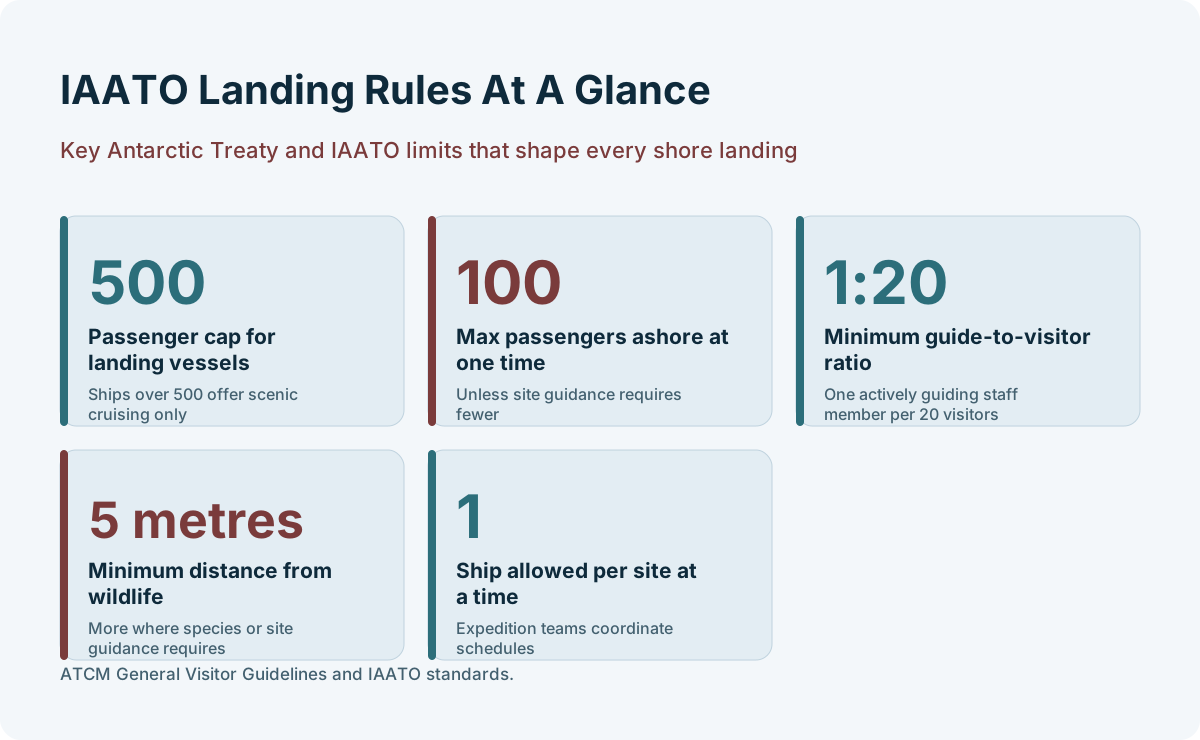
The full visitor guidelines are published by the Antarctic Treaty system, and the landing rules are stated plainly in the ATCM General Visitor Guidelines poster. For the broader picture of where tourism actually happens, the Antarctic Treaty Secretariat notes that roughly 98 percent of voyages concentrate on the Peninsula during the austral summer.
Which Ships Actually Get You Ashore
Ship size is the biggest hardware factor in landing quality: a vessel at or under 100 guests can put everyone ashore at once under the IAATO cap, and ships in the 130 to 200 range land in two quick rotations, while bigger vessels must cycle more groups and shorten each landing. The Hondius, the National Geographic Endurance and the Magellan Explorer all sit in that fast-landing zone.
The Hondius, operated by Oceanwide Expeditions, carries 170 guests in 80 cabins and was the first-registered Polar Class 6 passenger vessel in the world, in the operator's own wording. She sails from Ushuaia on 11, 13 and 19-day Peninsula voyages from $7,800 per person, which places her firmly in the value tier for a full Drake-crossing expedition cruise. At 170 guests she lands everyone in two rotations, and her ice class gives the bridge flexibility in heavier ice years. The Hondius guide page covers her cabins and typical routes in detail.
The National Geographic Endurance, sailing for Lindblad Expeditions with National Geographic, carries 138 guests with a PC5 Polar Code rating and a patented X-Bow hull, on 12 to 22-day voyages from $11,900 per person. Her sister ship, the National Geographic Resolution, shares the same specification. At 138 guests she needs just two rotations per landing, and one cost comparison reports that Lindblad bundles the pre-cruise Buenos Aires hotel, the charter flight to Ushuaia and gratuities into the fare.
The Magellan Explorer, operated by Antarctica21, is a different animal: an 88-guest fly-cruise ship that reaches the Peninsula by a roughly two-hour charter flight from Punta Arenas to King George Island, skipping the Drake crossing entirely. Her 8-day Classic Antarctica air-cruise starts from $13,795 per person. At 88 guests she can land everyone in a single rotation, and her fly-cruise model trades sea days for a shorter, weather-dependent trip.
| Ship | Class | Passengers | Ice class | From, per person | Voyage length | Departs from |
|---|---|---|---|---|---|---|
| HondiusOceanwide Expeditions | Small-Ship Budget | 170 | Polar Class 6 | from $7,800 | 11 to 19 days | Ushuaia |
| National Geographic EnduranceLindblad Expeditions (with National Geographic) | Standard Expedition | 138 | PC5 | from $11,900 | 12 to 22 days | Ushuaia |
| Magellan ExplorerAntarctica21 | Fly-Cruise | 96 (88 in Antarctica) | LR PC6 | from $13,795 | 8 days | Punta Arenas (fly) to King George Island |
Choosing between these three approaches is exactly the kind of decision worth talking through with someone who knows the current schedules, and a free consultation on the right ship will map your dates, budget and landing priorities against what is actually sailing this season.
How To Read An Itinerary Before You Book
Judge an itinerary by three things: the number of planned Peninsula days, whether it names continental landings such as Paradise Bay or Neko Harbour, and the ship's guest count relative to the 100-ashore cap. A twelve-day voyage with five landing days on a 130-guest ship will deliver more time ashore than a nine-day voyage with three landing days on a 300-guest ship, even if both brochures look similar.
Be sceptical of itineraries that list ten sites in five days; that is a wish list, not a plan, and the expedition team will cut it to fit weather. Prefer itineraries that name specific alternatives, because that signals a team used to re-planning. And check whether the route includes the Lemaire Channel and the Gerlache Strait, since those are the waterways that connect Paradise Bay, Neko Harbour and Port Lockroy into the classic southern circuit.
| Landing site | What you see | Landing type | Typical region |
|---|---|---|---|
| Paradise Bay | Glacier calving, gentoo colony, continental landing | Continental landing | Western Peninsula, Gerlache approach |
| Port Lockroy | Museum, post office, gift shop, large gentoo colony | Island landing, managed rotation | Neumayer Channel |
| Neko Harbour | Gentoo colony, snow-slope viewpoint, continental landing | Continental landing | Western Peninsula |
| Half Moon Island | Chinstrap colony, Weddell seals, sheltered beach | Island landing | South Shetlands |
| Whalers Bay, Deception Island | Whaling station ruins, volcanic beach, optional swim | Island landing inside caldera | South Shetlands |
| Baily Head | Large chinstrap colony on the island's outer coast | Exposed surf landing, calm days only | Deception Island outer coast |
| Lemaire Channel | Cliffs, glaciers, icebergs, whale watching | Scenic cruise, no landing | Between Booth and Wiencke islands |
Timing interacts with the site list more than most first-time visitors realise. Early-season voyages in October and November find courting penguins, maximum snow cover and the most dramatic sea ice, but some southern approaches may still be congested with ice. January and February open every channel and bring the whales in. If you are torn between shoulder-season pricing and peak-season access, that is a genuine decision point: compare seasons with a free consultation before you lock dates, because the right answer depends on which sites matter most to you.
| Month | Landing conditions | Wildlife highlight | Trade-off |
|---|---|---|---|
| October to November | Pristine snow, some ice-constrained approaches | Courting penguins, elephant seal pups in the South Shetlands | Colder, fewer whales |
| December | Most channels opening | Egg hatching begins mid-month | Peak pricing begins |
| January | Most reliable access to all sites | Chicks hatching, humpbacks returning | Busiest month at popular sites |
| February | Full access, longer daylight use | Peak whale activity, chicks fledging | Less pristine snow |
| March | Still landable, cooling | Strong whale activity, molting adults | Season winding down, more swell risk |
The final structural choice is how you get there. Sailing the Drake from Ushuaia gives you sea days, seabirds and the classic crossing on a ship like the Hondius; flying from Punta Arenas on the Magellan Explorer model trades those days for a shorter trip and a small risk that weather delays the charter. Some operators also run sail-one-way, fly-the-other hybrids that halve the exposure. There is no universally right answer, only the one that fits your schedule and your stomach, and it is the single most common question a consultation gets. This is why Cruises In Antarctica frames every ship and itinerary page around landing reality rather than brochure language: the sites, the rotation math and the season are what you are actually buying.
Common Questions About Antarctica Landing Sites
What Are The Best Landing Sites In Antarctica?
The sites that recur most across operator schedules are Paradise Bay, Port Lockroy, Neko Harbour, Half Moon Island and Whalers Bay on Deception Island, with the Lemaire Channel as a scenic cruise rather than a landing. No landing is guaranteed; weather, ice and site coordination decide on the day.
Can You Actually Set Foot On Antarctica On A Cruise?
Yes, if your ship carries 500 passengers or fewer and offers landings. IAATO rules cap vessels at 100 passengers ashore at a time from any ship, so small expedition vessels land everyone in one or two rotations. Ships above 500 passengers may not make landings at all.
Is Paradise Bay A Landing Or A Scenic Cruise?
Paradise Bay is a genuine continental landing with a gentoo colony and an Argentine refuge, and it is also used for Zodiac cruising among the icebergs. It is one of the two classic continental landings, alongside Neko Harbour.
How Close Can You Get To Penguins At A Landing Site?
IAATO visitor guidelines say to keep at least 5 metres from wildlife on land or ice, with greater distances for nesting birds, molting penguins or animals showing stress. Penguins sometimes approach you, and standing still while they do is the accepted response.
Why Do Some Antarctic Cruises Not Land At All?
Vessels carrying more than 500 fare-paying passengers are prohibited from making landings in Antarctica under ATCM and IAATO rules, so large cruise ships offer scenic cruising only. Biosecurity and site capacity rules also mean only one vessel visits a landing site at a time.
Which Ship Size Gives The Most Time Ashore?
Ships at or under 100 guests can put everyone ashore in a single rotation, and vessels up to about 200 guests land in two, while larger ships must rotate more groups and shorten each landing. Guest count is the clearest predictor of how much time you spend on shore.