How To Book An Antarctica Cruise: Direct, Agent And Operator Checks
 By Oleg G.
Booking an Antarctica cruise is unlike booking any other voyage: deposits arrive 150 days out, the seller matters as much as the price, and the cheapest quote is not always the safest one. Here is how to buy this expedition cruise with your eyes open.
Quick answer: Book an Antarctica cruise direct with the operator or through a specialist agent at the same published fare, thanks to rate parity across major lines. Verify IAATO membership in the public directory, check financial protection for your country, expect a 20 to 25 percent deposit and book 12 to 18 months ahead.
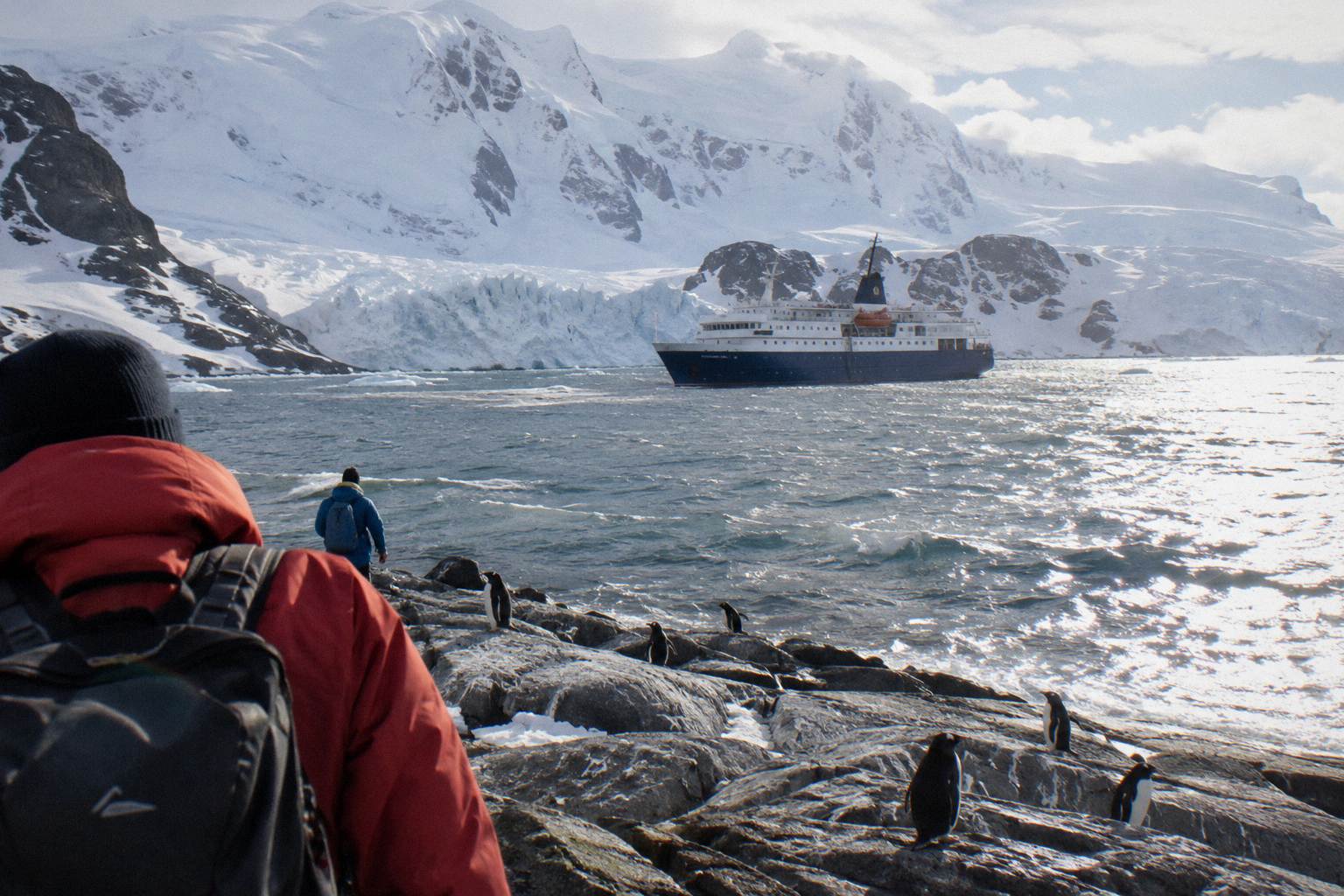
Booking a cabin on an Antarctic expedition cruise is not a one-click purchase. The season runs roughly October to April, the Antarctic Treaty system puts real paperwork behind every departure, and the deposit you pay months in advance is what holds your berth on a ship that may carry fewer than 200 guests. The buying decision is really three decisions stacked together: who sells you the voyage, who operates it, and when you commit your money.
How Do You Actually Book An Antarctica Cruise?
You choose a voyage, then book either direct with the operator or through a specialist polar agent, both at the same published fare. The operator runs the ship, files the environmental documentation and takes your deposit, which for 2026-27 ranges from 20 percent at Oceanwide Expeditions to 25 percent at Quark Expeditions, with final payment due 60 to 150 days before departure. Book 12 to 18 months ahead for peak dates.
An expedition cruise to the Peninsula is sold as a voyage, not as a flexible date range. Pick your itinerary length first, because the classic ten to twelve day Peninsula trips, the longer Falklands and South Georgia combinations, and the rare Ross Sea voyages sit in entirely different price bands. Then pick the ship and cabin category, and only then decide who you pay.
Most United States travelers reach the classic expedition gateway of Ushuaia via Buenos Aires, a routing we walk through in detail in how to get to Antarctica. That matters at booking time because flights, gateway hotel nights and the charter flights used on fly-cruise products are not always bundled into the fare, and a good seller will tell you which parts of the trip you still have to arrange.
The transaction itself is slower than mainstream cruising. You will usually complete a booking form, pay a deposit, and receive voyage documents plus a medical and fitness questionnaire to return closer to departure. Operators also file environmental documentation for the voyage; the United States operator requirement is described on the EPA's page on environmental impact assessments for nongovernmental expeditions. Passengers do not file that paperwork themselves, the operator handles it.
Direct With The Operator Or Through A Specialist Agent?
Prices are generally the same either way, because major operators such as Silversea, Seabourn, Ponant, Viking and HX maintain rate parity, and agents are paid by the operator rather than a markup. Booking direct gives you control and immediate access to the operator's system, while a specialist agent adds cross-operator comparisons, itinerary matching and sometimes added perks at the same fare.
The rate parity point deserves its own sentence, because it is the single fact that changes how people shop. There is no discount war between booking channels on these voyages: specialist agencies say the fare you are quoted for a given cabin on a given sailing is the same fare the operator would quote you directly. What differs is what surrounds the price.
Direct booking suits travelers who already know their ship, their cabin category and their departure date, and who want one throat to choke when a schedule changes. You will be in the operator's reservation system from day one, which makes name changes, cabin upgrades and payment queries straightforward.
A specialist agent suits travelers comparing across lines, which is most first-timers. Specialist agencies describe the value as itinerary matching across multiple operators, ship and route expertise, support when changes are needed, and perks such as shipboard credits or upgrades on qualifying bookings. Since agents are paid by the operator out of the same published fare, that guidance costs you nothing on the sticker price.
The honest trade-off is accountability. Direct, you rely entirely on the operator's own service standards; through an agent, you have a second party who has an incentive to advocate for you but who sits between you and the operator's operations team. Neither route removes the terms and conditions: cancellation scales and final payment deadlines belong to the operator in every case.
Here is how the two routes compare on the things that actually differ:
| What you get | Booking direct | Booking via a specialist agent |
|---|---|---|
| Published fare | Operator's rate | Same rate, per rate-parity practice across major lines |
| Who pays the seller | You pay the operator | The operator pays the agent |
| Cross-operator comparison | You do the research yourself | Agent matches itineraries across multiple lines |
| Perks and credits | Whatever the operator offers | May include shipboard credits or upgrades on qualifying bookings |
| Changes and disputes | Directly with the operator's system | Agent advocates, but operator terms govern |
Whichever route you pick, the seller conversation comes back to the same fork in the road: which operator, and how do you know they are sound to hand a deposit of thousands of dollars to? If you are not sure where to start, talk through your options for free with someone who compares these operators all season.
How Do You Vet An Antarctica Cruise Operator Before Paying?
Check three things in order: IAATO membership in the public directory at iaato.org, financial protection appropriate to your country, such as ATOL or ABTA in the UK, and then the ship itself, its ice class, its passenger count and its safety and expedition record. Membership signals commitment to protocols but does not replace reviewing each vessel on its own facts.
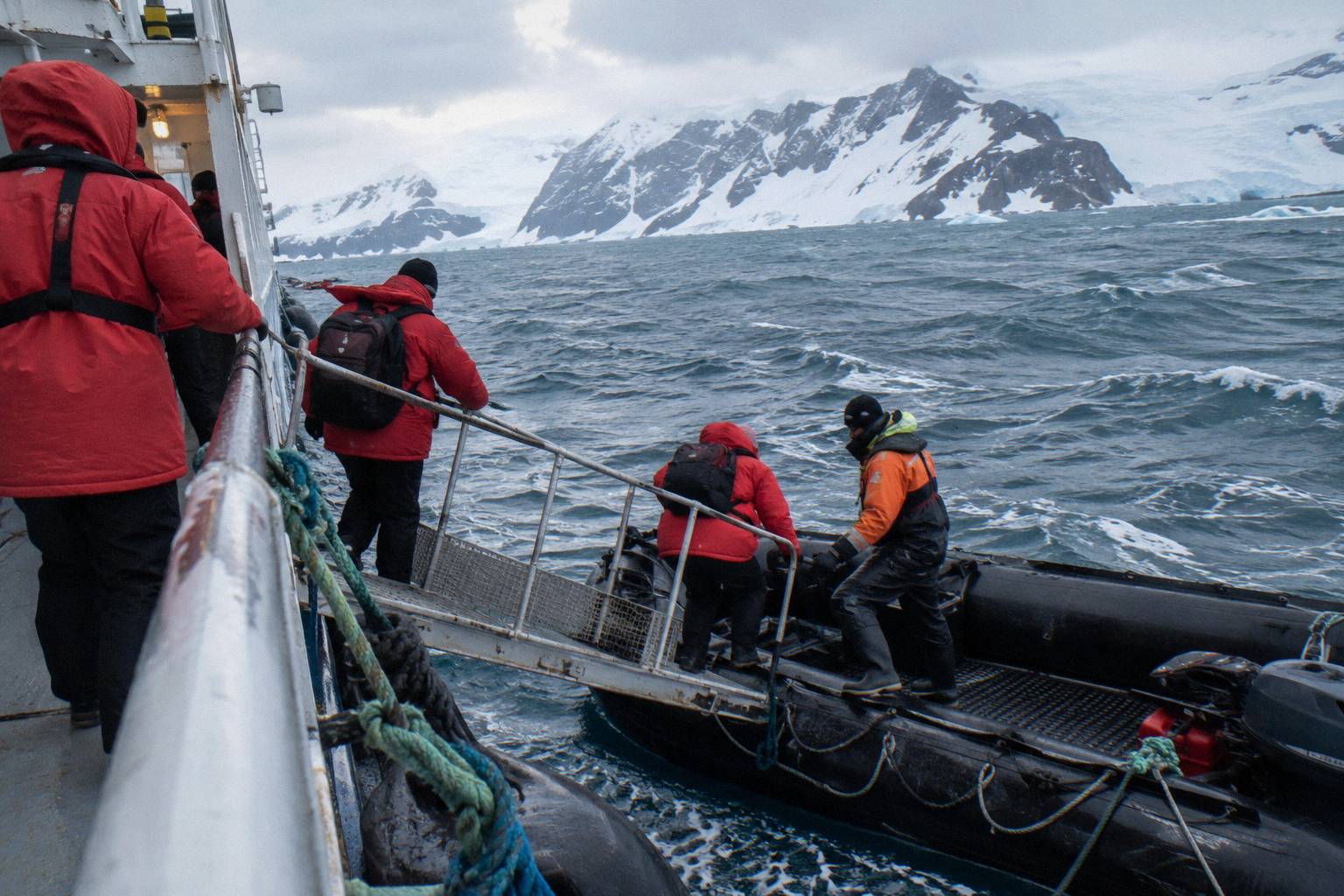
The vetting step is where an Antarctica booking most differs from a Caribbean one, because Antarctic tourism is self-regulated through the International Association of Antarctica Tour Operators. IAATO's guidance includes the landing rules that shape your experience: vessels carrying more than 500 passengers may not make landings at all, no more than 100 passengers from one vessel may be ashore at a time, and sites operate with a minimum 1:20 guide-to-visitor ratio. Those rules come from the Antarctic Treaty visitor guidelines, published in the ATCM general visitor guidelines that IAATO members follow.
Start with the membership check, which takes two minutes. IAATO keeps a public membership directory listing current Operators, Provisional Operators and Associates. Not every operator in the region is a member, so a ship that does not appear in the directory is a fact you want to know before, not after, you pay.
Financial protection is next, and it is jurisdiction-specific. UK-based operators and packages may hold ATOL or ABTA protection, while United States travelers often rely on operator bonding or NACOA membership, which booking guidance recommends verifying directly with the company. Ask the seller, in writing, what happens to your money if the operator ceases trading before Day 1.
Then vet the ship, not just the company. The roster data is public: the Oceanwide ship Hondius, built 2019, carries 170 guests in 80 cabins with a Polar Class 6 ice class, while Quark's Ultramarine carries 199 guests with an ice class of 1A+, PC6. Passenger count matters because of the 100-ashore rule: on a ship at or under about 100 guests, everyone can land at once, while larger vessels rotate groups, which changes how much time ashore you personally get. We break that dynamic out fully in Antarctica cruise ship sizes.
Ask the seller for the expedition team ratio and the landing record on recent sailings, and check whether your chosen itinerary carries landing guarantees at all. It cannot: weather, ice and wildlife conditions cancel or shorten landings, and any seller promising otherwise has misread the product.
Which Ship Should You Book For A First Crossing?
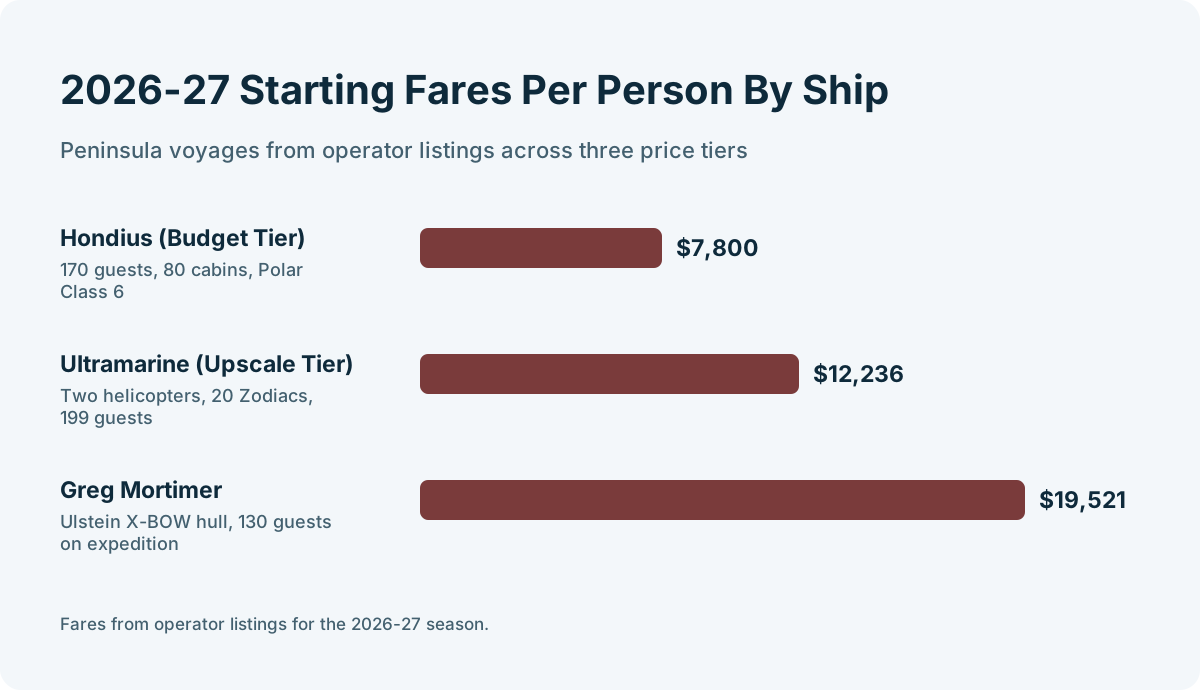
Match the ship to your budget and tolerance for motion, not to a brand. The trio of Hondius, Ultramarine and Greg Mortimer spans the 2026-27 market: Hondius from $7,800 per person in the budget tier, Ultramarine from $12,236 per person in the upscale tier with helicopters on board, and Greg Mortimer from $19,521 per person with an Ulstein X-BOW hull.
For a first Antarctic expedition cruise, the choice usually lands on a small-ship budget vessel or an upscale expedition ship, and the price gap between those tiers is measured in thousands of dollars per person. The budget tier buys you the same landings, the same penguins and the same Zodiac rides, with simpler cabins and fewer onboard amenities. Other pages covering the same trip are gathered on Cruises In Antarctica.
Hondius is the value benchmark on this site, and its guide page covers it in depth: 170 guests in 80 cabins, built 2019, Polar Class 6, sailing eleven and thirteen day Peninsula voyages from Ushuaia, with fares from $7,800 per person for the 2026-27 season according to the operator's listings. Oceanwide's smaller ships, Ortelius at 108 guests and Plancius at 108 guests, sit nearby in the same tier, as we compare in Ortelius versus Plancius.
The upscale tier adds comfort and, on some ships, genuine hardware. Ultramarine carries two twin-engine Airbus H145 helicopters on two helidecks along with 20 Zodiacs in an internal hangar, and Quark lists 2026-27 Peninsula voyages from $12,236 per person, a voyage-level fare shared with World Voyager and Ocean Explorer, so do not treat that number as exclusive to one ship.
| Ship | Class | Passengers | Ice class | From, per person | Voyage length | Departs from |
|---|---|---|---|---|---|---|
| HondiusOceanwide Expeditions | Small-Ship Budget | 170 | Polar Class 6 | from $7,800 | 11 to 19 days | Ushuaia |
| UltramarineQuark Expeditions | Upscale Expedition | 199 | 1A+, PC6 | from $12,236 | 12 to 14 days | Buenos Aires, Ushuaia |
| Greg MortimerAurora Expeditions | Upscale Expedition | 130 | – | from $19,521 | 12 to 26 days | Ushuaia |
Greg Mortimer sits above both in price, from $19,521 per person per Aurora's listings, with an Ulstein X-BOW hull, 130 guests on expedition and a heavy activity menu including sea kayaking. An X-BOW hull and modern stabilizers genuinely change how a Drake Passage crossing feels, though no vessel cancels the ocean.
If the ship decision is stalling your booking, that is exactly the kind of question worth putting in front of someone who compares these routes for a living: match a ship to your plans before you pay a deposit on the wrong one.
When Should You Book And What Deposit Do You Pay?
Book 12 to 18 months ahead for popular 2026-27 departures, with peak December and January dates demanding the earliest commitment. Deposits run 20 percent at Oceanwide Expeditions, 25 percent at Quark Expeditions, and roughly $2,500 per person or around 30 percent in Aurora agency contexts, with final payment due 60 to 150 days before Day 1.
The deposit schedule is the part of an Antarctica booking that surprises people most, so here it is plainly. Quark Expeditions terms effective June 2026 call for a 25 percent deposit if you book 151 or more days before Day 1, 100 percent if you book inside 150 days, with final payment due 150 days out. Oceanwide Expeditions takes a 20 percent deposit on a confirmed reservation, full payment if you book within two months of departure, and the balance 60 days before sailing. Aurora Expeditions examples run at $2,500 per person or around 30 percent, with final payment typically 90 to 95 days before departure, varying by itinerary. Details for HX, Lindblad, Silversea, Ponant, Atlas, Poseidon, G Adventures and Antarctica21 are not published in a form this guide could confirm, so verify those on the operator's own terms page.
| Operator | Deposit | Final payment | Notes from published terms |
|---|---|---|---|
| Quark Expeditions | 25% if booked 151+ days out, 100% if 150 days or fewer | 150 days before Day 1 | Terms effective June 2026 |
| Oceanwide Expeditions | 20% on confirmation, full payment inside two months of departure | 60 days before departure | Balance due 60 days out |
| Aurora Expeditions | $2,500 per person or around 30% in agency contexts | Typically 90 to 95 days before departure | Varies by itinerary |
Timing works backward from those deadlines. Shoulder-season months, November and March, price lower and can be booked later, while prime December and January sailings sell first. Prices sit lowest on shoulder dates, older vessels and during promotions, with early-booking offers for 2026-27 and 2027-28 commonly reaching 10 to 30 percent off and up to 40 percent on select unsold sailings, per the polar cruise deal listings.
One more date to hold in your head: the season itself. Tourist expedition voyages run from about early November to late March, and roughly 98 percent of tourism voyages touch the Antarctic Peninsula across the austral summer, per the Antarctic Treaty Secretariat's tourism page. There is no booking a July departure; there is only choosing which month inside that window.
A realistic timeline, built from the operator and agency guidance:
| Months before departure | What to do | Why |
|---|---|---|
| 12 to 18 | Choose operator, ship and cabin, pay deposit | Peak dates and best cabins go first |
| 6 to 12 | Watch early-booking offers and cabin upgrades | Promos commonly run 10 to 30% off |
| 3 to 6 | Book flights to the gateway city | Domestic connections are weather-prone in peak season |
| 2 to 5 | Final payment due; insurance bought at deposit stage should be in place | Operator minimums for medical evacuation apply |
| 1 to 2 | Return medical form, review packing list | Forms need a GP signature on many lines |
Note that booking inside two months of departure can mean paying the full fare upfront rather than a deposit, and that the last-minute route is a gamble on unsold berths rather than a plan. We treat that strategy honestly in last-minute Antarctica cruise deals.
What Should You Check On Two Competing Quotes?
Confirm every figure is per person, double occupancy, then compare cabin category, inclusions, single supplement, gratuities, insurance minimums, cancellation terms, deposit and final payment deadlines side by side. Two quotes at the same headline price can differ by thousands once flights, parkas, kayaking fees and insurance are counted.
The quote checklist comes straight from the comparison guidance used by specialist sellers, and it exists because Antarctic fares are built differently by each line. Start with the basis: is the quoted figure per person in a shared cabin, or a sole-occupancy rate? Single supplements range from 25 percent extra to 1.5 to 2 times the twin rate, or are waived on select sailings by lines like Silversea and Ponant, so a "solo" quote needs decoding before you compare it with anything.
Then the inclusions. Some operators bundle a complimentary parka, loan boots, drinks or gratuities, others do not, and optional activities such as kayaking or camping sit outside the base fare on many ships. Insurance is the quiet one: most operators require or strongly recommend travel insurance with medical evacuation coverage, and major operators set high minimums, figures such as $500,000 at Quark and $250,000 at Ponant per the insurance comparison listings. That premium belongs in your comparison.
Finally the terms: deposit amount, final payment date and the cancellation ladder, which escalates toward 100 percent close to departure on the lines that publish their terms. A cheaper quote with a harsher cancellation scale is not cheaper if your plans are not fixed. If you would rather have someone stress-test both quotes with you, you can check your quotes before paying, at no cost and with no obligation to book through anyone.
The same checklist applies to the ship pairings we publish across the site, from Antarctica cruise prices by cabin to the head-to-head comparisons, because the underlying question is always the same: what does this fare actually buy?
Common Questions About Booking An Antarctica Cruise
Is it cheaper to book an Antarctica cruise direct or through an agent?
Generally neither. Major operators such as Silversea, Seabourn, Ponant, Viking and HX maintain rate parity, so the published fare is the same through both channels, and agents are paid by the operator. Agents may add perks such as shipboard credits on qualifying bookings.
How far in advance should I book an Antarctica cruise?
Twelve to eighteen months ahead for popular 2026-27 departures, especially peak December and January sailings. Shoulder months, November and March, price lower and can sometimes be booked later, including via last-minute unsold inventory, though that is a gamble rather than a strategy.
What deposit do I pay on an Antarctic expedition cruise?
Published terms for 2026-27 run 20 percent at Oceanwide Expeditions, 25 percent at Quark Expeditions and roughly $2,500 per person or around 30 percent in Aurora agency contexts. Final payment falls due 60 to 150 days before Day 1 depending on the operator, and booking inside the final window can mean paying the full fare upfront.
How do I know an Antarctica operator is legitimate?
Check IAATO membership in the public directory at iaato.org, confirm financial protection relevant to your country, such as ATOL or ABTA in the UK or operator bonding or NACOA membership in the US, and then review the specific ship's ice class, passenger count and expedition record. Membership indicates commitment to protocols but does not replace reviewing the vessel.
Do I need travel insurance to book an Antarctica cruise?
In practice, yes. Travel insurance with medical evacuation coverage is required or recommended by most operators and is not included in base fares. Minimums can be high, with figures such as $500,000 at Quark and $250,000 at Ponant appearing in insurance comparisons, and proof is often requested before departure or at check-in.
Can passengers land on any Antarctica cruise they book?
Not on every ship. Vessels carrying more than 500 passengers are prohibited from making landings and offer scenic cruising only. On landing vessels, no more than 100 passengers from one ship may be ashore at a time, with a 1:20 guide-to-visitor ratio, so larger ships rotate groups ashore. Weather and ice can still cancel or shorten any landing.
More Cost And Booking
 Cruise CostA per-person price ladder from $7,050 berths to $32,320 luxury voyages, with what fares include and what they quietly leave out.Read the guide
 Cheap Antarctica CruisesThe honest floor for Antarctica fares, which ships carry it, and what it costs all-in.Read the guide
 Last-Minute DealsDo last-minute Antarctica berths still exist, and what do they really save?Read the guide
 What Is IncludedWhat an Antarctica fare really covers, operator by operator, plus the hidden costs with published amounts.Read the guide