Fridtjof Nansen And Roald Amundsen: HX Hybrid Ships
 By Oleg G.
HX operates two near-identical hybrid ships in Antarctica, the 2020-built MS Fridtjof Nansen and the 2019-built MS Roald Amundsen, alongside the smaller and older MS Fram. This guide compares all three against the landing rules that shape what a 490-guest vessel can actually do ashore.
Quick answer: MS Fridtjof Nansen carries 490 guests, was built in 2020 and sails Antarctic voyages of 15, 18 and 19 days from roughly $10,485 per person on operator fares. Its sister MS Roald Amundsen, built 2019, also carries 490. Both sit just under the 500-passenger rule that governs Antarctic landings.
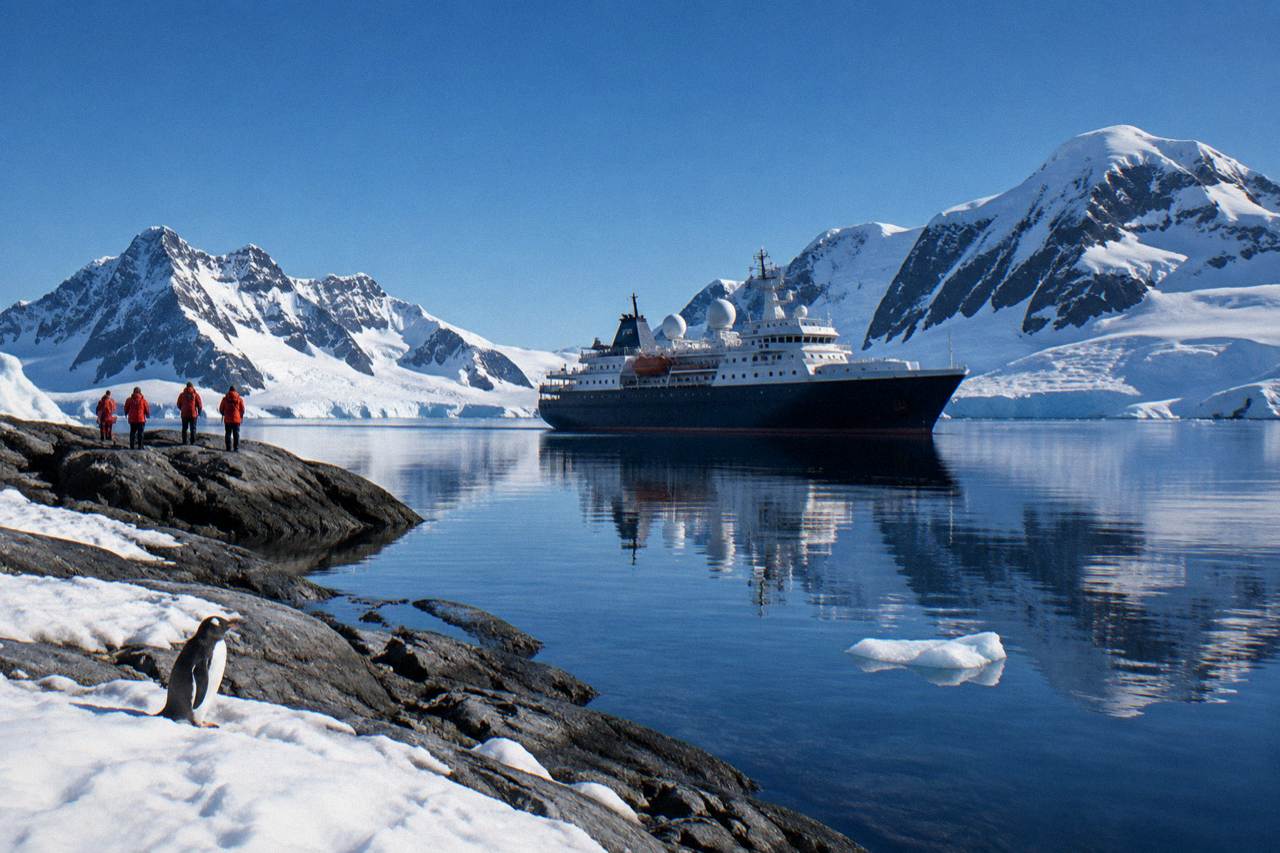
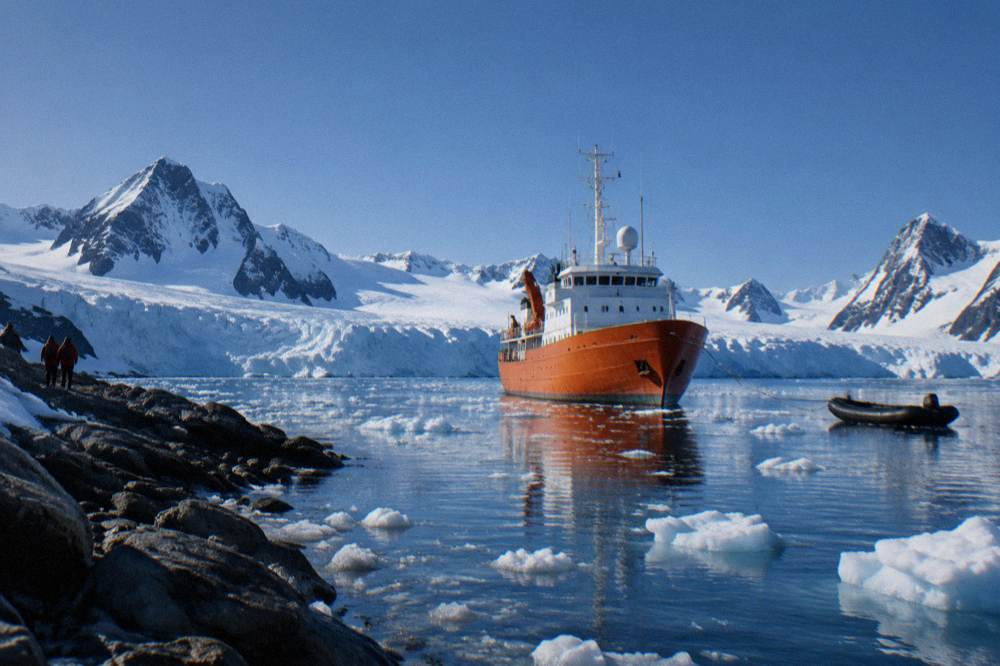
The MS Fridtjof Nansen is one of two hybrid battery-equipped expedition ships HX sails to Antarctica, and it is the newer of the pair. Both it and the MS Roald Amundsen carry 490 guests, a number that sits deliberately just below the regulatory line that decides whether a ship's passengers may go ashore at all. That single figure shapes almost everything about how a voyage on this cruise feels day to day, from the number of people sharing your Zodiac to how long you wait between landing slots.
This guide compares the two hybrid sisters across the roster data, then sets them against the third HX vessel in the Antarctic, the 200-guest MS Fram, which is a different kind of ship entirely. The 2026-27 schedules for all three vessels are active, and the differences between them turn out to be larger than a shared livery suggests.
What Is The MS Fridtjof Nansen?
The MS Fridtjof Nansen is HX's second hybrid expedition ship, built in 2020, carrying 490 guests on Antarctic voyages of 15, 18 and 19 days. It departs from Valparaíso and Buenos Aires, with fares from around $10,485 per person. It is a standard expedition ship rather than a luxury vessel, and it lands passengers in Antarctica.
The ship entered service a year after its sister, the MS Roald Amundsen, built in 2019. Both carry names drawn from polar history, and HX extends the thread with a third Antarctic vessel simply called MS Fram. Operator materials describe both hybrid ships as using battery packs to support the engines and cut fuel draw at sea, though the roster carries no independent figure for the size of those batteries or the emissions saved, so treat the hybrid label as direction rather than measurement.
The itineraries matter as much as the hardware. The roster shows the Fridtjof Nansen sailing 15, 18 and 19-day voyages, longer than the classic 10 to 12-day Peninsula cruise most first-timers picture. Those routes typically fold in the Falklands and, on some departures, other stops before the Peninsula itself, which changes both the price of the trip and the leave you need from work. HX reported 34 Antarctica voyages in its record 2025-26 season with 5 percent global booking growth, and its 2026-27 operations continue on the Fridtjof Nansen, Roald Amundsen and Fram, so the ship's schedule is current rather than residual.
One planning note before anything else: because the Fridtjof Nansen departs from Valparaíso as well as Buenos Aires, check which port your chosen departure uses before booking flights. The two gateways sit in different countries with different connection patterns, and the wrong assumption there is an expensive fix.
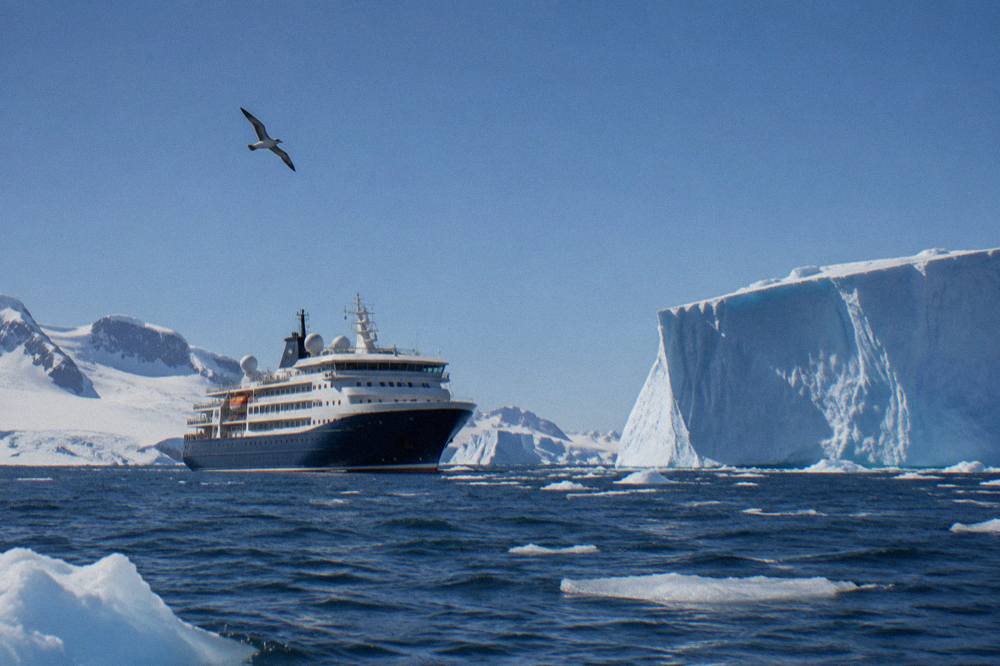
How Do Fridtjof Nansen And Roald Amundsen Differ?
In Antarctica, almost nothing: both ships carry 490 guests, both are hybrid expedition vessels, and both land passengers. The real differences are the build year, 2019 versus 2020, and the itineraries, with the Roald Amundsen sailing 12 and 16-day voyages from Buenos Aires and Ushuaia while the Fridtjof Nansen runs 15, 18 and 19-day routes from Valparaíso and Buenos Aires.
The two ships are sisters in the genuine sense, built to the same platform in successive years. Book a cabin on either one and the roster shows no difference in ice class, none is stated for either vessel, and no difference in guest count. What you are really choosing between is the shape of the voyage. The Roald Amundsen's 12-day departures are the closest thing HX offers to a classic Peninsula cruise, a Drake crossing each way either side of the Peninsula days. The Fridtjof Nansen's 15 to 19-day routes stretch the same destination into a fuller journey, which suits travellers who want the Falklands or a longer rhythm at sea and have the leave to match.
Fares sit close together. Operator fares show the Fridtjof Nansen's Antarctica and Falklands expedition cruise from $10,485 per person and the Roald Amundsen's Explorer's Route from $10,863, the latter spanning nine departures between October 2026 and December 2027. Neither number is confirmed against the live listing by this site, and HX fares move with cabin category and season, so the gap between the ships in any given week may be smaller or larger than those two starting points suggest.
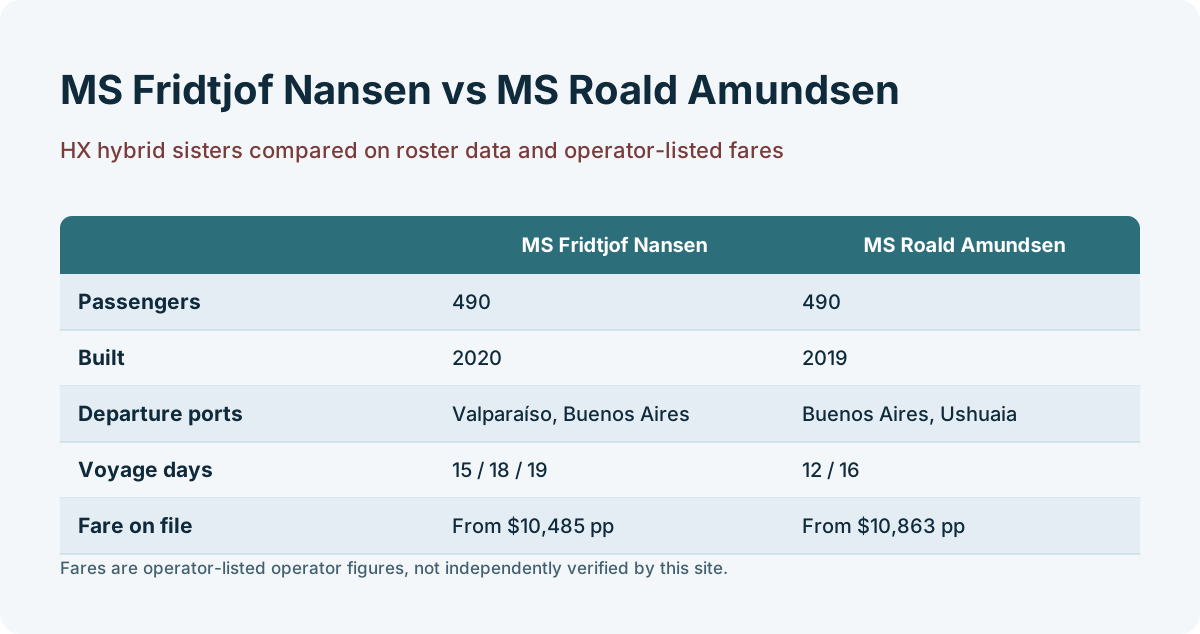
The comparison below pulls the roster fields for both hybrid sisters side by side.
| Field | MS Fridtjof Nansen | MS Roald Amundsen |
|---|---|---|
| Operator | HX (Hurtigruten Expeditions) | HX (Hurtigruten Expeditions) |
| Class | Standard expedition | Standard expedition |
| Passengers | 490 | 490 |
| Built | 2020 | 2019 |
| Ice class | Not stated on roster | Not stated on roster |
| Departure ports | Valparaíso, Buenos Aires | Buenos Aires, Ushuaia |
| Voyage days | 15 / 18 / 19 | 12 / 16 |
| Fare on file | From $10,485 pp | From $10,863 pp |
Both fare rows are single starting points from one listing each, not a price promise, and cabin category can move the total a long way from either figure. If the choice between the two ships is coming down to a few hundred dollars or one specific departure date, that is exactly the kind of question a free consultation before you book is built to settle, at no cost and with no obligation.
Does A 490-Passenger Ship Still Make Landings In Antarctica?
Yes. The Antarctic rules prohibit vessels carrying more than 500 fare-paying passengers from making landings, and both HX hybrid ships carry 490, so they qualify. But the 100-passengers-ashore limit means a full ship rotates through landings in groups, so part of each day is spent waiting your turn rather than standing on shore.
The two rules come from the Antarctic Treaty system's visitor guidance, and they shape expedition planning more than any brochure spec. The first, stated plainly in IAATO's general visitor guidelines, is that vessels with more than 500 passengers shall not make landings in Antarctica. The second is that a maximum of 100 passengers may be ashore from a vessel at any one time, unless site-specific guidance requires fewer. A guide-to-visitor ratio of at least 1:20 applies during landings, and only one ship may visit a site at any one time.
For a 490-guest ship the arithmetic is straightforward: guests go ashore in roughly five rotations, and the expedition team runs a continuous Zodiac shuttle to keep the flow moving. In practice this means the ship anchors longer at each site, the daily programme is more scheduled, and your stretch on the ice at any one landing is shorter than it would be on a 130-guest vessel such as Aurora's Sylvia Earle. It does not make the landings worse, but it does build a queue into the day. If hours ashore are your priority, ship size matters more than any amenity, and the Antarctica cruise ships guide breaks the whole roster by size class.
The rotation table shows what each HX vessel's guest count means against the 100-ashore limit.
| HX vessel | Guests on roster | Groups of 100 needed ashore | Voyage days on file |
|---|---|---|---|
| MS Fridtjof Nansen | 490 | About 5 | 15 / 18 / 19 |
| MS Roald Amundsen | 490 | About 5 | 12 / 16 |
| MS Fram | 200 | 2 | 12 / 16 / 18 / 23 |
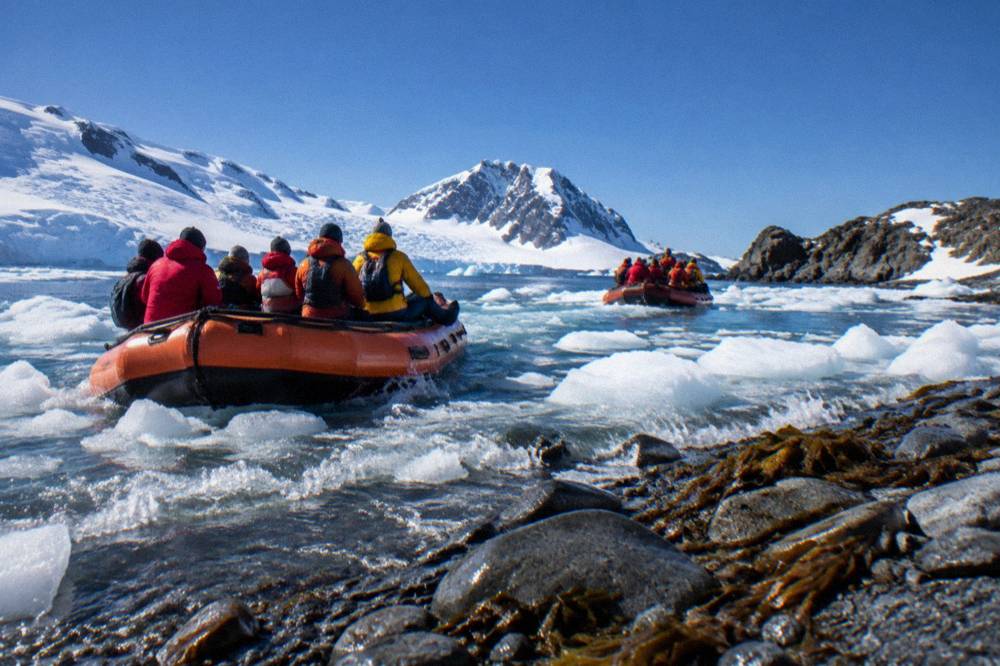
Season context matters as well. IAATO's landed-visitor count rose about 6 percent in 2025-26, according to the organisation's data and statistics page, and its site coordination allows only one vessel at a landing site at a time. A 490-guest ship therefore books the same site windows the small ships use, one reason big-vessel itineraries sometimes swap a planned landing for scenic cruising when the schedule tightens.
How Does MS Fram Differ From The Hybrid Sisters?
MS Fram is a different animal: a 200-guest ship built in 2007, sailing 12, 16, 18 and 23-day voyages from Buenos Aires, Santiago de Chile, Ushuaia and Punta Arenas. It carries fewer than half the guests of the hybrid sisters, so landings rotate faster, but its fare, from $17,208 per person, starts well above either sister's.
The Fram is HX's older, smaller workhorse, and the roster places it in the upscale expedition class rather than standard expedition, a step up in positioning. With 200 guests aboard, the 100-ashore rule needs two rotations instead of five, which changes the texture of every landing day: more time on shore, less waiting, a smaller crowd at the rail when whales appear. The trade is price. The fare attached to the Fram's October 2026 springtime departure, from $17,208 per person under an anniversary offer, is tied to one specific sailing, but it signals that the smaller ship starts above the sisters' entry fares.
Routes differ as well. The Fram's port list includes Punta Arenas, which no roster field attaches to either hybrid sister, and its voyage lengths run from 12 to 23 days, the widest spread in the HX fleet. The 23-day option is the one for travellers thinking about a full sub-Antarctic circuit, while the hybrid sisters hold the middle of the range. If you are weighing HX against other operators entirely, the Antarctica cruise lines guide compares the fleet against Oceanwide, Quark, Lindblad and the rest.
The table below sets all three HX Antarctic vessels against each other.
| Ship | Class | Passengers | Ice class | From, per person | Voyage length | Departs from |
|---|---|---|---|---|---|---|
| MS Fridtjof NansenHX (Hurtigruten Expeditions) | Standard Expedition | – | – | from $10,485 | 15 to 19 days | Valparaíso, Buenos Aires |
| MS Roald AmundsenHX (Hurtigruten Expeditions) | Standard Expedition | – | – | from $10,863 | 12 to 16 days | Buenos Aires, Ushuaia |
| MS FramHX (Hurtigruten Expeditions) | Upscale Expedition | 200 | – | from $17,208 | 12 to 23 days | Buenos Aires, Santiago de Chile, Ushuaia, Punta Arenas |
Read across the three rows and one pattern stands out: the hybrid sisters are near twins on paper, and nearly every meaningful difference in this fleet comes from the Fram's smaller guest count and broader port list. Which of those differences is worth paying for depends on your dates and your tolerance for crowds, not on any spec-sheet line.
What Do Fridtjof Nansen Voyages Cost And Include?
Operator fares show the Fridtjof Nansen from $10,485 per person and the Roald Amundsen from $10,863. Independent 2026 cost reporting puts cheapest published Peninsula fares on mainstream expedition lines at roughly $9,000 to $12,000 per person, so the HX sisters sit inside the expected band, with flights, insurance and tips added on top.
Start with the fare itself. The $10,485 figure comes from an operator page for the ship's Antarctica and Falklands expedition cruise, and the $10,863 figure from the Roald Amundsen's Explorer's Route listing. One 2026 cost guide reports cheapest published Peninsula fares on mainstream expedition lines at roughly $9,000 to $12,000 per person, which frames where HX sits: mid-market for the category. On this site's roster the luxury tier starts far higher, with Ponant's L'Austral listed from $18,700 and Le Soléal's Ross Sea expedition from $32,320, while the budget tier runs from Oceanwide's Plancius at $7,050 and Poseidon's Sea Spirit at $8,846.
Then add the real extras. A realistic all-in budget for a 10 to 12-day mid-range Peninsula trip, fare plus flights, gear, tips and insurance, runs $12,000 to $25,000 per person according to the same cost reporting, and recommended tips average about $16 per person per day. Travel insurance that covers medical evacuation is required or recommended by most operators and is never in the base fare; a 2026 insurance comparison cites operator minimums including $500,000 at Quark, $250,000 at Ponant and $150,000 at Lindblad, and operators commonly ask for proof before departure or at check-in. Getting to the ship is its own budget line, and the Antarctica cruise cost guide works through it line by line.
| Cost item | Planning range | Notes |
|---|---|---|
| Fridtjof Nansen fare | From $10,485 pp | Operator page |
| Roald Amundsen fare | From $10,863 pp | Operator page, 9 departures Oct 2026-Dec 2027 |
| Fram fare | From $17,208 pp | Operator page, one Oct 2026 departure |
| Tips | About $16 pp per day | 2026 cost reporting, recommended average |
| Insurance | Not in base fare | Operator minimums cited at $150,000 to $500,000 depending on line |
| All-in budget, mid-range trip | $12,000-$25,000 pp | Fare plus flights, gear, tips, insurance |
Early-booking offers for the 2026-27 and 2027-28 seasons commonly reach 10 to 30 percent off according to operator calendars, with one deal tracker noting up to 40 percent on select unsold 2026-27 sailings. Last-minute discounts exist but are limited in availability and cabin choice, and they are uncommon for peak December sailings, which the same reporting says book 18 or more months ahead. If your dates are fixed to a school holiday or a specific month, that booking rhythm matters more than any fare table.
Do The Hybrid Ships Cross The Drake Passage?
Yes, on the classic routes. The Roald Amundsen's 12 and 16-day voyages from Ushuaia cross the Drake by sea, and expedition ships typically take about two days each way, with operator guidance putting crossings between 18 and 48 hours depending on conditions. The Fridtjof Nansen's longer routes add days at sea either side.
No HX ship in the roster offers a fly-cruise Antarctic product. The fly-the-Drake model belongs to operators such as Antarctica21, sailing from Punta Arenas with a flight to King George Island, and it typically adds $2,000 to $5,000 over comparable sailing voyages according to operator comparisons. On an HX booking, the crossing is part of what you are buying. The passage has a reputation for rough water, and reporting on the route puts rough conditions at roughly 30 percent of crossings versus calmer seas around 70 percent, with typical swells of 3 to 5 metres and severe conditions documented far higher.
Two honest notes on comfort. Modern expedition ships generally carry stabilizers, and newer designs use zero-speed fins that keep working while the vessel is stationary, but the roster states no ice class and no stabilizer specification for either HX hybrid, so do not book on the assumption of a specific system. And no single month is reliably calmer: sources on the passage describe conditions as unpredictable year-round within the season, with summer generally offering more stable windows. If the crossing is the part of the trip you are dreading, weigh the fly-cruise operators against HX before you commit, because the sea days are baked into every HX Antarctic voyage.
How Do You Reach The Ship And When Should You Book?
Most travellers reach an HX departure through Buenos Aires, connecting to Ushuaia on domestic flights, and the standing advice is to arrive at least one night, ideally two, before embarkation. Peak-season Ushuaia ran roughly 80 percent hotel occupancy in January 2026, and December sailings on popular ships book 18 or more months ahead.
There are no direct flights from the United States to Ushuaia. The standard routing is a long-haul arrival into Buenos Aires, a transfer between the international and domestic airports, then a domestic flight south. Schedule data shows Aerolineas Argentinas operating about 27 weekly flights on the Buenos Aires to Ushuaia corridor, with JetSMART adding several more, and one 2026 analysis of the airport found 78.8 percent of Ushuaia's outbound passengers travelled on Buenos Aires routes. That concentration is why a transfer buffer of four to five hours between airports is the usual recommendation.
Weather adds the risk. The corridor is prone to disruption in peak season, and port reporting from Ushuaia recommends arriving a night or two early precisely because a delayed domestic flight can cost the voyage. The city's hotels felt that pressure in January 2026, when roughly 80 percent occupancy coincided with more than 43,720 cruise passengers passing through. US citizens enter Argentina visa-free for up to 90 days with a valid passport, and the same 90-day visa-free rule applies to Chile if your plans include a Punta Arenas gateway.
On timing: early-booking discounts for these seasons commonly reach 10 to 30 percent off, while last-minute deals are limited in availability and cabin choice. If you are trying to weigh a specific cabin on a specific Fridtjof Nansen departure against a Roald Amundsen sailing two weeks later, a free consultation on dates and cabins costs nothing and often resolves it in one conversation.
Which HX Ship Fits Your Antarctic Trip?
Choose the Roald Amundsen for the shortest HX Peninsula cruise at 12 days, the Fridtjof Nansen for a 15 to 19-day journey that adds the Falklands, and the Fram if a 200-guest ship with faster landings justifies a higher starting fare. All three land passengers, so the choice is about length, crowd size and budget, not about whether you set foot on the continent.
The decision tree is simple once the numbers are on the table. If you have two weeks and want the classic first trip, the Roald Amundsen's 12-day route is the fit. If you have three weeks and want the voyage to feel like a journey rather than a dash, the Fridtjof Nansen's longer itineraries earn their extra days in the Falklands and at sea. If landing time is what you are buying and the budget stretches, the Fram's 200 guests change the daily rhythm in a way no cabin upgrade can.
Season is the other axis. The Antarctic Treaty System's tourism page notes that roughly 98 percent of tourism voyages occur in the Antarctic Peninsula during the seven-month austral summer from October to April. Within that window, penguin chicks typically begin hatching mid-December on the Peninsula, whale sightings increase from mid-January onward, and February to March peaks for whale watching and Circle-crossing attempts, so the month you choose shapes what you see as much as the ship does. The best time to visit Antarctica guide covers that calendar in full.
One honest caveat from research rather than experience: the hybrid label attracts a lot of marketing language, and the roster carries no verified figure for what the batteries actually save on any given voyage. If low-impact travel is a genuine reason you are choosing between operators, ask the operator directly what the hybrid system does on the specific route, and treat generic sustainability claims as background rather than data.
Common Questions About The MS Fridtjof Nansen
How Many Passengers Does The MS Fridtjof Nansen Carry?
The ship carries 490 guests. That places it just under the 500-passenger ceiling above which vessels may not make landings in Antarctica, so passengers do go ashore, in rotations of up to 100 at a time under the site rules.
Is The MS Fridtjof Nansen The Same Ship As The MS Roald Amundsen?
They are sister ships built to the same platform, both hybrid vessels carrying 490 guests, but not the same ship. Roald Amundsen was built in 2019 and sails 12 and 16-day voyages; Fridtjof Nansen was built in 2020 and sails 15, 18 and 19-day voyages.
How Much Does A Fridtjof Nansen Antarctica Cruise Cost?
Operator fares show the ship's Antarctica and Falklands expedition cruise from $10,485 per person.
Can A 490-Passenger Ship Land Passengers In Antarctica?
Yes. The rule prohibits landings only from vessels carrying more than 500 fare-paying passengers. A 490-guest ship qualifies, but the 100-passengers-ashore limit means landings run in about five rotations with a full ship, so shore time per landing is shorter than on smaller vessels.
What Is The Difference Between The Fridtjof Nansen And The MS Fram?
The Fram carries 200 guests against the hybrid sisters' 490, was built in 2007 against 2019 and 2020, and is positioned as an upscale expedition ship. Its landings rotate faster with fewer guests aboard, but its fare starts higher, from $17,208 per person on one October 2026 departure.
Where Does The Fridtjof Nansen Sail From?
The roster lists Valparaíso and Buenos Aires as its departure ports, with voyages of 15, 18 and 19 days. Longer itineraries typically include the Falklands before reaching the Antarctic Peninsula.
The fleet picture at Cruises In Antarctica keeps all three HX vessels in one place, but the short version is this: the hybrid sisters give you a mid-priced, mid-sized expedition cruise with landings, and the Fram gives you fewer fellow guests at a higher entry fare. Whichever way you lean, the month you travel and the length of voyage will shape the trip more than the differences between two ships built a year apart.