Solo Travel To Antarctica: Single Supplements, Share Cabins And Ships
 By Oleg G.
Solo travellers to Antarctica face a fare structure built for two: most cabins are priced per person in twin share, and travelling alone usually means paying a single supplement. But several operators cut or waive that supplement, and one expedition ship has dedicated solo cabins with no supplement at all.
Quick answer: Solo Antarctica travel usually costs 25 to 100 percent more than the twin-share fare through a single supplement. Oceanwide offers share-cabin matching, G Adventures waives the supplement when you share, and Aurora's Greg Mortimer and Sylvia Earle carry dedicated solo balcony staterooms priced without a supplement on select categories. A free consultation gets current solo offers.
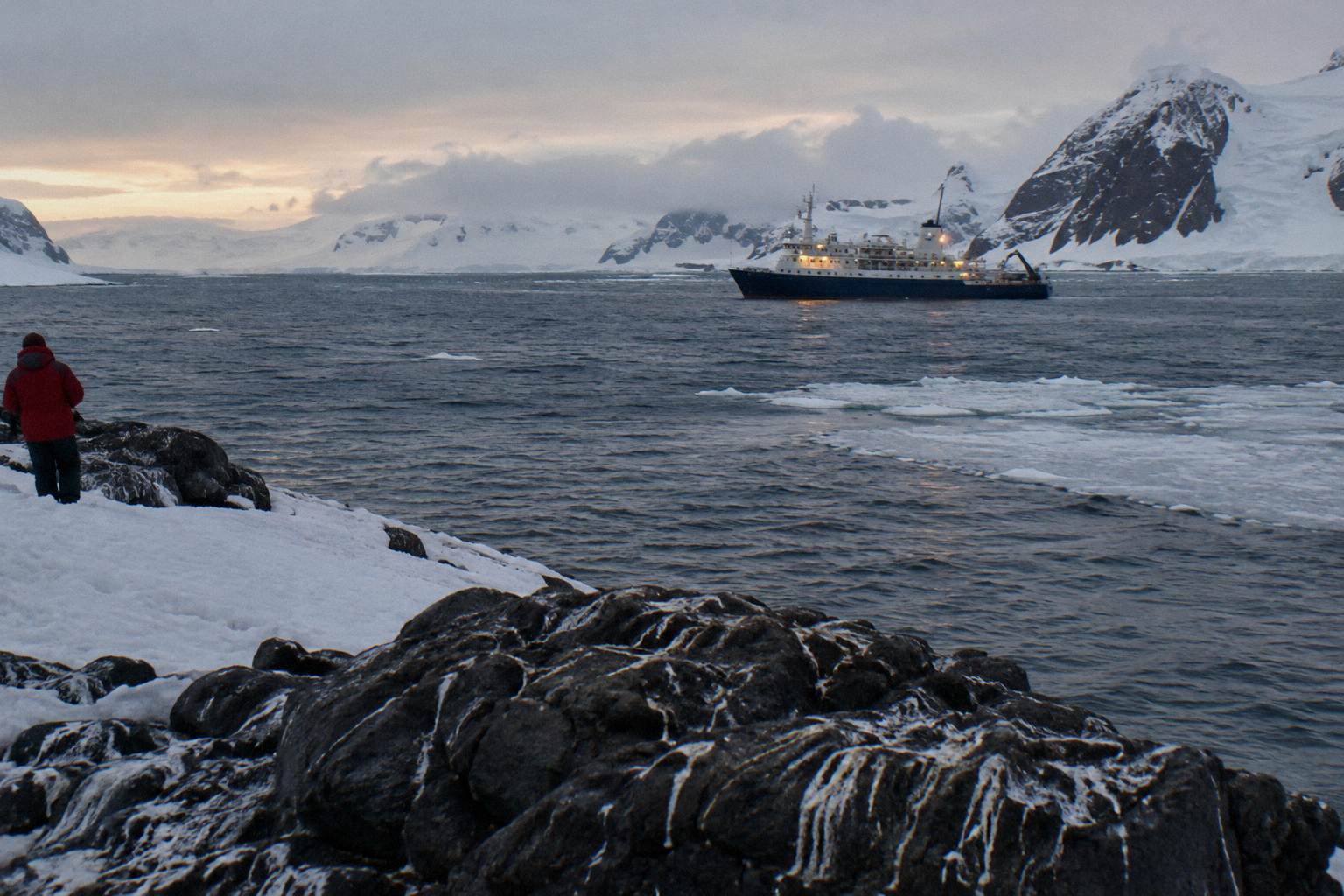
Antarctica is one of the few destinations where travelling alone changes the price of the trip rather than just the experience. Expedition berths are quoted per person based on two people sharing a cabin, so a solo traveller is either matched with a stranger, charged for the empty bed, or booked into one of the small number of cabins designed for one person. The difference between those three paths can be thousands of dollars on the same voyage, which is why the solo question deserves its own research rather than a footnote in a general booking guide. This page pulls together what the operators themselves publish: supplement ranges, share-cabin schemes, the specific ships with dedicated solo cabins, and what the fares on file mean for someone travelling alone. The expedition cruise is the product here, and solo pricing is one of its sharpest edges. For the wider fare picture, see the site's guide to what an Antarctica cruise costs.
What Does Solo Travel To Antarctica Actually Cost?
The core solo penalty is the single supplement, which typically adds 25 to 100 percent of the twin-share fare depending on the ship, the cabin and the date, according to one solo-travel comparison of current operator policies. There is no fixed industry rate, so the supplement has to be checked per sailing, and the same voyage can be a fair solo buy on one date and a poor one on another.
The mechanics are simple. Operators price cabins on the assumption of double occupancy, because a ship earns its revenue per cabin, not per person. When one person occupies that cabin, the line either absorbs the loss or passes it on. Most pass it on. The supplement is usually expressed as a percentage of the twin fare: a low supplement means the solo traveller pays the twin rate plus a quarter; a full supplement means paying for both beds.
The range matters more than the average. A 25 percent supplement on a mid-range cabin is a nuisance; a 100 percent supplement, effectively doubling the fare, can push a voyage out of reach entirely. Some lines soften the blow on selected sailings: one operator comparison notes that supplements are waived on select departures by certain luxury lines, and that sharing options are often available in lower cabin categories. Solo travellers with flexible dates can use that variance to their advantage by shopping departures rather than ships alone.
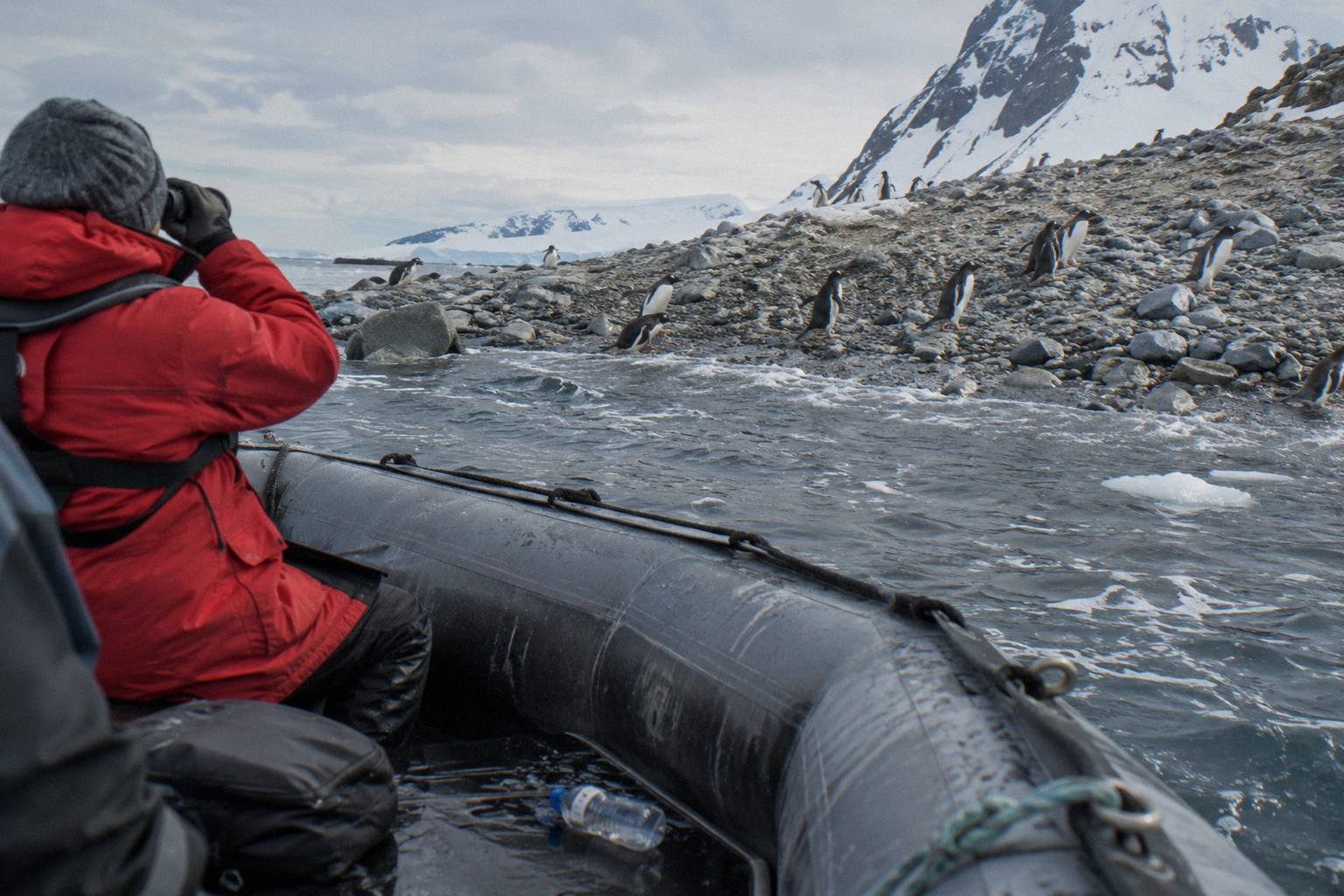
There is also a structural point worth knowing before any price comparison. The season runs November to March, and shoulder months, November and March, typically carry lower base fares than the December-January peak. A solo traveller who takes a supplement hit on a shoulder-season departure can still come out ahead of a peak-date booking with a smaller supplement. The two variables work together, and both move.
If you want a read on what your specific dates and cabin would cost as a solo booking, get a free solo fare consultation before comparing ships yourself; the consultation carries no obligation.
Which Operators Waive Or Cut Single Supplements?
Oceanwide Expeditions offers shared cabins on a share basis for solo travellers, G Adventures charges no single supplement when sharing a twin or triple with another same-gender traveller, and Aurora Expeditions offers up to 10 dedicated solo cabins per sailing with no single supplement. HX waives the solo supplement on select bookings made within six months of departure. These are operator-stated policies, not guarantees on every sailing.
Each of these schemes works differently, and the differences matter. Oceanwide's share basis means you book a berth in a shared cabin and pay the per-person share fare rather than a single supplement. This is the cheapest legitimate route to Antarctica for a solo traveller, and it pairs with the lowest fares on the roster: Oceanwide's Plancius lists Antarctic Peninsula voyages from $7,050 per person, and its Hondius and Ortelius from $7,800.
G Adventures runs a similar matching model on its Expedition ship. No supplement applies when you agree to share a twin or triple with another same-gender traveller; if you want a cabin to yourself, standard supplement rules apply. The Expedition's Antarctica Classic voyage lists from $7,439 per person, so a matched share on that sailing is one of the most affordable solo berths in the market.
Aurora's scheme is different in kind: rather than matching strangers, it builds solo berths into the ship. Up to 10 dedicated solo cabins per sailing carry no single supplement, which means a solo traveller books a cabin designed for one person at a fair price rather than gambling on a match. The details of those cabins are worth their own section below.
The waiver landscape shifts with the calendar. Operators discount unsold inventory as departure approaches, and HX's no-supplement offer applies to select bookings within six months of departure. One deals file reports last-minute discounts of 25 to 60 percent on select 2026-27 departures, with November and March sailings typically carrying the largest reductions. A solo traveller with flexibility can stack a supplement waiver on a discounted fare, but availability is limited and cabin choice narrows late in the booking cycle; the site's guide to last-minute Antarctica cruise deals covers that market in full.
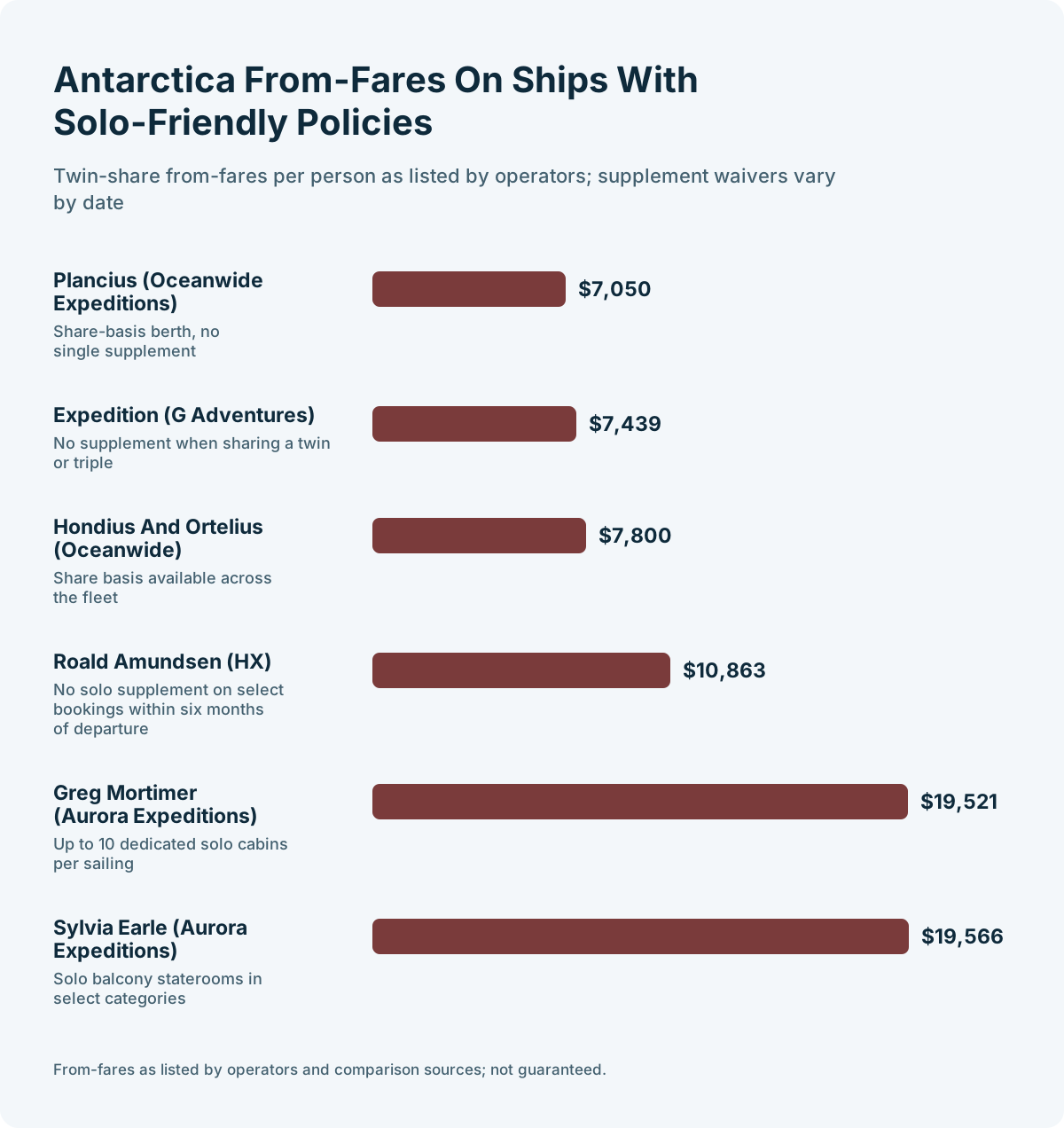
The table below summarises the operator-stated solo policies alongside the roster fares for the ships involved.
| Operator | Solo policy as stated by the operator or comparison sources | Ship and roster from-fare (twin share) |
|---|---|---|
| Oceanwide Expeditions | Shared cabins on a share basis for solo travellers | Plancius from $7,050; Hondius and Ortelius from $7,800 |
| G Adventures | No single supplement when sharing a twin or triple with a same-gender traveller | Expedition from $7,439 |
| Aurora Expeditions | Up to 10 dedicated solo cabins per sailing, no single supplement | Greg Mortimer from $19,521; Sylvia Earle from $19,566 |
| HX | No solo supplement on select bookings within six months of departure | Roald Amundsen from $10,863 (operator-reported fare) |
| Typical range | Single supplements generally 25 to 100 percent of the twin-share fare | Varies by ship, cabin and date |
One caution applies to every row: policies are departure-specific. A waiver that exists on one November sailing may not exist on the December peak, and cabin categories eligible for matching are usually the cheaper ones. The only way to know what applies to your dates is to check the live sailing or ask through a free consultation on current solo offers.
Share Cabins: The Cheapest Solo Route To The Ice
Yes, sharing a cabin is the cheapest solo route to Antarctica: you take a berth in a shared twin, triple or quad and pay the per-person fare with no single supplement. Oceanwide offers cabins on a share basis across its fleet, and G Adventures waives the supplement on shared twins and triples, putting a solo berth on the cheapest ships at the published fare, from $7,050, before flights and gear.
The economics are the whole story. A quad cabin on Plancius, a converted Dutch Navy oceanographic vessel rebuilt as a passenger ship in 2009, is priced for four people sharing. The roster lists Plancius Antarctic Peninsula voyages from $7,050 per person, and on a share basis a solo traveller pays the per-person fare for the category booked, with no doubling. Ortelius, a former Russian research vessel built in Gdynia in 1989, and Hondius, the first-registered Polar Class 6 vessel in the world in the operator's own wording, both list Peninsula voyages from $7,800 per person.
What you trade is privacy. A quad cabin on Plancius is about 12 square metres with two upper and two lower berths and a single porthole. You will sleep, dress and store gear in a shared space for ten to twelve days. For many solo travellers that trade is acceptable, even enjoyable: the shared-cabin route tends to fill with other solo travellers, which is a social head start rather than a social cost.
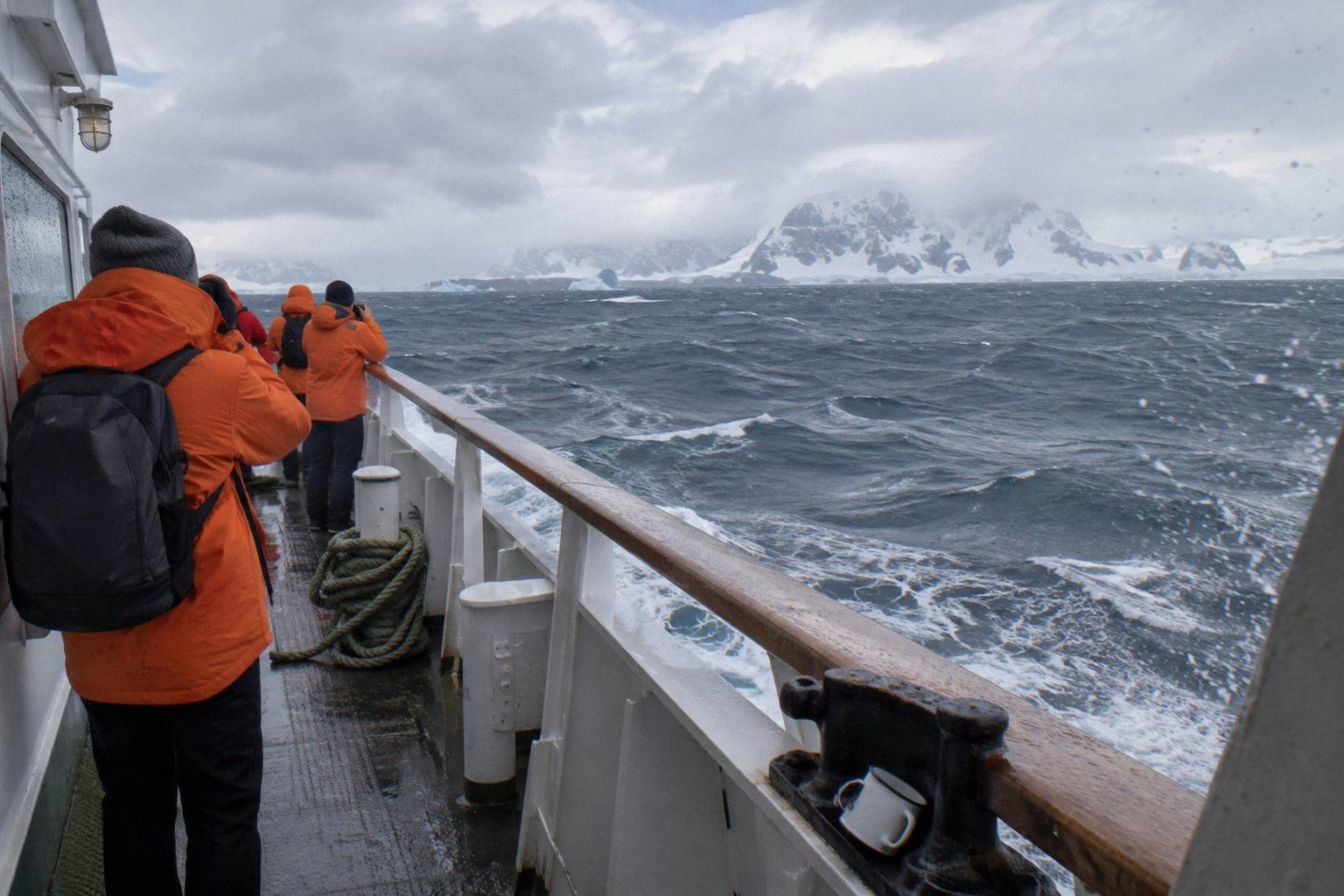
G Adventures' scheme matches same-gender travellers. What happens if a shared cabin does not fill is not stated in the sources, so confirm it for the specific sailing before you rely on it. Sharing options are often available in lower cabin categories, so do not assume they extend to every category.
For solo travellers whose priority is the landing experience rather than the cabin, this is the strongest value on the market. The Zodiacs, the guides, the landings and the scenery are identical from a quad berth and a suite; only the room differs. If that framing fits how you travel, the share-cabin ships deserve the top of your shortlist, and a consultation can confirm which departures still have share berths open.
Solo Cabins On Specific Ships
Aurora Expeditions' Greg Mortimer and Sylvia Earle carry dedicated solo balcony staterooms in specific categories priced with no single supplement, and Lindblad's National Geographic Endurance offers dedicated solo cabins in categories SA and SB with balcony options. These are the only ship-specific solo berths confirmed in the published material; other ships may carry solo-friendly cabins, but their operator pages do not state it.
The Greg Mortimer, built in 2019 with an Ulstein X-BOW hull, is the clearest case. It carries dedicated solo balcony staterooms in categories A, B and C, priced with no single supplement, alongside up to 10 dedicated solo cabins per sailing across the Aurora fleet policy. The ship takes 130 passengers on expedition, has 15 Zodiacs with four dedicated boarding doors, and lists Antarctic voyages from $19,521 per person twin share for a 12-day sailing. A solo traveller in one of those staterooms pays the stated fare rather than the fare plus a supplement, which on a ship in this class is a meaningful saving against the typical supplement range.
The Sylvia Earle, Aurora's 2022 sister ship, also offers dedicated solo balcony staterooms with no single supplement on select categories. It carries the same 130-passenger expedition capacity, 15 Zodiacs and an Ulstein X-BOW, and lists Spirit of Antarctica, a 12-day voyage, from $19,566 per person twin share. The two ships are close siblings, and a solo traveller choosing between them is really choosing dates and departure ports rather than hardware.
Lindblad's National Geographic Endurance, a PC5 Category A vessel with a patented X-Bow, offers dedicated solo cabins in categories SA and SB, with balcony options, per one travel-centre listing of the ship's cabin plan. The roster lists its Voyage to Antarctica, a 12-day sailing, from $11,900 per person. Note the distinction: a dedicated solo cabin is not the same as a waived supplement on a twin cabin, and the Endurance listing describes the cabins without stating a no-supplement price, so the actual solo cost on that ship needs a live check.
The comparison below sets the three roster ships most relevant to a solo booking side by side: the two Aurora vessels with dedicated solo staterooms and the G Adventures Expedition with its no-supplement sharing model.
| Ship | Class | Passengers | Ice class | From, per person | Voyage length | Departs from |
|---|---|---|---|---|---|---|
| Greg MortimerAurora Expeditions | Upscale Expedition | 130 | – | from $19,521 | 12 to 26 days | Ushuaia |
| Sylvia EarleAurora Expeditions | Upscale Expedition | 130 | – | from $19,566 | 12 to 20 days | Ushuaia |
| Expedition (G Adventures)G Adventures | Small-Ship Budget | 128 | Ice Class 1A | from $7,439 | 11 to 14 days | Ushuaia |
And here is the same trio in plain figures, as the roster records them.
| Ship | Operator | Passengers | Solo relevance | Roster from-fare (twin share) |
|---|---|---|---|---|
| Greg Mortimer | Aurora Expeditions | 130 on expedition | Dedicated solo balcony staterooms, categories A, B and C, no single supplement | From $19,521 (12-day voyage) |
| Sylvia Earle | Aurora Expeditions | 130 | Dedicated solo balcony staterooms, no supplement on select categories | From $19,566 (12-day voyage) |
| Expedition | G Adventures | 128 | No single supplement when sharing a twin or triple with a same-gender traveller | From $7,439 (11-day voyage) |
Fairness requires saying what the sources do not. The operator pages for these ships do not itemise how many solo staterooms exist per deck, which categories are excluded, or whether the no-supplement pricing survives on peak December and January sailings. Treat the policies as real but date-limited, and verify the specific departure.
What A Solo Traveller Pays In Practice
In practice, a solo traveller pays the published twin-share fare on a matched share or a dedicated solo cabin, or that fare plus 25 to 100 percent when booking a cabin alone. One 2026 cost guide puts the realistic all-in budget for a 10 to 12-day mid-range Peninsula trip, covering fare, flights, gear, tips, and insurance, at $12,000 to $25,000 per person.
The arithmetic is easiest to see in a worked comparison. Take three realistic solo paths on roster ships for the 2026-27 season:
| Solo path | Ship and voyage | Twin-share from-fare on file | Solo outcome |
|---|---|---|---|
| Matched share, no supplement | G Adventures Expedition, Antarctica Classic, 11 days | $7,439 | Pay $7,439 if matched into a twin or triple |
| Share basis | Oceanwide Plancius, Peninsula voyage, 10-11 days | $7,050 | Pay $7,050 in a shared cabin |
| Dedicated solo balcony stateroom | Aurora Greg Mortimer, 12-day Peninsula voyage | $19,521 | Pay the stated fare, no supplement, on select categories |
| Single supplement applied | Same Greg Mortimer voyage | $19,521 | Pay the fare plus 25 to 100 percent, per the typical supplement range |
| Typical supplement on a mid-range ship | Lindblad National Geographic Endurance, 12-day voyage | $11,900 | Pay the fare plus 25 to 100 percent, per the typical supplement range |
Two things jump out. First, the gap between the cheapest and most expensive solo path on this table is larger than the gap between budget and luxury ships themselves, because a full supplement effectively doubles an upscale fare while a matched share holds a budget fare flat. A solo traveller who pays a full supplement on an upscale ship spends far more than a matched solo traveller on a budget ship, for a comparable amount of time ashore. Second, the dedicated solo stateroom is the middle path: Aurora-style solo cabins give you a private room at the twin fare on select categories.
The add-ons do not change with solo status but do change the budget. One 2026 cost guide puts the realistic all-in budget for a 10 to 12-day mid-range Peninsula trip, fare plus flights plus gear plus tips plus insurance, at $12,000 to $25,000 per person, and notes recommended tips averaging about $16 per person per day. Travel insurance with medical evacuation coverage is required or recommended by most operators and is not included in base fares; the site's guide to Antarctica travel insurance explains the evacuation minimums operators impose.
Booking timing also behaves differently for solo berths. Share cabins need time to fill: book early and the operator has more chances to find you a match; book late and an unfilled share may convert to a supplement or a cancellation. Dedicated solo staterooms are scarce by design, up to 10 per sailing on the Aurora policy, so they can go early on popular dates. The last-minute discount market, with its reported 25 to 60 percent reductions on select departures, favours flexible solo travellers, but one deals source notes that last-minute availability is limited in cabin choice and uncommon for peak December sailings, which book furthest ahead.
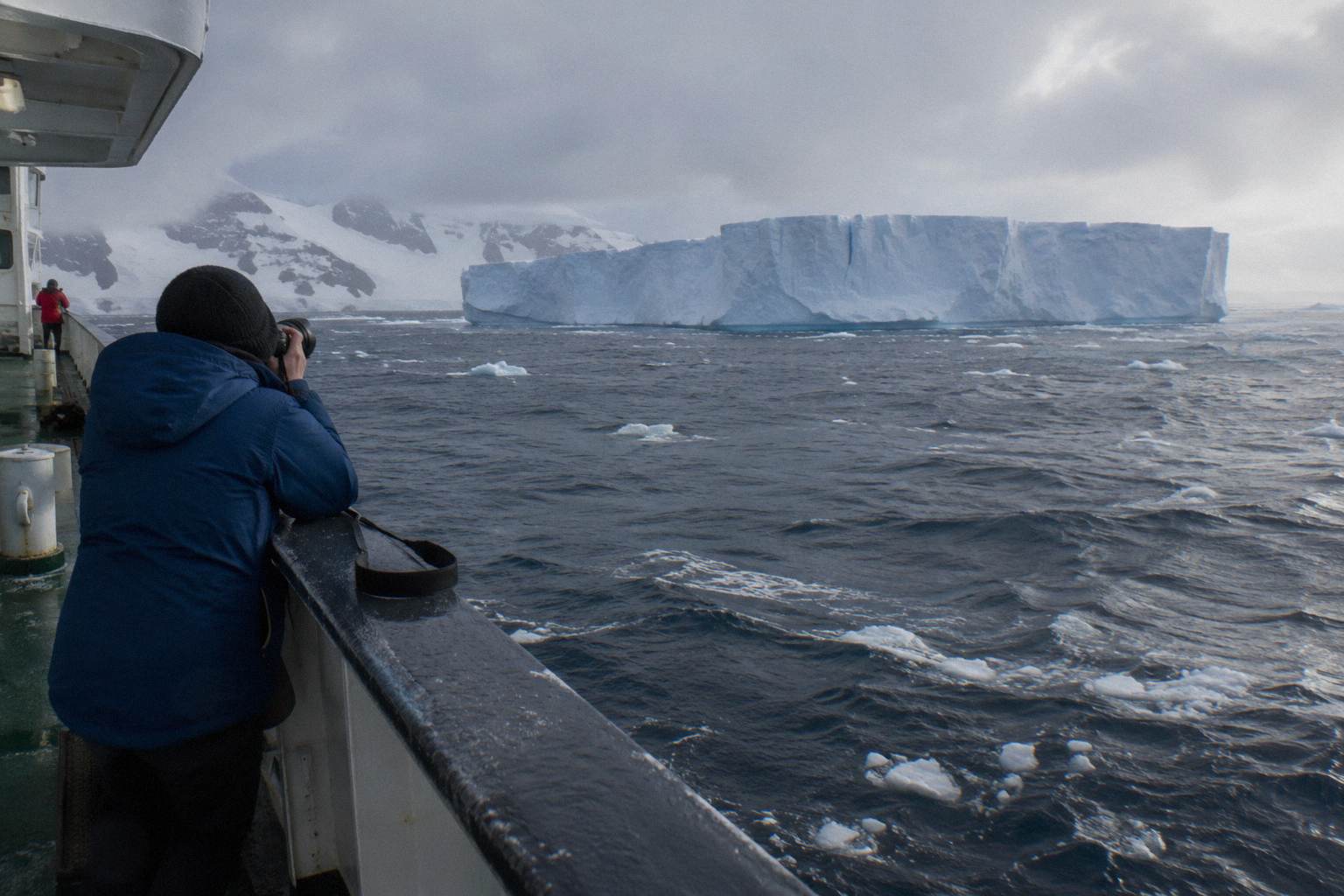
This is the decision point where a second pair of eyes pays for itself. If you would like someone to check which of these solo paths is actually open on your dates, ask for a free consultation and lay out your budget and travel window.
Is Solo Travel Safe And Sociable On An Expedition Ship?
Small expedition ships offer solo travellers a sociable onboard environment, with shared briefings, communal meals and mixed Zodiac groups, and safety is supported by expedition-team oversight and mandatory medical forms, according to one solo-travel analysis of current operator practice. Women solo travellers follow the same policies and safety protocols as other solo guests. No operator-stated solo surcharge on safety, and no solo-specific restriction, appears in any published policy.
The social mechanics of an expedition cruise favour solo travellers more than most holidays. Most ships in this market carry roughly 80 to 200 passengers, seating is open or communal at meals on many lines, and the daily rhythm, a morning briefing, a Zodiac landing, lunch, an afternoon landing, a recap over dinner, forces strangers into repeated contact. By the second day, faces are familiar. A solo traveller on a 12-day Peninsula voyage is not dining alone unless they choose to.
The share-cabin and dedicated-solo routes stack sociability further. A shared quad on Plancius starts with three built-in companions. One comparison notes that the sociable onboard environment is a specific benefit for solo travellers on these ships, and that is consistent with how the product is designed.
Safety is handled at the operator level rather than left to individuals. Mandatory medical forms are standard on expedition bookings, the expedition team supervises every landing, and the IAATO framework that governs all member operators caps landings at 100 passengers ashore at a time with a minimum 1:20 guide-to-visitor ratio, per the general visitor guidelines. Solo status does not change any of this: the same briefings, the same Zodiac discipline, the same guide coverage apply to every guest.
For context on scale, IAATO recorded 85,195 landed visits in the 2025-26 season out of 113,518 total visitors, per the association's data statistics, and solo travellers are a normal, planned-for part of that traffic. Nothing in the published material suggests solo travellers need special arrangements beyond the standard booking.
Solo Travel Planning Questions And Booking Strategy
The practical solo strategy is to fix your priority first: lowest price means a share cabin on a budget ship, privacy without a supplement means a dedicated solo stateroom on Aurora's ships, and full cabin choice means accepting a supplement and shopping for the lowest one. Book share berths and solo staterooms early, watch the within-six-month waiver window if your dates are flexible, and confirm every policy on the specific departure before paying a deposit.
Start with the honest self-assessment. If the cabin is a place to sleep between landings, the share route on Oceanwide or G Adventures saves heavily against an upscale booking and puts the same penguins in front of your camera. If privacy matters after a long day in the cold, the Greg Mortimer or Sylvia Earle solo stateroom at the twin fare is the rational buy, and the fare on file, from $19,521 and $19,566 respectively for 12-day voyages, is what you actually pay.
Then work the calendar. Shoulder months, November and March, carry lower base fares and deeper discounts; peak December and January carry the best weather and wildlife but the thinnest solo availability. The supplement range of 25 to 100 percent means the same ship can be a fair solo buy on one date and a poor one on another. A solo traveller who treats the departure date as a variable, not a fixed point, gains more from that flexibility than any other single decision. On Cruises In Antarctica, the month-by-month guides track how fares and wildlife shift across the season.
Finally, check before you commit. Supplement policies, waiver windows and solo-cabin counts are departure-level facts, and the operator pages do not itemise them per sailing. This is where a free consultation on solo options earns its keep: the consultation costs nothing, carries no obligation, and hands you to a vetted expedition-cruise agency partner who can see live solo availability across operators at once, something no single operator page shows.
Common Questions About Solo Travel To Antarctica
Solo travel Antarctica: how much extra does travelling alone cost?
Typical single supplements run 25 to 100 percent of the twin-share fare, so a voyage listed from $19,521 per person twin share carries a meaningfully higher solo price when a supplement applies. Share-cabin schemes and dedicated solo staterooms avoid the supplement entirely on the sailings where they apply.
Which Antarctica operators waive the single supplement?
Oceanwide offers shared cabins on a share basis, G Adventures charges no supplement when you share a twin or triple with a same-gender traveller, Aurora offers up to 10 dedicated solo cabins per sailing with no supplement, and HX waives the solo supplement on select bookings within six months of departure.
Are there ships with cabins designed for solo travellers?
Yes. Aurora's Greg Mortimer and Sylvia Earle carry dedicated solo balcony staterooms in specific categories priced with no single supplement, and Lindblad's National Geographic Endurance offers dedicated solo cabins in categories SA and SB with balcony options. These are the ship-specific solo berths confirmed in the published material.
Is it safe to travel to Antarctica alone?
Expedition cruising handles safety at the operator level: mandatory medical forms, expedition-team supervision on every landing, and IAATO rules capping 100 passengers ashore at a time with a minimum 1:20 guide ratio. Solo travellers follow the same protocols as everyone else, and women solo travellers follow the same policies as other solo guests.
Will I be lonely on a solo Antarctica cruise?
Unlikely. Small expedition ships run communal dining, shared briefings and mixed Zodiac groups, and the daily rhythm pushes guests into repeated contact. Share cabins and solo staterooms add built-in proximity to other solo travellers, and one comparison of current practice describes the onboard environment as specifically sociable for solo guests.
What is the cheapest way for a solo traveller to reach Antarctica?
A matched share cabin on a budget expedition ship. Oceanwide's Plancius lists Peninsula voyages from $7,050 per person on a share basis, and G Adventures' Expedition lists from $7,439 with no supplement when sharing. Add flights, gear, insurance and tips, which one 2026 cost guide puts at a $12,000 to $25,000 all-in budget on a mid-range trip.
More Couples, Solo Travellers And Adults
 Honeymoon CruiseShips, suites, costs and timing for an Antarctic honeymoon, built from operator fares.Read the guide
 Marriage In AntarcticaWhat is legally possible for an Antarctic wedding, which operators host ceremonies, and the practical route most couples take.Read the guide
 Adults-Only Antarctic CruisesMinimum ages by operator, the one true adults-only line, and how to book a quieter Antarctic voyage.Read the guide
 Antarctica With KidsMinimum ages, family programmes and the ships that take children to Antarctica.Read the guide