Environmental Impact Of An Antarctica Cruise: Carbon, Fuel And Footprint
 By Oleg G.
An Antarctic expedition cruise burns marine fuel to reach the least visited continent on Earth, and a 2025 study puts the emissions in hard numbers. Here is what is actually known about carbon, black carbon, fuel rules and the choices that shrink the footprint.
Quick answer: Antarctic cruise tourism in the 2022-23 season emitted an estimated 437,280 tonnes of CO2-equivalent, roughly 4.15 tonnes per passenger on average. Heavy fuel oil has been banned in Antarctic waters since August 2011 under MARPOL, IAATO caps landings at 100 passengers ashore, and hybrid ships such as MS Roald Amundsen cut, but do not eliminate, fuel burn.
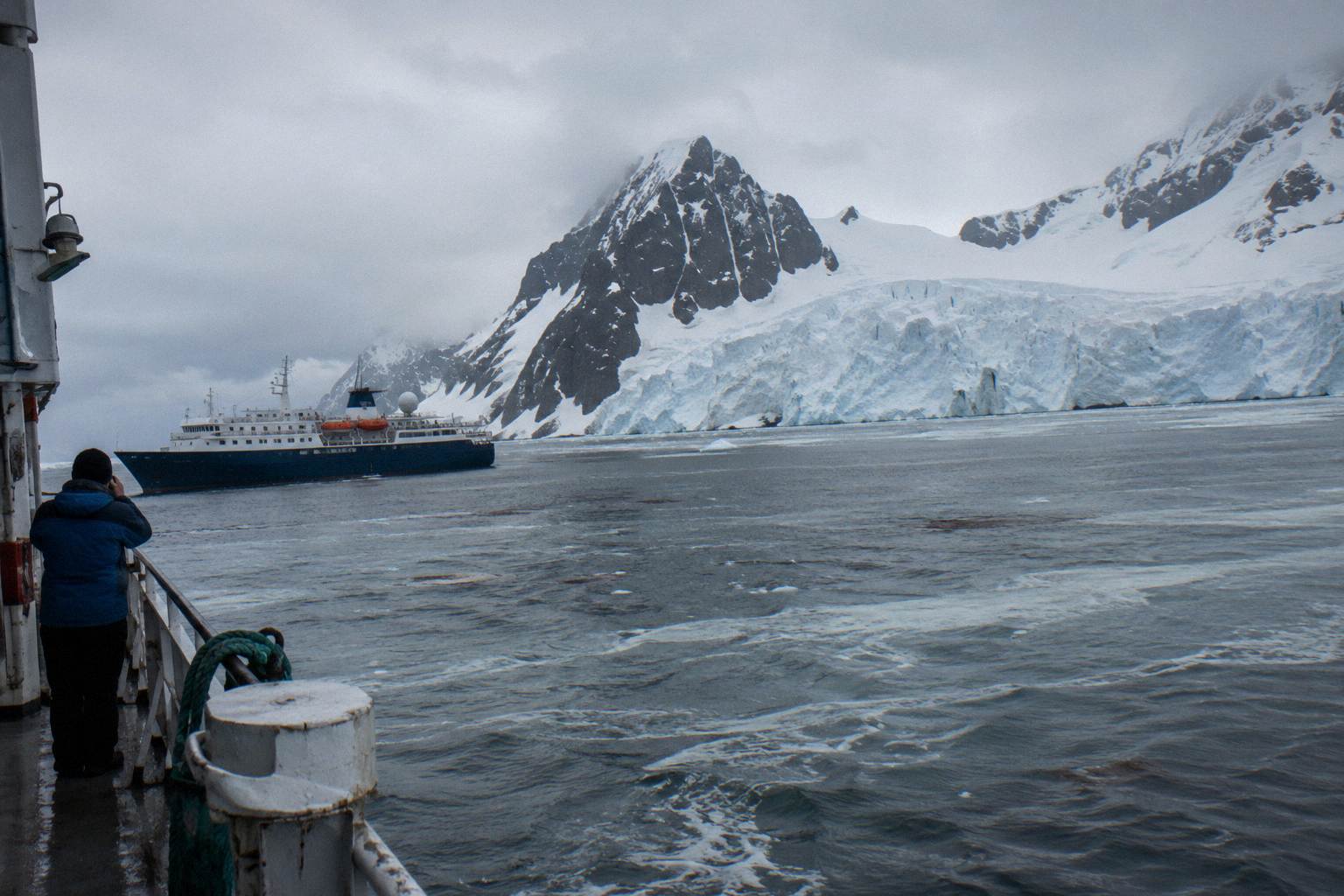
What Is The Environmental Impact Of An Antarctica Cruise?
The measurable impact splits into four parts: carbon dioxide and other greenhouse gases from burning marine fuel, black carbon that darkens snow, the local footprint of landings and wildlife disturbance, and the wider logistics of flying to South America. A 2025 study estimates the 2022-23 Antarctic cruise season produced roughly 437,280 tonnes of CO2-equivalent, about 4.15 tonnes per passenger on average across transport modes. Regulations and operator practice address each part with different force.
Every Antarctica cruise is, at bottom, a voyage powered by fossil fuel across the roughest ocean on the planet, and the honest starting point is that the journey carries a real climate cost. The most recent peer-reviewed estimate, an update study published in 2025, put total cruise tourism emissions for the 2022-23 Antarctic season at approximately 437,280 tonnes of CO2-equivalent, which averages to about 4.15 tonnes per passenger across the different ways people travel there. That per-passenger average blends ship-only travellers with those who fly as part of fly-cruise arrangements, so it is an average across modalities rather than a per-cruise figure.
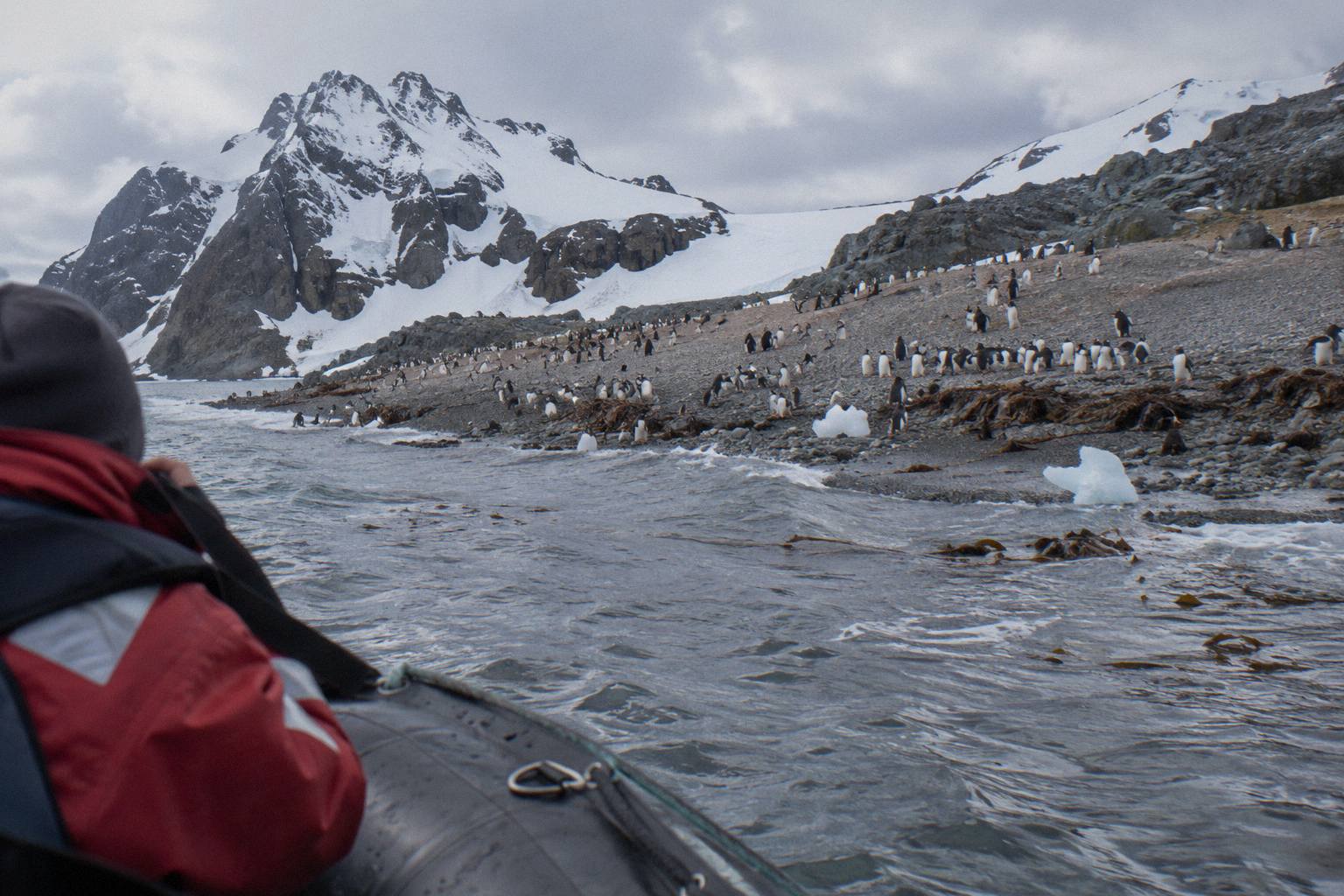
The second measurable impact is black carbon, soot particles deposited on snow and ice near tourist sites, documented in a 2022 study referenced in the tourism emissions literature. Black carbon matters because dark particles on white snow absorb sunlight and accelerate melting locally, which is why researchers have focused on it even though the absolute quantities are small next to the CO2 problem. Third, there is the physical footprint ashore: IAATO rules cap passengers on land, mandate biosecurity cleaning, and set wildlife approach distances, all designed to keep landing impact, in the treaty's own language, no more than minor or transitory. Fourth, most travellers fly long-haul to Buenos Aires, Ushuaia or Punta Arenas before the voyage even begins, and those flights sit outside every operator's onboard sustainability claim.
If weighing these numbers against your own trip plans feels like a genuinely hard call, a free consultation on lower-impact voyages can walk through the ship-by-ship differences with you.
Carbon Emissions Per Passenger: The 2025 Study Numbers
The figure is approximately 4.15 tonnes of CO2-equivalent per passenger for the 2022-23 season, an average across modalities, on total cruise tourism emissions of about 437,280 tonnes. The same research stream links Antarctic tourism emissions to ship fuel burn, itinerary length and how passengers reach the gateway ports. No operator publishes a per-ship, per-voyage emissions figure, so any single number beyond the study average should be treated with caution.
The Farreny et al. update study, published in the Journal of Sustainable Tourism in 2025, is the most recent peer-reviewed estimate the site holds. It calculated total Antarctic cruise tourism emissions for the 2022-23 season at roughly 437,280 tonnes of CO2-equivalent and an average of about 4.15 tonnes per passenger. The per-passenger figure is an average across modalities, meaning it mixes conventional sailing voyages with fly-cruise products where a charter flight replaces two days at sea, and it does not isolate individual operators or ships.
What the study framework does make clear is where the emissions sit: overwhelmingly in the fuel burned by the vessel, which scales with distance sailed, speed, and ship size, with aviation playing a secondary but material role for fly-cruise guests. A two-day Drake Passage crossing each way on a 12-day Peninsula itinerary simply burns more fuel than an eight-day air-cruise that flies over the passage, though the charter flight carries its own emissions that partially offset the saving. Nobody has published a clean head-to-head number for that trade-off.
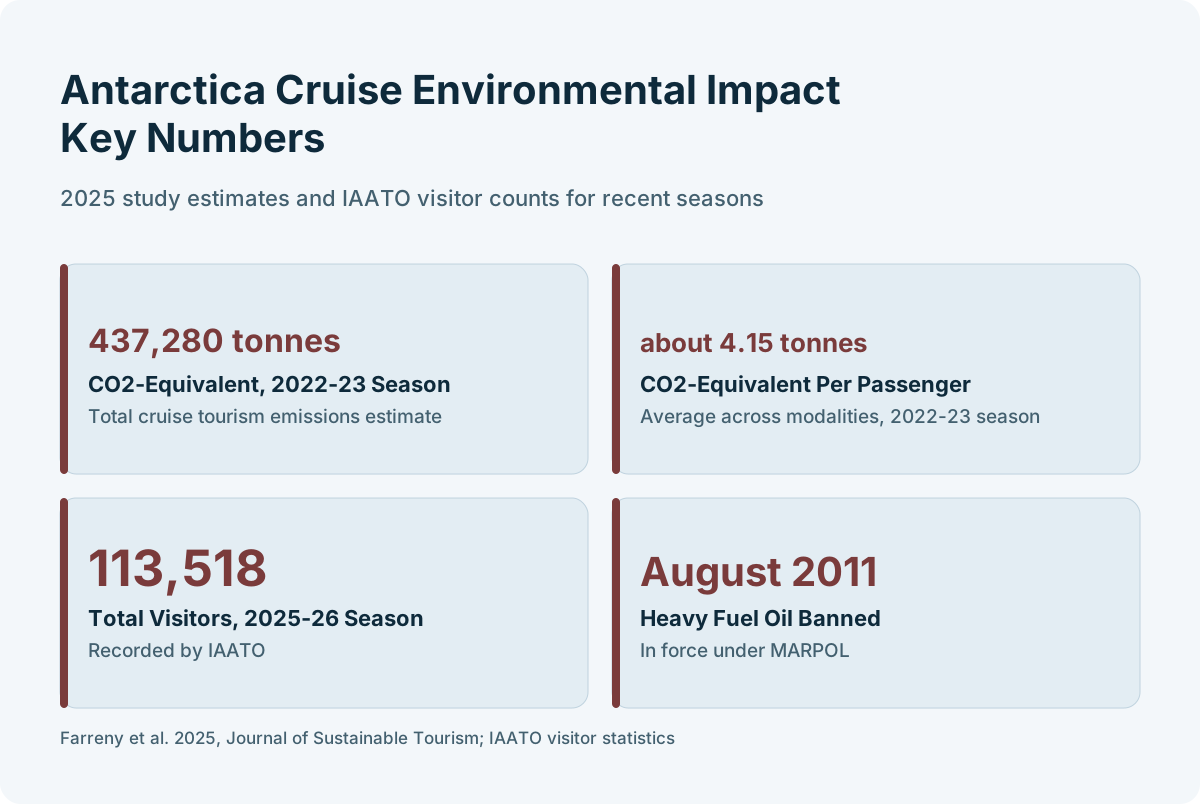
For context on scale, IAATO recorded 113,518 total visitors in the 2025-26 season, of whom 85,195 made landed visits and 27,217 were cruise-only. Visitor numbers and emissions are not the same thing, but the two move together, and both have grown as the industry has added ships and departures.
Black Carbon: The Soot That Darkens Antarctic Snow
Black carbon is soot emitted by ship engines and deposited on snow, where dark particles absorb sunlight and speed local melting. A 2022 study by Cordero et al. documented black carbon deposition on snow near Antarctic tourist sites, and the finding is referenced in the 2025 tourism emissions research. No operator publishes a per-voyage black carbon figure for its ships.
Black carbon deserves its own section because it operates differently from CO2. Carbon dioxide mixes globally and matters over decades; black carbon lands on the snow near where it is emitted, within roughly the areas ships visit, and acts immediately. Darkened snow melts faster, and in Antarctica that local melting feeds back into the very landscapes passengers come to see. The Cordero et al. 2022 study documented black carbon deposition on snow near tourist sites, and the 2025 Farreny et al. update references that work as part of the impact picture.
The practical implication for a traveller is uncomfortable but real: a ship idling or manoeuvring close to shore around popular landing sites concentrates soot exactly where the snow is. This is one reason IAATO's operational measures include site scheduling that spreads vessels around the Peninsula rather than clustering them, though the mechanism for that is coordination through the ship scheduler rather than an explicit black carbon rule. Engine technology may matter too, and the hybrid ships discussed later in this guide are the obvious candidates, though no one publishes their black carbon output against older ships.
The 2011 Heavy Fuel Oil Ban And What Ships Burn Now
Heavy fuel oil has been banned in Antarctic waters since August 2011 under the MARPOL convention, applying to all operators. That rule removed the dirtiest and most persistent marine fuel from the region, cutting both sulphur and soot and removing the worst-case spill scenario of a heavy oil grounding. What ships burn instead, lighter distillate grades, is cleaner but still fossil fuel.
Before 2011, the standard Antarctic cruise fuel was the same heavy residual fuel used across merchant shipping, cheap, viscous, and catastrophic if spilled because it persists in cold water. The ban, in force since August 2011 under MARPOL, forced every operator calling in Antarctica to switch to distillate fuels. The environmental case was twofold: distillates burn cleaner, reducing sulphur oxides and particulate emissions including black carbon, and a spill of light fuel in polar water, while still serious, weathers and disperses very differently from heavy oil.
| Fuel and impact measure | Status in Antarctic waters |
|---|---|
| Heavy fuel oil | Banned since August 2011 under MARPOL |
| Required replacement fuels | Lighter distillate fuels such as marine gas oil |
| Black carbon deposition on snow | Documented near tourist sites by a 2022 study |
| Season CO2-equivalent emissions | About 437,280 tonnes estimated for 2022-23 |
| Per-passenger average | Roughly 4.15 tonnes CO2-equivalent, across modalities |
The ban is the single biggest regulatory environmental win in Antarctic cruising, and it is worth saying plainly that everything sailing there today operates under it. It does not make the fuel clean, only cleaner, and the emissions study numbers above describe the post-ban fleet. For a deeper look at the safety architecture around Antarctic shipping generally, see our guide to how safe an Antarctica cruise actually is.
Hybrid Ships: MS Roald Amundsen, MS Fridtjof Nansen And The Technology Story
HX's MS Roald Amundsen and MS Fridtjof Nansen use hybrid diesel-electric propulsion, which the operator presents as reducing fuel burn. Hybrid systems let engines run at efficient constant load with battery support, particularly valuable at low speeds near shore and in ice. The roster confirms both ships sail Antarctic itineraries, but no operator publishes the fuel saving per voyage.
Hybrid diesel-electric propulsion is the most concrete technology story in the Antarctic fleet. MS Roald Amundsen, built in 2019, and her sister MS Fridtjof Nansen, built in 2020, both use hybrid diesel-electric propulsion. In general terms, hybrid systems let engines run closer to their efficient load during the low-speed, high-manoeuvre phases that dominate Antarctic operations, though HX's exact battery configuration is not published. Both carry up to 490 passengers, both offer Science Centre facilities and lecture programs aboard, and both are HX's mainstream Antarctic platforms with voyages of roughly 12 to 19 days, Roald Amundsen sailing from Buenos Aires and Ushuaia, Nansen from Valparaíso and Buenos Aires. The rest of the planning pages sit on Cruises In Antarctica.
A third option worth comparing is Aurora Expeditions' Greg Mortimer, a 2019 Ulstein X-BOW vessel carrying up to 148 guests with 130 on expedition. The X-BOW is Ulstein's patented inverted bow design; no verified fuel or performance figures are published for it, so no efficiency claim is made on the hull's behalf. Aurora's smaller scale, 15 Zodiacs and four boarding doors, means fewer people per landing rotation under the IAATO limits, which is a footprint argument of a different kind from engine technology.
| Ship | Class | Passengers | Ice class | From, per person | Voyage length | Departs from |
|---|---|---|---|---|---|---|
| MS Roald AmundsenHX (Hurtigruten Expeditions) | Standard Expedition | – | – | from $10,863 | 12 to 16 days | Buenos Aires, Ushuaia |
| MS Fridtjof NansenHX (Hurtigruten Expeditions) | Standard Expedition | – | – | from $10,485 | 15 to 19 days | Valparaíso, Buenos Aires |
| Greg MortimerAurora Expeditions | Upscale Expedition | 130 | – | from $19,521 | 12 to 26 days | Ushuaia |
On fares, the roster shows MS Roald Amundsen Antarctic voyages reported from $10,863 per person and MS Fridtjof Nansen from $10,485 per person, while Greg Mortimer's Antarctic voyages start from $19,521 per person on the operator's own listing. If hybrid technology or small-ship landings are shaping your ship choice, this is a natural moment for a conversation about matching a ship to your priorities, free and with no obligation.
Operator Carbon Claims: Offsets, Neutrality And What To Verify
Lindblad Expeditions states that its expeditions are 100% carbon neutral via offsets across its fleet, and Aurora Expeditions and Quark Expeditions make carbon offset or neutral claims through programmes the operators themselves describe. These are marketing and policy claims, not audited per-voyage emissions figures, and they should be read as claims. None of these claims has been independently audited in public, so treat neutrality language as a starting question rather than a settled fact.
The offset landscape in Antarctic cruising is a claims landscape. Lindblad states its expeditions are 100% carbon neutral through offsets; Aurora and Quark both describe carbon offset or neutral programmes via verified schemes, with specific tonnage figures varying by season and report and none published in a form that can be verified. The honest framing is that an offset claim tells you the operator has purchased credits somewhere in the world, not that your voyage emitted nothing, and the quality of credits, whether they represent additional, permanent removals, determines whether the claim has substance.
When you compare operators on environmental grounds, useful questions include whether emissions figures are published, what the offsets fund, and whether the claim covers the whole company or only certain voyages. A hybrid ship with a modest, transparent programme may be a more grounded choice than an older ship wearing a large neutrality banner, and the consultation route lets you ask these questions of someone who knows the operators' current positions ship by ship.
How IAATO Rules Limit The Footprint On Land
IAATO caps landings at 100 passengers ashore per site at any one time, requires a 1:20 guide-to-visitor ratio, prohibits landings from vessels carrying more than 500 passengers, and allows only one ship at a site at a time. Mandatory biosecurity means boots and equipment are washed before arrival and between sites, and visitors must keep at least 5 metres from wildlife. These measures keep the physical footprint of tourism, in treaty language, minor and transitory.
The International Association of Antarctica Tour Operators, founded in 1991 by seven operators, is the body through which nearly all Antarctic cruise tourism is managed. Its environmental measures are specific and enforceable on members: the 100-passenger landing cap, the one-ship-per-site scheduling rule, the 5-metre wildlife distance minimum, mandatory biosecurity cleaning of boots, bags, tripods and clothing before arrival and again between sites, and site-specific visitor guidelines maintained using member-reported data and a shared vessel scheduling system.
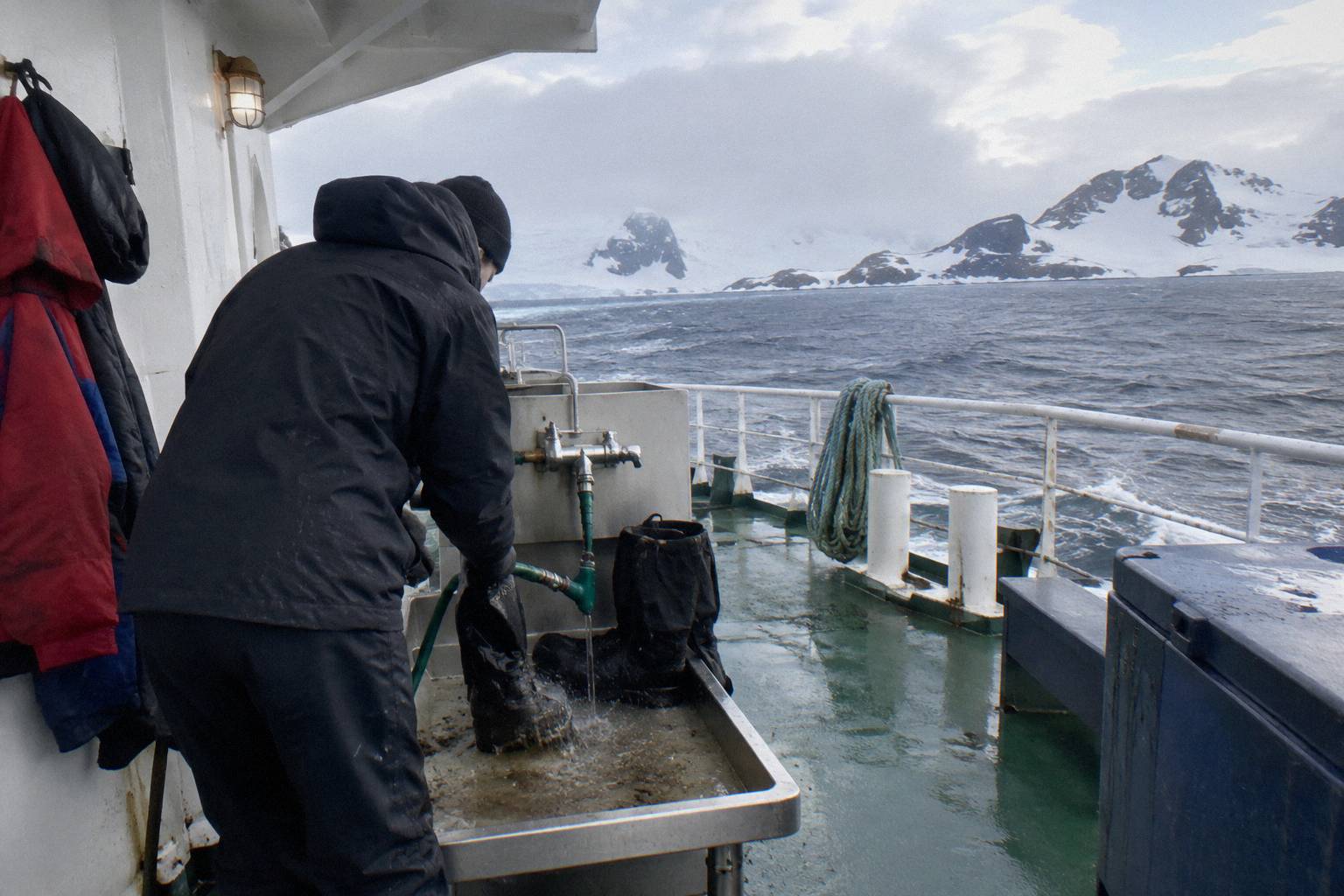
The biosecurity rules exist to prevent non-native seeds and pathogens reaching Antarctica, a concern sharpened in recent seasons by the detection of highly pathogenic avian influenza in the region since 2023-24. The visitor guidelines sit under the Antarctic Treaty System, and roughly 98% of tourism voyages occur on the Antarctic Peninsula during the austral summer, concentrating all of this activity in a relatively small area, which is precisely why the scheduling and cap system matters. For the full rulebook in detail, see our dedicated guide to the IAATO rules that govern every Antarctic landing.
| IAATO or treaty measure | The rule |
|---|---|
| Landing cap | Max 100 passengers ashore per site at one time, unless site guidance is stricter |
| Ship size limit on landings | Vessels over 500 passengers may not make landings |
| Site exclusivity | Only one ship may visit a landing site at any one time |
| Guide ratio | Minimum 1:20 expedition staff to visitors ashore |
| Wildlife distance | At least 5 metres from wildlife on land or ice |
| Biosecurity | Boots and all equipment washed before arrival and between sites |
Practical Lower-Impact Choices You Actually Control
The levers a traveller controls are ship size and technology, itinerary length and type, travel to the gateway, and operator transparency. Hybrid ships cut close-to-shore fuel burn, shorter or fly-cruise itineraries change the fuel mix, and choosing an operator that publishes its numbers pushes the industry toward disclosure. IAATO membership is checkable through the public member directory, and shoulder-season travel spreads demand across the season rather than concentrating it.
No choice available to a passenger eliminates the impact of an Antarctic cruise, but the choices are not equal. A hybrid diesel-electric ship such as Roald Amundsen or Fridtjof Nansen addresses fuel burn at the engineering level. A smaller ship such as Greg Mortimer reduces the per-landing footprint through fewer passengers ashore per rotation under the same IAATO cap. A shorter voyage burns less fuel, with the caveat about charter flights noted earlier. And travel to Ushuaia or Punta Arenas is part of your personal footprint whatever the ship does, so routing and stopover choices count.
| Choice | Environmental logic | Trade-off |
|---|---|---|
| Hybrid ship (e.g. MS Roald Amundsen) | Battery-supported diesel-electric propulsion, efficient engine loading | 490-passenger vessel, landing rotations ashore |
| Small ship (e.g. Greg Mortimer, 130 on expedition) | Fewer guests ashore at once under the same IAATO cap | Higher fare per person on the operator listing |
| Fly-cruise itinerary | Removes up to four days of Drake Passage fuel burn | Charter flight adds its own emissions |
| Shoulder-season departure | Spreads demand across the season | Conditions and wildlife timing differ from peak season |
| Verify IAATO membership | Checkable via the public directory before booking | Takes five minutes |
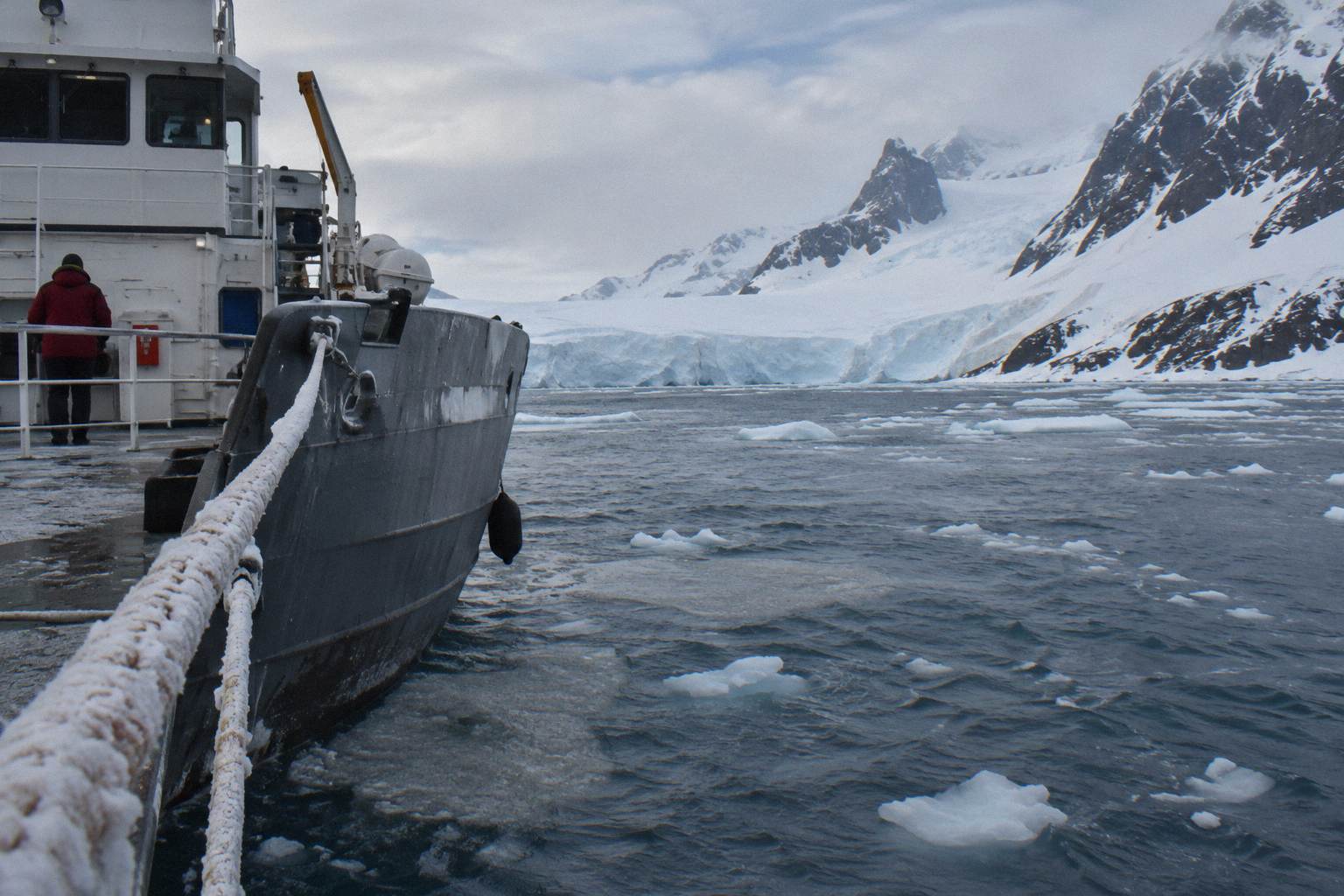
One number to hold onto when you weigh all this: the roughly 4.15 tonnes CO2-equivalent per-passenger average. Set against it the fact that the 2025-26 season put 85,195 people ashore under rules designed to leave no trace on land, and the honest conclusion is that the climate cost is real, the local footprint is tightly managed, and the difference between a high-impact and lower-impact version of the same dream trip comes down to ship, season and itinerary choices made months in advance. This is the exact conversation a free Antarctica cruise consultation is built for, and it costs nothing to have it.
Common Questions About Antarctica Cruise Environmental Impact
What is the carbon footprint of an Antarctica cruise?
A 2025 study estimates about 4.15 tonnes of CO2-equivalent per passenger on average across modalities for the 2022-23 season, on total cruise tourism emissions of roughly 437,280 tonnes. No per-ship or per-voyage figure is published.
Is heavy fuel oil banned in Antarctica?
Yes. Heavy fuel oil has been banned in Antarctic waters since August 2011 under the MARPOL convention, applying to all operators. Ships burn lighter distillate fuels instead, which are cleaner but still fossil fuels.
What is black carbon and why does it matter in Antarctica?
Black carbon is soot from ship engines that deposits on snow, where dark particles absorb sunlight and accelerate local melting. A 2022 study documented deposition on snow near Antarctic tourist sites.
Are hybrid cruise ships really better for Antarctica?
Ships such as MS Roald Amundsen and MS Fridtjof Nansen use hybrid diesel-electric propulsion, which supports efficient engine loading and battery use at low speeds. The operators present this as reducing fuel burn; no independently verified per-voyage saving figure is published.
Are carbon-neutral cruise claims trustworthy?
Lindblad states its expeditions are 100% carbon neutral via offsets, and Aurora and Quark make offset claims through programmes they describe. These are operator claims, not audited per-voyage emissions figures, so treat neutrality language as a question to probe rather than a settled fact.
How does IAATO reduce environmental damage from cruises?
IAATO caps landings at 100 passengers ashore per site at one time, requires a 1:20 guide ratio, bars vessels over 500 passengers from landing, allows one ship per site at a time, and mandates biosecurity cleaning plus 5-metre wildlife distances.
More Rules, Safety And The Environment
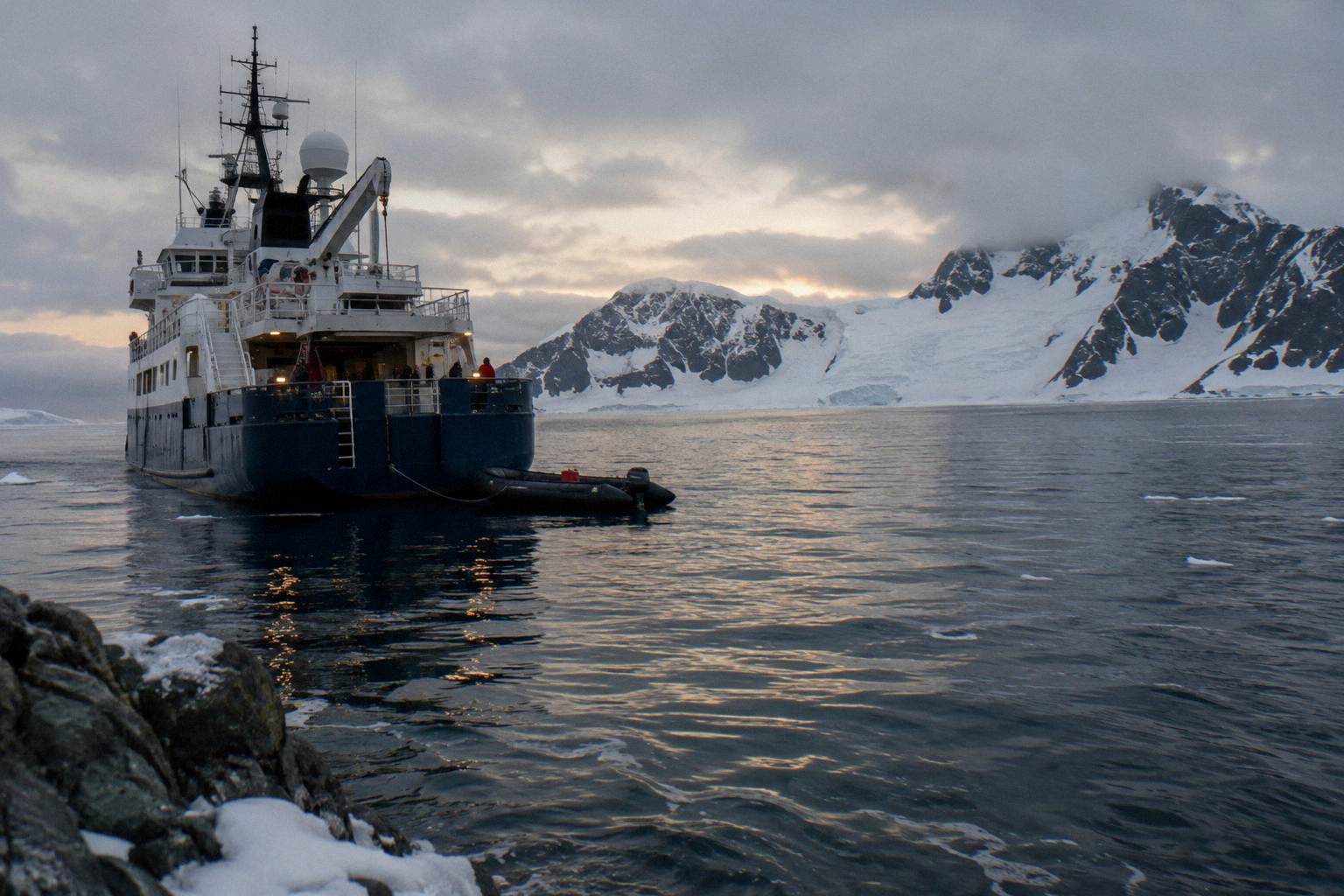 IAATO RulesThe rules every Antarctica visitor follows, from the 100-ashore limit to souvenir bans.Read the guide
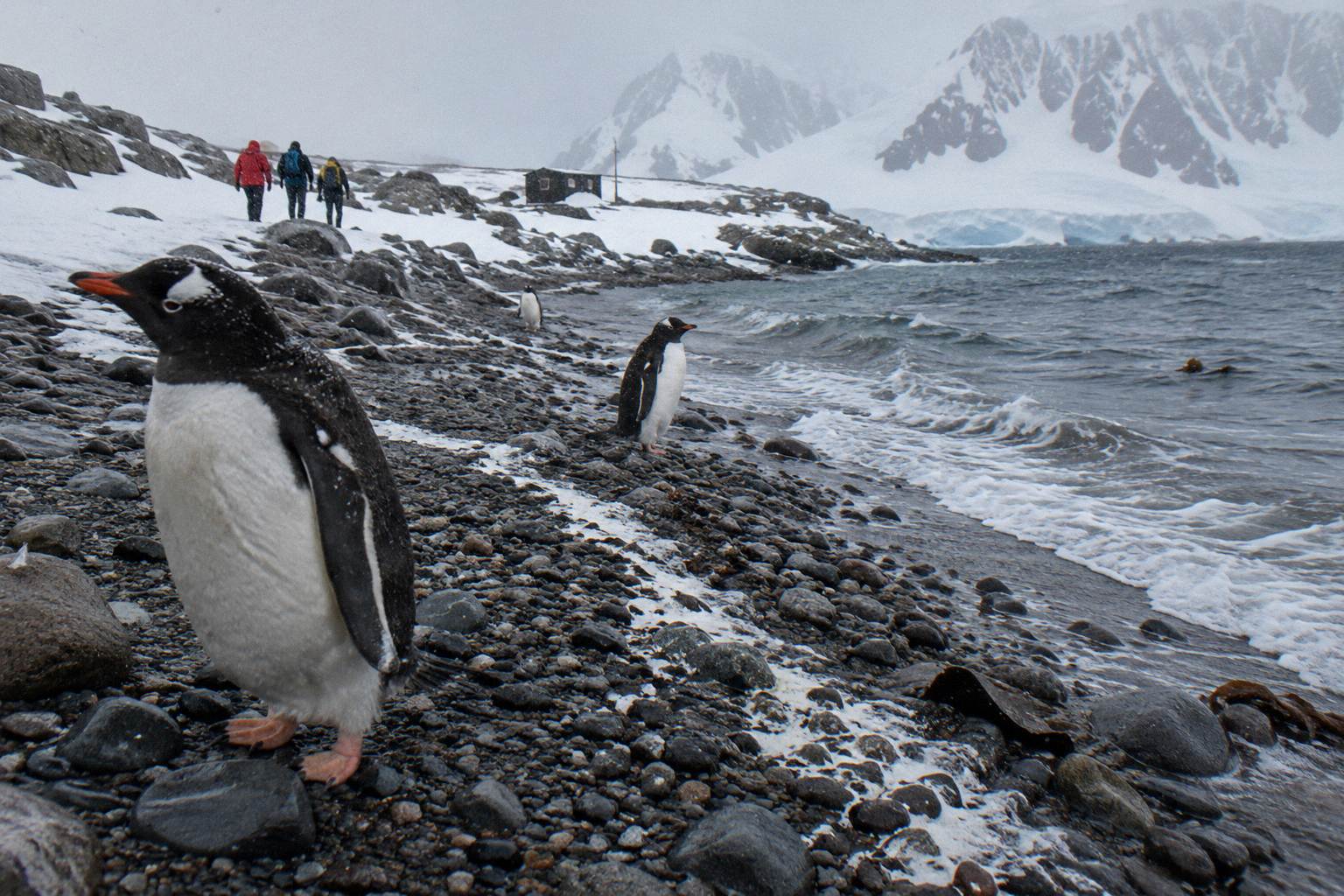 Avian Flu In AntarcticaWhat H5N1 means for Antarctic landings, wildlife and your voyage.Read the guide
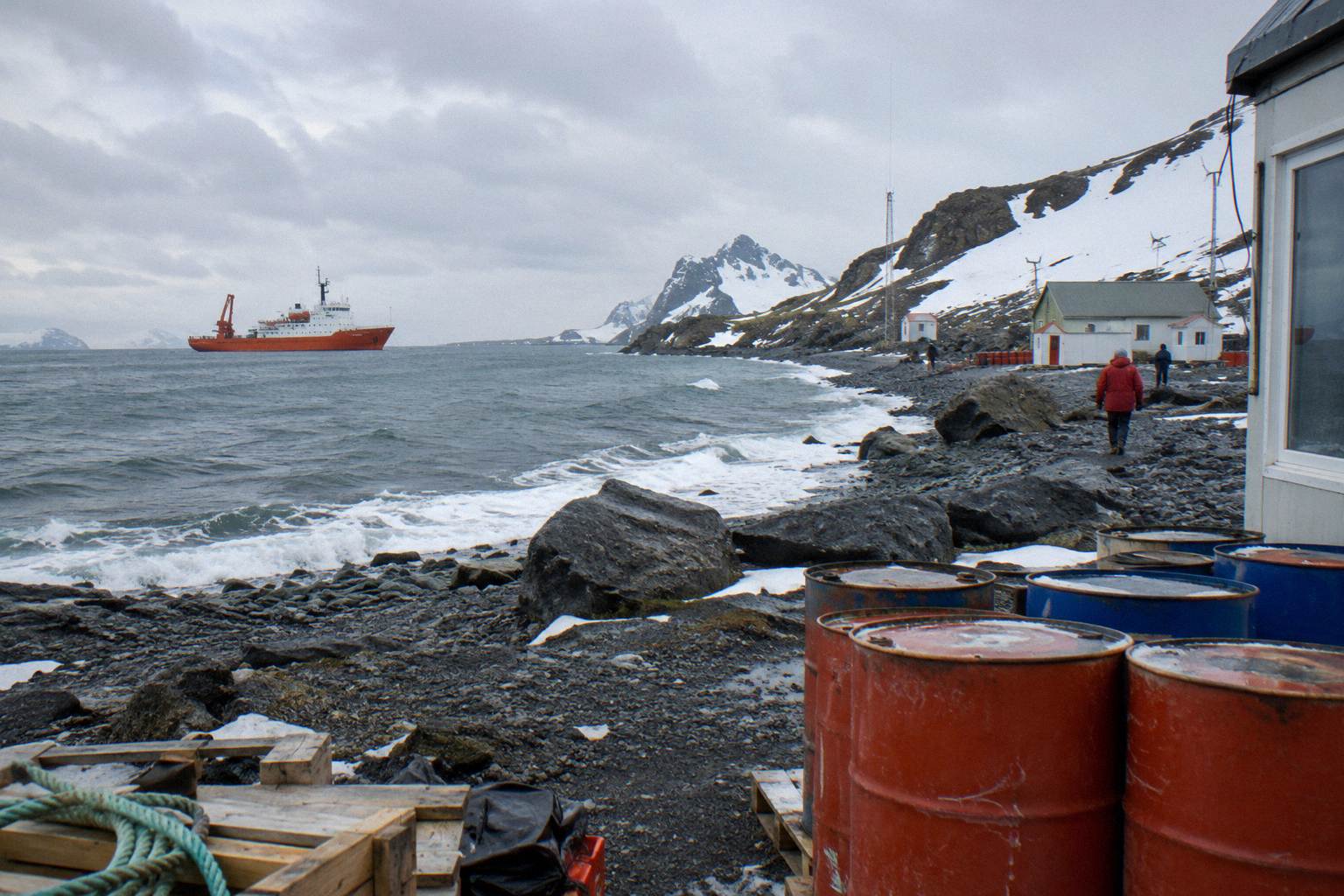 Research StationsWhich Antarctic bases let cruise passengers ashore, and which stay firmly closed.Read the guide