Last-Minute Antarctica Cruise Deals: Do They Still Exist?
 By Oleg G.
Yes, last-minute Antarctica cruise berths exist, but the market that sells them is narrower and more seasonal than the deal headlines suggest. Here is what the published numbers actually show.
Quick answer: Last-minute Antarctica cruise deals are real: published reports show 25 to 60 percent off select 2026-27 departures, and Ushuaia agencies do resell unsold berths. But they cluster in November and March, on budget ships like Plancius, Ortelius and the G Adventures Expedition, and are rare for peak December sailings.
Do Last-Minute Antarctica Cruise Deals Still Exist?
Yes, they do, but the market is narrower than the deal-hunting copy suggests. Published reports for the 2026-27 season show last-minute discounts of 25 to 60 percent on select departures, with November and March shoulder sailings typically offering the larger discounts. Last-minute discounts are uncommon on peak December sailings, which reportedly book 18 or more months ahead.
The honest starting point is that an Antarctica cruise is one of the few travel products where genuine last-minute inventory exists, because operators would rather fill a berth cheaply than sail with an empty cabin. Unsold-berth trackers reported discounts of 25 to 60 percent on select 2026-27 departures, with examples on the HX ships Fridtjof Nansen and Roald Amundsen sailing in November and December 2026. One seller of late Antarctic inventory advertised reductions up to 40 percent on select November and December 2026-27 cruises. These are real numbers from named sources, not marketing claims, and they answer the core question: the deals exist.
The catch is what "last minute" means here: a specific date on a specific ship. You are not shopping a catalog. You are waiting for an operator to blink on a sailing that has not filled, and then moving fast on whichever cabin category is left. Sources describe last-minute deals as limited in availability and cabin choice.
This site exists because that shopping process is genuinely hard to do alone. Cruises In Antarctica tracks the ships and the season patterns so you can judge whether a late berth suits you, and a free consultation on current deals can tell you what is actually unsold before you plan around a price that no longer exists.
How The Ushuaia Walk-Up Market Actually Works
Ushuaia is the clearing house. Local agencies there receive unsold inventory directly from operators and resell it to walk-up travelers and to people on alert lists, and one sourcing guide reports savings of 40 to 54 percent versus standard fares on late bookings. The catch is timing: you arrive in Tierra del Fuego with flexible dates and wait, which trades certainty for price.
The mechanism is simple and worth understanding before you chase it. Operators do not want to sail with empty berths, so when a departure approaches and cabins remain, the inventory gets pushed out to agencies in Ushuaia that handle walk-up and alert-based bookings. One published guide to the Ushuaia last-minute market describes exactly this flow: the agencies receive unsold berths from operators and resell them, either to travelers physically in town or to people who have asked to be notified. You can read the same source directly at this guide to last-minute Ushuaia bookings.
What the walk-up model demands from you is flexibility on almost everything except the destination. You may arrive hoping for one itinerary and be offered a different one. The date may shift by a day or two when a ship's schedule moves. Your cabin will be whatever is left. If you are a solo traveler this matters more, because a share-basis berth or a dedicated solo cabin has to be among what is left.
The season also decides how well the strategy works. November and March, the shoulder months, typically offer the larger discounts because that is where availability sits, according to the same sourcing. The expedition season runs November to March, with the mainstream vessels concentrated on the Antarctic Peninsula. Early November and late March sailings carry more risk with them, rougher potential crossings and changing wildlife, in exchange for lower prices and better odds of a late berth.
The alternative to flying down and waiting is the alert route: you register with a seller or agency, state your dates and budget, and get notified when a matching cabin drops. It may miss some walk-up offers made to people already in town, but it removes the cost of sitting in Ushuaia for an open-ended week.
How Much Can A Last-Minute Booking Actually Save?
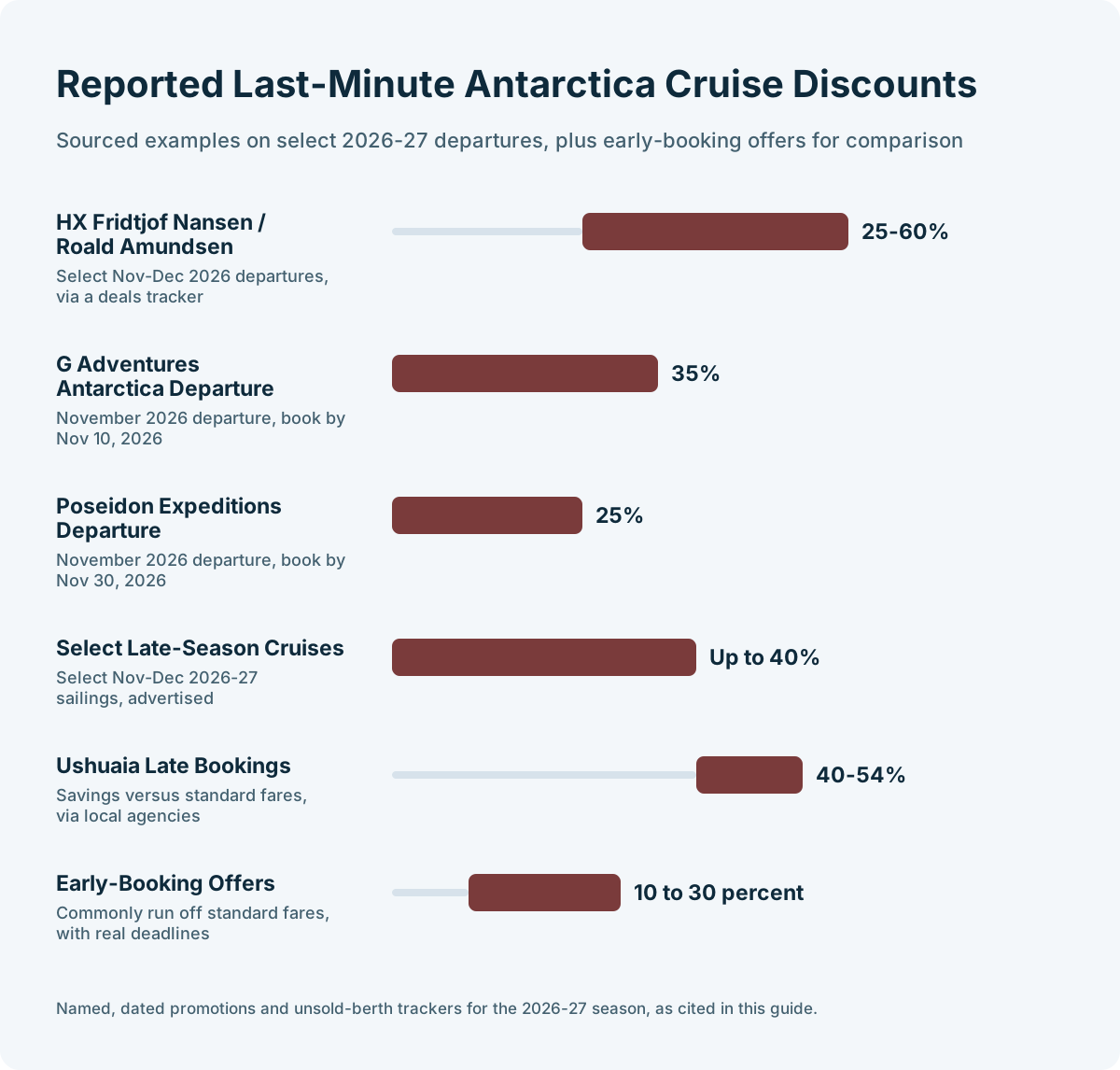
On the published examples, the honest range is wide: 25 percent off a November 2026 Poseidon departure for bookings by the end of that month, 35 percent off a November 2026 G Adventures departure, and reported savings of 40 to 54 percent on Ushuaia late bookings, with discounts up to 60 percent logged on select 2026-27 HX sailings. Against that, December peak berths rarely discount at all.
The numbers come from named, dated promotions, so it is worth laying them out plainly. G Adventures ran 35 percent off a November 2026 Antarctica departure, a booking window that closed on November 10, 2026. Poseidon Expeditions offered 25 percent off a November 2026 departure, bookable by November 30, 2026. A deal aggregator logged discounts of 25 to 60 percent on select 2026-27 sailings including the HX ships Fridtjof Nansen and Roald Amundsen, and a specialist seller advertised up to 40 percent off select November and December departures. You can verify the HX examples on the live tracker at this unsold-berth deals page.
Two things those numbers do not say. First, none of them applies to the ship or the date you may already have in mind. The discounts are on specific unsold departures, and the specific cabin is part of the deal. Second, the percentage is taken off the operator's standard fare, which itself varies by cabin category and season. A 40 percent cut from a peak-season balcony rate can still cost more than a shoulder-season twin at full price.
| Published example | Discount | Conditions reported |
|---|---|---|
| HX Fridtjof Nansen / Roald Amundsen sailings | 25-60% | Select Nov-Dec 2026 departures, via a deals tracker |
| G Adventures Antarctica departure | 35% | November 2026 departure, book by Nov 10, 2026 |
| Poseidon Expeditions departure | 25% | November 2026 departure, book by Nov 30, 2026 |
| Select late-season cruises (reseller) | Up to 40% | Select Nov-Dec 2026-27 sailings, advertised |
| Ushuaia late bookings generally | 40-54% savings reported | Versus standard fares, via local agencies |
The baseline matters here. Entry-level expedition berths on Drake-crossing itineraries begin at roughly $7,500 to $8,995 per person for 10- to 11-day Peninsula voyages in shared twin or triple cabins, per one 2026 cost guide. A deep percentage off a higher category can land near that same floor, which is why the real question is never "what percentage" but "what final fare, in which cabin, on which ship." That is a question about live inventory, and a check on real current availability answers it faster than any published table can.
Early-Booking Deals Versus Last-Minute Prices
Early-booking offers for the coming seasons commonly run 10 to 30 percent off, with up to 40 percent on select unsold 2026-27 sailings, and last-minute reductions sometimes cut deeper than the early offer on the same operator. The trade is straightforward: book early for choice of ship, cabin and date, or book late for price and take what is left.
The structure of the Antarctic pricing year is that operators open each season's fares high, attach early-booking discounts with real deadlines, and then, for sailings that under-fill, let prices fall again inside the final months. Published examples show last-minute reductions of 35 percent on one operator's November 2026 departure that were deeper than its standard early offers on the same line. That is the honest version of the "wait and save" argument, and it is true for the departures where it is true.
What waiting costs you is everything besides price. Peak December and January sailings, the warmest and most wildlife-rich months on the Peninsula, are the ones that fill first, and last-minute discounts are described as uncommon for peak December specifically. Last-minute deals are also limited in cabin choice, and waiting means booking flights to Ushuaia at short notice.
The people for whom last-minute genuinely wins are a specific type: flexible on dates, flying on a budget route into Argentina anyway, happy with a shared cabin, and unattached to a particular ship. If you want a specific vessel, a solo cabin, a December date, or a South Georgia itinerary, the early-booking side of the ledger is where you will end up with something you actually want. Planning the full budget is easier with our complete Antarctica cruise cost breakdown, which is written for people comparing both routes.
Which Ships And Months Hold The Unsold Berths
The published discounts name HX, G Adventures and Poseidon departures, and the larger discounts cluster in the shoulder months of November and March. Roster from-fares show where the bottom of the market sits: Plancius starts from $7,050, the G Adventures Expedition from $7,439, and Ortelius from $7,800, so the discount conversation happens at the bottom of the market.
The budget small-ship fleet sets the floor any discounted fare is measured against. Plancius, a 1976-built former Dutch Navy oceanographic vessel rebuilt as a passenger ship in 2009, carries 108 passengers in 50 cabins and lists Peninsula voyages from $7,050 per person. Ortelius, a 1989 former Russian research vessel, also carries 108 and starts from $7,800. The G Adventures Expedition, built 1976, carries 128 and starts from $7,439.
Plancius deserves a specific mention because it has the lowest roster from-fare and an itinerary list that stretches from 10-day Peninsula trips to 33-day extremes. Its Basecamp voyages include camping, kayaking, snowshoe hiking, mountaineering and a photo workshop in the program.
The months follow the same logic as the ships. November and March, the shoulder ends of the November-to-March expedition season, are where sources report the larger discounts and where availability sits. A budget-focused season guide put typical shoulder pricing around $7,279 for a November G Adventures sailing in its 2026 examples. Peak December and January, with the longest daylight, the warmest Peninsula temperatures and peak penguin-chick activity, are the months that fill first and discount last.
Comparing the three roster ships side by side shows how narrow the choice at this end of the market really is.
| Ship | Class | Passengers | Ice class | From, per person | Voyage length | Departs from |
|---|---|---|---|---|---|---|
| PlanciusOceanwide Expeditions | Small-Ship Budget | 108 | 1D | from $7,050 | 10 to 33 days | Ushuaia |
| OrteliusOceanwide Expeditions | Small-Ship Budget | 108 | UL1 | from $7,800 | 11 to 25 days | Ushuaia |
| Expedition (G Adventures)G Adventures | Small-Ship Budget | 128 | Ice Class 1A | from $7,439 | 11 to 14 days | Ushuaia |
| Ship | Operator | Passengers | Built | Ice class | Peninsula from (pp) | Typical voyage days |
|---|---|---|---|---|---|---|
| Plancius | Oceanwide Expeditions | 108 | 1976 (rebuilt 2009) | 1D (Lloyds, at 5 m draught) | $7,050 | 10-33 |
| Ortelius | Oceanwide Expeditions | 108 | 1989 | UL1 (equivalent to 1A) | $7,800 | 11-25 |
| Expedition (G Adventures) | G Adventures | 128 | 1976 | Ice Class 1A | $7,439 | 11-14 |
| Hondius | Oceanwide Expeditions | 170 | 2019 | Polar Class 6 (equivalent 1A-Super) | $7,800 | 11-19 |
| Sea Spirit | Poseidon Expeditions | 114 | 1991 (refit 2017) | Ice-strengthened hull | $8,846 | 12-23 |
One caution on the walk-up dream: the deepest discounts land on the least flexible products. A 60 percent headline on a select HX sailing applies to that sailing, in the cabins that were unsold, on the date it was unsold. If your heart is set on a particular class of ship, the mainstream versus expedition comparison in our expedition versus traditional cruise guide explains what you actually give up by taking whatever is left.
What A Last-Minute Berth Costs Beyond The Fare
A late berth still needs flights, gear, insurance and a realistic budget. One published cost guide puts the all-in range for a 10- to 12-day mid-range Peninsula trip at $12,000 to $25,000 per person including fare, flights, gear, tips and insurance, with tips averaging about $16 per person per day. The discount trims the fare component, not the rest of the stack.
The airfare is the piece that quietly erodes last-minute savings. US travelers reach Ushuaia through Buenos Aires, and booking late means buying those flights at short notice. Several operators bundle pre-cruise hotel nights and charter flights into their packages; on the walk-up route you buy all of that separately, at short notice, in Patagonia's busiest port town.
Insurance is the other non-negotiable. Most operators require or recommend full travel insurance with medical evacuation coverage, and it is not included in base fares. The same published cost guides note that fuel surcharges are rare or minimal in published 2026-27 pricing, but medical evacuation cover is standard. If you are booking a cabin weeks out, you need a policy you can buy immediately.
Then there is cabin economics. Single supplements typically run from 25 percent extra up to one and a half to two times the twin-share rate, depending on ship, cabin and date, though some lines waive them on select sailings and lower categories often have sharing options. For a solo traveler, the last-minute market is mostly a market for shared berths. Oceanwide offers share-basis cabins for solo travelers, and G Adventures charges no single supplement when a solo traveler shares a twin or triple with another traveler of the same gender, both of which make those two operators the natural home for a late-booking solo.
| Cost element | What published cost guides say | How a last-minute booking changes it |
|---|---|---|
| Cabin fare | Entry berths from roughly $7,500-$8,995 pp, 10-11 day Peninsula voyages | The discounted piece; 25-60% off select departures |
| Flights to Ushuaia | Routed via Buenos Aires; several operators bundle charters | Bought separately, at short notice |
| Insurance | Medical evacuation required or recommended by most operators; not in base fares | Same cost, bought faster, tighter windows |
| Tips | Average about $16 pp per day | Unchanged by the discount |
| All-in budget | $12,000-$25,000 pp for a 10-12 day mid-range trip | Fare falls, the rest does not |
The risk ledger is short but real. Last-minute discounts are limited in availability and cabin choice, and they are uncommon for peak December sailings. A November or March berth on a budget ship at 40 percent off is a genuine find. A December balcony at 40 percent off does not exist in any published example, and waiting for one is how a season gets missed entirely.
So Should You Wait For A Deal?
Wait only if you are flexible on ship, cabin and date, and flying to South America anyway. Book early if you want a December or January departure, a specific vessel, a better cabin or a South Georgia itinerary, because the published evidence says those sell first and rarely discount. The published deals point to shoulder-month departures and whatever cabins are left, and for the right person that is a bargain.
I have spent a long time reading operator fare pages for this site, and the sources point to a discount market in Antarctica is a budget-ship, shoulder-month market with a short booking fuse. The genuine strategy is not "wait for a deal" in the abstract, it is "decide in September which November and March departures you would accept, register for alerts, and be ready to move the week they open." Waiting until late to book a peak December date rarely pays, because last-minute discounts are uncommon on peak December sailings.
If you are torn, the season question usually resolves the ship question, and our guide to the best time to visit Antarctica lays out the month-by-month trade. For anyone whose priority is simply the lowest possible fare into the Peninsula, the walk-up and alert route through the budget fleet is the one with a documented track record of savings, and checking what is genuinely unsold right now is the first step before you build a plan around it.
Common Questions About Last-Minute Antarctica Cruise Deals
Do last-minute Antarctica cruise deals still exist?
Yes. Published 2026-27 examples include 25 to 60 percent off select departures, 35 percent off a November 2026 G Adventures sailing, 25 percent off a November 2026 Poseidon sailing, and advertised savings up to 40 percent on select late-season cruises. The larger discounts typically appear in the November and March shoulder months.
How much can I save on a last-minute Antarctica cruise?
Reported figures range from 25 percent on named operator promotions to savings of 40 to 54 percent on Ushuaia late bookings versus standard fares, with discounts up to 60 percent logged on select 2026-27 sailings. The percentage applies to a specific unsold departure and cabin, not to the ship or date of your choosing.
Can you really just show up in Ushuaia and get a cheap berth?
It happens. Ushuaia agencies receive unsold inventory directly from operators and resell it to walk-up travelers and alert-list subscribers. The trade-off is an open-ended wait in town, last-minute airfares, and a cabin that is whatever is left.
Which months have the most last-minute Antarctica availability?
November and March, the shoulder ends of the November-to-March expedition season, are where sources report the larger discounts and greater availability. Peak December and January sailings fill first, and last-minute discounts are described as uncommon for peak December, which travelers reportedly book 18 or more months ahead.
Which ships most often have unsold berths?
Published 2026-27 examples name HX's Fridtjof Nansen and Roald Amundsen, a G Adventures departure and a Poseidon departure. On fare alone, the lowest roster from-prices sit on Oceanwide's Plancius (108 passengers, from $7,050 pp), the G Adventures Expedition (128, from $7,439) and Ortelius and Hondius (from $7,800).
Is it cheaper to book last minute or with an early-booking offer?
Both exist. Early-booking offers for coming seasons commonly run 10 to 30 percent off, with up to 40 percent on select unsold 2026-27 sailings, and published examples show last-minute reductions sometimes deeper than the early offer on the same operator. Last minute wins on price but loses on choice of date, ship and cabin; early booking wins on all three.
More Cost And Booking
 Cruise CostA per-person price ladder from $7,050 berths to $32,320 luxury voyages, with what fares include and what they quietly leave out.Read the guide
 Cheap Antarctica CruisesThe honest floor for Antarctica fares, which ships carry it, and what it costs all-in.Read the guide
 What Is IncludedWhat an Antarctica fare really covers, operator by operator, plus the hidden costs with published amounts.Read the guide
 Prices By MonthPublished month-by-month fares for the 2026-27 season, from about $6,900 in March to $30,205 over Christmas.Read the guide