Snow Or Rain On An Antarctica Cruise? What The Weather Really Brings
 By Oleg G.
Most people picture Antarctica as a desert of permanent snow, and the precipitation statistics back that up for the interior. But a Peninsula cruise is a different climate, and in midsummer you can meet rain, wet snow, or both in a single landing.
Quick answer: Yes, it can rain on an Antarctic Peninsula cruise, most likely between December and February when coastal temperatures hover near freezing. November and March run colder. The British Antarctic Survey reports the Peninsula has warmed roughly 0.3 to 0.5 degrees Celsius per decade since the 1950s, with more rain events replacing snow.
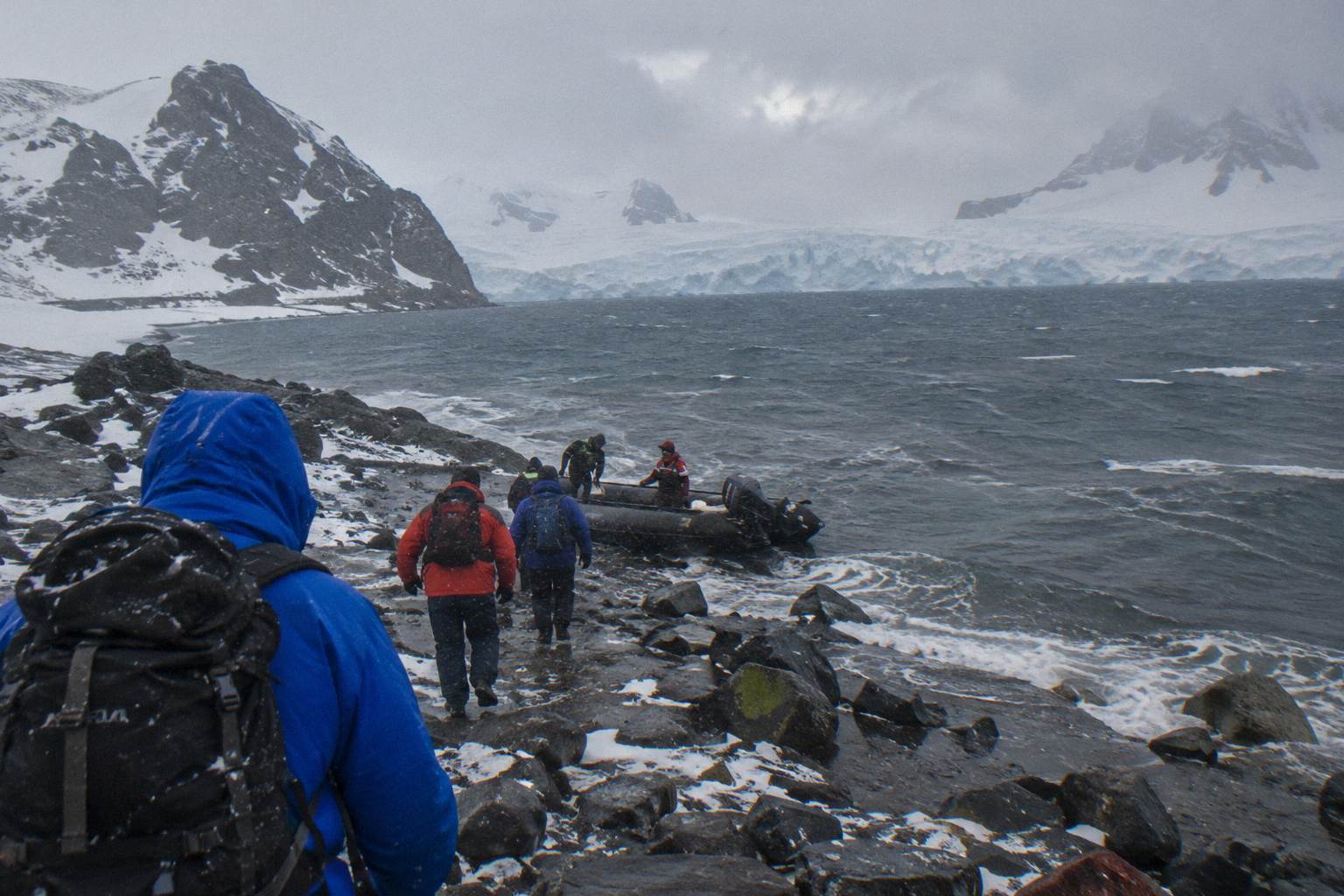
The Antarctic Peninsula, where roughly 98 percent of Antarctic tourism voyages happen according to the Antarctic Treaty Secretariat, is the part of Antarctica cruise passengers actually experience. In the austral summer its coasts sit close enough to freezing that the same water can fall as snow one hour and rain the next. If you are booking an Antarctica cruise and staring at a jacket spreadsheet, that distinction shapes your packing.
Does It Rain In Antarctica?
Yes, it rains on the Antarctic Peninsula, most often in the height of summer. Coastal summer temperatures typically run from about -5 to +5 degrees Celsius, so the Peninsula sits right at the freezing line where precipitation phase flips between snow and rain depending on the day.
The question needs splitting in two, because "Antarctica" covers a whole continent, and nobody on a tourist cruise visits the interior weather. What you experience is the Peninsula and its islands, roughly between 62 and 66 degrees south, where a Cruises In Antarctica voyage spends nearly all its time.
There, the pattern is different. Research on northern Peninsula precipitation covering 1985 to 2016 found that the share of precipitation falling as rain versus snow varies with air temperature, and that warmer anomalies increase the proportion of rain. In practical cruise terms: a December day at 2 degrees Celsius with wind off open water can deliver an hour of drizzle, then drop to sleet by evening.
Rain here is a gear question as much as a weather one: waterproofs matter at least as much as warmth. The British Antarctic Survey reports summer rain days increasing on the northern Peninsula, with some characterisations putting the northwest at more than fifty days with rain a year.
If your whole mental image of the trip is powder and penguins, that is still mostly right, but plan for water. A decision about which month to travel and how waterproof your kit needs to be is exactly the kind of thing worth settling early, and a free consultation on dates and gear can pin down the month-by-month trade-offs before you commit.
Rain Versus Snow On The Peninsula In Summer
Summer rain on the Peninsula concentrates in December through February, when coastal air temperatures sit near or just above freezing, while November and March run colder, with fresh deep snow on land in November. Typical summer air temperatures run from about -5 to +5 degrees Celsius, with wind chill pushing deck and Zodiac conditions well below that.
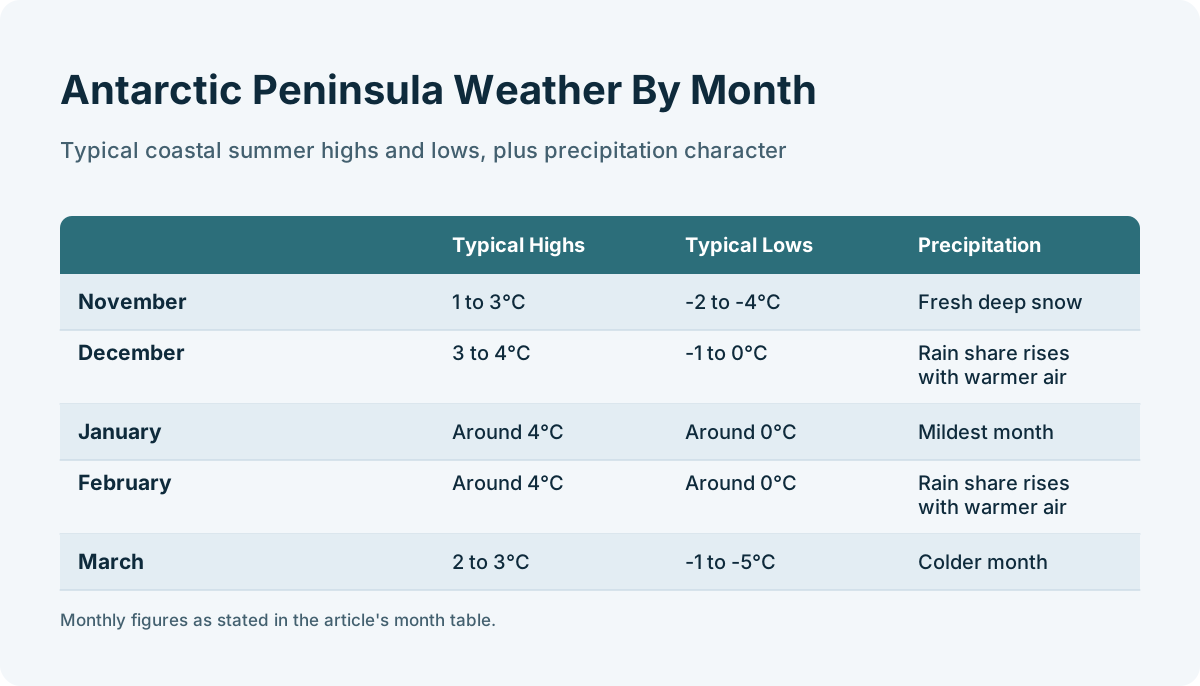
Month by month, the temperature bands on the Peninsula coast look roughly like this, based on station data from sites such as Carlini and Esperanza:
| Month | Typical highs | Typical lows | Precipitation character |
|---|---|---|---|
| November | 1 to 3°C | -2 to -4°C | Fresh deep snow; some sites still snowed in or ice-blocked |
| December | 3 to 4°C | -1 to 0°C | Summer season; rain share rises with warmer air |
| January | Around 4°C | Around 0°C | Mildest month, often near or above freezing |
| February | Around 4°C | Around 0°C | Summer season; rain share rises with warmer air |
| March | 2 to 3°C | -1 to -5°C | Not stated |
November is the freshest, most pristine-looking month, with greater sea ice coverage and deep snow on land, and some landing sites may still be snowed in or blocked by ice. December brings the longest daylight, near 20 hours or more on the Peninsula, and the first penguin chicks. January is typically the warmest month, often near or above freezing on the northern Peninsula. February is similarly mild, and March is a colder shoulder month with the advantage of lower fares and strong whale activity.
The rain itself matters less than what it does to the snow you stand on. A rain event can turn landing sites slushy. By February, colonies are described in operator materials as messier, with chicks in crèches and more activity. February and March also bring what the seasonal guides call increased fur seal activity on the Peninsula, and wet ground plus seals changes how an expedition team manages a landing, because IAATO guidance requires keeping at least 5 metres from wildlife.
Your experience of precipitation is also a daylight experience. Daylight hours on the Peninsula run roughly 17 to 18 hours in November, peak near 19 to 21 hours around the solstice in late December, then fall back to about 12.5 hours by March. More daylight simply means more hours in which weather can change, and Peninsula weather changes fast enough that expedition teams keep multiple landing plans and brief guests nightly.
The Warming Trend On The Antarctic Peninsula
The Peninsula has warmed by roughly 0.3 to 0.5 degrees Celsius per decade since the 1950s according to the British Antarctic Survey, and recent winters show more rain events replacing snow, with 2025 and 2026 heatwaves noted; higher-emissions projections point to more summer rain and a longer melt season.
The current position of the British Antarctic Survey is that the Peninsula has warmed by about 0.3 to 0.5 degrees Celsius per decade since the 1950s, and that recent winters show more rain events replacing snow, with heatwaves noted in the 2025 and 2026 seasons. BAS also reports that summer rain days are increasing on the northern Peninsula, with some characterisations putting the northwest at more than fifty rain days per year.
The mechanism is simple: precipitation phase follows air temperature. Peer-reviewed analysis of 1985 to 2016 data found that warmer anomalies raise the proportion of precipitation falling as rain rather than snow. Under higher-emissions projections, the Peninsula sees more summer rain and a lengthening melt season. Nobody can tell you whether your specific January voyage will get drizzle; what the data supports is that drizzle is a growing share of the norm rather than a fluke.
One caution: the warming trend is real, but summer air temperatures still run from about -5 to +5 degrees Celsius. Treat warming as a shift in the odds, not a new climate. If you want help weighing a warmer, wetter January against a colder, snowier November, that is a fair question for a season-choice conversation with a specialist.
What Rain And Snow Mean For Your Gear
Wet conditions, not extreme cold, are the packing problem on a Peninsula cruise: rain and slush soak inadequate gear long before the temperature hurts you, so fully waterproof shell layers, sealed seams and quick-drain gloves matter more than thick insulation, which you can adjust in layers.
The classic first-timer mistake is overpacking bulky insulation and underpacking waterproofing. The reality of Peninsula weather is that most days sit between -5 and +5 degrees Celsius, which is a ski-hill temperature band, and the thing that makes people miserable is water: rain through a "water-resistant" jacket, slush into non-sealed boots, sodden gloves that never dry in cabin air. Our full Antarctica packing list covers the complete kit, but the rain-and-snow lens changes a few priorities:
| Gear item | Why precipitation decides it |
|---|---|
| Waterproof shell jacket and trousers | Must be genuinely waterproof, not water-resistant; rain and wet snow defeat cheap shells |
| Sealed waterproof boots | Most landings are wet landings, plus slush and meltwater |
| Two or three glove pairs | One soaked pair ruins a landing; rotate and dry |
| Synthetic or wool base layers | Cotton stays wet; a January drizzle plus cotton is hypothermia risk |
| Dry bags for camera gear | Rain, spray and Zodiac splashes hit electronics first |
Operators help more than newcomers expect. Most expedition operators provide a complimentary parka, often yours to keep, and loan waterproof boots, per cost guides covering the major lines; Oceanwide and G Adventures list boot loan and parkas among their inclusions. That shifts your own budget toward the layers and the small waterproof items, and it means you should check what your specific voyage includes before buying an expensive parka you may not need. Gratuities, typically in the $15 to $25 per day range on most lines per recent cost guides, are a separate line to plan.
Snow you can brush off. Rain gets into everything, and wet gear does not dry well in small cabins. Pack so that a two-hour drizzle during a Zodiac cruise is an inconvenience rather than an expedition-ending problem, and photograph with the expectation of spray: dry bags and a lens cloth you keep inside your jacket are worth their weight.
How Rain And Snow Affect Landings And Zodiacs
Wind, swell and ice are the conditions operators cite when captains and expedition leaders judge each landing case by case; rain mainly makes a landing wetter and slower, with slush making walking harder.
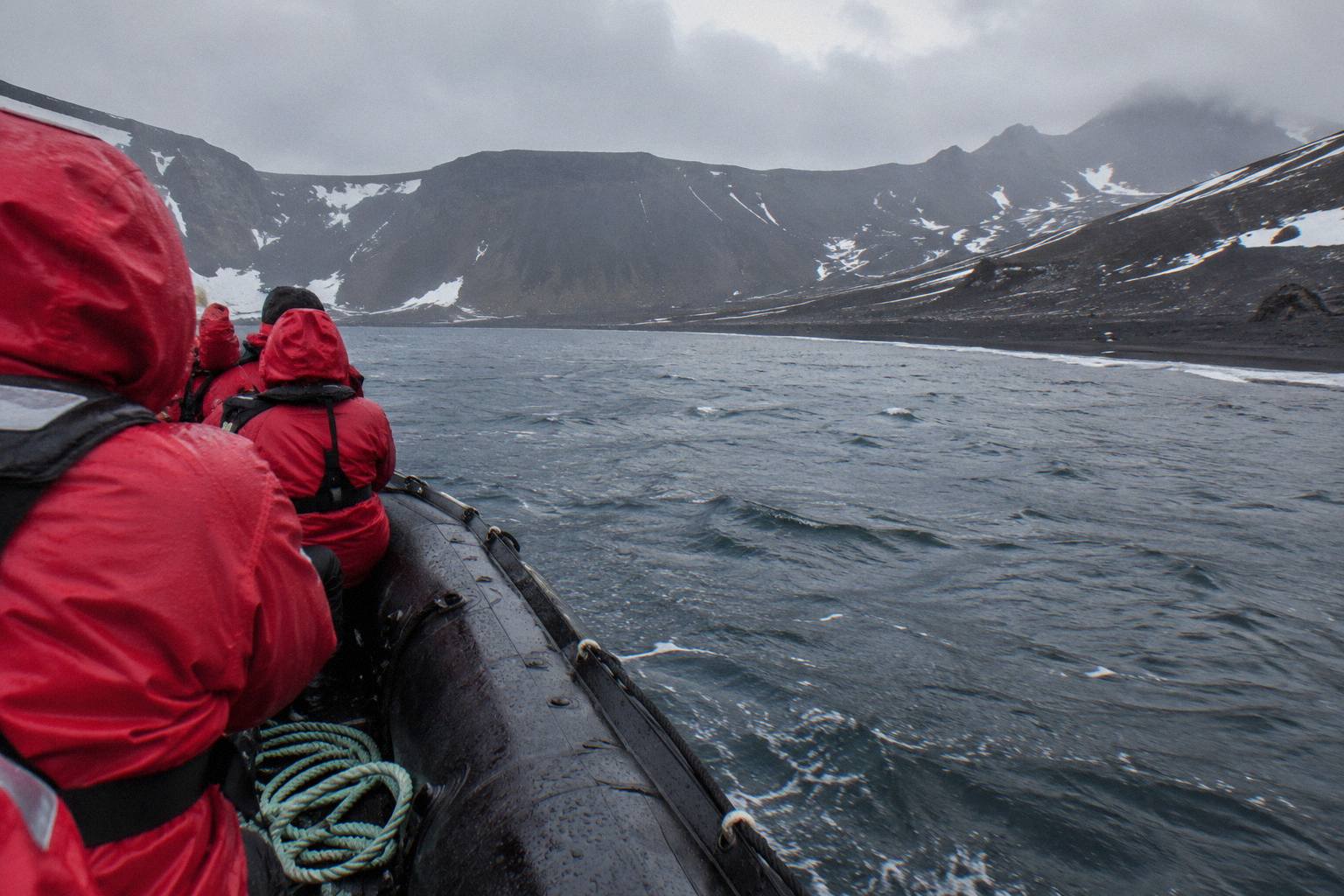
Most Peninsula landings are wet landings: you step from the Zodiac into shallow water onto a beach, so your feet are getting wet regardless of what falls from the sky. Rain adds a second source of water and one more variable for the expedition team. The rules the teams work within come from IAATO: a maximum of 100 passengers ashore from a vessel at any one time, a minimum 1:20 guide-to-visitor ratio, at least 5 metres from wildlife, and careful boot and equipment cleaning between sites for biosecurity.
Wind is the variable expedition teams describe weighing most, because wind against swell at the gangway makes Zodiac launches unsafe, and katabatic gusts can arrive off the ice sheet without warning. Expedition leaders monitor forecasts every few hours and hold Plan A, B and C options for each day.
The weather also changes what you photograph. November's deep fresh snow is the pristine postcard look, and after it, operators report quieter landing sites and greater sea ice. Later in the season, colonies are described as messier and busier. Neither is "better", they are different trips, and knowing which aesthetic you want is part of how to answer the broader question of the best time to visit Antarctica.
Practical habits that help: keep your shell hooded even in light drizzle because wet hair chills fast on a moving Zodiac; use the ship's mudroom properly, since IAATO guidelines require cleaning boots and gear between sites; and treat every landing as one that could get rained on, which means camera protection and dry spares in your dry bag, not in the cabin.
Which Ships Sail This Weather: The Oceanwide Trio
Three budget ships that sail these conditions are Oceanwide Expeditions' Hondius, Ortelius and Plancius, carrying 170, 108 and 108 passengers respectively, with fares on 2026-27 Peninsula departures from $7,800, $7,800 and $7,050 per person.
Small-ship expedition vessels are the natural home of this kind of weather. Because they carry fewer guests than large ships, they need fewer landing rotations under the 100-passengers-ashore rule. On the Oceanwide fleet, Basecamp-style voyages bundle activities such as camping, kayaking, snowshoe hiking and photo workshops into the fare on select departures, which suits travellers who want to be out in whatever falls from the sky.
| Ship | Passengers | Ice class | Length | 2026-27 Peninsula from-fare |
|---|---|---|---|---|
| Hondius | 170 | Polar Class 6 (equivalent 1A-Super) | 107.6 m | From $7,800 pp |
| Ortelius | 108 | UL1 (equivalent to 1A) | 90.95 m | From $7,800 pp |
| Plancius | 108 | 1D (Lloyds 100A1, Ice Class 1D at 5 m draught) | 89 m | From $7,050 pp |
| Ship | Class | Passengers | Ice class | From, per person | Voyage length | Departs from |
|---|---|---|---|---|---|---|
| HondiusOceanwide Expeditions | Small-Ship Budget | 170 | Polar Class 6 | from $7,800 | 11 to 19 days | Ushuaia |
| OrteliusOceanwide Expeditions | Small-Ship Budget | 108 | UL1 | from $7,800 | 11 to 25 days | Ushuaia |
| PlanciusOceanwide Expeditions | Small-Ship Budget | 108 | 1D | from $7,050 | 10 to 33 days | Ushuaia |
The Hondius is the newest and largest of the three, built in 2019 and described by the operator as the first Polar Class 6-registered passenger vessel in the world, with cabins from quad porthole up to a Grand Suite with private balcony. Its sheltered indoor Zodiac boarding platform keeps boarding out of the weather. We profile the ship in detail in our Hondius guide.
The Ortelius is a 1989-built former Russian research vessel and it runs Oceanwide's Weddell Sea emperor penguin voyages with helicopter access, where early-season ice and snow are the whole point. The Plancius, a converted Dutch Navy oceanographic vessel rebuilt for passengers in 2009, is the value anchor of the fleet at from $7,050 per person on 2026-27 Peninsula departures, and its cabin categories run from quad porthole to superior.
Swell on the Drake crossing is a separate question from rain; our Drake Passage crossing guide covers what that two-day transit each way is really like. Gratuities on Oceanwide voyages are suggested at 10 to 15 EUR or USD per passenger per day, and fares exclude flights and alcohol, so budget accordingly when comparing against more inclusive upscale lines.
If you are weighing the trio against each other, or against a pricier line with balconies and open bars, a free voyage comparison consultation will sort the trade-offs in one conversation, with no obligation attached.
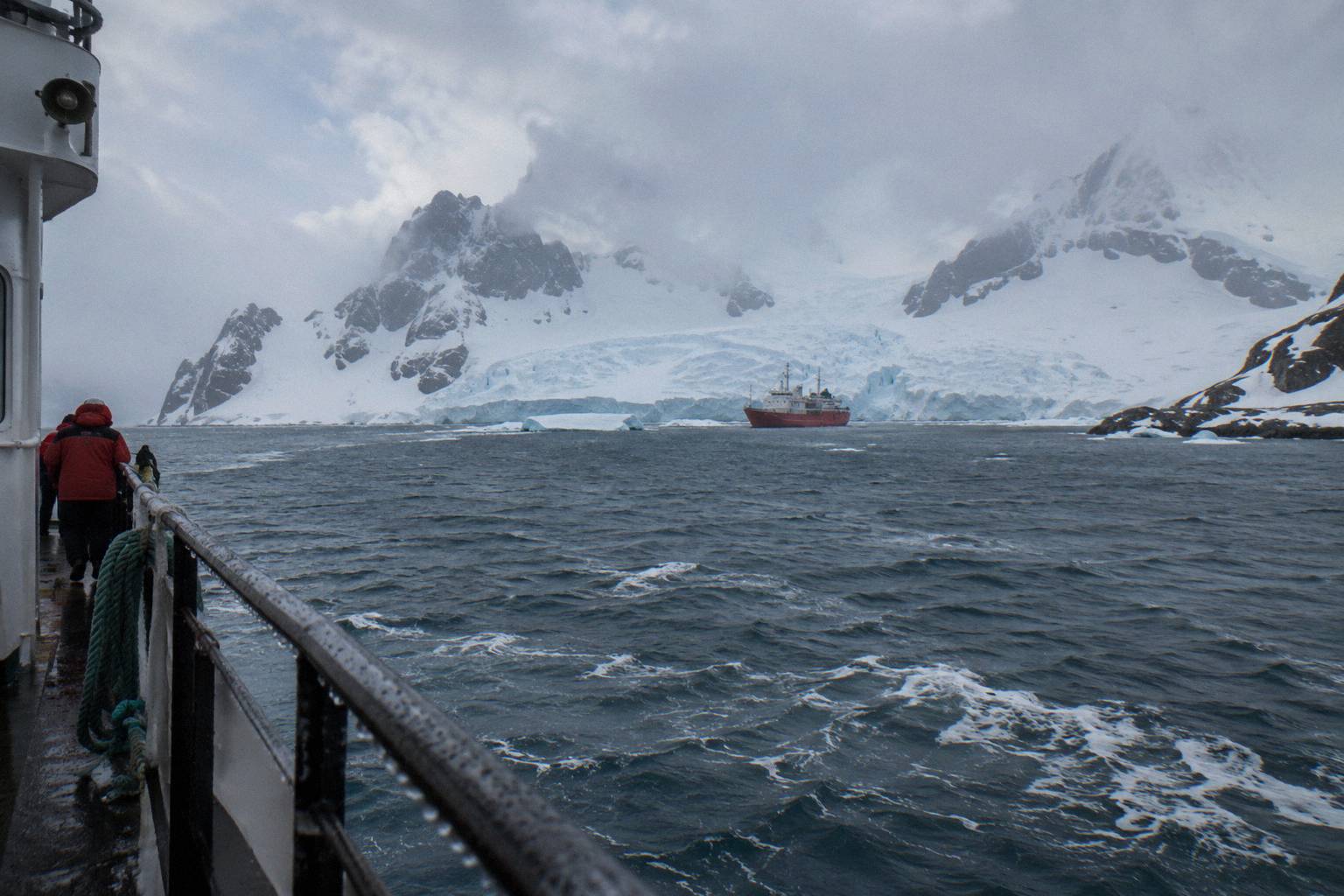
Booking Around The Weather You Want
Choose November or March for the coldest, snowiest, cheapest conditions, December to February for warmth, long daylight and the highest chance of rain, and book 12 to 18 months ahead for peak dates; shoulder-season fares sit 20 percent or more below peak, with November and March departures from around $6,900 to $8,500 per person.
The pricing pattern follows the precipitation pattern closely enough to be useful. November and March are the shoulder months, with fares often 20 percent or more below peak; the 2026-27 examples show an 11-day March Oceanwide sailing from about $6,900 and November G Adventures and Albatros departures in the $7,279 to $8,463 range. December and January carry the highest demand and the holiday premiums, with Lindblad's December 22, 2026 departure flagged at from $30,205 per person in one price survey, against $11,900 starting fares on the same line's standard 12-day voyages.
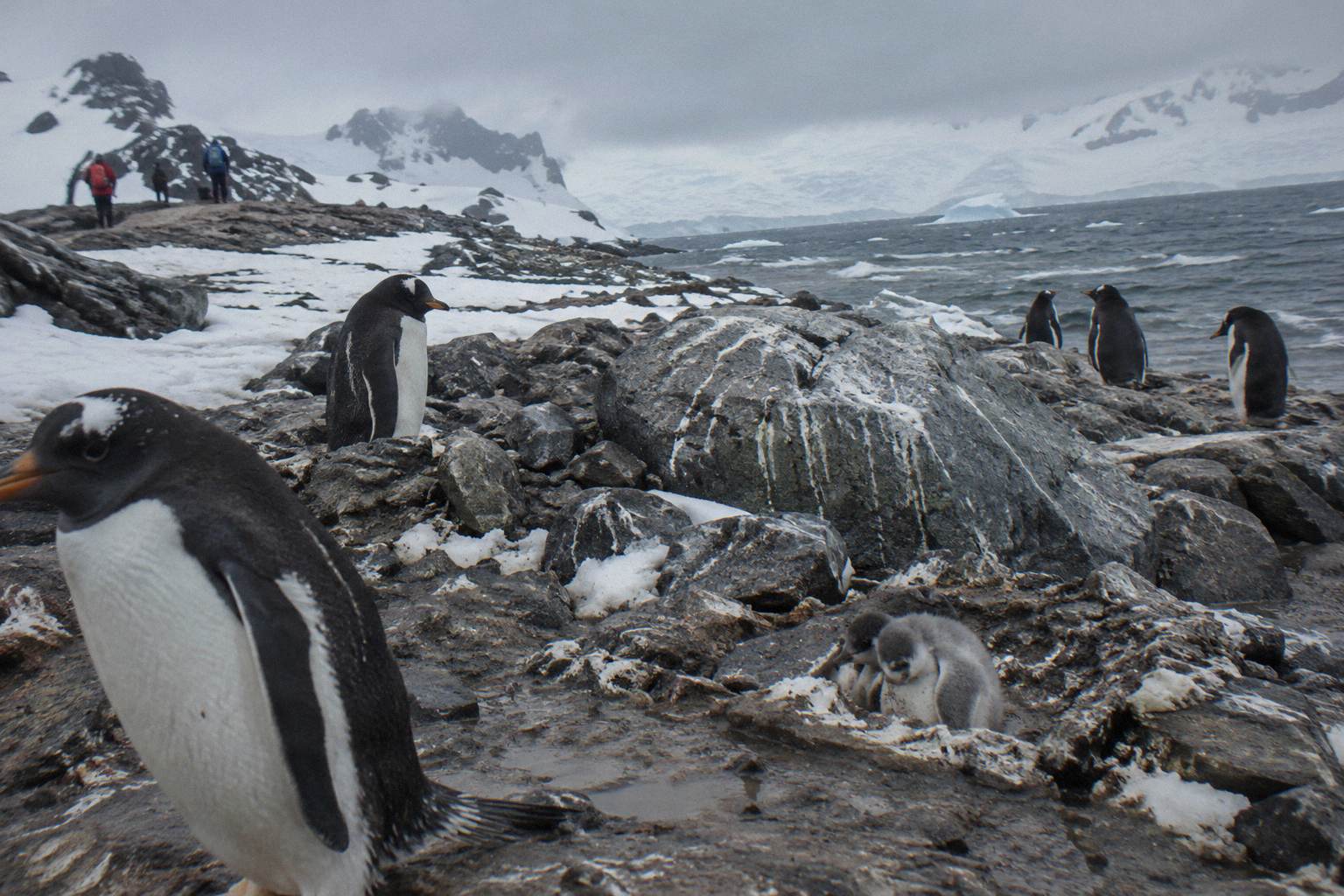
Rain-tolerance is therefore partly a budget decision. If a drizzly afternoon would genuinely dent your trip, favour November, when fresh snow lies deep and temperatures run coldest. If long daylight, the mildest temperatures and the bustle of penguin chicks matter more, take January or February and buy the better shell jacket. December sits between them and carries the solstice daylight maximum plus Christmas and New Year premiums on the peak dates. Early-booking discounts for the 2027-28 season commonly run 10 to 30 percent off, while last-minute discounts of 25 to 60 percent appear on unsold departures but limit your cabin choice and are uncommon for peak December dates, which book furthest ahead.
Insurance is the piece travellers connect late. Travel insurance with medical evacuation cover is required or strongly recommended by most operators and is not included in base fares, and you should arrange it at deposit stage. Weather is the reason: a storm-delayed gateway flight or a rerouted voyage is exactly the contingency cover exists for, and operator terms on cancellations escalate steeply toward 100 percent close to departure.
Common Questions About Snow And Rain In Antarctica
Does it rain in Antarctica?
Yes, on the Antarctic Peninsula, most likely between December and February when coastal temperatures sit near freezing. Roughly 98 percent of tourism voyages happen in the Peninsula region where rain is possible.
Is snow or rain more common on an Antarctic cruise?
Published figures do not give a month-by-month split. Snow is most likely in the colder months of November and March, when Peninsula lows run between -1 and -5 degrees Celsius, and rain becomes a real possibility in December, January and February, when highs reach 3 to 4 degrees Celsius.
Is Antarctica getting rainier?
According to the British Antarctic Survey, the Peninsula has warmed about 0.3 to 0.5 degrees Celsius per decade since the 1950s, recent winters show more rain replacing snow, and summer rain days are increasing on the northern Peninsula, with some northwest areas characterised at more than fifty rain days in a year.
Will rain cancel my shore landings?
Rain is not the condition operators cite. Expedition teams judge each landing case by case on wind, swell at the gangway, beach waves and ice, so dress for wet conditions and expect the call to turn on wind and swell.
What should I pack if it rains on my cruise?
Genuinely waterproof shell jacket and trousers, sealed waterproof boots, spare gloves, and synthetic or wool layers rather than cotton. Most operators supply a parka and loan boots, so spend your own budget on layers, dry bags and glove spares.
Which month is snowiest for an Antarctica cruise?
November, which offers the greatest sea ice coverage, deep fresh snow on land. March is also colder than midsummer and pairs colder conditions with lower shoulder-season fares and strong whale activity.
More Season And Wildlife
 Best Time To VisitMonth by month through the Antarctic season: wildlife, ice, light and price compared.Read the guide
 Antarctica WildlifePenguins, whales and seals by month: what to see, when to go, and which route and ship to book.Read the guide
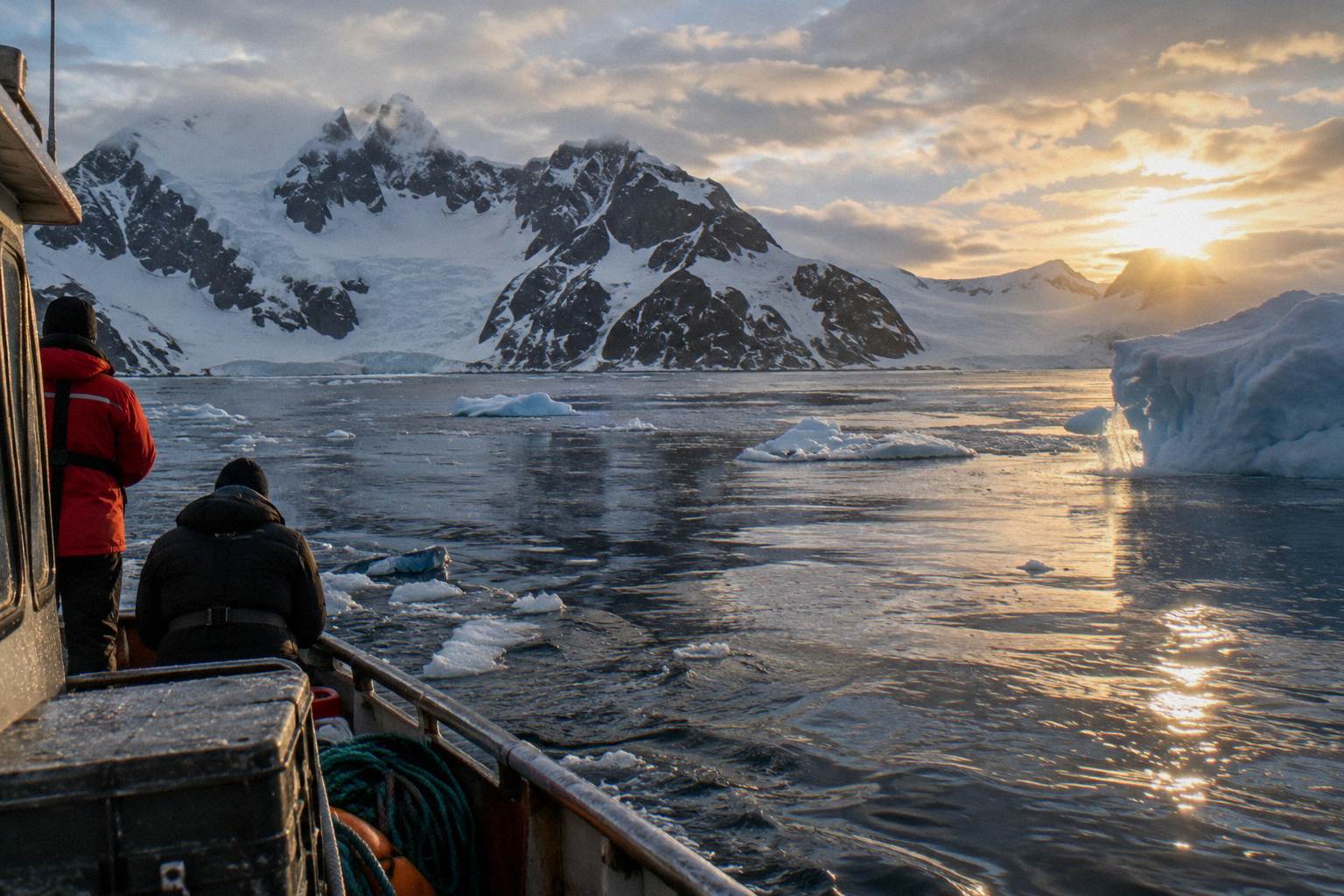 Antarctica DaylightMonth-by-month daylight hours from Ushuaia to the Antarctic Circle, midnight sun dates and what long days mean on board.Read the guide
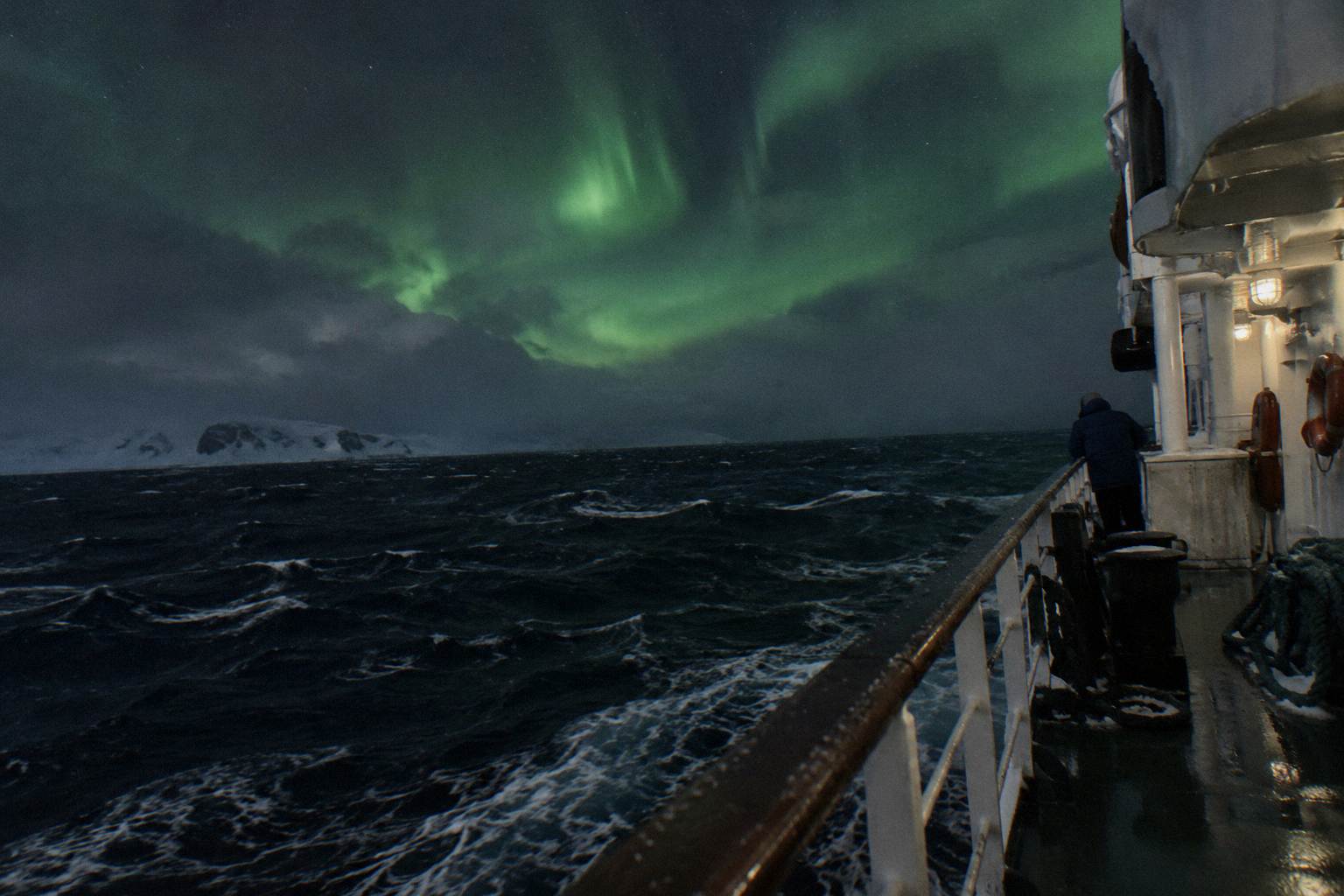 Southern Lights At SeaWhich Antarctic sailings give you a real night sky, and which never will.Read the guide