Falkland Islands On An Antarctica Cruise: What You See And Why It Adds Days
 By Oleg G.
Most Antarctica cruises sail straight past the Falklands. The itineraries that stop there trade sea days for albatross colonies, king penguins and a stop in Stanley, and the trade-off is measured in days and dollars.
Quick answer: Falklands and Antarctica combination voyages run 16 to 28 days total, against 10 to 13 days for a classic Peninsula-only cruise, with from-fares around $17,809 per person against roughly $6,900 for Peninsula-only. Stanley, West Point, Carcass and Saunders islands are the usual stops, and US citizens need no visa for either Argentina or Chile.
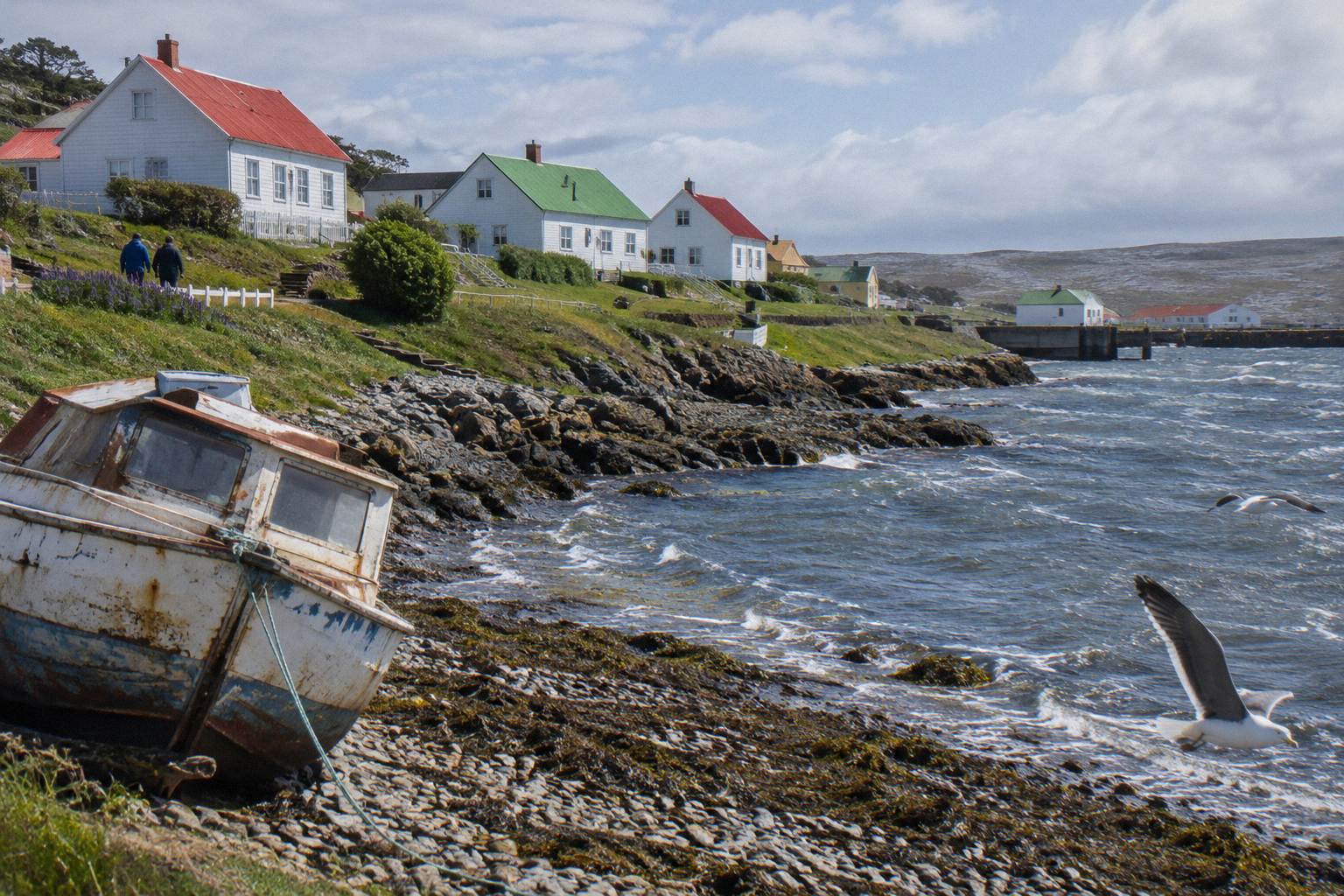
The Falkland Islands sit off the South American coast, and every Antarctica cruise that includes them pays for the privilege in itinerary days. A classic Antarctic Peninsula voyage runs 10 to 13 days with 4 to 6 days in Antarctica itself; the Falklands, South Georgia and Antarctica combinations run 16 to 28 days with 3 to 9 days in Antarctica. The islands are the reason the longer routes exist, and this guide sets out exactly what you get for the extra week.
The route makes sense geographically: ships bound for the Falklands continue to South Georgia and on to the Peninsula, or reverse the loop. Oceanwide Expeditions runs the full circuit on Plancius and Hondius, with departures such as a 20-night Falklands, South Georgia and Antarctic Peninsula voyage on Plancius from 24 October 2026 and a Hondius combination from 16 January to 3 February 2027. The Falklands are not a tack-on: they are a wildlife stop on some of the longest expedition cruises in the region.
What The Falkland Islands Add To An Antarctica Cruise
The Falklands add a temperate, wildlife-dense first act to a polar voyage: black-browed albatross colonies, rockhopper, gentoo and king penguins, and a stop in Stanley. They also turn a 10-to-13-day Peninsula trip into a 16-to-28-day circuit.
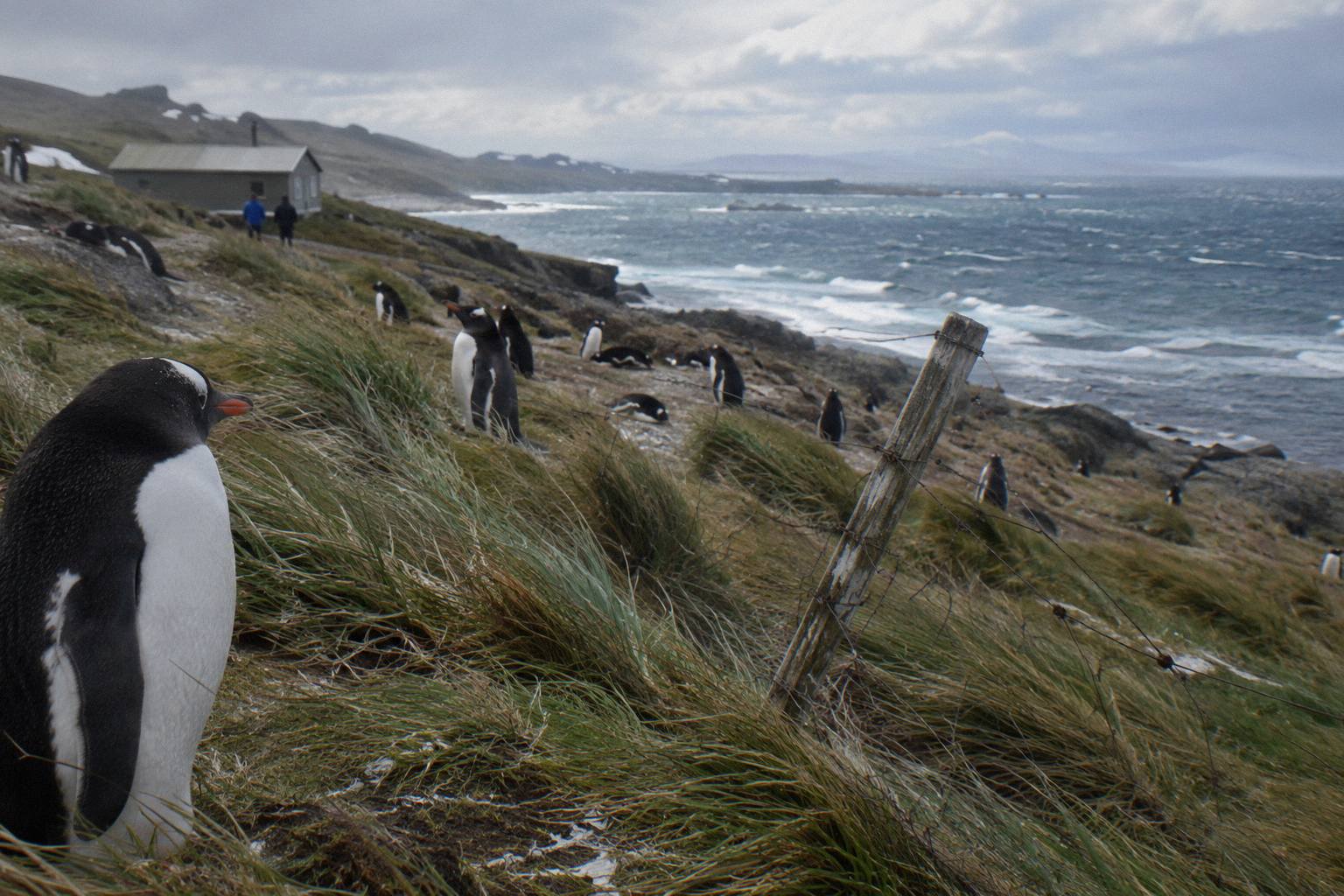
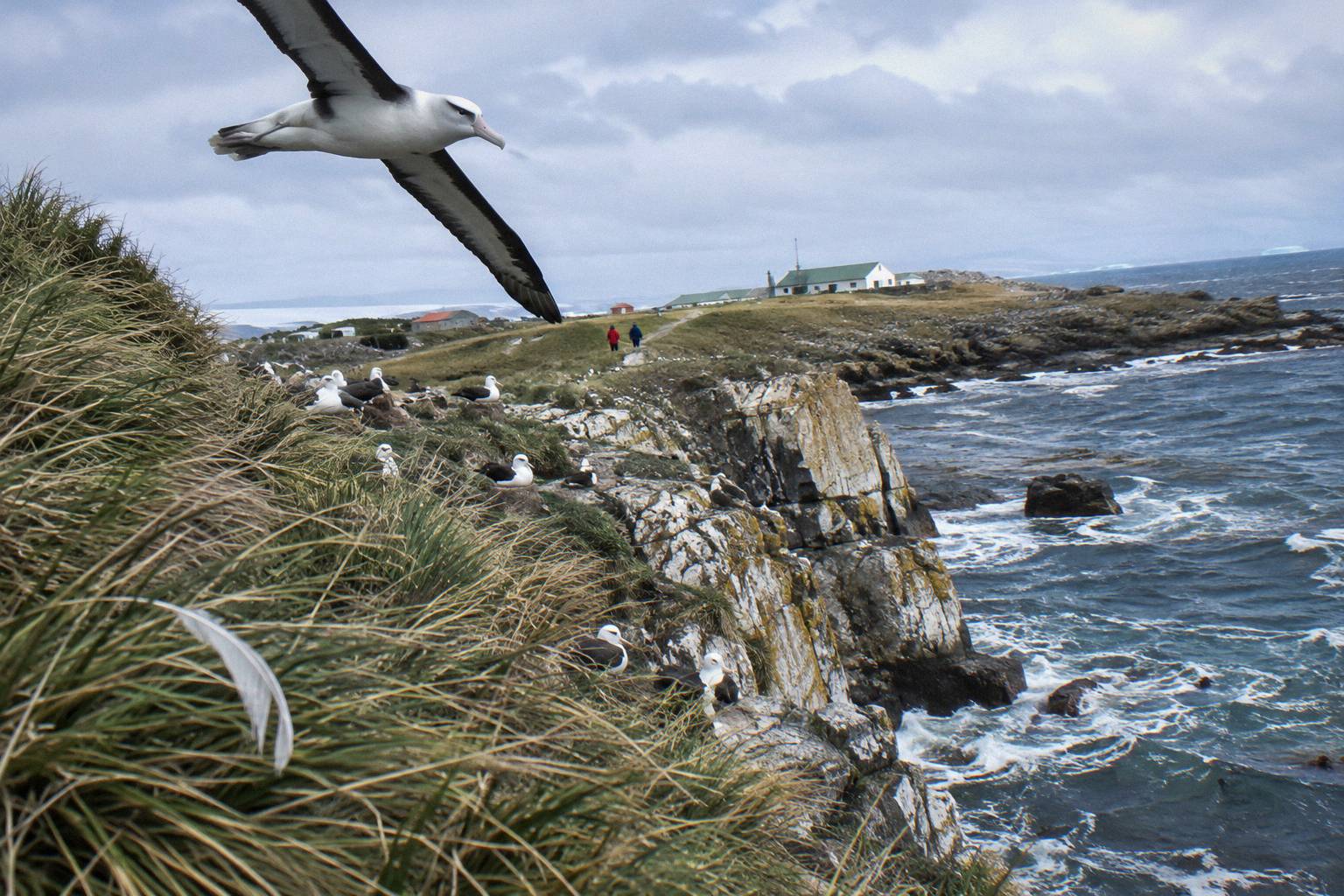
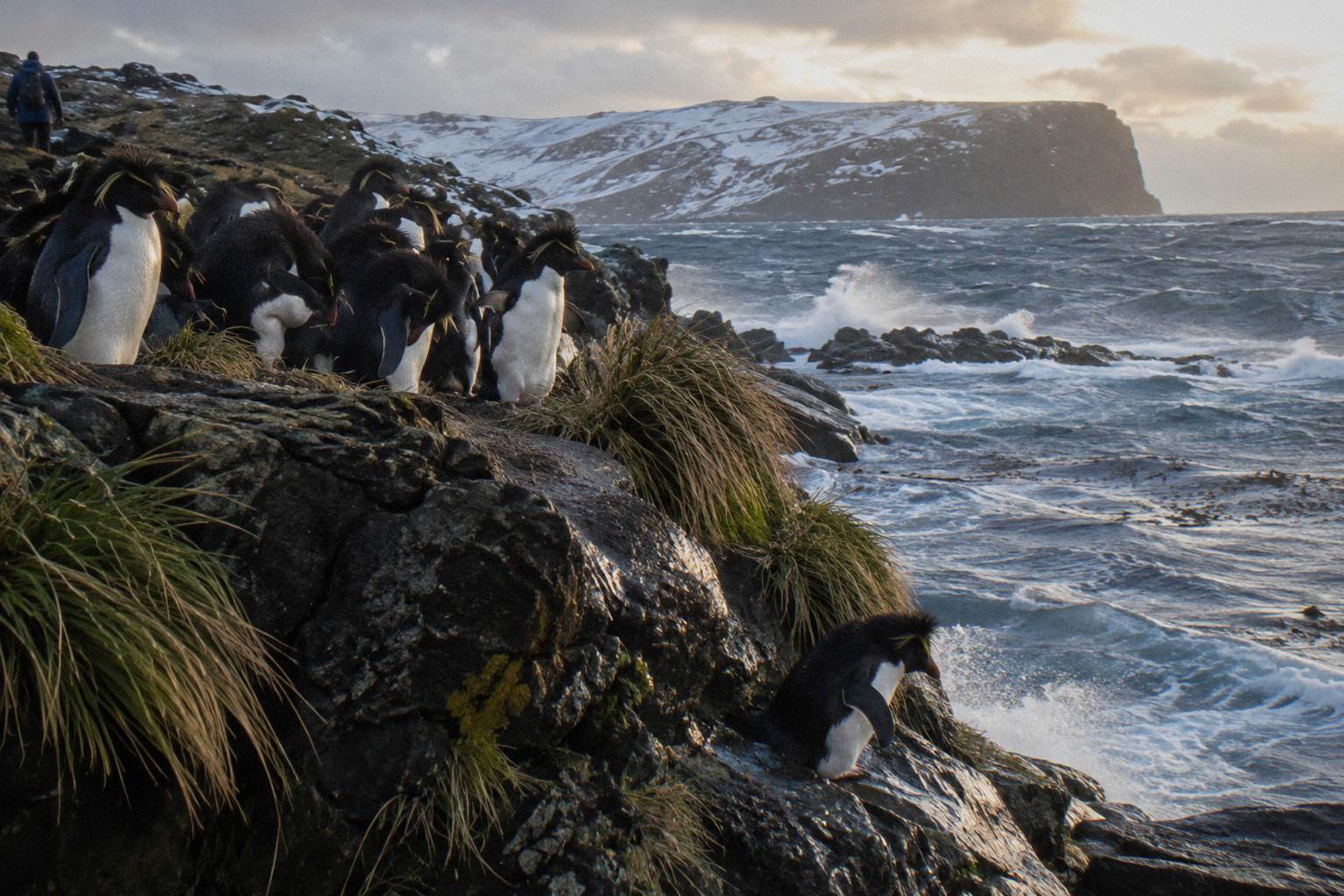
The core difference is habitat. The Antarctic Peninsula is ice, rock and hardy wildlife; the Falklands are grassy, windswept and crowded with breeding seabirds. On the standard combination routes the islands give you landings at Stanley, West Point, Carcass and Saunders Island, with wildlife that includes black-browed albatross, rockhopper penguins, gentoo penguins and king penguins at Volunteer Point.
There is also a town stop: Stanley sits on the list of Falklands calls alongside the outer islands. The trade is honest: the same sea days that carry you to the Falklands are days you do not spend on the Peninsula, and operators' itineraries show the Antarctic portion of combination voyages shrinking to as few as three days on the shorter versions.
The question of whether the Falklands are worth it usually comes down to time and budget rather than interest. If you have two weeks, a Peninsula-only cruise is the sensible choice. If you have three or more, the combination routes are the ones that justify the journey to the far south in the first place, and a free consultation on Falklands routes can lay the real dates and fares side by side before you commit.
What You Actually See: Stanley And The Outer Island Landings
Stanley is the town stop. The wildlife landings happen on the outer islands, West Point, Carcass and Saunders, and the published wildlife list covers black-browed albatross, rockhopper and gentoo penguins, with king penguins at Volunteer Point.
Stanley is the port of call. Large cruise ships also call there on South America itineraries that include scenic Antarctic cruising without landings, so the town is used to visitors; on expedition voyages the stop is paired with the outer islands.
The outer islands are the point of the call. West Point, Carcass and Saunders islands are the named landings on combination voyages, and the wildlife list across them covers black-browed albatross, rockhopper and gentoo penguins. Volunteer Point is where the islands' king penguins are listed, the same species most travellers associate with South Georgia.
Landing rules follow the same IAATO framework as Antarctica itself. A maximum of 100 passengers may be ashore from a vessel at any one time unless site-specific guidance requires fewer, and the guiding ratio is at least one expedition staff member for every twenty visitors, per the IAATO general visitor guidelines. On ships of 108 to 170 passengers, that means rotations, so the smaller the vessel, the more time each group gets at West Point or Saunders.
How Many Days The Falklands Add To The Itinerary
Classic Peninsula voyages run 10 to 13 days; Falklands, South Georgia and Antarctica combinations run 16 to 28 days total. Published itineraries do not break out how many of those extra days belong to the Falklands alone.
The arithmetic comes from the route: the onward legs to South Georgia and then the Peninsula add open-water passages, and the result is a voyage that spends more of its total length at sea than a Peninsula-only trip, in exchange for three distinct destinations. The published pattern on the 2026-27 schedules bears this out: Oceanwide's Falklands, South Georgia and Antarctic Peninsula itinerary on Plancius runs about 20 nights, against 10 to 13 days for the operator's Peninsula-only departures.
| Itinerary type | Total days | Days in Antarctica | Typical from-fare |
|---|---|---|---|
| Classic Antarctic Peninsula | 10-13 | 4-6 | from ~$6,900 |
| Falklands + South Georgia + Antarctica | 16-28 | 3-9 | from ~$17,809 |
| Falklands-inclusive shorter combos | 16-23 | Not stated | Not stated |
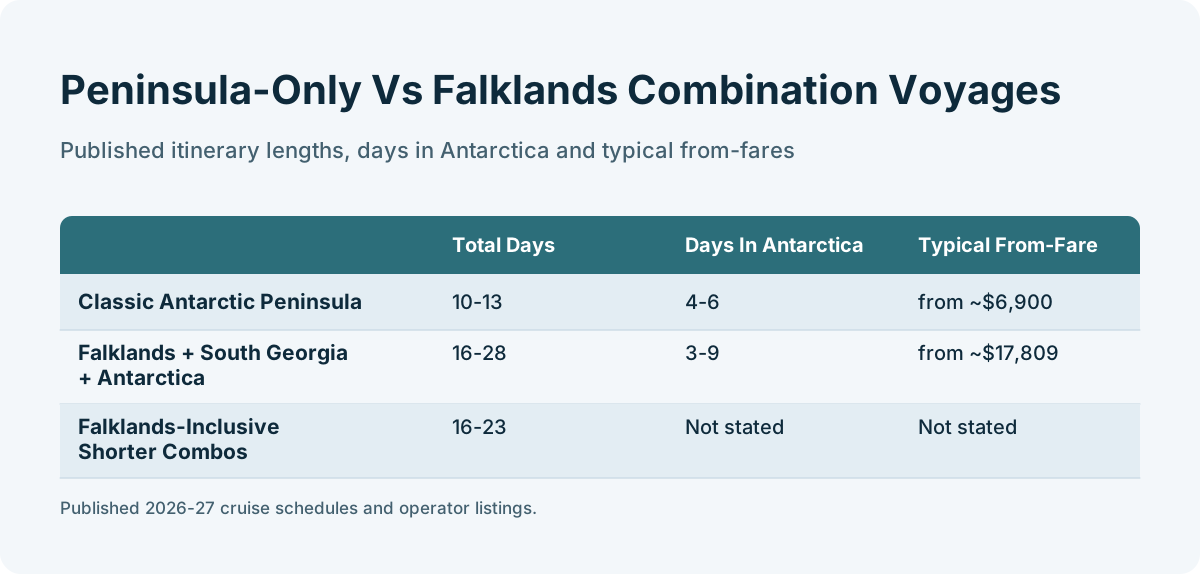
The table shows the real decision. The combination routes cost roughly two to three times a shoulder-season Peninsula voyage, and they demand a bigger block of calendar. For travellers who can take three weeks, the combination is the trip; for travellers with a fixed fortnight, the Falklands are the first thing to cut, and the Peninsula itinerary is what remains. If that trade-off is where you are stuck, comparing route lengths with a specialist costs nothing and settles it quickly.
Falklands Wildlife: What The Islands Give You That Antarctica Does Not
The Falklands wildlife list covers black-browed albatross, rockhopper penguins, gentoo penguins and king penguins at Volunteer Point, a different mix from a Peninsula-only voyage.
Black-browed albatross head the published wildlife list, with rockhopper penguins alongside. Gentoo penguins appear in both the Falklands and Antarctica, so they are a constant rather than a differentiator.
King penguins at Volunteer Point are the bridge species. They appear again, in far larger numbers, on South Georgia, where St Andrews Bay is put at about 250,000 or more pairs. If king penguins are a priority, a Falklands and South Georgia combination is the route that includes them, and the full South Georgia and Antarctica itinerary guide covers what the bigger colonies add.
Published wildlife calendars put seal pups at their best from mid-December to January on South Georgia and the Falklands, and the shoulder months of November and March bring the same fare advantages here as they do on Peninsula routes.
Entry Rules For Cruise Passengers
US citizens need no visa for Argentina or Chile, the two gateway countries, for tourist stays of 90 days or fewer, and a valid passport is the requirement in both. For the Falklands themselves, published cruise listings say standard passport and visa rules apply by nationality and give no further detail.
The gateway question comes first, because every Falklands combination voyage starts from a South American port. Ushuaia in Argentina is the main embarkation point for the Oceanwide ships, and Punta Arenas in Chile serves fly-cruise products. The US State Department's country information lists Argentina and Chile as visa-free for US citizens for tourist stays of up to 90 days, and the same pages note the valid-passport requirement. Published cruise listings say standard passport and visa rules apply by nationality and do not spell out Falklands-specific rules, so confirm with the operator before booking. Other pages covering the same trip are gathered on Cruises In Antarctica.
One practical point does come from the operators: buffer nights. Operators recommend arriving in the gateway city a day or two before embarkation, so a delayed flight does not cost the sailing. That advice applies doubly to a 20-night voyage, where missing embarkation costs the whole trip rather than a shortening.
Sample Voyages And Fares For The 2026-27 Season
The published 2026-27 pattern is clear: Oceanwide's Plancius and Hondius both list Falklands-inclusive circuits, with Peninsula-only from-fares on the Oceanwide fleet of $7,050 to $7,800 per person and the longer combination voyages priced well above those. Quark's Antarctic Explorer from-fare is $12,236 per person for a Peninsula-only comparison.
The roster fares are voyage-level, so treat them as the floor rather than the fare for the Falklands routes specifically. Plancius lists Peninsula voyages from $7,050 per person, Hondius from $7,800 and Ortelius from $7,800, across their Antarctic schedules. The Falklands combinations are among the longer voyages in each ship's programme: Plancius lists voyage lengths up to 33 days, Ortelius up to 25 and Hondius up to 19, and the operator's schedules for 2026-27 include a 20-night Falklands, South Georgia and Antarctic Peninsula departure on Plancius from Puerto Madryn on 24 October 2026, ending in Ushuaia, and a Falklands-South Georgia-Antarctica voyage on Hondius from 16 January to 3 February 2027.
| Ship | Operator | Passengers | Ice class | Length | Voyage days on roster | Peninsula from-fare |
|---|---|---|---|---|---|---|
| Plancius | Oceanwide Expeditions | 108 | 1D | 89 m | 10-33 | from $7,050 pp |
| Hondius | Oceanwide Expeditions | 170 | Polar Class 6 | 107.6 m | 11-19 | from $7,800 pp |
| Ortelius | Oceanwide Expeditions | 108 | UL1 (equiv. 1A) | 90.95 m | 11-25 | from $7,800 pp |
| Ship | Class | Passengers | Ice class | From, per person | Voyage length | Departs from |
|---|---|---|---|---|---|---|
| PlanciusOceanwide Expeditions | Small-Ship Budget | 108 | 1D | from $7,050 | 10 to 33 days | Ushuaia |
| HondiusOceanwide Expeditions | Small-Ship Budget | 170 | Polar Class 6 | from $7,800 | 11 to 19 days | Ushuaia |
| OrteliusOceanwide Expeditions | Small-Ship Budget | 108 | UL1 | from $7,800 | 11 to 25 days | Ushuaia |
The three Oceanwide ships share the small-ship budget class, and the differences between them matter more on a 20-night voyage than on a short Peninsula hop. Plancius is a converted Dutch Navy oceanographic vessel rebuilt as a passenger ship in 2009, carrying 108 guests in 50 cabins. Hondius, built in 2019, is the first-registered Polar Class 6 vessel in the world in the operator's own wording and carries 170 guests in 80 cabins. Ortelius is a former Russian research vessel from 1989, also 108 guests in 50 cabins, and is the ship the operator uses for helicopter-supported remote voyages. On a long combination route, the two 108-passenger ships come close to landing everyone at once under the 100-ashore rule, while Hondius at 170 rotates more groups.
Wider market pricing frames the gap. One 2026 cost guide reports live 2027-28 itineraries across ten lines ranging from $11,321 to $28,500+ per person. Early-booking offers for 2026-27 and 2027-28 commonly reach 10 to 30 percent off, with deadlines through 2026, so the listed from-fares are not always the price paid.
Choosing A Ship For A Falklands And Antarctica Route
For a Falklands-inclusive voyage, choose the ship by passenger count and programme rather than by fare alone: Plancius and Ortelius at 108 guests come close to landing everyone at once under the 100-ashore rule, while Hondius at 170 guests rotates more groups ashore but is the newest of the three. All three sail from Ushuaia.
Plancius deserves a close look for this route specifically. The ship lists voyages of up to 33 days, which is where the full Falklands, South Georgia and Peninsula circuits live, and its 10 Zodiacs with two gangways keep landings moving. The cabin categories run from quadruple porthole to superior, with no balconies. Basecamp-style departures bundle activities such as camping, kayaking and hiking at no extra charge on select voyages, which matters when you are comparing total trip cost across three weeks.
Hondius and Ortelius each have their own case. Hondius is the comfort pick of the three: a 2019 new build with Polar Class 6, a Grand Suite with private balcony at the top of the cabin range, and a sheltered indoor Zodiac boarding platform. Ortelius is the specialist: its schedule includes the helicopter-supported Weddell Sea voyages, so if you are pairing the Falklands with an emperor penguin attempt, that is the ship. The operator's suggested gratuity on all three is 10 to 15 EUR or USD per passenger per day, which belongs in any honest budget for a 20-night voyage.
If you are weighing these three against each other for a specific season, a free voyage comparison consultation will show live Falklands-departure availability, which changes faster than the published from-fares suggest.
When To Sail A Falklands And Antarctica Combination
The season is November through March, the same window as Peninsula-only cruises, and the published 2026-27 Falklands-inclusive departures span it: Plancius sails from Puerto Madryn on 24 October 2026, and Hondius runs a Falklands, South Georgia and Antarctica voyage from 16 January 2027.
The 2026-27 schedules show Plancius arriving in Puerto Madryn on 24 October 2026 after repositioning from the Netherlands and sailing its Falklands, South Georgia and Peninsula voyage from there, the Hondius combination in mid-January, and the last Peninsula sailings in late March 2027. Shoulder months also carry the fare advantage: November and March departures are often 20 percent or more below peak.
| Month | What the Falklands add | Fare pattern |
|---|---|---|
| November | Courting penguins, pristine snow | Often 20%+ below peak |
| December | Longest daylight, incubation at colonies | Peak pricing begins |
| January | Hatching chicks, South Georgia king penguin activity | Peak pricing |
| February | Whale numbers peak, chicks in creches | Not stated |
| March | Fledging chicks, strong whale activity | Shoulder discounts return |
Wildlife timing across the whole route favours December to February if you want chicks and whales together, and November or March if price matters more. South Georgia's king penguin activity peaks November to January, which argues for the early departures if the Falklands are your bridge to South Georgia. The Antarctic Treaty Secretariat notes that roughly 98 percent of tourism voyages occur during the austral summer window, per its tourism overview, and the Falklands circuits are no exception.
How The Falklands Route Compares With Peninsula-Only
A Falklands route trades Antarctic days for range: three destinations instead of one, seabird colonies and king penguins instead of maximum ice time, and a 16-to-28-day commitment instead of 10 to 13. Travellers who want the most Antarctica per day choose the Peninsula; travellers who want the full Southern Ocean story choose the circuit.
The honest version of the comparison is that the Peninsula-only voyage is more Antarctica per day and per dollar. Four to six days of landings on a 10-to-13-day trip is a concentrated dose, and the classic route is described in full in the Antarctic Peninsula cruise guide. The Falklands circuit spreads the experience across temperate islands, South Georgia and the ice itself, with more sea days between them.
The Drake Passage question belongs here too. Combination voyages cross the Drake in one direction or both, and operators put the crossing at 18 to 24 hours in good conditions and 36 to 48 in rough seas, so a Falklands circuit that ends in Ushuaia still pays the Drake toll. The Drake Passage crossing guide covers what that means in practice.
Common Questions About A Falklands And Antarctica Cruise
How many days does a Falklands and Antarctica cruise take?
Falklands, South Georgia and Antarctica combinations run 16 to 28 days total, against 10 to 13 days for a classic Peninsula-only cruise.
Do US citizens need a visa for the Falkland Islands on a cruise?
US citizens need no visa for the gateway countries, Argentina and Chile, for tourist stays of 90 days or fewer, with a valid passport. Published cruise listings do not detail Falklands-specific entry rules beyond ordinary passport requirements, so confirm with your operator before booking.
What wildlife do you see in the Falkland Islands?
Black-browed albatross colonies, rockhopper penguins, gentoo penguins and king penguins at Volunteer Point are the signature sightings on the published wildlife list.
Which ships run Falklands and Antarctica cruises?
Oceanwide Expeditions runs the circuit on Plancius and Hondius, with 2026-27 departures including a 20-night Falklands, South Georgia and Antarctic Peninsula voyage on Plancius. Peninsula-only from-fares on Oceanwide's ships run from $7,050 to $7,800 per person.
When is the best time to sail a Falklands combination route?
The season runs November through March. Published 2026-27 Falklands-inclusive departures include late October and mid-January; shoulder months are often 20 percent or more below peak, and South Georgia's king penguin activity peaks November to January.
Is a Falklands cruise worth the extra days?
It depends on your time and budget. The combination routes cost roughly two to three times a shoulder-season Peninsula voyage and demand three or more weeks, but they add albatross colonies, king penguins and Stanley to the trip. Travellers with a fixed fortnight should choose Peninsula-only.
More Routes And Landings
 Peninsula CruisesThe classic Peninsula route explained: lengths, fares, landing sites and timing.Read the guide
 Antarctic CircleLonger, costlier voyages that push past 66 degrees south, and what the extra days buy.Read the guide
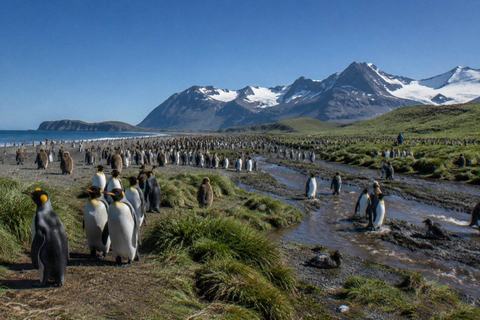 South Georgia CruisesThe 18-to-22-day Falklands, South Georgia and Peninsula itinerary, the premium wildlife cruise.Read the guide
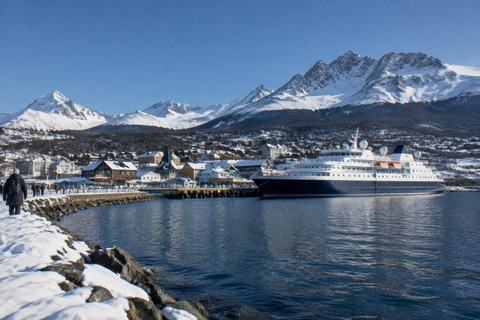 Cruises From UshuaiaShips, routes, fares and arrival logistics for the world's main Antarctica departure port.Read the guide