Can Tourists Go To South Georgia Island?
 By Oleg G.
South Georgia is open to tourists, but there is no short or cheap way in: every visit arrives by expedition ship, usually on a 19 to 23 day voyage that also calls in the Falkland Islands and the Antarctic Peninsula.
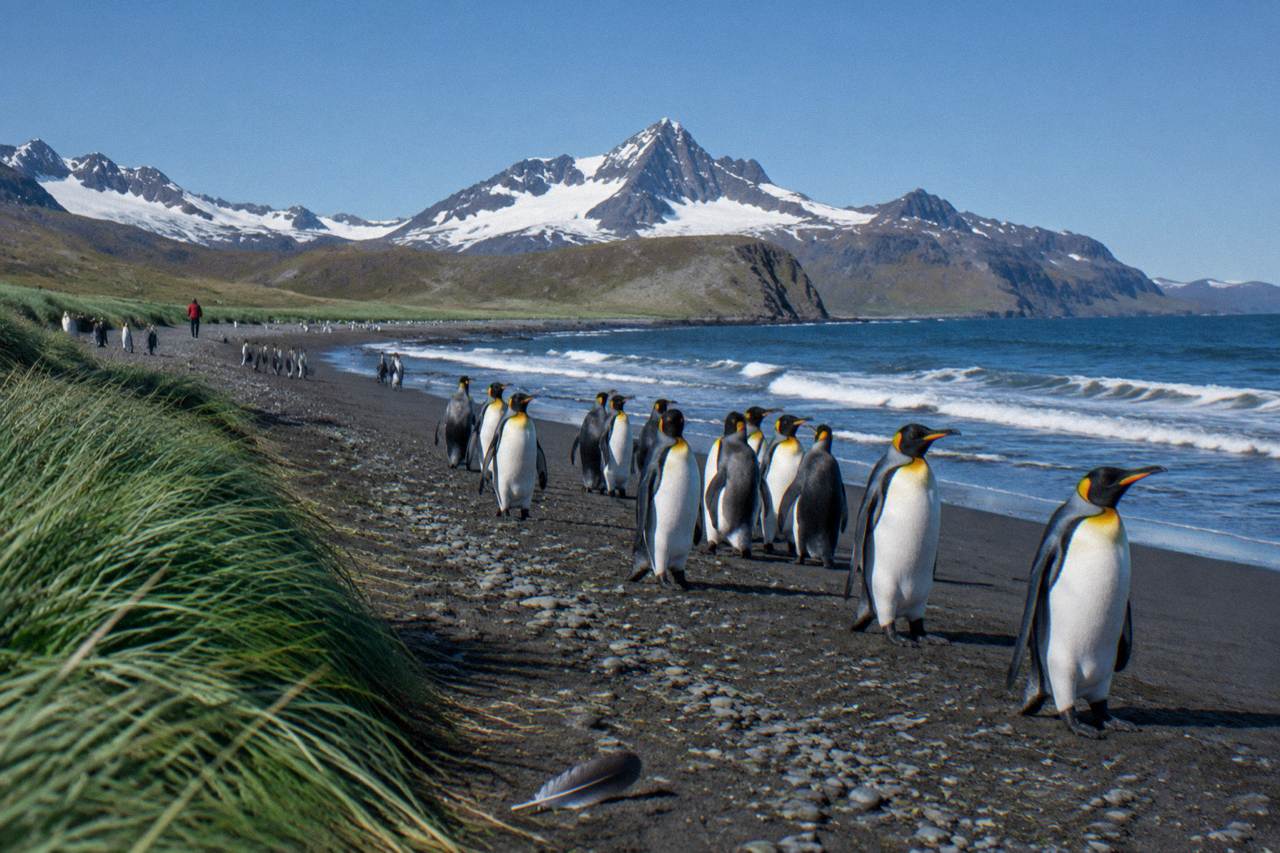
South Georgia sits alone deep in the South Atlantic, east of the tip of South America and far outside the standard Antarctic Peninsula circuit, and that distance shapes everything about visiting it. The island holds some of the largest concentrations of wildlife in the polar regions: Poseidon Expeditions' own South Georgia page describes the king penguin colony at St. Andrews Bay as holding roughly 250,000-plus pairs. Reaching that beach is the practical question, and every voyage tracked on Cruises In Antarctica gets there the same way: by expedition ship, on a long itinerary.
Can Tourists Go To South Georgia Island?
Yes, tourists can go to South Georgia, but only as passengers on a scheduled expedition voyage: there is no independent route, no hotel, no day trip. Access comes on combo itineraries, typically 19 to 23 days, linking the Falkland Islands, South Georgia and the Antarctic Peninsula in one sailing, nearly always round trip from Ushuaia in Argentina.
The island is a British Overseas Territory, and all tourist visits are run through IAATO-member expedition operators who coordinate landings under the Antarctic Treaty system's visitor guidelines. The same rules that govern Peninsula landings apply here: a maximum of 100 passengers ashore from a vessel at any one time unless site guidance requires fewer, a minimum 1:20 ratio of actively guiding staff to visitors, and only one ship at a site at a time.
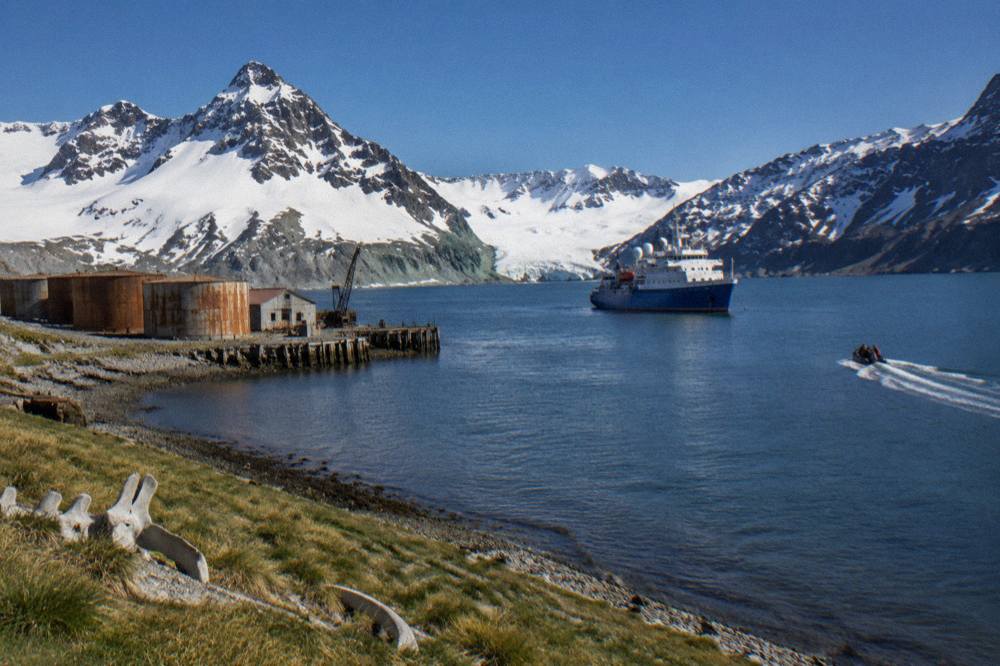
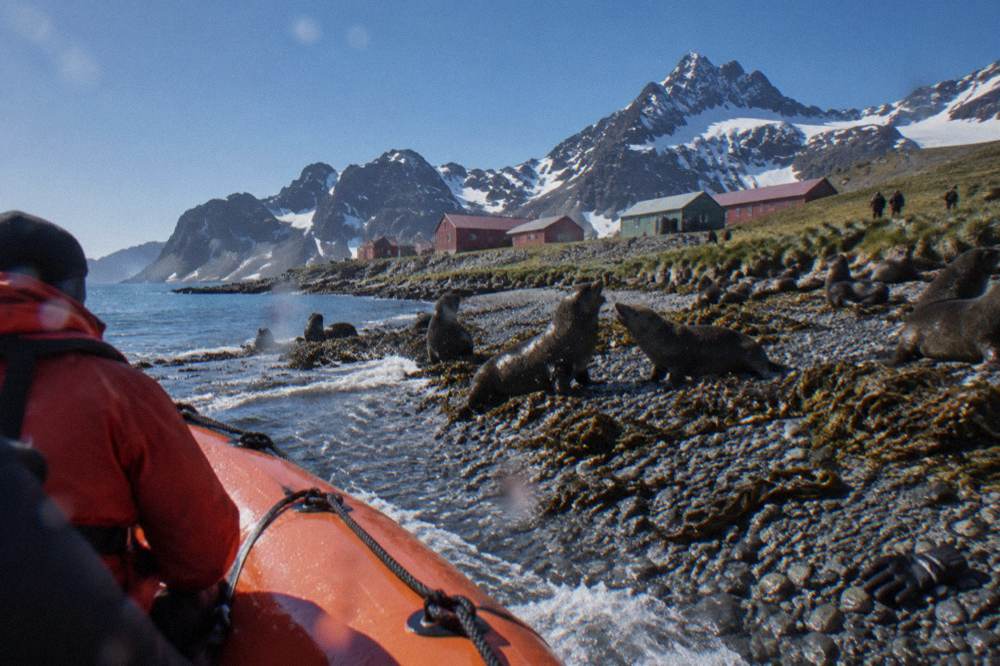
That structure is why the experience feels nothing like a mainstream port call. You arrive by Zodiac, step onto a beach that may hold tens of thousands of king penguins, and stay for a few hours under the supervision of the expedition team. Then the ship moves on, usually overnight, toward the next bay.
IAATO's data for the 2025-26 season recorded 85,195 landed visitors across the Antarctic region, a figure that includes South Georgia landings as well as Peninsula ones. The regional total, with cruise-only passengers counted, was 113,518. South Georgia is the smaller share of that: it adds days of open-ocean sailing to an itinerary, so only the longer voyages call there.
How Do Tourists Actually Reach South Georgia?
Nearly all tourists reach South Georgia on a cruise that starts or ends in Ushuaia with a smaller number of voyages routing via Cape Town. There is no tourist flight and no ferry: the island lies across a multi-day stretch of the Scotia Sea, so the voyage itself is the transport. Combo itineraries of roughly 19 to 23 days are the standard format.
The classic shape is the Falklands, South Georgia and Antarctic Peninsula loop. Operator listings for 2026 departures show this format running 20 to 23 days, for example a 22-day Sylvia Earle itinerary in October and November 2026, and 21-day National Geographic programs. You spend two to three days at sea between each leg, which is where the voyage length comes from: Ushuaia to the Falklands, the Falklands to South Georgia, South Georgia southwest across the Scotia Sea to the Peninsula, then the Drake Passage back to Ushuaia.
A handful of ships approach differently. Swan Hellenic's SH Diana and SH Vega list Cape Town as a port alongside Ushuaia, which reflects the South Africa to Antarctica routings some seasons carry. Heritage Expeditions' Heritage Adventurer runs a 28-day voyage from New Zealand that explores the Ross Sea and includes historic hut visits, a different part of the polar map entirely, but it shows the scale of the itineraries that reach the truly remote southern islands.
The crossing to South Georgia is open-ocean sailing, and it is worth being honest about what that means. The same logic that applies to the Drake Passage applies to the Scotia Sea legs: conditions vary, and expedition ships handle them routinely, but a traveller prone to seasickness should plan remedies for the multi-day passages, not just the famous ones. Our guide to the Drake Passage crossing experience covers what those days at sea actually feel like.
If the sailing-versus-flying question is what brought you here, the short version is that the fly-the-Drake shortcut applies to Peninsula voyages only: every South Georgia itinerary is a full sailing itinerary, which is part of why it draws a self-selecting crowd.
Which Ships Sail To South Georgia?
The ships that reach South Georgia are the longer-itinerary expedition vessels: Oceanwide's Hondius, Lindblad's National Geographic Endurance and Resolution, Ponant's Le Lyrial, Aurora's Sylvia Earle and Greg Mortimer, and Swan Hellenic's SH Diana and SH Minerva among them. All of them are small-to-mid-size expedition ships carrying between 130 and 264 passengers, because the landing rules effectively cap what can work there.
Because vessels with more than 500 fare-paying passengers are prohibited from making landings in Antarctica, and only 100 passengers may be ashore at once, the South Georgia fleet is made up of ships that can actually put everyone on the beach in rotation. That is a hard operational filter, and it is why you will not see a large cruise ship on any South Georgia itinerary.
| Ship | Operator | Passengers | Voyage days on the roster | Fare from |
|---|---|---|---|---|
| Hondius | Oceanwide Expeditions | 170 | 11 / 13 / 19 | $7,800 pp |
| National Geographic Endurance | Lindblad Expeditions | 138 | 12 / 16 / 21 / 22 | $11,900 pp |
| Le Lyrial | Ponant | 245 | 18 | $26,780 pp |
| Sylvia Earle | Aurora Expeditions | 130 | 12 / 13 / 20 | $19,566 pp |
| Greg Mortimer | Aurora Expeditions | 130 | 12 / 13 / 14 / 23 / 26 | $19,521 pp |
| SH Diana | Swan Hellenic | 192 | 9 / 11 / 17 / 20 / 23 | $9,800 pp |
A note on reading that table: the fare shown is the lowest Antarctic-region fare the roster holds for each ship, not a South Georgia-specific fare. Hondius's $7,800 entry point, for instance, is the lowest of its Antarctic Peninsula departures, and its 19-day voyage is the one that reaches the Falklands and South Georgia.
Hondius deserves a closer look as the value entry into this category. It is a 2019-built, Polar Class 6 vessel carrying 170 guests in 80 cabins, and Oceanwide's own wording calls it the first-registered Polar Class 6 ship in the world. It sails from Ushuaia, and its 19-day itinerary is the classic Falklands, South Georgia and Peninsula loop at the budget end of the market. I have not sailed this specific ship, but on paper its pairing of a modern ice class with a genuinely low fare is unusual in this category. The full Hondius ship profile works through the cabin categories and deck plan in detail.
At the other end of the scale, Le Lyrial carries up to 245 guests in Ponant's luxury format. Its roster fare of $26,780 per person is for a 17-night Great Austral Loop departure in November 2026, an itinerary that includes South Georgia. Lindblad's National Geographic Endurance, a 2021-built PC5 ship with the patented X-Bow hull, runs 21 and 22-day itineraries from $11,900, and its sister ship National Geographic Resolution covers similar ground with an 18-day option as well.
For a side-by-side look at the three most distinct ways to do this voyage, the budget expedition ship, the naturalist-led mid option and the luxury French version, here is the comparison:
| Ship | Class | Passengers | Ice class | From, per person | Voyage length | Departs from |
|---|---|---|---|---|---|---|
| HondiusOceanwide Expeditions | Small-Ship Budget | 170 | Polar Class 6 | from $7,800 | 11 to 19 days | Ushuaia |
| National Geographic EnduranceLindblad Expeditions (with National Geographic) | Standard Expedition | 138 | PC5 | from $11,900 | 12 to 22 days | Ushuaia |
| Le LyrialPonant | Luxury | 245 | – | from $26,780 | 18 days | Ushuaia, Buenos Aires |
Choosing between them is genuinely a decision moment: the gap between Hondius's $7,800 entry fare and Le Lyrial's $26,780 fare, on broadly similar geography, is the real fork in the road. If you are weighing that trade-off, get help choosing a South Georgia voyage through a free consultation, and let someone who tracks these departures narrow the field for you.
What Does A South Georgia Voyage Cost?
A South Georgia voyage costs from $7,800 per person at the low end on Oceanwide's roster entry, with fares ranging from $11,321 to $28,500-plus across one 2027-28 survey of ten lines and luxury roster fares stretching from $23,020 to $32,320. Plan on $12,000 to $25,000 per person all-in for a mid-range trip once flights, gear, tips and insurance are added.
The fare ladder is steep and fairly consistent across the market. A 2026 cost survey of live 2027-28 Antarctic itineraries across ten lines found per-person fares ranging from $11,321 to $28,500+, roughly $950 to $2,600 per night in double occupancy on classic sailings. South Georgia combos sit at the upper end of the per-voyage scale simply because they are longer, not because the per-night rate is dramatically different.
What the base fare covers varies by line, and this is where comparisons mislead. One 2026 cost guide notes that Lindblad bundles a pre-cruise Buenos Aires hotel, the charter flight to Ushuaia, alcoholic beverages, prepaid gratuities and an expedition jacket into the fare. A budget line's lower headline number covers the cabin, the meals and the expedition program, and little else. Most expedition operators provide a complimentary parka, often yours to keep, and loan waterproof boots. At the floor of the market, entry-level berths on Drake-crossing itineraries begin at roughly $7,500-$8,995 per person for 10 to 11-day Peninsula voyages in shared twin or triple cabins.
| Cost line | Typical range or figure | Notes |
|---|---|---|
| Budget voyage fare | from $7,800 pp | Oceanwide's lowest Peninsula-region fare; the 19-day South Georgia combo prices higher |
| Mid-range voyage fare | from $11,900 pp | Lindblad 'starting from' card, 12-day voyage; longer itineraries price higher |
| Luxury voyage fare | $23,020 to $32,320 pp | Ponant per-person fares on 2026-27 listings |
| Gratuities | about $16 pp per day | Recommended average; $15 to $25 unless prepaid by the line |
| Single supplement | 25% extra up to 1.5 to 2x the twin rate | Waived on select luxury sailings; sharing options exist at lower categories |
| Insurance with medical evacuation | required by most operators | Quark lists a $500k evacuation minimum, Ponant $250k, Lindblad $150k |
Two of those lines deserve a warning. Insurance with medical evacuation cover is not optional: operators require it, often with a stated evacuation minimum, and it is never in the base fare. And the single supplement is the quiet budget killer for solo travellers: at 1.5 to 2 times the twin rate on some lines, it can add five figures to a South Georgia booking. Some luxury lines waive it on selected departures, which is worth hunting for.
Early-booking offers for the 2026-27 and 2027-28 seasons commonly reach 10 to 30 percent off, and select unsold 2026-27 sailings have carried up to 40 percent. Those discounts have deadlines, and peak December sailings book furthest ahead, sometimes 18 months or more. If the timing question is the thing holding you up, ask about South Georgia departure timing in a free consultation rather than guessing at the calendar.
When Is The Best Time To Visit South Georgia?
The season runs November to March, and the wildlife calendar shifts sharply across it: November brings courtship, fur seal mating and the first king penguin eggs, December to January brings hatchlings and creches, and February to March brings peak whale activity and the fattest, most photogenic king penguin chicks. There is no bad month, only different animals doing different things.
November is the courtship month. On South Georgia, king penguins lay their eggs starting in late November among the early breeders, while fur seals engage in mating rituals across the beaches. The landscapes carry maximum snow cover, which many photographers prefer, and the Peninsula rookeries are full of stone-gifting and nest-building. Temperatures on the Peninsula can drop to around -5°C in November, so it is the coldest end of the season.
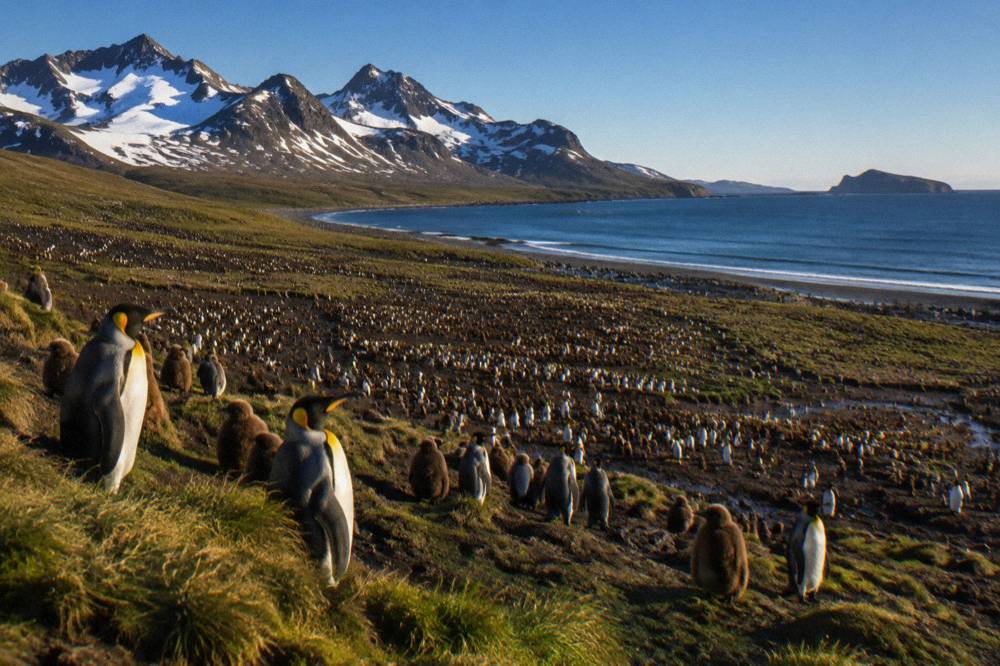
December into January is the peak for penguin chicks. King penguin chicks form creches by January, and the St. Andrews Bay colony, with its 250,000-plus pairs per Poseidon Expeditions' page, is at its most active from December through February. Seal pups are best viewed mid-December to January on South Georgia and the Falklands. This is also the most booked-up window, so the fare and cabin availability math matters most here.
February and March bring the whales. Humpback sightings increase from mid-January onward, and February to March is the peak for whale watching, with minke and orca active in the krill-rich waters. Adult penguins begin molting in February and the chicks start learning to swim. March also brings fledging imperial shags on the Peninsula. The days shorten slightly, the light gets lower and warmer in tone, and the fares soften a touch at the margins.
One thing the calendar does not change: the sea. No single month is reliably calmer for the open-ocean passages, and conditions stay unpredictable across the whole season. If your priority is a specific wildlife moment, pick the month for that and accept the sea state as it comes.
What Will You See On South Georgia?
The headline is wildlife density on a scale the Antarctic Peninsula does not match: king penguin colonies in the hundreds of thousands, fur seals crowding the beaches, elephant seals, and increasing numbers of humpback whales feeding in the surrounding waters. The island also carries the history of the Antarctic whaling era and the great expeditions, which several itineraries touch on at preserved sites.
St. Andrews Bay is the number that stops people. Roughly 250,000-plus king penguin pairs, per Poseidon Expeditions' South Georgia page, stand in a single amphitheatre of a bay backed by glaciers. Salisbury Plain and Gold Harbour hold smaller but still enormous colonies. The noise, the smell and the sheer biomass are what visitors remember, and the same beaches carry fur seals in numbers that require the expedition staff to set careful walking routes.
The seal calendar matters for what your landings look like. Fur seal abundance on the Peninsula peaks in February and March, but on South Georgia the mating season in November puts territorial males across the beaches, and pupping follows into December and January. Elephant seal pups appear in the South Shetlands from the late October ice breakup, and the South Georgia beaches carry their own haul-outs through the season.
Whales are the rising story. After the sea ice recedes, krill abundance draws humpbacks, minkes and orcas toward the feeding grounds, and sightings build from mid-January onward. IAATO's new voluntary geofenced whale area around the South Orkney Islands, with a 10-knot speed restriction from November to May, reflects how seriously the operators now take whale protection on these routes.
The landing rules shape the experience everywhere. You keep at least 5 metres from wildlife on land, more where species or site guidance requires it, and you do not sit or kneel on the ground in wildlife areas under the current biosecurity protocols. Boots and equipment are washed before you arrive and cleaned again between sites. These are not burdensome rules; they are the reason the colonies still approach you with indifference rather than fear. Our piece on why you cannot kneel on Antarctic ground explains the background.
Do You Need A Permit Or Visa For South Georgia?
As a tourist, you arrange nothing yourself: the expedition operator holds the permissions for the voyage and every landing, including the South Georgia Government's visit requirements, and US-based operators also file environmental documentation with the EPA before the season. What you personally need is a valid passport, visa-free entry to Argentina or Chile for US citizens for stays up to 90 days, and the insurance policy your operator requires.
The permit burden sits entirely on the operator side. Under the US framework, when tour operators plan expeditions to Antarctica they are required to submit environmental documentation to the EPA, and the Antarctic Treaty system's visitor guidelines bind every IAATO member through their own operating permits. You will never see or sign a landing permit; you will sign an IAATO visitor declaration acknowledging the rules.
The gateway country is the part that touches you directly. US citizens enter Argentina visa-free for up to 90 days with a valid passport, and the same applies to Chile, so the Punta Arenas or Ushuaia routing involves no visa paperwork. Argentina formally requires health or medical coverage including evacuation for foreign visitors under its 2025 rule update, which lines up with what your operator demands anyway.
The insurance minimums are the one place travellers get caught out. The comparison across operators shows Quark listing a $500k medical evacuation minimum, Ponant $250k and Lindblad $150k, plus full trip-cost cancellation cover, with proof often required before departure or at check-in. A standard travel policy's evacuation cap may fall short of these numbers, so check the figure before buying.
Biosecurity is the other personal obligation. The visitor guidelines require you to carefully wash boots and clean all equipment, including clothes, bags, tripods, tents and walking sticks, before bringing them to Antarctica, and to clean again between sites. Operators run gear checks before the first landing, and on fly-cruise programs they facilitate expedition boot and parka rental partly for this reason.
If the paperwork picture still feels tangled, that is a normal reaction, and it is exactly the kind of thing a consultation untangles quickly: get your South Georgia paperwork questions answered for free, with no obligation attached.
Common Questions About South Georgia Island
Can Tourists Go To South Georgia Island?
Yes. Tourists visit South Georgia every season, but only as passengers on scheduled expedition voyages, typically 19 to 23 day combo itineraries that also call in the Falkland Islands and the Antarctic Peninsula, sailing round trip from Ushuaia.
How Much Does A South Georgia Cruise Cost?
Voyage fares start from $7,800 per person on Oceanwide's roster entry and from $11,900 at Lindblad in a twin-share cabin, with Ponant's luxury fares running from $23,020 to $32,320 on 2026-27 listings. One 2026 cost guide puts a realistic all-in budget for a mid-range Antarctic trip at $12,000 to $25,000 per person including flights, gear, tips and insurance.
How Long Does It Take To Get To South Georgia?
The island sits across the Scotia Sea from South America, and the standard combo itinerary spends two to three days sailing between each leg. Plan on a 19 to 23 day voyage for the classic Falklands, South Georgia and Antarctic Peninsula loop.
When Is The Best Month To See King Penguins On South Georgia?
King penguin breeding activity runs November through January, with eggs laid from late November and chicks forming creches by January. Colony activity at St. Andrews Bay, which holds roughly 250,000-plus pairs, stays at its peak from December to February.
Do I Need A Visa For South Georgia?
No tourist visa applies. The operator holds the landing permissions and the South Georgia Government's visit requirements. You need a valid passport, visa-free entry to Argentina or Chile for US citizens for stays up to 90 days, and the travel insurance your operator requires.
Can You Fly To South Georgia?
No tourist flight serves the island. Every visit arrives by expedition ship, which is why the itinerary length, not the airfare, is the main planning variable for a South Georgia trip.