Buenos Aires Or Ushuaia: Which Antarctica Departure Fits You?
 By Oleg G.
Buenos Aires and Ushuaia both sell themselves as the gateway to Antarctica, but the two cities hand you completely different voyages. One is a scenic round trip on a resort ship, the other an expedition cruise built around Zodiac landings. Here is how the routes, the logistics, the time in Antarctic water and the price tags actually compare.
Quick answer: Buenos Aires offers 14- to 22-night mainstream round trips with two to four days of scenic Antarctic cruising and no landings, from roughly $2,859 to $6,408 per person. Ushuaia hosts the 10- to 13-day expedition cruises that land passengers, from about $7,050 on the roster ships. The two routes suit different travellers, not different budgets alone.
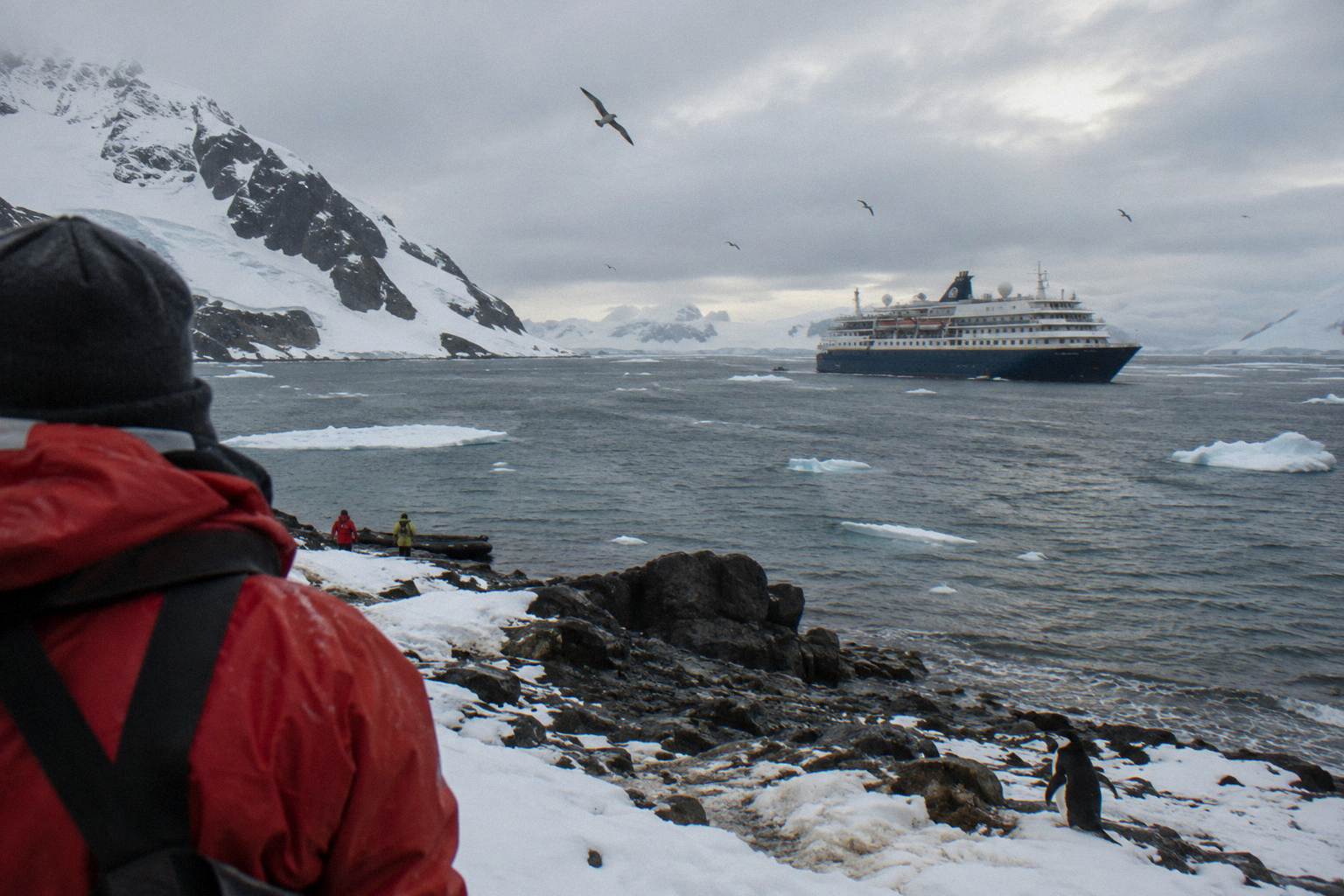
Two cities, two completely different Antarctic products. Buenos Aires sells long mainstream voyages on resort ships that glide along the Peninsula for a few scenic days and turn back north. Ushuaia, at the very bottom of Argentina, is where most expedition cruises with actual landings begin. A traveller comparing the two is not really comparing ports, they are comparing two kinds of voyage, and the difference shows up in the itinerary, the price and the number of hours you spend standing on Antarctic ground.
The distinction comes straight from the rules that govern Antarctic tourism. The IAATO visitor guidelines state that vessels with more than 500 passengers shall not make landings in Antarctica. That single sentence splits the market in two. The big ships sailing round trips from Buenos Aires are scenic cruisers by law, not by choice, while the smaller expedition vessels working out of Ushuaia carry Zodiacs and land guests daily when conditions allow. Around 98 percent of Antarctic tourism happens along the Peninsula, as the Antarctic Treaty Secretariat notes, and both routes reach that same stretch of coast.
This guide lays out what each departure actually delivers: which lines round trip from Buenos Aires, how expedition travellers get from Buenos Aires to Ushuaia, how many days each route gives you in Antarctic water, and what the two cost. If you want the short version of the expedition side, the Cruises In Antarctica guides to each ship carry the full details.
What Kind Of Antarctica Voyage Sails From Each City?
A Buenos Aires departure is a South American cruise that includes two to four days of scenic Antarctic sailing, on ships carrying well over 500 passengers, with no landings and two Drake Passage crossings. A Ushuaia departure is a dedicated expedition cruise of roughly 10 to 13 days, on ships under 500 passengers that run Zodiac landings and cruises, with one Drake crossing each way or a flight instead. Same destination, different sport.
The Buenos Aires product is built around the cruise itself. Itineraries run 14 to 22 nights and stitch the Antarctic Peninsula into a broader Patagonian and South Atlantic route: Montevideo, Puerto Madryn, Port Stanley in the Falklands, Ushuaia, Punta Arenas and the Chilean fjords. Antarctica appears as a highlight block of scenic cruising days, with the ship slowing among icebergs and humpbacks visible from the deck rails. Passengers never step ashore on the continent, because the ships are too large to comply with IAATO landing rules.
The Ushuaia product inverts that. On an expedition cruise the sea days are the commute and the Peninsula days are the point. A typical 11- or 12-day voyage spends two days crossing the Drake each way and gives the rest to landings and Zodiac cruises, one site in the morning and another after lunch when the weather cooperates. The ships are small, the guide ratio is at least one expert to twenty guests ashore, and the daily briefing drives the schedule.
Neither route is a downgrade of the other. The Buenos Aires round trip trades landings for comfort, length and a lower nightly rate. The Ushuaia expedition trades shipboard resort amenities for time on the ground. The rest of this guide is about what those trades cost in money and in days.
Which Mainstream Cruise Lines Round Trip From Buenos Aires?
Holland America, Princess, Celebrity, Norwegian and Oceania all operate Buenos Aires itineraries that include Antarctic scenic cruising. Lengths run from 14 to 22 nights, fares start near $2,859 per person for an inside cabin, and every one of these voyages is scenic only, with no landings, because each ship carries more than 500 guests. They suit travellers who want Antarctica inside a broader, comfortable South American cruise.
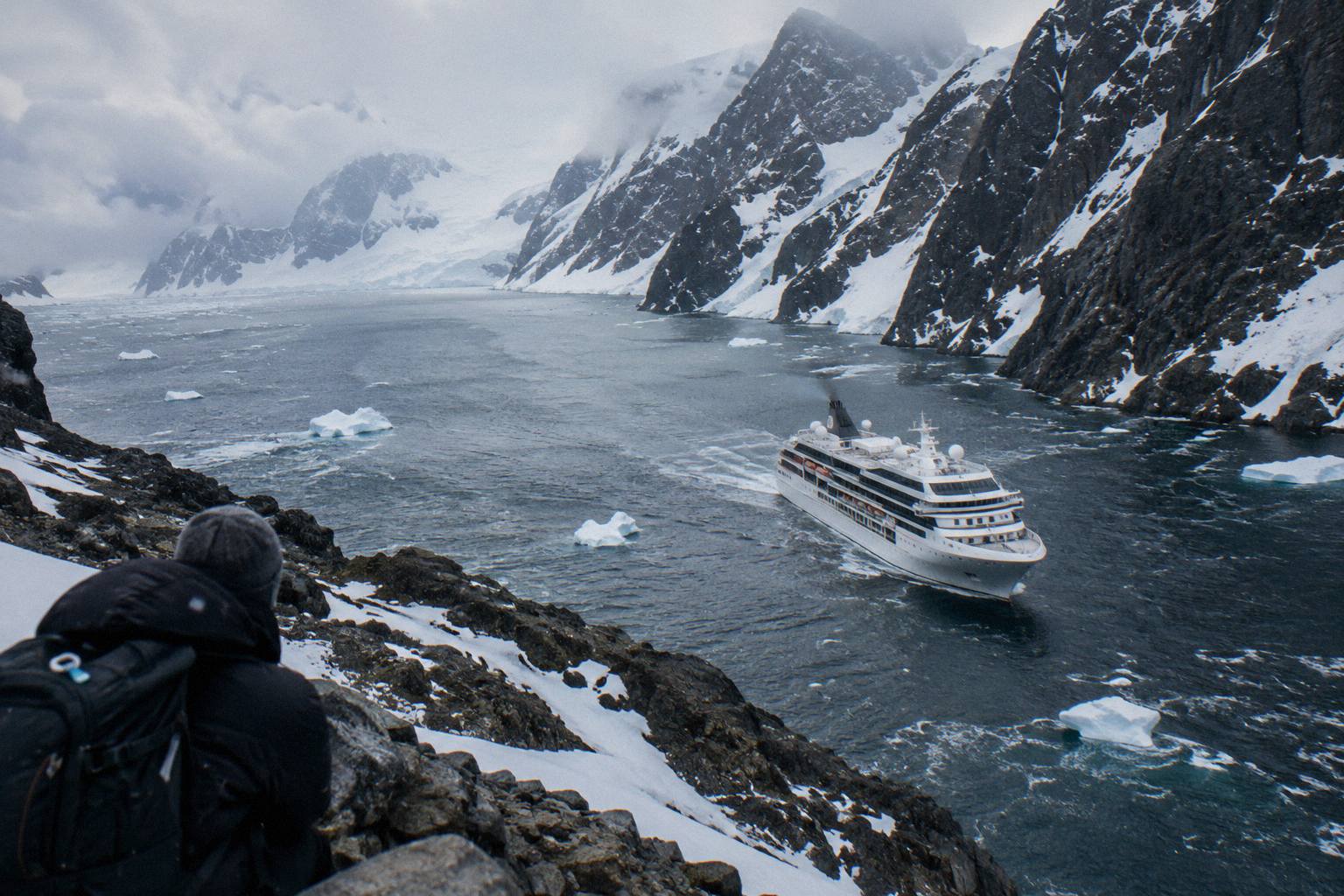
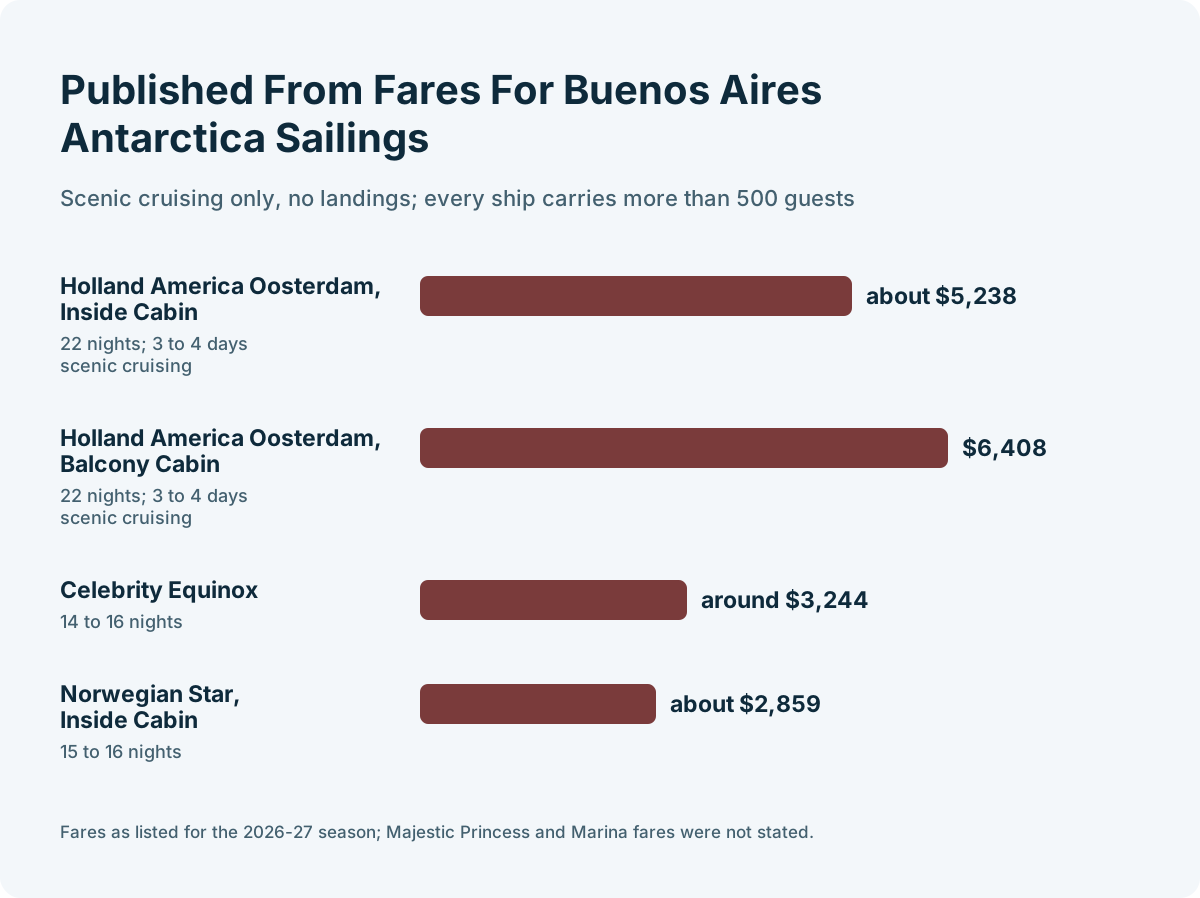
The clearest example for the 2026-27 season is Holland America's Oosterdam, which operates 22-night sailings from Buenos Aires to San Antonio, the port for Santiago, with a December 19, 2026 departure running into January 10, 2027. The itinerary includes three to four days of Antarctic scenic cruising and calls at Montevideo, Punta del Este, Puerto Madryn, Port Stanley, Ushuaia, Punta Arenas, Puerto Chacabuco and Puerto Montt. Published listings show cruise-only fares from about $5,238 for an inside cabin, $5,240 for an oceanview and $6,408 for a balcony.
Princess fields the Majestic Princess on 17-night itineraries from Buenos Aires through the December-to-January window, with an overnight of scenic cruising in Antarctic Peninsula waters and calls at Punta Arenas, Ushuaia, Port Stanley and Puerto Madryn. Celebrity's Equinox runs 14- to 16-night voyages from the same port with two or more days of scenic Antarctic sailing, from around $3,244 per person. Norwegian's Star covers 15- and 16-night Buenos Aires to San Antonio routes, scenic cruising past Paradise Bay and Elephant Island, with fares listed from about $2,859 for an inside cabin. Oceania's Marina adds a 20-night San Antonio to Buenos Aires option on the same pattern.
Here is how the published Buenos Aires options stack up for the season:
| Line | Ship | Length | Route pattern | Antarctic time | Published from fare |
|---|---|---|---|---|---|
| Holland America | Oosterdam | 22 nights | Buenos Aires to San Antonio (Santiago) | 3 to 4 days scenic cruising | about $5,238 inside, $6,408 balcony |
| Princess | Majestic Princess | 17 nights | Buenos Aires departure and return area | overnight scenic Antarctic sailing | fare not stated in the listings read |
| Celebrity | Equinox | 14 to 16 nights | Buenos Aires, Montevideo, Puerto Madryn, Ushuaia | 2 or more days scenic cruising | around $3,244 |
| Norwegian | Norwegian Star | 15 to 16 nights | Buenos Aires to San Antonio | scenic calls include Paradise Bay and Elephant Island | about $2,859 inside |
| Oceania | Marina | 20 nights | San Antonio to Buenos Aires | Peninsula scenic cruising | fare not stated in the listings read |
Every ship in that table is a scenic cruiser in Antarctic water, whatever its brochure implies. If you are weighing one of these voyages against a landing-based trip, the honest framing is in our expedition versus traditional cruise comparison. If you already know you want to stand on the continent rather than look at it, that decision points you straight to Ushuaia, and a free consultation on your route is a quick way to test which side of the line you fall on before you pay a deposit.
How Do Travellers Reach Ushuaia From Buenos Aires?
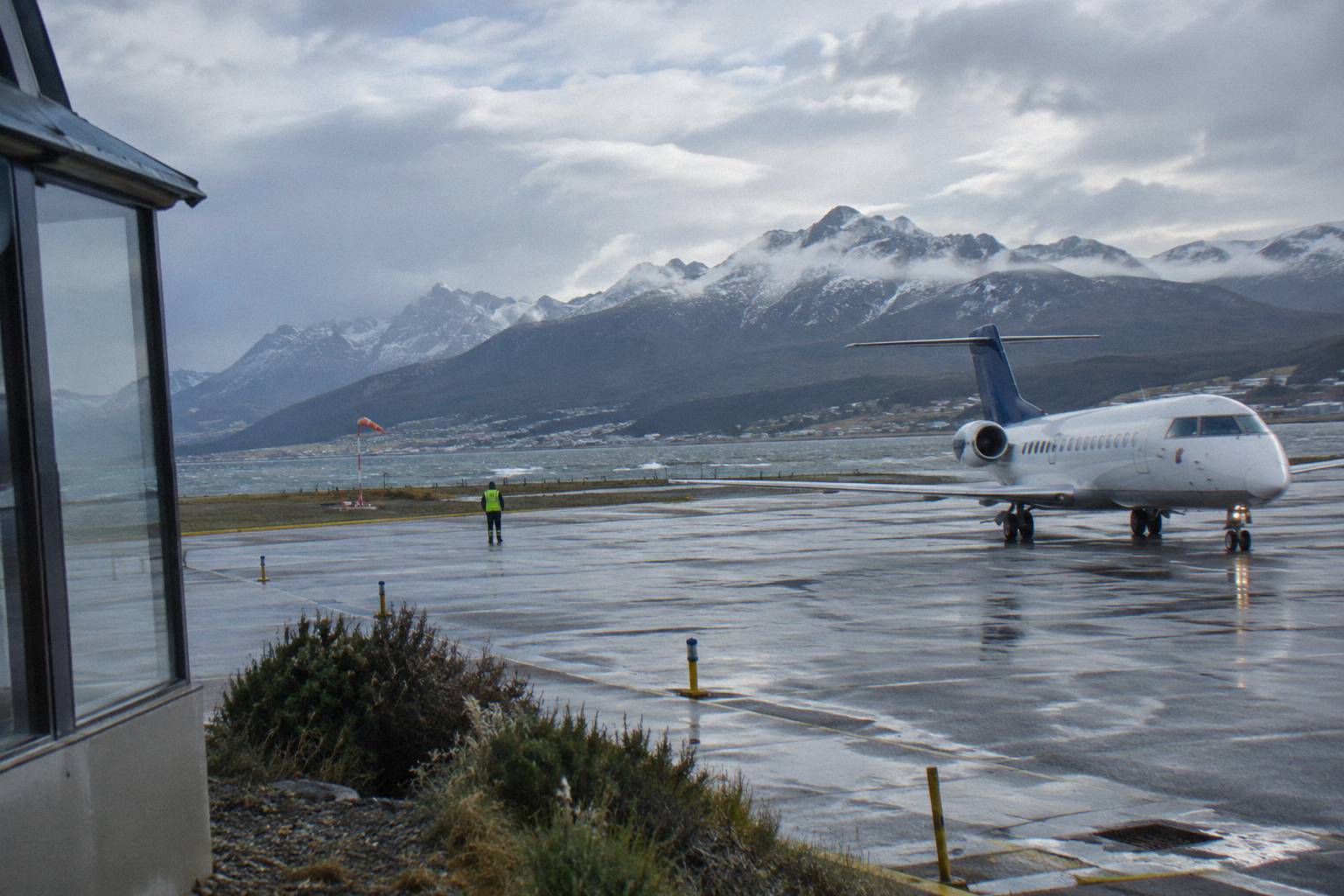
The standard routing is a domestic flight from Buenos Aires to Ushuaia, about 3 hours 40 minutes nonstop, with Aerolineas Argentinas flying multiple frequencies daily and JetSMART several times weekly from the city airport, AEP. Long-haul international arrivals land at EZE, and the airport-to-airport transfer runs roughly 30 to 60 minutes by taxi. Many operators bundle or sell a charter or group flight from Buenos Aires to Ushuaia with the voyage.
The airport detail matters more than it sounds. Buenos Aires has two fields. International long-haul flights arrive at Ezeiza, EZE, while the domestic departures to Ushuaia, USH, leave mostly from the city airport, Aeroparque, AEP. Direct flights on the AEP to USH corridor run about three hours and forty minutes, and Aerolineas Argentinas operates the route heavily, with JetSMART flying several frequencies a week. Flybondi has flown the corridor too, though it suspended the route across the 2026 low season and planned to rebuild frequency from July.
The practical consequence is a transfer between airports in Buenos Aires, plus a buffer for weather. Flights on this corridor are weather-prone in peak season. The general recommendation in operator materials is at least one night, ideally two, in Buenos Aires or Ushuaia before embarkation. Several operators remove the guesswork: Viking, HX, Atlas Ocean Voyages, Seabourn, Ponant and Scenic all include or arrange charter and group flights from Buenos Aires to Ushuaia in their packages, Lindblad sells a group flight option, and Quark offers the flight as an add-on.
Here is what the onward connection looks like:
| Leg | Airline or option | Frequency | Time |
|---|---|---|---|
| AEP Buenos Aires to USH Ushuaia | Aerolineas Argentinas | multiple daily departures | about 3 hours 40 minutes |
| AEP Buenos Aires to USH Ushuaia | JetSMART | several flights weekly | same corridor, times vary |
| EZE to AEP transfer | taxi or private car | as needed | typically 30 to 60 minutes depending on traffic |
| Buenos Aires to Ushuaia charter | bundled by Viking, HX, Atlas, Seabourn, Ponant, Scenic | packaged with the voyage | operated as group flights |
The Buenos Aires round trip traveller never deals with any of this. Their ship starts and ends in the same city, there is no domestic flight, and the only real logistical requirement is arriving in Buenos Aires in time for embarkation. That simplicity is a genuine selling point, while an itinerary from Ushuaia adds a second set of travel logistics on top of the voyage itself. The port is ready for it either way. Ushuaia projects more than 590 cruise calls for the season, with maintenance works on lighting, fenders and fire protection under way, and Argentina's ports agency issued Resolution 51/2026 setting dynamic berth allocation and arrival sequencing at the pier.
How Many Days Does Each Route Give You In Antarctic Waters?
A 22-night Buenos Aires round trip includes roughly three to four days of scenic Antarctic cruising. A 12-day Ushuaia expedition cruise gives about four to six days on the Peninsula, plus the two Drake crossings on either side. The expedition route concentrates far more of its voyage inside Antarctic water, while the round trip spends most of its length on South American ports and open sea.
This is the number that surprises people. A 22-night itinerary sounds nearly twice the length of a 12-day expedition voyage, yet the Antarctic portion of that 22-night sailing is a three or four day block, and everything else is Montevideo, the Falklands, the fjords and sea days. The Princess and Celebrity voyages allocate two or more days to the Peninsula, sometimes with overnight scenic cruising, and then turn north.
The Ushuaia voyages invert the ratio. A typical 10- to 13-day expedition itinerary crosses the Drake at the start and end and spends the remainder among the South Shetland Islands and the western Peninsula, moving between landing sites. The ship's position, the ice and the weather decide each day rather than a fixed port schedule. Ships rotate their guests ashore under the IAATO limit of 100 passengers from one vessel at a time, so smaller vessels mean shorter waits and more time off the ship.
| Route style | Total itinerary | Days in or near Antarctic waters | Landings |
|---|---|---|---|
| Buenos Aires round trip | 14 to 22 nights | 2 to 4 scenic cruising days | none, vessels carry more than 500 passengers |
| Ushuaia expedition cruise | 10 to 13 days typical | the balance of the voyage after two Drake crossings | daily Zodiac landings and cruises when conditions allow |
There is one more wrinkle worth knowing. Some operators let you skip the sea crossing entirely: Antarctica21's Classic Antarctica Air-Cruise runs eight days and seven nights through the Punta Arenas gateway in Chile, with a charter flight of about two hours to King George Island in place of the Drake. That is a third route, not a Buenos Aires or Ushuaia decision, and we cover it separately in the fly versus sail Drake question. It is also more exposed to weather: flights to the island's gravel strip are delayed regularly, and operators build hotel nights into the package for exactly that reason.
What Does Each Route Cost?
Buenos Aires large-ship voyages start near $2,859 to $5,238 per person for inside cabins on 14- to 22-night itineraries, cruise only. Ushuaia expedition cruises run from roughly $7,000 to $15,000 and up for 10 to 13 days, with roster ships showing published from fares of $7,800 on Hondius and $11,900 on National Geographic Endurance. The expedition fare buys landings, expert guiding and a small ship.
The published comparison is stark. On the Buenos Aires side, the cheapest read for the season is Norwegian's inside cabins at about $2,859 for 15 or 16 nights, and Celebrity lists from around $3,244. Holland America's Oosterdam shows from about $5,238 inside. Those fares are per person, cruise only, before flights to Buenos Aires. They are also scenic-only fares: the price of the voyage is the price of looking at Antarctica from the ship.
| Route | Length | Published from fare, per person | What the fare buys |
|---|---|---|---|
| Buenos Aires round trip | 14 to 22 nights | about $2,859 to $6,408 by cabin grade | long South American itinerary, scenic Antarctic cruising, no landings |
| Ushuaia expedition cruise | 10 to 13 days | roughly $7,000 to $15,000 and up per one comparison guide | small expedition ship, Zodiac landings, expert team |
| Hondius, Oceanwide | 11 to 19 day voyages | from $7,800 | small-ship budget expedition, Ushuaia departures |
| National Geographic Endurance | 12-day Voyage to Antarctica | from $11,900 | standard expedition class, 138 guests, Ushuaia departure |
On the expedition side, the roster ships give concrete anchors. Oceanwide's Hondius, a 2019-built Polar Class 6 vessel carrying 170 passengers in 80 cabins, lists Antarctic Peninsula departures from $7,800 per person. National Geographic Endurance, a 2021-built PC5 Category A ship with 138 guests, shows a starting card of $11,900 for the 12-day Voyage to Antarctica. Seabourn's expedition ships sail from Ushuaia on 10- to 12-day voyages, but a current fare for those is not on file, so it needs a live check rather than a quoted number. Add the flights and a hotel night or two in Buenos Aires or Ushuaia, plus the gear and insurance layers, and the gap between the two routes holds at several thousand dollars for comparable dates.
The honest way to frame it: the round trip is cheaper per night and much cheaper in total, and it delivers a genuinely pleasant cruise with Antarctic scenery included. The expedition cruise is a focused purchase, at a price closer to a luxury purchase than a mainstream one. If the budget question is the one blocking your decision, a free Antarctica cruise consultation can pull live fares for both routes against your actual dates, which no published table can do.
The deeper cost breakdown, including what the season does to prices month by month, is in our guide to what an Antarctica cruise costs.
Which Expedition Ships Sail From Ushuaia?
Ushuaia hosts the landing fleet across every price tier: budget small ships like Hondius and Plancius from $7,800 and $7,050, standard expedition ships like National Geographic Endurance from $11,900, and luxury expedition vessels like Seabourn Venture, whose current fares are not published and need a live check. All of them land passengers. The differences are cabin comfort, expert ratios and onboard polish, not access.
The ship that best represents the standard expedition tier is National Geographic Endurance. She was built in 2021 with a Polar Code PC5 Category A hull, one of the stronger ice classifications on the landing fleet, and carries 138 guests. Her 12-day Voyage to Antarctica sails from Ushuaia with longer 16- to 22-day combinations available. Our National Geographic Antarctica cruise guide covers her sister ship and the wider fleet in detail.
At the value end, Hondius shows how little the floor costs. Her cabin list includes quad and triple porthole cabins, and her Peninsula fares start from $7,800. She was the first-registered Polar Class 6 vessel in the world in the operator's own wording, she sails 11-, 13- and 19-day Peninsula itineraries from Ushuaia, and her Zodiac operation works from a sheltered indoor boarding platform, which matters in driving weather.
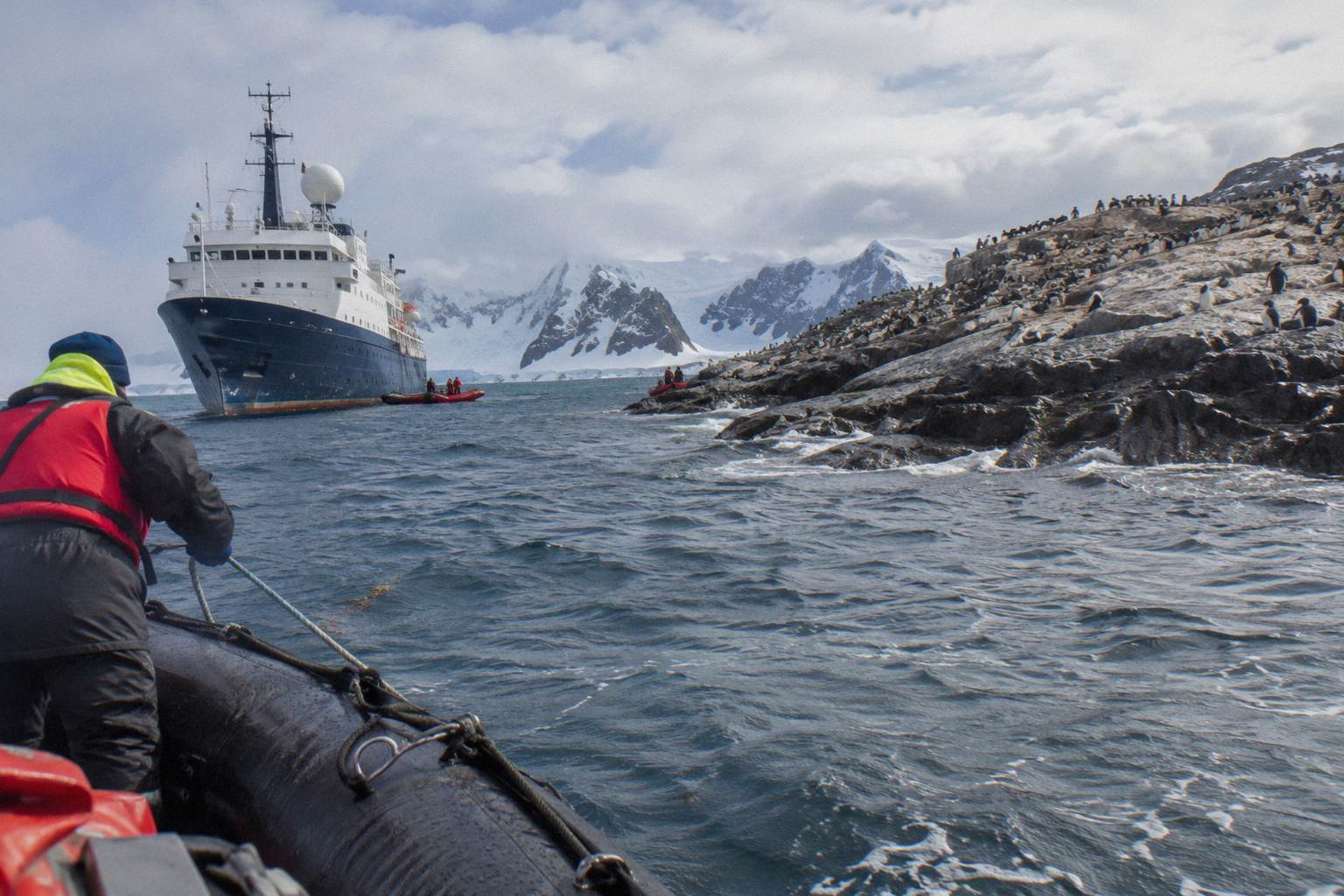
At the luxury end, Seabourn Venture runs 10- to 12-day Antarctic voyages from Ushuaia, plus 20- and 21-day South Georgia combinations, with a 24-Zodiac operation and an expedition team that sources put at 19 to 26 members. Her per-person fare is not on file, so pricing her against the published anchors above requires a consultation rather than a guess. Between these three tiers sits most of the fleet that matters.
For a side-by-side look at one ship from each tier, here is the comparison:
| Ship | Class | Passengers | Ice class | From, per person | Voyage length | Departs from |
|---|---|---|---|---|---|---|
| National Geographic EnduranceLindblad Expeditions (with National Geographic) | Standard Expedition | 138 | PC5 | from $11,900 | 12 to 22 days | Ushuaia |
| HondiusOceanwide Expeditions | Small-Ship Budget | 170 | Polar Class 6 | from $7,800 | 11 to 19 days | Ushuaia |
| Seabourn VentureSeabourn | Luxury | – | – | – | 10 to 21 days | Ushuaia |
The point of the spread is this: once you commit to a Ushuaia departure and landings, your real choice is comfort level and fare, not whether you reach the continent. All three tiers put you ashore under the same IAATO rules, with the same hundred passenger limit and the same guide ratio of at least one to twenty.
Which Departure Suits Which Traveller?
Choose Buenos Aires if you want a long, affordable, low-logistics cruise that shows you the Peninsula from the deck, with South American ports and fjords filling the itinerary. Choose Ushuaia if being ashore, close to penguins and under expedition guidance, is the reason for the trip and the fare is acceptable. The decision is about what you want Antarctica to be, not which port is better.
The round trip traveller is usually honest with themselves in one specific way: Antarctica is a highlight of a bigger holiday, not its sole purpose. The 14- to 22-night format bundles Montevideo, the Falklands, Patagonia and the Chilean fjords into a single fare that starts around $6,408 for a balcony on Oosterdam, there is no domestic flight or gear rental to plan around, and the Drake crossings happen on a large stabilised hull. Travellers who would rather not board a Zodiac may prefer this route.
The Ushuaia traveller has decided that the continent itself is the purchase. The fares are two to three times the cheapest mainstream deck, the logistics include flights and buffer nights, and the ship is a working expedition platform rather than a resort. In exchange they get roughly four to six days on the Peninsula, daily landings, kayaks and Zodiac cruises where the ship offers them, and a small community of a hundred-odd fellow passengers rather than thousands. The wildlife difference is not the count of animals, it is the distance to them: five metres on foot versus binocular range from a high deck.
A third profile is worth naming, because it is common: the traveller who wants landings but fears the Drake. For them the answer is not Buenos Aires, it is the fly-cruise model from Punta Arenas, or a sail one way and fly the other on operators that offer it. That choice trades the crossing for flight weather risk, and it deserves its own conversation. If you are sitting between two or three of these profiles, a consultation on which departure fits you is exactly the conversation the form exists for, and it costs nothing.
Common Questions About Buenos Aires Versus Ushuaia Departures
Can you fly from Buenos Aires straight to Antarctica?
No scheduled flight connects the two. The fly-cruise routes to Antarctica run from Punta Arenas in Chile, with a charter flight of about two hours to King George Island, and Antarctica21's Classic Antarctica Air-Cruise works that way over eight days and seven nights. From Buenos Aires, the standard connection is the domestic flight to Ushuaia to board a ship.
Do the Buenos Aires round trips ever land passengers in Antarctica?
No. IAATO rules state that vessels carrying more than 500 passengers shall not make landings, and the mainstream ships sailing round trips from Buenos Aires are all above that line. Their Antarctic time is scenic cruising only, viewing the Peninsula and its wildlife from the ship.
How long is the flight from Buenos Aires to Ushuaia?
About 3 hours 40 minutes on a direct flight from the city airport, AEP, to Ushuaia. Aerolineas Argentinas flies the route multiple times daily and JetSMART several times a week. International arrivals land at EZE, and the transfer between the two airports typically runs 30 to 60 minutes by taxi.
Which route is cheaper, Buenos Aires or Ushuaia?
The Buenos Aires round trip, by a wide margin. Mainstream fares read from about $2,859 for an inside cabin on a 15-night Norwegian sailing, while Ushuaia expedition cruises start around $7,800 on roster ships like Hondius and $11,900 on National Geographic Endurance. The expedition fare buys landings and a small ship, which the mainstream fare does not.
Do expedition cruises from Ushuaia include the flight down from Buenos Aires?
Some do. Viking, HX, Atlas Ocean Voyages, Seabourn, Ponant and Scenic all bundle or arrange charter and group flights from Buenos Aires to Ushuaia in their packages, Lindblad sells a group flight option, and Quark offers the flight as an add-on. Check the package wording before assuming, and plan a buffer night regardless.
Is Ushuaia worth arriving early for on its own?
Most operators recommend at least one and ideally two nights before embarkation, both for flight delay risk and because Ushuaia is the practical base for Tierra del Fuego. The buffer is standard advice for this corridor, where flights are weather-prone in peak season.
More Routes And Landings
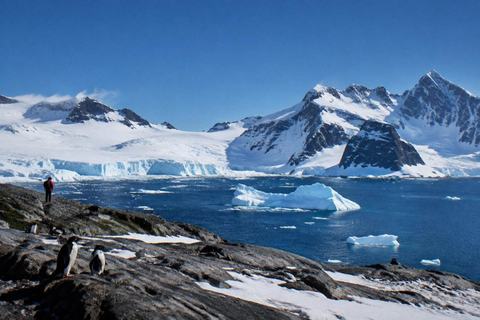 Peninsula CruisesThe classic Peninsula route explained: lengths, fares, landing sites and timing.Read the guide
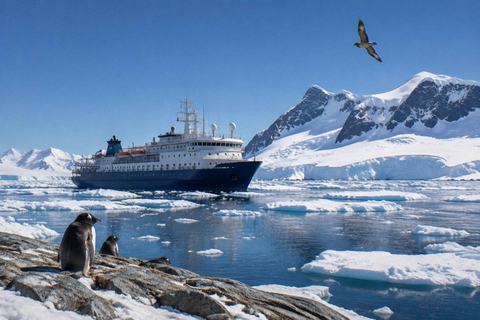 Antarctic CircleLonger, costlier voyages that push past 66 degrees south, and what the extra days buy.Read the guide
 South Georgia CruisesThe 18-to-22-day Falklands, South Georgia and Peninsula itinerary, the premium wildlife cruise.Read the guide
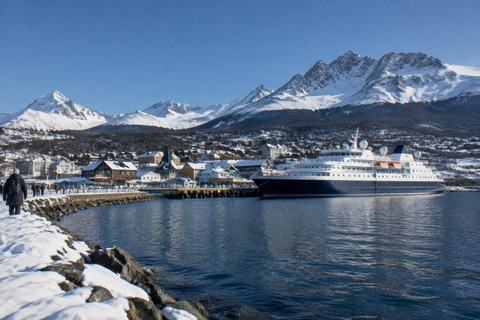 Cruises From UshuaiaShips, routes, fares and arrival logistics for the world's main Antarctica departure port.Read the guide