Expedition Vs Traditional Antarctica Cruise: Landings Or Scenic Sailing?
 By Oleg G.
A big mainstream ship can show you Antarctica from the water. An expedition ship can put you on it. The 500-passenger landing rule splits the two formats, and everything else, price, days at sea, what your days look like, follows from that line.
Quick answer: Only ships carrying 500 or fewer passengers may land guests in Antarctica, so mainstream vessels above that size offer scenic cruising with no shore visits. Expedition ships carry 13 to 200 guests, run Zodiac landings and lectures, and start around $7,050 per person for 2026-27. Mainstream scenic voyages start near $3,227.
What Is The Difference Between An Expedition Cruise And A Traditional Antarctica Cruise?
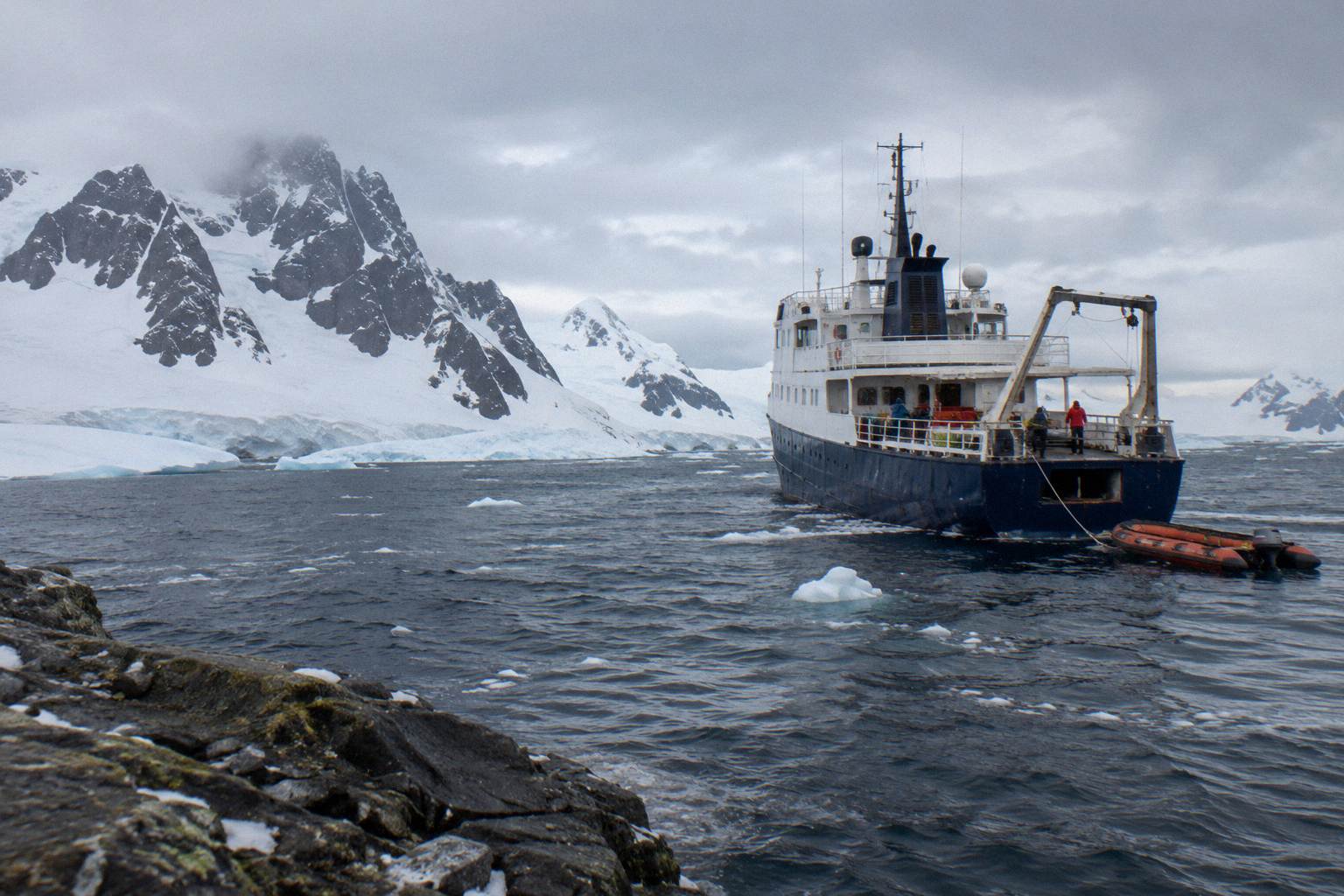
The difference is whether you step ashore. Expedition ships carry small passenger loads, run Zodiac landings and field programs, and employ a dedicated expedition team. Traditional mainstream ships carry more than 500 passengers, are prohibited from making landings in Antarctica, and offer scenic cruising past ice, islands and coastline instead. Everything about price, pace and daily routine follows from that single split.
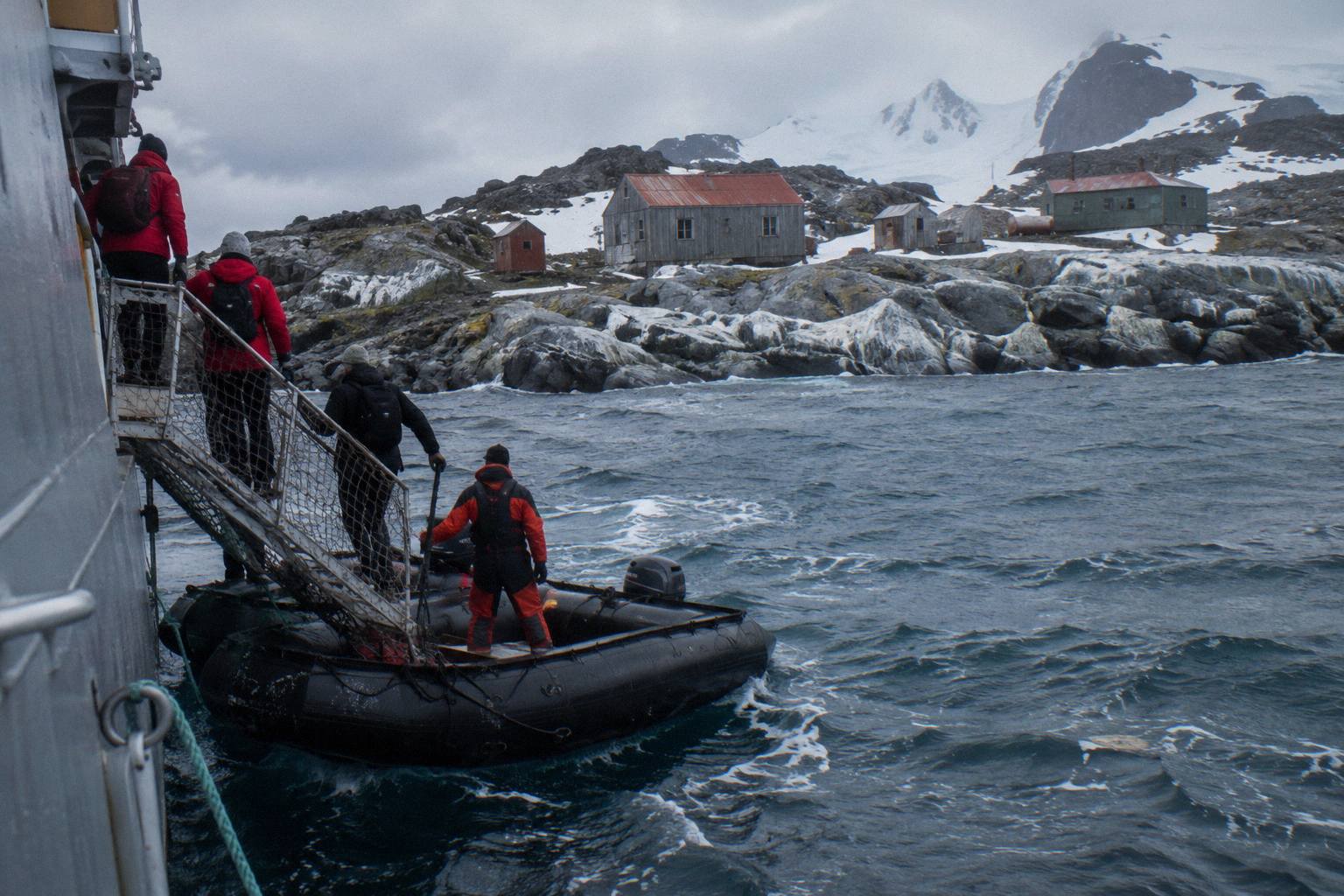
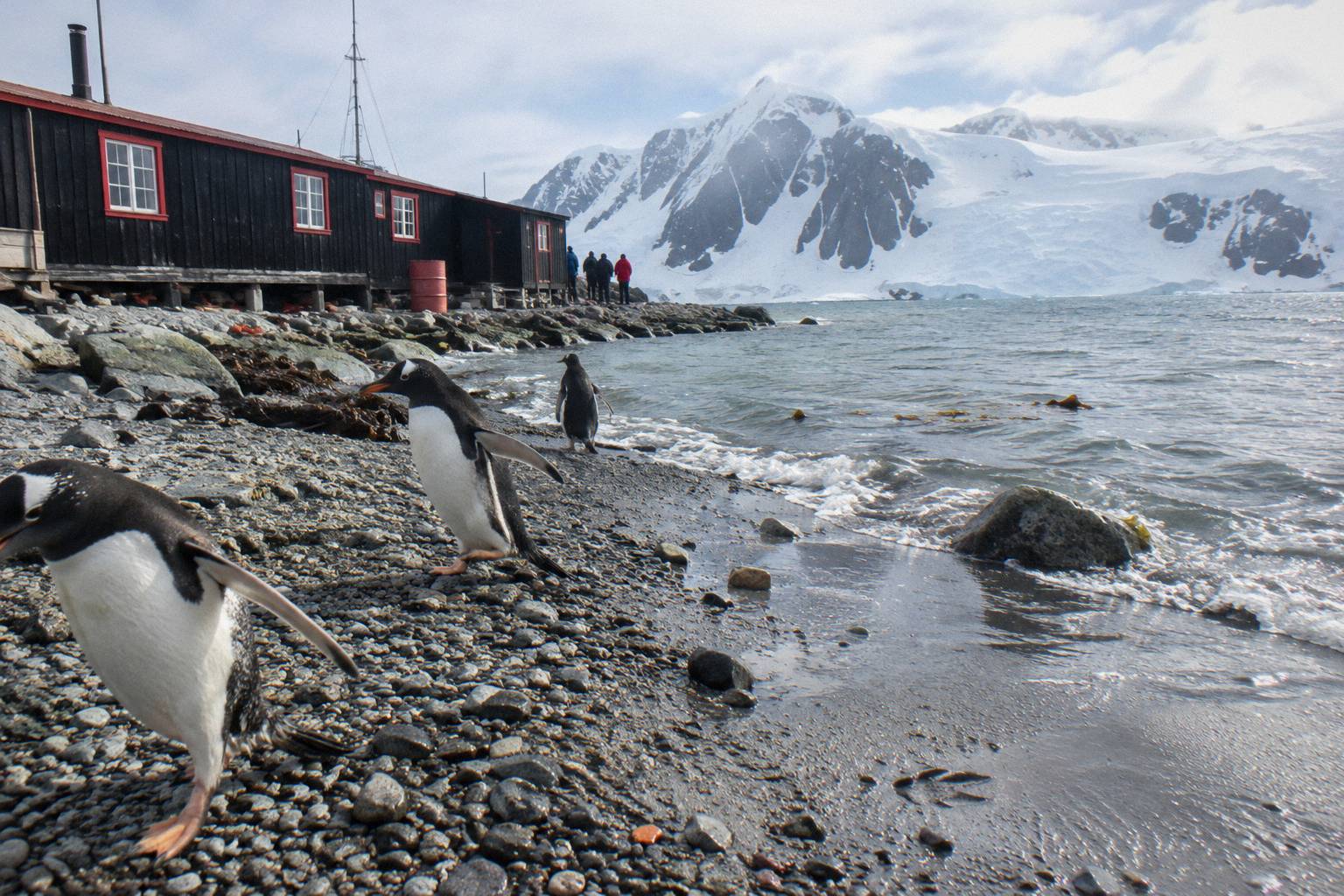
Think of the two formats as different products sold in the same waters. A mainstream voyage is a resort ship that calls at South American ports and spends three or four days sailing Antarctic waters, viewing glaciers and icebergs from open decks. An expedition voyage is a working polar vessel that anchors near landing sites, launches rigid inflatables and puts you on a beach with penguins, under rules set by the International Association of Antarctica Tour Operators (IAATO) and the Antarctic Treaty system. The views can be similar from the water. The experience of standing on Antarctic ground is only available on the smaller ships.
The market reflects the split. In the 2025-26 season IAATO recorded 113,518 total visitors to Antarctica, of whom 85,195 made landings and 27,217 were cruise-only, meaning they saw the continent entirely from on board. Both are real, legitimate ways to see Antarctica, and both are covered in depth across Cruises In Antarctica, but they are not the same trip.
This guide covers the whole trade-off: the rule that creates it, what each format actually delivers day to day, what each costs in the 2026-27 season, and which traveller each suits. If you already know you want to land, our guide to Antarctic Peninsula cruises picks up where this page ends.
The 500-Passenger Rule That Decides Whether You Can Step Ashore
Antarctic Treaty visitor guidance states that vessels carrying more than 500 passengers shall not make landings in Antarctica. Ships in the smaller landing categories may put passengers ashore, but no more than 100 passengers from one vessel may be on a site at any one time, guided at a ratio of at least one guide per twenty visitors.
That wording matters because it is not a marketing claim, it is the regulatory floor. IAATO sorts vessels into categories by size, and only some of them may land guests at all.
| IAATO category | Passengers on board | Landings |
|---|---|---|
| C1 | 13-200 | Landings permitted |
| C2 | 201-500 | Landings permitted with restrictions |
| CR | More than 500 | No landings, cruise only |
| YA | Yachts, up to 12 | Landings permitted |
The Antarctic Treaty System's tourism page adds the scale behind the rule: approximately 98 percent of all tourism voyages occur in the Antarctic Peninsula region during the seven-month austral summer, which is why the rules concentrate there.
The 100-passenger cap has a second effect worth understanding before you choose a ship. On a vessel carrying 200 guests, the ship rotates groups, so your landing is shorter while other groups take their turn. On a ship carrying 100 or fewer, everyone can go ashore at once and the landing runs longer for each person. That is why passenger count, more than cabin luxury, drives the character of an expedition voyage, and why our guide to Antarctica cruise ship sizes works through the categories in detail.
Mainstream ships are built around a different logic. They carry about two thousand guests or more, comply with the no-landing rule by design, and deliver Antarctica as scenery: scenic cruising in places such as Paradise Bay or off Elephant Island, announced from the bridge, watched from heated decks and glass-walled lounges. For some travellers that is genuinely enough. For others it is a beautiful two-day screen saver. Knowing which one you are is the whole decision.
What A Traditional Mainstream Antarctica Voyage Actually Looks Like
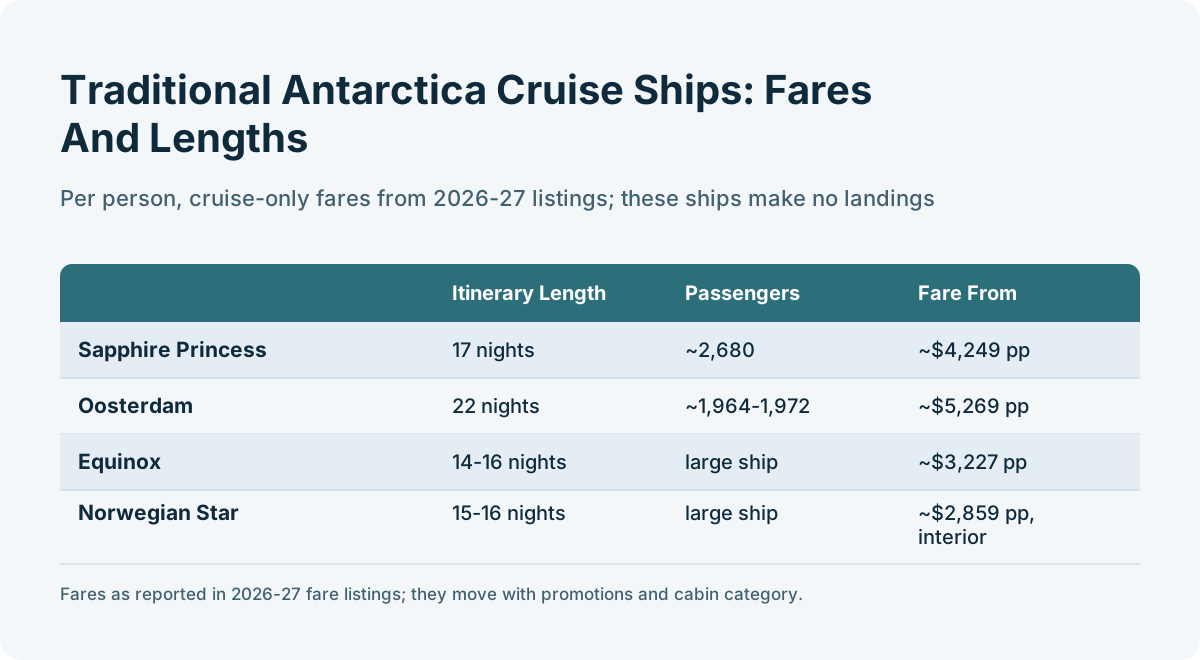
A traditional mainstream Antarctica voyage is a 14 to 22 night South America cruise with three to four days of Antarctic scenic sailing and no landings. Ships such as Princess's Majestic Princess (3,560 guests) and Holland America Line's Oosterdam (about 1,964 to 1,972) run these itineraries, with published fares starting around $3,227 to $5,269 per person before air and extras.
The shape of the trip is consistent across the lines. You sail from Buenos Aires, call at Montevideo, Punta del Este, Puerto Madryn and Port Stanley in the Falklands, reach Ushuaia and Punta Arenas, and then turn south for the Antarctic segment. Holland America Line's Oosterdam, for example, operates 22-night Buenos Aires to San Antonio itineraries in December 2026 and February 2027 that include three to four days of scenic cruising in Antarctic waters, alongside ports like Puerto Madryn, Port Stanley, Ushuaia and Puerto Montt. Princess operates similar 17-night Antarctic and South America voyages from Buenos Aires with overnight scenic cruising in Peninsula waters. Celebrity runs 14 to 16 night versions from Buenos Aires.
What you give up is the shore. These ships are above the 500-passenger line, so they hold to scenic cruising, and their Antarctic time is spent at sea or at anchor off glacial scenery rather than at landing sites. What you gain is resort infrastructure: multiple restaurants, spas, entertainment, large stabilised hulls that handle the Drake Passage with less motion than a 100-passenger former research vessel, and a lower per-night price than any expedition ship can offer. A 22-night sailing that touches Antarctic waters from an inside or balcony cabin can cost less than five nights on a luxury expedition ship.
| Ship | Line | Passengers | Itinerary length | Antarctic segment | Published fare from |
|---|---|---|---|---|---|
| Majestic Princess | Princess Cruises | 3,560 | 17 days, Buenos Aires round trip | Scenic cruising, no landings | from ~$3,297 pp (interior) |
| Oosterdam | Holland America Line | ~1,964-1,972 | 22 nights, Buenos Aires to San Antonio | 3-4 days scenic cruising, no landings | ~$5,269 pp |
| Equinox | Celebrity Cruises | large ship | 14-16 nights from Buenos Aires | 2+ days scenic cruising, no landings | ~$3,227 pp |
| Norwegian Star | Norwegian Cruise Line | large ship | 15-16 nights, Buenos Aires to San Antonio | Scenic cruising, Paradise Bay and Elephant Island area | ~$2,859 pp, interior |
Fares in that table are per person, cruise-only, as reported in 2026-27 fare listings, and they move with promotions and cabin category. If the price-to-days math is what decides this for you, talk through the numbers with our team before committing to a category, because a balcony on a mainstream ship and a shared quad on an expedition ship can land surprisingly close together.
What An Expedition Voyage Adds: Zodiacs, Landings, Lectures
An expedition voyage adds shore access and a daily program built around it: Zodiac landings and cruises, usually one or two per day when conditions allow, an onboard expedition team of naturalists, historians and scientists, lectures and briefings, and the field gear, boots and biosecurity routines that landings require. The ship itself becomes a base, not the destination.
The rhythm of a day is the clearest illustration. At breakfast the expedition leader briefs the room on the plan, with alternate options ready in case wind or swell rules a site out. Zodiacs launch from a sheltered boarding platform, and by mid-morning you are ashore at a gentoo colony or cruising among ice at water level. The afternoon repeats elsewhere. On ships of the size used by the main expedition operators, the guide ratio of at least one to twenty and the 100-passenger ashore cap shape how long each landing lasts.
Oceanwide Expeditions' Hondius is a good example of the format at the accessible end of the market. Built in 2019, she carries 170 passengers in 80 cabins, measures 107.6 metres, and holds Polar Class 6, a classification her operator describes as equivalent to 1A-Super. Her Zodiacs board from a sheltered indoor platform, and her Basecamp voyages bundle free camping, kayaking, snowshoe hiking, mountaineering and photo workshops into the fare rather than selling them as add-ons. Published Peninsula fares for her 2026-27 season start from $7,800 per person.
The lecture program is not decoration, it is what fills the sea days and turns a scenic crossing into something more. Hondius, for example, has an observation lounge and a separate lecture room. When a voyage includes the Drake Passage, those two crossing days each way are the venue for ice, wildlife and history talks that set up everything you see afterward. Our guide to the Drake Passage crossing covers what those days are actually like at sea.
Landing-based voyages also carry obligations scenic ships never touch. Biosecurity rules require you to wash boots and clean all gear, including clothes, bags, tripods and walking sticks, before bringing them to Antarctica, and to clean again between sites. You keep at least five metres from wildlife on land, and site guidance can require more. None of it is onerous, but it is part of what you are buying: the right to stand on a continent that is managed rather than consumed.
Expedition Vs Traditional Antarctica Cruise: The Trade-Offs Side By Side
Compare the formats on six axes and the choice clarifies. Expedition ships land passengers, mainstream ships cannot. Expedition voyages run 8 to 23 nights focused on the Peninsula; mainstream voyages run 14 to 22 nights, mostly in South America. Expedition fares start near $7,050, mainstream fares near $2,859, but they are not buying the same thing.
| Expedition voyage | Traditional mainstream voyage | |
|---|---|---|
| Passenger count | 13-500 (landing categories); typical ships 80-200 | ~1,964-3,560 (2026-27 examples) |
| Landings | Yes, 1-2 per day when conditions allow | No, prohibited above 500 passengers |
| Antarctic time | 4-6 landing days on classic Peninsula itineraries | 3-4 days scenic cruising |
| Itinerary length | 8-23 nights (Peninsula focus), 20+ with South Georgia | 14-22 nights, mostly South American ports |
| Onboard style | Lectures, expedition team, field gear | Theatre, spa, multiple restaurants, entertainment |
| Fare from, 2026-27 | ~$7,050 pp (shared cabin, 10-11 days) | ~$2,859 pp (interior, 15-16 nights) |
Read the table as a menu rather than a scoreboard. The mainstream column buys comfort per night, Drake stability from a wide, stabilised hull, and a broader regional itinerary. The expedition column buys the continent itself: boots on ground, Zodiacs at water level, penguins at five metres. Neither column is wrong, and the cheapest way to be wrong is to buy one expecting the other, which happens most often when a mainstream booking is described in sales copy as "Antarctica" without the words "scenic cruising".
Three Very Different Expedition Ships, At Three Very Different Prices
Within the expedition format the spread is wide. Oceanwide's Hondius carries 170 from $7,800. Lindblad's National Geographic Endurance carries 138 from $11,900. Viking's Octantis carries 378, and no current fare is published, so a live price needs a consultation. All three may land passengers; the experience of landing differs sharply by ship size.
These three ships sit at recognisable points along the spectrum. Hondius, covered above, is a purpose-built polar vessel at the value end, with quad and triple porthole cabins among its categories and a Polar Class 6 hull. National Geographic Endurance, from the Lindblad Expeditions and National Geographic partnership, carries 138 guests, was built in 2021, holds ice class PC5 Category A, and starts from $11,900 for the 12-day Voyage to Antarctica, with the fare card also noting months rather than specific dates. Viking's Octantis is the outlier in every direction: 378 guests, 202.7 metres, Polar Class 6, built 2022, adult-focused and closer in feel to a mainstream ship than to a 90-passenger converted research vessel, while still operating inside the landing categories.
| Ship | Class | Passengers | Ice class | From, per person | Voyage length | Departs from |
|---|---|---|---|---|---|---|
| HondiusOceanwide Expeditions | Small-Ship Budget | 170 | Polar Class 6 | from $7,800 | 11 to 19 days | Ushuaia |
| National Geographic EnduranceLindblad Expeditions (with National Geographic) | Standard Expedition | 138 | PC5 | from $11,900 | 12 to 22 days | Ushuaia |
| Viking OctantisViking | Upscale Expedition | 378 | Polar Class 6 | – | – | – |
The size difference inside this trio is the 100-passenger cap in action. On a 138-guest ship like Endurance, the ship rotates groups and each landing is a shorter, orderly turn. On a 170-guest ship like Hondius the same rotation applies at slightly larger scale. On Octantis, with 378 guests, the logistics are closer to a scheduled shuttle operation. If maximising your minutes ashore is the priority, the smallest vessels in our expedition cruise guide do that best; if you want landings plus more onboard amenities, the luxury and larger expedition ships offer them more consistently.
Choosing between them is a genuine decision point, and it is the kind of question a short article cannot answer for you, because it depends on dates, cabin budget and how much the onboard comfort is worth to you personally. Get a free consultation on ship choice and the conversation happens with someone who books these decks all season.
Which Format Suits Which Traveller
Choose a traditional mainstream voyage if the priority is comfort, cost per night and a broad South American itinerary, and if seeing Antarctica from the water is enough. Choose an expedition voyage if standing on the continent, close to wildlife, with a small group and expert guides, is the point of the trip. Neither format suits a traveller who expects the other's strengths.
Some honest profiles from the two-year research behind this site. The mainstream format fits a traveller who wants Antarctica as one chapter of a longer holiday, who values stability in the Drake, who may be cruising with companions who would not enjoy a small ship's roll, or whose budget makes a 22-night scenic itinerary far more attainable than a 12-night expedition one. It also fits anyone uncertain about small-ship life: no lectures, no boots, no landings to keep up with, and full resort facilities for the sea days.
The expedition format fits a traveller for whom Antarctica is the destination, not a segment. It is the right call if you want to photograph penguins from land, if you want kayaking or camping on the ice, if small groups and expedition staff matter more than entertainment, or if you would regret, permanently, watching the continent from behind glass. Age is no barrier either way; our guide to Antarctica cruises for seniors shows how both formats work for older travellers, and solo travellers have dedicated cabins and shared-cabin options on several expedition lines.
The budget view matters too. A realistic all-in plan for a 10 to 12 day mid-range Peninsula trip, fare plus flights, gear, tips and insurance, runs $12,000 to $25,000 per person once everything is counted, while a mainstream scenic sailing can enter the conversation under $6,000 per person before air. Whether the landing is worth roughly doubling the trip cost is not a question with an objective answer. It is the question, and it is worth asking out loud before any deposit changes hands.
Common Questions About Expedition Vs Traditional Antarctica Cruise
Can large cruise ships land passengers in Antarctica?
No. Antarctic Treaty visitor guidance states that vessels carrying more than 500 passengers shall not make landings in Antarctica. Mainstream ships above that size offer scenic cruising only, with no shore access at any site.
How many people can be ashore at one time from an expedition ship?
A maximum of 100 passengers from one vessel may be ashore at any one time, unless site-specific guidance requires fewer, guided at a minimum ratio of one guide per twenty visitors. Larger expedition ships rotate groups ashore, so each landing is shorter per person than on ships of 100 or fewer guests.
Is a traditional Antarctica cruise cheaper than an expedition cruise?
Yes, per night and often in total. Mainstream scenic voyages with an Antarctic segment publish fares from roughly $2,859 to $5,269 per person for 2026-27, while expedition voyages with landings start from $7,050 per person in a shared cabin. The mainstream fare buys scenery from the water, not shore access.
Do expedition ships cross the Drake Passage too?
Most do, typically about two days each way between Ushuaia and the Peninsula. Some operators also offer fly-cruise itineraries that replace one or both crossings with a roughly two-hour charter flight to King George Island, which cuts sea time but adds weather delay risk of one to three days.
Can I see penguins from a mainstream cruise ship?
You can see penguin colonies, glaciers and icebergs from the decks and lounges of a scenic-cruising ship, and whale sightings are common in Antarctic waters. What you cannot do is step ashore, so all wildlife viewing happens from on board rather than at the five-metre wildlife distance you would keep on land.
More Choosing A Ship
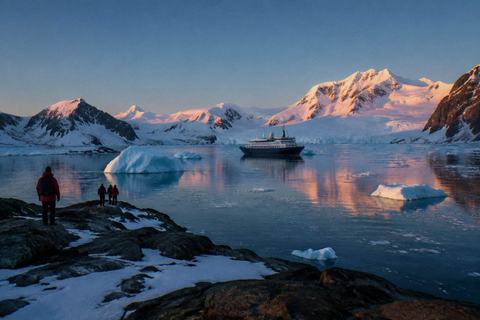 Choosing Your ShipFive decisions that narrow 43 expedition ships down to the one you should book.Read the guide
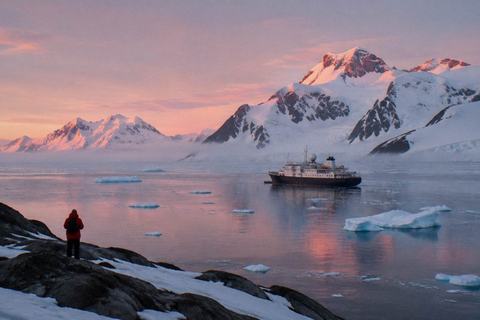 Cruise Ships ComparedShip size decides whether you land: compare every major Antarctica vessel by passengers, ice class and fare.Read the guide
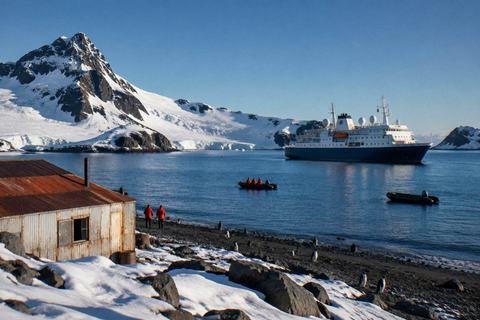 Cruise Lines ComparedAll fourteen Antarctica cruise lines mapped, with fleets, fares and landing rules.Read the guide
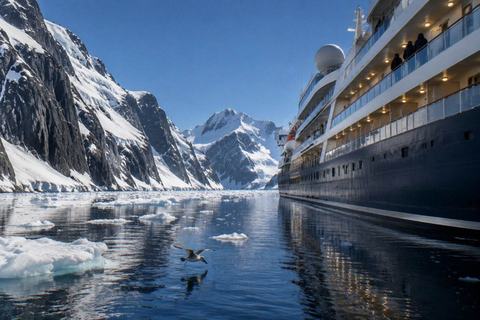 Luxury CruisesWhat a premium Antarctica fare really buys: suites, included extras and the ships at the top tier.Read the guide