How To Cut The Cost Of An Antarctica Cruise Without Losing What Matters
 By Oleg G.
Most of the money on an Antarctica cruise is spent on things that do not touch the ice. Here is how to cut those and keep the parts that do.
Quick answer: Entry berths on budget expedition ships start around $7,050 per person (Plancius) and $7,439 (G Adventures Expedition). Save by sharing a cabin, sailing in November or March, booking 12-18 months ahead, and flying to Ushuaia independently, while keeping landings, small-ship size and time ashore intact.
What Actually Drives The Price Of An Antarctica Cruise
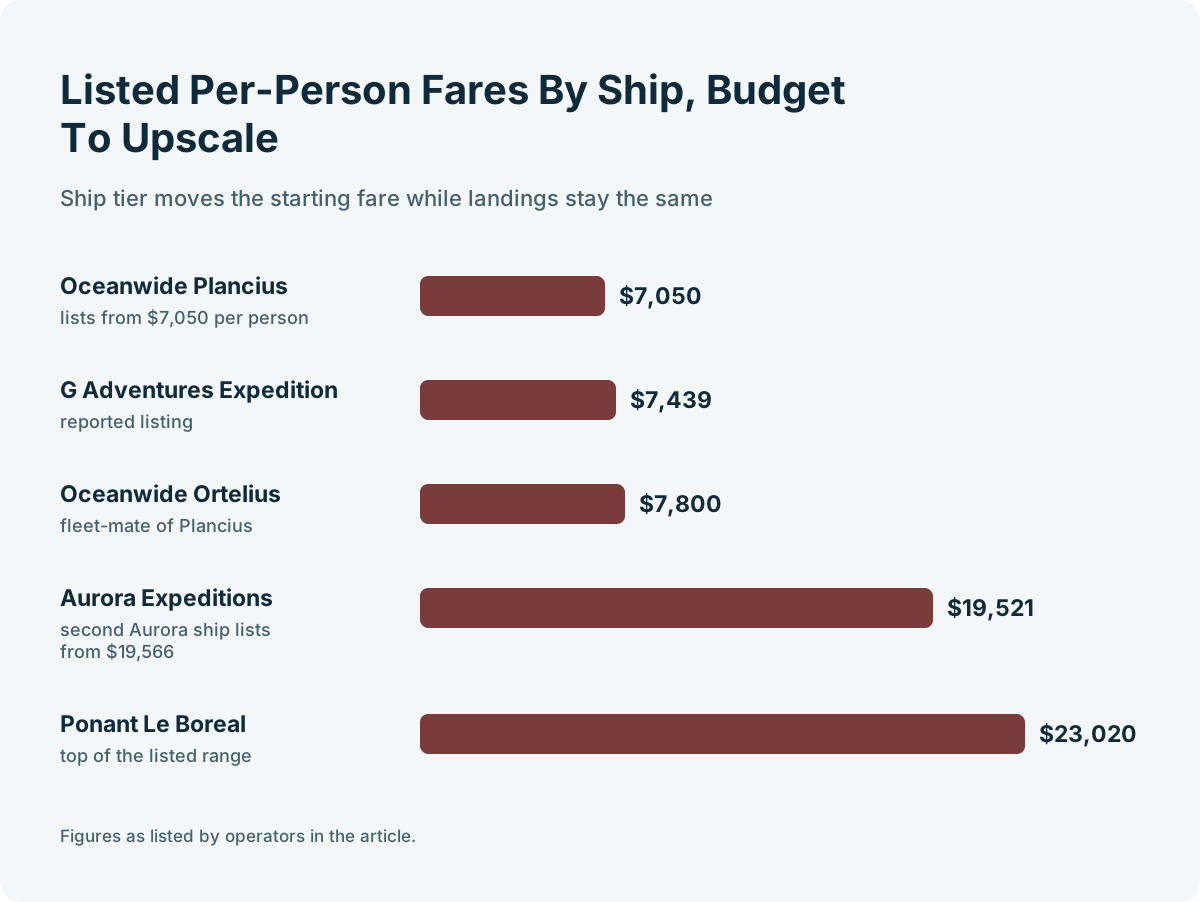
The fare buys three things: the ship, the month and the cabin. Ship tier moves the per-person price from roughly $7,000 on converted research vessels to $19,000 and up on newer upscale ships, month moves it by 20 percent or more between shoulder and peak, and cabin category can double the fare within one sailing. The landings themselves cost the same everywhere.
An Antarctica cruise is unusual among big trips in that the expensive line items are mostly invisible from the deck. The gap between the cheapest and most expensive berth on the same sailing can be enormous while the actual experience on the ice is nearly identical. According to one 2026 cost guide, entry-level berths on Drake-crossing itineraries begin at roughly $7,500-$8,995 per person for 10- to 11-day Peninsula voyages in shared twin or triple cabins, while the same routes on upscale ships run from $12,000 upward.
The roster numbers bear this out. Oceanwide's Plancius lists from $7,050 per person, its fleet-mate Ortelius from $7,800, and G Adventures' Expedition from a reported $7,439. At the other end, Aurora Expeditions' ships list from $19,521 and $19,566, and Ponant's Le Boréal from $23,020. Nobody's penguins are better on the more expensive ship. What the extra money buys is cabin comfort, onboard polish and, on some vessels, helicopters or submarines.
If you want the full price anatomy, our Antarctica cruise cost breakdown walks through every line item, and our cheap Antarctica cruise guide lists the specific ships and tactics for the lowest fares. This page is about the discipline of cutting cost without cutting the reason you are going.
What To Keep And What To Trade
Keep the small ship, the landings and the time ashore; trade the cabin, the month and the flight routing. Nothing you buy on a cheaper cabin reduces your time on the ice, but a bigger ship or a scenic-only voyage removes the landings entirely, and that is the one trade that guts the trip.
The single most valuable thing your fare pays for is the landing operation. IAATO rules cap passengers ashore at 100 at a time and require a 1:20 guide-to-visitor ratio, so ships under about 120 guests can put all or most guests ashore at once, while larger vessels rotate groups and shave individual time on land. A ship like Plancius (108 passengers) or Ortelius (108) keeps any rotation short. Vessels carrying more than 500 passengers cannot make landings at all, per IAATO standards, so their fares buy scenic cruising only.
What you trade instead:
| Keep | Trade | Why the trade works |
|---|---|---|
| Landings (Zodiac operations) | Cabin category | A quad porthole berth puts you on the same Zodiac as the suite guest |
| Small ship (under 200 guests) | Ship age and polish | Older converted vessels cost less per berth, same landing sites |
| 10-12 days on the Peninsula | Route extensions | Falklands and South Georgia add days and dollars |
| Expedition team and lectures | Balconies, spas, suites | These do not touch the ice |
| One Drake crossing | Charter flights | Fly-the-Drake options add roughly $2,000-$5,000 over sailing |
The cabin trade is the biggest single lever. On Oceanwide's Hondius, sample fares run from roughly $9,600 in a quad porthole to $15,000+ for a balcony suite, a spread of more than $5,000 on the identical voyage. On Quark's Ultramarine, category samples run from about $16,890 in an Explorer Triple to $37,990 in the top suites. The penguins do not check your cabin category.
The Shoulder Months: November And March
November and March departures often price 20 percent or more below peak, and the wildlife and ice trade-offs are modest: November gives courtship displays and pristine snow with fewer whales, March gives peak whale activity and fledging chicks with colder, darker days. Peak December-January pricing is the premium you pay for maximum daylight and chicks.
The 2026-27 season runs November through March, and the pricing curve is steep at its edges. Sample fares from operator listings show March Oceanwide departures around $6,900 for an 11-day trip, November G Adventures around $7,279 and Ocean Nova around $8,463, against December-January figures of $12,000-$17,000 and holiday departures approaching $30,205 on Lindblad's National Geographic Endurance. The shoulder discount is real: November and March departures typically offer the larger discounts because of shoulder-season availability.
What you give up in November is whales (migration still ongoing) and access to some landing sites that remain snowed in or ice-blocked. What you get is courtship behaviour, fresh deep snow, quieter landings and lower fares. March gives you the best whale numbers of the season, fledging penguin chicks and the last sailings of the year, with daylight down to about 12.5 hours on the Peninsula. Neither month removes the landing program.
For a deeper comparison of the trade-offs, see our month-by-month Antarctica cruise prices guide, and for the timing question more broadly, the best time to visit Antarctica.
One practical wrinkle for shoulder-month shoppers: the same early-booking offers that apply to peak sailings also apply to November and March, so a 10-30 percent early-booking discount may apply on top of the shoulder-month fare; check each offer's terms. On select unsold sailings, discounts reach as high as 40 percent, and operators are most motivated to fill those berths late in the booking cycle, which tends to mean edge-of-season departures. If your dates are flexible, watching for late inventory on a March sailing can beat booking a peak-week cabin months in advance.
Photographers should also weigh the light itself. November brings fresh snow for landscape work, while March still gives roughly 12.5 hours of Peninsula daylight, returning sunsets and strong whale activity. The choice mostly comes down to which wildlife moments you want on camera and how much fare you are willing to trade for them.
Share A Cabin: The Single Biggest Saving
Sharing a cabin is one of the largest legitimate discounts in Antarctic travel: quad and triple berths price from roughly $7,050-$9,600 per person versus $11,400-$12,500 for a twin on comparable sailings, and several operators waive or reduce single supplements through matching programs.
The cabin mathematics are stark. On Hondius sample pricing, a quad porthole runs about $9,600-$10,150 per berth while a twin porthole runs $11,400-$12,500, and the superior and suite categories climb from $13,150 upward. On Hondius you sleep four to a room with upper and lower berths, and you save roughly $1,800 or more for the privilege of a slightly worse night's sleep.
For solo travellers the matching programs matter even more. G Adventures charges no single supplement when sharing a twin or triple with another same-gender traveller. Oceanwide offers shared-cabin options on a share basis for solo travellers. Aurora offers up to 10 dedicated solo cabins per sailing with no single supplement, and Greg Mortimer and Sylvia Earle both carry dedicated solo balcony staterooms in select categories with no supplement. Typical single supplements otherwise run 25-100 percent of the twin-share fare, so escaping them is worth as much as a season of promo hunting.
| Operator / ship | Solo or share mechanism | Approximate saving |
|---|---|---|
| G Adventures Expedition | No single supplement when sharing twin/triple with same-gender traveller | Full supplement waived |
| Oceanwide (Plancius, Ortelius, Hondius) | Shared cabins on a share basis | From ~$7,050 (Plancius from-fare) |
| Aurora (Greg Mortimer, Sylvia Earle) | Up to 10 dedicated solo cabins, no supplement | Supplement waived |
| HX | No solo supplement on select bookings within six months of departure | Supplement waived on select sailings |
If you want the full solo picture, our solo travel in Antarctica guide covers every matching program in detail.
Book Early, Book With The Deposit Calendar In Mind
Early-booking offers commonly reach 10-30 percent off, with select unsold 2026-27 sailings discounted up to 40 percent, and deposits are modest: Oceanwide takes 20 percent with balance due 60 days out, Quark takes 25 percent with final payment 150 days before departure. The widest choice of cabins and fares goes to people who commit early.
The early-booking economics come straight from the operator calendars. Early-booking offers for 2026-27 and 2027-28 seasons commonly reach 10-30 percent off, with up to 40 percent reported on select unsold 2026-27 sailings and deadlines running into 2026. Peak December sailings book 18 or more months ahead, which means the people paying the least for the best dates are the people who planned earliest.
The deposit terms tell you how flexible each operator is. Quark requires a 25 percent deposit if booked 151 or more days before Day 1, with final payment due 150 days out. Oceanwide takes 20 percent on confirmation with the balance due 60 days before departure. Cancellation penalties escalate steeply from there, which is why the booking order matters: pick the ship, pick the month, then commit with the deposit while the cheapest categories are still open. Our deposits and payments guide has the full operator-by-operator terms.
Last-minute deals do exist, with discounts of 25-60 percent reported on select departures, but they are a gamble on cabin choice and are uncommon for peak December sailings. If you can travel on short notice, our last-minute Antarctica cruise deals guide covers that route honestly; if you cannot, early booking is the reliable path.
The Budget Ships: Plancius, Ortelius And Expedition
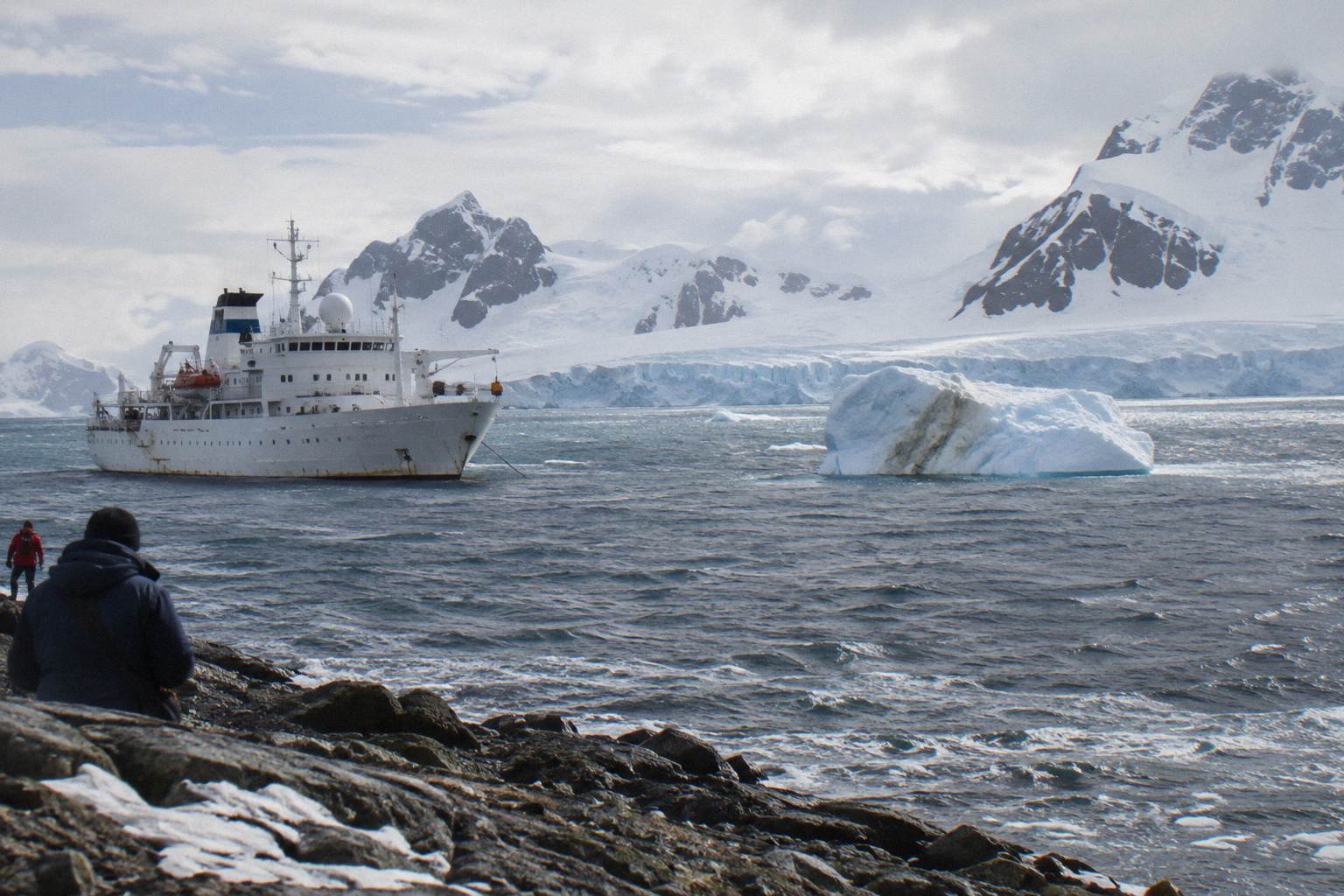
Three ships anchor the value tier: Plancius (108 guests, from $7,050), Ortelius (108 guests, from $7,800) and G Adventures' Expedition (128 guests, from $7,439). All three are IAATO-category vessels that make landings, and all three put you on the ice on the same Peninsula sites as ships costing three times more.
Plancius is the roster's cheapest published fare and the ship this site features for budget travellers. She is a converted Dutch Navy oceanographic vessel, rebuilt as a passenger ship in 2009, carrying 108 guests in 50 cabins with an ice class of 1D. Oceanwide's Basecamp voyages include free camping and kayaking. She sails 10- to 33-day voyages from Ushuaia.
Ortelius is her fleet-mate: a former Russian research vessel built in Gdynia in 1989, also 108 guests in 50 cabins, with a UL1 ice class (equivalent to 1A), higher than Plancius's 1D. She is the ship for helicopter-accessed Weddell Sea voyages, with 10 Zodiacs and fares from $7,800. G Adventures' Expedition is a 1976-built, 128-guest vessel with Ice Class 1A, listing from $7,439 with Zodiac excursions and expert guides, and a G Adventures package includes a Ushuaia hotel night, transfers, a parka to keep and boot loan.
| Ship | Class | Passengers | Ice class | From, per person | Voyage length | Departs from |
|---|---|---|---|---|---|---|
| PlanciusOceanwide Expeditions | Small-Ship Budget | 108 | 1D | from $7,050 | 10 to 33 days | Ushuaia |
| OrteliusOceanwide Expeditions | Small-Ship Budget | 108 | UL1 | from $7,800 | 11 to 25 days | Ushuaia |
| Expedition (G Adventures)G Adventures | Small-Ship Budget | 128 | Ice Class 1A | from $7,439 | 11 to 14 days | Ushuaia |
The honest differences between them are itinerary style and ship condition, not the quality of the ice. Plancius and Ortelius run Oceanwide's program; Expedition comes as a G Adventures package with a hotel night and transfers. All three deliver the thing you are actually buying: small-ship landings with a full expedition team.
Flights, Insurance And The Hidden Costs
The fare is not the budget. International flights to the gateway run $530-$1,200+, mandatory evacuation insurance $200-$500+, and a realistic all-in budget for a mid-range Peninsula trip is $12,000-$25,000 per person including fare, flights, gear, tips and insurance. Cutting these costs is where another few thousand dollars hides.
The gateway logistics are the first target. Most travellers fly into Buenos Aires and connect to Ushuaia, and Aerolineas Argentinas operates roughly 27 weekly flights on the AEP-USH corridor with JetSMART adding several low-cost frequencies. Booking that domestic leg yourself, early, keeps you in control of the fare, though some operators (Atlas, and Scenic, Ponant and Viking on some packages) bundle flights, so check what is bundled before you buy separately. Operators commonly recommend at least one buffer night in the gateway city, and Ushuaia hotel occupancy in January 2026 was around 80 percent, so book that night early too.
Insurance is not optional at this destination. Operators impose high medical-evacuation minimums, with examples including Quark at $500,000 and Ponant at $250,000, plus full trip-cost cancellation cover. Budget $200-$500+ for a policy that meets your operator's minimum. Tips average about $16 per person per day by one 2026 estimate, and optional activities like kayaking and camping add $350-$2,000 if not included, which is another reason the Basecamp-style bundled voyages are good value.
| Hidden cost | Typical range | How to cut it |
|---|---|---|
| International flights to gateway | $530-$1,200+ | Book early; use miles on the long-haul leg |
| Ushuaia domestic connection | Varies by season | Book AEP-USH early; JetSMART competes on price |
| Travel insurance with evacuation | $200-$500+ | Buy at deposit stage; match operator minimum exactly |
| Tips | ~$16 per person per day | Budget it; some lines (Lindblad) bundle gratuities |
| Optional activities | $350-$2,000 | Choose Basecamp voyages where they are included |
If the decision between two quotes has you stuck, our compare Antarctica cruise quotes checklist walks through it line by line, and a free consultation can pressure-test the numbers: get the fares checked before you commit.
A Savings Plan That Keeps The Landings
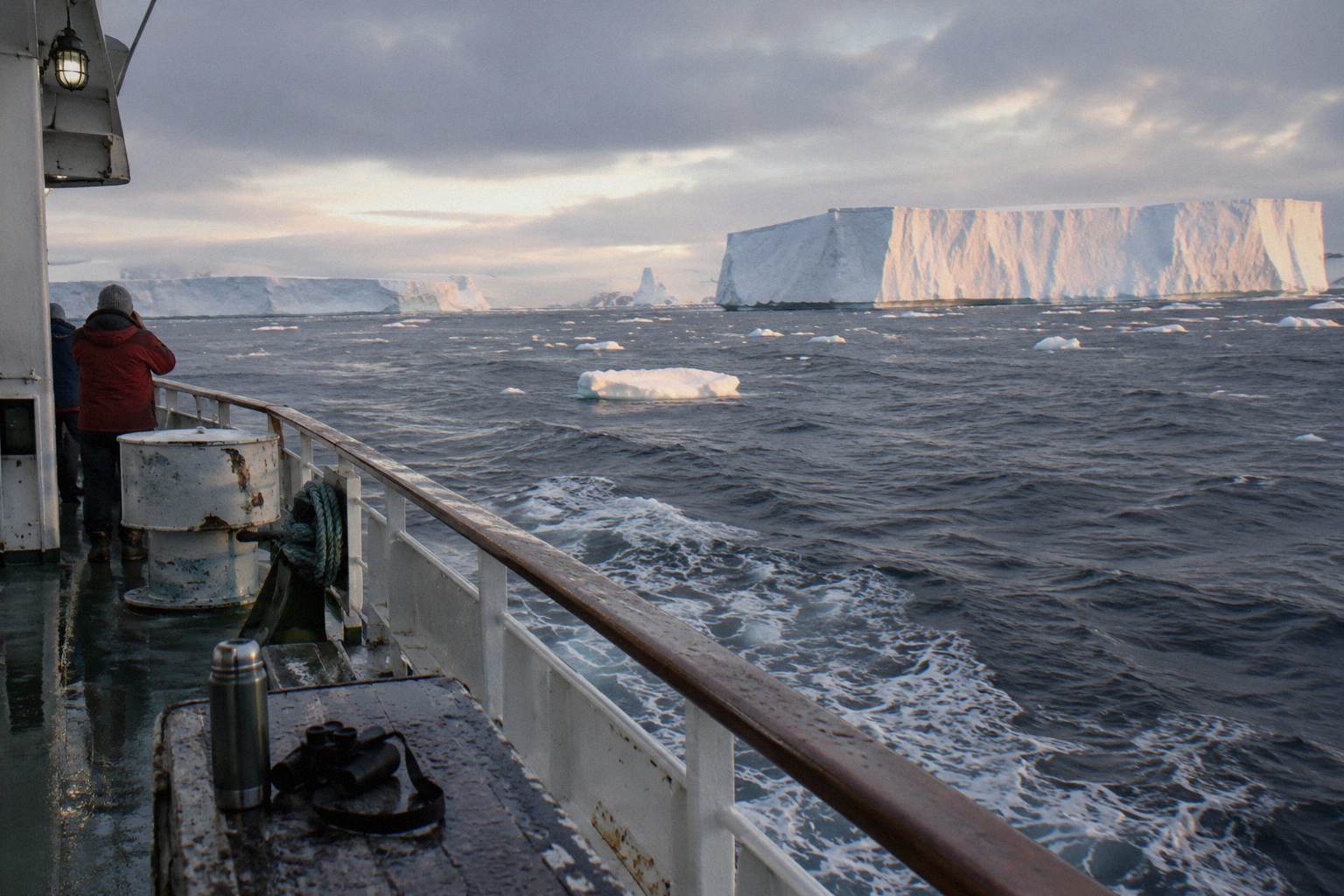
A realistic savings stack: quad or triple cabin (roughly $1,800-$2,400 against a twin porthole on Hondius), November or March departure (20 percent or more), early-booking offer (10-30 percent), independent flights and exact-minimum insurance, applied to a budget ship like Plancius. Stacked carefully, the same landings cost far less than a mid-range fare.
Here is the stack in one table, with each lever's published value:
| Savings lever | Published value | What it costs you |
|---|---|---|
| Quad/triple share cabin | Quad from ~$7,050-$9,600 vs twin from ~$11,400 | Privacy and space |
| November or March departure | 20 percent+ below peak | Whales (Nov) or daylight (Mar) |
| Early-booking offer | 10-30 percent off, up to 40 percent on select sailings | Committing 12-18 months out |
| Budget ship vs upscale | $7,050-$7,800 vs $12,000+ from-prices | Ship polish, balconies |
| Independent flights and insurance matching | Hundreds to $1,000+ | Research time |
| Skip fly-the-Drake | Avoid the ~$2,000-$5,000 charter premium | Two days at sea each way |
The one thing not to trade is the landing operation itself. A cheaper voyage on a 500-plus-passenger ship with no landings is not a cheaper version of this trip; it is a different trip. IAATO's own figures put the distinction plainly: vessels carrying more than 500 passengers shall not make landings in Antarctica, while ships in the C1 category (13-200 passengers) operate the full Zodiac program. The 2025-26 season recorded 85,195 landed visits versus 27,217 cruise-only passengers, and you want to be in the first group. IAATO publishes the visitor statistics behind these numbers, and the Antarctic Treaty visitor guidelines define the landing rules your ship operates under.
On Cruises In Antarctica we keep the ship pages updated with the roster figures, so before you commit to a fare, have the current Plancius, Ortelius and Expedition numbers checked against your dates: a free consultation on the cheapest valid option costs nothing and carries no obligation.
Common Questions About Cutting Antarctica Cruise Cost
How much does a cheap Antarctica cruise actually cost?
Published from-fares on budget expedition ships start at $7,050 per person on Plancius, a reported $7,439 on G Adventures' Expedition and $7,800 on Ortelius, for Peninsula voyages. A realistic all-in budget including flights, insurance, tips and gear is $12,000-$25,000 per person.
Is it cheaper to book an Antarctica cruise last minute?
Sometimes. Discounts of 25-60 percent have been reported on select departures, and Ushuaia agencies handle unsold berths. But last-minute deals are limited in availability and cabin choice, and are uncommon for peak December sailings, which book 18 or more months ahead.
Which month is cheapest for an Antarctica cruise?
November and March, the shoulder months. Sample fares include March Oceanwide departures around $6,900 and November G Adventures around $7,279, versus $12,000-$17,000-plus for December and January.
Does a cheaper cabin mean less time ashore?
No. Cabin category affects only the room. The landings, Zodiacs, expedition team and time on the ice are identical for every passenger on the sailing, which is why the cabin is the best thing to trade away.
Do I have to pay a single supplement as a solo traveller?
Not always. G Adventures waives the supplement when you share a twin or triple, Oceanwide offers shared cabins on a share basis, and Aurora carries up to 10 dedicated solo cabins per sailing with no single supplement.
How early should I book to get the best price?
Twelve to eighteen months ahead for peak dates. Early-booking offers commonly reach 10-30 percent off, and early booking secures better cabin selection.
More Cost And Booking
 Cruise CostA per-person price ladder from $7,050 berths to $32,320 luxury voyages, with what fares include and what they quietly leave out.Read the guide
 Cheap Antarctica CruisesThe honest floor for Antarctica fares, which ships carry it, and what it costs all-in.Read the guide
 Last-Minute DealsDo last-minute Antarctica berths still exist, and what do they really save?Read the guide
 What Is IncludedWhat an Antarctica fare really covers, operator by operator, plus the hidden costs with published amounts.Read the guide