Embarkation And Disembarkation Day In Ushuaia: Timing, Luggage And Flights Home
 By Oleg G.
Boarding an Antarctic expedition ship is a logistics day, not a sailing day. Here is how the pier, the luggage and the flight home actually work, based on what the operators publish.
Quick answer: Most Ushuaia expeditions board in the late afternoon, around 4 pm on Quark itineraries, after a hotel night in town. Ships arrive back around 7 to 8 am on disembarkation day, and operators advise against booking any flight out of Ushuaia before noon. One buffer night before the voyage is the standard recommendation.
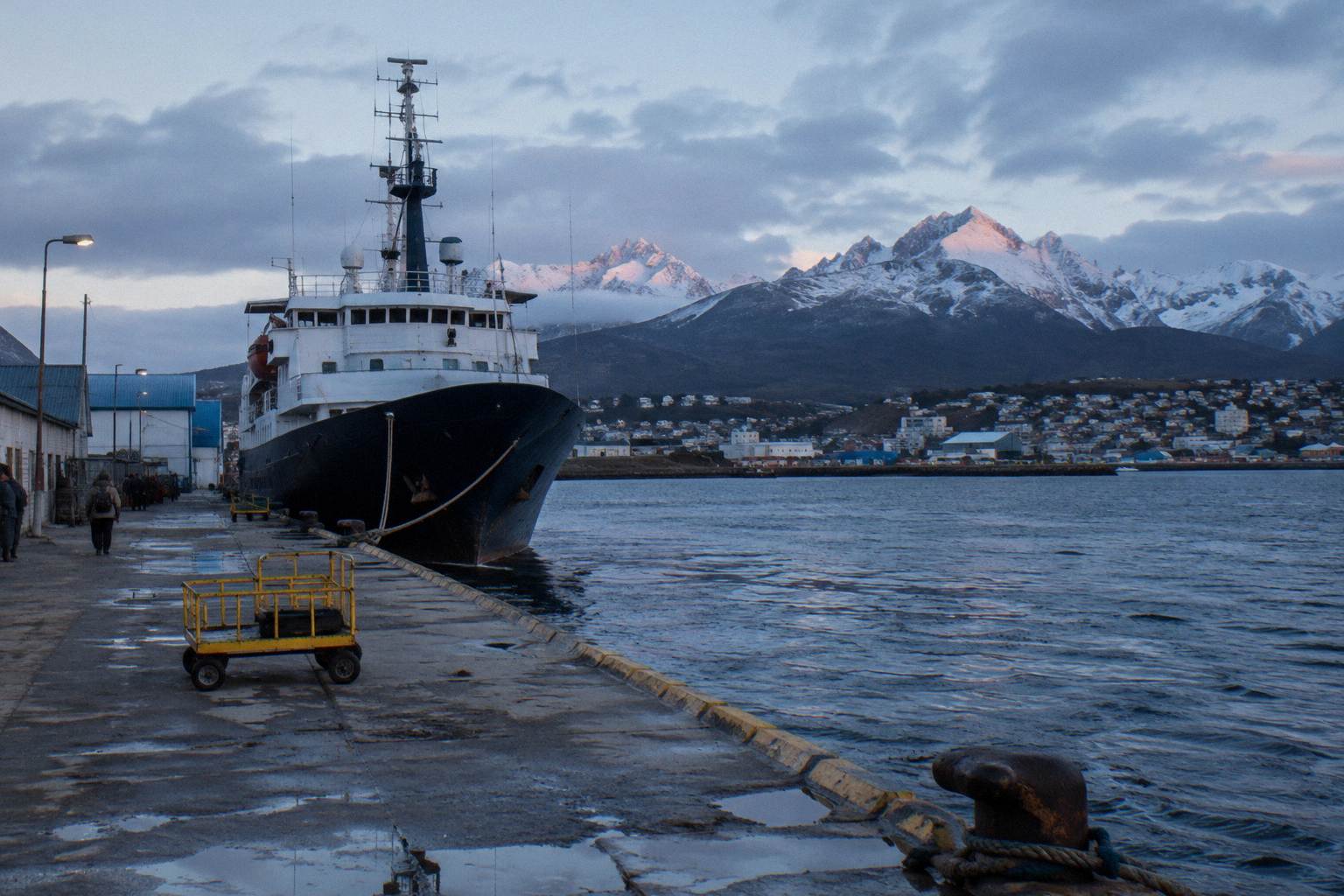
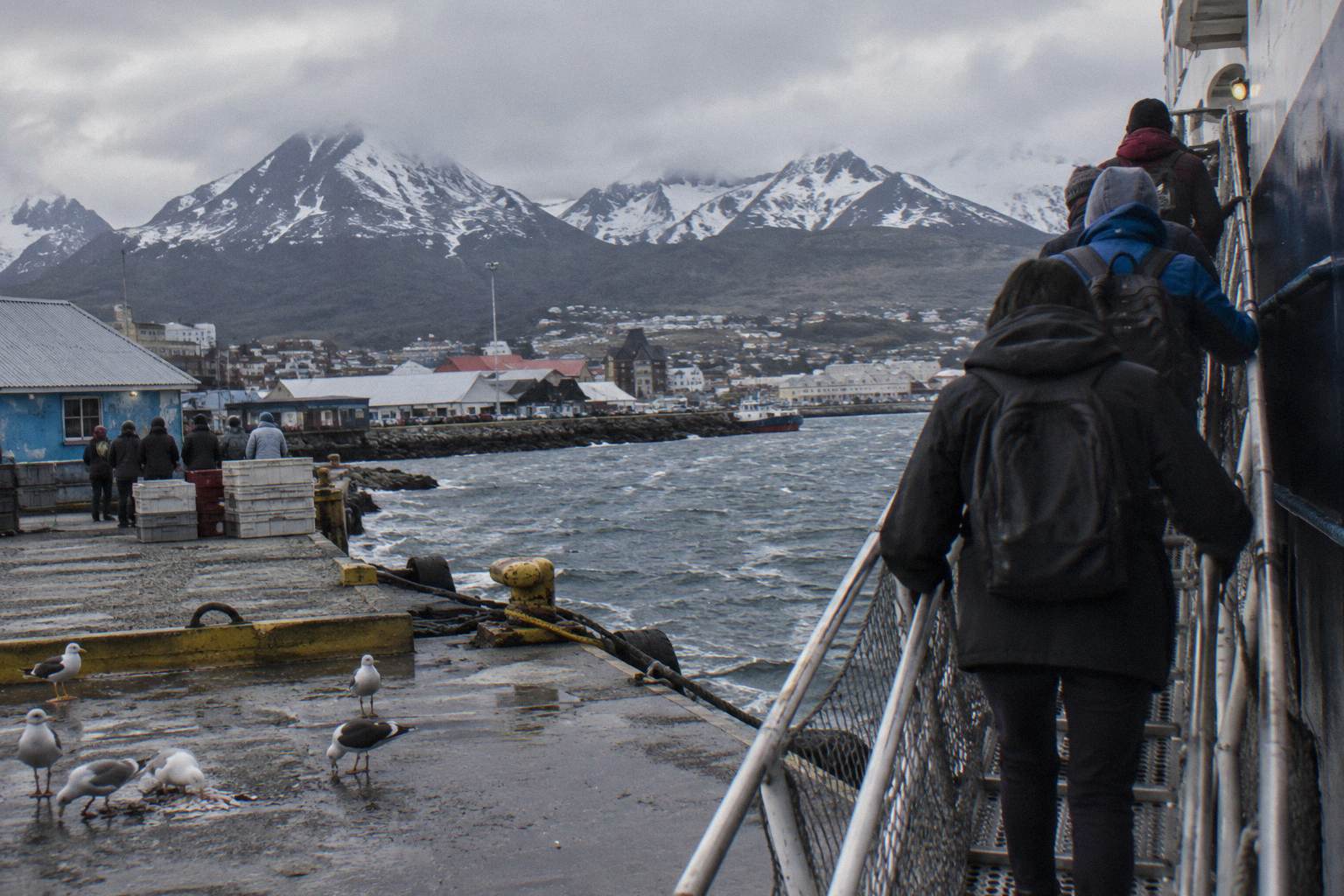
The pier in Ushuaia sits on Av. Maipú, a short drive from the airport, with the Beagle Channel in front of it. On embarkation day the difference between a smooth boarding day and a stressful one is almost entirely down to planning. Cruises In Antarctica covers the whole booking journey, and this guide is the narrow, practical slice of it: what time you board, where your bags go, and when you can safely fly home afterwards.
The details below come from operator-published itinerary documents and port guidance for the 2026-27 season. Where an operator does not state a time, we say so rather than guessing.
What Time Do You Board The Ship In Ushuaia?
Boarding in Ushuaia is an afternoon affair on almost every expedition itinerary: Quark Expeditions, for example, typically embarks around 4 pm, often on day two of its itineraries after a hotel night. Aurora Expeditions guests check in at their hotel from 3 pm the day before and transfer to the ship the following day. Oceanwide Expeditions simply asks guests to arrive the day before and follow final joining instructions.
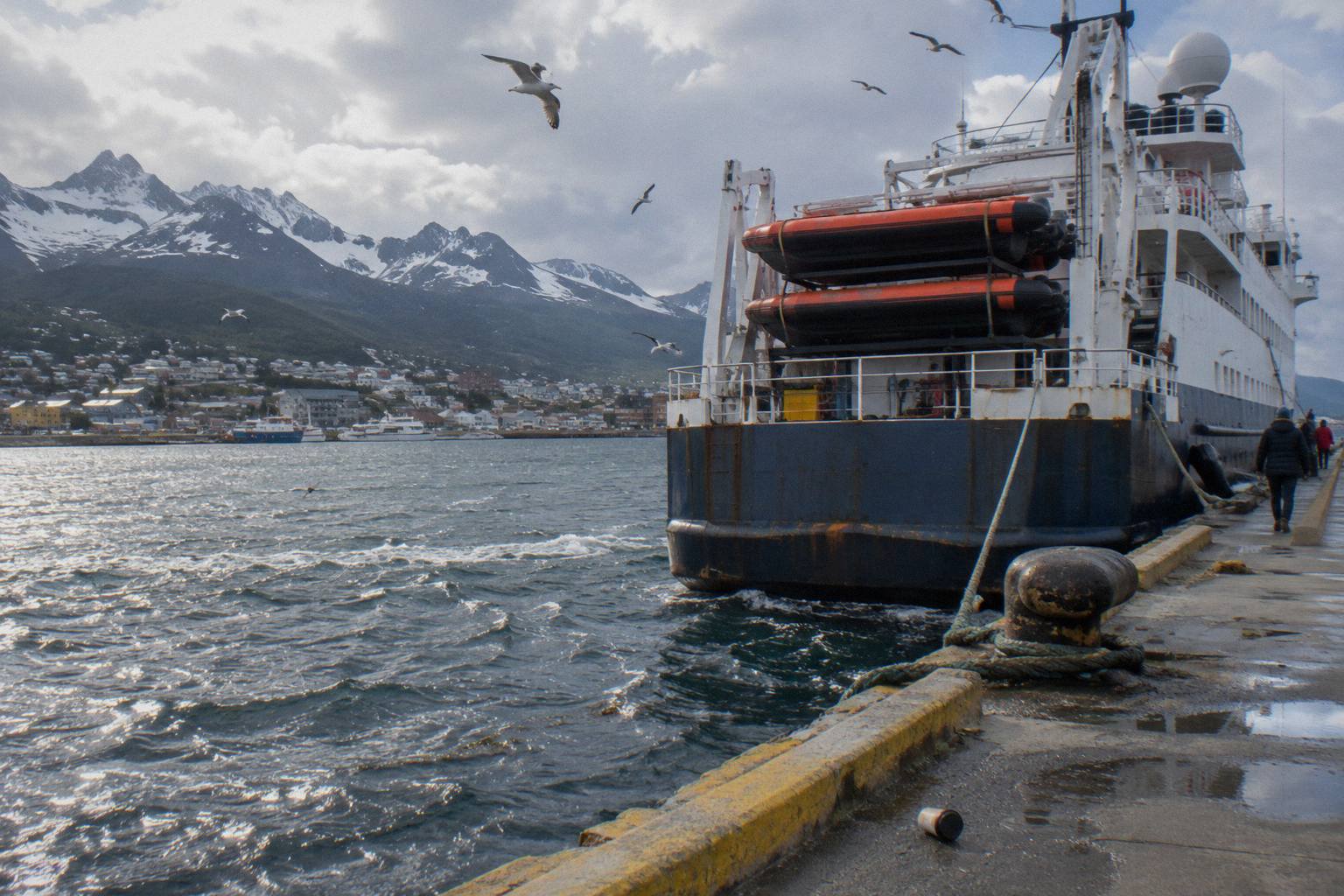
The reason for the late start is practical. The ship has usually landed its previous passengers that same morning, with disembarkation around 7 to 8 am on Quark and Aurora voyages, and the hours in between are its turnaround.
The day before boarding is usually a travel day, not a free day. If you are flying down from Buenos Aires, domestic flights from Aeroparque (AEP) to Ushuaia take roughly three hours and forty minutes, and operators consistently recommend arriving a day ahead of the ship. Many Quark itineraries include a pre-cruise hotel night in Ushuaia or Buenos Aires for exactly this reason.
What you actually do on boarding day is low-drama. A morning in town, luggage handed over, then the transfer to the pier and the gangway. Your operator's final documents give the exact sailing time. The crossing itself is a separate question we cover in our guide to the Drake Passage crossing.
The one thing not to do is treat boarding day as a buffer for your international flight. If your plane from Buenos Aires lands at midday and the ship sails at six, one delayed domestic flight turns into a missed voyage, and the operator will not hold the ship.
If you are deciding between a voyage that starts with a Buenos Aires charter and one that starts straight from Ushuaia, check the routing with a specialist, because the hotel-night structure changes which flights you can safely book on either side.
Where Does Embarkation Happen And How Do You Reach The Pier?
Ushuaia's cruise pier is on Av. Maipú in the centre of town, roughly a 10 to 15 minute taxi ride from Ushuaia airport, which sits on a peninsula south of the city. Oceanwide Expeditions notes that pier access on Maipú Street requires a boarding pass, and many operators arrange group transfers on embarkation day.
The airport-to-town transfer is the easy leg, about 3 to 7 km. The expensive part of reaching Ushuaia is never the last taxi, it is everything upstream: the international flight into Buenos Aires Ezeiza and the domestic connection from Aeroparque.
That transfer between Buenos Aires airports is a common weak point for Antarctic passengers. The two airports are about 40 km apart by road. Private transfers and remises typically take 45 minutes to two hours depending on traffic, and the shuttle alternatives have their own schedules. Buenos Aires transfer guides recommend planning at least four hours between an international arrival at Ezeiza and a domestic departure from Aeroparque.
| EZE to AEP option | Typical journey time | Notes |
|---|---|---|
| Private transfer or remis | 45 minutes to 2 hours | Fixed-price options around USD 60 per car |
| Manuel Tienda León shuttle | About 1h 15m to 1h 20m | Hourly or frequent departures |
| Neo Bus shuttle | Not stated | About every 90 minutes; slightly cheaper than Tienda León |
If all of that sounds like a lot of logistics for one day, that is because it is, and it is why operators recommend a night in Ushuaia before boarding. Our getting to Ushuaia guide breaks the full routing down, including the fly-versus-bus question for anyone already in Patagonia.
If you are coming from Chile instead, the Punta Arenas to Ushuaia bus runs 10 to 12 hours with a ferry crossing of the Strait of Magellan at Primera Angostura on the way. It works, but it is a full day of travel with a border crossing in it, so do not schedule it for boarding day itself.
Ushuaia's port has been changing under the season's traffic, and a few current facts from the port reporting are worth knowing before you plan your pier logistics:
Luggage Drop, Tags And What Happens To Your Bags
Your main bag normally leaves you before you do. Quark collects luggage from hotels in the morning of embarkation and transfers it to the ship; Aurora Expeditions asks guests to leave bags at hotel reception by around 11 am for transfer to the vessel; Oceanwide handles luggage per its final instructions.
Labelling matters. Aurora Expeditions hands out luggage tags and information at a hotel hospitality desk, and other operators explain tagging in their final documents.
The practical advice is simple. Keep the day pack that holds your passport, medication, seasickness remedies and a change of clothes with you, and hand over everything else. On the first afternoon you will want the jacket and the camera long before you see your main luggage again.
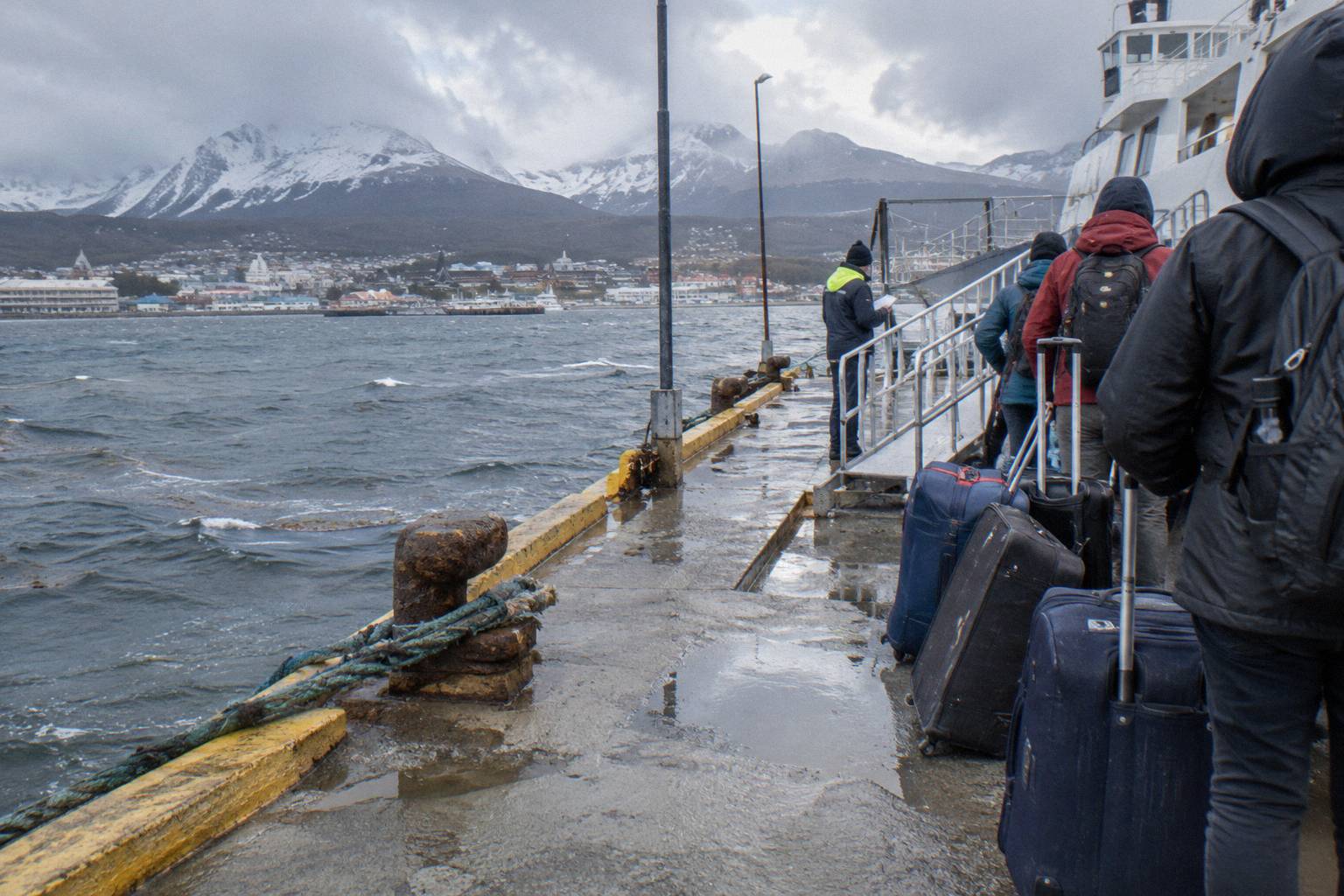
There is also a biosecurity step at the gangway, and it is not a formality. IAATO's general visitor guidance asks travellers to carefully wash boots and clean all equipment, including clothes, bags, tripods, tents and walking sticks, before bringing them to Antarctica, and to clean again between sites. Arrive with clean boots and gear, because operators apply these rules.
The IAATO visitor guidelines (PDF) state the rules plainly.
On the way home the flow reverses. You put your main bag outside your cabin the last night, or on the last morning, and it appears on the pier after disembarkation. From there it is either a shuttle, a bus or a short taxi to the airport, depending on your operator and your flight time.
Buffer Nights: Why You Want More Than One Day In Ushuaia
Operators recommend arriving in Ushuaia at least the day before embarkation, and the reason is blunt: the ship cannot wait for you. Oceanwide Expeditions says a pre-voyage night covers flight delays and lost luggage, and port reporting noted roughly 80 percent hotel room occupancy in Ushuaia in January 2026, so the buffer-night beds are not always easy to get either.
Two nights is what careful planners use. One covers the domestic flight from Buenos Aires, which is weather-prone in peak season, and the second covers the international side. The Antarctica season runs through the austral summer, and the Antarctic Treaty Secretariat notes that roughly 98 percent of tourism voyages happen in the Peninsula region during the seven-month October-to-April window, which is exactly when Patagonian weather is at its most changeable.
If you need to pick just one extra night, put it before the cruise, not after. A delayed arrival costs you a voyage that may have taken two years of saving. A delayed departure costs you a rebooking fee.
If you are still choosing between a sailing itinerary and a fly-cruise from Punta Arenas, both of which change your embarkation city entirely, talk through the gateway options with a specialist before you commit, since the consultation is free and the routing decision is hard to reverse.
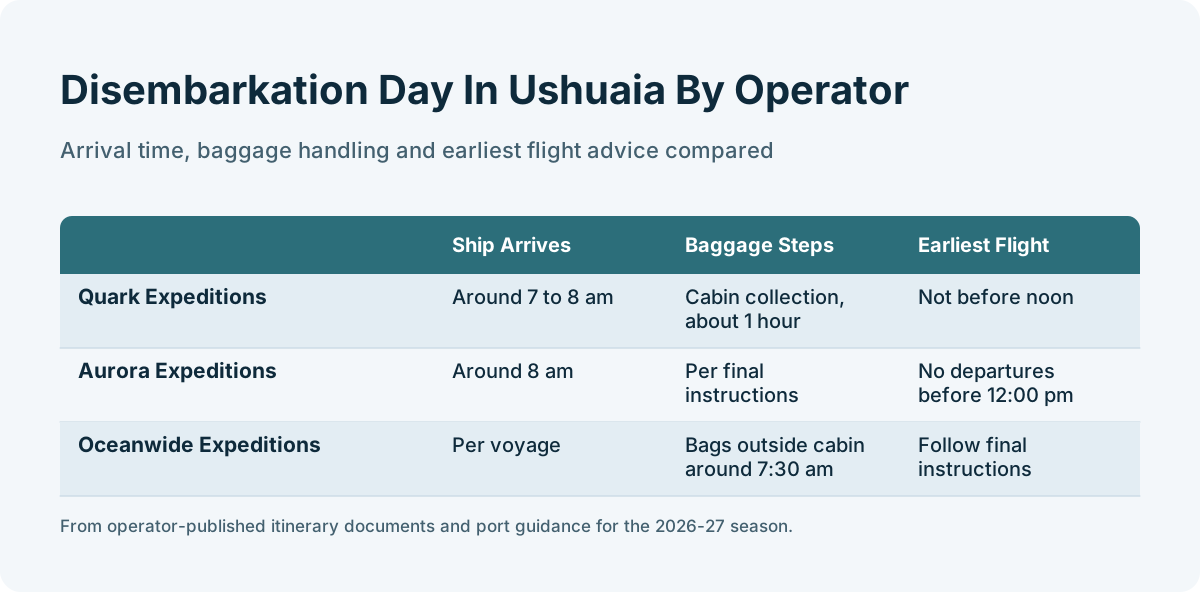
Disembarkation Day: Timing And The Earliest Safe Flight Home
Ships arrive back in Ushuaia in the early morning, around 7 to 8 am on Quark voyages, with the disembarkation process taking roughly an hour. Quark advises booking flights as late in the day as possible and not before noon on disembarkation day; Aurora Expeditions disembarks around 8 am and recommends no departures before 12:00 pm, with direct airport transfers for early flights.
The pattern across operators is consistent even where the details differ. Oceanwide passengers place luggage outside the cabin early in the morning, around 7:30 am in published examples, and it is collected and available on the pier. Options from the pier include an airport bus, luggage storage or your own transport.
The flight advice deserves to be taken literally. The port, the town and the airport are all close together, so a noon flight is physically possible, but a stiff wind, a late channel entry or a slow baggage transfer can eat the margin. Quark staff may reconfirm flights 48 hours before disembarkation for exactly this reason.
| Operator | Ship arrives | Baggage on disembarkation | Earliest flight advice |
|---|---|---|---|
| Quark Expeditions | Around 7 to 8 am | Collected from cabin, process about 1 hour | Flights as late as possible; not before noon |
| Aurora Expeditions | Around 8 am | Per final instructions; direct transfers for early flights | No departures before 12:00 pm |
| Oceanwide Expeditions | Per voyage | Bags outside cabin around 7:30 am | Follow final joining and disembark instructions |
Insurance is the other half of the flight-home question. Operators require medical evacuation cover with high minimums plus trip cancellation cover for the fare paid, and proof is often requested before departure or at check-in. Our Antarctica travel insurance guide compares what the operators demand.
Fly-Cruise Embarkation In Punta Arenas: A Different Day Plan
Air-cruise passengers do not board in Ushuaia at all. Antarctica21 asks passengers to be in Punta Arenas before about 2 pm on the day the expedition starts, and Polar Latitudes requires arrival at Hotel Cabo de Hornos by 14:00 the day before the charter flight, with a strict 20 kg checked baggage limit on the Punta Arenas to King George Island aircraft.
The flight itself takes around two hours and lands on a gravel strip at Teniente Rodolfo Marsh Martin Aerodrome on King George Island, where the expedition ship waits. The whole embarkation day is compressed into a briefing, a hotel night, a bus to the airport and a flight, which is why the operators build the schedule so rigidly.
The trade-off is weather exposure, not sea exposure. Antarctic charter flights are delayed by fog, low cloud and wind at the island airstrip, and delays of one to three days are documented, with operators providing gateway hotel stays and meals while the schedule slips. Silversea reports that roughly 80 percent of its fly-cruise flights depart on schedule. That is a good figure, but it is a figure about the odds, not a promise about your departure.
Delays cut both ways. If the return flight cannot operate, the standard contingency is that passengers stay on the ship and sail back across the Drake Passage to Ushuaia instead, which is a longer trip than you booked and one your onward flights need to be able to absorb. Booking flexible international tickets out of Punta Arenas or Santiago, with a spare day or two after the scheduled return, is the practical answer.
Which Ship You Board Changes Your Day
Not every boarding day looks the same, because the ship sets the pace. A 170-passenger vessel like Hondius boards fewer people than the larger expedition ships, and IAATO rules cap passengers ashore from one vessel at 100 at any one time and bar vessels over 500 passengers from landings entirely.
The Oceanwide Expeditions ship Hondius is the featured vessel for this guide because she illustrates the small-ship boarding day well. She carries 170 passengers in 80 cabins, was built in 2019, holds Polar Class 6, and measures 107.6 m. Peninsula voyages on her run 11, 13 and 19 days, and Oceanwide lists Antarctic Peninsula departures from $7,800 per person.
Her fleet-mates run the same Ushuaia pier routine at different scales. Ortelius, a former Russian research vessel built in 1989, carries 108 people in 50 cabins and holds UL1 ice class (equivalent to 1A); her Weddell Sea voyages use helicopters for emperor penguin access. Ultramarine, Quark's 199-passenger ship, carries two twin-engine helicopters on two helidecks plus 20 Zodiacs in an internal hangar. Quark's Peninsula fares start from $12,236 per person at the voyage level, shared across its ships.
| Ship | Class | Passengers | Ice class | From, per person | Voyage length | Departs from |
|---|---|---|---|---|---|---|
| HondiusOceanwide Expeditions | Small-Ship Budget | 170 | Polar Class 6 | from $7,800 | 11 to 19 days | Ushuaia |
| OrteliusOceanwide Expeditions | Small-Ship Budget | 108 | UL1 | from $7,800 | 11 to 25 days | Ushuaia |
| UltramarineQuark Expeditions | Upscale Expedition | 199 | 1A+, PC6 | from $12,236 | 12 to 14 days | Buenos Aires, Ushuaia |
If comparing those three against each other, or against anything else in the fleet, is where your planning has stalled, get free help choosing an expedition ship rather than reading another dozen cabin pages, because the differences that matter on boarding day are rarely the ones in the brochure.
A Worked Day-Plan For Boarding Day
A boarding day with a late-afternoon embarkation splits into three blocks: a free morning in Ushuaia, a midday luggage handover, and a pier arrival in the early afternoon followed by the safety drill. Below is what that looks like hour by hour on a typical 4 pm embarkation.
Treat the table as a template, not a schedule: your operator's final joining instructions override everything here, and some itineraries, especially ones that bundle a Buenos Aires charter flight, compress the day considerably.
| Time | What happens | Notes |
|---|---|---|
| Morning | Free time in Ushuaia | Verify boarding details at your hotel hospitality desk if there is one |
| Around 11 am | Main luggage handed over | Aurora collects at hotel reception; keep a day pack with documents and meds |
| Midday | Lunch in town | Not stated |
| Early afternoon | Transfer to the pier on Av. Maipú | Group transfers on many itineraries |
| Around 4 pm | Gangway, biosecurity check, cabin access | IAATO cleaning rules apply |
| Late afternoon | Safety briefing | Timing per operator documents |
| Evening | Sail away down the Beagle Channel | Timing per operator documents |
The infographic below compresses the same information into a single view of how the day is built.
If your plan runs the other direction, arriving by bus from Punta Arenas or flying in from Buenos Aires the same day, tighten the table by a few hours and drop the free morning, but keep the buffer logic. Our Ushuaia hotels guide covers where to spend the night before, and things to do in Ushuaia fills the spare hours if you arrive two days early, as you probably should.
When your dates are locked to a specific sailing, the boarding-day details are worth confirming against the fine print, and a free consultation covers your exact voyage rather than a generic pattern, so it is worth asking before you finalise flights.
Common Questions About Ushuaia Embarkation Day
What time do Antarctica cruise ships leave Ushuaia?
Embarkation is in the late afternoon, around 4 pm on Quark itineraries, with other operators following a similar pattern. Your operator's final itinerary gives the exact time for your voyage.
Can I fly to Ushuaia on embarkation day?
You can, but operators advise against it. Domestic flights from Buenos Aires take about three hours and forty minutes, and the ship does not wait for delayed arrivals. The standard advice is at least one night in Ushuaia before boarding, and a four-hour minimum connection window between Ezeiza international arrivals and Aeroparque domestic departures.
How early can I fly home after disembarkation?
Ships arrive back around 7 to 8 am. Quark advises flights as late in the day as possible and not before noon; Aurora recommends nothing before 12:00 pm and runs direct airport transfers for early flights.
Do I carry my own luggage onto the ship?
Usually not. Quark collects bags from hotels in the morning, Aurora collects them from hotel reception by around 11 am, and Oceanwide handles bags per its final instructions. Keep a small day pack with passport, medication and a change of clothes with you.
Do I need to clean my gear before boarding?
Yes. IAATO guidance asks travellers to wash boots and clean all equipment, clothes, bags, tripods and walking sticks before bringing them to Antarctica, and operators apply those rules before landings.
How does fly-cruise embarkation differ?
Instead of a Ushuaia pier, you start in Punta Arenas, with a mandatory hotel arrival before about 2 pm and a briefing the day before a roughly two-hour charter flight to King George Island. Baggage is limited to 20 kg checked on Polar Latitudes flights, and weather delays of one to three days are a documented part of the model.
More Ushuaia And Punta Arenas
 Ushuaia Before Your CruiseHow many nights to buffer in Ushuaia, how to fly in, and how embarkation day works at the world's southernmost cruise port.Read the guide
 Ushuaia HotelsAreas, arrival timing and booking windows for the night before your Antarctic sailing.Read the guide
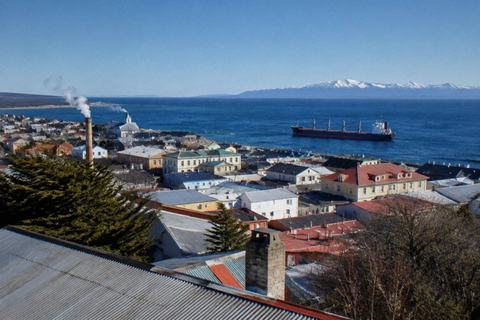 Punta Arenas GatewayThe Chilean fly-cruise gateway: flights to King George Island, air-cruise ships, costs and entry rules.Read the guide
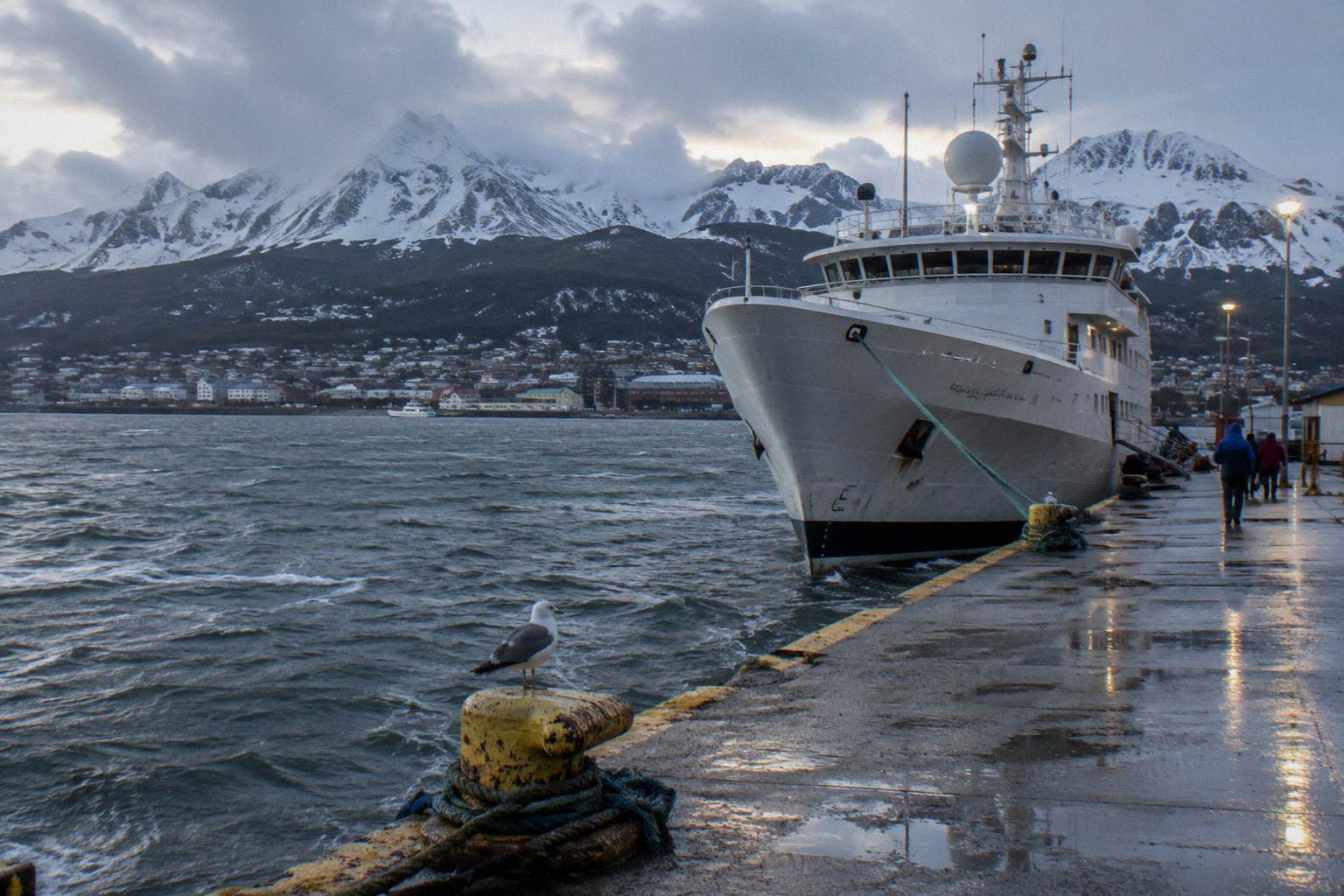 Getting To UshuaiaFlights, transfers and buffer nights for reaching the world's southernmost cruise port.Read the guide