Is A Balcony Cabin Worth It In Antarctica?
 By Oleg G.
The balcony question is the most common cabin decision on an Antarctic booking, and the honest answer depends less on money than on where your daylight hours actually go. Here is what the operator pages and the 2026-27 fare lists show.
Quick answer: Balconies are usable but restricted: operator guidance says they are often locked in rough seas, and wind and cold limit time outside. Published 2026-27 category pairs include $9,268 versus $11,065 on MS Fridtjof Nansen and $16,890 versus $21,490 on Ultramarine, per person, while all-suite lines remove the choice.
How Usable Is A Balcony On An Antarctic Cruise?
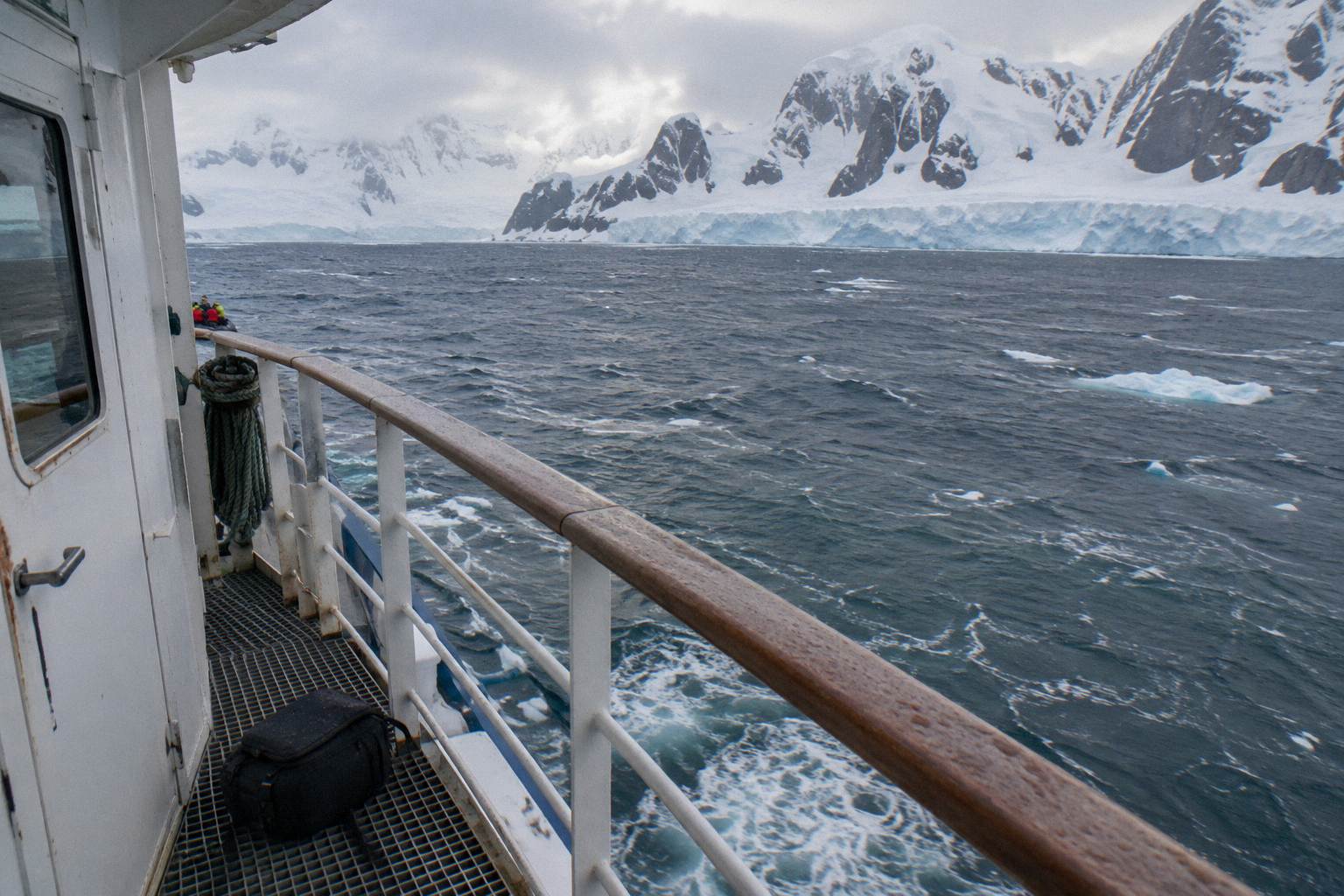
For most of a Peninsula voyage the honest answer is: less usable than in warm-water cruising, but more usable than the sceptics claim. Cabin guidance across the expedition fleet notes that balconies are often locked in rough seas on the Drake crossing, and that wind, cold and safety rules limit time outside. Yet in the calm bays of the Peninsula itself, with long austral-summer daylight, a private outdoor seat between landings on an expedition cruise is genuinely pleasant.
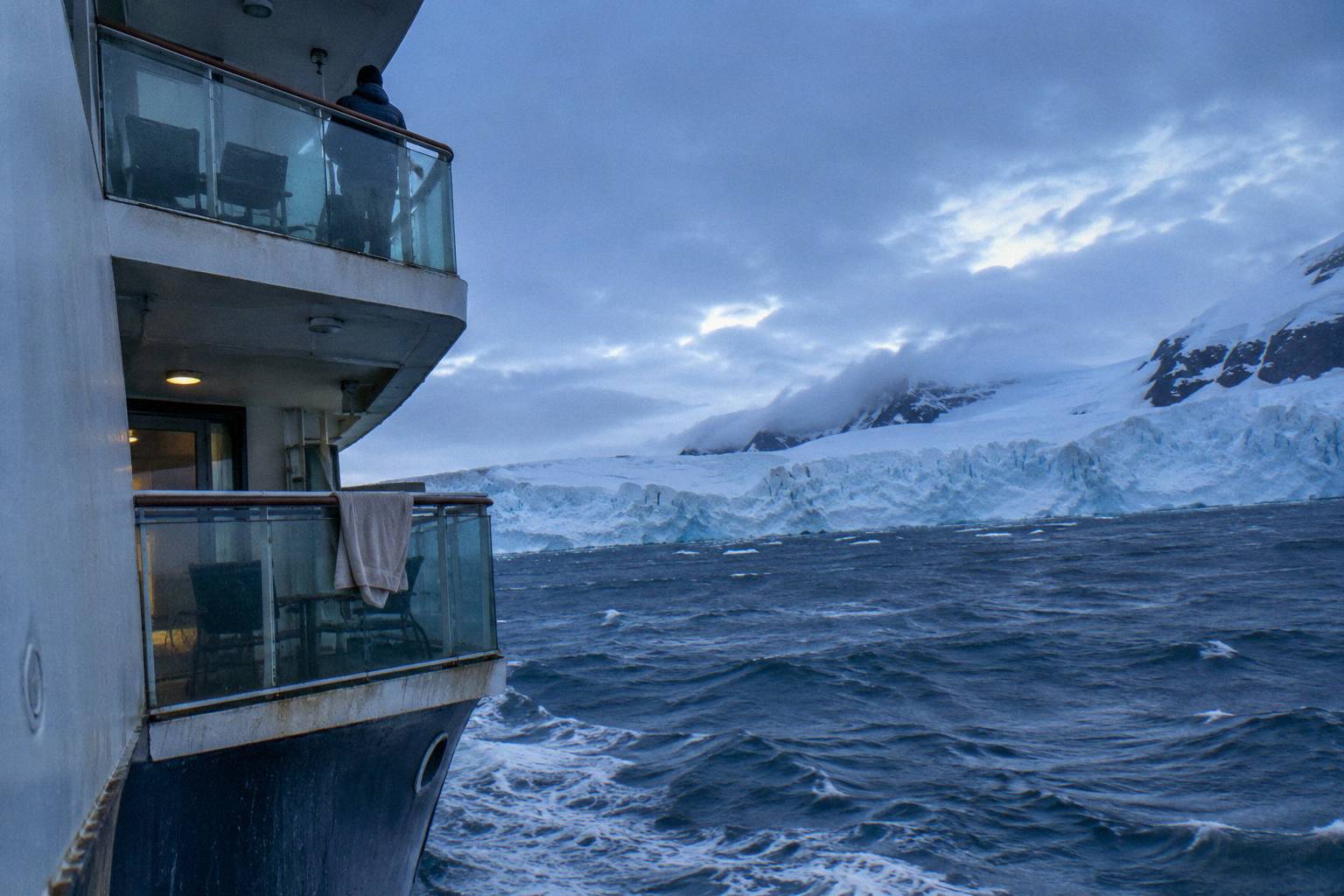
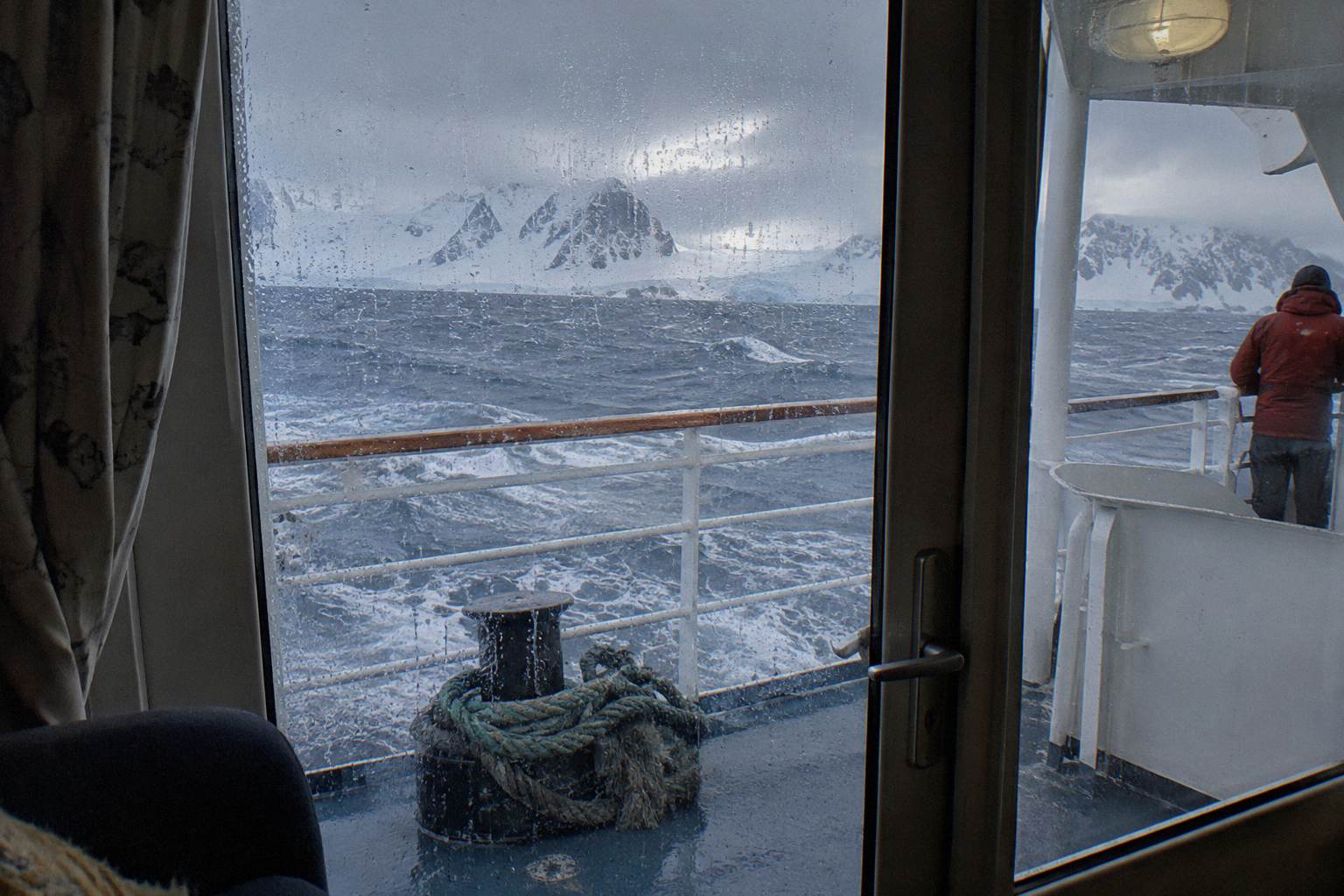
The case against starts with the crossing. Vessels typically spend about two days reaching the Peninsula from Ushuaia, and that is the stretch where a veranda earns nothing. Cabin guidance for the polar fleet is blunt about this: balconies are often locked in rough seas, and their usability in Antarctica is limited by wind and cold even in sheltered water. You cannot leave a balcony door open for fresh air the way you would in the Mediterranean, and sliding glass in cold weather is exactly what it sounds like: a wall with a view, most of the time.
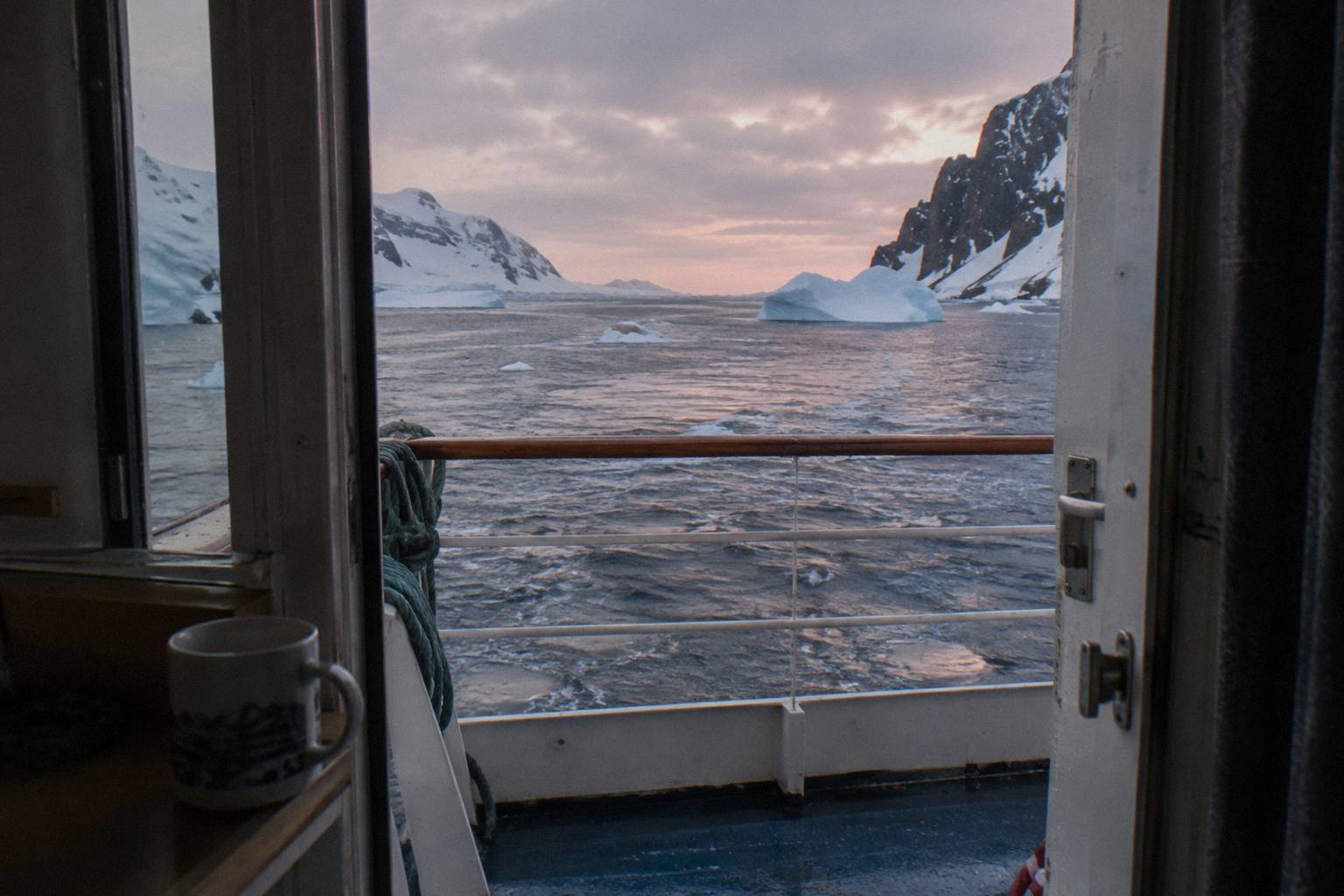
The case for starts once the ship arrives. Roughly 98 percent of Antarctic tourism voyages happen on the Peninsula during the austral summer, according to the Antarctic Treaty Secretariat's tourism page, and those waters are a different world from the open Drake. In sheltered Peninsula water a private veranda can beat a crowded bow rail for watching a humpback surface late in the evening. The wind chill is real, but so is the privacy: no queue for the railing, no sharing the moment with the rest of the guest list.
There is a third factor that rarely appears in glossy cabin descriptions, and it is the one that decides most bookings: motion. The general guidance repeated across operator FAQ pages is that the least motion is found midship on lower decks, while forward and higher decks move more. If the balcony you are offered sits on a high or forward deck, the cabin category you pay a premium for can also be one that rocks more on passage nights. Quark's own ship page makes the point in reverse: on Ultramarine, the Terrace Suites on central Deck 6 are called out for minimal movement.
A second and quieter factor is where the balcony categories actually sit. Cabin guidance places porthole cabins on the lower decks and window cabins midship, while balcony suites spread across multiple decks; on Ultramarine they span Decks 4 and 6. The same cabin guidance warns against berths directly above or below engine rooms, theatres and public spaces, because noise travels at sea in ways hotel walls do not. A high-deck balcony next to a public room can therefore pair a fine view with more motion and more noise, a trade brochures rarely spell out.
So the honest framing is not "is a balcony worth it" but "when will I actually stand on it". If your answer is "in the bays, on calm evenings, with a camera", the premium can pay. If your answer is "I mostly sleep and shower in the cabin and live in the observation lounge", it will not.
What A Balcony Cabin Costs On Named Ships?
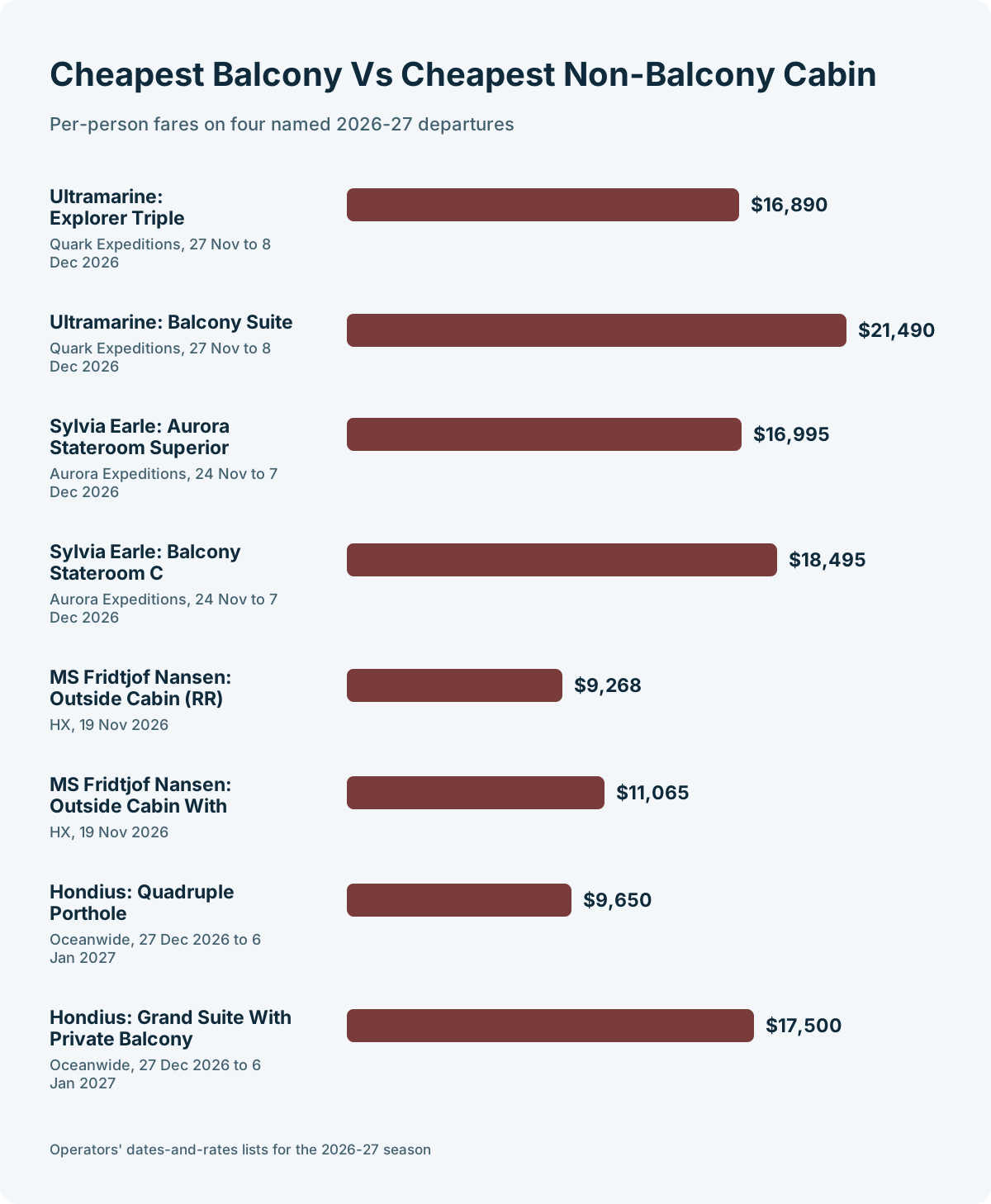
On 2026-27 departures with published category pricing, four operator fare lists let you read the veranda step directly. On HX's MS Fridtjof Nansen an outside cabin lists at $9,268 against $11,065 for the balcony version; on Quark's Ultramarine the step runs from a $16,890 Explorer Triple to a $21,490 Balcony Suite, per person. On all-suite luxury ships the choice disappears entirely.
The cleanest published comparisons come from the operators' own dates-and-rates lists and the fare files circulated for the 2026-27 season. Four examples make the spread concrete, and because each pair comes from a single named departure, you are comparing cabins on the same voyage, not marketing floors across a fleet.
| Ship (Operator) | Sample 2026-27 departure | Cheapest non-balcony cabin | Cheapest balcony cabin |
|---|---|---|---|
| Ultramarine (Quark Expeditions) | 27 Nov to 8 Dec 2026 | Explorer Triple, $16,890 | Balcony Suite, $21,490 |
| Sylvia Earle (Aurora Expeditions) | 24 Nov to 7 Dec 2026 | Aurora Stateroom Superior, $16,995 | Balcony Stateroom C, $18,495 |
| MS Fridtjof Nansen (HX) | 19 Nov 2026 | Outside cabin (RR), $9,268 | Outside cabin with balcony (XTJ), $11,065 |
| Hondius (Oceanwide Expeditions) | 27 Dec 2026 to 6 Jan 2027 | Quadruple Porthole, $9,650 | Grand Suite with private balcony, $17,500 |
Two caveats apply to that table, and both matter. First, these are per-person fares for specific named 2026-27 departures, not ship-wide price floors. Second, the Hondius pair compares a four-berth porthole cabin against the top suite, which is a cabin-size jump as much as a balcony jump. The Sylvia Earle pair is the fairest like-for-like step on the list, and it is also the narrowest.
Nor does the ladder stop at the veranda. On Quark's 2026-27 dates-and-rates samples for Ultramarine, balcony and explorer suites run about $19,690 to $21,490, while deluxe, terrace and penthouse suites reach roughly $25,000 to $37,990 on November and December departures. Once you are comparing at that altitude, the question stops being whether a balcony is worth it and becomes which bundle of space, position and inclusions you are buying. Inclusions matter more than the cabin label: the 2026-27 fare comparisons note that Oceanwide excludes kayaking and camping add-ons that typically run $350 to $2,000, while lines such as Atlas bundle drinks and gratuities into the fare itself.
At the luxury end the question dissolves. The all-inclusive tier described across the 2026-27 fare comparisons includes Silversea (all-suite, butler service, drinks and gratuities included), Seabourn (drinks, gratuities, Wi-Fi and excursions included), Scenic (drinks and gratuities included), Ponant (drinks and gratuities included), Viking (drinks with meals included) and Atlas Ocean Voyages (wine, spirits and beer included). On these ships the veranda is a structural feature of the cruise, not an upsell: Silversea's fleet page for Silver Endeavour lists nine suite categories and every one of them with a balcony. You are not choosing whether to pay for a balcony; you are choosing whether to sail a ship where the balcony is the baseline.
That is why the real comparison is between expedition lines where categories split the ship vertically. Here on Cruises In Antarctica we track those category pairs as they are published, because the cabin decision is made when you book.
If the numbers above leave you unsure which category fits your budget, get a free cabin consultation before you commit to a category.
What A Window Or Porthole Cabin Gives You Instead?
A window or porthole cabin gives you the identical landings, Zodiacs, lectures, meals and expedition team as the balcony suite one deck up. What you give up is private outdoor space, usually some square metres and often a higher deck position. On most Peninsula voyages, cabin time is the smallest slice of the day, so the loss is smaller than it looks on a deck plan.
Oceanwide's fleet shows the trade in its clearest form, because the Dutch operator publishes the whole ladder on its dates-and-rates listing. On Hondius, the 2026-27 fare lists price a quadruple porthole cabin from roughly $9,600 to $10,150 per berth, a twin porthole from about $11,400 to $12,500, a twin window from about $12,500 upward, superior and deluxe categories from about $13,150, and the junior and grand suites with balcony in the $15,000-plus range. Every one of those guests steps onto the same Zodiac at the same beach in the morning.
| Hondius cabin tier | Sample 2026-27 fare per person | What you get |
|---|---|---|
| Quadruple Porthole | ~$9,600-$10,150 | Four berths, lowest price on the ladder |
| Twin Porthole | ~$11,400-$12,500 | Two berths with a porthole |
| Twin Window | ~$12,500+ | Two berths with a window |
| Superior / Deluxe | ~$13,150+ | Not stated |
| Junior / Grand Suite with balcony | ~$15,000+ | Private balcony at the top of the ladder |
The multiplier logic cuts both ways. A quad porthole berth on a budget expedition ship is one of the cheapest routes to a landing-based Antarctic voyage, and Plancius, Oceanwide's converted Dutch Navy oceanographic vessel, carries a from-fare of $7,050 per person on its Peninsula departures. If the goal is maximum time ashore per dollar, the balcony is the first thing to cut, not the last.
What a window buys that an interior never can is a sense of the place during the hours you are not outside. Passages between landings, drifting ice at odd hours, a whale escort alongside the hull: a porthole turns the cabin from a box into part of the voyage. Porthole cabins also sit on the lower decks, which happens to be where the ship moves least.
One practical footnote belongs here because it changes the cabin maths for some travellers: if you use a CPAP machine, Oceanwide states that every cabin in its fleet has bedside power outlets, while distilled water is not supplied as standard and requirements should be flagged when booking. If you travel with medical equipment, ask about it before choosing a category, and the veranda may drop down the priority list.
Two honest limits on the window route deserve saying out loud. A porthole is not a panorama: it frames, it does not open onto a view, and on the lower decks you may be looking at grey water more often than at ice. And a window cabin will never give you the private standing spot outside your own door, which matters to some travellers more than any fare difference. Our page on cabin categories across the fleet breaks the tiers down ship by ship if you want the wider picture.
The Three Ships Where A Balcony Buys The Most?
The ships where a veranda earns its premium are the ones that pair private balconies with alternatives: sheltered public viewing space, stabilised or hull-quietened motion, and itineraries with long calm-water stretches. Aurora Expeditions' Greg Mortimer, Silversea's Silver Endeavour and Scenic's Eclipse all qualify, in different ways and at very different price points.
The pattern behind all three is the same. A balcony only earns its keep on a cruise when the ship gives you calm water to look at and comfortable ways to be outside, and each of these vessels answers that brief differently: one through hull design and activity range, one through fly-cruise routing, one through sheer hardware.
| Ship | Class | Passengers | Ice class | From, per person | Voyage length | Departs from |
|---|---|---|---|---|---|---|
| Greg MortimerAurora Expeditions | Upscale Expedition | 130 | – | from $19,521 | 12 to 26 days | Ushuaia |
| Silver EndeavourSilversea | Luxury | 220 | PC6 | – | 6 to 13 days | King George Island, Puerto Williams |
| Scenic EclipseScenic | Luxury | – | – | – | 13 to 22 days | – |
Greg Mortimer is the strongest mid-price case. Aurora Expeditions built her in 2019 around the Ulstein X-BOW, a hull form designed to slice into head seas rather than slam over them, which is claimed to reduce slamming, pitch, noise and vibration. She carries 130 guests on voyages of 12 to 26 days from Ushuaia, with the ship page's lowest published Antarctic fare from $19,521 per person twin share. That is suite-tier money, and it buys a ship small enough that the balcony is one of several good viewing options rather than a substitute for deck space.
Silver Endeavour moves the question to the luxury tier. Silversea lists her at 220 guests with a PC6 ice-class rating, sailing voyages of 6 to 13 days from King George Island and Puerto Williams, and a King George Island start means a flight rather than a Drake crossing. We have no current published fare for her, so a number needs a consultation rather than a guess, and the operator's ship page describes nine suite categories in which every suite features a balcony. A short voyage with no Drake crossing tilts the ratio of calm-water time to open-sea time toward what a balcony owner wants; if that profile fits you, check current Silver Endeavour fares here for free.
Scenic Eclipse plays a different card again: she carries a helicopter and a submarine among her expedition tools, and Scenic lists its Eclipse ships at Polar Class 6 with up to 200 guests in Antarctica, across 13 to 22-day itineraries. We have no current published fare for her either, and Scenic's all-inclusive structure, with drinks and gratuities included per the 2026-27 fare comparisons, means the veranda is simply part of the furniture rather than a line item you approve. If you are weighing these ships against each other, our Silver Endeavour versus Seabourn comparison covers the all-suite logic in more depth.
Between these three, the same veranda buys three different things: quiet motion and a wide activity range on Greg Mortimer, maximum calm-water time on Silver Endeavour's fly-cruises, and helicopter-and-submersible hardware on Scenic Eclipse. The cabin category is identical; the voyage wrapped around it is not, which is exactly why the premium question has no single answer.
Does The Drake Crossing Kill The Balcony Value?
Mostly, yes, for the transit days. According to Quark Expeditions, a Drake Passage crossing takes 18 to 24 hours in optimal conditions and stretches to 36 to 48 hours in rougher seas, and cabin guidance states that balconies are often locked in rough seas. On a classic ten to twelve day cruise with two crossings, that is up to four of your days with a veranda you cannot open.
That asymmetry is why the same balcony can be a smart buy on a fly-cruise and a marginal one on a roundtrip sailing. Quark's own guidance on flying versus sailing the Drake frames the trade: a ship crossing takes roughly two days each way, while a roughly two-hour flight from Punta Arenas to King George Island skips it. The balcony's value scales with the second number, not the first.
Motion compounds the point. The standard advice from operator sea-sickness FAQs, as Oceanwide's seasickness guidance puts it, is to book midship on a lower deck if motion worries you, because the ship pivots around its centre. A balcony on a high deck sits at the wrong end of that lever. If you are prone to seasickness on the crossing, the honest cabin choice is not the balcony suite at all: it is a lower-deck outside cabin plus good medication, and the savings fund a longer or better cruise.
There is a counter-argument, and it deserves a fair hearing. Newer expedition ships carry zero-speed stabilisers that work while the vessel is stationary and, in some cases, fins sized well above the industry standard, and the modern polar fleet's hull forms and dynamic positioning systems exist partly for exactly this comfort problem. The balcony does not stop the ship pitching. It does, however, turn every calm evening at anchor into private theatre, and on a Peninsula voyage there can be several of them.
Our deeper look at X-BOW hulls and stabiliser systems explains which ships take the edge off the crossing if you decide to sail both ways.
Who Should Pay For A Balcony, And Who Should Not?
Pay for the balcony if you are booking a suite-tier ship anyway, travelling as a couple who value private time between landings, or someone for whom a crowded observation deck genuinely spoils the moment. Skip it if your priority is maximum time ashore, your budget is the binding constraint, or you are sensitive to motion and would be happier low and midship in an outside cabin.
| Traveller type | Verdict | Why, in practice |
|---|---|---|
| Couple on a luxury ship | Pay | The veranda is already the baseline on all-suite lines; no premium decision exists |
| Photographer on a budget ship | Skip | You will be on deck or in a Zodiac at prime light anyway; the balcony sits empty at golden hour |
| Motion-sensitive traveller | Skip | Lower-deck midship cabins move least |
| Traveller who wants solitude | Pay | The only private outdoor space on the ship is the one behind your own door |
| Guest maximising time ashore | Skip | Every category gets the same landings; spend the difference on a longer itinerary |
| Shoulder-season value hunter | Skip | November and March fares run well below peak, and that gap beats a balcony at any time of year |
The budget logic deserves one more pass with the raw numbers in view. Published 2026-27 fares put quad berths on ships like Hondius in the $9,600 range, while the like-for-like veranda steps elsewhere on the market run from the $9,268 versus $11,065 pair on MS Fridtjof Nansen to the $16,890 versus $21,490 pair on Ultramarine. The same money that lifts you one cabin tier will instead buy a category of extra voyage, an earlier or later season with better ice or whale timing, or the flights and insurance that actually get you to Ushuaia.
Another way to price the veranda is against the costs that sit outside the fare entirely. The 2026-27 cost breakdowns put international flights to the gateway at roughly $530 to $1,200 or more, full travel insurance at $200 to $500 or more, and single supplements at 40 to 100 percent for travellers sailing alone, with optional activities at $350 to $2,000 on top. The same fare lists show March Peninsula departures around $6,900 against holiday-period voyages that climb past $30,000, and Oceanwide's Basecamp sailings bundle camping, kayaking and snowshoeing into the fare at no charge. Against those numbers, a veranda is the most discretionary line on the page and usually the first thing a careful planner tests.
Which trade you should make depends on how you answer the usability question in the first section, and that is a genuinely individual call. A free consultation on your cabin choice can pressure-test the balcony decision against the specific departure, because a balcony on a February circle-crossing voyage and a balcony on a late-March whale-watching trip are not the same purchase at the same price.
Common Questions About Balcony Cabins In Antarctica
Is a balcony cabin worth it in Antarctica?
Only sometimes. A balcony is pleasant in calm Peninsula anchorages and locked during rough Drake crossings, and the published 2026-27 fare pairs range from narrow steps to wide ones depending on the ship. All-suite ships remove the question entirely.
Are balconies locked on the Drake Passage?
Frequently, yes. Cabin guidance for the polar fleet states that balconies are often locked in rough seas, and the Drake crossing takes 18 to 48 hours each way depending on conditions. Expect the veranda to be out of action for part or all of each transit.
Which Antarctica ships have balconies in every cabin?
The all-suite luxury tier: Silversea's Silver Endeavour lists nine suite categories, all with balconies, and Seabourn, Scenic and Ponant are among the luxury lines that emphasise all-suite ships with veranda or balcony cabins. On these lines the balcony is included in the cruise fare rather than sold as an upgrade.
Is a balcony cabin better for wildlife viewing?
Rarely. Landings, Zodiac cruises and open deck space put you closer to whales, penguins and seals than a private veranda does, and wildlife viewing from the ship happens mostly from public observation areas with better sightlines.
How much more does a balcony cabin cost in Antarctica?
On named 2026-27 departures, the published pairs are $9,268 for an outside cabin versus $11,065 for a balcony outside cabin on MS Fridtjof Nansen, and $16,890 for an Explorer Triple versus $21,490 for a Balcony Suite on Ultramarine, per person. Compare like-for-like categories before judging any figure, because some listed pairs cross cabin sizes as well as balconies.
More Choosing A Ship
 Choosing Your ShipFive decisions that narrow 43 expedition ships down to the one you should book.Read the guide
 Cruise Ships ComparedShip size decides whether you land: compare every major Antarctica vessel by passengers, ice class and fare.Read the guide
 Cruise Lines ComparedAll fourteen Antarctica cruise lines mapped, with fleets, fares and landing rules.Read the guide
 Luxury CruisesWhat a premium Antarctica fare really buys: suites, included extras and the ships at the top tier.Read the guide