MS Roald Amundsen Antarctica Cruise: Ship Review, Cabins And Itineraries
 By Oleg G.
MS Roald Amundsen is HX's hybrid-powered, 490-guest expedition vessel that sails the Antarctic Peninsula each season on 12- to 16-day voyages from Buenos Aires and Ushuaia.
Quick answer: MS Roald Amundsen is a 2019-built, 490-passenger hybrid diesel-electric expedition ship operated by HX, sailing 12- to 16-day Antarctic voyages in 2026-27 from $9,567 per person. All cabins are outside, about half have balconies, and fares include flights from Buenos Aires, drinks, a jacket to keep and escorted landings.
What Is The MS Roald Amundsen?
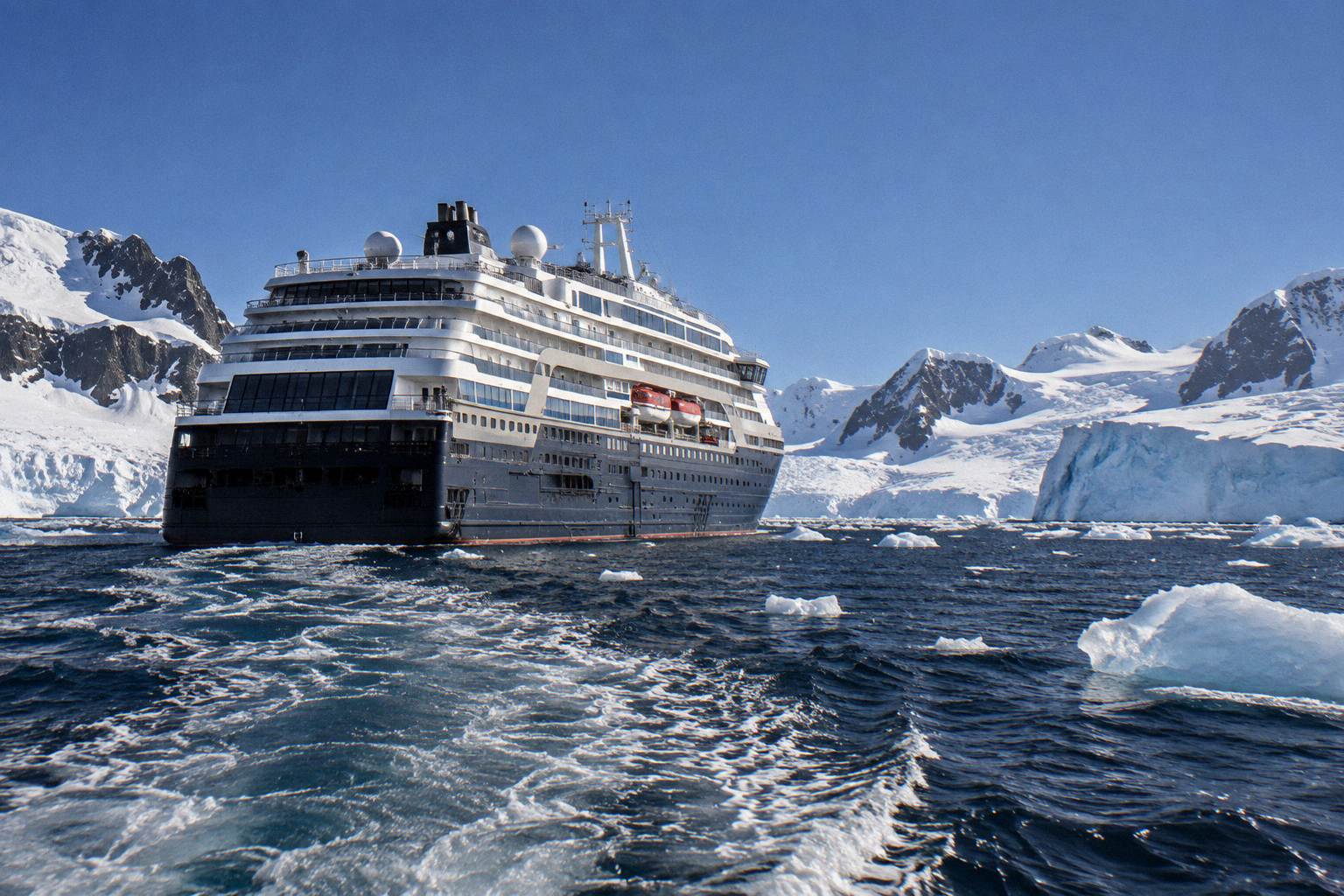
MS Roald Amundsen is a 490-guest expedition cruise ship built in 2019 at Kleven Yards in Norway and operated by HX (Hurtigruten Expeditions), named after the first man to reach the South Pole. She is 140 metres long, 20,889 gross tonnes, has a service speed of 15 knots and runs on hybrid diesel-electric propulsion, which the operator credits with about 20 percent lower fuel use and CO2.
She is a big ship by expedition standards, and that is the single most important thing to understand before shortlisting her for an Antarctic cruise. At 490 guests she sits at the top of IAATO's landing-capable categories, which means shore time runs on rotation rather than with everyone ashore at once. What you get in exchange is stability in the Drake Passage, a wide cabin spread and an onboard infrastructure, a two-level observation deck, a Science Center, an infinity pool, that smaller polar vessels simply cannot carry. The Antarctic Treaty rules that shape every voyage, including the 100-passenger landing limit and the 1:20 guide ratio ashore, are set out in IAATO's general visitor guidelines, and HX is an IAATO operator.
HX publishes her cabin categories and 2026-27 Antarctic departures on its own ship page. HX completed 34 Antarctica voyages across its fleet in its record 2025-26 season and has carried that programme into 2026-27 on Roald Amundsen, Fridtjof Nansen and Fram.
For a cruise on this ship you are really buying two things: a hybrid-powered vessel with genuine science programming, and HX's all-inclusive fare structure, which bundles flights from Buenos Aires, drinks and a hotel night into the headline price. That bundle is why her from-prices look different from operators who quote cruise-only. It also means the like-for-like gap between her $9,567 lead-in and a budget operator's $7,000 cruise-only fare is smaller than the raw numbers suggest, once you add the flights, the drinks and the hotel night back in on the cheaper quote.
Cabins And Suites On MS Roald Amundsen
Every cabin on MS Roald Amundsen is an outside cabin, and HX states that 50 percent of them carry a private balcony; a 2024 HX fact sheet put the total at 265 cabins. Categories run from 161-square-foot balcony cabins up to 517-square-foot XL suites, with several aft suites featuring outdoor hot tubs. Accessible balcony cabins and a range of suite grades fill out the inventory.
The live cabin list, with sizes as published by HX, looks like this:
| Category | Type | Size |
|---|---|---|
| MA | XL expedition suite with balcony | 495–517 sq ft |
| MC | Corner suite with balcony and hot tub | 215–323 sq ft |
| MD | Large suite with balcony | 377 sq ft |
| ME | Expedition suite with balcony | 237–301 sq ft |
| MF | Corner suite, large windows | 237 sq ft |
| XT | Balcony cabin | 194 sq ft |
| XTD | Balcony cabin | 161–205 sq ft |
| XY | Accessible balcony cabin | 205 sq ft |
| XTJ | Balcony cabin | 18 m² |
A couple of honest observations for anyone choosing a cabin on this Antarctic cruise. First, the lowest balcony categories are compact by luxury-line standards; an XTD at 161 square feet is a comfortable cabin, not a suite, and the balcony itself is small. Second, the aft suites with hot tubs are genuinely distinctive, a heated outdoor tub at the stern with a polar view is an unusual thing at sea, and the MC corner suites, which come with a balcony and a hot tub, are the grade to ask about if that appeals.
HX does not publish how many cabins sit in each category code, so the list above gives sizes, not counts. If cabin choice matters to you more than the sailing date, it is worth getting help matching the right grade to the right departure, and a free consultation on cabin choice costs nothing.
Midship, lower-deck cabins move least in the Drake Passage, which is worth remembering if you are sensitive to swell. Balconies are pleasant in the Peninsula but see limited use during an open-ocean crossing, so do not pay a large premium purely for Drake-day balcony time. A useful rule of thumb from the broader fleet: the cabins you actually spend daylight hours in on an expedition ship are the public ones, the observation deck and the Science Center, and the cabin is mostly for sleeping and storing gear. That argues for putting your money into suite hot tubs or location rather than sheer square footage.
Dining And Life On Board
Dining on MS Roald Amundsen runs across three named restaurants plus a pool bar: Aune is the main restaurant included for all meals, Fredheim is the second restaurant, and Lindstrom is the a la carte room, included for suite guests and otherwise charged at 15, 25 or 35 euros for breakfast, lunch or dinner. Standard drinks, including wine, beer and spirits, are included in the Antarctic fare.
The three-restaurant split matters more on this ship than on a 130-guest vessel, because on sea days, and a Drake round-trip gives you about four of them, the restaurants and lounges are the ship. Aune handles breakfast, lunch and dinner for everyone; Fredheim gives you a second option; Lindstrom is the special-occasion room. The included-drinks policy covers beer, wine and spirits, with premium brands excluded.
Beyond food, the public spaces are the Science Center, the two-level indoor-outdoor observation deck forward, a sauna, gym, hot tubs and the infinity pool. The Science Center is the hub of any HX voyage, the space where the expedition team runs lectures and science sessions on sea days. Starlink Wi-Fi is fitted across the HX fleet and included in the fare.
Sea kayaking is offered as a paid add-on on Antarctic voyages rather than an inclusion; the operator's Highlights of Antarctica page prices guided sea kayaking at $229 and a Discovery Kayak session at $148. Landings, Zodiac cruising and the lecture programme are all part of the fare.
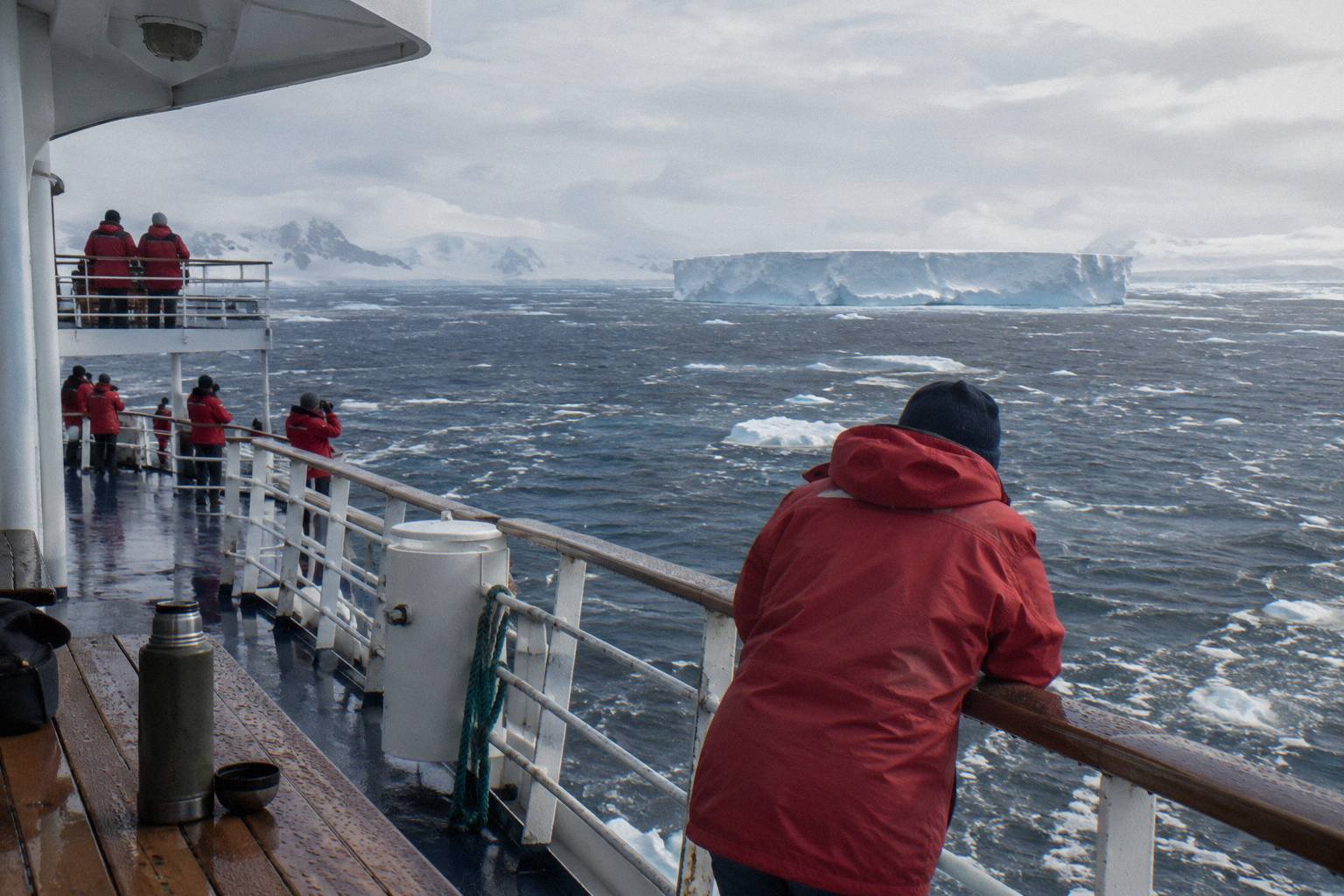
The daily rhythm on board follows the ice and the weather rather than a fixed schedule. Mornings usually bring a landing or a Zodiac cruise, the afternoon a second outing or a scenic transit through one of the Peninsula's channels, and evenings a recap briefing where the expedition leader confirms, or redraws, the next day's plan. Attending the evening recap is the single best habit aboard any expedition ship: it is where you learn why a landing changed, what the ice charts show and where the whales were sighted, and on a ship this size it also helps you pick the naturalists whose walks suit your pace.
| Ship | Class | Passengers | Ice class | From, per person | Voyage length | Departs from |
|---|---|---|---|---|---|---|
| MS Roald AmundsenHX (Hurtigruten Expeditions) | Standard Expedition | – | – | from $10,863 | 12 to 16 days | Buenos Aires, Ushuaia |
| MS Fridtjof NansenHX (Hurtigruten Expeditions) | Standard Expedition | – | – | from $10,485 | 15 to 19 days | Valparaíso, Buenos Aires |
| National Geographic EnduranceLindblad Expeditions (with National Geographic) | Standard Expedition | 138 | PC5 | from $11,900 | 12 to 22 days | Ushuaia |
2026-27 Antarctic Itineraries And Prices
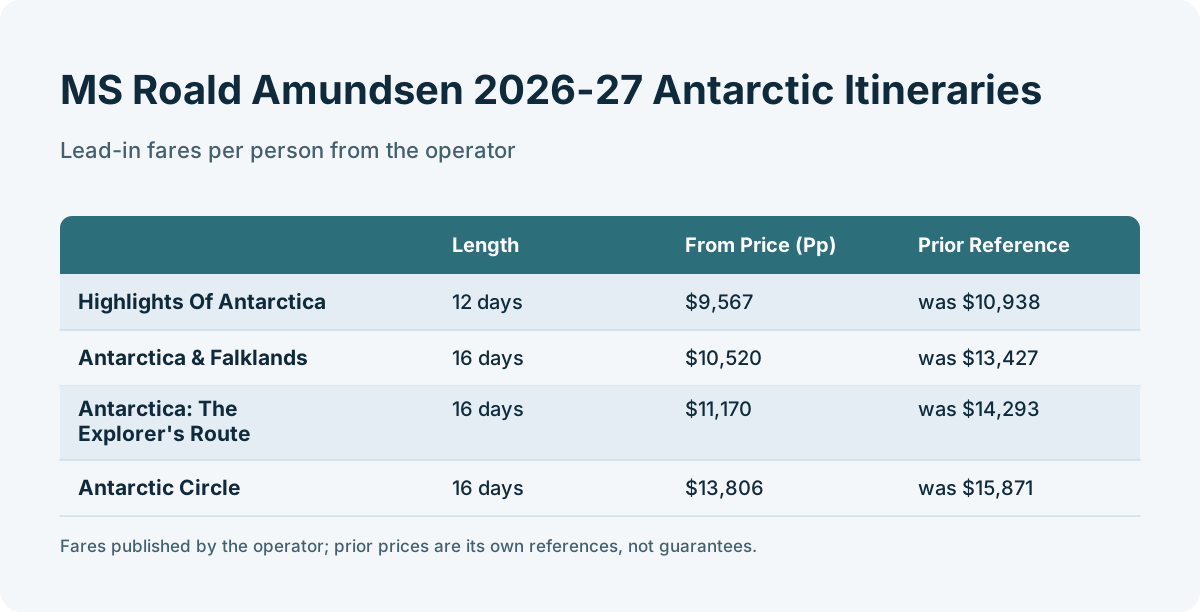
MS Roald Amundsen sails four Antarctic products in 2026-27, with ship departures on 19 and 29 November 2026, 28 November 2026, 12 December 2026, 4 March 2027 and 18 March 2027. Lead-in fares from the operator are $9,567 per person for the 12-day Highlights of Antarctica, $10,520 for the 16-day Antarctica and Falklands, $11,170 for the 16-day Iconic Antarctica, and $13,806 for the 16-day Antarctic Circle voyage.
The full picture as published by HX:
| Itinerary | Length | Routing | From price (pp) |
|---|---|---|---|
| Highlights of Antarctica | 12 days | Buenos Aires hotel night, flights, embark Ushuaia | $9,567 (was $10,938) |
| Antarctica & Falklands | 16 days | Round-trip flights from Buenos Aires | $10,520 (was $13,427) |
| Iconic Antarctica: The Explorer's Route | 16 days | Round-trip flights from Buenos Aires | $11,170 (was $14,293) |
| Antarctic Circle | 16 days | Round-trip flights from Buenos Aires | $13,806 (was $15,871) |
Two reading notes on those numbers. The 12-day Highlights voyage includes a pre-cruise hotel night in Buenos Aires with breakfast and economy flights Buenos Aires to Ushuaia, which is why its headline price compares well against cruise-only quotes from other lines. And the "was" figures are HX's own prior-price references, not a guarantee of what you will pay on any given date; cabin grade and season move the number substantially.
The itineraries differ in more than length. Highlights is the classic Peninsula sampler, with the Antarctic landing days wrapped around the two-day Drake crossings. The Falklands voyage adds grassland, settlement and albatross colonies to the ice, a genuinely different wildlife mix. Iconic Antarctica stretches the Peninsula time, and the Antarctic Circle departure aims south of 66 degrees 33 minutes, an ambition that depends on ice and weather. If crossing the Circle itself is the goal, that is the one to pick from this ship's calendar.
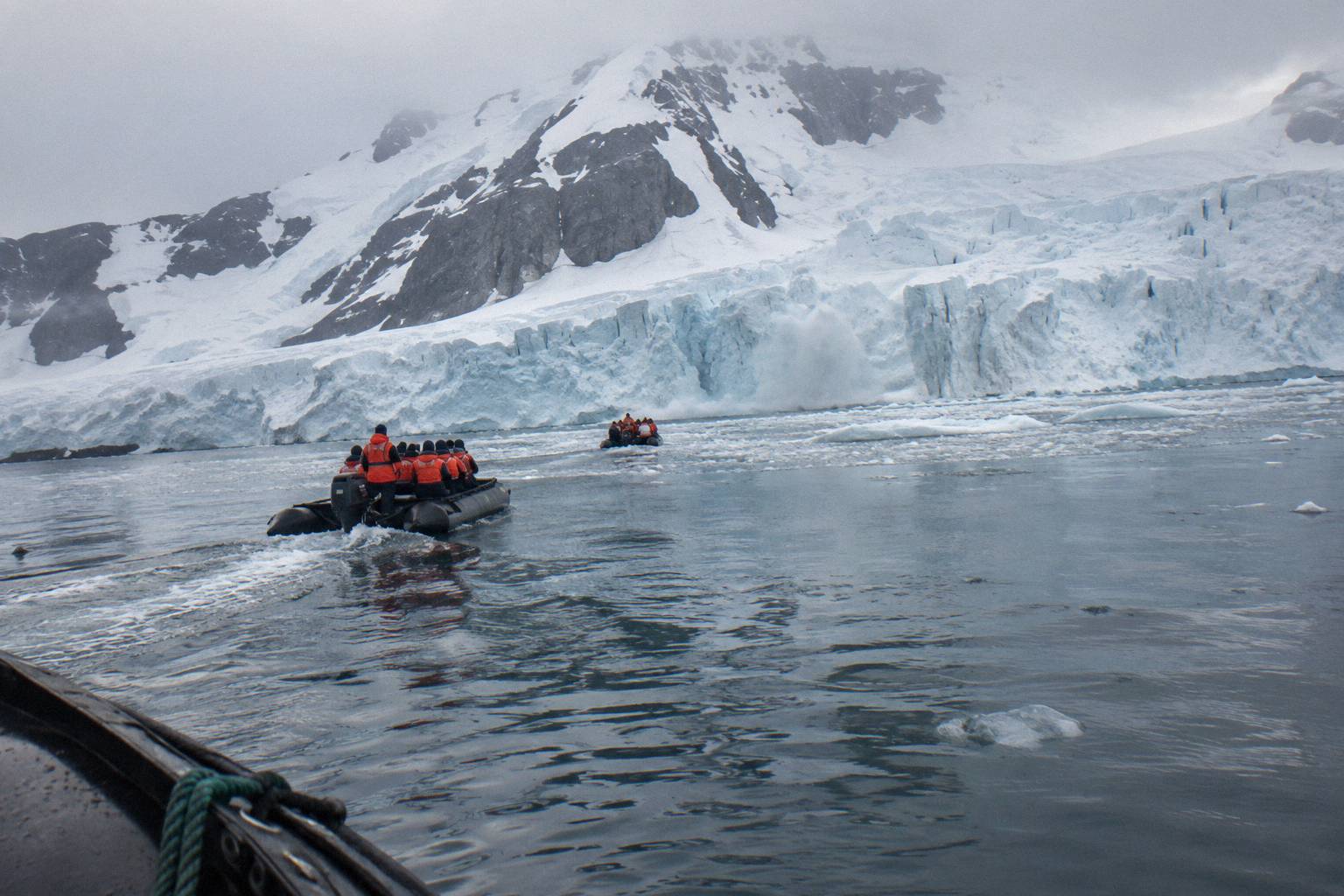
The March departures sit at the quiet, whale-rich end of the season, when penguin chicks have fledged and humpback numbers peak, while the November sailings meet fresher snow and more sea ice. If the choice between months is the decision you are stuck on, talk through season and price timing with a specialist before committing; it is free and there is no obligation.
For a full pricing-context read across the market, our Antarctic cruise cost guide breaks down what these figures include and where they sit against budget and luxury operators. If this specific vessel is the reason you are shopping, it is also worth knowing that her sister ship sails overlapping routes at overlapping prices, so an open mind within the HX fleet can unlock a better date.
What The Fare Includes
The HX Antarctic fare on MS Roald Amundsen includes a Buenos Aires hotel night with breakfast (on the 12-day voyage), economy flights between Buenos Aires and Ushuaia, all meals, coffee, tea, wine, beer, spirits and soft drinks, a wind- and waterproof expedition jacket to keep, Starlink Wi-Fi and escorted landings. Muck boots are loaned, gratuities are covered by the operator, and international flights are excluded.
That is a broad bundle by expedition-industry standards. Several competitors quote lower headline numbers that then add charter flights, drinks and tips separately, so the honest way to compare is on a like-for-like basis, as our guide to what an Antarctica cruise includes lays out. On this ship the main extras are kayaking, premium-brand drinks, spa treatments and any optional restaurant charges outside the suite arrangement.
Insurance is the one cost nobody bundles. Operators across the Antarctic market require medical-evacuation cover, with minimums commonly between $100,000 and $500,000; our Antarctica travel insurance guide covers the detail. Budget for it on top of the fare rather than discovering it at check-in.
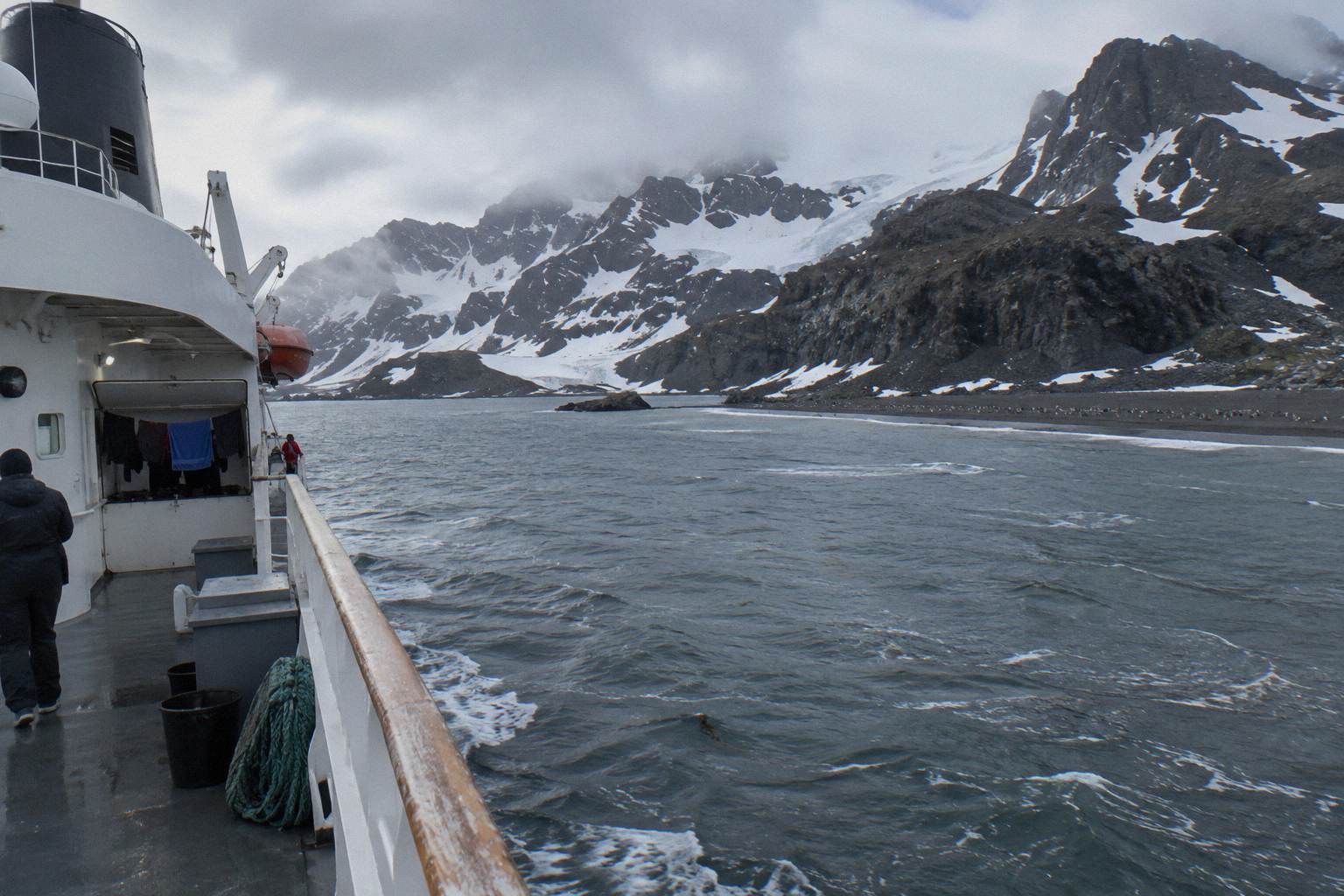
One practical note on the ship's crew: at delivery the vessel was recorded with 151 crew. HX does not publish a current crew or expedition-team headcount for her.
A few smaller items round out the picture. Muck boots are loaned for the duration, which saves you buying and flying a pair of heavy rubber boots you will wear for a fortnight; the jacket, by contrast, is yours to keep, and it is a proper polar layer rather than a souvenir windbreaker. Wi-Fi is included but satellite-dependent at high latitudes, so download anything you actually need before leaving Buenos Aires. And because the fare wraps the gateway logistics so tightly, the main thing left to arrange yourself is the international flight into Argentina, plus any buffer nights either side, which seasoned Antarctica travellers always build in.
Who The Ship Suits, And Who Should Look Elsewhere
MS Roald Amundsen suits travellers who want a stable, well-equipped, mid-priced Antarctic cruise with strong science programming, an inclusive fare and no single overwhelming speciality, and it is a particularly good fit for first-timers who value comfort over maximum shore time. Travellers whose priority is the most landings per day, or the smallest groups, should look at vessels under 200 passengers.
The trade-off is straightforward and comes from the rules rather than from HX: a 490-guest ship rotates its passengers ashore under the 100-passenger limit, so your individual landing time per site is shorter than on a 100-guest vessel where everyone steps off at once. Some cruisers never notice; photographers and wildlife obsessives often do. Our guide to Antarctic cruise ship sizes works through exactly how passenger count changes your time on the ice.
She is also not the adults-only option. Viking's expedition ships hold that position in this market with an 18-plus policy. And if helicopters, submarines or butler service are on your wishlist, this is the wrong ship; her expedition toolkit is Zodiacs, kayaks and science, not aviation.
Where she quietly excels is resilience. A 140-metre, 20,889-tonne hull takes the Drake Passage with less drama than a small vessel, and the sheer number of cabins means HX can price this ship aggressively, which is exactly what the $9,567 lead-in represents. Repeat visitors who have already done a small-ship trip sometimes pick a vessel like this deliberately for a second or third lap: they have seen the colonies at dawn, and now they want a sauna, a lecture on krill biology and a gin and tonic included in the price while someone else handles the itinerary.
How She Compares With Fridtjof Nansen And National Geographic Endurance
Against her sister ship MS Fridtjof Nansen, Roald Amundsen offers a near-identical ship and fare structure, so the choice usually comes down to dates and price. Against the 138-guest National Geographic Endurance, the comparison is philosophical: HX gives you scale, stability and inclusiveness from $9,567, while Lindblad gives you a PC5 Polar Class hull, an X-Bow, a near 1:1 crew ratio and included gratuities from $10,800.
The comparison below sets the three ships side by side.
| MS Roald Amundsen | MS Fridtjof Nansen | National Geographic Endurance | |
|---|---|---|---|
| Operator | HX | HX | Lindblad Expeditions |
| Built | 2019 | 2020 | 2020 (later converted) |
| Guests | 490 | 490 | 138 |
| Length | 140 m | 140 m | 124.4 m |
| Ice class | PC(6) at delivery | Not published | PC5, Category A |
| Hull | Conventional bow | Conventional bow | Ulstein X-Bow |
| Staff and crew | 151 recorded at delivery | Not published | 116 |
| Cabins | 265 (2024 sheet), 50% balconies | Not published per code | 76 |
| Antarctic from-price | $9,567 (12 days) | $10,485 (15 days) | $10,800 (12 days) |
| Balconies on lowest fares | Available | Available | Categories 3 and up |
Fridtjof Nansen is the true sister: same 140-metre hull, same 490 guests, same hybrid concept, with a 2020 build and a from-price on her Antarctic voyages of about $10,485. If an Amundsen date is sold out or mispriced for your budget, her sister is rarely a downgrade. Our detailed head-to-head, Fridtjof Nansen versus Roald Amundsen, works through the differences deck by deck.
The Endurance comparison is different in kind. Lindblad's ship carries 138 guests with 116 staff and crew, holds Polar Class 5 Category A where the HX pair hold PC6, and pushes her X-Bow hull through seas that have conventional bows pitching. Her fares include beer, wine, cocktails, crew gratuities and a parka or jacket on select voyages, and her 12-day Voyage to Antarctica starts from $10,800, with flights not included. You pay more per person for far more ship per guest. See our Roald Amundsen versus National Geographic Endurance comparison for the full breakdown.
A simple way to frame the decision: if your mental image of the perfect Antarctic evening is a crowded, cheerful recap in a big lounge followed by a swim in the infinity pool, book the HX ship and enjoy the value. If it is a quiet dinner with a naturalist at your table and a glass-walled bow slicing through the Southern Ocean, the extra dollars for Endurance buy something real. Neither answer is wrong, and the two head-to-head pages above exist precisely because this fork catches almost every serious Antarctica buyer at some point.
If you are weighing this trio, get a free opinion on these three ships before booking; matching the right one to your priorities is exactly the kind of decision a specialist handles daily.
Common Questions About The MS Roald Amundsen
How many passengers does MS Roald Amundsen carry?
490 guests, per the operator's published specification. That places her in the largest landing-capable IAATO category, which means shore excursions run in rotations under the 100-passengers-ashore rule.
What is the cheapest Antarctic cruise on MS Roald Amundsen?
The 12-day Highlights of Antarctica voyage, listed from $9,567 per person including a Buenos Aires hotel night and flights to Ushuaia. Prices vary by date and cabin grade.
Do all cabins have balconies?
No. All cabins are outside cabins, and HX states that about half have private balconies. Balcony cabins start around 161 square feet and suite categories with balconies and hot tubs reach 517 square feet.
Is MS Roald Amundsen an icebreaker?
No. She is an ice-strengthened expedition ship, delivered with the DNV GL class notation PC(6), suited to summer and autumn operation in first-year ice around the Antarctic Peninsula. PC6 is the standard class for most Antarctic expedition tonnage.
Are drinks and gratuities included?
Wine, beer, spirits and soft drinks are included, excluding premium brands. Gratuities are covered by the operator on the HX fleet, and the expedition jacket is yours to keep. Kayaking, premium drinks and spa treatments cost extra.
Does the ship have Wi-Fi?
Yes. Starlink Wi-Fi is fitted across the HX fleet and included in the fare. Speeds in polar regions vary with location and conditions, so treat it as good for messaging and email rather than heavy streaming.
Choosing a ship is the decision that shapes every other part of an Antarctic cruise, the from-price, the shore time, the sea days, the whole rhythm of the voyage. Cruises In Antarctica exists to make that decision easier, and this profile is one of a set covering every vessel in the 2026-27 fleet.
More Antarctic Ship Profiles
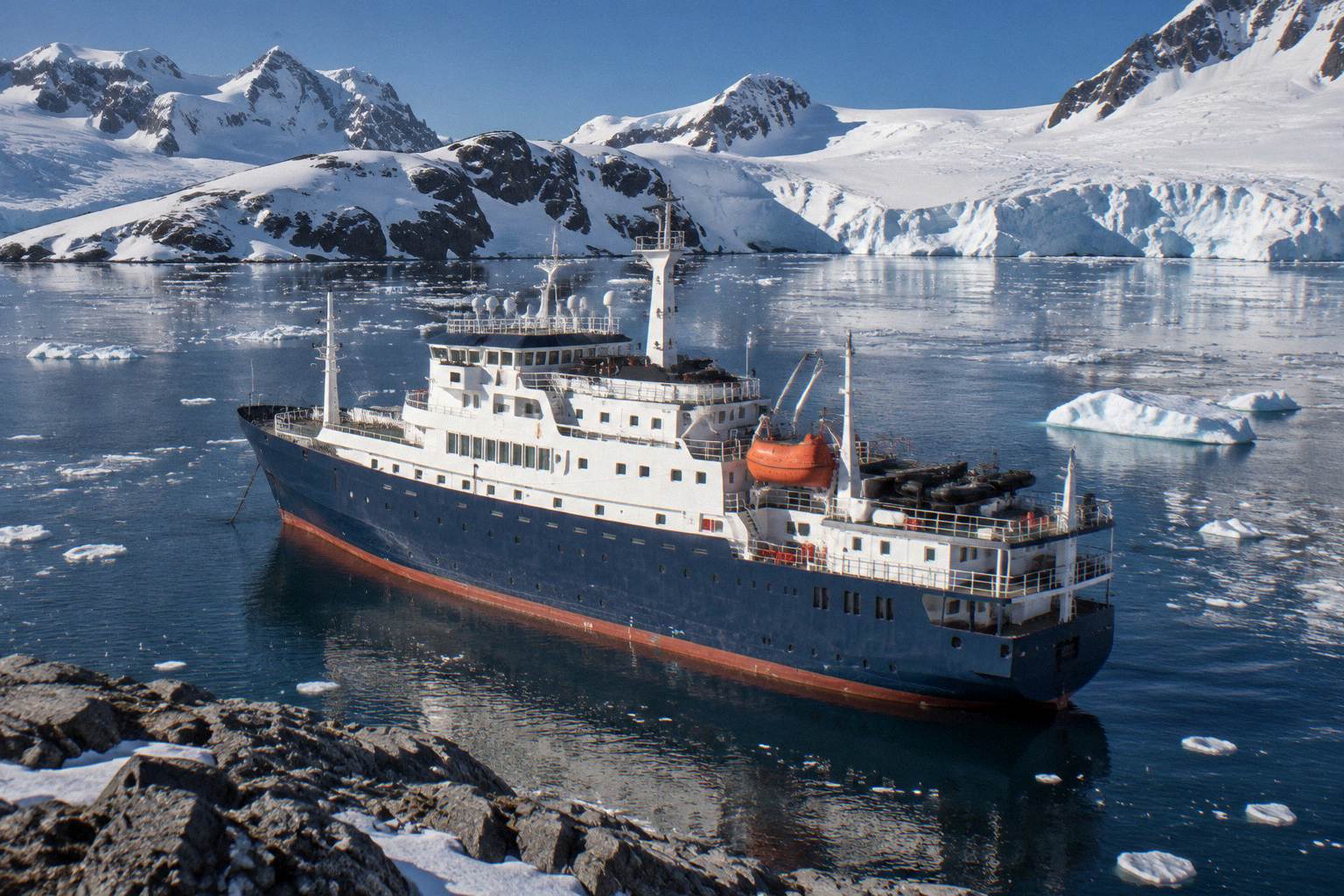 MV Plancius ReviewA no-balcony, 108-guest expedition ship with straightforward cabins, strong ice handling for its age, and Oceanwide's activity-focused Basecamp voyages.Read the guide
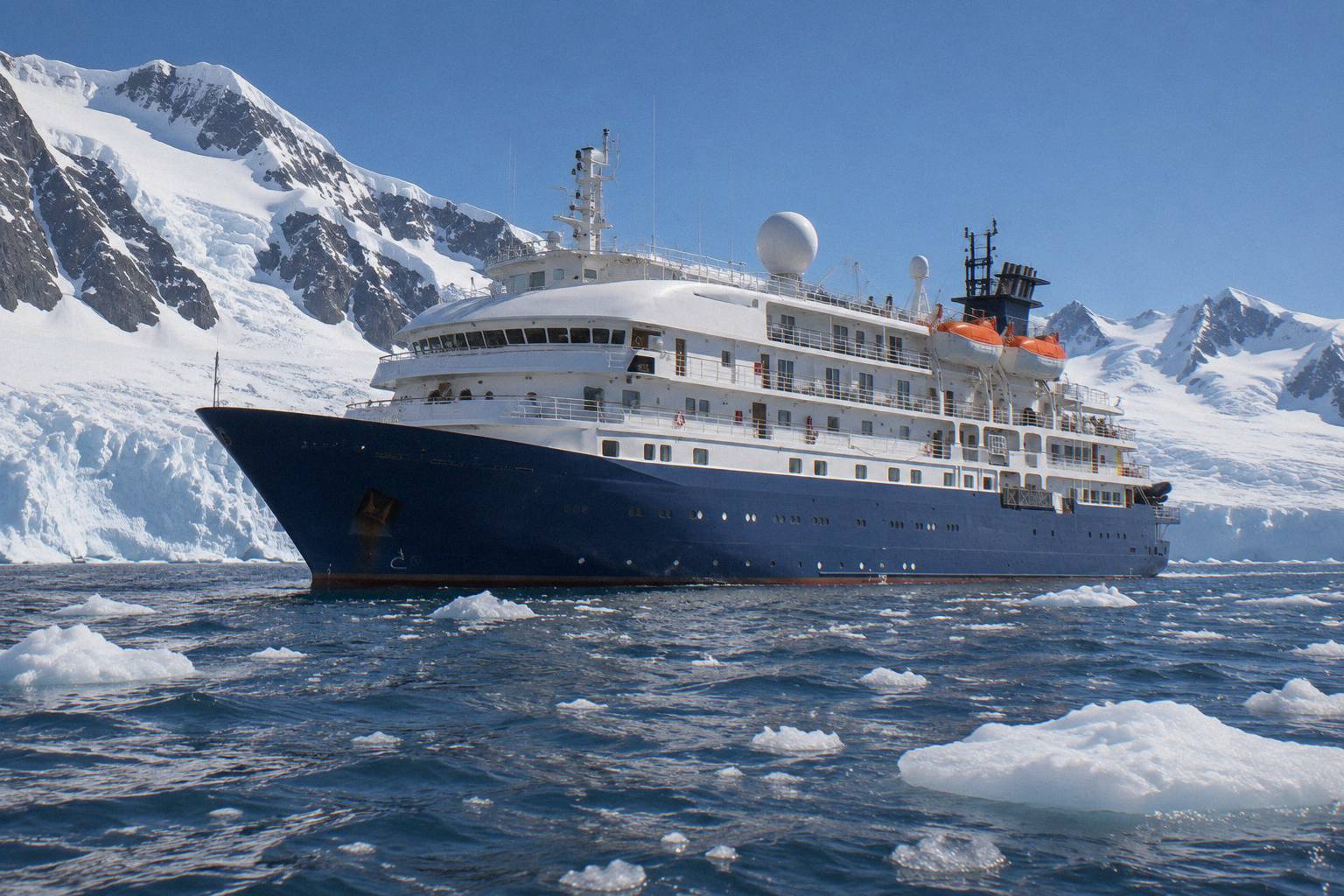 Sea Spirit ReviewPoseidon's 114-guest Sea Spirit reviewed: cabins, fares, itineraries and who it suits.Read the guide
 Ultramarine ReviewQuark's helicopter flagship reviewed: cabins, dining, itineraries and fares.Read the guide
 Ocean ExplorerQuark's 138-guest X-BOW ship reviewed: cabins, ice class, itineraries and fares.Read the guide