Can You Pay For An Antarctica Cruise With Points And Miles?
 By Oleg G.
Miles can cover the long flight to the southern gateways and shave real money off the cruise fare through card portals and loyalty credits, but the expedition fare itself is almost never a points redemption. Here is exactly where points help and where they stop.
Quick answer: You cannot redeem airline miles for the cruise fare, but you can fly to Buenos Aires, Ushuaia or Punta Arenas on awards from about 17,500 points economy, pay for the cruise through Amex, Chase or Capital One travel portals at around 1 cent per point, and stack loyalty discounts of 5% or more on lines like Silversea and Ponant.
Antarctica is the one destination where the flight and the voyage live on completely different planets of pricing logic. A redemption that books your seat to the tip of South America can be excellent value; a redemption that tries to erase the expedition fare itself usually is not, because the operators that sail there rarely publish their cabins as award inventory. The numbers below come from operator loyalty pages, card-portal terms and the points-press reporting on the 2026-27 and 2027-28 seasons, and they are worth reading before you move a single point.
This site, Cruises In Antarctica, exists to help you compare the ships and voyages first, then work out how to pay. An expedition cruise on a vessel like Silver Endeavour is the expensive half of the trip, and the honest answer on points is that they help most around its edges, not at its core.
What Points And Miles Can Realistically Cover
Points realistically cover the flights to the southern gateways, part of the cruise fare if you buy it through a card portal at about one cent per point, and loyalty discounts of 5 to 12.5 percent on repeat-operator lines like Silversea and Ponant. What they do not cover is award redemption of the cabin itself: no expedition operator was found publishing berths as award inventory.
Start with the shape of the whole bill. For the 2026-27 season, budget expedition berths begin around $7,050 per person on Oceanwide's Plancius and around $7,800 on Hondius, while upscale expedition lines start near $12,236 on Quark voyages and $11,900 on Lindblad's 12-day Antarctic voyage, and luxury lines run higher still. Add the international flights, a gateway hotel night and insurance, and one 2026 cost guide puts a realistic all-in budget for a mid-range ten-to-twelve-day Peninsula trip at $12,000 to $25,000 per person. Points are best spent against the pieces of that stack that airlines and card issuers will actually price in miles.
The season matters for the flight half too. Roughly 98 percent of Antarctic tourism happens in the Peninsula region during the austral summer, with expedition sailings concentrated November through March and no tourist ships at all from April to September. The recommended booking lead for prime departures is 12 to 18 months.
The southern legs of this journey, the domestic hops down to Ushuaia or over to Punta Arenas, are weather-prone in peak season. Build a buffer into any award routing that touches Patagonia.
Award Flights To Buenos Aires, Ushuaia And Punta Arenas
There are no direct flights from the United States to Ushuaia, so every award itinerary connects through Buenos Aires or Santiago. Business class to Buenos Aires runs roughly 40,000 to 60,000 points one way on oneworld and Star Alliance partners, economy from about 17,500 to 30,000 points, and the final legs to Ushuaia price around 10,000 to 14,000 miles on AAdvantage or about 13,000 to 14,500 on Flying Blue.

The routing logic is fixed by geography. Aerolineas Argentinas (SkyTeam), LATAM (oneworld), American, United, Delta, Iberia and Air Europa all serve Buenos Aires EZE or partner onto it, and connections to Ushuaia depart mainly from the domestic airport, AEP. Points-tracking sites report business awards to EZE from 40,000 to 60,000 points one way, with examples including 50,000 Alaska miles on American metal from Dallas or Miami, and 40,000 to 57,500 miles via AAdvantage or Avianca LifeMiles. Economy observations start around 17,500 points.
The last leg is where itineraries break. Ushuaia's airport is small, weather-prone in peak season, and almost entirely fed from Buenos Aires; 2026 reporting noted 78.8 percent of USH outbound passengers travelled via Buenos Aires routes, with international arrivals connecting from EZE to AEP. AAdvantage prices the short economy hops from about 10,000 to 14,000 miles from GRU or EZE, and Flying Blue from roughly 13,000 to 14,500 miles. Punta Arenas awards are thinner on the ground and less commonly reported in points searches.
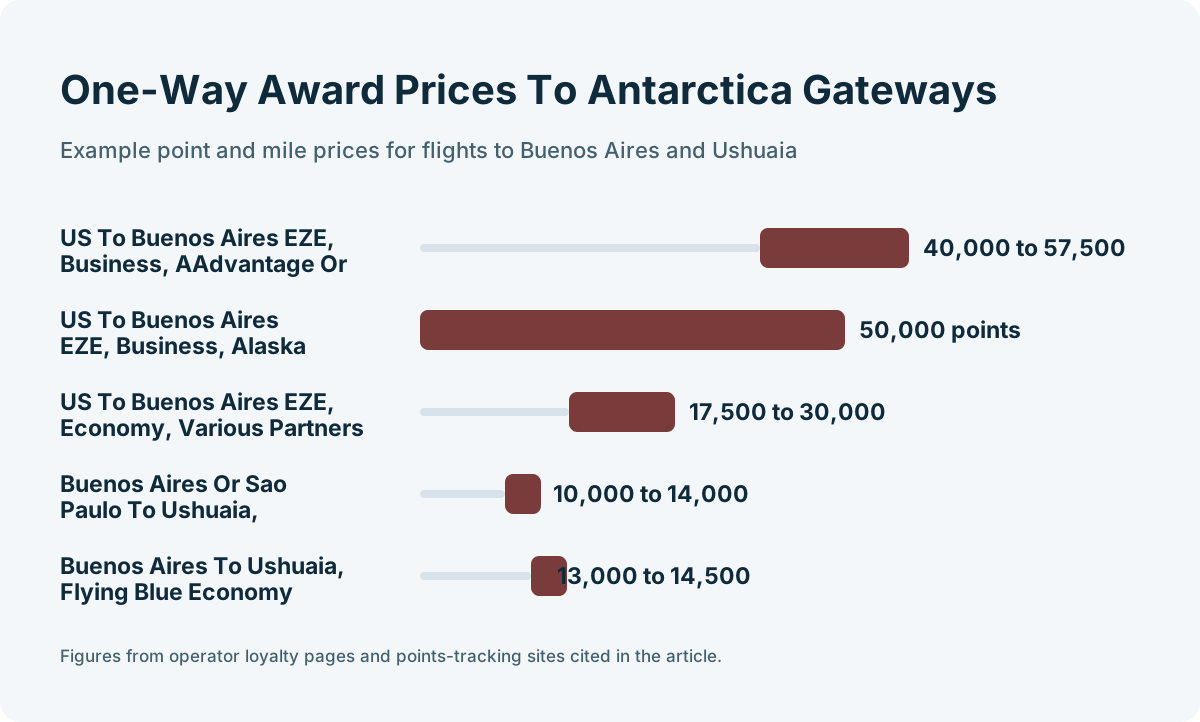
| Route And Program | Cabin | Example One-Way Award Price |
|---|---|---|
| US to Buenos Aires EZE, American via AAdvantage or Avianca LifeMiles | Business | 40,000 to 57,500 points |
| US to Buenos Aires EZE, Alaska miles on American metal (DFW or MIA) | Business | 50,000 points |
| US to Buenos Aires EZE, various partners | Economy | About 17,500 to 30,000 points |
| Buenos Aires or Sao Paulo to Ushuaia, American AAdvantage | Economy | 10,000 to 14,000 miles |
| Buenos Aires to Ushuaia, Flying Blue | Economy | About 13,000 to 14,500 miles |
The buffer rule deserves its own sentence. Ushuaia hotel occupancy hit roughly 80 percent in January 2026 against more than 43,720 cruise passengers in the season's peak, and the standard advice is at least one, ideally two, nights in the gateway before embarkation. Flybondi also suspended its Buenos Aires to Ushuaia route from late April 2026 through the low-season months, planning to double frequency from July, a reminder that even scheduled capacity on that corridor flexes with the season. If your cruise boards in Ushuaia and your award flight misses, a missed embarkation is typically treated as a no-show, so redemption flexibility and a spare night are worth real money here.
Before you lock the flying half, it is worth having someone check the sailing dates against live fares, because the cruise price determines whether the whole trip is even bookable on your budget. A free consultation on your dates and ships costs nothing and gives you the real per-person fare before you commit a single point to the flights.
Can You Book The Cruise Itself With Card Points?
You can, but only by paying cash through a card travel portal, not by redeeming miles for award cabins. Amex Travel sells Silversea, Seabourn, Ponant and Lindblad expedition sailings, often with onboard credits of $100 to $300 per stateroom on qualifying bookings of five nights or more, while Chase and Capital One generally redeem at about one cent per point. At that rate a $12,236 fare costs over 1.2 million points.
The mechanics are simple and slightly brutal. No expedition line sailing to Antarctica was found publishing its cabins as award inventory or acting as a transfer partner, so the only route is buying the fare through a portal that accepts points as currency. The American Express travel portal carries Silversea including its expedition ships, Seabourn, Ponant and the Lindblad and National Geographic joint programmes, with its Cruise Privileges programme offering the onboard credits noted above on qualifying sailings. Chase Travel sells the major cruise lines too, redeeming points at about one cent each, with a legacy 1.5 cent rate on Sapphire Reserve points earned before 2025 that runs until October 2027. Capital One travel sells cruises at one cent per mile.
Whether any of this is good value is arithmetic, not opinion. Pay-with-point rates on cruises through Amex often land at 0.7 to one cent per point, the points press notes, which is below what the same currencies can do in premium-cabin award space to the very gateways these cruises leave from. A business award to Buenos Aires at 50,000 points beats a one-cent redemption on almost any reasonable valuation table. The rational order of operations is therefore: burn miles on the flight, keep the cruise as a cash purchase, and use card-portal perks and loyalty status to soften the fare.
| Card Portal | Expedition Lines Sold | Redemption Rate | Notable Cruise Perk |
|---|---|---|---|
| Amex Travel | Silversea, Seabourn, Ponant, Lindblad / National Geographic | Often 0.7 to 1 cent per point | Cruise Privileges onboard credits of $100 to $300 per stateroom on qualifying 5-plus-night bookings |
| Chase Travel | Major cruise lines | About 1 cent per point | 1.5 cents per point on pre-2025 Sapphire Reserve points until October 2027 |
| Capital One Travel | Major cruise lines | 1 cent per mile | Not stated |
One caution on this whole approach: the numbers above are portal and programme terms, not operator promises, and a portal booking of a complex expedition sailing can complicate cabin selection, name changes and cancellation handling. If a card-portal redemption is genuinely part of your plan, ask about paying with points in your consultation before anything is booked, so the hand-off to the agency partner happens with that constraint on the table.
Loyalty Programmes That Actually Apply To Antarctic Sailings
Four operator programmes deliver real value on Antarctic voyages: Silversea's Venetian Society at 5 percent off select sailings from your first voyage onward, Ponant's Yacht Club at 5 percent savings plus a 50 euro onboard credit after two cruises scaling to 12.5 percent, Seabourn Club with tiered perks and milestone free cruises, and Quark's Shackleton Club with tiered credits and early access. Lindblad offers no traditional points programme, only group and past-guest benefits.
These programmes matter more in Antarctica than most cruise regions, because the operators repeat: Silversea sails Silver Endeavour, Silver Wind and Silver Cloud on Peninsula itineraries; Ponant sends its fleet; Seabourn runs Venture and Pursuit. Returning-guest economics compound quickly on fares of this size, and the loyalty pages state the benefits apply to expedition sailings, not just warm-weather itineraries.
The Silversea programme is the most straightforward of the group. Venetian Society membership brings 5 percent savings on select sailings from your first voyage onward, with an additional 5 to 10 percent booking benefit and perks like laundry, Wi-Fi and priority at higher tier-day counts; at 350 Venetian Society Days the programme cites a complimentary seven-day cruise, and at 500 Days a 14-day one. Ponant's Yacht Club offers 5 percent savings plus a 50 euro onboard credit after two cruises, scaling to 12.5 percent savings and a 200 euro credit at Commodore level after twenty. Seabourn Club tiers from roughly 15 to 20 points bring Wi-Fi, laundry, excursion discounts and spa credits, with milestone free cruises at 350 and 460 Club Days, and past-guest recognition carries onto the expedition ships.
| Operator And Programme | Core Antarctica-Relevant Benefit | Entry Threshold |
|---|---|---|
| Silversea, Venetian Society | 5 percent off select sailings, extra 5 to 10 percent booking benefit at higher tiers, milestone free cruises at 350 and 500 VS Days | Membership from first voyage |
| Ponant, Yacht Club | 5 percent savings plus 50 euro onboard credit after 2 cruises, scaling to 12.5 percent plus 200 euro at Commodore | 2 cruises |
| Seabourn, Seabourn Club | Wi-Fi, laundry, excursion discounts, spa credits by tier; free cruises at 350 and 460 Club Days | About 15 to 20 Club points |
| Quark, Shackleton Club | Tiered credits, discounts and early access based on expeditions sailed | Silver after 1 expedition |
| Lindblad | No points programme; group savings of 5 percent for groups of 8 or more, past-guest offers | Group of 8 |
Read those percentages against real fares and the appeal is obvious. On a voyage priced near the $12,236 Antarctic Explorer starting point that Quark lists across Ultramarine, Ocean Explorer and World Voyager, a 5 percent returning-guest benefit is real money, and on a luxury Silversea or Ponant sailing the same percentage grows fast. The catch is that you have to have sailed the operator before, which is why first-time Antarctic travellers should think of loyalty as a reason to concentrate future bookings with one line, not a day-one discount. For a deeper look at how the two luxury programmes compare on the ships that actually sail south, see our Silversea versus Seabourn guide.
Group Discounts And Booking Levers On The Operators
Quark Expeditions starts group discounts at 10 guests or 5 cabins, with savings from 5 percent and complimentary berths for larger groups, while Lindblad offers 5 percent savings for groups of 8 or more on voyage fares. Early-booking offers across the industry commonly reach 10 to 30 percent off, with up to 40 percent reported on select unsold 2026-27 sailings.
Points collectors tend to think in redemption rates, but the biggest percentage levers on an Antarctic cruise are these conventional ones. The group thresholds are low enough that two families or a small club of friends can clear them: five cabins is ten travellers in doubles, and Quark's programme also allows delayed deposits and a dedicated specialist for the group, with full-ship charters quoted on request.
Early booking is the other lever, and it stacks with the calendar reality from earlier in this article. Peak December and January departures book 12 to 18 months ahead, and last-minute discounts, while they exist on unsold inventory, are limited in cabin choice and are uncommon for peak-season sailings. If you are determined to combine a late deal with award flights, note the tension immediately: you cannot hold award space while you wait for a fare drop, and last-minute inventory appears close to departure.
None of these levers requires an award wallet, which is exactly why they belong in the same conversation as your miles. A 5 percent group discount on a full expedition fare moves more cash than most domestic award tickets are worth, and unlike a card-portal redemption it does not drain a balance you could spend at 1.5 cents on a business-class seat to Ushuaia's gateway. For the fuller cost-cutting picture, our guide to cutting an Antarctic cruise cost covers cabin sharing, shoulder months and the Basecamp-style included-activity voyages.
The Featured Ship: Silver Endeavour
Silver Endeavour is Silversea's 220-guest luxury expedition ship, built in 2021 with a PC6 ice-class rating, sailing six-to-thirteen-day voyages from King George Island and Puerto Williams, and her current Antarctic fare is not published, so a live price needs a consultation. For points collectors she is a strong candidate for the card-portal route, because Amex Travel sells Silversea and the line's Venetian Society credits and discounts apply to her sailings.
The relevance to this article is direct. Silver Endeavour is the ship where the two halves of points strategy meet: her itineraries include the fly-cruise pattern from King George Island that pairs with award flights into Punta Arenas, and her fares sit at the luxury tier where the Amex Cruise Privileges credits and Venetian Society percentages move real money. The Silversea fleet page lists her at 220 guests with the PC6 ice-class rating, and her cabin categories all feature balconies, from the Classic Veranda Suite up to the Owner's Suite. Onboard she carries the Otium Spa, a pool deck, Explorer and Observation lounges, a library and a fitness centre, plus a Mud Room for expedition operations.
The honest caveat on pricing: her Antarctica fare is not published, so no number is quoted here, and a current fare needs a consultation. What can be compared against is the class of ship, and the spread across the luxury and budget expedition tiers is where the value question gets decided.
Silver Endeavour sits at the top of that spread, with Seabourn Venture in the same luxury category but no published passenger figure or fare, and Hondius anchoring the small-ship budget end at 170 passengers, built in 2019, Polar Class 6, with Peninsula voyages from $7,800 per person. Those are three different answers to the same question, and a points collector's budget changes depending on which one is right.
| Ship | Class | Passengers | Ice class | From, per person | Voyage length | Departs from |
|---|---|---|---|---|---|---|
| Silver EndeavourSilversea | Luxury | 220 | PC6 | – | 6 to 13 days | King George Island, Puerto Williams |
| Seabourn VentureSeabourn | Luxury | – | – | – | 10 to 21 days | Ushuaia |
| HondiusOceanwide Expeditions | Small-Ship Budget | 170 | Polar Class 6 | from $7,800 | 11 to 19 days | Ushuaia |
Choosing among them is a genuine decision moment rather than a research exercise, because the fare difference between a 220-guest luxury ship and a 170-guest budget ship can exceed the entire cost of your flights. If you are holding a large points balance and wondering whether the portal route makes the luxury tier reachable, get help weighing the ships against your balance before you commit.
What Points Almost Never Cover
Points almost never cover the expedition activity add-ons like kayaking or camping, which run roughly $350 to $2,000 per activity on lines that charge for them, travel insurance with the medical evacuation cover operators require, single supplements of 25 to 100 percent of the twin fare, and the internal gateway logistics like charter flights on fly-cruise packages, which typically add $2,000 to $5,000 over comparable sailing voyages.
Insurance is the line item that surprises people most. One 2026-27 cost comparison puts insurance and evacuation cover at $200 to $500-plus per person, with $100k to $300k of coverage required, and it sits outside base fares as a separate cash purchase. No card portal sells it as a points redemption at a rate that makes sense; it is bought from a specialist insurer, and it is mandatory in practice if not always in letter.
Activity add-ons are the second trap for the optimistic. On operators that charge separately, kayaking sits around $1,099 and camping near $399 on one budget line's price sheet, with the broader category running $350 to $2,000, and the same logic applies to helicopter flightseeing where offered. Gratuities are a smaller cash leak, with suggested rates of $10 to $15 per person per day on the budget operators and $15 to $25 where not prepaid. None of these appear on any award chart.
The single-supplement question deserves a special word for solo points collectors, because a solo cabin does not price at the twin rate. The standard range is 25 percent extra up to 1.5 to 2 times the twin fare, though it can be waived on select sailings by lines including Silversea and Ponant, and sharing options exist in lower categories. If your strategy assumed one award ticket and one cabin, run the supplement math before assuming the balance covers the trip. Our Antarctica cruise cost guide breaks these line items down in full.
An Honest Bottom Line For Points Collectors
The honest play is this: burn airline miles on business or economy awards to Buenos Aires or Santiago, accept a cash connection to Ushuaia or Punta Arenas, buy the cruise in cash, and let loyalty status, group thresholds and early-booking windows do the percentage work. Card portals at about one cent per point only make sense on very large balances, and cruise-line loyalty beats them on value from your second Antarctic voyage onward.
The pattern is consistent: the airlines and the loyalty programmes will happily price the journey south, the insurance market and the activity operators will not, and the cruise lines reward repetition rather than redemption. A traveller holding a large flexible-points balance and no expedition history gets a nearly free flight and a full-price cabin. A traveller who has sailed Silversea once gets 5 percent off the next Antarctic fare, and the difference compounds at luxury-tier prices.
Practically, that means sequencing. Book the sailing on the ship and season you want, early, and then solve the flights. If a portal redemption is part of the plan, confirm the sailing is bookable through that portal before transferring anything, because not every itinerary and cabin category appears there. And if the goal is the lowest possible cash outlay rather than the fewest dollars period, the budget expedition tier, from Plancius berths at $7,050 per person to Sea Spirit at $8,846, leaves far more of the trip payable in points of one kind or another than the luxury tier ever will.
If you want a second opinion on the numbers before you move anything, a free consultation on the whole trip budget puts a specialist on the details, at no cost and with no obligation to book.
Common Questions About Paying For An Antarctic Cruise With Points And Miles
Can you book an Antarctica cruise as an award redemption?
No. No expedition operator sailing to Antarctica was found publishing cabins as award inventory or acting as a transfer partner. The only points route is buying the cash fare through a card travel portal, typically at about one cent per point.
How many miles does it take to fly to Ushuaia?
Business class to Buenos Aires runs roughly 40,000 to 60,000 points one way, economy about 17,500 to 30,000, and the connecting domestic leg from Buenos Aires to Ushuaia prices around 10,000 to 14,000 AAdvantage miles or about 13,000 to 14,500 Flying Blue miles. There are no direct US to Ushuaia flights.
Which card portals sell Antarctic expedition cruises?
Amex Travel sells Silversea, Seabourn, Ponant and Lindblad / National Geographic expedition sailings, with Cruise Privileges onboard credits of $100 to $300 per stateroom on qualifying bookings. Chase and Capital One travel portals sell major cruise lines at about one cent per point or mile.
Do cruise line loyalty programmes apply to Antarctic sailings?
Yes. Silversea's Venetian Society, Seabourn Club, Ponant's Yacht Club and Quark's Shackleton Club all state benefits that apply to expedition sailings, including Antarctica. Lindblad has no points programme, only group and past-guest offers.
Can points cover kayaking, camping or insurance on an Antarctic cruise?
Generally no. Activity add-ons run roughly $350 to $2,000 where charged, and insurance with evacuation cover typically costs $200 to $500-plus with $100k to $300k of coverage required. Both are cash purchases, not redemptions.
Is a points-funded Antarctica trip actually cheaper overall?
It can be, if the miles cover the flights and the cruise fare is softened by a 5 percent loyalty discount or a group booking at Quark's 10-guest threshold. But paying for the voyage itself through a card portal at about one cent per point consumes roughly 700,000 to well over a million points on a single fare, so most travellers keep the miles for air and pay the voyage in cash.
More Cost And Booking
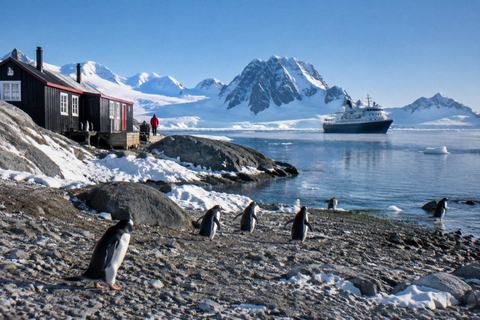 Cruise CostA per-person price ladder from $7,050 berths to $32,320 luxury voyages, with what fares include and what they quietly leave out.Read the guide
 Cheap Antarctica CruisesThe honest floor for Antarctica fares, which ships carry it, and what it costs all-in.Read the guide
 Last-Minute DealsDo last-minute Antarctica berths still exist, and what do they really save?Read the guide
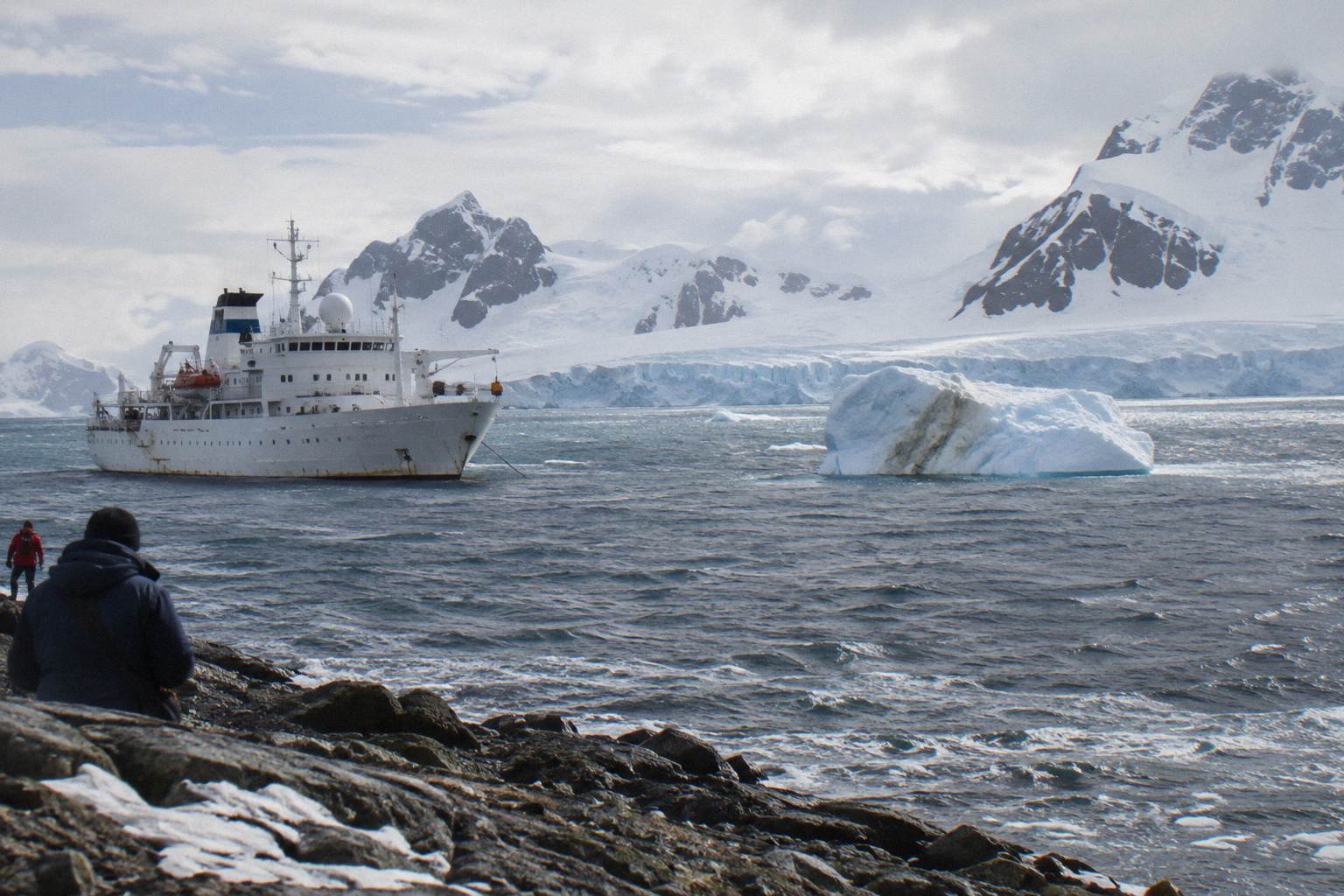 What Is IncludedWhat an Antarctica fare really covers, operator by operator, plus the hidden costs with published amounts.Read the guide