Antarctica Fly-Cruise Delays: How Often Flights Slip And What Happens
 By Oleg G.
A fly-cruise trades up to four days of Drake Passage sailing for a two-hour charter flight, and that flight is the one link in the itinerary no schedule can guarantee. Here is what operator data says about delays, and what happens when they hit.
Quick answer: Antarctica21 reports that of 346 charter flights to King George Island through April 2025, 264 left on the scheduled day, 26 left early, 40 slipped by one day, 13 by two days and 3 by three days. Silversea puts its on-time share near 80 percent. When flights slip, operators cover hotel nights in Punta Arenas and adjust the voyage.

The fly-cruise is the shortcut of Antarctic travel: a charter aircraft of about seventy seats lifts off from Punta Arenas in southern Chile and lands on a gravel strip on King George Island roughly two hours later, where a small expedition ship waits to carry you along the Peninsula. Operators running this model, from Antarctica21 to fly or sail variants from Quark Expeditions, Aurora Expeditions and Lindblad, market it as the way to skip the Drake Passage entirely.
The catch is the airstrip. Antarctic tourism runs almost entirely inside the austral summer, with roughly 98 percent of voyages touching the Peninsula between October and April, according to the Antarctic Treaty Secretariat. Inside that window, the weather on King George Island answers to nobody, and the flight is the single point where a fly-cruise can stall. This guide sets out the delay rates operators have published, what happens on the ground in Punta Arenas when a flight slips, and how the return leg is handled if the aircraft cannot fly at all.
What A Fly-Cruise Actually Changes
The fly-cruise replaces a two-day Drake Passage crossing in each direction with a charter flight of roughly two hours between Punta Arenas and King George Island, removing up to four days of sea transit from the voyage. The trade is schedule certainty for sea time: the sailing is tolerant of weather, while the flight is wholly dependent on a gravel runway that closes in fog, wind and low cloud.
Antarctica21 has run the air-cruise model since 2003, flying guests over the Drake rather than sailing them across it. Other operators sell the same idea in hybrid form. Quark flies one leg and sails the other on variants of its World Voyager and Ocean Explorer departures, Aurora offers sail-and-fly combinations on its expedition ships, and Lindblad's Antarctica Direct itineraries fly the Drake in one or both directions. HX, by contrast, sells no dedicated fly-cruise product for the 2026-27 season and sails from Ushuaia throughout.
For a passenger weighing a cabin, the maths is simple and unforgiving. Sailing both ways buys four sea days but no aviation risk; flying both ways buys four extra days of landings, Zodiac cruises and wildlife for the price of a schedule you do not control. Our guide to flying the Drake Passage works through that comparison in full.
There is also a seasonal angle worth knowing before you commit. Shoulder-season dates can carry lower fares, and on a short itinerary a slipped flight day costs the voyage proportionally more. Crossing choice, month and fare all interact here, and it is a reasonable moment to get a free fly-the-Drake consultation rather than guess.

Why Flights To King George Island Slip
The charter lands on a gravel runway, Teniente Rodolfo Marsh Martin Aerodrome, where fog, wind and low visibility close operations for hours or days at a time. The aircraft is small, around seventy seats, checked baggage is typically limited to 20 kg, and excess weight is often not permitted at all. The flight itself is short: about two hours from Punta Arenas.
The runway is the whole story of fly-cruise delays. It is a gravel strip at Chile's Frei base on King George Island, and when fog, low cloud or wind close it, the charter waits in Punta Arenas until conditions allow.
The practical details shape the experience more than the schedule does. Because the aircraft is a BAe 146 or Avro RJ type with roughly seventy seats, the passenger load is small and the boarding is quick, but the baggage allowance is tight: typically 20 kg checked plus 5 to 7 kg carried on, with dimensions restricted and soft bags preferred. Excess baggage is frequently not permitted, and fly-cruise operators commonly provide or help you rent expedition boots and parkas.
| Charter leg | What the operators publish |
|---|---|
| Route | Punta Arenas to Teniente Rodolfo Marsh Martin Aerodrome, King George Island |
| Typical flight time | About two hours |
| Aircraft | BAe 146 or Avro RJ type, around 70 passengers |
| Runway | Gravel strip, weather-dependent operations |
| Checked baggage | Typically 20 kg |
| Carry-on | 5 to 7 kg, dimensions restricted, soft bags preferred |
The mechanics of the airstrip matter because they explain the delay pattern in the operator data later in this guide. Our King George Island flight guide covers the airstrip, the flight and the embarkation logistics in detail, including what the operators do on the morning of departure.
What A Delay Looks Like In Punta Arenas
When the charter cannot fly, operators typically provide hotel nights, meals and regular updates in Punta Arenas, and some release the flight early if conditions improve ahead of schedule. Guests are advised to arrive early in the Chilean gateway and to book international flights home with one to two spare days of flexibility after the scheduled return.
The ground handling is more settled than first-timers expect. Fly-cruise operators run the Punta Arenas hotel night as part of the package, so a delayed outbound flight usually means a second covered night in the same city rather than a scramble for rooms, with meals and expedition-team updates through the day. Some operators allow an early departure if the weather window opens before the rescheduled slot, which is why keeping your day clear in Punta Arenas matters as much as the extra night itself.
The city itself is the primary fly-cruise gateway for several operators, with pre-flight briefings and gear checks already part of the stay. Our guide to Punta Arenas as an Antarctic gateway covers where the fly-cruise experience actually starts, and what the pre-flight day involves.
The return leg is the one to plan around. Operators report that fly-cruise delays of one to three days occur, and the practical response is the same across the market: hotel stays and meals in the gateway while the itinerary is adjusted, with onboard time or landing plans reworked to absorb the lost day. Booking your international flights with one to two spare days after the scheduled return is the standard advice in operator materials, because a missed long-haul connection is far more expensive than a hotel night in Chile.

What Happens If The Charter Cannot Fly After The Voyage
If the return flight cannot operate, passengers typically remain on the ship and sail back across the Drake Passage to Ushuaia or an alternative port. Aurora Expeditions states this contingency in its published plans, and operators across the market handle it similarly: the voyage absorbs the change, the crew feeds you, and the sea does the rest.
This is the scenario that decides whether a fly-cruise suits you. The whole point of the air-cruise is skipping the Drake, so the fallback of sailing it anyway is not a failure of the product, it is the designed safety valve. Aurora's contingency planning page states it plainly: passengers remain aboard and the ship returns to Ushuaia or another port by sea. The operators who publish delay figures, Silversea among them, report that stays of one to three days in the gateway are the working range, after which the voyage proceeds one way or the other.
The financial edge of a delay sits with the insurance, not the operator. Missed embarkation caused by a flight delay is typically treated as a no-show with a full penalty in standard booking terms, and operators recommend flexible flight tickets and travel insurance for exactly this reason. Trip cancellation, trip interruption and medical evacuation cover are described as strongly advised across IAATO operators for fly-cruise itineraries, and evacuation cover in particular is not a place to economise when your transport home is a seventy-seat jet on a gravel strip. Our guide to Antarctica travel insurance covers the cover levels worth demanding.
| Protection | Why it matters for a fly-cruise |
|---|---|
| An early arrival in Punta Arenas | Weather checks and delays eat a day before the charter flies |
| Flexible international flights home | One to two spare days after the scheduled return |
| Insurance with evacuation and delay cover | Strongly advised across IAATO operators |
| The sail-back contingency in your booking terms | If the return charter cannot fly, ships typically return by sea |
| Soft luggage within the limits | Excess baggage is often not permitted on the charter |
If that mix of contingency and fine print is where your planning energy should go, a consultation costs nothing and answers it directly: compare fly-cruise contingency plans with someone who reads them every week.
The Ships And Fares On Fly-Cruise Routes
The fly-cruise fleet is small: Antarctica21 flies guests to Magellan Explorer and the new Magellan Discoverer, both around 88 guests on air-cruises, with Classic Antarctica air-cruises from $13,795 per person. Silversea runs Silver Endeavour on fly-cruises roundtrip from King George Island, carrying 220 guests, with 6-night voyages listed from about $21,600 to $21,900. Shorter express products run from about $5,995 to $6,995.
Magellan Explorer is Antarctica21's established air-cruise ship. Built in 2019, registered LR PC6 ice class and carrying up to 88 guests on air-cruises across 50 cabins in seven categories, it operates the 8-day Classic Antarctica air-cruise from Punta Arenas with fares from $13,795 per person. Ten Zodiacs, kayaking and guided hiking are the standard expedition kit, with the optional activities carrying their own charges. Our full Magellan Explorer ship guide covers the cabins and the onboard detail.
Its new fleet mate follows the same model. Magellan Discoverer is the newest vessel in the Antarctica21 fleet, sailing its first Antarctic season in 2026-27 with the same 88-guest air-cruise format, PC6 ice class and the same $13,795 starting fare, and wet and dry science labs onboard.
The luxury alternative runs the other direction. Silversea's Silver Endeavour, a 220-guest PC6 expedition ship, operates fly-cruises roundtrip from King George Island, with 6-night voyages listed from about $21,600 to $21,900; a fare for your dates needs a consultation rather than a guess. The trio below compares the three fly-cruise ships directly.
| Ship | Class | Passengers | Ice class | From, per person | Voyage length | Departs from |
|---|---|---|---|---|---|---|
| Magellan ExplorerAntarctica21 | Fly-Cruise | 96 (88 in Antarctica) | LR PC6 | from $13,795 | 8 days | Punta Arenas (fly) to King George Island |
| Magellan DiscovererAntarctica21 | Fly-Cruise | 88 | PC6 | from $13,795 | – | Punta Arenas (fly) to King George Island |
| Silver EndeavourSilversea | Luxury | 220 | PC6 | – | 6 to 13 days | King George Island, Puerto Williams |
Beyond those three, the express products show how elastic the category is. Antarctica21's 6-day Antarctica Express Air-Cruise lists from $5,995 to $6,995 for travellers who want the shortest possible exposure, and Quark's 9- to 10-day fly and sail itineraries aboard World Voyager and Ocean Explorer run roughly $15,640 to $18,295, blending one Drake crossing with one charter flight. The one-way hybrids deserve their own look: sailing south and flying home, or the reverse, halves the aviation risk while keeping one classic crossing, and our one-way fly-cruise guide works through which direction suits which traveller.
The fare spread across these products is wide enough that the right answer genuinely depends on your dates, your budget and your tolerance for a lost day, which makes it a natural moment for a free fly-cruise consultation.

How Often Antarctica Fly-Cruise Flights Slip, By The Numbers
Antarctica21 figures covering 346 charter flights through April 2025 show 264 departures on the scheduled day, about 76 percent, and 26 that left early. Forty flights were delayed by one day, 13 by two days and 3 by three days. Silversea separately reports that around 80 percent of its fly-cruise departures run on schedule, with delays of one to three days when they slip.
Those numbers come from the operator's own flight record, and they are the clearest picture of the risk available. More than two out of three delayed flights in the Antarctica21 dataset slipped by a single day, and no flight in the record was delayed by more than three. Independent commentary sits slightly lower: one polar travel specialist, citing more than two decades of data, puts the on-time share near 75 percent, while Silversea reports about 80 percent of its fly-cruise departures leaving on schedule.
| Flight outcome | Flights | Share of 346 |
|---|---|---|
| Departed on the scheduled day | 264 | About 76 percent |
| Departed early | 26 | About 8 percent |
| Delayed by one day | 40 | About 12 percent |
| Delayed by two days | 13 | About 4 percent |
| Delayed by three days | 3 | About 1 percent |
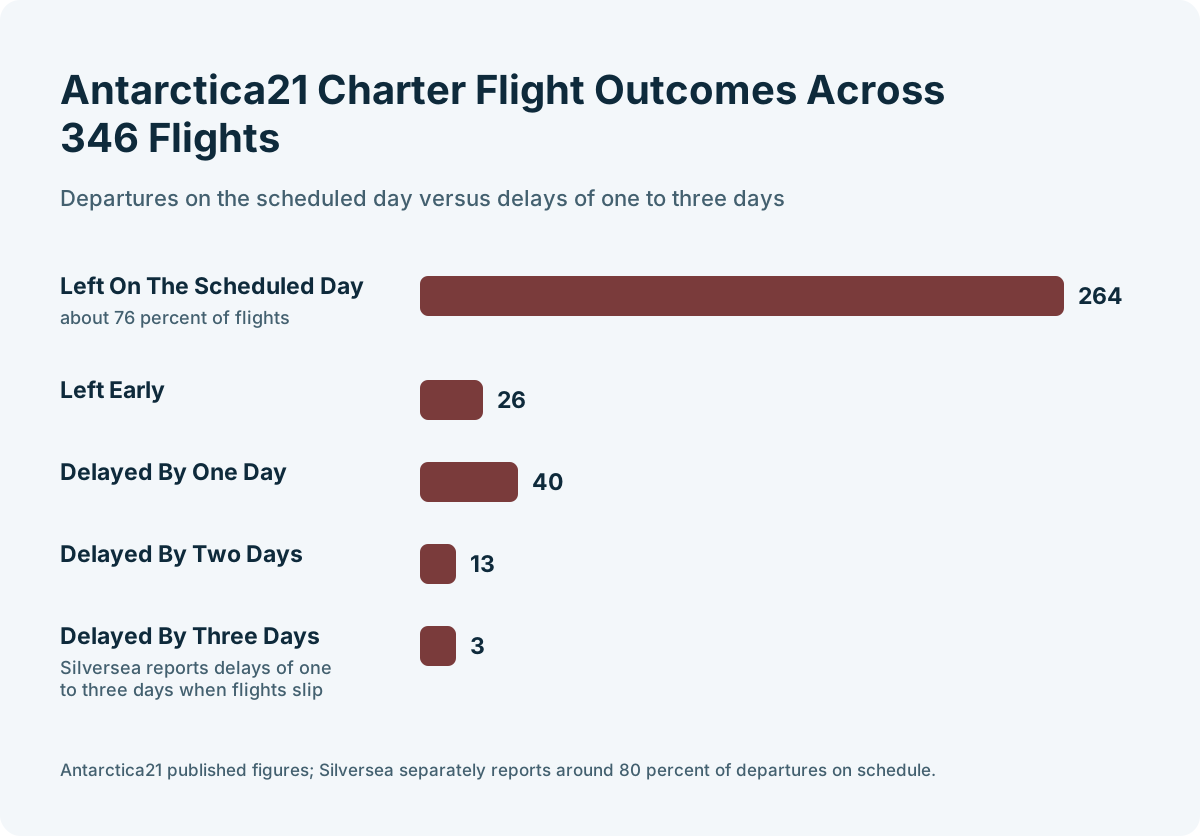
Read honestly, the data says the delay risk is real but bounded. Roughly one flight in four does not leave on its scheduled day, and most of those either left early or slipped by a single day, and the operators' published response is a covered hotel night rather than a ruined expedition. The failure mode that matters, the return flight that cannot fly at all, has a defined answer in the sail-back contingency. The 346-flight record is documented by Cruise Ports, for travellers who want the raw history.
Should The Delay Risk Change How You Book?
For most travellers, no: the delay is a covered hotel night in the great majority of cases, not a lost expedition. Where it should change your booking is if your return dates are fixed without spare days, if you are sailing a short November or March itinerary, or if the thought of an unplanned Drake crossing by sea genuinely bothers you.
The booking pattern that fits the data is straightforward. Choose the fly-cruise for the extra days ashore, then protect it: arrive early in Punta Arenas, keep the international tickets flexible, carry insurance that names weather delay and medical evacuation, and know before you pay the deposit that the fallback is a sea voyage to Ushuaia. Those four habits convert the delay from a disruption into a scheduling detail.
Travellers with hard return dates are the one group who should think twice. If you must be back at work the morning after your scheduled return, a three-day slip is not an inconvenience, it is a crisis, and the sailing voyage with its fixed sea days is the safer instrument. The same logic applies in miniature to the shortest express itineraries, where a single lost day removes a larger share of the whole voyage.
Two years of reading operator contingency documents for Cruises In Antarctica has left me with one durable impression: the travellers who cope best with a slipped charter are the ones who knew the plan existed before the plane turned back. The plan is almost always the same plan, and it is a good one.
Whether that trade suits your dates, your budget and your itinerary is a personal call, and it is exactly the question a consultation exists to answer. Talk through your fly-cruise options with a vetted expedition-cruise agency partner at no cost, and land the decision before the fares move.
Common Questions About Antarctica Fly-Cruise Delays
How often are flights to King George Island delayed?
Across 346 Antarctica21 charter flights through April 2025, 264 departed on the scheduled day and 26 left early, so roughly 84 percent of flights ran on or ahead of schedule. Forty flights were delayed by one day, 13 by two days and 3 by three days, and none in the record slipped further than that. Silversea separately reports about 80 percent of its fly-cruise departures run on schedule.
What happens if my flight to Antarctica is cancelled?
Operators typically provide hotel nights, meals and regular updates in Punta Arenas while the flight waits for a weather window, and some release the charter early if conditions improve ahead of the rescheduled slot. The voyage itinerary is adjusted to absorb the lost day, with onboard time or landing plans reworked rather than the trip cut short.
What happens if the return flight cannot operate at all?
Passengers typically remain on the ship and sail back across the Drake Passage to Ushuaia or an alternative port. Aurora Expeditions states this contingency in its published plans, and operators across the market handle it in the same way. It converts a failed flight into two extra sea days with full board.
Should I buy travel insurance for a fly-cruise?
Yes. Operators across the IAATO market strongly advise trip cancellation, trip interruption and medical evacuation cover for fly-cruise itineraries, and missed embarkation from a flight delay is typically treated as a no-show with a full penalty in standard booking terms. Flexible international flight tickets are the companion recommendation in operator guidance.
How many buffer days should I add around the charter?
Operator guidance is to arrive early in Punta Arenas before the outbound flight and to book international flights home with one to two spare days of flexibility after the scheduled return. Because delays of one to three days are the documented range, that buffer covers the great majority of real outcomes without padding the trip unnecessarily.
More Drake Passage
 Drake Passage CrossingDuration, conditions, on-board routine and the fly-cruise alternative for the Drake Passage.Read the guide
 Is The Drake Dangerous?The honest answer on Drake Passage danger: incidents, ice class rules, and what ships do in bad weather.Read the guide
 Drake Shake GuideHow rough the Drake Shake really is, what prevents seasickness, and how to skip the crossing entirely.Read the guide
 Fly The DrakeSkip the Drake Passage crossing with a two-hour flight to King George Island and more days on the Peninsula.Read the guide