South Shetland Islands: The First Landings Of Most Voyages
 By Oleg G.
Most Antarctic Peninsula cruises call at the South Shetland Islands before reaching the continent itself. Here is what the islands hold, which sites ships actually visit, and how King George Island anchors the fly-cruise alternative.
Quick answer: The South Shetland Islands sit north of the Antarctic Peninsula and are an early landing area on many Peninsula expedition cruises. Key visited sites include Half Moon Island, the Aitcho Islands, Livingston Island beaches, Deception Island's flooded caldera and King George Island, the fly-cruise flight gateway. Landings follow IAATO rules of 100 passengers ashore at a time.
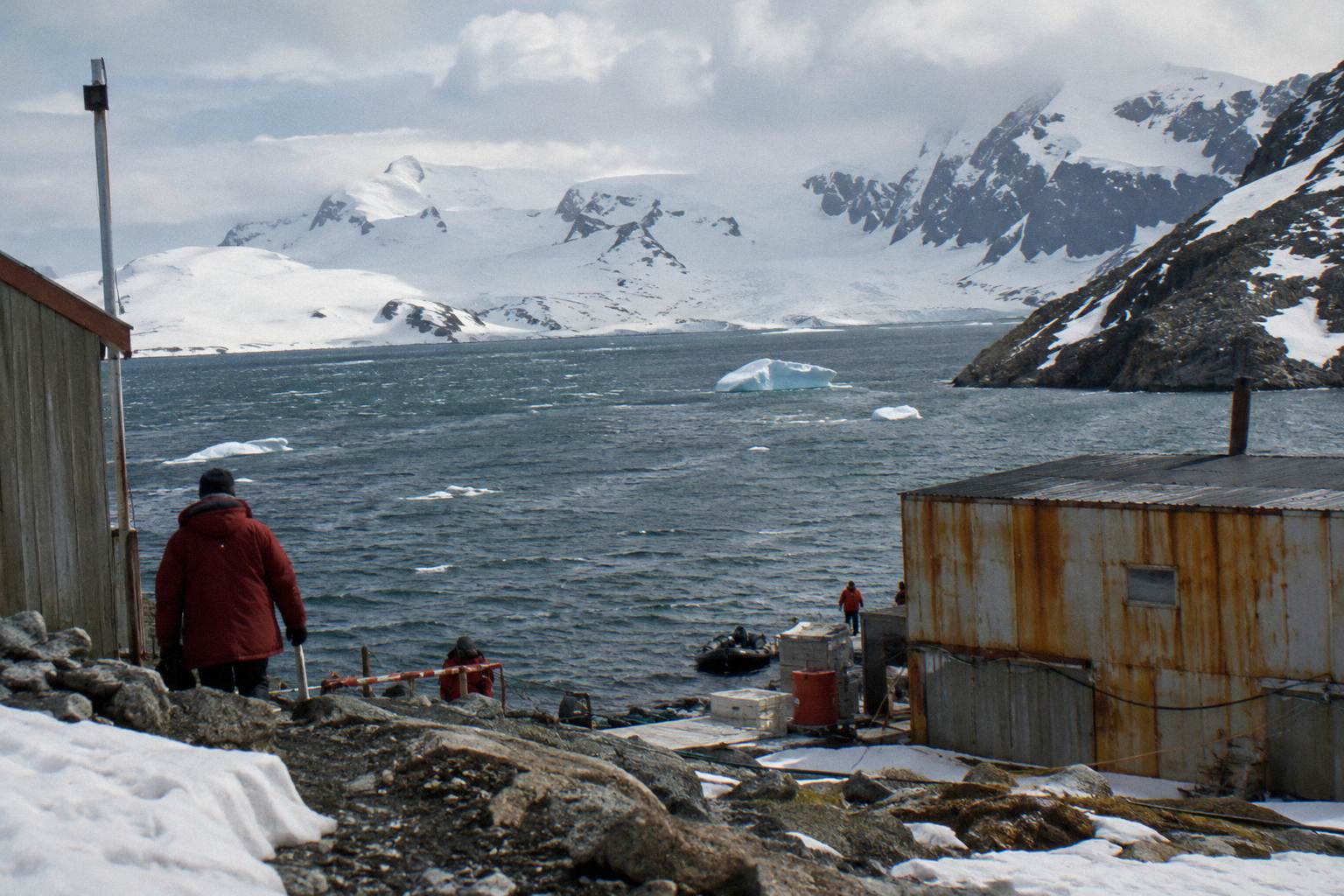
The South Shetland Islands are where many Antarctic expeditions begin. Lying north of the Antarctic Peninsula, they sit on the approach from the Drake Passage, and ships reach them frequently in the core season. For many travellers on an expedition cruise, the first Zodiac landing of the voyage happens not on the continent but on one of these islands.
That matters for planning. The islands offer a concentration of wildlife, history and volcanic scenery that a well-run voyage can sample in a day or two, and expedition teams use them to build flexibility into the schedule. This guide covers the main islands and landing sites, the wildlife and research stations, the rules that govern every shore visit, and the King George Island flight that underpins the fly-cruise alternative to the Drake Passage.
What Are The South Shetland Islands?
The South Shetland Islands lie north of the Antarctic Peninsula. King George, Livingston, Deception, Half Moon and the Aitcho group are the names that appear again and again on expedition cruise logs, and several of their sites carry current visitor guidelines.
The islands' history includes sealing, whaling and scientific stations, and whaling-era ruins survive at Deception Island's Whalers Bay. King George Island has research stations that can be visited by prior arrangement, and tourism is managed through IAATO and Antarctic Treaty site guidelines rather than any single national authority.
For a cruise passenger the practical picture is simple: ice blocks these islands less severely than sites further south, they hold penguin and seal colonies, and ships reach them frequently in the core season. That combination makes them a regular early stop and a useful fallback when ice or weather blocks sites further south. The Antarctic Treaty Secretariat notes that roughly 98 percent of all tourism voyages occur in the Antarctic Peninsula region during the austral summer, and the South Shetlands sit at the front door of that region (Antarctic Treaty tourism overview).
Where The Islands Sit On A Peninsula Voyage
On a classic 10-to-13-day Peninsula expedition cruise, the South Shetlands are often among the first landings after the Drake Passage. Which island a ship uses on a given day depends on ice, swell and other vessels.
A typical sailing from Ushuaia crosses the Drake in 18 to 48 hours each way, depending on conditions, and the first sheltered water it reaches is the South Shetlands. An expedition team will usually brief passengers the night before with a Plan A, B and C for the following morning, because wind and swell decide which beach is workable. Half Moon Island and the Aitcho group are frequent early calls; Deception Island requires a ship-level navigation through Neptune's Bellows, the narrow entrance to the flooded caldera, which adds its own weather calculus.
IAATO rules shape every one of these calls. A maximum of 100 passengers may be ashore from a vessel at any one time, one ship may visit a site at a time, and vessels carrying more than 500 passengers may not make landings in Antarctica at all (IAATO visitor guidelines). On a ship of 100 guests or fewer everyone can land together; on larger vessels the shore time rotates. If you are still weighing how ship size changes your day, the guide on Antarctica cruise ship sizes breaks the trade-offs down, and the crossing itself is covered in our Drake Passage crossing guide.
If you already know you want maximum time ashore rather than a fast first taste, it is worth getting help matching a ship to that goal before you commit: get free help choosing your voyage.
The Main Islands And Landing Sites
The sites most often visited are Half Moon Island, the Aitcho Islands, Livingston Island beaches, Deception Island and King George Island, with ATCM visitor guidelines at several of them setting caps, curfews and boundaries. None of these are continental landings; the South Shetlands are islands, and stepping onto the continent itself usually happens later in the voyage at sites such as Neko Harbour.
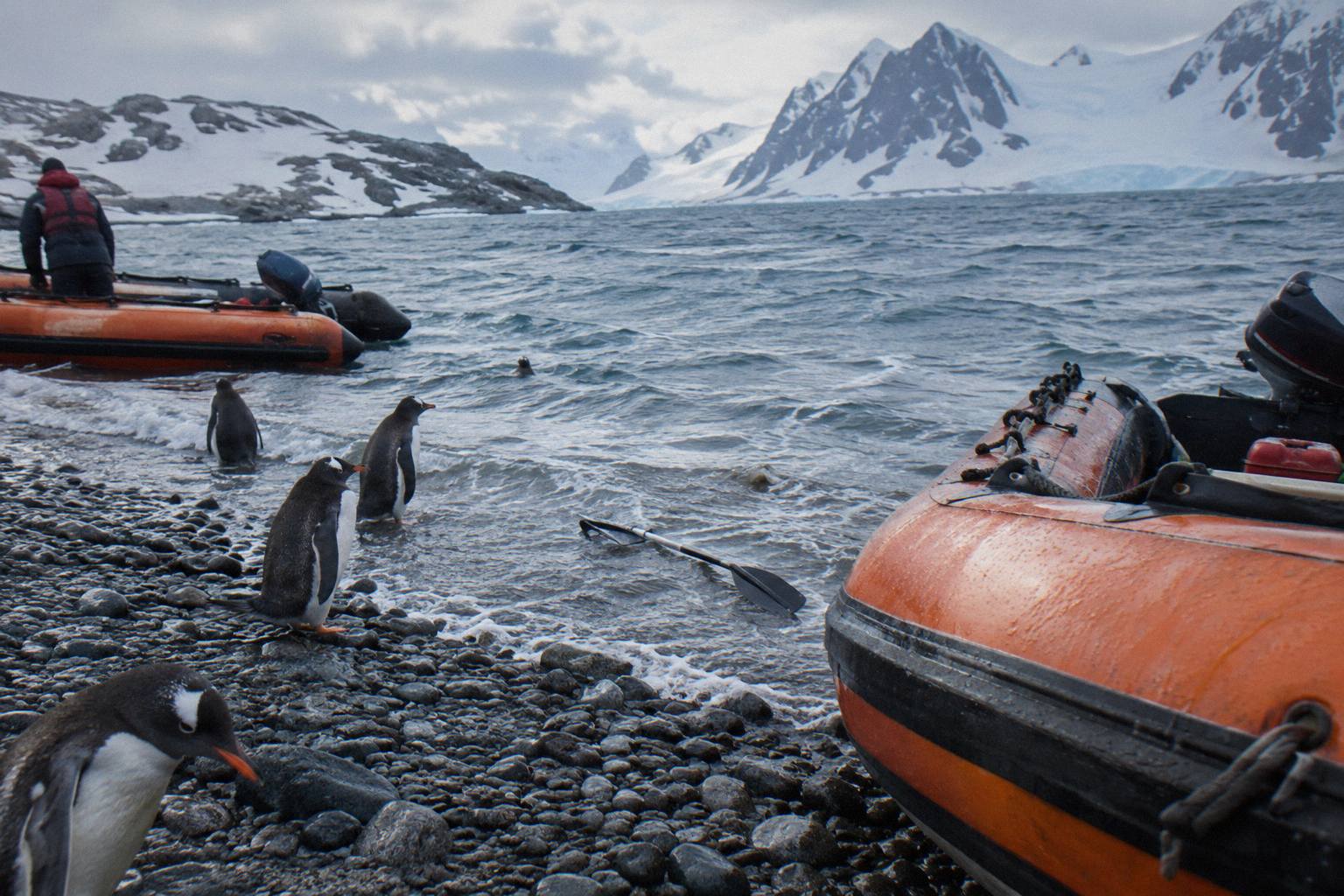
Half Moon Island has chinstrap penguins, Wilson's storm-petrels and seals, with a small landing beach and walks on cobbled beaches and a hill. The ATCM guideline for the island allows a maximum of 100 visitors ashore at once with a 1:20 guide ratio, a curfew on landings between 22:00 and 04:00, one ship at a time and a maximum of three ships per day. The Aitcho Islands, around Barrientos Island, offer gentoo and chinstrap penguins, southern giant petrels and elephant seals on a cobble and sand beach, with similar caps and breeding-season limits.
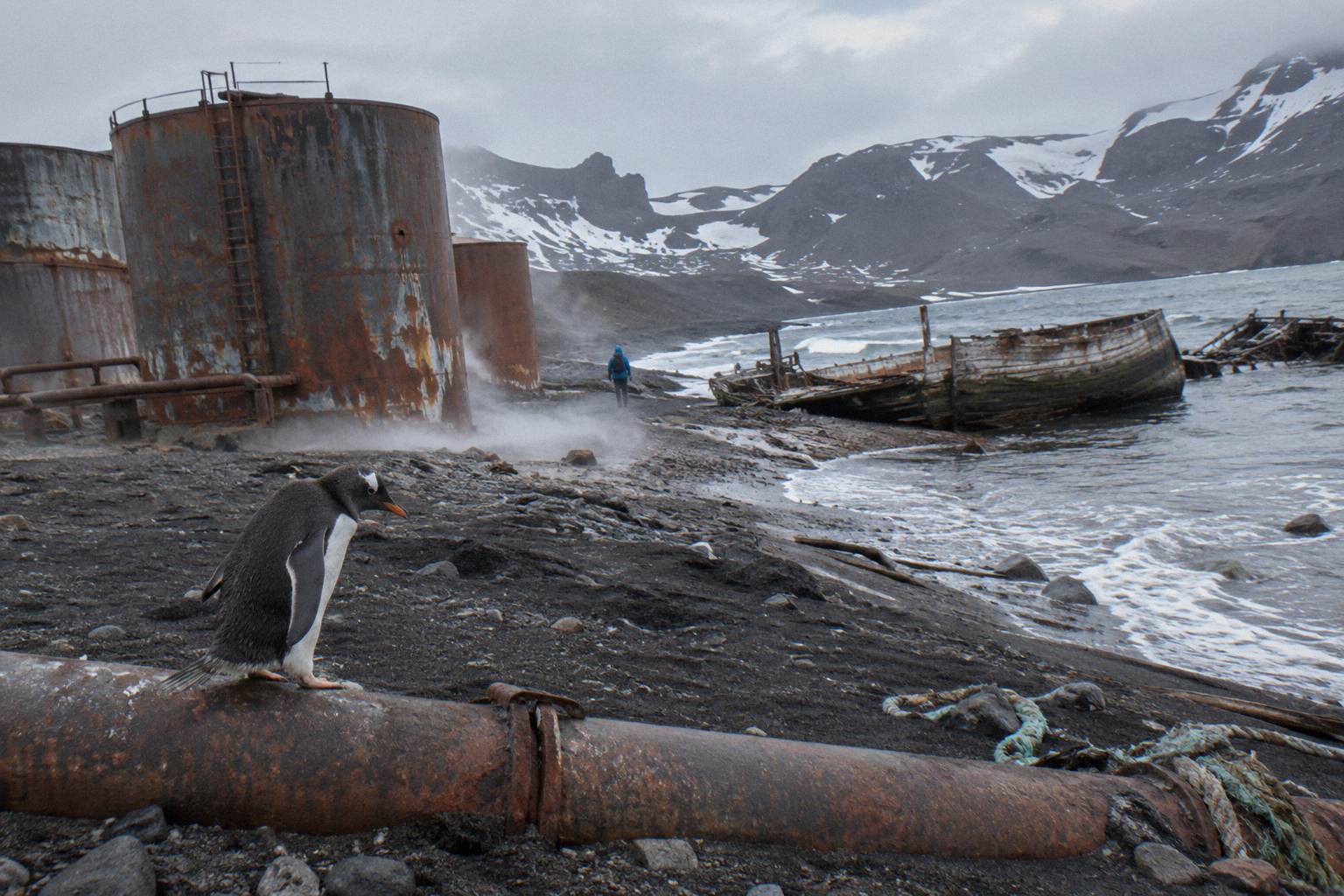
Livingston Island hosts several beaches used for wildlife landings, with the same standard IAATO limits applying where guidelines exist. Deception Island is the outlier: a still volcanically active caldera entered through Neptune's Bellows, with whaling station ruins at Whalers Bay and a separate, stricter cap at Baily Head, where visitor numbers are limited to 350 per day with time limits. King George Island is less a scenic landing than a logistical hub, with station visits by prior arrangement alongside penguin and seal beaches. The table below pulls the published detail together.
| Site | Island group | What you see ashore | Key rules from the site guideline |
|---|---|---|---|
| Half Moon Island | South Shetlands (east) | Chinstrap penguins, storm-petrels, seals, cobble beach walk | Max 100 ashore, 1:20 guide ratio, curfew 22:00-04:00, one ship at a time, max 3 ships/day |
| Aitcho Islands (Barrientos) | South Shetlands | Gentoo and chinstrap penguins, giant petrels, elephant seals, vegetation | Max 100 ashore, 1:20 ratio, breeding-season time and ship-size limits |
| Livingston Island sites | South Shetlands | Penguins, seals, seabirds on varied beaches | Standard IAATO limits where guidelines exist |
| Deception Island: Whalers Bay | Deception caldera | Whaling station ruins, volcanic features | ASMA 4 code of conduct applies; ship enters via Neptune's Bellows |
| Deception Island: Baily Head | Deception caldera | Not stated | Max 350 visitors per day, time limits |
| King George Island | South Shetlands | Beaches with penguins and seals; research stations by arrangement | Standard limits; station visits need prior agreement |
One habit worth building before you travel: read the evening briefing properly. The expedition team announces which of these sites is planned and why, and the reasoning, ice, swell, another vessel in the scheduler, is a genuine education in how Antarctic cruising actually works day to day.
King George Island And The Fly-Cruise Connection
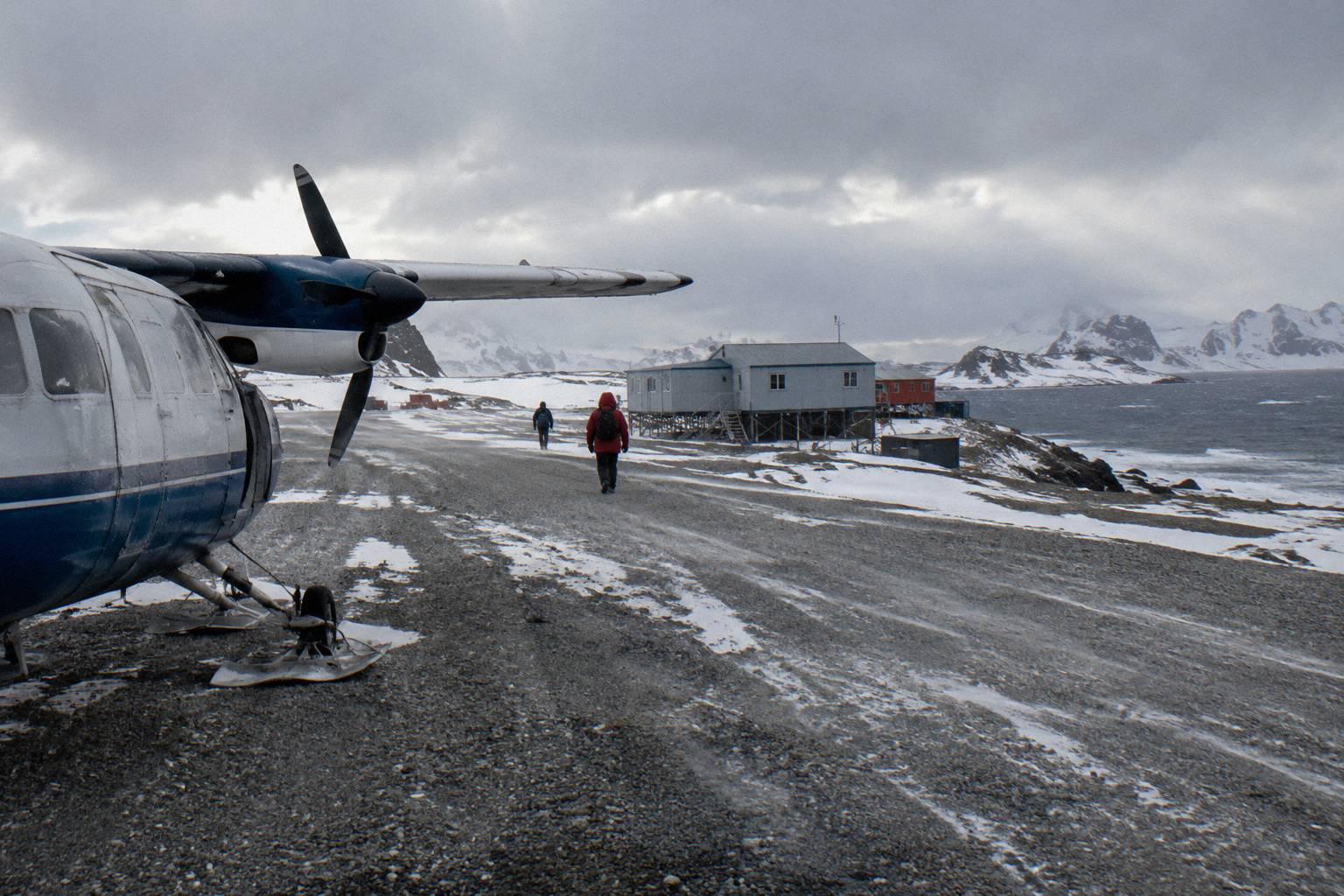
King George Island is the hub of the fly-cruise model: charter flights of roughly two hours carry passengers from Punta Arenas to the Teniente Rodolfo Marsh Martin aerodrome, a gravel strip beside the Frei Chilean base, where they board an expedition ship without ever crossing the Drake by sea. Operators including Antarctica21, Quark Expeditions, Silversea and Lindblad all sell variants of this product for the 2026-27 season.
The flight itself is the constraint. Aircraft are typically BAe 146 or Avro RJ types seating around 70 passengers, baggage is limited to about 20 kg checked plus a small carry-on, and the gravel runway is subject to wind, fog and low visibility. Antarctica21's own data on 346 flights through April 2025 shows 264 departing on the scheduled day, 26 early, 40 delayed by one day, 13 by two days and 3 by three days; one secondary source cites roughly 75 percent of flights departing on schedule. Operators build contingency into the product: hotel nights and meals in Punta Arenas during delays, and if the return flight cannot operate, passengers typically remain aboard and sail back across the Drake to Ushuaia.
This is the trade-off in its plainest form. A fly-cruise such as the Classic Antarctica Air-Cruise, 8 days and 7 nights roundtrip from Punta Arenas aboard a ship like Magellan Explorer, buys back the days the crossing would take, at the price of weather dependence and a tighter, smaller-ship experience. Sailing both ways from Ushuaia is slower but cheaper per day and immune to runway fog. If you are torn between the two, the full comparison lives in our fly the Drake guide, and the flight itself is covered in detail in the King George Island flight guide.
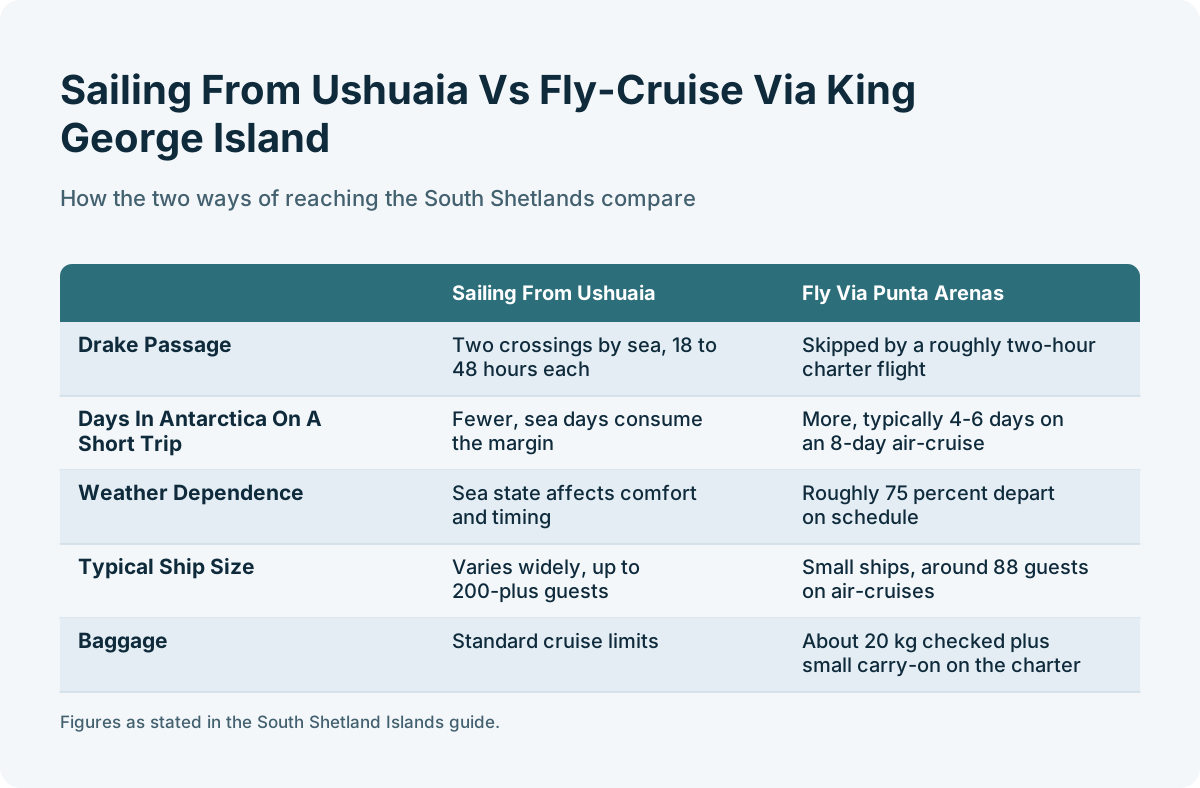
The two approaches differ on almost every practical dimension, so the side-by-side view is worth studying before you lean either way.
| Factor | Sailing from Ushuaia | Fly-cruise via King George Island |
|---|---|---|
| Gateway city | Ushuaia, Argentina | Punta Arenas, Chile |
| Drake Passage | Two crossings by sea, 18 to 48 hours each | Skipped by a roughly two-hour charter flight |
| Days in Antarctica on a short trip | Fewer, sea days consume the margin | More, typically 4-6 days on an 8-day air-cruise |
| Weather dependence | Sea state affects comfort and timing | Flight delays of one to three days occur; roughly 75 percent depart on schedule |
| Typical ship size | Varies widely, up to 200-plus guests | Small ships, around 88 guests on air-cruises |
| Baggage | Standard cruise limits | About 20 kg checked plus small carry-on on the charter |
| If the return flight cannot operate | Not applicable | Passengers typically sail back across the Drake to Ushuaia |
Deciding between flying and sailing is a big fork in Antarctica planning, and it changes price, ship and gateway city all at once, so this is a good moment for a free consultation before you book.
Wildlife Across The Islands
Chinstrap and gentoo penguins are the main penguins at South Shetland landings, with elephant, Weddell and fur seals on the beaches and skuas and gulls around them. The IAATO five-metre wildlife distance applies everywhere, with greater distances for nesting or stressed animals.
The seasonal rhythm matters. In November the penguins are courting and nest-building, with fresh snow on land and more sea ice offshore, and early ships can find elephant seal pups in the South Shetlands. In December and January the colonies move from eggs to chicks. From February into March the chicks gather in crèches and fledge, whale numbers peak in the surrounding waters, and the colonies empty by late March or early April. Because the South Shetlands are visited from the very first departures of November through the last sailings of March, the experience shifts noticeably with the month you choose. The wider set of guides lives on Cruises In Antarctica.
The month you pick therefore changes what a South Shetland landing actually looks like, and the pattern below holds across the archipelago's main sites.
| Month | Penguins on the South Shetlands | Other wildlife | Conditions and access |
|---|---|---|---|
| November | Courtship, nest-building, egg laying begins | Elephant seal pups on early sailings | More sea ice, pristine snow, limited access; shoulder fares |
| December | Incubation; first chicks hatch late in the month | Whale arrivals beginning; seal activity builds | Ice recedes, opening more coast; peak daylight |
| January | Chicks hatching and being fed | Humpback sightings increasing from mid-month | Channels mostly ice-free; peak fares |
| February | Chicks in creches, learning to swim | Whale numbers peak, including humpbacks and minkes | Less sea ice; Circle crossings more feasible |
| March | Fledging chicks; colonies thinning toward empty | Strong whale activity in krill-rich waters | Ice variable; shoulder fares return |
The rules that protect the wildlife are enforced by the expedition team, not left to goodwill. Boots and equipment must be washed before arrival and cleaned again between sites, visitors must keep at least five metres from wildlife on land or ice, and drones must not be flown near animals. Kneeling or sitting on the ground in wildlife areas is restricted under the enhanced biosecurity protocols that have applied since the avian influenza outbreaks, a habit change many first-timers do not expect. ATCM 48 in 2026 updated site-specific approach distances and caps, so the briefing you get aboard reflects the current season's rules, not a brochure's.
Deception Island: The Flooded Caldera
Deception Island is a volcanic caldera entered through Neptune's Bellows; ships that make it inside can land passengers at Whalers Bay among whaling station ruins and volcanic features.
The island is managed as Antarctic Specially Managed Area No. 4, with its own code of conduct layered on top of the general IAATO rules. Whalers Bay holds whaling station ruins, and a landing here feels more like industrial archaeology than wildlife watching, although penguins and seals are present. Baily Head is another Deception site, and its guideline caps visitation at 350 people per day with time limits.
The caldera crossing is a genuine maritime event. Entering Neptune's Bellows depends on conditions, and both volcanic activity and swell are noted at the island. If your heart is set on stepping inside a volcano, tell whoever helps you plan: not every voyage calls here, and swell windows decide it on the day. Our dedicated Deception Island cruise guide goes deeper.
Which Ships Visit The South Shetland Islands
Expedition ships across the Peninsula fleet visit the South Shetlands, from 88-guest fly-cruise ships to 200-passenger vessels; the differences that matter to a landing-focused traveller are passenger count, ice class and itinerary length, and the ships below illustrate the spread from budget sailing to fly-cruise.
The Oceanwide Expeditions fleet is a useful benchmark for the sailing model. Hondius, built in 2019 and the first-registered Polar Class 6 passenger vessel in the world, carries 170 guests in 80 cabins from Ushuaia on 11-to-19-day voyages, with Antarctic Peninsula departures from $7,800 per person. Her fleetmates Ortelius and Plancius carry just 108 guests each, which puts nearly every passenger ashore at once under the 100-ashore rule, a real advantage at sites where larger ships must rotate. Ortelius is also the ship used for helicopter-supported Weddell Sea voyages, a different route but the same operator family.
At the fly-cruise end, Magellan Explorer carries up to 88 guests on air-cruises from Punta Arenas, flying to King George Island and sailing the surrounding waters, with Classic Antarctica air-cruise fares from $13,795 per person. The comparison table shows the spread.
| Ship | Class | Passengers | Ice class | From, per person | Voyage length | Departs from |
|---|---|---|---|---|---|---|
| HondiusOceanwide Expeditions | Small-Ship Budget | 170 | Polar Class 6 | from $7,800 | 11 to 19 days | Ushuaia |
| Magellan ExplorerAntarctica21 | Fly-Cruise | 96 (88 in Antarctica) | LR PC6 | from $13,795 | 8 days | Punta Arenas (fly) to King George Island |
| OrteliusOceanwide Expeditions | Small-Ship Budget | 108 | UL1 | from $7,800 | 11 to 25 days | Ushuaia |
The numbers explain why the same landing site can feel so different from two ships. A 108-guest vessel lands nearly everyone at once, a 170-guest ship must rotate groups, and an 88-guest fly-cruise ship can land everyone together.
Choosing between a 108-berth former research vessel, a 2019-built 170-berth ship and an 88-guest fly-cruise is exactly the kind of decision where the numbers only tell half the story, so it is worth using the free planning consultation before committing to a cabin.
Best Time To Visit And The Rules That Shape Your Day
The South Shetlands are visited from the first sailings of November through the last departures of late March; November brings pristine snow and courting penguins at lower fares, December and January deliver peak daylight and chicks, and February to March offer receding ice, whales and better odds of pushing further south. No month is objectively best, and the right choice depends on what you want to see and what you want to pay.
Early season has real appeal for photographers: fresher snow, more sea ice and shoulder-season pricing, with the caveat that some sites may be inaccessible. Mid-season buys the longest days and the egg-to-chick stage, at peak prices. Late season trades snow for whales and open water, and it is the window in which Antarctic Circle crossings become more feasible on itineraries that attempt them. The month-by-month detail, including daylight hours and fare patterns, is laid out in our best time to visit Antarctica guide.
Whatever the month, the shape of a day ashore is fixed by the rules. Your landing will last one to three hours depending on site, weather and ship size; you will step from a Zodiac into shallow water, so waterproof boots are essential, and some operators, Quark among them, include them in the fare; and the expedition team will hold you to the five-metre wildlife distance and the biosecurity cleaning routines. None of this is onerous, but knowing it in advance changes how you pack and how you read the daily plan. For the wider picture of what a fare includes and what it does not, see our guide on what an Antarctica cruise includes.
Common Questions About The South Shetland Islands
Are the South Shetland Islands part of Antarctica?
The islands lie north of the Antarctic Peninsula, and tourism there is managed through IAATO and ATCM site guidelines like the rest of Antarctica. Landings here do not count as continental landings; they are island landings.
Which South Shetland sites will my cruise actually visit?
It depends on ice, swell, your ship's schedule and the IAATO ship scheduler, which allows only one vessel at a site at a time. Half Moon Island, the Aitcho Islands, Deception Island and King George Island are frequently visited sites, but no specific landing is ever guaranteed, and expedition teams carry Plan A, B and C for every day.
Can you land on King George Island from a cruise?
Yes, on beach sites with penguins and seals, and at research stations by prior arrangement. King George Island is better known as the fly-cruise gateway: charter flights from Punta Arenas land at the Frei base gravel airstrip in about two hours, and passengers board ships such as Magellan Explorer without crossing the Drake by sea.
What wildlife will I see in the South Shetland Islands?
Chinstrap and gentoo penguins are the staples, with elephant, Weddell and fur seals on the beaches, skuas and gulls overhead and giant petrels near the Aitcho Islands. Whales, including humpbacks and minkes, are increasingly seen in the surrounding waters from January onward and peak in February and March.
How close can I get to penguins on a landing?
IAATO guidance requires keeping at least five metres from wildlife on land or ice, with greater distances for nesting birds, molting penguins or stressed animals. The expedition team enforces this on every landing, and enhanced biosecurity protocols also restrict kneeling or sitting on the ground in wildlife areas.
Do fly-cruise passengers avoid the Drake Passage entirely?
Usually, but not always. The roughly two-hour flight to King George Island skips the crossing, and Antarctica21 data on 346 flights shows the large majority departing on the scheduled day. If the return flight cannot operate due to weather, passengers typically remain aboard and sail back across the Drake to Ushuaia, so a sea crossing remains a possibility on any fly-cruise booking.
More Routes And Landings
 Peninsula CruisesThe classic Peninsula route explained: lengths, fares, landing sites and timing.Read the guide
 Antarctic CircleLonger, costlier voyages that push past 66 degrees south, and what the extra days buy.Read the guide
 South Georgia CruisesThe 18-to-22-day Falklands, South Georgia and Peninsula itinerary, the premium wildlife cruise.Read the guide
 Cruises From UshuaiaShips, routes, fares and arrival logistics for the world's main Antarctica departure port.Read the guide