Antarctica Cruise Ship Sizes: Why Passenger Count Decides Your Trip
 By Oleg G.
Passenger count is the single number that most shapes an Antarctica voyage: it sets whether you step ashore at all, how long you stand on land, and how the ship handles the Drake Passage.
Quick answer: IAATO groups Antarctica ships into size categories: yachts up to 12 guests, C1 ships of 13 to 200 passengers, C2 ships of 201 to 500, and cruise-only vessels over 500 which cannot land guests at all. No more than 100 passengers may be ashore at one time, so on ships carrying more than 100, groups rotate and each guest gets less time on land.
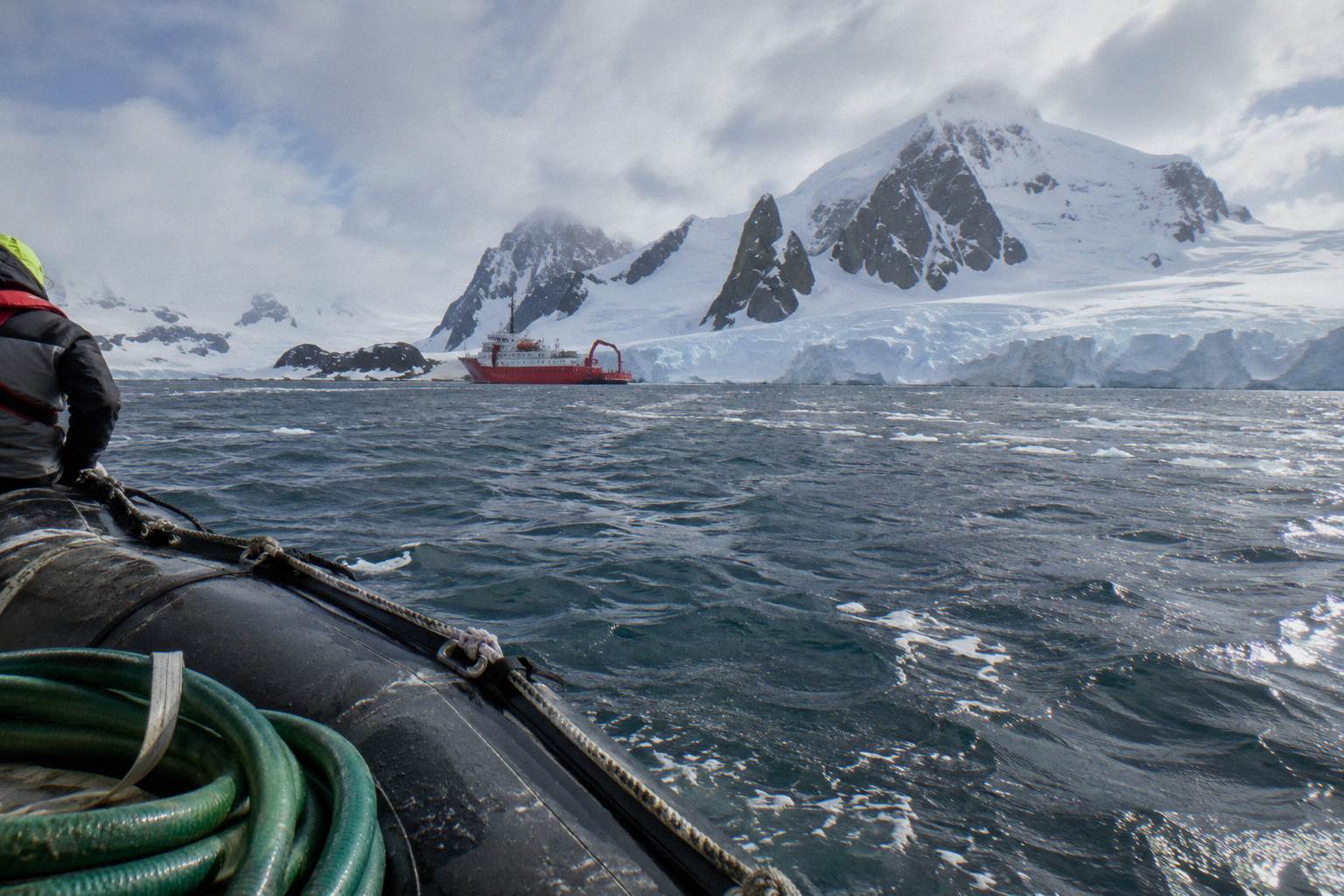
The number printed on a ship's capacity page matters more in Antarctica than anywhere else in cruising. That is not about cabin space or queue length at dinner. It is about a set of rules, written into the visitor guidelines that govern all landings, which tie your time on the ice directly to how many people are standing next to you on the gangway. Choose a cruise on the wrong-sized ship and you may still see the continent beautifully from the deck. Choose well, and you spend your afternoon beside a penguin colony rather than waiting for your group's turn to leave the ship.
This page explains the size tiers, what each one means for landings and sea conditions, and how to use the numbers when comparing ships and fares. Every passenger figure below comes from the operators' own ship pages as recorded in our ship roster, and every rule comes from the IAATO and Antarctic Treaty material that regulates the season. The featured example is Sea Spirit, a 114-guest ship that sits in one of the more interesting middle tiers of the small-ship band.
One framing note before the numbers. Ship size in Antarctica is not a luxury scale, it is an access scale. The biggest ships in the region are barred from landing anyone, and the smallest ones put every guest on the ice at once. Everything in between is a negotiation between those two poles, and the negotiation is governed by arithmetic you can check yourself before you book a cabin.
What Are The Antarctica Cruise Ship Size Categories?
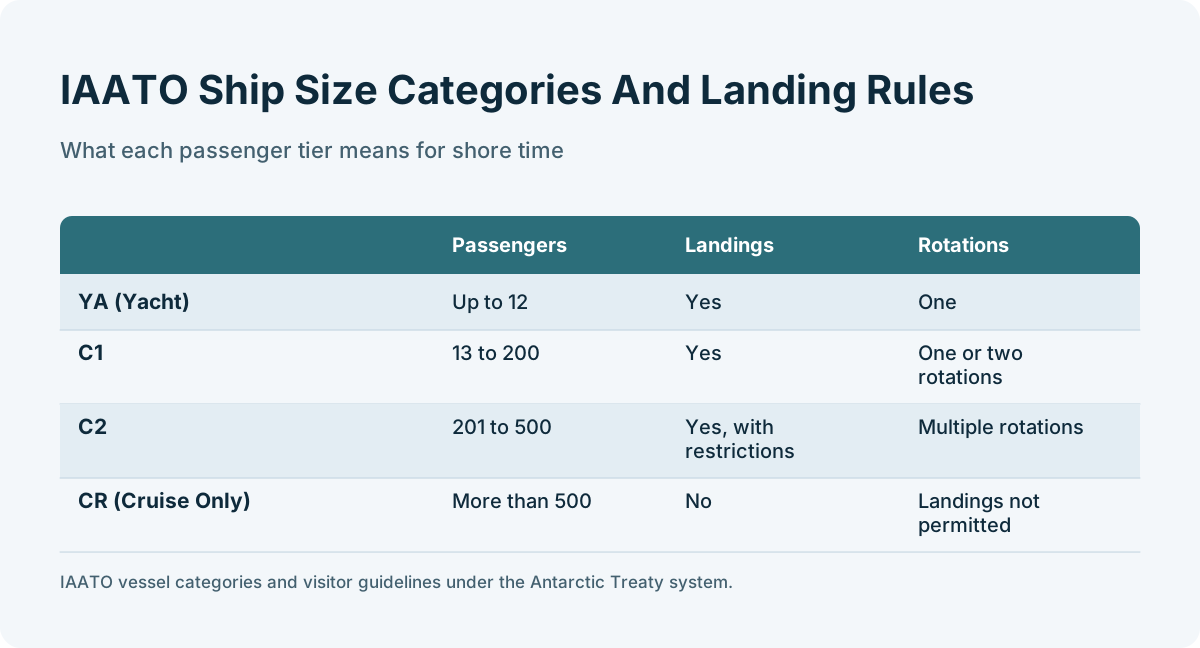
IAATO sorts vessels into size categories with hard operational consequences: yachts carrying up to 12 guests, C1 expedition ships of 13 to 200 passengers, C2 ships of 201 to 500, and cruise-only vessels over 500 which may not land anyone. The same framework caps passengers ashore at 100 at any one time and requires at least one guide for every 20 visitors. Those two limits, not the hull, decide how your landing day runs.
Those thresholds are not marketing labels. They come from IAATO's vessel directory and the visitor guidelines adopted under the Antarctic Treaty system, and every operator that lands guests in Antarctica works inside them. A ship with 199 passengers qualifies as C1 and can run landings in a single rotation split, since 199 people divided into groups of 100 or fewer means two waves per site visit. A ship with 378 passengers sits in C2: landings are still allowed, but the rotation mathematics changes and each wave shortens. A vessel carrying more than 500 fare-paying passengers cannot land anyone, which is why the large mainstream ships visiting the region offer scenic cruising only.
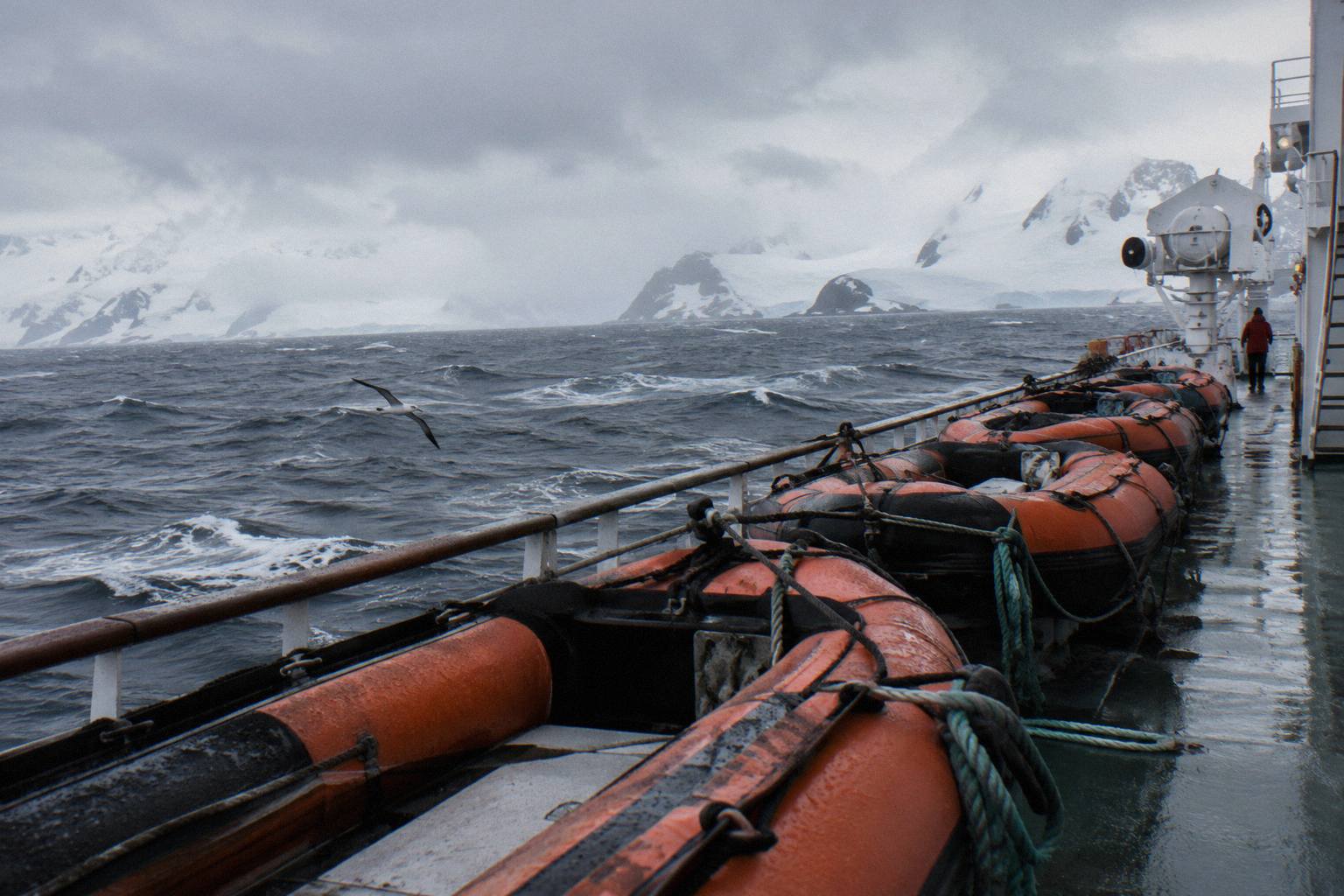
The concentration of traffic explains why these categories carry so much weight. The Antarctic Treaty Secretariat's tourism material notes that approximately 98 percent of tourism voyages concentrate on the Antarctic Peninsula during the seven-month austral summer, which means many ships are working a relatively short coastline each season. Size rules are how that pressure stays managed: one vessel per site at a time, capped groups ashore, and a floor on guide numbers. Here is the category structure in one view:
| IAATO category | Passengers carried | Landings permitted | What it means on the ground |
|---|---|---|---|
| YA (yacht) | Up to 12 | Yes | Everyone goes ashore together at most sites |
| C1 | 13 to 200 | Yes | One or two rotations per landing, depending on numbers |
| C2 | 201 to 500 | Yes, with restrictions | Multiple rotations, shorter turns per guest |
| CR (cruise only) | More than 500 | No | Scenic cruising in Antarctic waters, no shore time |
The practical takeaway is that the interesting dividing lines sit at 100 and 200 passengers rather than at the top of the scale. A ship at or under 100 can put its whole complement ashore at once, weather permitting. A ship over 100 but still inside C1 splits into two groups. Above 200, a site visit starts to feel scheduled, and the largest expedition ships in the region, at 490 passengers, are working the same landing rules with nearly five times as many guests to cycle through the same beach.
If you are weighing a specific sailing against these thresholds, ask about ship size before booking; the consultation is free and the person on the other end can check the vessel's category against your priorities before any deposit is discussed.
How Does The 100-Passenger Landing Rule Change Your Day?
Because no more than 100 passengers from one vessel may be ashore at any one time, a ship carrying 490 guests must rotate roughly five groups through each site, so each traveller gets a fraction of the shore time the same visit gives on a 90-guest ship. Ships carrying 100 or fewer land everyone at once and spend the whole weather window on the ice instead of waiting for a turn.
The guideline is written plainly: a maximum of 100 passengers may be ashore from a vessel at any one time, unless site-specific guidance requires fewer. Add the rule that only one ship may visit a site at any one time, and you can see why expedition teams guard the schedule so carefully. On a 114-guest ship such as Sea Spirit, the split is a simple half-and-half: one group on land, one group Zodiac cruising along the ice edge, then a swap. On a 490-guest C2 ship the same landing becomes a chain of shorter rotations, and the staff-to-visitor floor of one guide per 20 visitors means the guides are spread across more groups too.
Time ashore is the thing most people are actually buying on an expedition cruise, so it is worth turning the arithmetic into a planning table. Read your candidate ship's passenger figure against the first column and the rest follows:
| Ship carries | Rotations needed per landing | Rough experience at the gangway |
|---|---|---|
| Up to 100 | One | Everyone lands together, full window on site |
| Over 100, up to 200 (C1) | Two | Two waves, typically land time plus a Zodiac cruise |
| 201 to 500 (C2) | Several | Shorter turns, more waiting between rotations |
| More than 500 (CR) | Landings not permitted | Scenic cruising only, no shore time at any site |
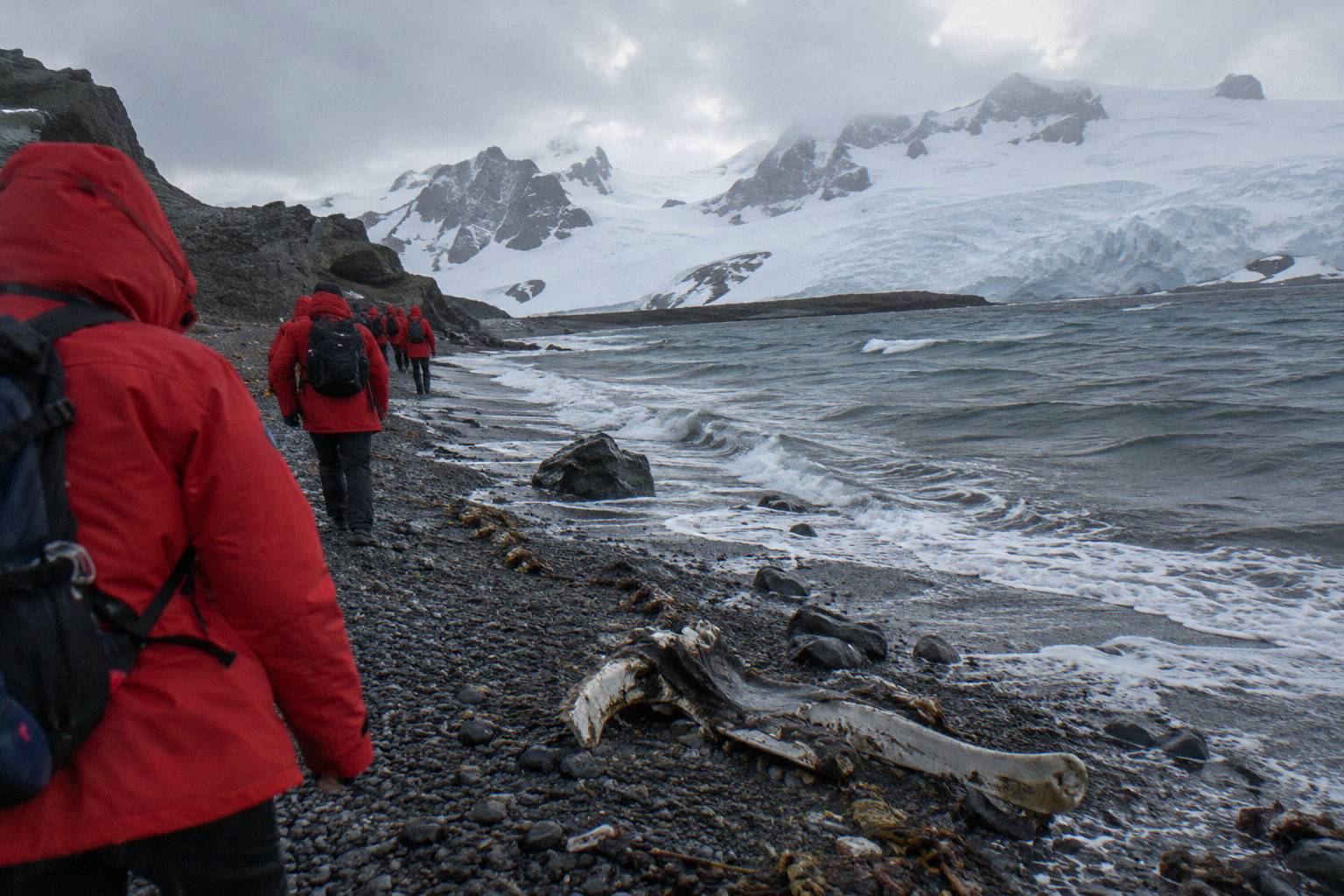
The rotation system also explains parts of the daily rhythm that surprise first-timers. Biosecurity rules require boots and equipment washed before the voyage and cleaned again between sites. Briefings, lectures and mealtimes are slotted around the landing windows, and on larger ships the expedition team runs the schedule tightly because five groups cannot each get a full afternoon. None of this makes bigger ships a bad choice; it makes them a different product, closer to a comfortable viewing platform with structured shore visits than to a small-group expedition.
Which Antarctica Ships Are The Smallest And The Largest?
Among the expedition ships in our roster the smallest carry 80 to 114 passengers, led by Ocean Nova at 80 and the Magellan ships at 88 on air-cruises, while the largest carry 490: HX's Fridtjof Nansen and Roald Amundsen, with Viking's Octantis and Polaris at 378 close behind. Every ship listed here may land guests; the roster contains no vessel above the 500-passenger line where landings stop.
The table below is built only from stated passenger capacities on the operators' own ship pages, as recorded in our roster. Where a ship has two figures, such as the Magellan vessels' air-cruise and sea-voyage counts, both are shown. Read it as a map of the market rather than a ranking: every ship here can land you, and the differences between them are differences of degree, not of kind.
| Ship | Operator | Passengers | Where it sits on the scale |
|---|---|---|---|
| Ocean Nova | Albatros Expeditions / Antarctica21 | 80 | Smallest in the roster |
| Magellan Explorer | Antarctica21 | 88 on air-cruises, 96 on sea voyages | Smallest tier, fly-cruise |
| Magellan Discoverer | Antarctica21 | 88 | Newest fly-cruise ship, first season 2026-27 |
| Ushuaia | Antarpply Expeditions | 90 | Small budget ship |
| Ortelius | Oceanwide Expeditions | 108 | Small budget ship |
| Plancius | Oceanwide Expeditions | 108 | Small budget ship |
| Sea Spirit | Poseidon Expeditions | 114 | Small-ship tier |
| MS Fram | HX | 200 | Sits right at the C1 ceiling |
| Viking Octantis | Viking | 378 | Large expedition, C2 |
| Viking Polaris | Viking | 378 | Large expedition, C2 |
| MS Fridtjof Nansen | HX | 490 | Largest in the roster |
| MS Roald Amundsen | HX | 490 | Largest in the roster |
Sea Spirit makes a useful case study in why the middle of the small-ship tier earns its keep. At 114 passengers it sits comfortably under the C1 ceiling and lands in two quick rotations, with voyages of 12 to 23 days from Ushuaia covering the classic Peninsula route plus longer Falklands and South Georgia combinations. Poseidon's listed fare for the 12-day Classic Antarctica voyage starts from $8,846 per person with seasonal savings applied, which places it near the value end of the expedition market. Its features include an ice-strengthened hull, a Zodiac fleet, sea kayaking and camping, so the activity list reads like a ship twice its price. If that combination fits what you came for, this is exactly the kind of ship where size and price point in the same direction.
For a fuller picture beyond raw passenger counts, our guide to the ships sailing to Antarctica covers the fleet operator by operator, and our comparison of expedition and traditional cruise styles explains why the over-500 ships never land anyone.
How Does Ship Size Affect Motion And The Drake Crossing?
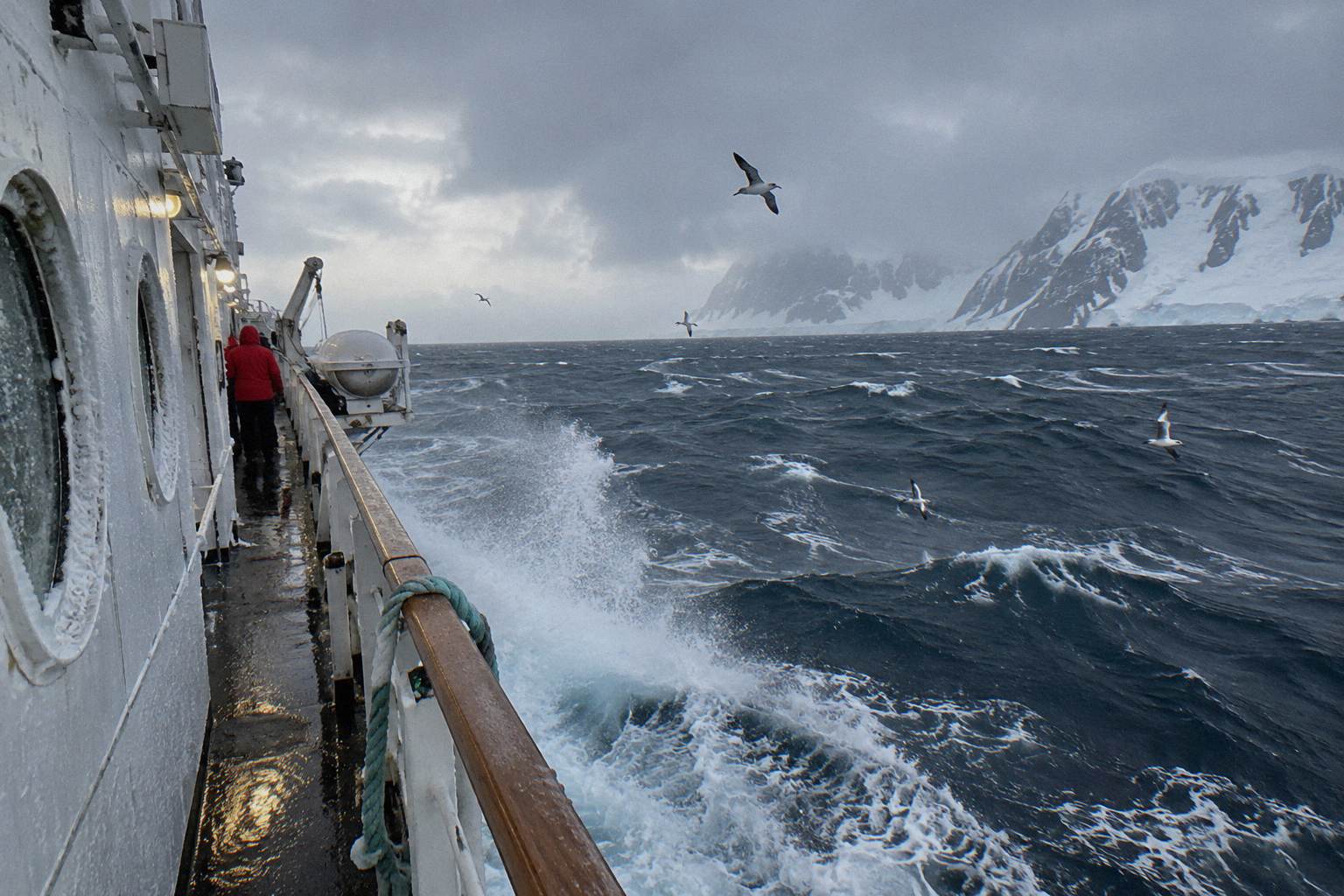
The published fleet guidance is blunt about the trade: smaller ships generally offer more time ashore per passenger but potentially more motion in rough seas, while larger stabilised ships such as Viking's 378-guest vessels provide more stability in the same conditions. The Drake Passage takes about two days each way on any hull, so the comfort difference is felt across roughly four days of a classic Peninsula voyage.
That framing comes from IAATO landing-impact material and fleet analyses rather than any single operator's sales copy, and it matches the physics. A 90-metre hull such as Sea Spirit's behaves differently in open water than a 202.7-metre hull such as Viking Octantis, and no amount of enthusiasm changes that. Larger stabilised ships spend their size on comfort and stability. Smaller ships spend theirs on access and a lower head-count at each landing.
The honest way to read the trade, with the same category bands used above:
| Size tier | Strength | What you give up |
|---|---|---|
| Up to 100 passengers | Everyone ashore at once, intimate Zodiac groups | Most motion in open water, simpler cabins |
| Over 100 to 200 passengers | Full landing rotations, good guide ratios | Moderate motion, still modest amenities |
| 201 to 500 passengers | Stability, amenities, cabin choice | Rotated, shorter landings, more guests per guide |
| More than 500 | Resort-scale comfort | No landings at all, scenic cruising only |
If you already know the Drake is the part of the trip you are least looking forward to, read our guide to the Drake Passage crossing before choosing a size tier; the two decisions genuinely depend on each other. After two years of comparing ship options for this site, I would give the sea-state question as much weight in your choice as the landing mathematics.
Does A Bigger Ship Buy A Better Antarctica Cruise?
Bigger hulls buy comfort, not access: the published 2026-27 fare bands run from about $6,900 to $10,750 per person for budget expedition ships, roughly $12,000 to $19,000 for upscale lines and $11,600 to $21,473 for luxury vessels, and higher tiers add open bar, gratuities, parkas, hotels and sometimes flights. None of that extra spend changes the 100-passenger landing limit by a single person.
The fare bands are worth seeing side by side, because they show that you are not simply paying more for more Antarctica. You are paying more for a softer version of the same regulated experience:
| Tier | Typical ships named in the published bands | Fare band, per person | What the money buys |
|---|---|---|---|
| Budget expedition | Oceanwide's Plancius, Ortelius, Hondius | About $6,900 to $10,750 | Full landings, shared cabins common, simple ships |
| Upscale expedition | Quark, Aurora, Lindblad | Roughly $12,000 to $19,000 | Balconies, better ratios, activity gear |
| Luxury | Silversea, Seabourn, Scenic, Ponant | About $11,600 to $21,473 | All-suite ships, drinks and gratuities often included |
| Traditional scenic | Celebrity, Princess, Holland America | From about $3,227 to $5,269 | Resort ship, scenic cruising only, no landings |
The inclusions stack explains most of the price spread. Higher tiers often add an open bar, prepaid gratuities, a parka, pre- and post-cruise hotel nights and sometimes charter flights, along with larger cabins and balconies. Select luxury ships add helicopters or submersibles on certain voyages. What no tier can add is shore time beyond the regulated rotation, and no fare band moves the 100-passenger line. A traveller who wants maximum minutes beside a penguin colony can be better served by a plain 108-guest ship than by a suite on a vessel carrying four times as many people. Our deeper treatment of that question, whether a nicer ship is worth it in Antarctica, works through the same trade with worked fare examples.
How Do You Check A Ship's Size Before You Book?
Check three numbers in order: the stated guest capacity on the operator's ship page, the IAATO category that capacity falls into, and whether the voyage sells shared cabins that change the ship's feel. The IAATO vessel directory publishes the categories, and operator ship pages carry the passenger figures; if a listing hides the number, treat that silence as a reason to ask before you book the cruise.
Start with the operator's own ship page rather than a summary elsewhere, because capacities get restated loosely in third-party listings and the landing rules only care about the real number. Every ship profile on Cruises In Antarctica lists the passenger figure exactly as the operator states it, together with the voyage lengths, gateway ports and the features the operator itself confirms. Then place that figure in its band using the IAATO vessel directory, which is the reference the categories come from.
Two cautions from the same research. First, a ship's maximum capacity and its expedition cap can differ: Aurora's Greg Mortimer, for example, is listed at a maximum of 148 with 130 on expedition, and the smaller of those two numbers is the one that affects your landing day. Second, shared-cabin arrangements on budget ships change the social feel of a vessel without changing its passenger count, so two 108-guest ships can still deliver noticeably different voyages. When the numbers leave you torn, a short free conversation about your priorities will sort the tie in one exchange.
Which Ship Size Should You Choose For An Antarctica Cruise?
Pick a ship carrying 100 or fewer if maximum time on the ice is the whole point, the band above that up to 200 for full landing rotations with more ship around you, and the 201-to-500 tier when comfort, stability and cabin choice outweigh longer shore excursions. Above 500 passengers the decision is made for you: those vessels are scenic-cruise ships and cannot land anyone.
To make that concrete, here are three roster ships sitting in three different tiers of the same market, compared side by side:
| Ship | Class | Passengers | Ice class | From, per person | Voyage length | Departs from |
|---|---|---|---|---|---|---|
| Sea SpiritPoseidon Expeditions | Small-Ship Budget | 114 | ice-strengthened hull | from $8,846 | 12 to 23 days | Ushuaia |
| UltramarineQuark Expeditions | Upscale Expedition | 199 | 1A+, PC6 | from $12,236 | 12 to 14 days | Buenos Aires, Ushuaia |
| Viking OctantisViking | Upscale Expedition | 378 | Polar Class 6 | – | – | – |
Read the trio as three philosophies rather than a podium. Sea Spirit, at 114 passengers, is the value-leaning small ship: two rotations per landing, kayaking and camping on the activity list, and fares from $8,846. Ultramarine, at 199 passengers, is the expedition-technology ship: right at the C1 ceiling, with two twin-engine helicopters on two helidecks and twenty Zodiacs stowed in an internal hangar, and voyage-level Quark fares from $12,236 that are shared across several ships in the fleet rather than exclusive to this one. Viking Octantis, at 378 passengers, is the comfort-first C2 ship: a Polar Class 6 hull of 202.7 metres built in 2022, guests rotating through landings in larger and shorter waves, and one 2026 cost guide reporting Viking's 13-day Antarctic Explorer from $14,999. None of them is a wrong answer; they are different answers to the same question about what a day in Antarctica should contain.
The decision usually collapses to two honest questions. First, how important is standing on land, and for how long, relative to the comfort of the ship between landings? Second, how much does the Drake crossing worry you, given that larger hulls smooth it and smaller hulls do not? Once you can answer both, the size tier picks itself and the ship choice narrows to a handful of candidates you can compare on fare, dates and cabin.
When you reach that point, get a free consultation on your shortlist. The hand-off goes to a vetted expedition-cruise agency partner, the conversation costs nothing, and it carries no obligation.
Common Questions About Antarctica Cruise Ship Sizes
What Are The Antarctica Cruise Ship Size Categories?
IAATO sorts vessels into yachts carrying up to 12 guests, C1 ships carrying 13 to 200 passengers, C2 ships carrying 201 to 500, and CR ships carrying more than 500, which are not permitted to make landings.
How Does The 100-Passenger Landing Rule Change Your Day?
No more than 100 passengers from one vessel may be ashore at any one time. Ships carrying 100 or fewer land everyone together, while larger ships rotate several groups through the same window, so each guest's time on site shrinks as the passenger count rises.
Which Antarctica Ships Are The Smallest And The Largest?
Ocean Nova, at 80 passengers, is the smallest in our roster, with the Magellan fly-cruise ships at 88 and Ushuaia at 90 close behind. The largest are MS Fridtjof Nansen and MS Roald Amundsen at 490 each, followed by Viking Octantis and Viking Polaris at 378.
Are Smaller Antarctica Cruise Ships Rougher At Sea?
The published guidance says smaller ships can expect potentially more motion in rough seas, while larger stabilised ships such as the 378-guest Viking expedition vessels provide more stability. Every ship still needs about two days each way to cross the Drake Passage.
Does A Bigger Ship Buy A Better Antarctica Cruise?
It buys comfort: balconies, inclusions and stability, with published fare bands running from about $6,900 on budget expedition ships to $21,473 at the luxury end. It does not buy extra shore time, because the 100-passenger landing limit applies to every ship equally.
What Is The Largest Ship That Still Lands Passengers?
In our roster the largest landing-capable ships are MS Fridtjof Nansen and MS Roald Amundsen, each carrying 490 passengers within the C2 category. Viking Octantis and Viking Polaris, at 378, are the next largest, and no roster ship crosses the 500-passenger line where landings stop.
More Choosing A Ship
 Choosing Your ShipFive decisions that narrow 43 expedition ships down to the one you should book.Read the guide
 Cruise Ships ComparedShip size decides whether you land: compare every major Antarctica vessel by passengers, ice class and fare.Read the guide
 Cruise Lines ComparedAll fourteen Antarctica cruise lines mapped, with fleets, fares and landing rules.Read the guide
 Luxury CruisesWhat a premium Antarctica fare really buys: suites, included extras and the ships at the top tier.Read the guide