Camping Overnight In Antarctica: What It Costs And What Happens
 By Oleg G.
A handful of expedition operators let passengers sleep ashore in Antarctica. Here is what the night involves, what it costs on each line, and how often weather cancels it.
Quick answer: Overnight camping in Antarctica is an add-on offered by Oceanwide Expeditions (free on Basecamp voyages), Quark Expeditions, Aurora Expeditions and G Adventures, typically around $399 to $495 per person elsewhere. Usually one night ashore under guide supervision, and no guarantee the weather allows it.
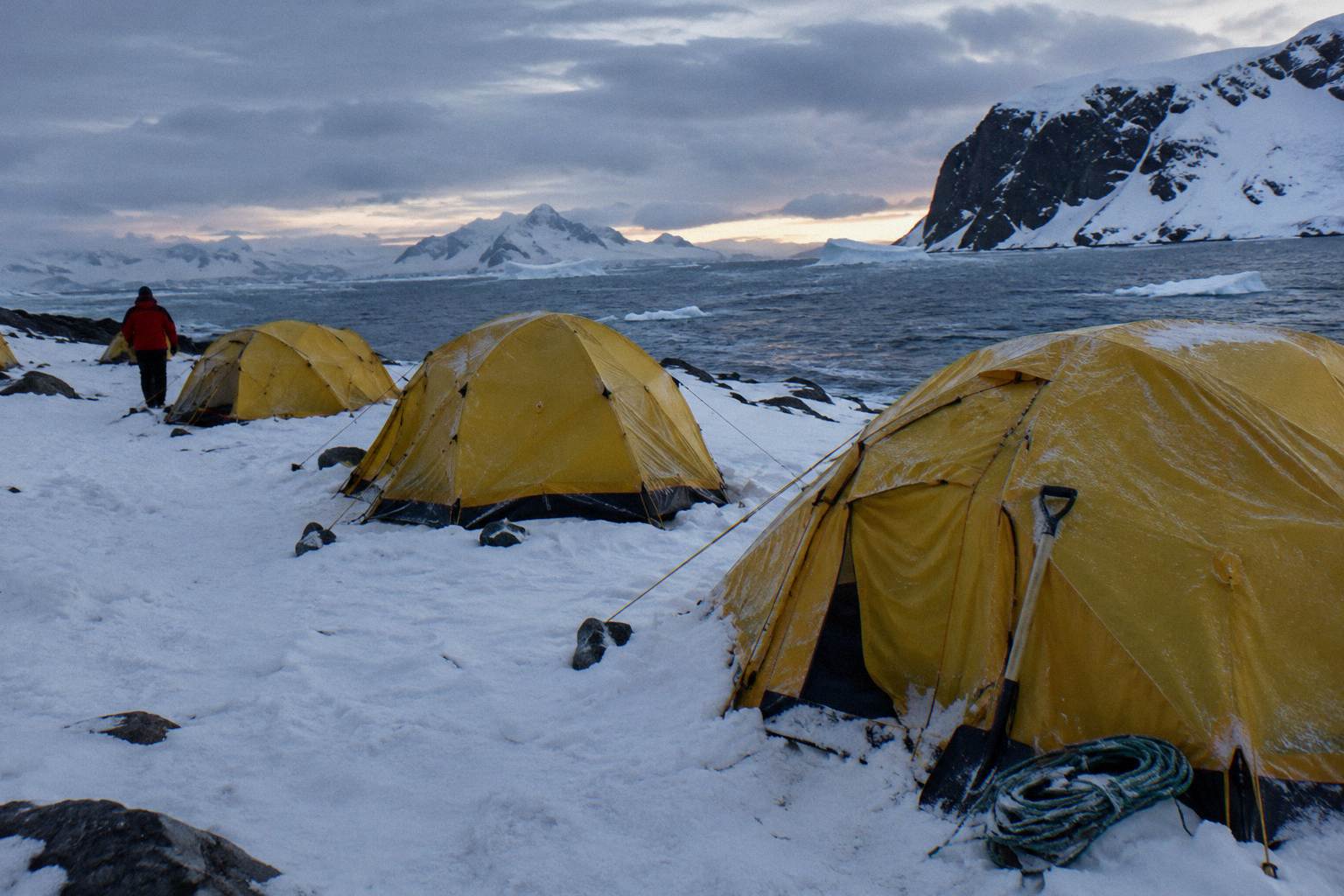
Most people who go to Antarctica see it from a ship and a Zodiac. A much smaller number spend a night ashore. Camping in Antarctica is a real, regulated activity run by a handful of expedition operators, usually for one night of a Peninsula voyage, and it is one of the few ways a cruise passenger sleeps on land in Antarctica. The expedition cruise itself is the product here: the camping option is sold as an add-on on top of the fare, or bundled free on specific voyages, and not every ship or departure offers it at all.
What Camping In Antarctica Actually Involves
Camping in Antarctica usually means one supervised night ashore, with nothing left behind. Operators run it under Antarctic Treaty and IAATO rules, offer it on select departures only, and treat it as subject to weather, site approval and environmental rules rather than a guaranteed part of the itinerary.
The format is deliberately minimal. IAATO guidelines require that activities have no more than a minor or transitory environmental impact, and nothing may be left behind on the site when the group leaves. Sleeping arrangements vary by operator, so ask what yours uses. IAATO's general visitor guidance, which governs every landing, also caps passengers ashore and requires a minimum ratio of one actively guiding staff member to twenty visitors, and those rules apply to a camping group like any other landing.
The night itself is short on sleep and long on atmosphere. Around Port Lockroy, December brings close to 22 hours of daylight, so the night is brief and bright. Operator schedules vary, so ask yours how the evening runs and how toilets and waste are handled ashore. The no-trace rule explains most of the format: camping in Antarctica is closer to a supervised bivouac than a camping holiday.
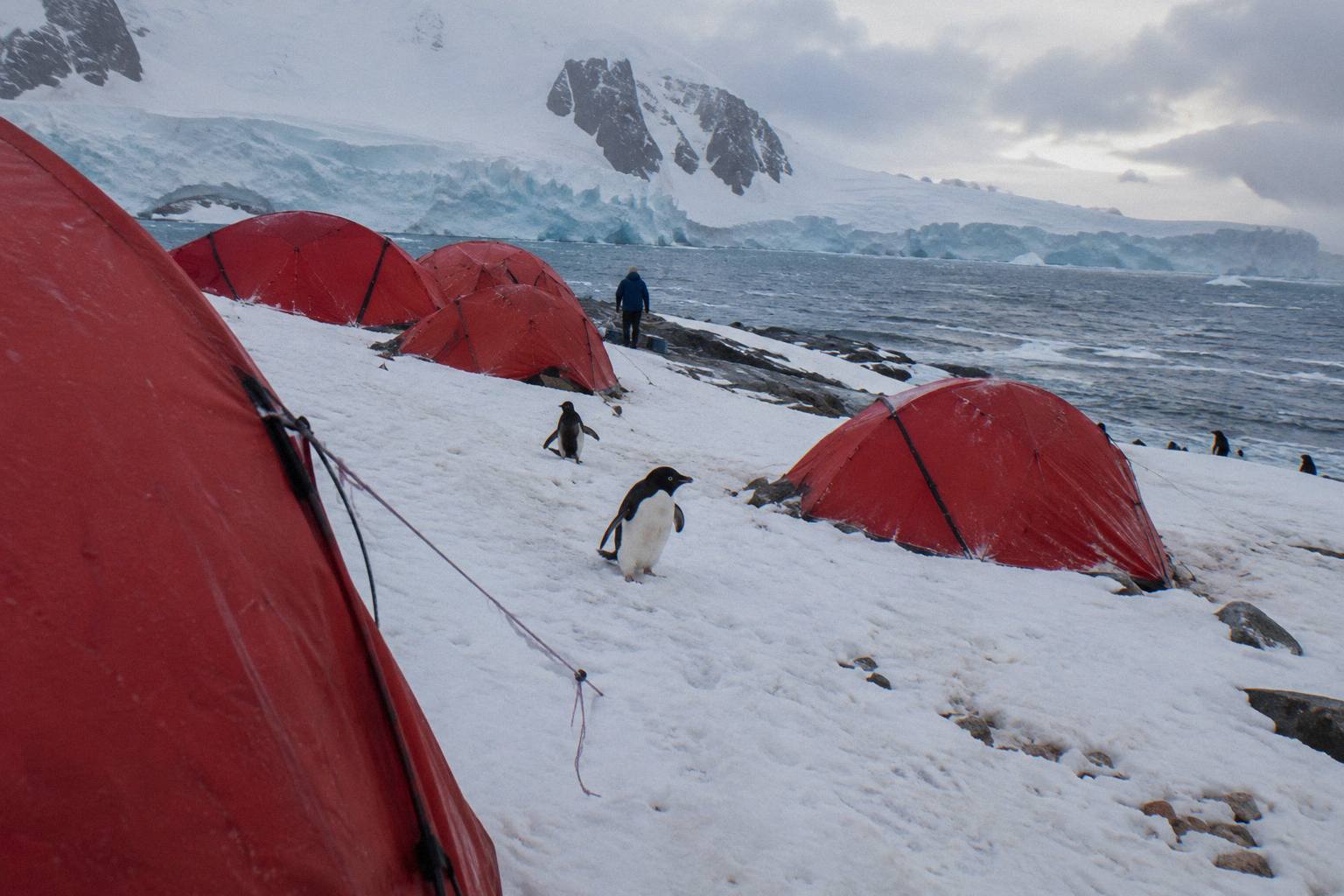
Biosecurity applies to the camping gear exactly as it does to boots. The visitor guidelines call for all equipment, tents and bags included, to be cleaned before it is brought to Antarctica and again between sites.
Which Operators Offer Overnight Camping
Four operator families run overnight camping on Antarctic Peninsula voyages: Oceanwide Expeditions (free on its Basecamp itineraries), Quark Expeditions, Aurora Expeditions and G Adventures. Poseidon Expeditions also lists camping among its activities. Not every departure on those lines includes it, so the voyage choice matters as much as the operator choice.
Oceanwide Expeditions is the clearest case. Its Basecamp voyages, sailed on ships including Hondius and Plancius, bundle camping, kayaking, snowshoeing, mountaineering and a photo workshop into the fare at no extra charge, as the operator's Basecamp voyage page spells out, which is why those departures are popular with activity-focused travellers. Quark Expeditions sells camping as a paid add-on on eligible voyages aboard ships such as Ultramarine, alongside kayaking and paddling options. Aurora Expeditions lists camping among its activity options on ships including Sylvia Earle, alongside kayaking and snowshoeing. G Adventures offers camping as a paid option on its Antarctica departures.
Choosing a voyage because of camping is a genuine decision point, and it is one where the departure list changes every season. If a night ashore is a priority rather than a nice-to-have, it is worth a free consultation to confirm which 2026-27 departures actually have camping on the manifest before anything is booked.
What Camping In Antarctica Costs
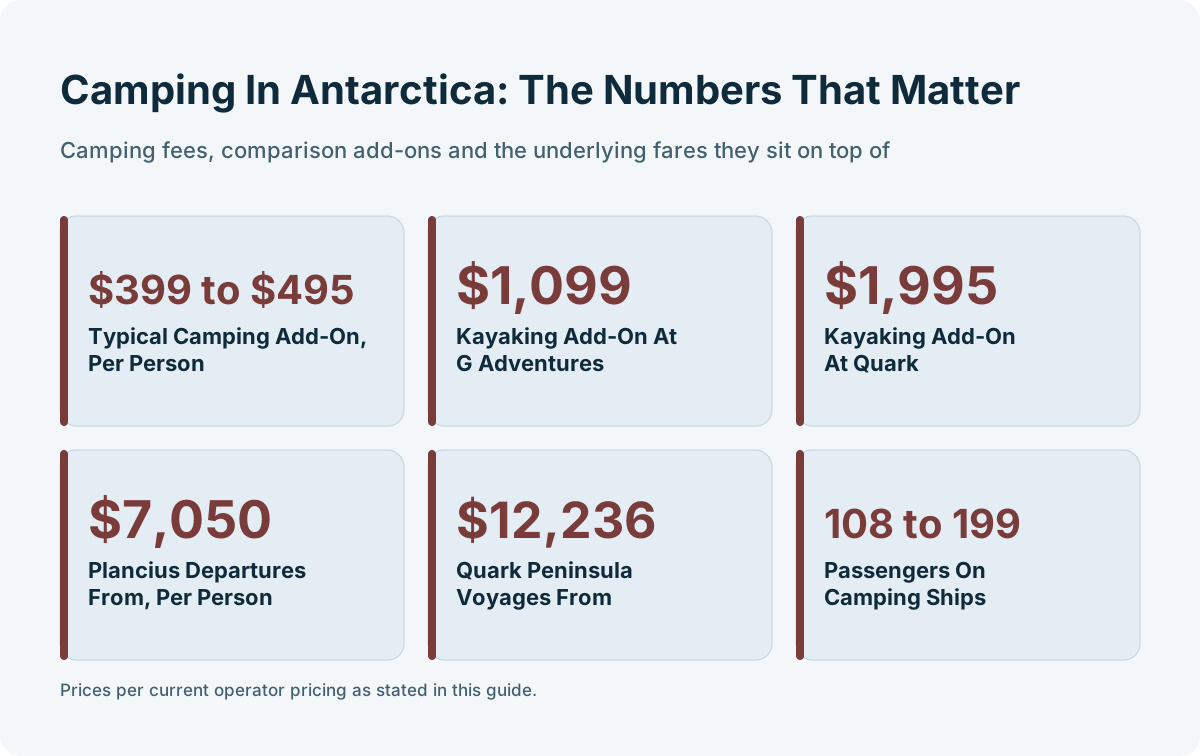
On Oceanwide Basecamp voyages camping is included in the fare. As a paid add-on elsewhere it typically runs about $399 to $495 per person for the night, per current operator pricing: G Adventures charges about $399, and Quark's activity pricing sits in the same few-hundred-dollar band. Kayaking, by comparison, runs about $1,099 at G Adventures and about $1,995 at Quark.
Because the add-on is small relative to a fare that starts around $7,000 even on budget ships, the practical constraint is not the fee but capacity. Spaces are limited per departure, and Quark's dates and rates pages advise reserving limited-capacity activities at the time of booking or shortly after, because they fill early. Our guide to activities to reserve in advance covers the same logic across every operator.
| Operator | How camping is sold | Typical price | Notes |
|---|---|---|---|
| Oceanwide Expeditions | Included on Basecamp voyages | Included in fare | Camping, kayaking, snowshoeing, mountaineering and photo workshop bundled |
| Quark Expeditions | Paid add-on on eligible voyages | Add-on pricing, reserve at booking | Limited capacity; kayaking about $1,995 by comparison |
| G Adventures | Paid add-on on Classic departures | About $399 per person | Kayaking about $1,099 on the same voyages |
| Aurora Expeditions | Activity option on activity-focused voyages | Not stated | Listed among Sylvia Earle's activity program |
| Poseidon Expeditions | Listed among ship activities | Not stated | Sea Spirit also runs kayaking and camping |
For context on the underlying fares: Oceanwide's Plancius lists Antarctic Peninsula departures from $7,050 per person, Hondius from $7,800, and Quark's Peninsula voyages, whose fares are voyage-level and shared across Ultramarine, Ocean Explorer and World Voyager, from $12,236. Those are the fares the camping fee sits on top of. Our Antarctica cruise cost guide breaks the full budget down, and Antarctica cruise prices by cabin shows how much the berth itself swings the total.
How The Night Works, Hour By Hour
Operators publish little detail on the night's schedule, and it varies by program. What is consistent is a briefing, a Zodiac shuttle ashore, a supervised night under the general visitor rules, and a return to the ship with nothing left behind.
Expect the expedition team to cover site rules and safety before you go. Camping spaces are limited per departure, and IAATO rules and site guidelines constrain how many people can be ashore at once.
| Stage of the night | What happens | What to expect |
|---|---|---|
| Briefing | Site rules and safety | Not stated |
| Gear issue | Camping kit for the night | Gear cleaned under biosecurity guidance |
| Landing | Zodiac shuttle to the site | Wet landings are common, so waterproof boots and trousers |
| Camp set-up | Not stated | Not stated |
| The night itself | Supervised night ashore | 1:20 guide ratio applies ashore |
| Wake-up call | Not stated | Not stated |
| Strike and inspect | Camp comes down | Nothing left behind |
| Return to ship | Zodiac shuttle back | Not stated |
The group shuttles to shore by Zodiac, and wet landings are common, so waterproof boots and trousers matter. What follows is the part people come for: a night ashore away from the ship, with long daylight in December and January.
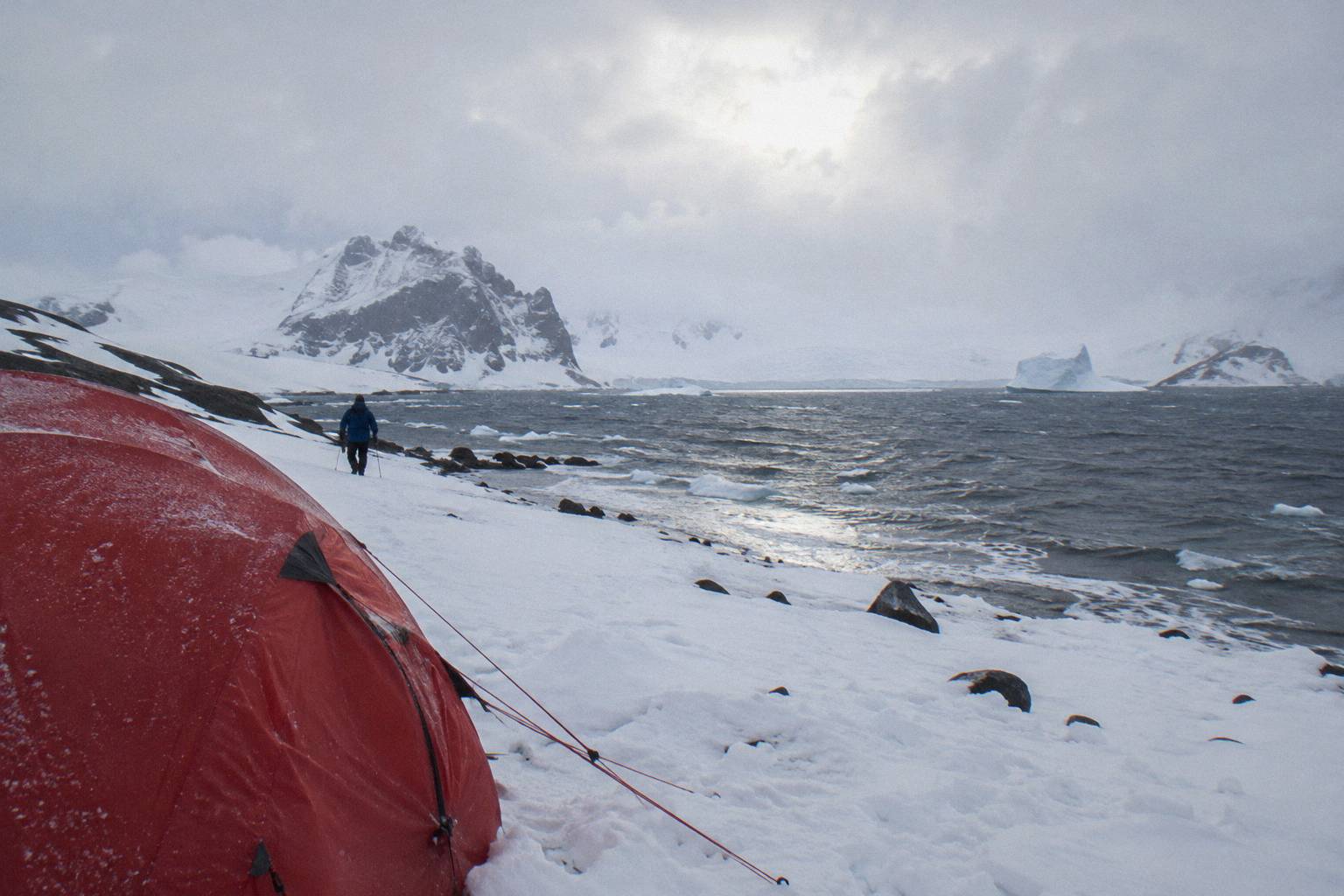
In the morning the camp comes down, nothing is left behind, and the group returns to the ship for the rest of the expedition program.
What The Operator Provides And What You Bring
Operators supply the camping kit and the guides; ask yours for its exact list. You wear the layered clothing, parka and waterproof boots you already use for landings, and everything that goes ashore must be cleaned under biosecurity rules.
The gear list is short because the ship already outfitted everyone for Antarctica. Gear is cleaned between sites under IAATO biosecurity guidance, and pockets and bags are vacuumed for seeds, the same procedure applied to every landing. The rest of the planning pages sit on Cruises In Antarctica.
| Provided by the operator | You bring yourself | Left on the ship |
|---|---|---|
| Camping kit for the night | Base layers and mid-layers | Anything not cleaned for biosecurity |
| Parka on some voyages | Parka and waterproof trousers if not supplied | Not stated |
| Boot loan on some voyages | Waterproof boots if not loaned | Not stated |
| Not stated | Hat, gloves, spare socks | Not stated |
| Guides ashore, 1:20 ratio | Small bag with water bottle | Not stated |
| Biosecurity cleaning guidance | Medications your doctor advises |
One practical note on warmth: a dry base layer for the night is sensible rather than the day's damp one. Peninsula summer air temperatures typically range from about -5°C to +5°C, and wind chill can push the effective cold lower, which is why the guides, not the guests, choose the site.
Weather Cancellations And When Camping Is Called Off
No operator guarantees camping. Wind, swell at the landing beach, katabatic gusts and shifting ice can all cancel the night. Operators frame every activity as weather and ice permitting, so ask yours what happens to the add-on fee if the night does not run.
The decision process is the same one that governs all Antarctic landings. Expedition leaders hold Plan A, B and C options for every day, monitor forecasts every four to six hours with the captain, and switch landing sites or cancel activities based on wind speed, swell at the gangway, beach waves and site protection. Katabatic winds, sudden downslope gusts that can develop without warning, are a specific risk for shore-based overnight programs because a camp cannot be moved as quickly as a Zodiac outing can. That is why a doubtful forecast can call off the night before anyone goes ashore.
Passengers have almost no control over this, which is why the honest framing matters: book the voyage for the voyage, and treat camping as a possible highlight rather than the point of the trip. Our severe weather on an Antarctica cruise guide covers the broader cancellation picture, including when whole sailings are cut short. If a night ashore is the single thing that would make the trip for you, say so early: ask about camping-friendly departures so the plan accounts for the cancellation risk from the start.
Who Camping In Antarctica Suits
Camping suits travellers who want the stillness more than the comfort: it is a short, cold night ashore, best for people who already enjoy wild camping and who accept that weather may cancel it. It does not suit travellers who struggle with cold, need a full night's sleep, or want hotel comforts.
The honest self-test is simple. If you have camped in cold weather before and liked it, this is that experience in an extraordinary setting. If you have never camped and are doing it purely to tick the continent-sleep box, expect a long night: the ground is hard, the bag is warm but the face is cold, and the light never fully fades in high summer. Operators expect the same physical abilities as for any landing, including managing uneven, snowy ground and Zodiac boarding, and any health question belongs with your doctor.
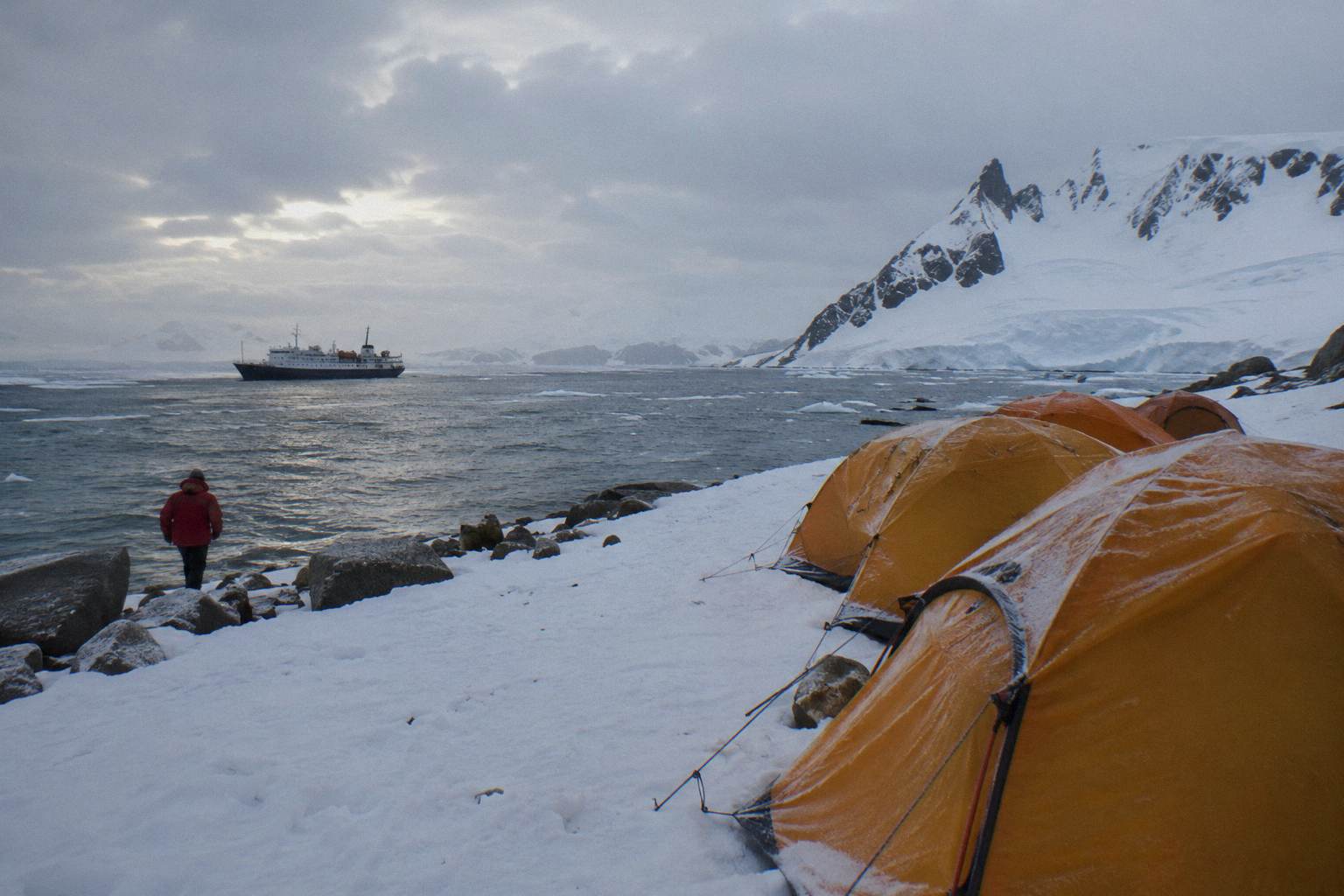
It is also worth knowing what camping is not. It is not a survival experience; it is a guided activity with the ship nearby. It is not a photography expedition either, since every tripod and bag has to pass biosecurity cleaning. And it is not private: you share the site with the rest of the camping group. What it offers is a night ashore that no day landing can replicate, and limited-capacity activities like this one are typically reserved at booking because spaces fill early.
The Ships That Run Camping Voyages
The camping option concentrates on a small set of ships: Oceanwide's Plancius and Hondius on Basecamp sailings, Quark's Ultramarine on eligible departures, Aurora's Sylvia Earle, and G Adventures' Expedition. Passenger counts range from 108 to 199, and every one of these ships is small enough to land passengers under IAATO limits.
Plancius is the classic Basecamp platform. A converted Dutch Navy oceanographic vessel, rebuilt as a passenger ship in 2009, she carries 108 passengers in 50 cabins and lists Peninsula departures from $7,050 per person. Her 10 Mark V Zodiacs and two gangways keep the off-ship program moving, and the Basecamp format, with camping, kayaking, snowshoeing, mountaineering and a photo workshop included, is built around exactly the kind of traveller who wants a night ashore. Her ice class notation is 1D at a draught of five metres, modest by modern standards, and her fares sit at the accessible end of the market.
Hondius, Oceanwide's 2019 newbuild, carries 170 passengers in 80 cabins, holds Polar Class 6, which the operator describes as equivalent to 1A-Super, and lists Peninsula departures from $7,800. She runs the same Basecamp program on her activity departures, with a sheltered indoor Zodiac boarding platform. Ultramarine is a different proposition: 199 passengers, two twin-engine helicopters on two helidecks, an internal Zodiac hangar with 20 Zodiacs, and voyage-level fares from $12,236 shared with other Quark ships. Camping aboard is a paid add-on on eligible departures rather than a bundled feature.
| Ship | Class | Passengers | Ice class | From, per person | Voyage length | Departs from |
|---|---|---|---|---|---|---|
| PlanciusOceanwide Expeditions | Small-Ship Budget | 108 | 1D | from $7,050 | 10 to 33 days | Ushuaia |
| HondiusOceanwide Expeditions | Small-Ship Budget | 170 | Polar Class 6 | from $7,800 | 11 to 19 days | Ushuaia |
| UltramarineQuark Expeditions | Upscale Expedition | 199 | 1A+, PC6 | from $12,236 | 12 to 14 days | Buenos Aires, Ushuaia |
The choice between these ships is really a choice between two philosophies. Plancius and Hondius sell the activity program in the fare on Basecamp sailings, with simple cabins and lower prices; Ultramarine sells comfort and hardware, with helicopters and a wider cabin range, and prices the activities separately. Neither is the better ship in the abstract; it depends entirely on whether the night ashore is the centre of the trip or one option among many. If you are weighing that trade-off, a free chat about ship and activity options will settle it faster than a brochure will.
Common Questions About Camping In Antarctica
Can you camp in Antarctica on a cruise?
Yes, on select departures. Oceanwide Expeditions includes camping on its Basecamp voyages, and Quark Expeditions, Aurora Expeditions, G Adventures and Poseidon Expeditions offer it on eligible sailings, Quark and G Adventures as a paid add-on. It is one supervised night ashore, not an independent expedition.
How much does camping in Antarctica cost?
On Oceanwide Basecamp voyages it is included in the fare. As a paid add-on it typically runs about $399 to $495 per person for the night, per current operator pricing, on top of a voyage fare that starts around $7,050 on Plancius and $12,236 on Quark's Peninsula voyages.
Do you sleep in a tent in Antarctica?
It depends on the operator's program, so ask yours what it supplies. The night is supervised under the same visitor rules as any landing, and in December and January daylight lasts around 19 to 22 hours near Port Lockroy.
Is camping in Antarctica guaranteed once booked?
No. Camping is weather and ice permitting, like every Antarctic activity. Wind, swell at the landing beach, katabatic gusts or shifting ice can cancel the night. Ask your operator what happens to the add-on fee if the night does not run.
Is camping in Antarctica cold?
Yes, though usually manageable. Peninsula summer temperatures run roughly -5°C to +5°C, and wind chill on an exposed site can push the effective cold well below that. A dry base layer for the night helps.
Are there toilets when camping in Antarctica?
Do not expect fixed facilities ashore. Ask your operator how it handles this, since visitor rules require that nothing is left behind on the site.
More Activities And Wildlife
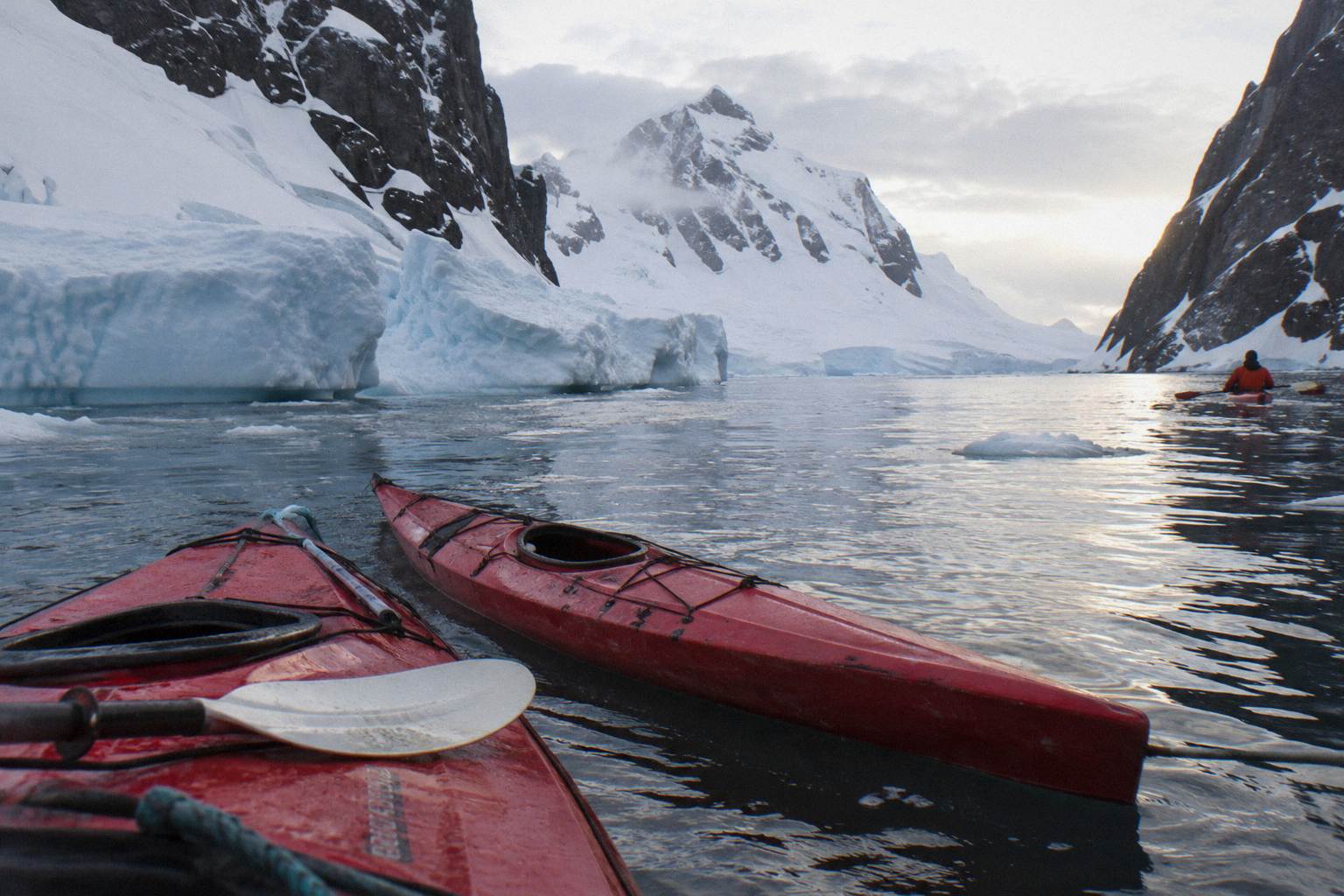 Antarctica KayakingOperators, prices and paddle skills for sea kayaking off an Antarctic expedition ship.Read the guide
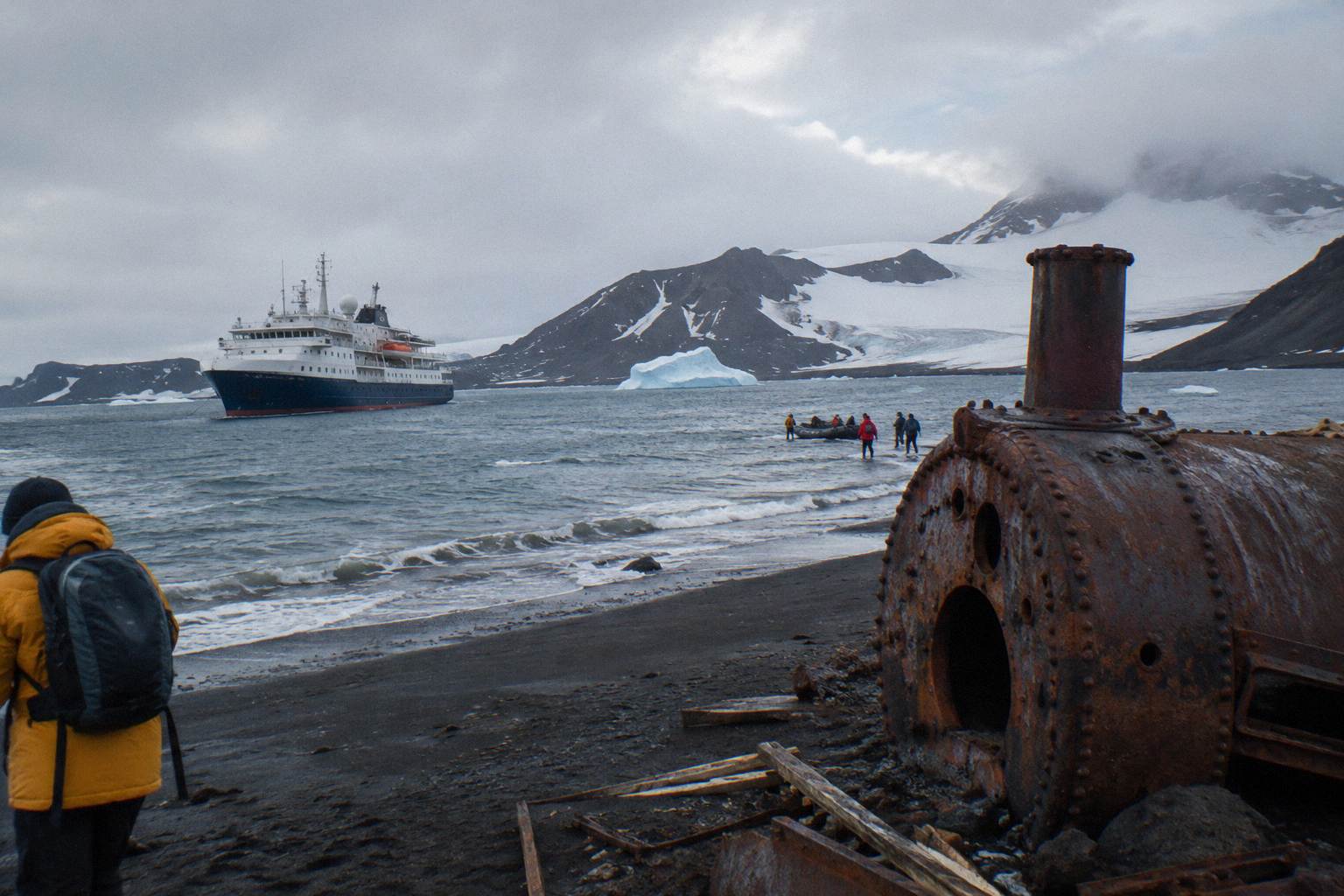 Polar PlungeWho offers the Antarctic polar plunge, what it costs and how it stays safe.Read the guide
 Hiking And SkiingActive Antarctica: hiking, snowshoeing, ski touring and mountaineering options compared.Read the guide
 Helicopters And SubmarinesWhich Antarctica ships carry helicopters or submarines, and what those flights and dives cost.Read the guide