The Antarctic Polar Plunge: How It Works And Who Offers It
 By Oleg G.
A polar plunge is the one activity on an Antarctica cruise where the ship does not take you to the wildlife, the wildlife is the water temperature. Here is who runs it, what it costs and how it stays safe.
Quick answer: The polar plunge is a supervised, one-time swim off the ship, typically included in the fare and offered by operators including Quark, Oceanwide, Aurora and Lindblad on most Peninsula voyages. Medical staff attend, a Zodiac or platform supports the jump, and no prior experience is required.
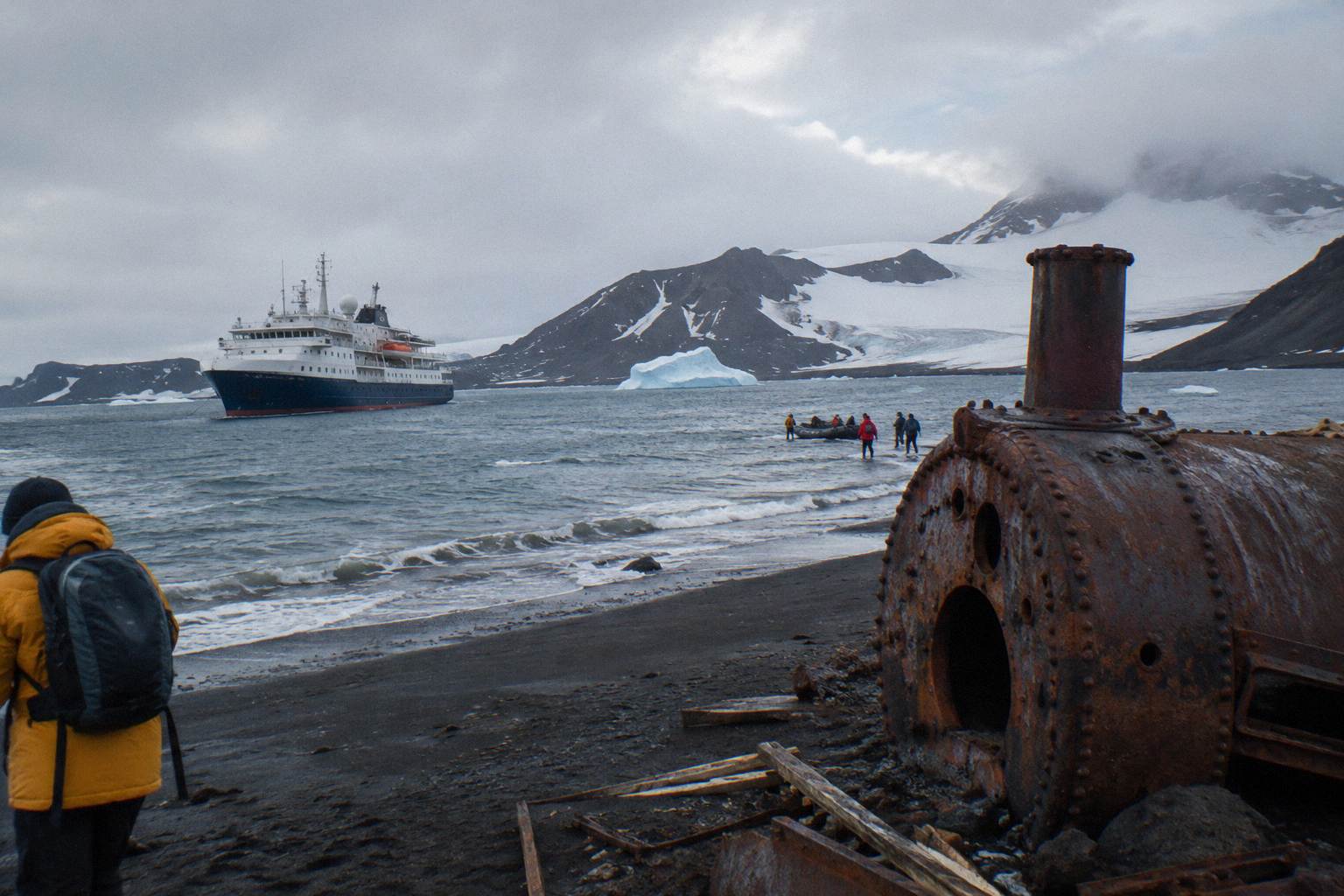
The polar plunge is the short, supervised swim that expedition ships offer in Antarctic water. Operators including Quark Expeditions, Oceanwide Expeditions, Aurora Expeditions and Lindblad run it on most Antarctic Peninsula voyages, usually once per sailing and usually at no extra charge. A doctor or medical staff member attends, and participants enter from a Zodiac or a ship platform under supervision. That is the short version. The details, which ships, which fares, what the safety rules actually say, are what this guide covers, drawing on operator pages and the IAATO visitor guidance.
What Is The Polar Plunge On An Antarctica Cruise?
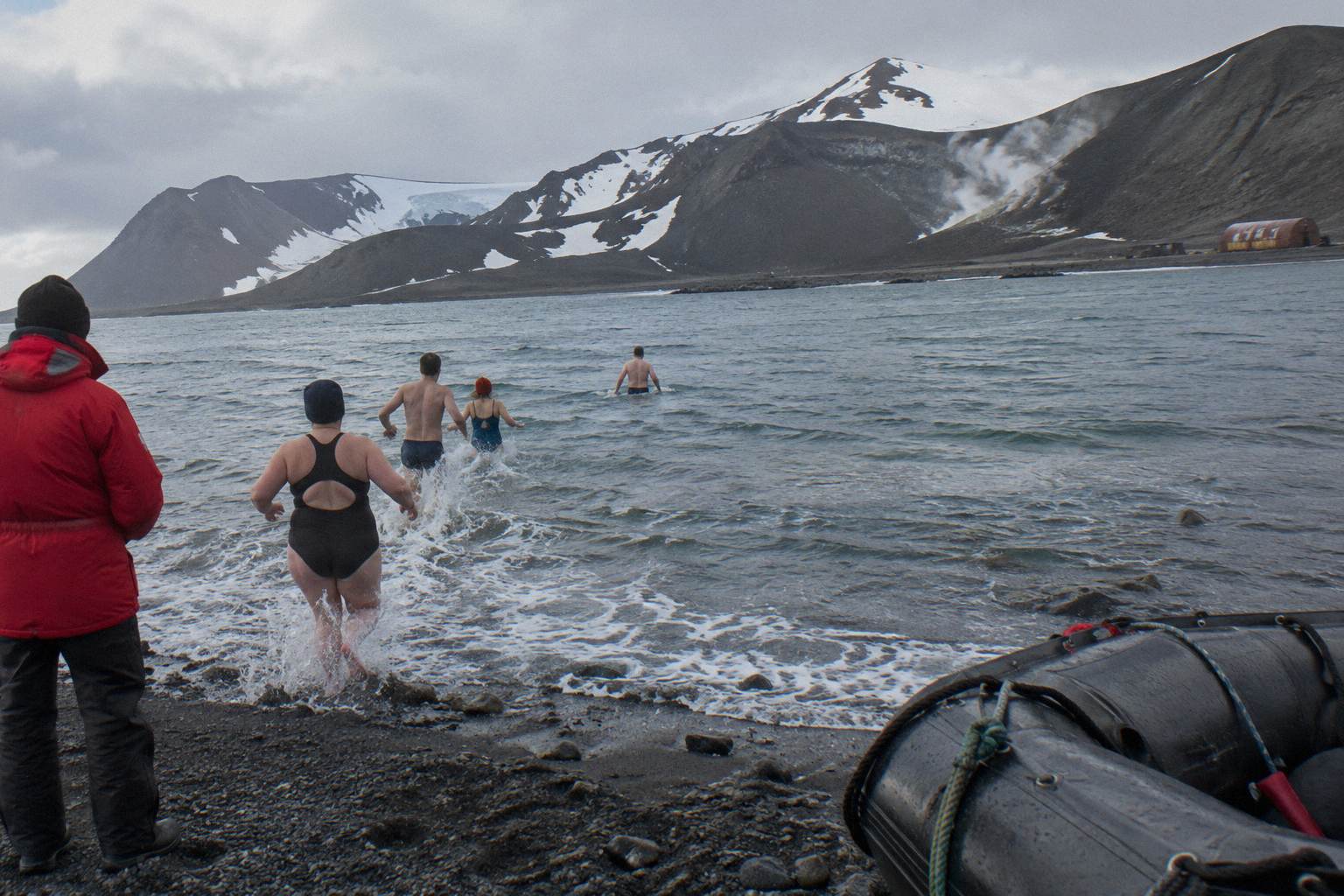
The polar plunge is a supervised jump or brief swim into Antarctic water, run once per voyage when conditions allow, with participants entering from a Zodiac or a ship platform while medical staff and the expedition team watch. It is typically included in the fare and is not sold as a paid add-on.
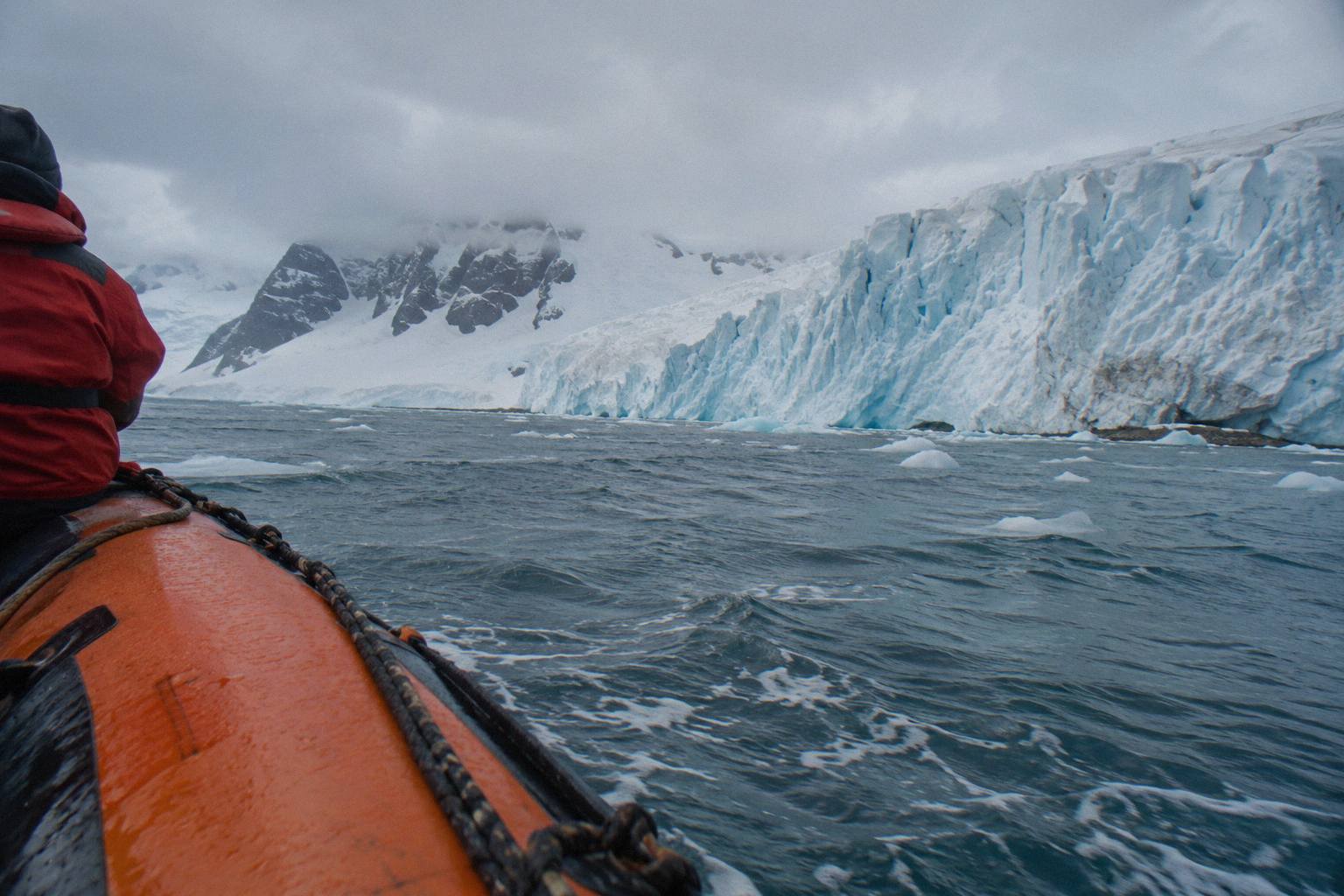
The mechanics are simple. The expedition team decides whether conditions allow it, participants enter from a Zodiac or a platform, and staff supervise throughout. Because it happens in a controlled setting with medical staff present, it is far removed from swimming in the open Southern Ocean.
If your underlying question is the broader one, whether tourists can swim in Antarctica at all, that is covered in detail in can you swim in Antarctica, which separates the organised plunge from anything unregulated. The two are very different things. The plunge is a scheduled, supervised event, and the wildlife-distance and site rules in the Antarctic Treaty visitor guidelines shape what is permitted everywhere.
One honest framing: this is a carnival of cold water, and not everyone who sails does it. Having spent two years reading operator pages and expedition accounts for this site, I found the plunge described as a voyage tradition rather than a requirement.
Which Operators Offer The Polar Plunge?
Operator pages and expedition descriptions name Quark Expeditions, Oceanwide Expeditions, Aurora Expeditions and Lindblad among the lines offering the polar plunge, and sources describing the activity say it appears on most Peninsula voyages. It is not universal: an operator's own page is the deciding source, and several lines do not state it at all. Typically included, typically once per voyage.
The clearest sourcing comes from expedition-activity roundups, which list the plunge as offered by Quark, Oceanwide, Aurora and Lindblad, and from individual ship pages. Aurora's Greg Mortimer page lists the polar plunge among its real expedition extras, alongside 15 Zodiacs with four dedicated boarding doors, sea kayaking, snowshoeing, snorkelling, paddling and scuba diving on select itineraries. Oceanwide runs it within its activity programme across its Peninsula voyages. Quark's brochures place it among the off-ship experiences on its sailings. Where a ship page is silent, silence is not a no; it simply means the operator has not published a statement, and you confirm at booking.
Here is how the documented picture looks across a spread of operators and ships, using only what the operator pages and the verified activity files state:
| Operator / ship | Polar plunge stated? | Source basis | Other activities stated |
|---|---|---|---|
| Quark Expeditions (Ultramarine, Ocean Explorer, World Voyager) | Offered, per activity descriptions | Operator brochures and activity pages | Kayaking, camping, paddling, helicopters on Ultramarine |
| Oceanwide Expeditions (Hondius, Ortelius, Plancius) | Offered on most Peninsula voyages | Activity roundups citing operator | Camping, kayaking, snowshoeing, mountaineering, photo workshops on Basecamp voyages |
| Aurora Expeditions (Greg Mortimer, Sylvia Earle) | Listed on ship pages | Greg Mortimer page: polar plunge stated | Kayaking, snowshoeing, snorkelling, paddling, polar plunge |
| Lindblad Expeditions | Offered | Activity roundups citing operator | Zodiacs, kayaks, ROV on National Geographic Explorer |
| Seabourn (Venture, Pursuit) | Not stated on ship pages | Page silent on plunge | 24 Zodiacs, kayaks, 19-person expedition team |
| Poseidon Expeditions (Sea Spirit) | Not stated on ship pages | Page silent on plunge | Kayaking, camping, sea kayaking |
The gap column matters. Seabourn's ship pages describe Zodiacs, kayaks and a large expedition team but do not name the plunge, and Poseidon's pages name kayaking and camping without it. That does not mean the activity never happens on those ships; it means the operator page does not state it, once, plainly, and you should ask before assuming. A ship's activities are part of what you are buying when you book an Antarctic expedition cruise, so the question is worth asking at the point of sale rather than on board.
Is The Polar Plunge Included In The Fare?
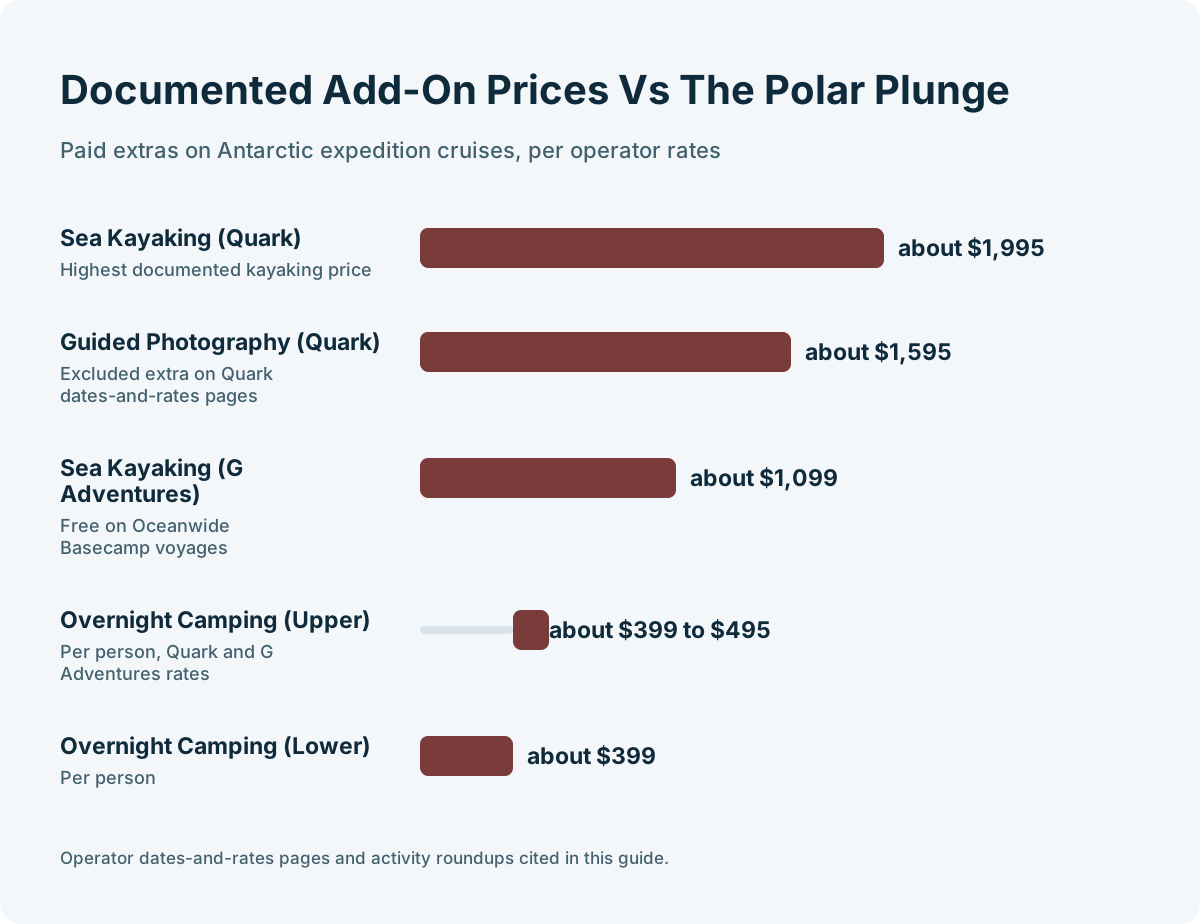
On the operators that state the activity, the polar plunge is typically included in the voyage fare rather than sold as an add-on. This separates it from kayaking and camping, which are frequently charged extras. Documented add-on prices run to roughly $1,995 for kayaking with Quark and around $1,099 with G Adventures, while camping is listed around $399 to $495 per person. The plunge itself carries no separate fee.
The pattern across operator materials is consistent. Paid adventure options on Antarctic expedition cruises are the ones with limited capacity and specialised gear: kayaking, camping, helicopter flightseeing, guided photography. Quark's dates-and-rates pages, for example, show guided photography at around $1,595 as an excluded extra, while no separate plunge fee appears in the operator material reviewed for this guide. Oceanwide goes further on its Basecamp departures, including camping, kayaking, snowshoeing, mountaineering and photo workshops in the fare on select sailings such as Hondius and Plancius.
What the fare does not cover, on every documented operator, is the kit of the trip around the cruise: international flights, travel insurance with the operator's required evacuation minimum, gratuities where suggested, and alcohol outside any bundled drinks package. A realistic all-in budget for a mid-range ten to twelve day Peninsula trip, fare plus flights, gear, tips and insurance, runs to roughly $12,000 to $25,000 per person in one recent cost guide. The plunge, in contrast, carries no separate fee where operators state it.
| Activity | Typically included? | Documented price where sold | Source |
|---|---|---|---|
| Polar plunge | Yes, on operators that state it | No separate fee stated | Quark, Oceanwide, Aurora materials |
| Sea kayaking | No, add-on on most voyages | About $1,995 (Quark); about $1,099 (G Adventures); free on Oceanwide Basecamp | Operator dates-and-rates pages |
| Overnight camping | No, add-on on most voyages | About $399 to $495 per person | Quark and G Adventures rates |
| Zodiac landings and cruises | Yes | Included in fare | All documented operators |
| Guided photography | No | About $1,595 (Quark) | Quark dates and rates |
The money question worth asking is therefore not whether the plunge costs extra but whether the voyage you are choosing charges for the activities around it. A Basecamp-style sailing with bundled activities can cost less in total than a cheaper fare plus a stack of add-ons. That is exactly the kind of arithmetic a free consultation can work through with you, voyage by voyage, before any money changes hands.
How The Plunge Is Run Safely?
The documented safety pattern is: medical staff or a doctor present, entry from a Zodiac or a supervised platform, a guide in the water or within reach, and a one-time event per voyage when conditions allow. Captains and expedition leaders assess each case on wind, swell at the gangway and site protection, and the plunge is cancelled or moved rather than run in marginal conditions. No operator publishes a fixed wind limit.
Operator descriptions state that participants enter from a Zodiac or a platform under supervision, a doctor or medical staff attend, and the event runs once per voyage when conditions allow. That conditional clause is the real safety system. The same expedition decision-making that governs every landing applies to the plunge: the leaders keep Plan A, B and C options, monitor forecasts every four to six hours with the captain, and switch or cancel based on wind, swell and ice. A sheltered site can remain workable in winds that would end operations at an exposed beach, which is why operators such as Quark rely on judgement rather than a fixed threshold. Everything else covered here is indexed on Cruises In Antarctica.
The other layer is you. Operators require passengers to manage ship movement and physical activity generally, and most require a medical questionnaire completed and signed by a doctor before the voyage; Quark requires its medical forms submitted no later than 90 days before Day 1. Anyone with a heart condition or other medical concern should talk to their own doctor before signing up, not on the gangway.
The IAATO visitor guidelines, which govern all landings, add the environmental rules: a minimum of five metres from wildlife in general, boot and equipment biosecurity between sites, and no activity with more than minor or transitory environmental impact. The safety picture in summary:
| Safety element | Documented practice | Source |
|---|---|---|
| Medical presence | Doctor or medical staff attend the plunge | Operator activity descriptions |
| Entry method | From a Zodiac or a supervised ship platform | Operator activity descriptions |
| Frequency | One-time event per voyage, conditions allowing | Operator activity descriptions |
| Go / no-go decision | Case-by-case on wind, swell at gangway, site protection, crew experience; no fixed wind threshold | Quark environmental assessment documents |
| Forecast monitoring | Expedition leaders review forecasts every 4-6 hours with the captain, holding Plan A/B/C options | Expedition planning accounts |
| Medical screening | Signed medical questionnaire before voyage; Quark forms due 90 days before Day 1 | Operator contract and medical-form policies |
| Environmental rules | 5 m wildlife minimum, biosecurity between sites, minor or transitory impact only | IAATO / ATCM visitor guidelines |
If a decision about which crossing style, sailing the Drake versus flying over it, is part of your plunge-day thinking, the consultation page covers the trade-offs with no obligation attached.
What The Plunge Actually Feels Like?
Expect cold. Peninsula summer air temperatures typically range from about -5°C to +5°C with wind chill often lower on deck, and the plunge is a brief, supervised entry into the water, not a swim. Nobody swims laps.
Operator descriptions keep the details short: supervised entry from a Zodiac or platform, medical staff present, and a single event per voyage when conditions allow. Some ships, such as Quark's World Voyager, list a sauna among their onboard facilities, which is a welcome place to warm up afterwards.
Ship layout matters too. Aurora's Greg Mortimer lists 15 Zodiacs with four dedicated boarding doors, and Sylvia Earle lists a mudroom, the kind of infrastructure that supports every Zodiac-based activity.
The one thing the plunge is not is a swimming excursion. The operators that offer it are explicit that entry is brief and supervised, and the distinction matters for anyone imagining a proper swim. The five-metre wildlife rule also applies, so the plunge happens away from seals and penguins rather than among them.
Which Ships And Voyages To Consider?
For a plunge-focused booking, the documented sweet spot is a Peninsula voyage on a ship whose activity list is published and priced. Oceanwide's Hondius sails from $7,800 per person with Basecamp departures bundling camping, kayaking and snowshoeing, Ortelius matches that entry fare on a 108-guest former research vessel, and Aurora's Greg Mortimer starts at $19,521 per person with the plunge listed on its ship page. All three are published 2026-27 figures.
Oceanwide's Hondius guide covers the ship in detail: 170 guests in 80 cabins, Polar Class 6, built 2019, 107.6 metres, sailing 11, 13 and 19-day Antarctic voyages from Ushuaia from $7,800 per person. Basecamp departures on Hondius and Plancius include the free activity bundle, and the plunge runs within the same programme. If the plunge is the headline rather than the footnote, a Basecamp sailing is the fare that treats activities as inclusions rather than extras.
Ortelius is the smaller, quirkier sibling: 108 passengers in 50 cabins, built in Gdynia in 1989 as a research vessel, ice class UL1, and the ship Oceanwide uses for helicopter-supported Weddell Sea emperor penguin voyages, also from $7,800 per person on Peninsula departures. Its cabin categories are functional rather than fancy, quadruple and twin portholes with no balconies, which is the trade you make for the lowest documented fares in the fleet. The Ortelius guide goes deeper on the helicopter voyages.
Aurora's Greg Mortimer, 130 passengers on expedition, Ulstein X-BOW, built 2019, is the upscale option, and its ship page is one of the few that lists the polar plunge by name among the activities, with 15 Zodiacs, kayaking, snowshoeing, snorkelling, paddling, scuba on select itineraries and the plunge all documented. Fares for its Antarctic voyages start at $19,521 per person twin share on the operator's Antarctica cards. House wine, beers and soft drinks with dinner are included on the Aurora ships, which changes the all-in arithmetic compared with lines that charge for drinks.
| Ship | Class | Passengers | Ice class | From, per person | Voyage length | Departs from |
|---|---|---|---|---|---|---|
| HondiusOceanwide Expeditions | Small-Ship Budget | 170 | Polar Class 6 | from $7,800 | 11 to 19 days | Ushuaia |
| OrteliusOceanwide Expeditions | Small-Ship Budget | 108 | UL1 | from $7,800 | 11 to 25 days | Ushuaia |
| Greg MortimerAurora Expeditions | Upscale Expedition | 130 | – | from $19,521 | 12 to 26 days | Ushuaia |
The three-way comparison above is the fare and capacity picture at a glance. The choice between them is a traveller-type choice, not a ranking: the budget-conscious multi-share berth on Ortelius, the bundled-activity Basecamp sailing on Hondius, or the X-BOW ship with the plunge printed in its activity list. Whichever way you lean, the roster figures above are the verified starting fares, and anything lower will be a promotion rather than a different price structure.
Booking The Plunge: Timing And Practicalities
Limited-capacity activities on Antarctic expedition cruises, kayaking, camping, helicopter options, are typically reserved at booking or shortly after, and spaces fill early; the polar plunge needs no reservation because the whole ship is invited, but the paid activities around it do. Booking twelve months or more ahead secures both the departure and the add-ons for peak December and January sailings, and medical forms are due well before departure.
The sequencing matters more than newcomers expect. Peak December and January departures, including the Christmas and New Year sailings, carry premium pricing, and limited-capacity paid activities fill early. The plunge itself is democratic: everyone who wants it gets their turn when the weather allows. But if your Antarctica cruise is meant to include kayaking among icebergs or a night camping on the continent, those are the line items to secure early.
Also worth doing at booking, not later: the insurance. Operators impose high medical-evacuation minimums, documented examples include $500,000 with Quark and $250,000 with Ponant, and full trip-cost cancellation cover is required or strongly recommended rather than optional. A weather-delayed charter flight or a cancelled sailing is a real possibility in this part of the world, and the plunge is the fun risk; an uninsured cancellation is the expensive one.
The final third of the decision, if you have read this far, is the easy part: which bay, which month, which ship. November offers courting penguins, pristine snow and shoulder-season fares; February brings peak whale numbers and the least sea ice; the plunge works in all of them. When the shortlist is down to two or three voyages, compare Antarctic cruise options with a consultation and let a specialist who sees live availability settle the tie.
Common Questions About The Antarctic Polar Plunge
What is the polar plunge in Antarctica?
A supervised, one-time jump or brief swim into near-freezing Antarctic water, run from a Zodiac or a ship platform with medical staff present and guides in reach. Operators including Quark, Oceanwide, Aurora and Lindblad offer it on most Peninsula voyages, and it is typically included in the fare.
Is the polar plunge included in the cruise fare?
On the operators that publish the activity, yes. The plunge appears without a separate price on Quark, Oceanwide and Aurora materials, unlike kayaking (documented around $1,995 with Quark, $1,099 with G Adventures) and camping (around $399 to $495), which are charged add-ons on most voyages.
Is the polar plunge safe?
It is run under supervision with a doctor or medical staff attending, entry from a Zodiac or platform, and cancellation or relocation when wind, swell or ice conditions are poor. Cold shock is a real physiological response, so passengers with heart conditions should discuss the plunge with their own doctor, and operators require a signed medical form before the voyage.
Can you swim in Antarctica outside the organised plunge?
The organised plunge is the supervised way to enter the water on an expedition cruise, and IAATO rules keep activity away from wildlife, at least five metres in general, with no more than minor or transitory environmental impact. The full picture is in the guide to swimming in Antarctica elsewhere on this site.
Which ships are best for a polar plunge?
Any ship whose activity list includes the plunge and whose fares fit your budget: Oceanwide's Hondius from $7,800 per person with Basecamp activity bundles, the 108-guest Ortelius at the same entry fare, or Aurora's Greg Mortimer from $19,521 with the plunge named on its ship page. All fares are published 2026-27 starting prices per person.
Do you have to do the polar plunge?
No. It is an optional activity, and passengers who prefer to stay dry can simply watch from the ship.
More Activities And Wildlife
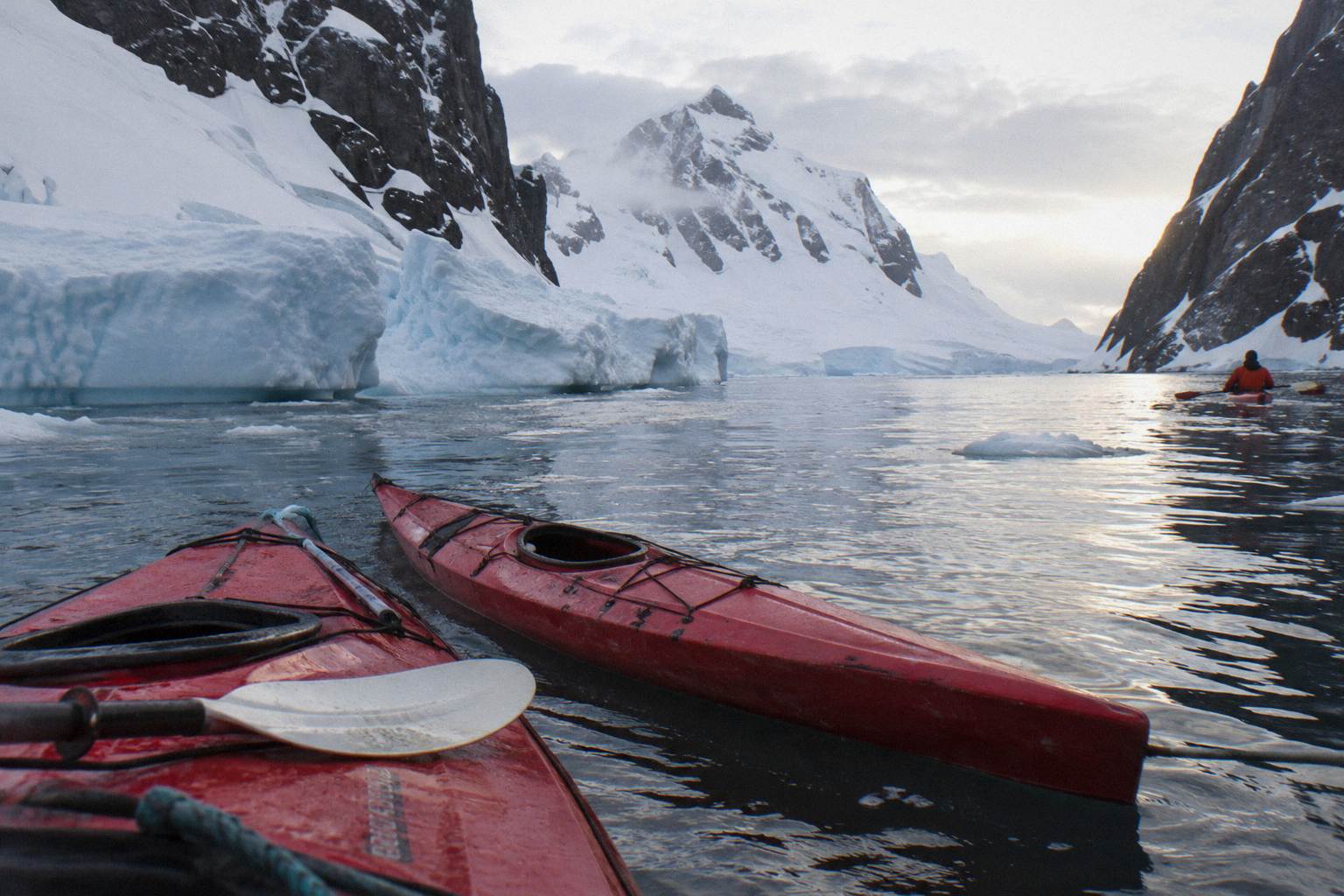 Antarctica KayakingOperators, prices and paddle skills for sea kayaking off an Antarctic expedition ship.Read the guide
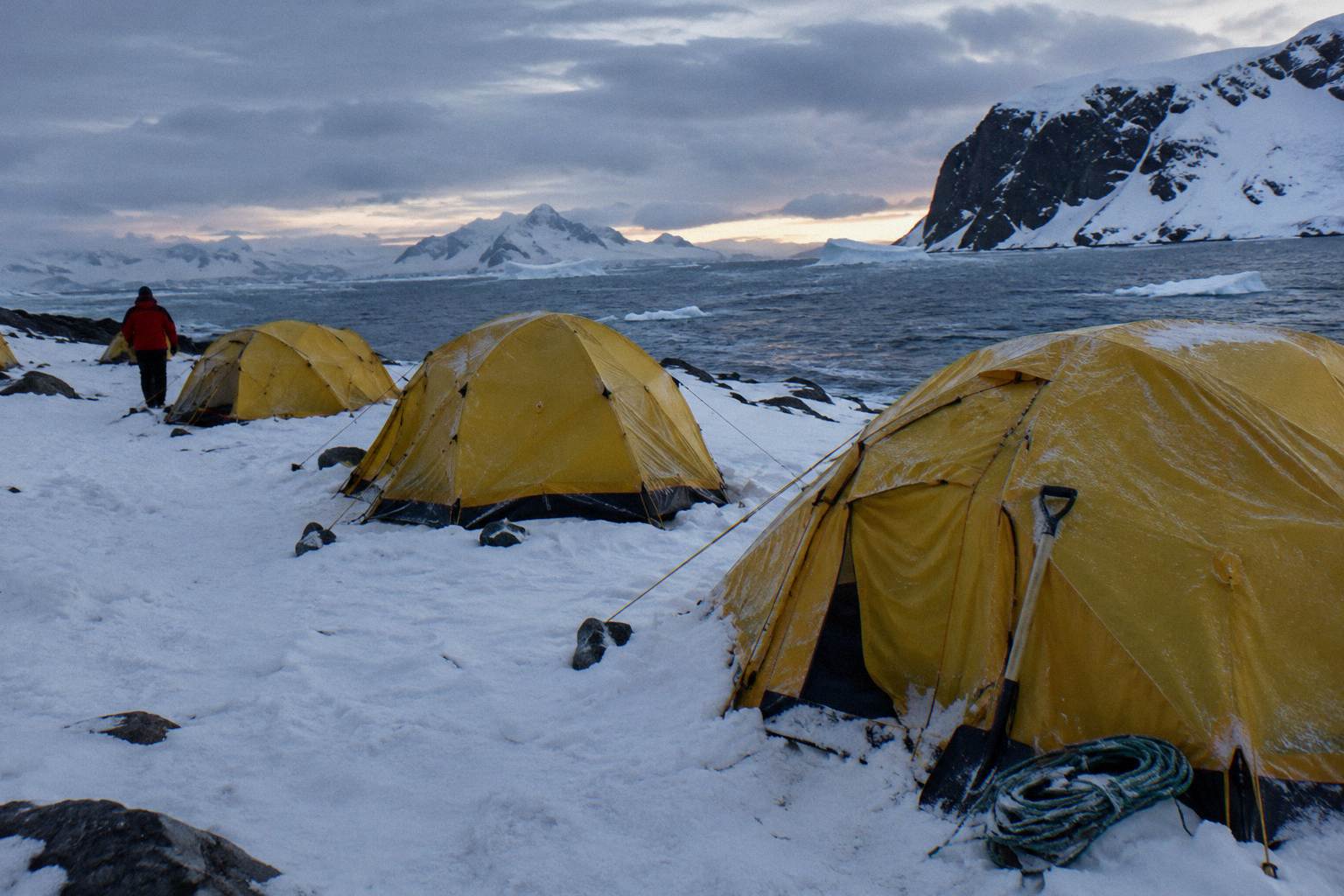 Antarctica CampingWhat an overnight ashore in Antarctica costs, how it runs, and when weather cancels it.Read the guide
 Hiking And SkiingActive Antarctica: hiking, snowshoeing, ski touring and mountaineering options compared.Read the guide
 Helicopters And SubmarinesWhich Antarctica ships carry helicopters or submarines, and what those flights and dives cost.Read the guide