Booking An Antarctica Cruise For A Group Or Family Reunion
 By Oleg G.
Group travel to Antarctica is organised differently from a normal cruise booking: cabins must be held together, deposits are larger, and a few operators publish real group terms. Here is what the operator pages and booking terms actually say.
Quick answer: Quark Expeditions starts group booking at 10 guests or 5 cabins with discounts from 5 percent, and Lindblad Expeditions offers 5 percent savings for groups of 8 or more. Budget ships like Hondius sail from $7,800 per person, and Oceanwide takes a 20 percent deposit to hold a confirmed group reservation.
Booking a single cabin on an Antarctica cruise is mostly a matter of picking a ship and a date. Booking for eight people, or eighteen, is a different exercise: the expedition cruise you want must still have adjacent cabins weeks after you started counting heads, the deposit is a group commitment rather than a personal one, and a handful of operators publish group policies that can save a real percentage off the fare. The good news is that small expedition ships are naturally suited to groups, because a vessel carrying 108 or 170 guests means your party is a visible share of the ship rather than a rounding error in a booking system.
This guide covers what the operator pages actually state about group booking, how cabins are held for a party, the shared-versus-private cabin decision that dominates group budgeting, and the point at which a full-ship charter starts to make sense. Facts come from operator booking terms and the ship roster on this site; where an operator does not publish a group policy, that is stated plainly rather than guessed at.
How Does Group Booking Work On An Antarctica Cruise?
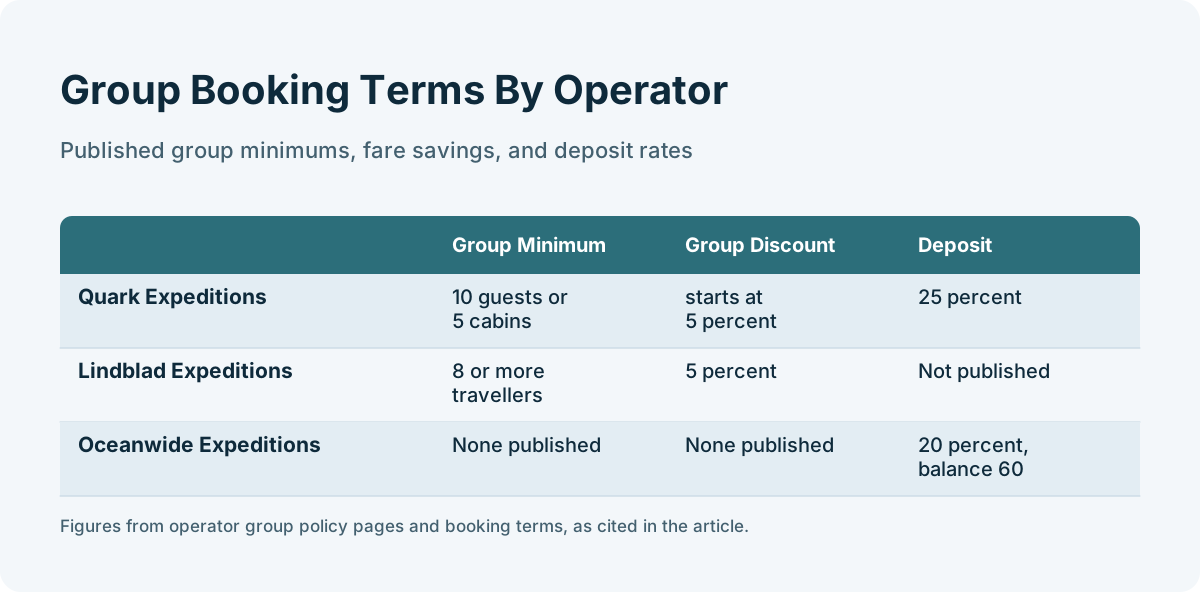
Group booking means reserving several cabins on one departure under a single reservation, usually with a named coordinator, a larger combined deposit and, on some operators, a discount or free berth once a threshold is met. The published thresholds are modest: Quark Expeditions starts groups at 10 guests or 5 cabins, and Lindblad Expeditions offers savings from 8 travellers. Most other operators handle groups case by case.
The clearest published group policy among the major operators belongs to Quark Expeditions. Its group polar voyages page states that groups typically begin at 10 guests or 5 cabins, with discounts starting at 5 percent, complimentary berths for larger groups, a delayed deposit, and a dedicated group specialist; full-ship charters are also available through the same channel. That is a published threshold, and it means a family reunion of ten people is already operating in group territory rather than as ten separate bookings. You can read the policy on the operator's own group voyages page.
Lindblad Expeditions publishes a group offer as well: 5 percent savings on voyage fares for groups of 8 or more, with group amenities possible and policies varying by sailing. For most other operators in the Antarctica market, including Oceanwide Expeditions, Aurora Expeditions, HX, Poseidon, G Adventures, Ponant and Silversea, no published group minimums, discounts or free-berth details could be found for the 2026-27 season. That does not mean those operators refuse groups; it means group terms are negotiated rather than published, which is exactly why a conversation with someone who knows each operator's current position is worth having before you commit. A free consultation for your group can help surface the unpublished terms.
The practical mechanics matter as much as the discount. A group reservation typically needs one person to act as coordinator, a single deposit covering all cabins, and a shared decision on cabin categories. Quark's group programme lists a delayed deposit among its terms, so ask each operator how long a block is held and what happens if a payment date is missed.
Which Cabins Can A Group Actually Hold Together?
On small ships a group's cabin block is limited by the ship itself: Hondius has 80 cabins, Ortelius and Plancius 50 each, Sea Spirit 60. The deposit that secures the block is 20 percent of the total price at Oceanwide, with the balance due 60 days before departure. Cabin mix is the biggest cost lever a group controls.
The deposit structure is the first thing a group organiser should understand. Oceanwide Expeditions, whose Hondius, Ortelius and Plancius sit at the budget end of the Peninsula market, takes a 20 percent deposit on a confirmed reservation, requires full payment if the booking falls within two months of departure, and sets the balance due 60 days out. Quark's booking terms, effective June 2026, set a 25 percent deposit for bookings made 151 or more days before departure, with final payment due 150 days before Day 1. For a group of ten on a mid-range ship, that is a five-figure sum collected from multiple households before the trip, so agree internally who pays and when before you request the hold.
The cabin inventory is the second constraint. Small ships simply have fewer cabins to block. The table below shows what a group is drawing from on three representative budget ships.
| Ship | Operator | Passengers | Cabins | Ice class | From (per person) |
|---|---|---|---|---|---|
| Hondius | Oceanwide Expeditions | 170 | 80 | Polar Class 6 (equivalent 1A-Super) | $7,800 |
| Ortelius | Oceanwide Expeditions | 108 | 50 | UL1 (equivalent to 1A) | $7,800 |
| Sea Spirit | Poseidon Expeditions | 114 | 60 | Ice-strengthened hull | $8,846 |
Hondius is a natural group ship for the budget tier. Built in 2019 and registered as the first Polar Class 6 vessel in the world in the operator's own wording, it carries 170 guests in 80 cabins ranging from quadruple porthole cabins of roughly 15 to 16 square metres up to a Grand Suite with a private balcony, and its Antarctic Peninsula departures for the 2026-27 season start from $7,800 per person. That spread of categories is what makes a group work: not everyone in a family reunion wants to pay for a suite, and Hondius lets the party split across four price points on the same sailing.
For a fuller side-by-side of the three budget ships, the comparison below pulls the roster figures together.
| Ship | Class | Passengers | Ice class | From, per person | Voyage length | Departs from |
|---|---|---|---|---|---|---|
| HondiusOceanwide Expeditions | Small-Ship Budget | 170 | Polar Class 6 | from $7,800 | 11 to 19 days | Ushuaia |
| OrteliusOceanwide Expeditions | Small-Ship Budget | 108 | UL1 | from $7,800 | 11 to 25 days | Ushuaia |
| Sea SpiritPoseidon Expeditions | Small-Ship Budget | 114 | ice-strengthened hull | from $8,846 | 12 to 23 days | Ushuaia |
A group block is also time-sensitive in a way individual bookings are not. Peak December and January sailings on popular ships book 12 to 18 months ahead, and a group needs several cabins in the same categories on the same sailing. If your group can only travel in the peak weeks, start the cabin hold earlier than feels reasonable.
Shared Or Private Cabins: The Biggest Group Cost Decision?
Shared cabins are the biggest single cost lever for an Antarctica group: multi-occupancy berths on budget ships run meaningfully cheaper than twins, and several operators help groups share. Oceanwide offers shared-cabin options on a share basis, G Adventures charges no single supplement when sharing with a same-gender traveller, and Aurora offers dedicated solo cabins with no supplement on select categories. Single supplements elsewhere range from 25 percent extra to 1.5 to 2 times the twin rate.
For a group, the question is not just solo-versus-couple but how many beds you actually need. Oceanwide's fleet, including Hondius and Ortelius, sells quadruple cabins with upper and lower berths, and the operator offers shared-cabin options on a share basis for solo travellers. A reunion party of twelve could, in principle, fill three quad porthole cabins on Hondius rather than six twins, cutting the accommodation line of the budget noticeably. Sample fares from the 2026-27 season illustrate the spread on Hondius: quad porthole berths around $9,600 to $10,150, twin porthole around $11,400 to $12,500, twin window above that, and superior or deluxe categories from around $13,150, with suite categories higher still.
The supplement question bites when group members want their own space. Across the market, single supplements typically range from 25 percent extra to 1.5 to 2 times the twin rate, though some lines waive or reduce them on select sailings. The published escape hatches are real but limited: G Adventures charges no single supplement when a traveller shares a twin or triple with another same-gender traveller; Aurora Expeditions offers up to 10 dedicated solo cabins per sailing with no single supplement, and its Greg Mortimer and Sylvia Earle carry dedicated solo balcony staterooms in select categories. National Geographic Endurance also offers dedicated solo cabins with balcony options. None of these are group discounts as such, but for a group containing solo travellers, they change the arithmetic enough to steer which ship the whole party books.
| Sharing option | Operator or ship | What the source says |
|---|---|---|
| Shared cabins on a share basis | Oceanwide Expeditions | Share-basis options for solo travellers across the fleet |
| No single supplement when sharing | G Adventures | Twin or triple shared with a same-gender traveller |
| Dedicated solo cabins, no supplement | Aurora Expeditions | Up to 10 per sailing; solo balcony staterooms on Greg Mortimer and Sylvia Earle |
| Dedicated solo cabins | National Geographic Endurance | Solo categories with balcony options |
| Typical supplement range | Market-wide | 25 percent extra up to 1.5 to 2 times the twin rate |
One honest caveat for family groups: multi-occupancy cabins on expedition ships are small. A quad porthole on Hondius is roughly 15 to 16 square metres shared between four people plus gear. For a group of friends in their twenties that is a fair trade for the fare saving; for a multigenerational reunion it may not be. Decide the cabin mix before anyone names a number, because it is the figure the group will argue about longest.
When Does A Full-Ship Charter Make Sense For A Group?
A full-ship charter makes sense when a group is large enough to fill, or nearly fill, a small expedition vessel and wants control of the itinerary, the activities and the guest list. Charters are available on operators such as Oceanwide and Quark, with rates on request, and the smallest ships carry 80 to 114 guests, putting a genuine charter within reach of a large reunion, an incentive trip or an affinity group.
The threshold is lower than most people assume. Sea Spirit carries 114 passengers in 60 cabins; Ortelius carries 108 in 50; the fly-cruise ship Magellan Explorer carries 88 guests on air-cruises. A family reunion of 50 couples, a university alumni group or a photography club with a strong membership base is already looking at a substantial fraction of one of these ships. Quark's group page lists full-ship charters alongside its cabin-group programme, and Oceanwide and Quark both offer charters with rates on request, so the mechanism exists even where no price is published. The wider set of guides lives on Cruises In Antarctica.
What a charter buys, beyond privacy, is control. On a chartered expedition cruise the group sets the tone: more photography time, more hiking, a heavier lecture programme, or a slower pace, within the IAATO rules that govern every operator. Those rules apply to charters exactly as they do to regular sailings: a maximum of 100 passengers ashore at any one time, a minimum 1:20 guide-to-visitor ratio, and one vessel at a landing site at a time. A charter does not buy you exclusive access to Antarctica itself, only to the ship.
The cost comparison is not per-person obvious. Charter rates are quoted for the vessel, so a group of 80 on a 100-berth ship is effectively paying for empty beds unless it fills them. Where a charter shines is when the group would otherwise struggle to find 40 adjacent cabins on a single scheduled departure, or when the itinerary itself, for example a Basecamp-style voyage with camping and kayaking included, is the point of the trip. Because charter rates are not published, compare a cabin block on a scheduled sailing against a charter quote before deciding, and the deeper comparison of charter options lives in our private Antarctica charter guide.
What Do Group Deposits, Deadlines And Cancellation Terms Look Like?
Group bookings follow the same cancellation ladders as individual ones, but more money is at stake at each step. Oceanwide charges up to 20 percent of the total price as the cancellation penalty from the day of booking, rising to 50 percent between 89 and 60 days out and 100 percent from 59 days, while Quark's 2026 terms charge 25 percent to the 120-day mark, 75 percent from 119 to 90 days, and 100 percent inside 89 days. A group organiser should treat the deposit as non-refundable.
These schedules are the reason group organisers exist. Collecting a 20 or 25 percent deposit from ten households, each of whom has their own doubts and their own calendar, is the hard part of an Antarctica group booking, and the operator's clock does not wait for your group chat. A clean approach: set an internal collection deadline well before the operator's, collect deposits into one account, and book the block only once the money is real. Operators also require travel insurance with medical evacuation coverage, with minimums that vary, examples include Quark at $500,000 and Ponant at $250,000, plus full trip-cost cancellation cover, and proof is often required before departure.
| Operator | Deposit | Final payment | Cancellation ladder |
|---|---|---|---|
| Quark Expeditions | 25% (151+ days out) | 150 days before Day 1 | 25% to 120 days, 75% 119-90 days, 100% inside 89 days |
| Oceanwide Expeditions | 20% on confirmation | 60 days before departure | 20% to 90 days, 50% 89-60 days, 100% inside 59 days |
Two structural facts from the wider cost picture help a group time its booking. Peak December and January departures typically book 12 to 18 months ahead, while shoulder months, November and March, carry lower fares, with sample 2026-27 Peninsula prices around $6,900 to $8,500 for 11 to 13 days against $12,000-plus in the peak. Early-booking offers across the 2026-27 and 2027-28 seasons commonly reach 10 to 30 percent off, with deadlines through 2026. A group with flexible dates can therefore save more by shifting the month than by negotiating the discount, and our month-by-month price guide breaks that down, while the payment mechanics are covered in deposits and payments explained.
One more group-specific point: the person who signs the group contract carries the risk. If three households drop out after the deposit date, the organiser is the one the operator invoices. Agree in writing within the group how drops are handled, and check whether the operator permits name changes on cabins before departure, a detail that varies by line and is worth confirming in writing at booking time.
Which Ships And Operators Suit A Group Best?
For groups, the best fits are Hondius, Ortelius, and Sea Spirit in the budget tier, since each offers a genuine spread of cabin categories and a passenger count small enough that a party feels part of the voyage rather than a queue, while Quark and Lindblad stand out in the upscale tier for publishing clear group terms.
Working down the budget tier: Hondius, at 170 passengers, offers the widest category range and the activity-heavy Basecamp departures, which include camping, kayaking, snowshoeing and hiking at no extra activity charge, a strong fit for an active family group. Ortelius, a 1989-built former research vessel carrying 108, is the intimacy pick, and its Weddell Sea Emperor Penguin voyages with helicopter flights are the sort of one-itinerary trip that binds a group together. Sea Spirit, a 1991-built ship refitted in 2017 carrying 114 in 60 suites, sits a half-step up in comfort, with retractable fin stabilisers retrofitted in 2019 that reduce roll both underway and at anchor, a detail seasickness-prone relatives will appreciate on the Drake crossing.
In the standard and upscale tiers, the operators with published group policies stand out. Quark's fleet for 2026-27, Ultramarine at 199 passengers, Ocean Explorer at 138 and World Voyager at 168, all sail the Peninsula from around $12,236 per person at the voyage level, with fares shared across the three ships, and the group programme starts at 10 guests or 5 cabins. Lindblad's National Geographic Endurance and Resolution, 138 guests each, sail from $11,900 for the 12-day Voyage to Antarctica, with the 5 percent group saving from 8 travellers plus a bundle that includes the pre-cruise Buenos Aires hotel, the charter flight to Ushuaia, alcoholic beverages, prepaid gratuities and the expedition jacket, inclusions that simplify group budgeting considerably.
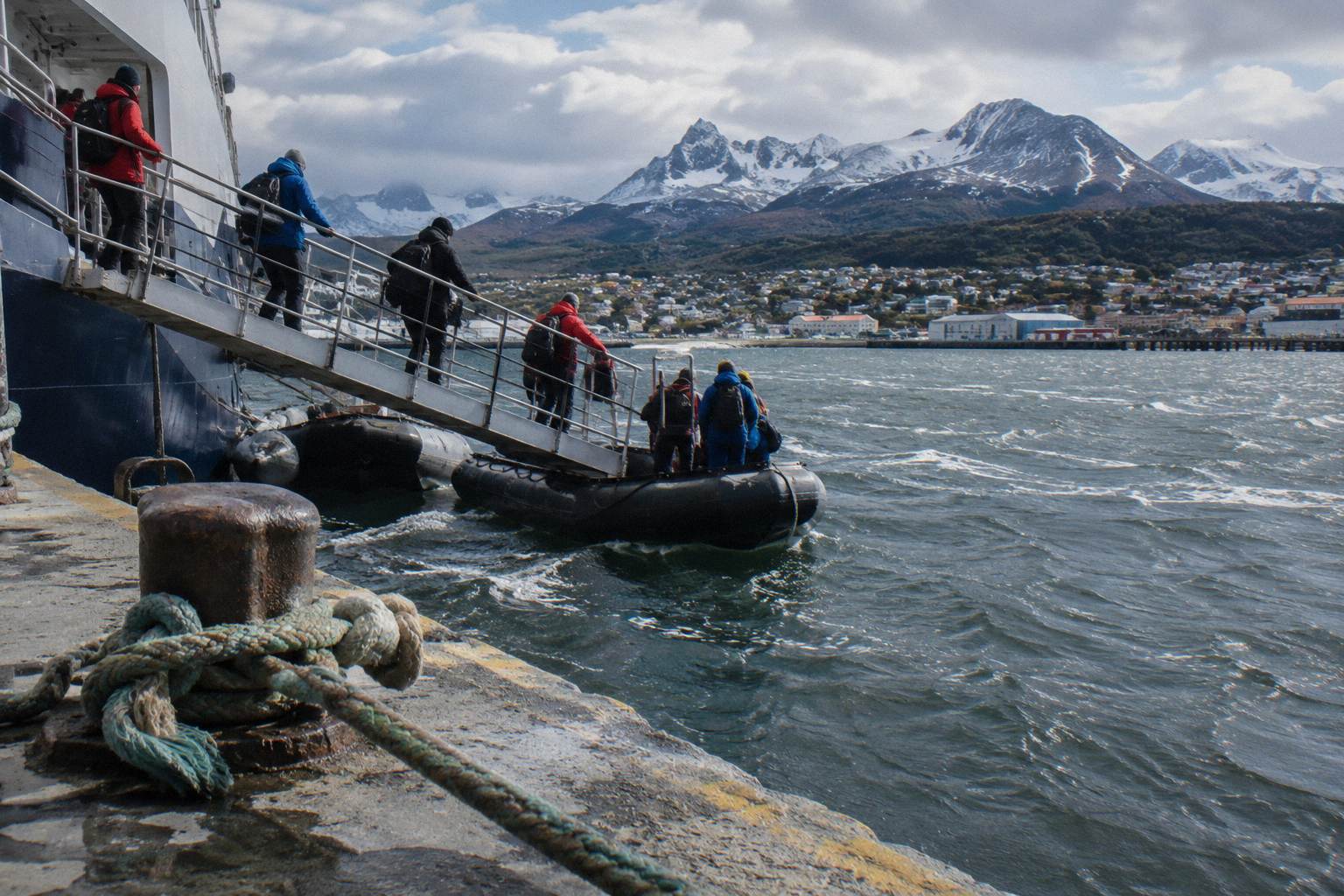
The group-size rule of thumb from the landing side: ships at or under 100 passengers can put everyone ashore at once under the IAATO limit, while larger vessels rotate groups, shortening individual time on land. For a group that wants to experience landings together rather than in shifts, that argues for the smaller vessels, and the trade-offs are laid out in our small-ship guide. Whatever the shortlist, holding cabins for ten people across three operators is far easier with help: talk through your group's options with a specialist before the quad berths you want sell out.
Common Questions About Group Booking An Antarctica Cruise
How many people count as a group on an Antarctica cruise?
Where operators publish a threshold, it is modest. Quark Expeditions treats groups as typically starting at 10 guests or 5 cabins, and Lindblad Expeditions applies group savings from 8 travellers. Most other operators negotiate group terms case by case rather than publishing a minimum.
Do groups get a discount on Antarctica cruises?
Published group discounts exist: Quark starts at 5 percent with complimentary berths for larger groups, and Lindblad offers 5 percent savings for groups of 8 or more on voyage fares. More often, the bigger saving comes from timing, with shoulder-month fares in 2026-27 samples running around $6,900 to $8,500 against $12,000-plus in peak season.
How big does a group need to be to charter a ship in Antarctica?
There is no fixed threshold, but the smallest expedition ships carry 80 to 114 guests, so a large family reunion, alumni group or club can fill a substantial share of one. Oceanwide and Quark both offer full-ship charters with rates on request. Because charter rates are quoted on request, compare a charter quote against a cabin block on a scheduled sailing.
How do you hold several cabins together on one sailing?
You book them as a single group reservation with one coordinator and one combined deposit. At Oceanwide the deposit is 20 percent of the total with the balance due 60 days before departure; Quark takes 25 percent for bookings made 151 or more days out. Ask the operator how long the block is held before payment, and collect deposits from the group before requesting the hold.
Can solo travellers in a group avoid the single supplement?
Sometimes. Single supplements typically run from 25 percent extra to 1.5 to 2 times the twin rate, but Oceanwide offers shared cabins on a share basis, G Adventures charges no supplement when sharing with a same-gender traveller, and Aurora Expeditions and Lindblad's National Geographic Endurance both offer dedicated no-supplement solo cabins on select categories.
Is a group booking harder to cancel than an individual one?
Yes, in practice. The deposit is a single commitment covering all cabins, and penalty ladders are steep: Oceanwide charges 20 percent of the total from booking, rising to 50 percent between 89 and 60 days out and 100 percent inside 59 days, while Quark charges 25 percent to the 120-day mark, 75 percent to 90 days and 100 percent inside 89 days. Agree internally how dropouts are handled before signing.
Booking an Antarctica cruise for a group rewards early decisions and honest internal arithmetic: the cabin mix sets the budget, the month sets the fare, and the deposit schedule sets the pace. Cruises In Antarctica exists to make that first decision easier, and a free consultation costs nothing but the hour it takes.
More Cost And Booking
 Cruise CostA per-person price ladder from $7,050 berths to $32,320 luxury voyages, with what fares include and what they quietly leave out.Read the guide
 Cheap Antarctica CruisesThe honest floor for Antarctica fares, which ships carry it, and what it costs all-in.Read the guide
 Last-Minute DealsDo last-minute Antarctica berths still exist, and what do they really save?Read the guide
 What Is IncludedWhat an Antarctica fare really covers, operator by operator, plus the hidden costs with published amounts.Read the guide