How Antarctica Shore Landings Work: Zodiacs, Boots And Time Ashore
 By Oleg G.
A shore landing is the reason you cross the Drake Passage. This guide walks through every step, from the Zodiac briefing to the boot scrub, so you know exactly what to expect when your feet hit the Antarctic shore.
Quick answer: Many Antarctica shore landings are wet landings: you step from a Zodiac into shallow water, wearing waterproof boots. IAATO rules cap visitors ashore at 100 at a time, with a 1:20 guide ratio, and landings typically last one to two hours. Biosecurity checks are mandatory before and after every outing.
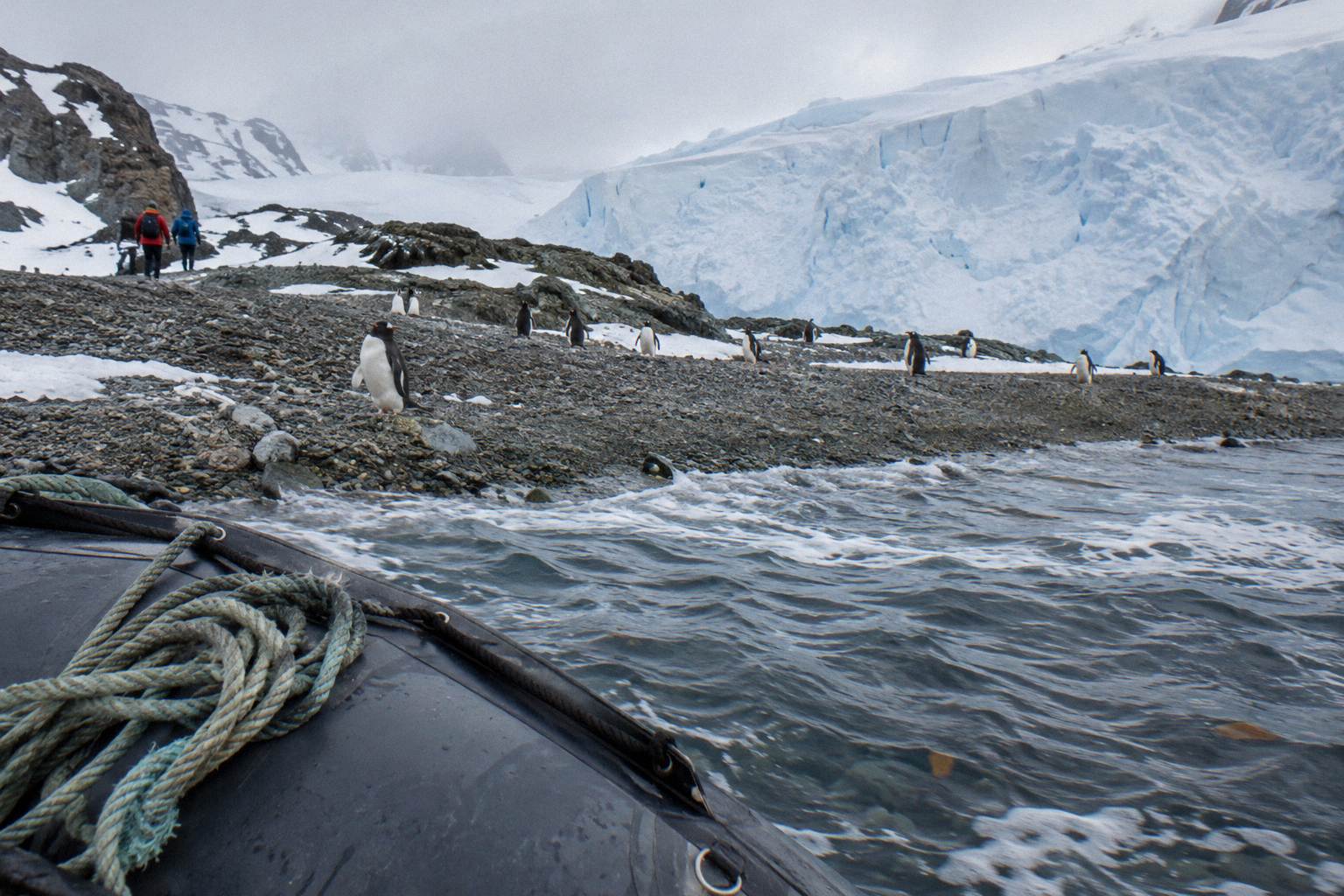
Shore landings are the daily highlight of any Antarctica expedition cruise, and the planning guides on Cruises In Antarctica return to them again and again, but first-timers often have no idea what the process actually looks like. You suit up, climb into a Zodiac, and suddenly you are stepping onto a beach full of penguins. The sequence is straightforward, but a handful of IAATO rules and practical details determine how long you stay ashore, how many landings you get in a day, and whether the whole thing happens at all.
The standard Antarctica shore landing is a wet landing from an inflatable Zodiac, typically lasting one to two hours, with mandatory biosecurity cleaning before and after, and governed by a strict 100-passenger-at-a-time limit ashore. The day begins with a briefing, moves through a gear check and boot scrub, and ends with a debrief. Below, we break down each step, keeping to what operator guidance and IAATO guidelines say.
What Happens Before A Shore Landing
Before any Zodiac touches the water, passengers attend a mandatory briefing that covers the day's landing site, wildlife distances, and safety hazards, then pull on waterproof layers and pass through a biosecurity station where every scrap of gear is inspected for seeds or organic matter and boots are scrubbed with disinfectant. The expedition leader reviews the plan, the landing site's topography, and any special hazards such as calving glaciers or unstable snow bridges. This is also when the Zodiac groups are called: smaller ships may land everyone at once, while ships carrying more than 100 passengers rotate groups to stay within the IAATO cap.
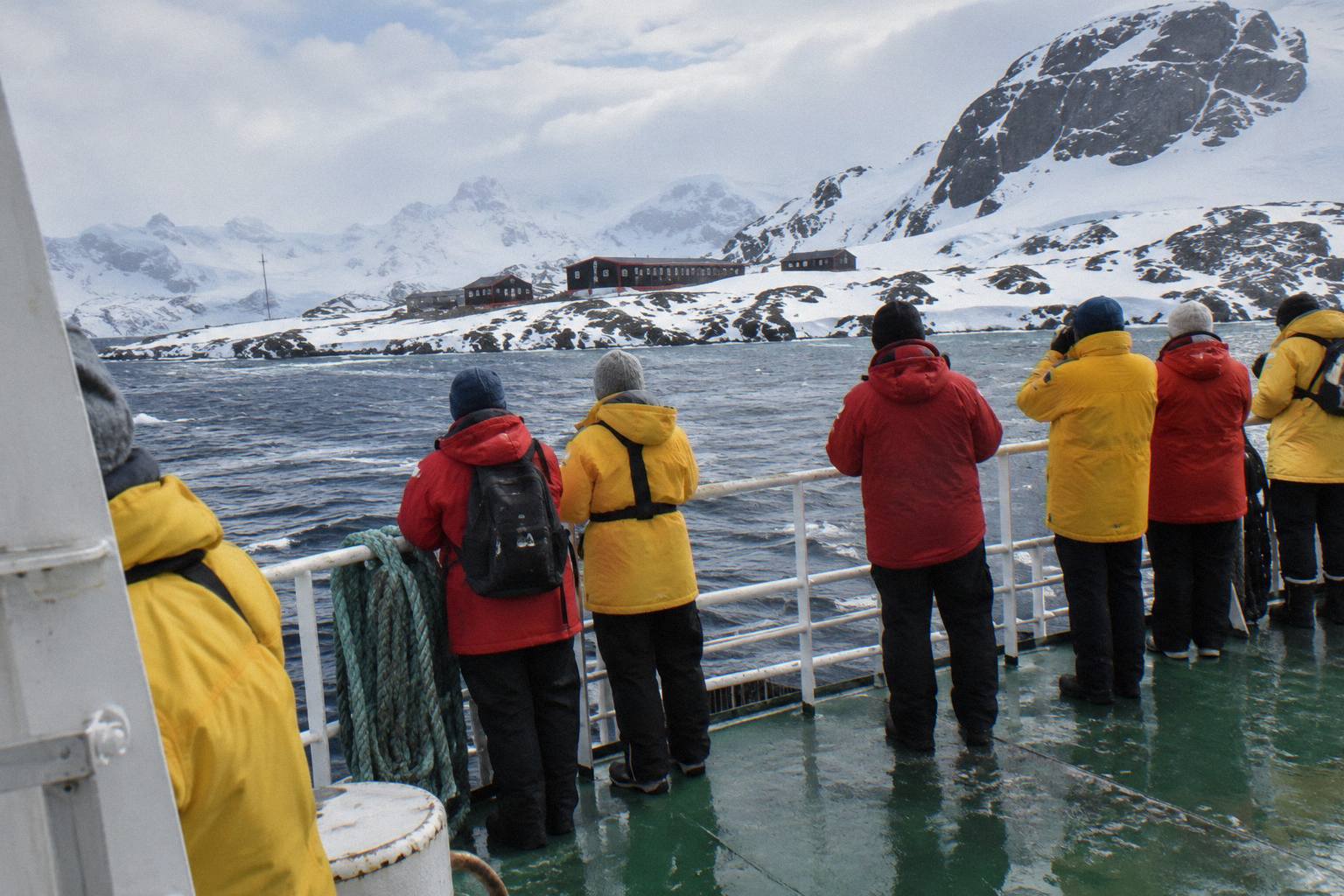
Biosecurity is non-negotiable. IAATO guidance calls for vacuuming pockets and cleaning gear, from bags to tripods, of seeds or organic matter. Boots are scrubbed and disinfected with a solution such as Virkon at a dedicated station, and the same process repeats when you return. The goal is to prevent introducing non-native species to the continent, and every operator enforces it. The expedition team also checks that your life jacket is properly fastened and that you are carrying nothing that could blow away or harm wildlife.
The Zodiac Boarding Sequence
Boarding a Zodiac involves a sailor's grip on the guide's forearm, a step from a gangway or platform onto the inflatable tube, and then a shuffle to a seat on the pontoon, all while the driver holds the boat steady against the ship's hull. Staff are positioned at the boarding point to steady each passenger.
On ships like Hondius, the boarding platform is sheltered and indoor, which means you never have to wait on an open deck in wind. Smaller ships with fewer passengers can often load all Zodiacs quickly, while larger vessels need more rotations. Once the Zodiac is full, the driver pushes off and heads toward the landing site.
Wet Landings: What They Are And How They Work
A wet landing means the Zodiac noses onto a beach and you swing your legs over the side, stepping into shallow water in waterproof boots, while staff offer a steadying hand. The water is cold, which is why waterproof boots and trousers matter. The driver holds the boat steady, and within a few steps you are on solid ground, often greeted by penguins or seals already going about their day.
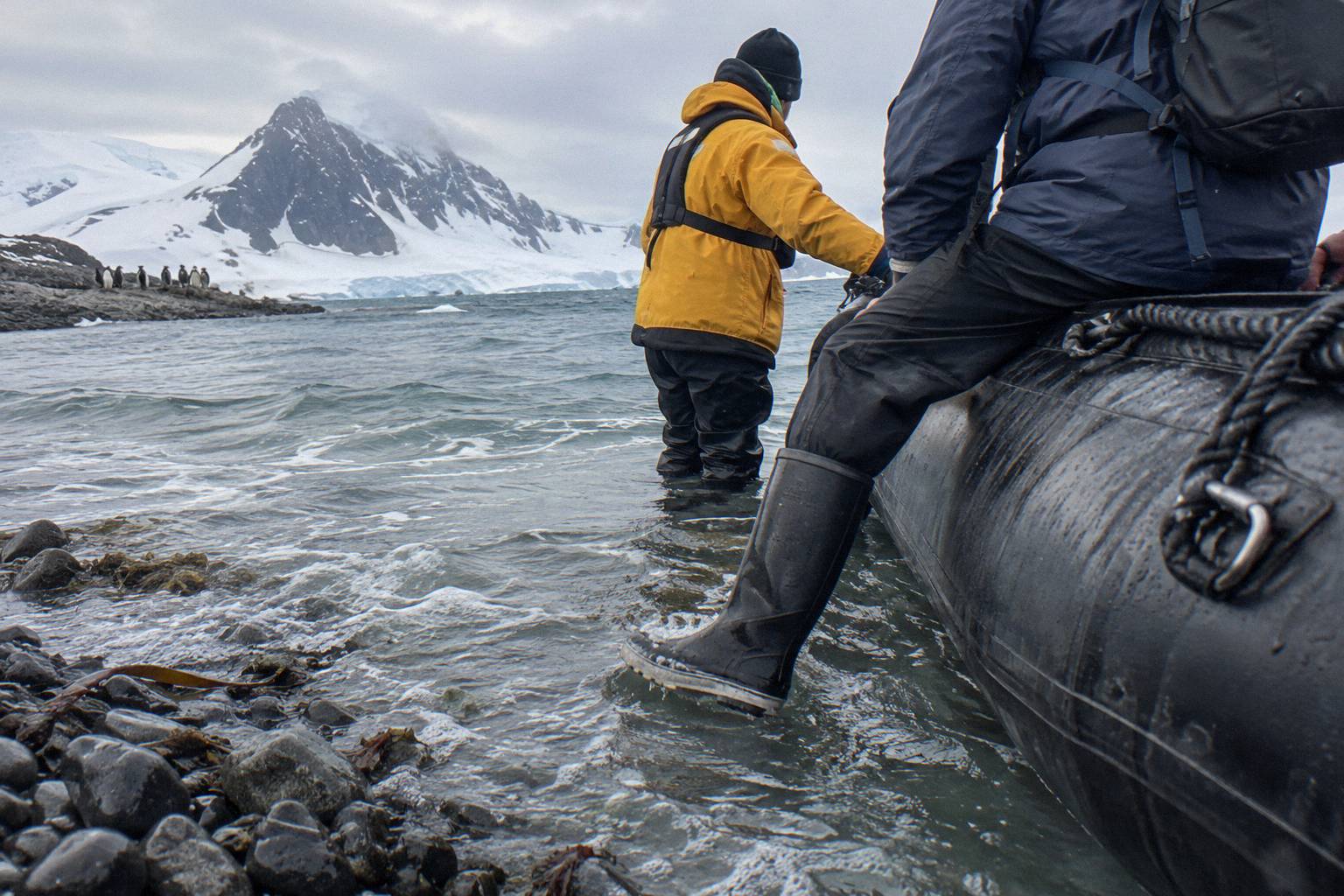
Dry landings, where you step directly onto rock, also happen, and operator guidance describes both wet and dry landings as common. Many operators loan the boots, so check before you pack your own. Wear warm socks and trousers that can be tucked into the boot shaft.
How Much Time You Get Ashore
A typical landing lasts between one and two hours, with the exact duration determined by the ship's passenger count, the site's capacity, and the weather, because IAATO rules limit 100 passengers ashore at any one time from a single vessel. Ships carrying fewer than 100 passengers can land everyone together, giving each person the full window. Ships with 200 or more passengers must split into groups, so individual time ashore can be shorter. The expedition team sets a return time, and you are free to wander within marked boundaries, watch penguins, or simply sit and absorb the landscape.
Guides are stationed along the route to answer questions and enforce wildlife distances. The minimum distance from most wildlife is five metres, and greater for nesting birds or seals. On a ship like Hondius, with 170 passengers, landings rotate, so you may have less time ashore than on a vessel under 100 passengers. The trade-off is that a bigger ship may carry more onboard facilities. For many travellers, the landing time is the single most important factor, and a free consultation with a polar specialist can help you weigh passenger counts against other priorities.
How Many Landings You Can Expect In A Day
Expedition cruises typically offer one to two landings per day when conditions allow, and weather, ice, and the ship's passenger count can reduce that, even to zero on some days. The day's schedule is never guaranteed. The expedition leader and captain review forecasts every four to six hours, and they have backup sites ready. The plan announced at breakfast can change by lunch.
On larger ships the rotation needed to stay under the 100-ashore limit shortens each person's time on land. The rest of the day is filled with meals, lectures, and scenic cruising.
IAATO Site Rules That Govern Every Landing
Every shore landing operates under the General Visitor Guidelines adopted by the Antarctic Treaty parties, which cap visitors ashore at 100 at a time, require a 1:20 guide-to-guest ratio, mandate specific wildlife distances, and limit each site to one ship at a time. IAATO operators run their landings to these rules. The 100-passenger cap is not a per-operator limit; it applies to each vessel individually, so a 90-passenger ship can put all its guests ashore simultaneously.
| Rule | Detail | Source |
|---|---|---|
| Maximum ashore | 100 passengers at once from one vessel (fewer if site guidance requires) | IAATO General Visitor Guidelines |
| Guide ratio | Minimum one actively guiding staff member per 20 visitors ashore | IAATO |
| Wildlife distance | At least 5 metres from most wildlife on land or ice; more where species or site guidance requires | IAATO and ATCM site guidelines |
| Single ship per site | Only one vessel at a landing site at any time | IAATO |
| Biosecurity | Boot washing and gear inspection before and after every landing | IAATO |
These rules are the reason smaller ships can offer a more immersive experience: under 100 passengers, they can land everyone at once, and ships over 500 passengers may not land at all. The guide ratio means there is always a staff member nearby to answer questions and keep visitors at safe distances. The single-ship rule means you will not share a site with another vessel's passengers at the same time.
The Biosecurity Cleaning Step By Step
Biosecurity is a multi-step process that begins before you leave home, continues with a thorough boot scrub at the ship's dedicated station before every landing, and repeats after you return, with crew inspecting gear for any organic material that could introduce non-native species. IAATO's guidelines are unambiguous: you must inspect and clean all outerwear, bags, and equipment before the voyage, and again between each landing. Avian influenza (H5N1) was first confirmed on the Antarctic Peninsula in February 2024, which gives the cleaning routine extra weight.
| Step | Action | When |
|---|---|---|
| Pre-voyage | Vacuum pockets, clean velcro, inspect boots and tripods for seeds or soil | Before leaving home |
| Pre-landing | Scrub boots with disinfectant solution at the ship's biosecurity station | Before boarding Zodiac |
| Ashore | Keep at least 5 metres from wildlife | During landing |
| Post-landing | Rinse and scrub boots again; crew may inspect gear | After returning to ship |
The disinfectant used is often Virkon. The routine is a small effort for one of the main conservation measures in Antarctica.
How A Landing Is Cancelled
Landings are cancelled when the expedition leader and captain determine that wind, swell, ice, or wildlife conditions make it unsafe or environmentally irresponsible to proceed, a decision made case by case that weighs wind, the swell at the gangway, beach waves, site protection and driver experience; Quark, for one, uses no fixed maximum wind speed. Cancellations happen. A planned landing at Neko Harbour might be swapped for a Zodiac cruise in a protected bay, or the ship may reposition to a different site entirely. The expedition team always has a Plan B and C, and the daily briefing explains the reasoning.
A cancelled landing is not a failed day; it is the system working as designed. The expedition leader monitors forecasts every four to six hours with the captain, using tools like Windy, and the captain can reposition the ship to find calmer waters. In some cases, a landing may be shortened rather than cancelled outright if conditions improve. The crew's priority is safety, and no one wants to be on an exposed beach in a katabatic wind gust.
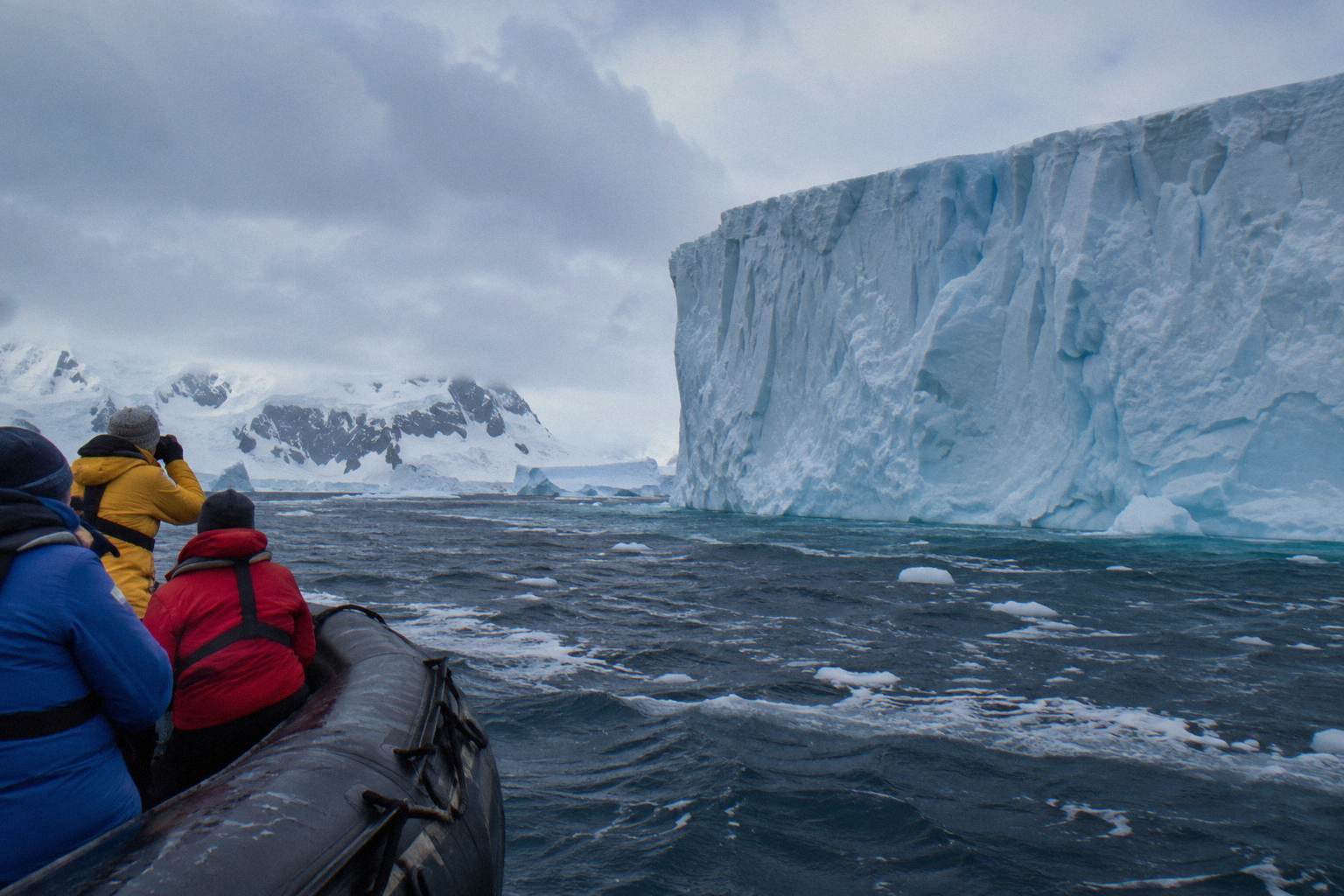
How The Ship You Choose Changes The Landing Experience
The number of passengers aboard directly determines how long you wait, how many landings you get, and which sites you can visit, because ships under 100 passengers can land everyone at once, while larger ships must rotate groups and vessels over 500 passengers may not land at all. A ship like Hondius, with 170 passengers, sits in the middle and rotates groups under the 100-person cap. Ultramarine, at 199 passengers, also rotates, but carries two helicopters for flights on select itineraries. Sea Spirit, with 114 passengers, is close to the cap, so its rotations are small.
| Ship | Class | Passengers | Ice class | From, per person | Voyage length | Departs from |
|---|---|---|---|---|---|---|
| HondiusOceanwide Expeditions | Small-Ship Budget | 170 | Polar Class 6 | from $7,800 | 11 to 19 days | Ushuaia |
| UltramarineQuark Expeditions | Upscale Expedition | 199 | 1A+, PC6 | from $12,236 | 12 to 14 days | Buenos Aires, Ushuaia |
| Sea SpiritPoseidon Expeditions | Small-Ship Budget | 114 | ice-strengthened hull | from $8,846 | 12 to 23 days | Ushuaia |
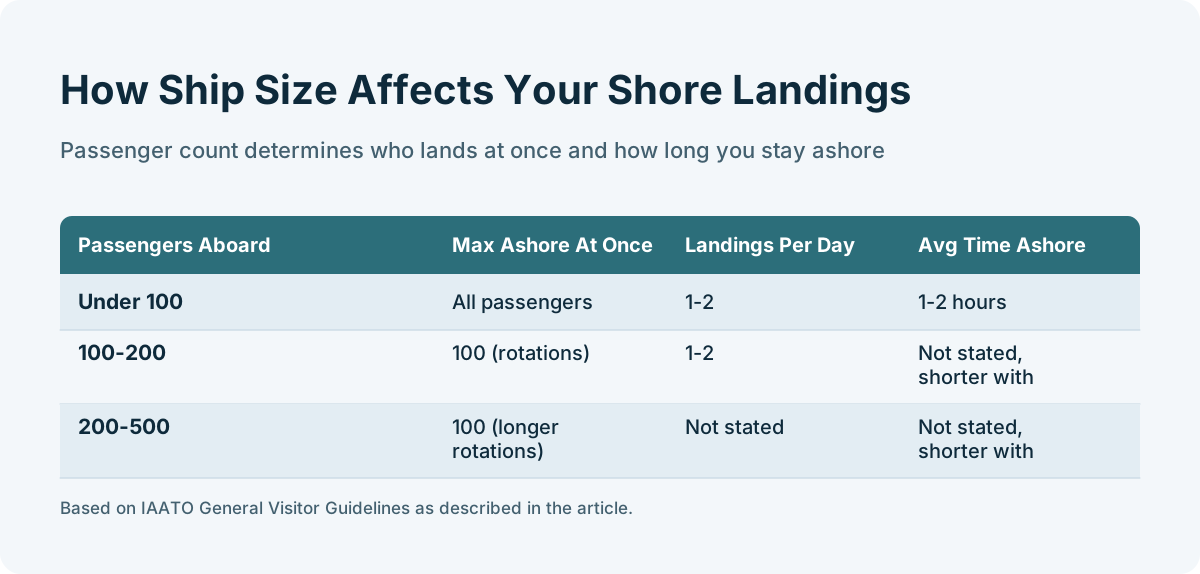
The trade-off is not just about passenger count. Zodiac numbers and boarding arrangements also differ by ship. The table below shows how the IAATO limit plays out by ship size, with typical operator figures where they exist.
| Ship Passenger Count | Max Ashore at Once | Typical Landings per Day | Average Time Ashore per Landing |
|---|---|---|---|
| Under 100 | All passengers | 1-2 | 1-2 hours |
| 100-200 | 100 (rotations) | 1-2 | Not stated, shorter with rotation |
| 200-500 | 100 (longer rotations) | Not stated | Not stated, shorter with rotation |
A free consultation with an expedition-cruise specialist can help you weigh these factors against your own priorities, whether that means maximizing time ashore or enjoying a larger ship's amenities.
What To Bring Ashore
Many operators supply the waterproof boots and parka; you supply the thermal layers, gloves, hat, sunglasses, and camera, and under IAATO biosecurity guidance anything you take ashore, walking sticks included, must be cleaned of seeds and soil. A small waterproof backpack is useful for a water bottle and spare gloves. Most landings are less than two hours, so you do not need snacks or a full daypack.
Some operators let you keep the parka after the voyage. The boots are loaned and returned at the end. Layering is key: a thermal base layer, a fleece or wool mid-layer, and the parka are usually sufficient, but on windy days you may want an extra shell. Gloves should be waterproof, and a neck gaiter is more practical than a scarf.
What A Continental Landing Means
A continental landing is one where you step onto the Antarctic mainland rather than an offshore island, with sites like Neko Harbour and Paradise Harbour counting as continental, while popular spots like Half Moon Island and Cuverville Island do not, and no operator guarantees a continental landing because ice and weather can force a change. The experience ashore is identical in terms of wildlife and scenery, but for many travellers the distinction matters. If a continental landing is important to you, check the itinerary's planned sites and read our continental landing guide.
Itineraries may plan a continental landing, but the Antarctic Peninsula is a maze of islands and channels, and many popular sites are on islands. The expedition leader will announce whether a landing is continental during the briefing, and some passengers keep a tally. For a deeper look at the sites themselves, our Antarctica landing sites guide covers the most visited locations and what makes each one unique.
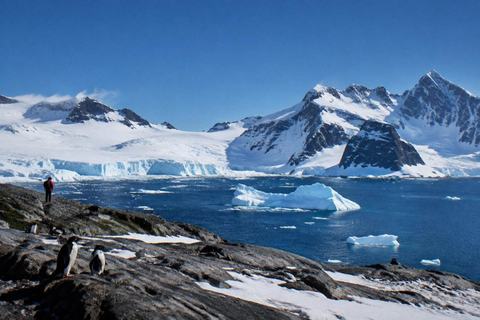
The definition of a continental landing hinges on whether the site lies on the Antarctic mainland itself, rather than an offshore island. Neko Harbour, in Andvord Bay, is a continental landing, and Paradise Harbour is counted as one too. In contrast, Half Moon Island belongs to the South Shetland Islands, and Cuverville Island and the Aitcho Islands are islands as well. The distinction is not always obvious from the ship, because the coastline is deeply indented with bays and channels, so the briefing is the place to ask.
For many passengers, the moment of stepping onto the Antarctic continent carries a quiet emotional weight. A continental landing can feel like a genuine arrival rather than a visit to an offshore island. Some travellers choose to mark the occasion with a photograph beside a sign or a flag, or simply by standing still and absorbing the scale of the ice. While the wildlife encounters and scenery are no different from those on island landings, the sense of place is distinct. However, the priority is always safety and environmental protection, so if ice blocks the approach or winds make a mainland beach unsafe, the expedition team will switch to an alternative island site without hesitation. Keeping a flexible mindset is part of travelling in Antarctica, and the expedition leader’s daily briefings will explain the reasoning behind each landing decision.
Common Questions About Antarctica Shore Landings
Do I need to know how to swim for a Zodiac landing?
No swimming skill is required. You wear a life jacket in the Zodiac, and a wet landing means stepping into shallow water. The crew assists every passenger.
Can I stay ashore as long as I want?
No. The expedition leader sets a return time based on the ship's schedule and the site's capacity. You must return to the landing point when called. The typical window is one to two hours.
What happens if I need a toilet while ashore?
Do not count on facilities ashore. Use the ship's facilities before you board the Zodiac, and with typical landings of one to two hours this is easier than it sounds. Ask the expedition team if you have a specific need.
Are landings wheelchair accessible?
Most expedition ships are not wheelchair accessible for Zodiac landings. The step into and out of the boat requires balance and a firm grip. Some newer vessels have accessible cabins, but the landing itself remains challenging. Speak with the operator before booking.
Can I take a drone ashore?
Not near wildlife: the visitor guidelines state that drones must not be used near wildlife. Ask your operator about its own drone policy before you pack one.
Do I need my own boots?
Usually not. Many operators loan waterproof boots, so check with yours. You mainly need warm socks. The boots are loaned for the duration of the voyage and returned at the end.
More Routes And Landings
 Peninsula CruisesThe classic Peninsula route explained: lengths, fares, landing sites and timing.Read the guide
 Antarctic CircleLonger, costlier voyages that push past 66 degrees south, and what the extra days buy.Read the guide
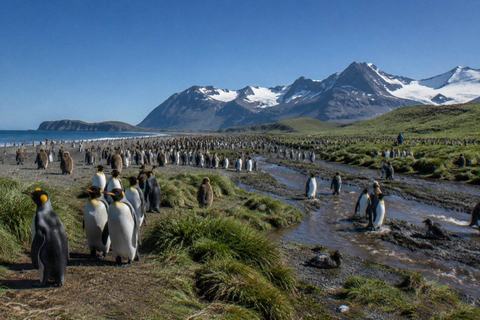 South Georgia CruisesThe 18-to-22-day Falklands, South Georgia and Peninsula itinerary, the premium wildlife cruise.Read the guide
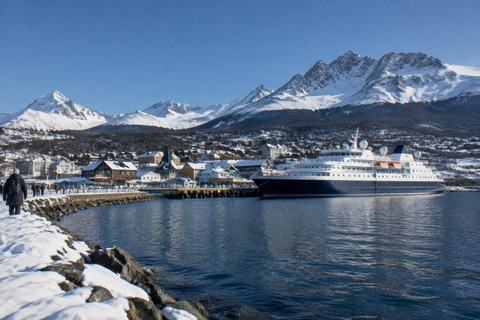 Cruises From UshuaiaShips, routes, fares and arrival logistics for the world's main Antarctica departure port.Read the guide