Antarctica Expedition Cruise: How It Works Day By Day
 By Oleg G.
An expedition cruise to Antarctica is sold on one thing: getting off the ship. Here is how the days actually run, from the morning briefing to the boot wash to the two-day crossing.
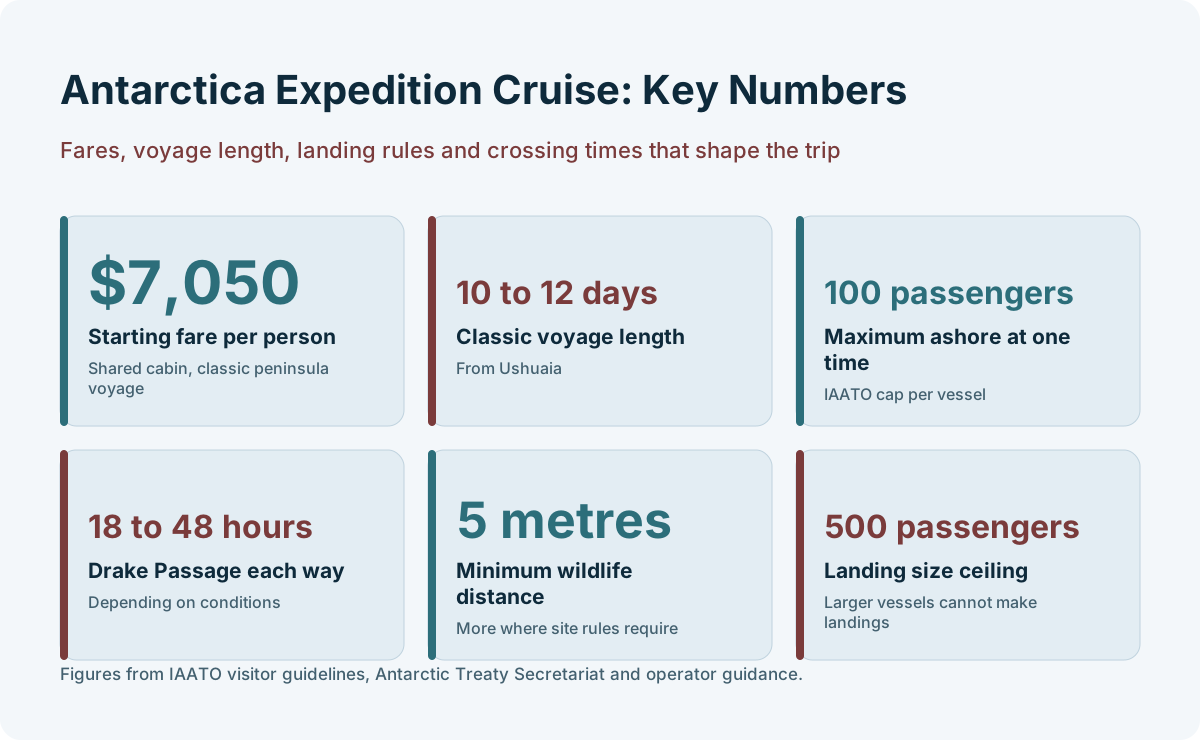
Quick answer: An Antarctica expedition cruise is a small-ship voyage built around Zodiac landings rather than onboard entertainment. Rules cap landings at 100 passengers ashore per ship at one time, with one guide per 20 guests. Classic Antarctic Peninsula voyages run 10 to 12 days from Ushuaia, spend 4 to 6 days on landings, and start from $7,050 per person in a shared cabin.
What Is An Antarctica Expedition Cruise?
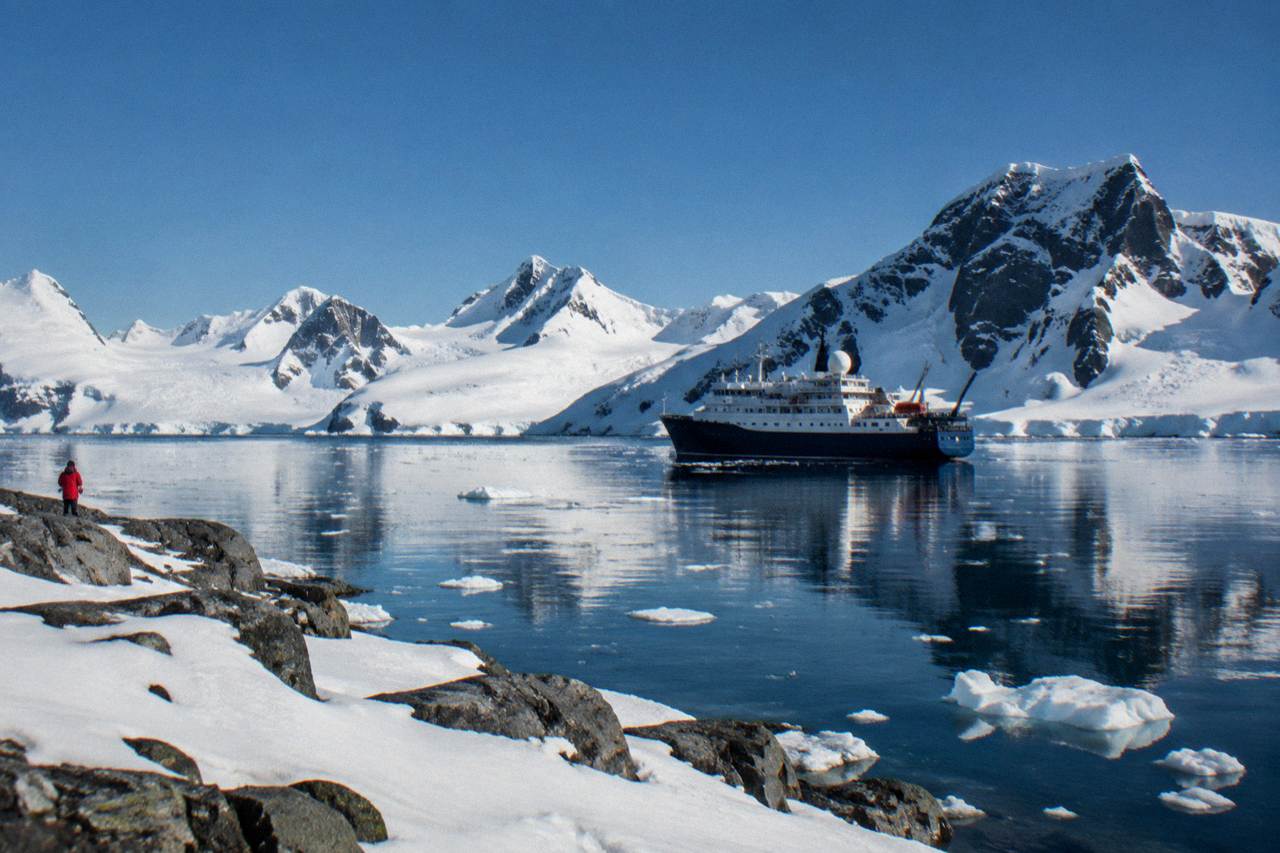
An Antarctica expedition cruise is a sea voyage on an ice-strengthened ship carrying roughly 80 to 500 passengers, sold on its off-ship programme rather than its entertainment. Landings by inflatable Zodiac, guided walks and lectures are the product. Classic Antarctic Peninsula voyages run 10 to 12 days from Ushuaia and start from $7,050 per person in a shared cabin.
The thing you are buying is not the ship; it is the landing. Approximately 98 percent of all tourism voyages in Antarctica happen in the Antarctic Peninsula across the seven-month austral summer from October to April, according to the Antarctic Treaty Secretariat's tourism page, and nearly every expedition cruise among them is built around putting passengers ashore in small inflatable boats. Large cruise ships do call in Antarctic waters, but vessels carrying more than 500 fare-paying passengers are prohibited from making landings at all. The ships that matter for an expedition cruise are therefore small: lecture lounges, Zodiac garages and mudrooms instead of promenades and theatre productions.
Across the ship roster tracked at Cruises In Antarctica, expedition vessels run from 90 berths on Antarpply's Ushuaia to 490 guests on HX's newest ships, and the fare ladder starts at $7,050 per person for a shared cabin on Oceanwide's Plancius. Cabin categories matter less here than on a warm-water cruise, because you will spend most daylight hours in a parka, in a Zodiac, or standing on a beach with a penguin colony a short walk away. What you are really choosing, when you choose a ship, is how many people land with you and how often.
How A Day Runs On An Antarctica Expedition Cruise
A landing day runs on a simple loop: breakfast, a short briefing where the expedition leader announces the plan, then a morning ashore or in the Zodiacs, lunch back on board while the ship repositions, a second outing in the afternoon, and a recap with the guide team before dinner. Sea days replace the outings with lectures.
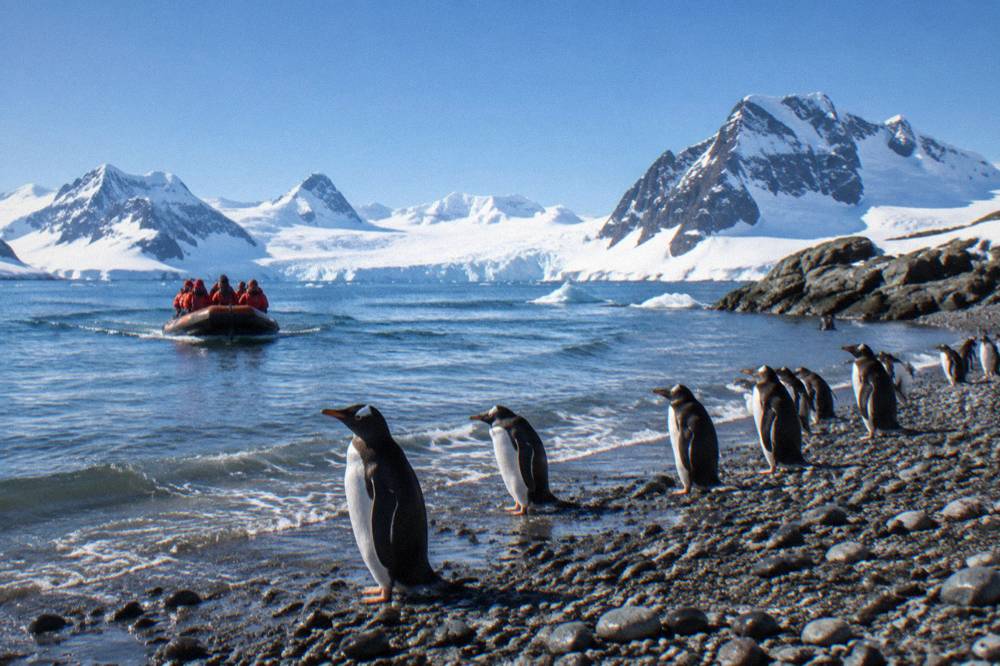
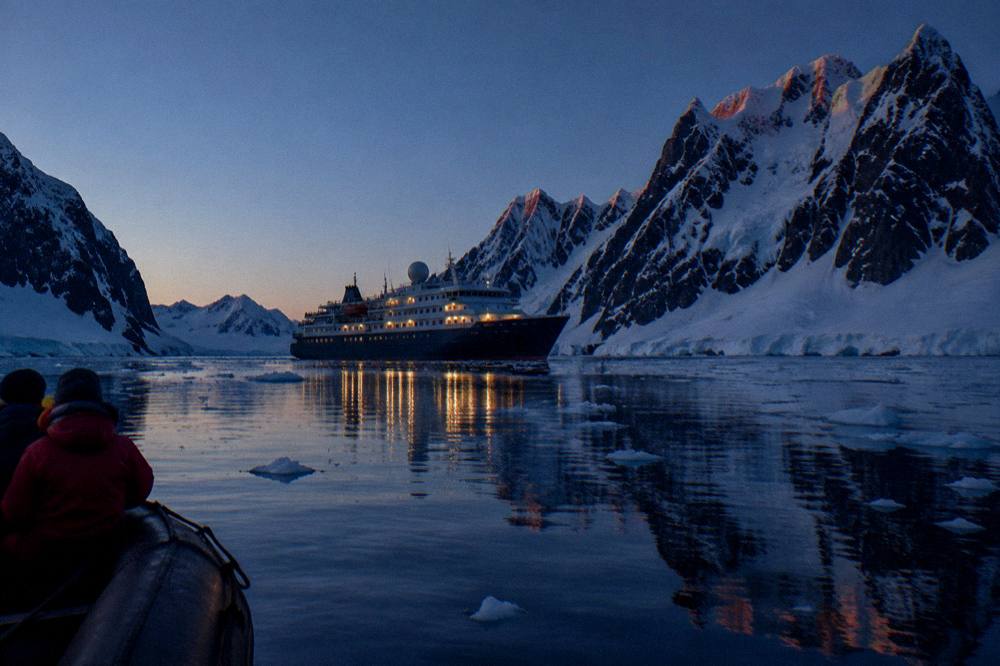
The morning briefing is the anchor of the day. The expedition leader names the site, describes the landing, flags the wildlife rules and splits guests into groups if rotations are needed. After that the mudroom opens: rows of lockers, rubber boots, and a queue of red parkas working down the gangway steps into the Zodiacs, which shuttle between the ship and the shore in loads of roughly eight to twelve people. Nobody rushes, because with only one ship per site and a hundred-person ashore cap there is no crowd to fight.
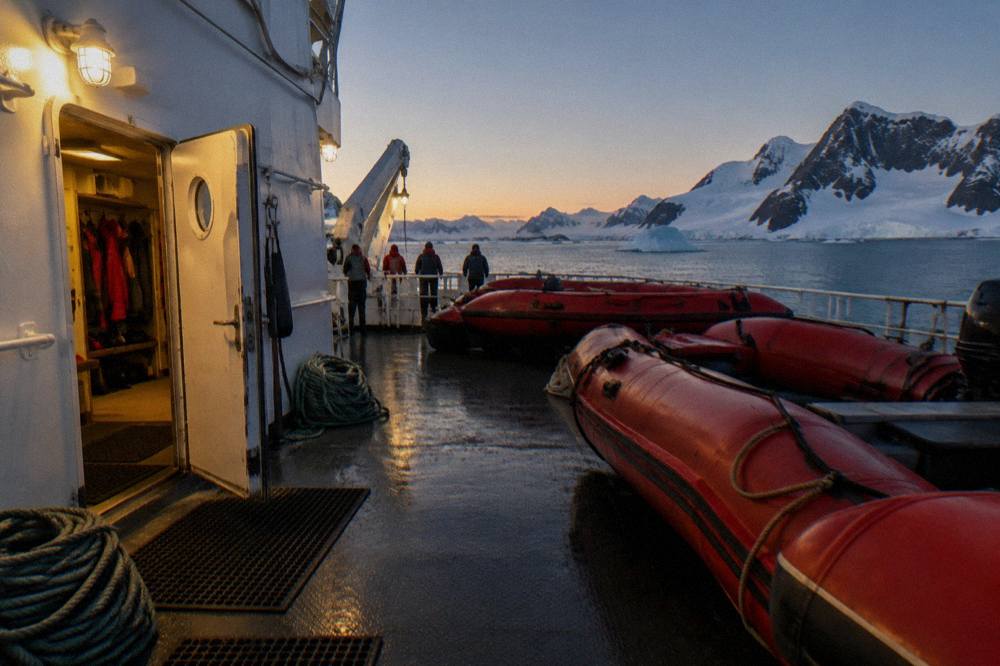
Afternoon brings either a second landing or a Zodiac cruise along the ice edge, where whales, seals and porpoising penguins are often the show. Then the ship lifts anchor and repositions overnight. The shape of the day is flexible by design: the plan announced at breakfast can change with wind, swell or ice, and the expedition team will say so plainly at the evening recap.
| Part of the day | What usually happens |
|---|---|
| Early morning | Breakfast; the expedition leader confirms the site and conditions |
| Morning | First landing or Zodiac cruise, often run in rotations |
| Midday | Lunch on board while the ship repositions toward the next site |
| Afternoon | Second outing: a landing, a Zodiac cruise or a scenic sail |
| Evening | Recap of the day, plan for tomorrow, a lecture, dinner |
| Overnight | The ship sails on or holds position; a new anchorage by breakfast |
Zodiac Landings And The 100-Passenger Rule
IAATO rules allow a maximum of 100 passengers ashore from any vessel at one time, require at least one actively guiding staff member for every 20 visitors, and bar ships carrying more than 500 passengers from landings altogether. Only one ship may visit a site at a time. Small ships land everyone together; larger ships rotate.
These three numbers do more to shape your voyage than any brochure paragraph. The caps come from the general visitor guidelines agreed under the Antarctic Treaty system, and every IAATO operator works inside them. On a ship carrying 100 guests or fewer, everyone can be ashore at once. On a 130-guest ship such as Greg Mortimer, the landing runs as two quick groups. On a 170-guest ship such as Hondius, the landing runs as two waves. On a 500-passenger vessel, nobody lands at all.
| Rule | What the guideline says | What it means on your voyage |
|---|---|---|
| Ashore cap | A maximum of 100 passengers may be ashore from a vessel at any one time, unless site guidance requires fewer | Ships above 100 guests split landings into rotations |
| Guide ratio | At least one actively guiding staff member per 20 visitors | A 130-guest ship lands with at least seven guides |
| Ship size ceiling | Vessels with more than 500 passengers shall not make landings | Large cruise ships sightsee from the water only |
| One ship per site | Only one ship may visit a site at any one time | Captains coordinate through the IAATO scheduler for quiet windows |
| Wildlife distance | Keep at least 5 metres from wildlife on land | More where nesting or site rules require; guides set the line |
The one-ship-per-site rule is the detail most first-time buyers miss. IAATO operators coordinate through a shared scheduler so that two vessels do not arrive at the same anchorage, which is why your daily plan sometimes lists a "possible site" rather than a confirmed one. Behind the scenes, the operator also carries the paperwork: United States-based operators must submit environmental documentation to the Environmental Protection Agency before running expeditions, and passengers book nothing with any authority themselves.
This is the real ship-size decision when you book an expedition cruise, and it is worth thinking through before you look at cabin categories. A ship under 100 guests lands everyone at once and moves on; a 200-guest ship gives you longer ashore per rotation but fewer total landings in a week. If maximising time on the continent is the goal, the smaller berth usually wins.
Biosecurity: Why Your Boots Get Washed Twice A Day
Before and between every landing you clean: boots go through a wash station or boot bath, and Velcro, pockets and bag flaps get picked and vacuumed. The general visitor guidelines ask travellers to wash boots and clean all equipment, including clothes, bags, tripods, tents and walking sticks, before arrival and again between sites.
Biosecurity exists to stop seeds, soil and pathogens, including avian influenza, travelling between colonies and continents. In practice it becomes part of the day's rhythm. You step into a tray of disinfectant before every Zodiac boarding, brushes sit at the top of every gangway, and before each landing the guide team may run a gear inspection on deck. Under protocols operating through the current seasons, sitting or kneeling on the ground in wildlife areas is off the menu, which is one reason photographers bring low tripods rather than mats.
The cleaning starts at home, not on the ship. Anything with Velcro, pockets or straps, right down to walking sticks and tripod feet, should be vacuumed and free of soil before you pack it. Our packing list for Antarctica covers which items cause the most trouble at the boot-wash tray, and which gear the ships loan out so you can leave at home.
None of this slows a landing down. A full biosecurity check for 100 guests takes minutes, the wash stations sit directly in the mudroom flow, and after the first day the routine becomes automatic: boots in the tray, gear picked clean, gloves on, into the boat.
Lectures, Science And Evenings On Board
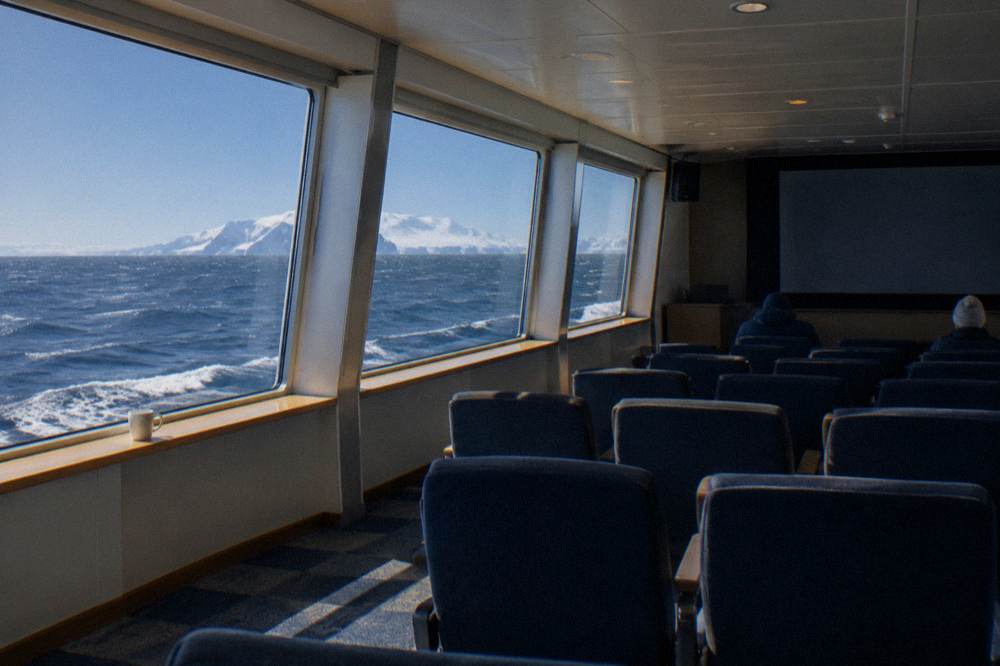
Onboard life is built around the expedition team. Evenings and sea days carry a lecture programme covering polar history, seabird and whale identification, photography and the next day's landing sites, and many ships run citizen-science projects guests can join. The evening programme is tomorrow's briefing, and the outer decks carry their own show in the midnight light.
The lecture lounge is where an expedition ship earns its fare. Teams typically include historians, ornithologists, marine mammal specialists and glaciologists, and the talks are pitched at interested amateurs rather than academics. On the 2026-27 season, AE Expeditions alone plans 18 scientists across 11 voyages covering whale ecology, penguins, biodiversity and colossal squid research, and several operators invite guests to join the data collection as part of citizen-science programmes. Newer tonnage takes this further: World Voyager, in the Quark fleet, carries a dedicated Science Hub.
Two years of reading deck plans and operator schedules for this site left one impression: the quality of the expedition team shapes the average day far more than the cabin category does. The cabin is where you sleep. The team is what turns a Zodiac ride into an hour of identifiable whale behaviour.
Activity add-ons extend the day further. Several ships in the current roster run kayak programmes, a few offer camping or stand-up paddleboarding, and HX expanded its kayaking and camping options after a record 34 Antarctica voyages in its 2025-26 season. These usually carry a surcharge, limited spaces and a sign-up sheet that opens on day one, so if a kayak morning matters to you, it belongs in the booking conversation rather than the boarding queue.
The Drake Passage Days At Sea
The Drake Passage crossing from Ushuaia takes roughly two days in each direction. Quark Expeditions' guidance puts a passage at 18 to 48 hours depending on conditions; one geography magazine's breakdown estimates about 70 percent of crossings run calm and about 30 percent rough. Those two days are filled with lectures, seabird watches and sleep.
The crossing is the price of admission and the most common worry in the booking conversation. Quark's own comparison frames the sail at 18 to 48 hours each way, and the vessel, the weather and the captain's course decide where in that band you land. One magazine estimate puts roughly 70 percent of crossings in the calm "Drake Lake" camp and about 30 percent in the "Drake Shake"; a polar guide publisher gives typical swells of 3 to 5 metres. Modern expedition ships carry retractable fin stabilisers, and several newer hulls use X-BOW designs that split waves rather than slam them.
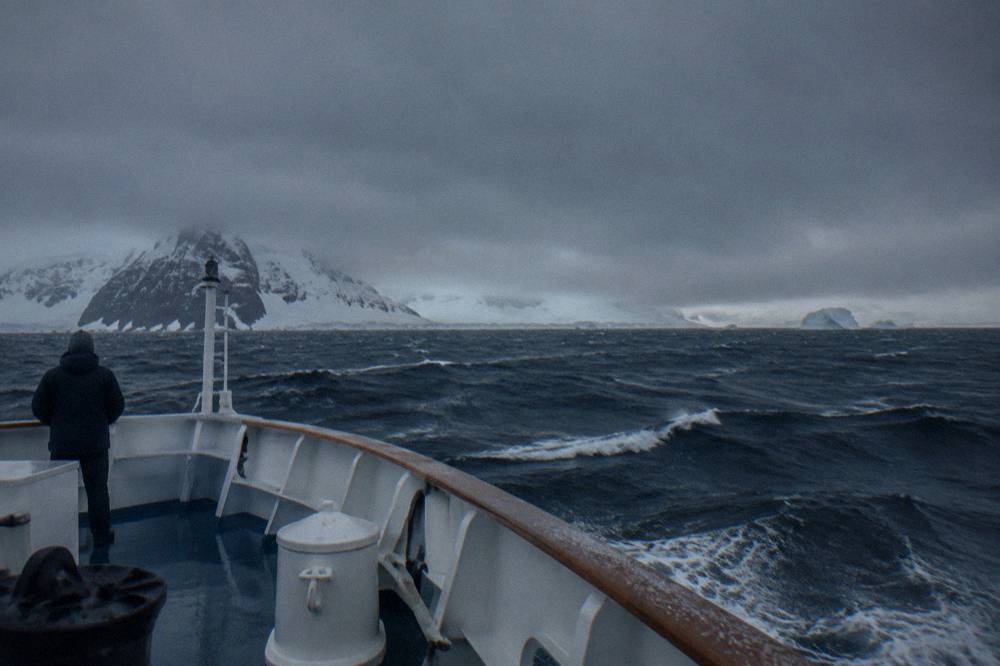
The days themselves are not lost time. Albatross and petrels follow the ship, the lecture programme runs back to back, the bridge or observation lounge is the best seat in the Southern Ocean, and by the second afternoon the first icebergs appear on the horizon. If you want the full picture of what those two days feel like, including the calm-versus-rough odds, our Drake Passage crossing guide goes deep on it.
The alternative is to fly. A charter flight from Punta Arenas to King George Island takes roughly two hours and skips the passage entirely, a model Antarctica21 has run since 2003, with trade-offs: cost guides report fly options typically add $2,000 to $5,000 over comparable sailing voyages, and the flights themselves are weather-dependent. Sail-and-fly hybrids cross by ship one way and fly the other. If the crossing question is the one holding up your booking, it is worth getting help weighing sail versus fly before you commit either way.
What A Typical 10 To 12 Day Voyage Looks Like
A classic 11-day Peninsula voyage spends day 1 embarking in Ushuaia, days 2 and 3 crossing the Drake Passage southbound, days 4 through 8 on landings across the South Shetland Islands and the western Peninsula, days 9 and 10 recrossing northbound, and day 11 disembarking. Operators typically allocate four to six days to landings on this route.
That allocation is the number worth memorising. Whatever the brochure promises, the classic Peninsula itinerary banks four to six days of actual landing weather across the South Shetlands and the western Peninsula, then protects it with flexibility: sites are chosen the evening before, and the expedition leader swaps Neko Harbour for Paradise Bay, or Half Moon Island for a Whalers Bay landing on Deception Island, based on wind and swell. Port Lockroy, the old British base with its post office, is a regular call on this circuit.
| Days | Where you are | What happens |
|---|---|---|
| Day 1 | Ushuaia | Afternoon embarkation; the expedition team's welcome briefing |
| Days 2-3 | Drake Passage | Southbound crossing: lectures, seabirds, biosecurity checks |
| Day 4 | South Shetland Islands | First landings; sites such as Half Moon Island or Whalers Bay |
| Days 5-7 | Western Peninsula | Landings and Zodiac cruises among sites such as Neko Harbour, Paradise Bay and Port Lockroy; scenic sailing when ice allows |
| Day 8 | Northern Peninsula or Shetlands | Final landings; often a polar plunge on ships that offer it |
| Days 9-10 | Drake Passage | Northbound crossing: packing, photo shares, the last lectures |
| Day 11 | Ushuaia | Morning disembarkation |
Timing within the season changes what you see on those landing days. The season runs from mid-October to mid-March; November brings courtship, maximum snow and pristine landings; penguin chicks typically hatch from mid-December; and whale sightings build from mid-January onward as krill draws humpbacks toward the coast. Longer itineraries extend the same structure: Falklands, South Georgia and Peninsula combinations run 20 to 23 days, and some 2026-27 sailings attempt an Antarctic Circle crossing as a southern extension.
Choosing A Ship: Hondius, National Geographic Resolution Or Greg Mortimer
Hondius, from Oceanwide Expeditions, carries 170 guests on Peninsula voyages from $7,800 per person; National Geographic Resolution, from Lindblad Expeditions, carries 138 guests from $11,900 on a 12-day voyage; Greg Mortimer, from Aurora Expeditions, carries 130 guests from $19,521. All three sail from Ushuaia.
Three ships from three operators make a useful spread of what an expedition cruise can look like at different price tiers, because they differ in size, style and inclusion more than in destination.
| Ship | Class | Passengers | Ice class | From, per person | Voyage length | Departs from |
|---|---|---|---|---|---|---|
| HondiusOceanwide Expeditions | Small-Ship Budget | 170 | Polar Class 6 | from $7,800 | 11 to 19 days | Ushuaia |
| National Geographic ResolutionLindblad Expeditions (with National Geographic) | Standard Expedition | 138 | PC5 | from $11,900 | 12 to 25 days | Ushuaia |
| Greg MortimerAurora Expeditions | Upscale Expedition | 130 | – | from $19,521 | 12 to 26 days | Ushuaia |
Hondius is the value anchor of the comparison. Oceanwide's 2019-built ship carries 170 guests in 80 cabins, was the first vessel registered to Polar Class 6 in the world in the operator's wording, and runs 11, 13 and 19-day routes from Ushuaia with Peninsula fares from $7,800 per person. At 170 guests, landings run in two rotations rather than one, which is the honest trade for a fare several thousand dollars below the mid tier. Our guide to Hondius covers the cabin categories and route choices in detail.
National Geographic Resolution sits a tier up. The 2021-built sister ship to National Geographic Endurance carries 138 guests, holds Polar Code PC5 Category A, and uses a patented X-Bow hull that splits head seas rather than pounding them, a genuine comfort on Drake days. Lindblad's listing shows a 12-day Voyage to Antarctica starting from $11,900 per person, and the fare structure leans inclusive: the operator bundles a pre-cruise Buenos Aires hotel, the charter flight to Ushuaia, alcoholic beverages, prepaid gratuities and an expedition jacket. If the X-Bow concept appeals to you, Aurora Expeditions has its own take on the design, and our guide to the Douglas Mawson, Aurora's newest X-BOW expedition ship covers how it stacks up against its fleetmates and what a voyage costs.
Greg Mortimer is the expedition-style pick of the three. Aurora's 2019-built, 130-guest ship carries an Ulstein X-BOW, keeps the guest count at the level where a single landing rotation covers everyone, and lists Peninsula voyages such as a 12-day photography-focused itinerary from $19,521 per person. The roster runs from 12 to 26 days, so the same hull can serve a first-timer and a South Georgia returnee.
For the wider fleet beyond these three, from Ponant's luxury sisters to Atlas's yacht-style ships, the full ship comparison guide lines up the current roster by class, capacity and fare. And if the choice has narrowed to two ships, it costs nothing to talk through ship choice for free with a specialist who books these voyages weekly.
What An Antarctica Expedition Cruise Costs
Published Peninsula fares across the main operators start near $7,050 per person in a shared triple or quad on the oldest ships and run up through $11,900 to $14,114 in the mid tier and $18,700 to $26,780 in the luxury tier. One cost guide puts a realistic all-in budget, flights and insurance included, at $12,000 to $25,000 per person.
The fare ladder is wide but legible. At the bottom sit Oceanwide's older tonnage, Plancius from $7,050 and Ortelius from $7,800, alongside other budget berths in the $7,500 to $8,995 band that cost guides report for entry-level twin and triple cabins on Drake-crossing itineraries. The middle tier holds Lindblad from $11,900, Atlas from $12,150 to $14,114 and Quark's Antarctic Explorer from $12,236, a voyage-level fare shared across Ultramarine, Ocean Explorer and World Voyager rather than tied to one ship. Ponant's luxury sisters run from $18,700 to $26,780 on their Peninsula and loop routes.
| Line item | Typical treatment | Figure to plan around |
|---|---|---|
| Entry berth | Shared triple or quad on older ice-class ships | $7,050 to $8,995 per person |
| Mid-tier fare | Newer ships, better cabins, more inclusions | roughly $11,900 to $14,114 |
| Luxury fare | Suites with drinks and gratuities included | $18,700 to $26,780 |
| Parka and boots | Most operators provide a parka, often to keep, and loan waterproof boots | included on most lines |
| Gratuities | Tipped separately unless the line prepays them | about $15 to $25 per person per day |
| Travel insurance | Not part of base fares; medical evacuation cover is required or recommended | each operator states its own evacuation minimum |
| Single supplement | Charged when a cabin is booked for one | from 25 percent extra to 1.5 to 2 times the twin rate |
The extras are predictable once you know them. Travel insurance with medical evacuation is required or recommended by most operators and never rides inside the base fare; operators such as Quark, Ponant and Lindblad set their own evacuation-cover minimums, which differ by line, so check the requirement before you buy a policy. Tips average around $16 per person per day by one cost guide's estimate, unless the fare prepays them as Lindblad's does. Flights to Ushuaia are your own book, and international arrivals connect through Buenos Aires, where a domestic transfer to Ushuaia needs a generous buffer.
Booking timing matters as much as tier. Peak December sailings can fill 18 or more months ahead, cost guides report, while early-booking offers for the coming seasons commonly run 10 to 30 percent off, and last-minute discounts exist but with thin cabin choice. The practical move is to fix your month, tier and ship size first, then chase the fare, and a free session to compare current fares with a specialist is the fastest way to see which departures actually fit that shortlist.
Common Questions About Antarctica Expedition Cruises
Do You Actually Get Off The Ship On An Expedition Cruise?
Yes, landings are the entire product. IAATO rules allow up to 100 passengers ashore from a vessel at any one time with at least one guide per 20 guests, and classic Peninsula voyages bank four to six landing days, usually with a morning and an afternoon outing each day.
What Is The Difference Between An Expedition Cruise And A Regular Cruise?
Size and purpose. Vessels carrying more than 500 passengers cannot make landings in Antarctica at all, so expedition ships stay small, carry Zodiacs and an expedition team instead of production entertainment, and sell the days off the ship rather than the days on it.
How Many Landings Do You Get On A Classic Peninsula Voyage?
On a 10 to 12 day itinerary, expect roughly four to six days of landing operations across the South Shetland Islands and the western Peninsula, with one or two outings per day depending on weather, ice and the ashore-cap rotations your ship size requires.
Can You Do An Expedition Cruise Without Sailing The Drake Passage?
Yes. Fly-cruise voyages replace the two-day crossing with a roughly two-hour charter flight from Punta Arenas to King George Island, a model Antarctica21 has operated since 2003. Cost guides report the flight typically adds $2,000 to $5,000 over a comparable sailing voyage, and the flights are weather-dependent.
When Should You Book An Antarctica Expedition Cruise?
Peak December departures can fill 18 or more months ahead, according to cost guides, while early-booking offers for coming seasons commonly run 10 to 30 percent off. Entry-tier berths from around $7,050 move first, so budget shared cabins reward the earliest decisions.