Antarctica Cruise Medical Forms, CPAP And Onboard Doctors
 By Oleg G.
Most Antarctica expedition operators ask every booked passenger to complete a medical questionnaire before sailing, and several require a doctor's signature on that paperwork. Oceanwide, for one, asks about any health problem needing emergency care, and operators set firm deadlines for returning them. This guide sets out only what the operator pages actually state: which lines require a signed form, how CPAP machines are handled, and where a doctor sails with you.
Quick answer: Most Antarctica expedition operators require a medical questionnaire after booking, and several require a doctor's signature. Quark asks for medical forms no later than 90 days before Day 1 of the voyage, while Oceanwide wants its Personal Information Form within a month of booking. Oceanwide allows CPAP on all its vessels, and its Hondius, Plancius and Ortelius each carry an onboard doctor.
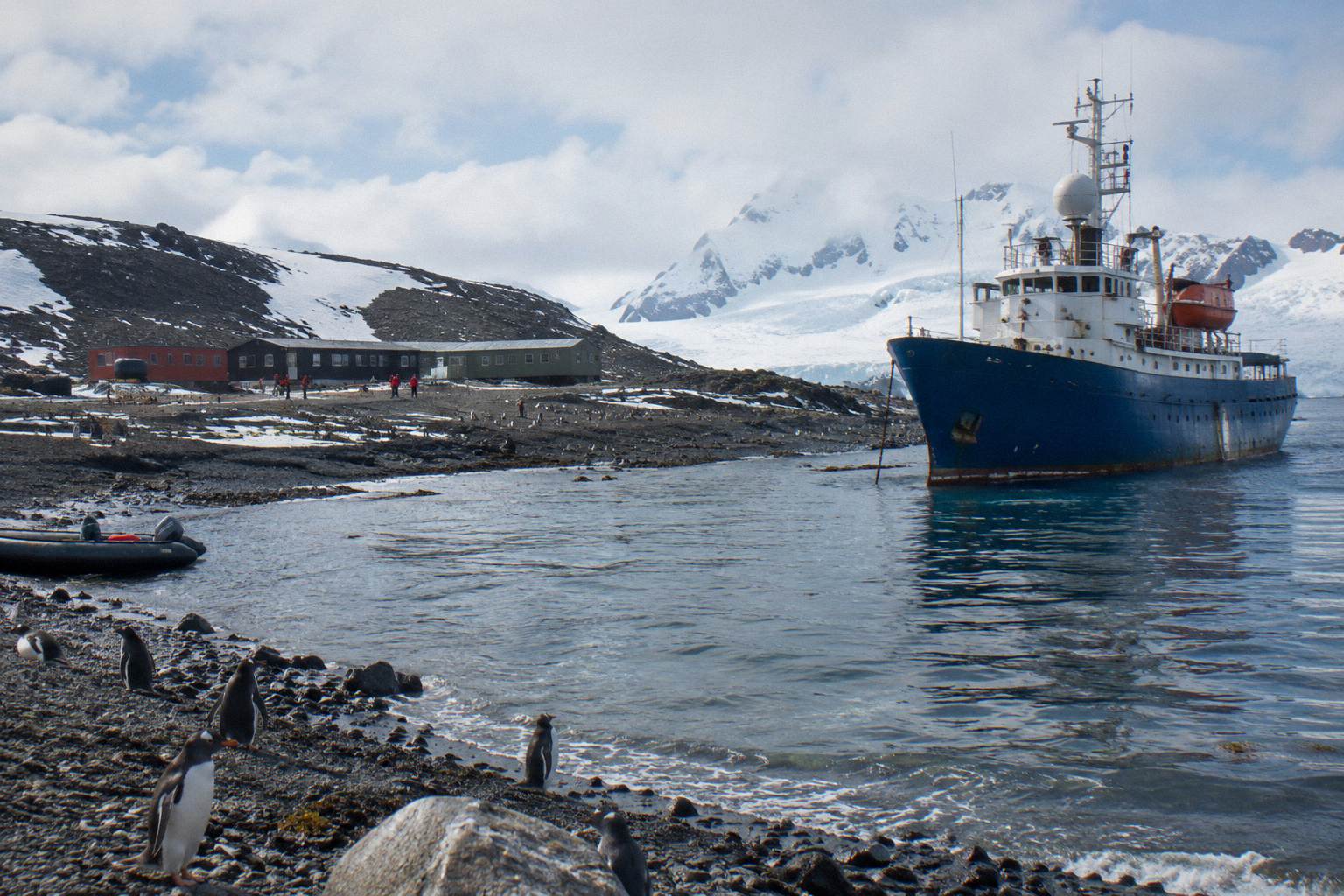
Most Antarctica expedition operators ask every booked passenger to complete a medical questionnaire before the voyage, and several require a doctor's signature on that paperwork. Oceanwide, for example, asks you to disclose any health problem that could need emergency care, and operators attach firm deadlines to the return of the forms. This guide reports only what operator pages and official documents state, flags where a policy is not published, and links to the planning guides that pick up the adjacent questions.
What Is An Antarctica Cruise Medical Form?
A medical form is a questionnaire about your health that the operator asks you to complete after booking an Antarctic voyage. Some operators ask for a doctor's signature on it. Oceanwide asks specifically about any health problem that could need emergency care, and the operator uses the answers to plan support for the sailing. Deadlines for returning it are stated in the booking terms.
The form is not an application you can fail in a general sense, and it is not a visa document either. It is a planning tool. An expedition cruise to Antarctica operates in a very remote region, so the operator needs to know, before the ship leaves Ushuaia, what support each of its passengers might need.
What varies between operators is the paperwork's name, who must sign it and when it is due. Quark Expeditions sends its medical forms by email link and treats the completed submission as a booking condition. Oceanwide Expeditions uses a Personal Information Form, and its FAQ states that any health problem requiring emergency care must be disclosed on it before the voyage. Other operators use a medical questionnaire signed by the passenger's own doctor. The planning guides on Cruises In Antarctica cover the rest of the pre-departure checklist, but this page stays on the health paperwork.
One point worth separating early: the medical form is a requirement of the operator, not of any government. The paperwork you complete goes to the expedition company.
Which Operators Require A Doctor-Signed Medical Form?
Quark Expeditions requires medical forms to be completed no later than 90 days before Day 1 of the voyage, or immediately if you book within that window. Oceanwide Expeditions asks for its Personal Information Form within one month of booking. Many operators require a questionnaire signed by your doctor, with deadlines that typically fall 30 to 90 days before departure.
The clearest published deadlines come from the operators' own pages. Quark's expedition contract states that medical forms are sent via an email link and must be completed and submitted no later than 90 days before Day 1, or immediately if the booking is made inside 90 days. Oceanwide's FAQ asks that the Personal Information Form be returned within one month of booking, and separately states that any health problem requiring emergency care must be disclosed before the expedition. Beyond those two, most operators require a medical questionnaire completed and signed by a doctor, with deadlines varying, 30 to 90 days being typical, with Polar Quest, for example, at 30 days prior to departure.
| Operator | What the operator page states | Stated deadline |
|---|---|---|
| Quark Expeditions | Medical forms sent by email link; completion is a booking requirement | No later than 90 days before Day 1, or immediately if booked within 90 days |
| Oceanwide Expeditions | Personal Information Form; emergency-care health problems must be disclosed | Returned within one month of booking |
| Polar Quest (cited example) | Medical questionnaire completed and signed by a doctor | 30 days prior to departure |
| Other operators generally | Doctor-signed medical questionnaire is the common pattern | 30 to 90 days before departure is the typical range |
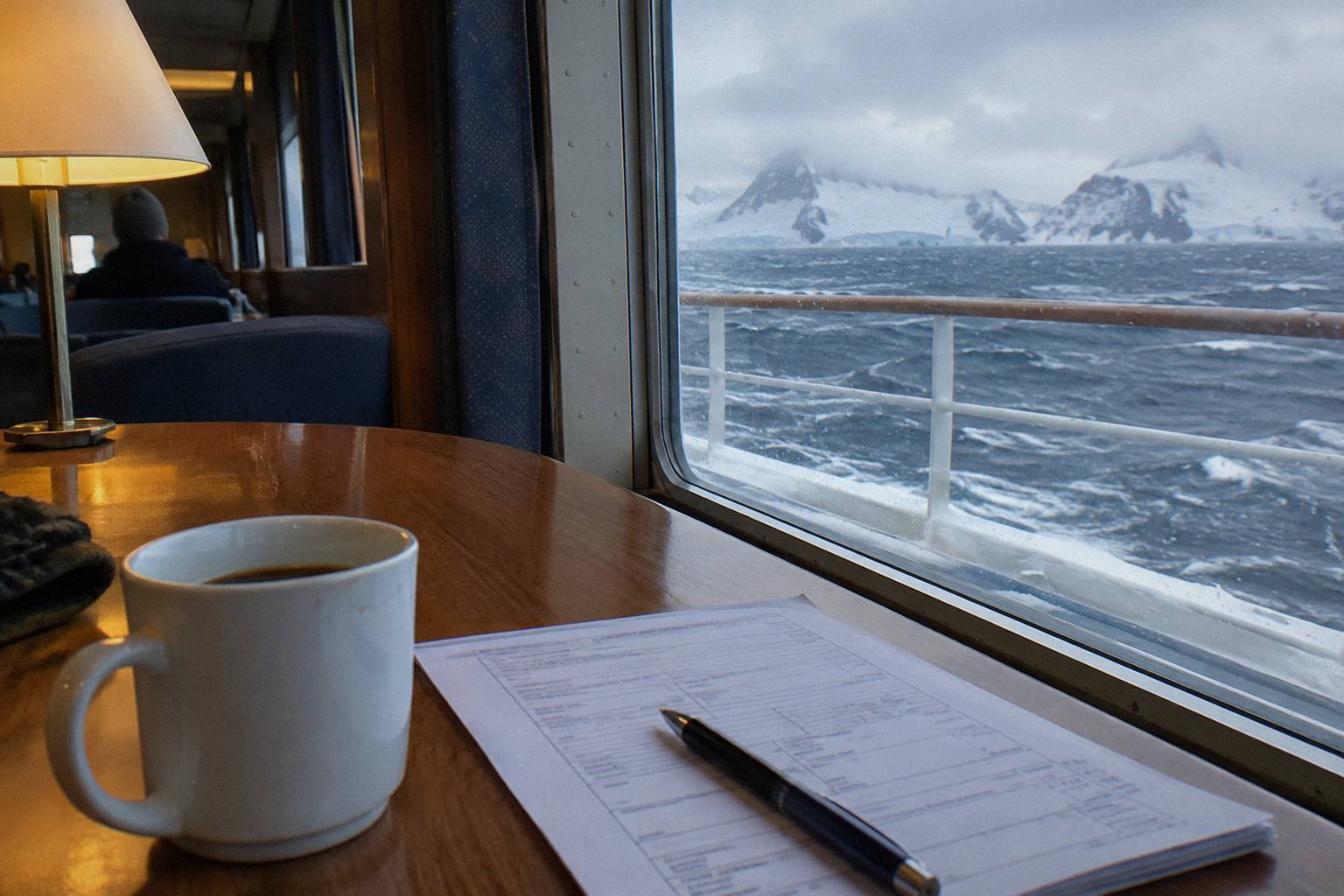
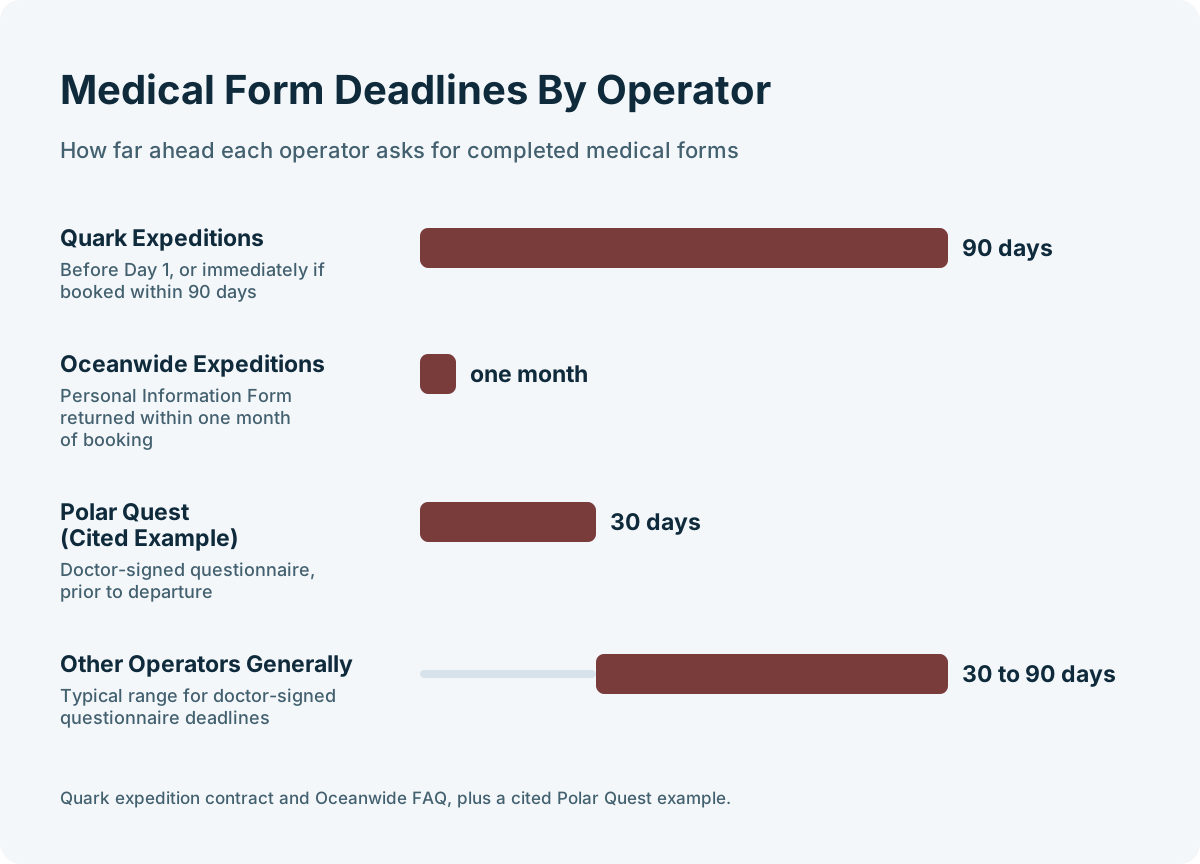
The practical takeaway is to treat the medical form as part of the booking, not as a formality for the final month. A traveller who books a cabin two weeks before sailing, which happens on last-minute departures, should expect to complete the paperwork immediately rather than on the standard schedule. If your departure is close or your situation is unusual, Quark's expedition contract and Oceanwide's health FAQ are the two pages that state their rules most plainly.
Can You Bring A CPAP Machine On An Antarctica Cruise?
Oceanwide Expeditions states that CPAP use is possible on all of its vessels and that all cabins have bedside power outlets. Distilled water is not available as standard on those ships, so travellers must inform the operator of their requirements ahead of travel. For Aurora, HX, Lindblad, Silversea, Ponant and Viking, the official FAQ pages searched do not state a CPAP policy.
That is the full extent of what we found published, and it is worth being blunt about the gap. We looked for CPAP policies covering power, outlets, distilled water and battery backup on Aurora, HX, Lindblad, Silversea, Ponant and Viking, and found none stated on their official pages. That absence is not a ban and not permission either; it means the question has to be asked directly before you commit to a cabin.
| Question | What the operator pages state |
|---|---|
| Can I use a CPAP machine on board? | Yes on all Oceanwide vessels, per the operator's FAQ |
| Is there power at the bed? | Oceanwide states all cabins have bedside power outlets |
| What about distilled water? | Not available as standard on Oceanwide ships; bring or arrange it, and inform the operator ahead |
| What do other lines say? | No CPAP policy found on the official FAQ pages of Aurora, HX, Lindblad, Silversea, Ponant or Viking |
The reason the question matters more on an expedition cruise than on a Caribbean sailing is power and supply. Distilled water is not standard on Oceanwide ships, and outlets, while present at every Oceanwide bedside, are not stated in writing by every line. The sensible sequence is to settle the equipment question first, then book. If a CPAP, an oxygen concentrator or any powered medical device is part of your travel kit, ask about device policies before booking, and get the answer in writing with the cabin confirmation.
Is There A Doctor On The Expedition Ship?
On the ships named in operator information, yes. An onboard doctor and clinic are reported on Hondius, Plancius and Ortelius, and on Quark's ships. Medical staffing is not published for every vessel in the industry, so the ship you are considering should be checked on its operator page before you book a cabin.
The published pattern is that an onboard doctor and clinic are present on larger vessels, with Oceanwide's three ships and Quark's fleet named as examples. On smaller vessels the staffing picture is not published, and the honest answer for any specific ship is to ask the operator rather than assume either way.
The featured ship on this page is a good illustration. Hondius, Oceanwide's 170-passenger Polar Class 6 vessel built in 2019, is one of the ships named with an onboard doctor and clinic. She sails Antarctic Peninsula voyages from Ushuaia, with Peninsula departures on the 2026-27 schedule showing fares from $7,800 per person, and her cabins run from quadruple porthole berths up to a Grand Suite with a private balcony. For travellers whose health planning centres on having a doctor aboard, she is one of the clearly documented options, and our Hondius ship guide covers her cabins and voyages in detail.
For comparison, here are two other small-to-mid polar expedition ships. Ultramarine, Quark's 199-passenger ship with a 1A+ and PC6 ice class, carries two twin-engine helicopters and 20 Zodiacs, and her Antarctic Peninsula voyages show fares from $12,236 per person, a voyage-level figure Quark shares across three of its ships. Greg Mortimer, Aurora Expeditions' 130-passenger Ulstein X-BOW vessel built in 2019, carries 15 Zodiacs with four dedicated boarding doors, and her Antarctica voyages show fares from $19,521 per person. Medical staffing for Greg Mortimer is not stated in the information we found, so ask Aurora directly.
| Ship | Class | Passengers | Ice class | From, per person | Voyage length | Departs from |
|---|---|---|---|---|---|---|
| HondiusOceanwide Expeditions | Small-Ship Budget | 170 | Polar Class 6 | from $7,800 | 11 to 19 days | Ushuaia |
| UltramarineQuark Expeditions | Upscale Expedition | 199 | 1A+, PC6 | from $12,236 | 12 to 14 days | Buenos Aires, Ushuaia |
| Greg MortimerAurora Expeditions | Upscale Expedition | 130 | – | from $19,521 | 12 to 26 days | Ushuaia |
Choosing between ships with a health requirement in mind usually comes down to questions the brochure does not answer: who signs your medical form, what the clinic carries, and how the Zodiac boarding works on a given vessel. Those are exactly the questions worth raising before a deposit.
How Fit Do You Need To Be For An Antarctic Cruise?
Operator guidance asks that travellers can walk on uneven, snowy or rocky ground, climb into and out of a Zodiac, often via steps or a platform, and manage ship movement and stairs on board. Staff assist with landings, but each passenger must be able to participate safely. The guidance describes requirements, not a fitness verdict on any individual traveller.
Operators are careful on this point, and this page keeps to their wording. The stated requirements are functional: walking on uneven terrain, climbing into and out of Zodiac landing craft, often with steps or a platform and staff assistance, and managing the movement and stairways of a ship at sea. Nothing in the operator guidance we found converts that into a rule about age, weight or any named medical condition, and no medical suitability claim belongs on this page.
What the guidance does say is that landing difficulty varies by site and weather, that wet and dry landings are both common, and that staff assist but passengers must participate safely. A landing can also be cancelled or shortened for weather, ice or wildlife conditions, which is worth knowing when you picture the trip: the requirement is about capability on the day, not endurance.
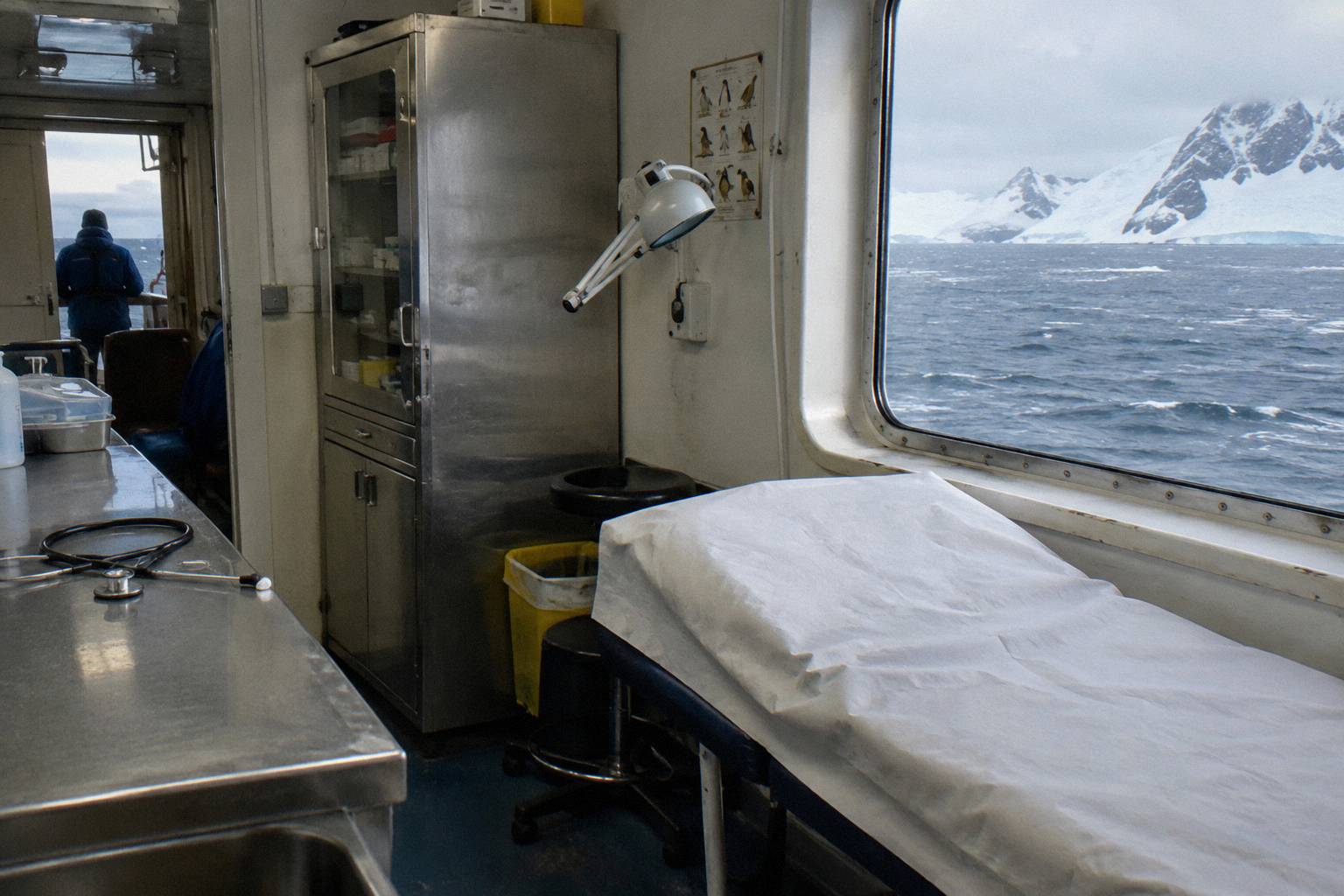
If you want to work through the physical demands in more detail, our Antarctic cruise fitness guide covers what operators ask for and how the expedition day actually runs. The medical form and the fitness expectation are two sides of the same planning step: the form tells the operator what support you need, and the fitness guidance tells you what the voyage will ask of you.
What About Limited Mobility And Wheelchair Access?
Wheelchair accessibility is limited on most expedition ships. Some newer vessels, including certain HX ships such as MS Fridtjof Nansen, have accessible cabins, elevators to passenger decks and roll-in showers. Zodiac boarding typically requires a sailor's grip and balance, which trade reporting describes as difficult or impossible with wheelchairs or walkers. Operators advise assessing mobility and give no guarantees.
This is the area where published guidance is most specific about limits. Wheelchair accessibility is limited on most expedition ships, while some newer vessels, with certain HX ships such as Fridtjof Nansen named as examples, offer accessible cabins, elevators to passenger decks and roll-in showers. The barrier is the transfer between ship and shore: Zodiac boarding typically requires a sailor's grip and the balance to step across, and trade reporting describes that as difficult or impossible for travellers using wheelchairs or walkers.
| Requirement area | What the operator guidance states |
|---|---|
| Walking ashore | Ability to walk on uneven, snowy or rocky ground |
| Zodiac transfers | Climbing into and out of Zodiacs, often via steps or platforms, with staff assistance |
| On board | Managing ship movement and stairs |
| Wheelchair users | Accessibility limited on most ships; accessible cabins exist on some newer vessels such as certain HX ships |
| Guarantees | Operators advise assessing mobility and state no guarantees of participation |
Operators also note that travellers with limited mobility may stay aboard or join Zodiac cruises only where feasible, and no guarantees are given. That is not a brush-off; it reflects that landing sites change with conditions. Our limited mobility guide goes deeper on which ship features matter and what questions to ask, and it pairs with this page's paperwork advice: the medical form is the right place to describe mobility needs in writing, early, so the expedition team can plan around them.
What Health Details Must You Disclose Before Sailing?
Oceanwide requires that any health problem needing emergency care be disclosed before the voyage through its Personal Information Form, returned within one month of booking. Beyond that, the official FAQ pages searched for the major operators do not state specific medication, dietary or allergy policies. The practical step is telling the operator your requirements early and in writing.
The disclosure rule that is published in plain words is Oceanwide's: a health problem requiring emergency care must be disclosed prior to the expedition via the Personal Information Form, which is also the form due within one month of booking. That is the operator's own framing, and it is a sensible template for any line: if a condition could require emergency care, the ship's doctor should know about it before the Drake Passage, not during it.
On medication and dietary needs, the honest position is that the official FAQ pages searched do not state specifics for the major operators: no published policy lines on vegetarian, vegan, gluten-free, kosher or halal catering, no stated timelines for allergy notification, and no detailed medication advice. We also found no published CPAP or medical-equipment policies beyond Oceanwide's, as covered earlier. None of that means the needs cannot be met; it means the answer lives in the booking conversation rather than on a public page.
The pattern that works, drawn from the operators that do publish their rules, is disclosure in writing at booking, a doctor's signature where the form asks for one, and a direct question to the operator about anything the form does not cover. Oceanwide's CPAP FAQ shows what a clear published answer looks like: use is possible on all vessels, outlets are at every bedside, distilled water is not standard, and the operator asks to be informed ahead.
How Do Medical Forms Connect To Travel Insurance?
A medical form and travel insurance are two separate requirements that both need to be in place before you sail. There is no universal insurance minimum to quote: the operator's own booking terms state what cover, if any, the line requires. The medical form tells the ship about your health; the policy pays for what goes wrong.
Keeping the two apart matters because travellers sometimes assume one covers the other. The medical form goes to the expedition operator and informs its onboard planning. Insurance is a contract between you and an insurer, and the operator's booking terms are the place that states any cover the line requires of you. Requirements differ by operator, so the right move is to read your specific operator's terms, and to ask about cover requirements when the medical form arrives.
The two documents do meet in one place: the medical form asks about conditions that could become emergencies, and an insurance policy is what responds if one does. That is why our Antarctica travel insurance guide is the natural next stop after the paperwork. If your health situation makes the choice of operator or ship feel complicated, talk through the options with a consultation before the deposit deadline, while cabins and deadlines still leave room to choose.
Common Questions About Antarctica Cruise Medical Forms
Do I need a doctor's signature on my Antarctica cruise medical form?
Many operators require a medical questionnaire completed and signed by your doctor, with deadlines typically 30 to 90 days before departure. Quark sends its forms by email link. Check your operator's booking terms for the exact requirement.
How far in advance is the medical form due?
Quark requires medical forms no later than 90 days before Day 1 of the voyage, or immediately if you book within that window. Oceanwide asks for its Personal Information Form within one month of booking. Polar Quest, for example, uses 30 days before departure.
Can I bring a CPAP machine on an Antarctic cruise?
On Oceanwide vessels, yes: the operator states CPAP use is possible on all its ships, with bedside power outlets in every cabin. Distilled water is not available as standard, so inform the operator ahead. Other major lines do not publish a CPAP policy on their official FAQ pages, so ask before booking.
Is there a doctor on board the ship?
On the ships named, yes: an onboard doctor and clinic are reported on Hondius, Plancius and Ortelius, and on Quark's ships. Medical staffing is not stated for every vessel, so confirm on the operator page for your ship.
Can I sail with limited mobility?
Operators advise assessing mobility and state no guarantees. Wheelchair accessibility is limited on most expedition ships, though some newer vessels such as certain HX ships have accessible cabins and roll-in showers. Zodiac boarding typically requires a sailor's grip and balance, described as difficult or impossible with wheelchairs or walkers.
More Planning And Preparation
 Packing ListWhat to wear, what the ship lends you, and what to leave at home.Read the guide
 Seniors GuideMobility, Zodiac boarding, the Drake Passage and medical support, assessed for older travellers.Read the guide
 Travel InsuranceWhy operators demand evacuation cover and what your policy must include.Read the guide
 Getting To AntarcticaShips, planes and gateway cities: every practical way to reach Antarctica.Read the guide