How Fit Do You Need To Be For An Antarctica Cruise?
 By Oleg G.
The honest answer to the fitness question is that a standard Antarctic Peninsula cruise does not require athletic conditioning, but it does require steady balance, a workable pair of knees and the ability to manage steps, wet ground and a moving ship. Here is what operators actually publish, what a landing physically involves, and what you can opt out of without missing the continent.
Quick answer: You need general mobility rather than fitness: the ability to walk over uneven, snowy or rocky ground for one to two hours, climb into and out of a Zodiac via steps or a platform, and manage stairs on a moving ship. Operators publish no distance or speed tests. Travellers who cannot do those things can still enjoy the cruise through Zodiac cruises and onboard programming, with no guarantees of landing participation.
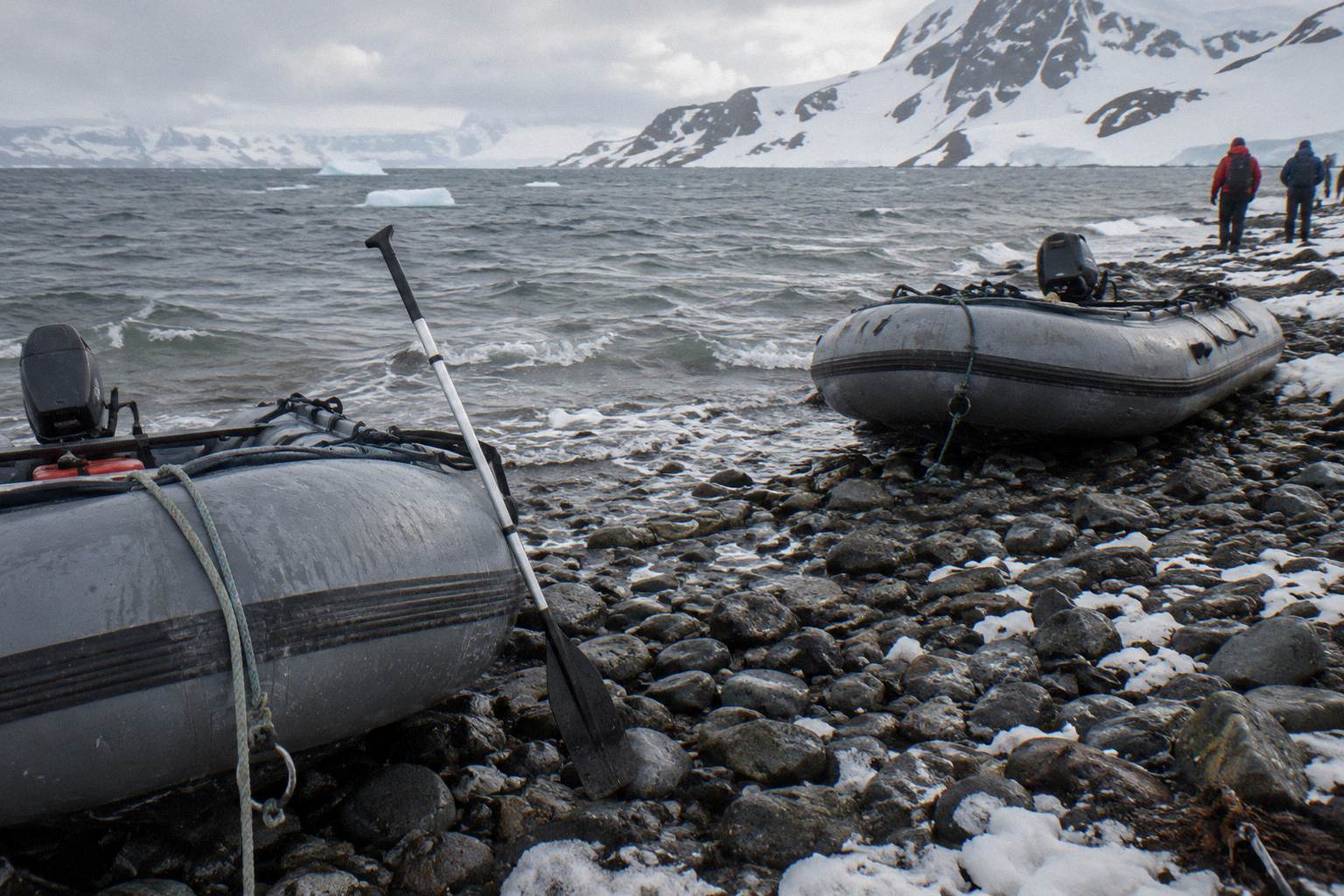
The fitness question comes up more often than almost any other in Antarctica planning, and it deserves a straight answer rather than reassurance. An expedition cruise is not a trekking holiday. Most of your day is spent on a warm ship, and the physical demands are concentrated into short bursts: a wet step out of a Zodiac, a slow walk over rocky or snowy ground, a flight of stairs while the ship moves. Whether that suits you is a question for your doctor, and the details below are worth knowing before you book a cabin.
This guide sticks to what operators and polar organisations actually publish. Nothing here is a medical suitability judgement for any individual; that is a conversation for your doctor and the operator's medical form. What we can do is describe, accurately, what the voyage will ask of your body, what the rules say about going ashore, and which parts of the cruise you can skip and still have a complete Antarctic experience.
How Fit Do You Need To Be For An Antarctica Cruise?
The baseline is functional mobility, not fitness in the gym sense: you should be able to walk on uneven, snowy or rocky ground for roughly one to two hours, climb into and out of a Zodiac, and manage stairs and a moving deck. Operator guidance describes these as participation requirements for landings rather than fitness tests, and limited-mobility passengers may stay aboard or join Zodiac cruises where feasible, with no guarantees.
Operator guidance is consistent on this point. Expedition operators state that passengers need the ability to walk on uneven, snowy or rocky ground, to climb into and out of Zodiacs, often via steps or a platform, and to manage ship movement and stairs, as one operator fitness page puts it. Nothing in the published requirements mentions pace, distance or stamina targets. The cruise itself, in other words, is built around short excursions, not endurance.
That said, honesty matters here. A landing is not a stroll on a paved path. Operators describe the ground as uneven, snowy or rocky, and difficulty varies by site and weather. Staff are present and will help, but the same operator guidance is clear that passengers must be able to participate safely themselves rather than being carried through the experience. If you are booking an Antarctica cruise and already know that a wet, slippery step is a genuine obstacle, plan for that in your cabin and ship choice rather than hoping it will not come up.
If you are unsure how your own mobility maps onto a specific departure, get free advice on ship and itinerary fit before you commit; the consultation carries no obligation and no price promise.
What Operators Say About Fitness Requirements
Published operator guidance asks for three things: walking on uneven, snowy or rocky ground, climbing into and out of Zodiacs with staff assistance, and managing a moving ship with stairs. Landing difficulty varies by site and weather, and while staff assist, passengers must be able to participate safely themselves. No operator publishes a minimum walking distance, a pace requirement or an age limit.
The clearest summary comes from operator health and fitness pages. One states plainly that travellers must be able to walk on uneven, snowy or rocky terrain, board Zodiacs via steps or platforms, and handle ship movement and stairs, and another operator's physical requirements page adds that landing difficulty varies by site and weather, that wet and dry landings are both common, and that staff assist but passengers must be able to participate safely. That last clause is the one to read twice: assistance with a Zodiac step is normal and expected, but the movement itself is yours to complete.
What operators do not publish is just as telling. None of the operator pages reviewed for this guide state an upper age limit, a weight limit or a required walking speed. Viking's expedition FAQ states a minimum age of 18 for its ships, but that is an age floor, not a ceiling. The screening mechanism operators actually use is not a fitness test at the gangway; it is the medical questionnaire, covered later in this guide, which your own doctor signs.
| Requirement | What it means in practice | Who states it |
|---|---|---|
| Walk on uneven, snowy or rocky ground | Cobble beaches, snow slopes, loose rock; typically one to two hours ashore | Operator health and fitness pages |
| Climb into and out of Zodiacs | A short ladder, steps or a platform, with staff assistance and a "sailor's grip" | Operator physical requirements pages |
| Manage ship movement and stairs | Stairways between cabins, dining and decks on a vessel that may roll in open water | Operator health and fitness pages |
| Participate safely yourself | Staff assist but do not carry the experience; you must complete the movements | Operator physical requirements pages |
One practical note on the ship movement requirement: the Drake Passage crossing is where a rolling ship is most felt, and the same balance and core stability that gets you into a Zodiac also gets you down a corridor on a swell. Our guide to the Drake Shake and seasickness covers the medication side of that crossing if rolling is your specific worry.
What A Zodiac Landing Physically Demands
A landing typically means a wet or dry step from a moving Zodiac onto a beach, then one to two hours of slow walking on cobble, sand, snow or rock with no paths and no handrails. Landings last one to two hours depending on site, weather and ship size, and the most common physical challenge is balance on uneven, sometimes slippery ground rather than distance covered.
The mechanics are worth picturing before you go. On a wet landing, the Zodiac's bow is run onto the beach and you step into shallow water wearing waterproof boots, as operator descriptions of Zodiac operations explain. On a dry landing you step onto a rock or a low platform. Either way, the boat is moving with the swell and you use the standard "sailor's grip" with crew assistance. It is a genuine weight-bearing step that needs balance.
Ashore, you walk on uneven, snowy or rocky ground. Typical time ashore is one to two hours per landing, weather and site permitting, and most Peninsula days offer one or two landings or Zodiac outings. Landing groups are supervised, and the five-metre wildlife rule means a lot of the time ashore is spent standing and watching.
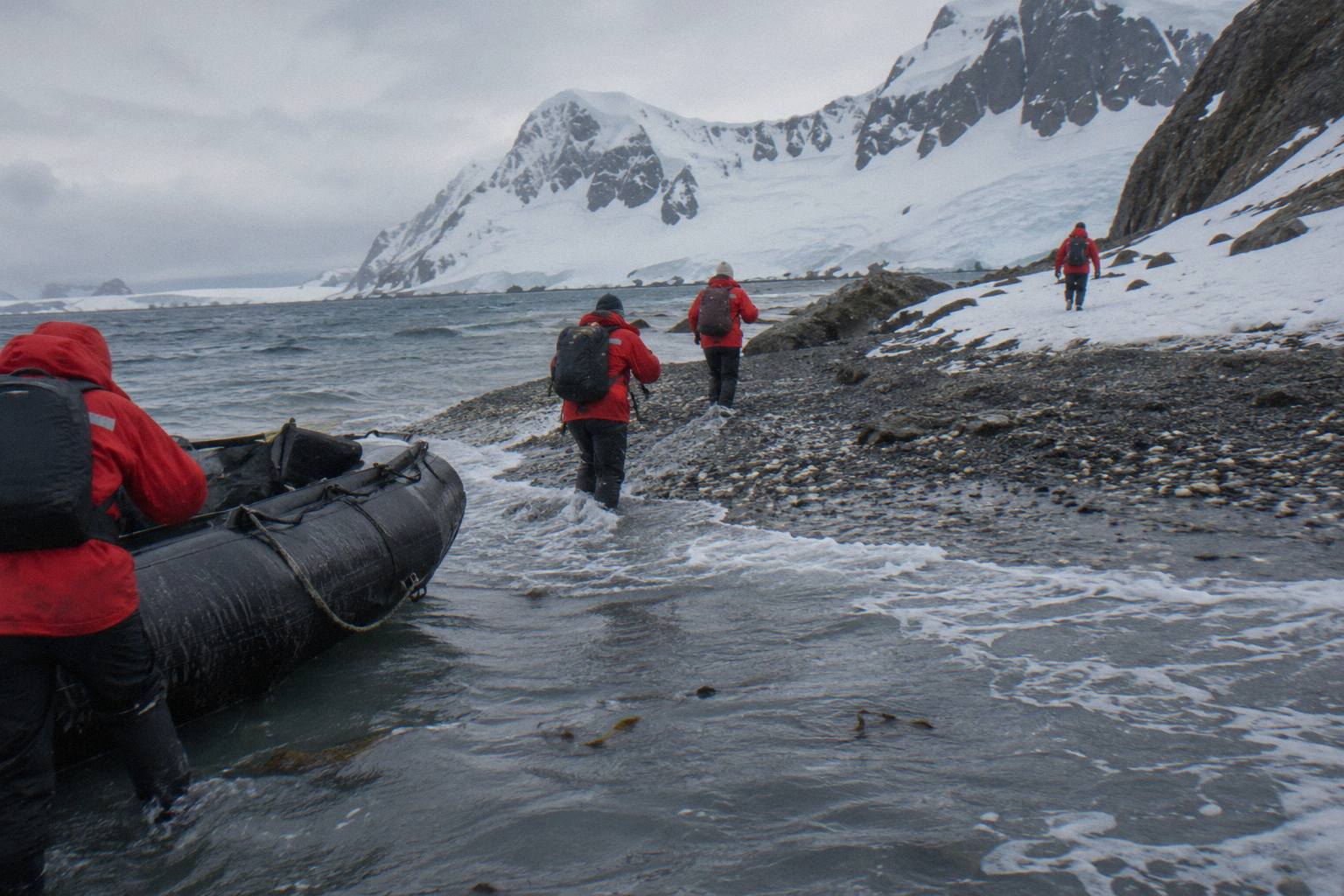
The rules that shape every landing come from the Antarctic Treaty system and IAATO. A maximum of 100 passengers may be ashore from a vessel at any one time unless site guidance requires fewer, one guide is required per 20 visitors ashore, and you must keep at least five metres from wildlife on land, all per the general visitor guidelines. Those numbers are why ships rotate groups and why your time on any given beach is bounded: the pace is set by the rules, not by your legs.
| Part of a landing | Physical demand | Typical detail |
|---|---|---|
| Boarding the Zodiac at the ship | Steps or a platform into the boat, crew-assisted | Sailor's grip |
| The ride | Seated in the Zodiac | Not stated |
| The beach step | Wet or dry step off a moving bow | Waterproof boots for wet landings |
| Walking ashore | Slow, uneven, no paths, one to two hours | Cobble, sand, snow or loose rock |
| Wildlife viewing | Stationary, standing or crouching | Minimum five metres from wildlife |
Landing Rules And Rotation Affect How Long You Walk
IAATO rules cap 100 passengers ashore at a time with a 1:20 guide ratio, which means larger ships rotate groups and your personal time on land is shorter; ships at or under about 100 passengers can land everyone at once. The rotation system, not your own stamina, is usually the binding constraint on how much walking you do in a day.
This is the part of the fitness question that surprises people. On a ship carrying 200 guests, you will be ashore in a rotation: one group lands while another Zodiacs or attends lectures, then they swap. On a ship at or under 100 passengers, everyone can be ashore together under the 100-ashore limit, which means no rotation and a longer, more relaxed window per landing. If walking stamina is your specific limitation, a smaller ship does not just feel friendlier, it structurally gives you more time to cover the same ground at your own pace.
The infographic below shows how the main rules and time figures fit together for a typical Peninsula landing day.
Our guide to Antarctica shore landings explained covers the full sequence from biosecurity check to boot wash, and the guide to Antarctica cruise ship sizes works through how passenger count changes your day.
Medical Forms, Doctors And What You Must Disclose
Most operators require a medical questionnaire completed and signed by your doctor, with deadlines typically 30 to 90 days before departure; Quark requires submission no later than 90 days before day one, and Oceanwide asks that any health problem requiring emergency care be disclosed on a form returned within one month of booking. Larger expedition vessels, including Oceanwide's Hondius, Plancius and Ortelius, carry a doctor and clinic.
The medical form is where the fitness question becomes official. It is the operator's way of knowing who is on board and whether a declared condition changes anything about your participation. Quark's expedition contract states medical forms must be completed and submitted no later than 90 days before day one, or immediately if you book within 90 days of departure. Oceanwide's guidance says any health problem requiring emergency care must be disclosed before travel via a personal information form, returned within one month of booking. Deadlines across the industry typically fall in the 30 to 90 day range before departure.
Two practical details from operator FAQs are worth knowing early. CPAP machines can be used on all Oceanwide vessels, with bedside power outlets in every cabin, but distilled water is not available as standard, so you must tell the operator your requirements ahead of time. And the presence of an onboard doctor varies by ship size: Oceanwide confirms a doctor on Hondius, Plancius and Ortelius, and whether your own ship carries one is a fair question to ask before you book a cabin. Our dedicated guide to Antarctica cruise medical forms walks through the paperwork timeline.
If a pre-existing condition is the reason you are asking the fitness question in the first place, ask about medical-form friendly operators in a free consultation rather than guessing; the hand-off is to a vetted expedition-cruise agency partner and it costs nothing.
Activities And Their Fitness Requirements
Kayaking needs no prior experience on most programs but does ask for basic fitness, with small groups of roughly 8 to 12; camping ashore is usually one night and costs roughly $399 to $495 as an add-on; the polar plunge is a supervised one-time event with medical staff present; and hiking and snowshoeing are included or low-cost options on many voyages. None of these are compulsory, and each is weather and conditions dependent.
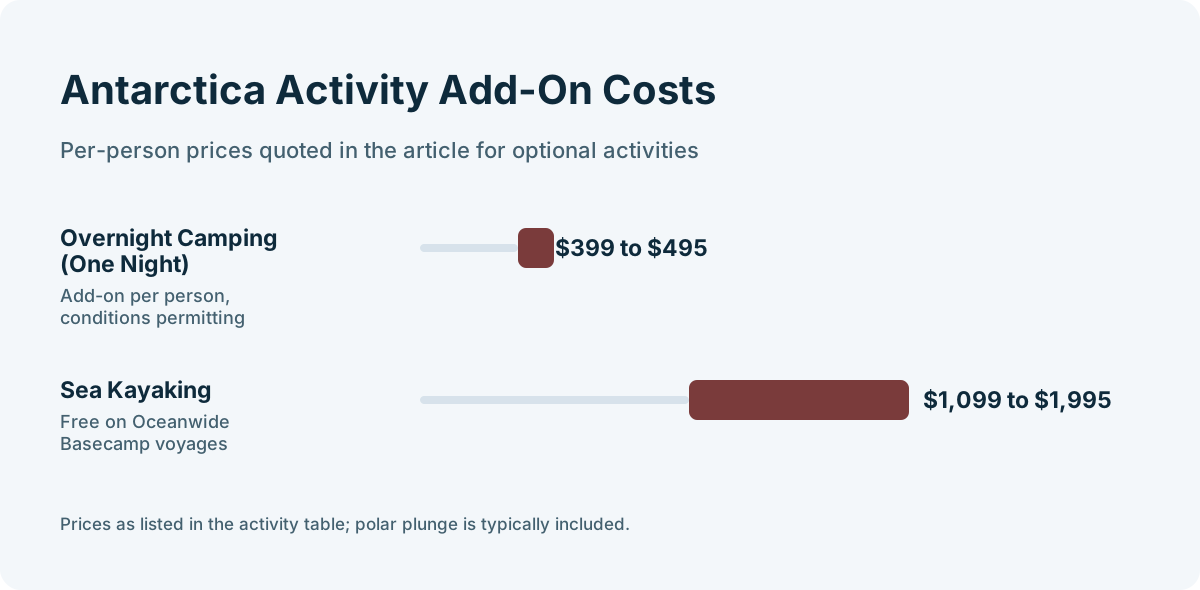
Every activity layer on top of the standard landing adds its own physical demand, and the good news is that all of them are optional. Sea kayaking is offered by Quark, Oceanwide on its Basecamp voyages, Aurora, Poseidon and G Adventures, and operator descriptions state that no prior experience is required for most programs, that basic fitness is advised, and that groups are small, typically 8 to 12 paddlers. Kayaking prices as an add-on run to roughly $1,099 with G Adventures and about $1,995 with Quark, while it is included free on Oceanwide's Basecamp voyages.
Camping is offered by Oceanwide on Basecamp voyages, plus Quark, Aurora and G Adventures on select sailings, usually for one night, subject to weather, site approval and environmental rules, at roughly $399 to $495 per person as an add-on. The polar plunge is offered by Quark, Oceanwide, Aurora, Lindblad and others on most Peninsula voyages; it is typically included, happens once per voyage when conditions allow, and medical staff are present while participants enter the water from a Zodiac or platform under supervision. Hiking, snowshoeing and mountaineering appear on Oceanwide's Basecamp voyages and across Aurora's trekking and ski touring options.
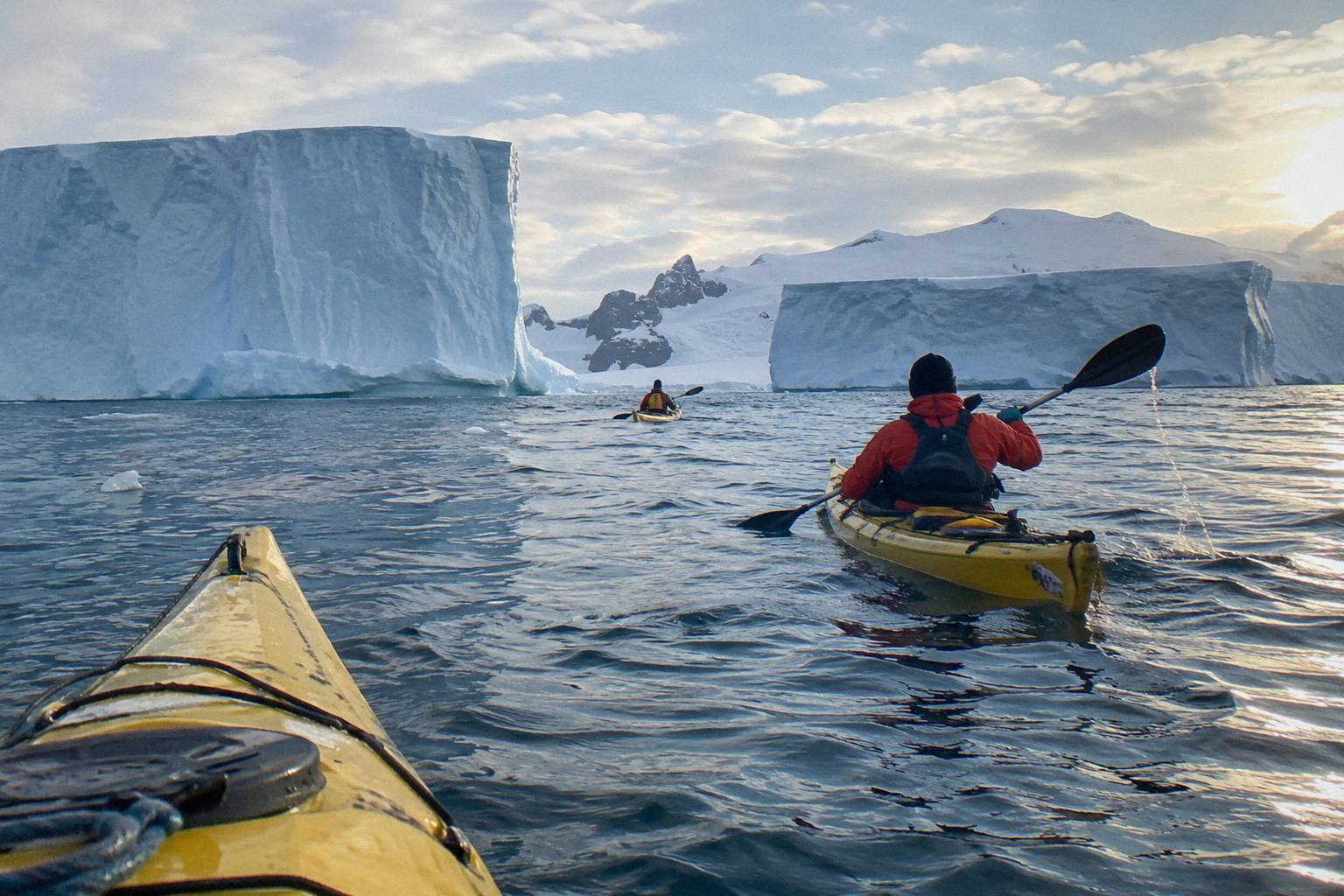
| Activity | Fitness asked | Cost and availability |
|---|---|---|
| Standard landing | Steady walking on uneven ground, Zodiac step | Included on every expedition cruise |
| Sea kayaking | No prior experience on most programs, basic fitness | Add-on around $1,099 to $1,995; free on Oceanwide Basecamp voyages |
| Overnight camping | Able to sleep ashore, handle cold and uneven ground | Add-on around $399 to $495; one night, conditions permitting |
| Polar plunge | Brief supervised water entry | Typically included, once per voyage, medical staff present |
| Hiking and snowshoeing | Moderate walking in snow | Included on Basecamp voyages; add-ons elsewhere |
One planning rule from operator booking notes matters more than any fitness note: limited-capacity activities such as kayaking, camping and helicopter landings are typically reserved at the time of booking or shortly after, because spaces fill early. If kayaking is the reason you are choosing this cruise, reserve it when you reserve the cabin, not on board. Our guide to which Antarctica activities to reserve in advance lists what books out first.
What You Can Skip And Still Enjoy The Cruise
If a landing is beyond you on a given day, the alternatives are real: Zodiac cruising along the shoreline for wildlife viewing is a standard offering that needs no beach step, and the ship's lecture programme, observation decks and science sessions fill the rest. Operators state that limited-mobility passengers may stay aboard or do Zodiac cruises only where feasible, but no operator guarantees landing participation to anyone.
This is the reassurance operators actually give. Their guidance says limited-mobility passengers may stay aboard or join Zodiac cruises only where feasible, and that no guarantees are made. Zodiac cruising is not a consolation prize: wildlife can be watched from the water as well as the beach, and a Zodiac cruise skips the beach walk, though it still starts with the Zodiac step.
The onboard side of the voyage is also genuinely rich. Expedition ships run lecture programmes from their naturalist teams, and the newer vessels add science centres and observation lounges; HX's ships feature Science Centres with touch screens, and on MS Fram microscopes too. Sitting in a warm lounge with a naturalist explaining what you just watched from the Zodiac is a normal part of the day, not a fallback.
The one thing to be honest with yourself about is the Zodiac step itself, because almost every off-ship experience, landing or cruise, starts with it. If that single movement is the obstacle, say so plainly when you book and ask which ships have the easiest boarding arrangement, since gangway heights and platform designs differ.
Which Ships Suit Different Mobility And Fitness Levels
Ship choice shapes the physical experience more than any training plan: smaller ships land everyone at once under the 100-ashore rule, newer ships have elevators and accessible cabins in some cases, and Zodiac boarding arrangements differ by vessel. Wheelchair accessibility is limited on most expedition ships, though some newer vessels, such as HX's Fridtjof Nansen, offer accessible cabins, and Zodiac boarding is described as difficult or impossible for wheelchair users.
The accessibility picture across the expedition fleet is candidly mixed. Industry reporting notes that wheelchair accessibility is limited on most expedition ships, that some newer vessels such as HX's MS Fridtjof Nansen have accessible cabins, elevators to passenger decks and roll-in showers, and that Zodiac boarding typically requires a sailor's grip and balance, which makes it difficult or impossible for wheelchairs and walkers. Operators advise assessing mobility honestly in advance, and our guide to Antarctica cruising with limited mobility works through this in detail.
For the fitness question specifically, three roster ships illustrate the range. Oceanwide's Hondius carries 170 passengers in 80 cabins, was built in 2019 as the first-registered Polar Class 6 vessel in the world in the operator's wording, and sails Peninsula voyages from $7,800 per person, with a doctor on board and a sheltered indoor Zodiac boarding platform, a detail that matters when the gangway step is your main concern.
At the more comfortable end, Lindblad's National Geographic Endurance carries 138 guests with a PC5 Category A ice class, a patented X-Bow hull and a near one-to-one overall staff-to-guest ratio of 116 staff and crew for 138 guests, with Antarctic voyages from $11,900 per person. Silversea's Silver Endeavour carries 220 guests with a PC6 ice class and all-balcony suites; the operator's ship page describes industry-leading Zodiac-to-guest and expert-to-guest ratios without publishing exact counts, and a current fare needs a consultation rather than a printed number.
| Ship | Class | Passengers | Ice class | From, per person | Voyage length | Departs from |
|---|---|---|---|---|---|---|
| HondiusOceanwide Expeditions | Small-Ship Budget | 170 | Polar Class 6 | from $7,800 | 11 to 19 days | Ushuaia |
| National Geographic EnduranceLindblad Expeditions (with National Geographic) | Standard Expedition | 138 | PC5 | from $10,800 | 12 to 22 days | Ushuaia |
| Silver EndeavourSilversea | Luxury | 220 | PC6 | – | 6 to 13 days | King George Island, Puerto Williams |
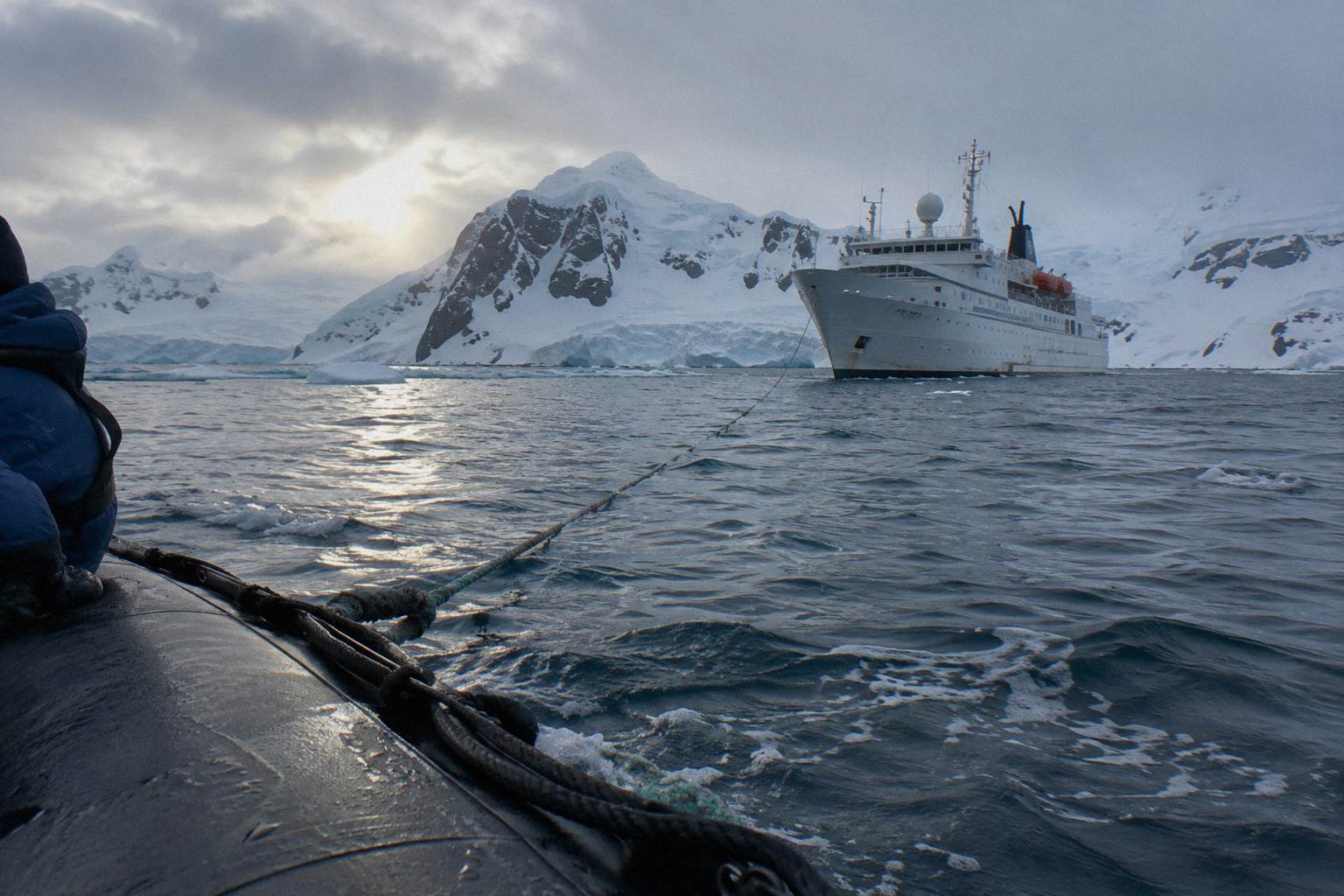
Matching a ship to your knees, balance and stamina is exactly the kind of decision a short conversation resolves better than a spec sheet, and it is why Cruises In Antarctica exists as a research site rather than a booking button. If you want a second opinion on whether a particular vessel's boarding arrangement and rotation schedule will work for you, talk through your mobility needs for free with an expedition-cruise specialist.
Common Questions About Fitness For An Antarctica Cruise
How fit do you need to be for an Antarctica cruise?
You need functional mobility rather than athletic fitness: the ability to walk slowly over uneven, snowy or rocky ground for one to two hours, step into and out of a moving Zodiac with crew assistance, and manage stairs on a ship that may roll. Operators publish no distance, pace or age requirements, and passengers who cannot manage landings can still enjoy Zodiac cruises and the onboard programme.
Do I have to be completely healthy to join an expedition?
No, but you must disclose relevant conditions. Oceanwide's guidance states that any health problem requiring emergency care must be disclosed before travel via a personal information form returned within one month of booking, and most operators require a medical questionnaire signed by your doctor, typically 30 to 90 days before departure.
Can I do an Antarctica cruise with limited mobility or a wheelchair?
Partly. Zodiac boarding typically requires balance and a sailor's grip, which industry reporting describes as difficult or impossible for wheelchair users, and accessibility is limited on most expedition ships. Some newer vessels, such as HX's MS Fridtjof Nansen, offer accessible cabins and elevators, and operators state that limited-mobility passengers may stay aboard or join Zodiac cruises where feasible, with no guarantees.
Is kayaking or camping too hard for an average person?
Operator descriptions state no prior experience is required for most kayaking programs, with basic fitness advised and small groups of roughly 8 to 12. Camping is usually a single night ashore, weather permitting, at roughly $399 to $495 as an add-on. Both are optional, and limited-capacity activities should be reserved at booking because spaces fill early.
Will there be a doctor on board?
It depends on the ship. Oceanwide confirms a doctor on Hondius, Plancius and Ortelius, and onboard doctors and clinics are reported on larger vessels. Ask about your specific ship before booking, and note that the polar plunge, where offered, is supervised with medical staff present.
More Planning And Preparation
 Packing ListWhat to wear, what the ship lends you, and what to leave at home.Read the guide
 Seniors GuideMobility, Zodiac boarding, the Drake Passage and medical support, assessed for older travellers.Read the guide
 Travel InsuranceWhy operators demand evacuation cover and what your policy must include.Read the guide
 Getting To AntarcticaShips, planes and gateway cities: every practical way to reach Antarctica.Read the guide