When To See Penguin Chicks In Antarctica
 By Oleg G.
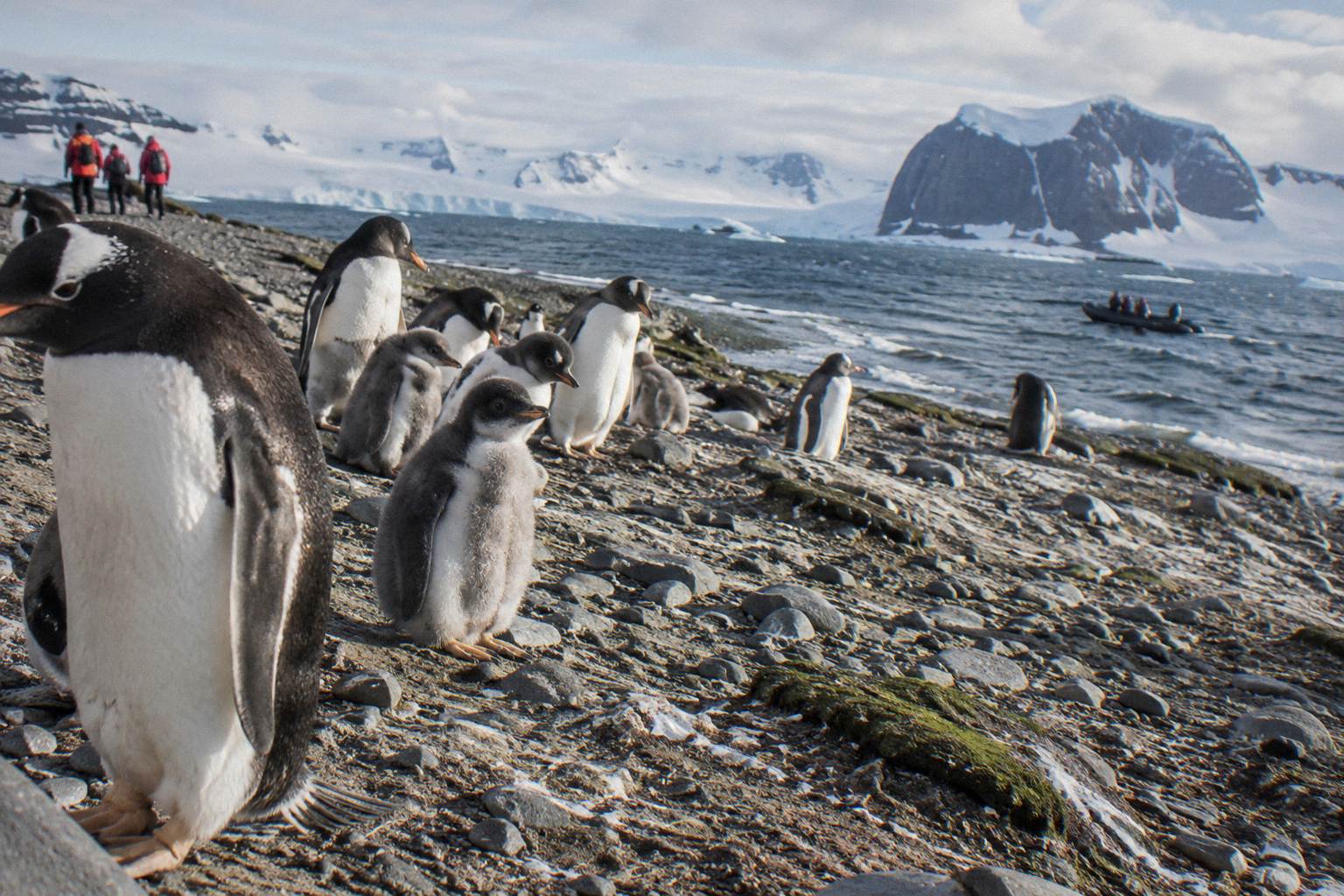
Penguin chicks in Antarctica hatch on a seasonal schedule: Adelie eggs open in late December, chinstraps follow in early January, and by February the colonies are full of creches. Timing a cruise around that calendar matters more than any other choice if chicks are the goal.
Quick answer: Adelie penguin chicks hatch in late December, chinstrap chicks in early January, and prime gentoo hatching runs late December to January. February and March bring chicks in creches and fledging on the Peninsula, while king penguin chicks form creches at South Georgia by January and stay visible through March.
When Do Penguin Chicks In Antarctica Actually Hatch?
Penguin chicks on the Antarctic Peninsula hatch from late December into January: Adelie eggs hatch in late December, chinstrap eggs in early January, and prime gentoo, Adelie and chinstrap hatching runs late December to January. February and March bring chicks in creches and fledging. A cruise between late December and February sails in the chick season.
The British Antarctic Survey gives the clearest published calendar. Adelie penguins lay their eggs in mid-November, the eggs hatch in late December, chicks join a creche at about three weeks old, and they go to sea by mid-February. Chinstrap penguins lay later, at the end of November, their eggs hatch in early January, and the chicks fledge roughly two months after that. That difference of a week or two between the species means a January landing can find Adelie and chinstrap chicks at different stages.
Gentoos vary by place. The Survey's published species leaflets note that gentoo chick fledging is faster in southern colonies, between 62 and 82 days, than in northern ones, where it can take 85 to 117 days. So the time from hatching to fledging depends on where the colony is.
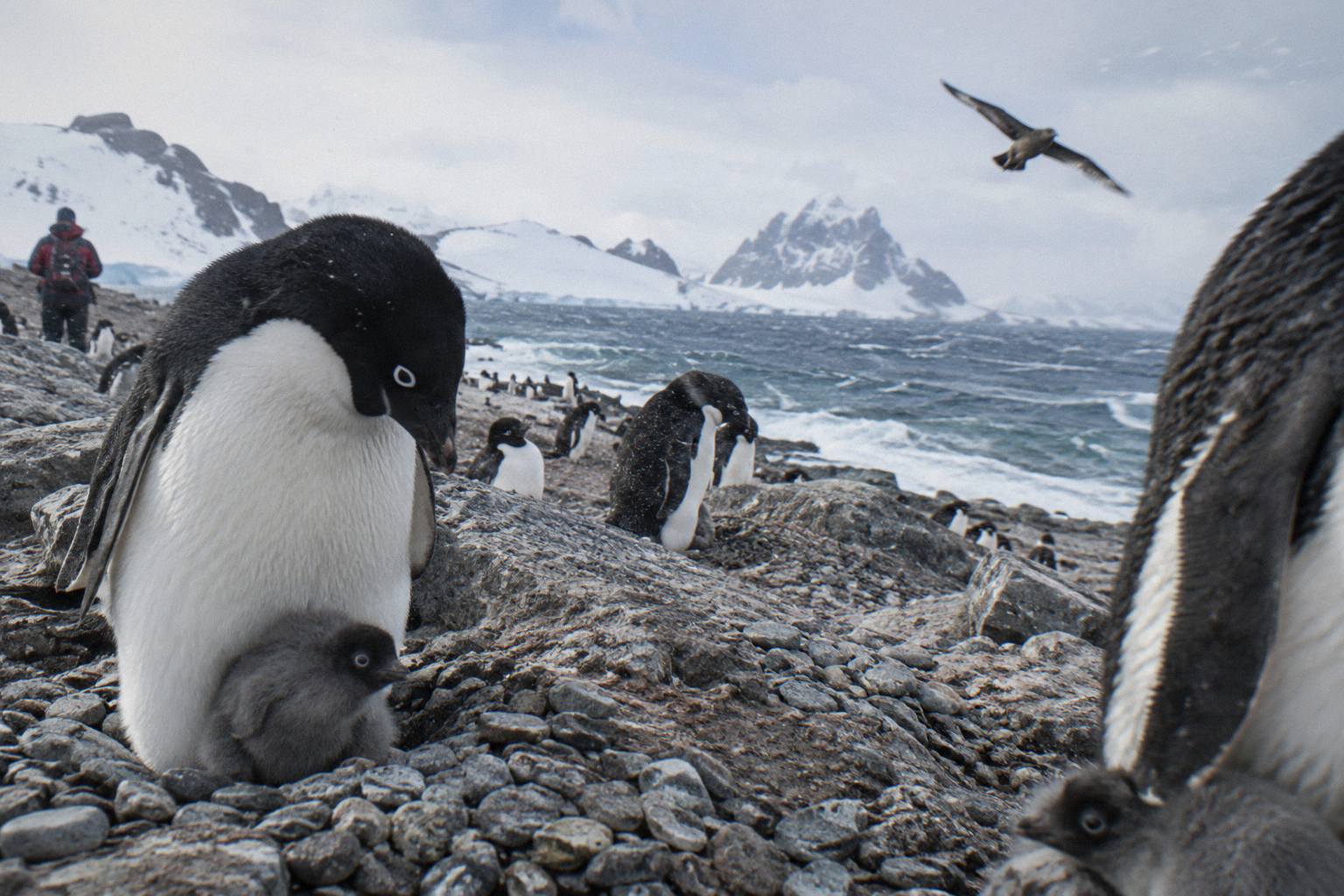
Why does any of this matter for planning? Because an Antarctica cruise is not a zoo visit. The birds are on their own clock, and a voyage that sails in November will show you courtship, nest-building and egg-laying, not chicks. If chicks are the reason you are going, the hatching calendar should drive your choice of month before you look at anything else, including price.
The season itself is fixed. The Antarctic Treaty Secretariat notes that roughly 98 percent of all tourism voyages occur during the austral summer, October to April, and Peninsula expedition cruises operate roughly mid-October to mid-March. Within that window, chick season is the second half: late December through February. That is the whole answer in one sentence, and the rest of this guide fills in the detail for each species and each month.
The Hatching Calendar For Gentoo, Chinstrap And Adelie Chicks
Adelie penguins lay in mid-November and hatch in late December; chinstraps lay in late November and hatch in early January; gentoos begin laying in November, with prime hatching late December to January and fledging times that vary between southern and northern colonies. Adelie chicks join a creche at about three weeks. The result is that January is hatching month, and February and March are creche and fledging months.
Here is the calendar as the British Antarctic Survey publishes it, in one table you can plan against:
| Species | Eggs laid | Eggs hatch | Chicks join creche | Chicks to sea |
|---|---|---|---|---|
| Adelie | Mid-November | Late December | About 3 weeks old | By mid-February |
| Chinstrap | Late November | Early January | Not stated | About 2 months after hatching |
| Gentoo | November | Late December to January | Not stated | 62-82 days (south), 85-117 days (north) |
One practical note sits behind those numbers: "late December" describes a colony-wide pattern, not a single date, so treat the calendar as a guide rather than a timetable.
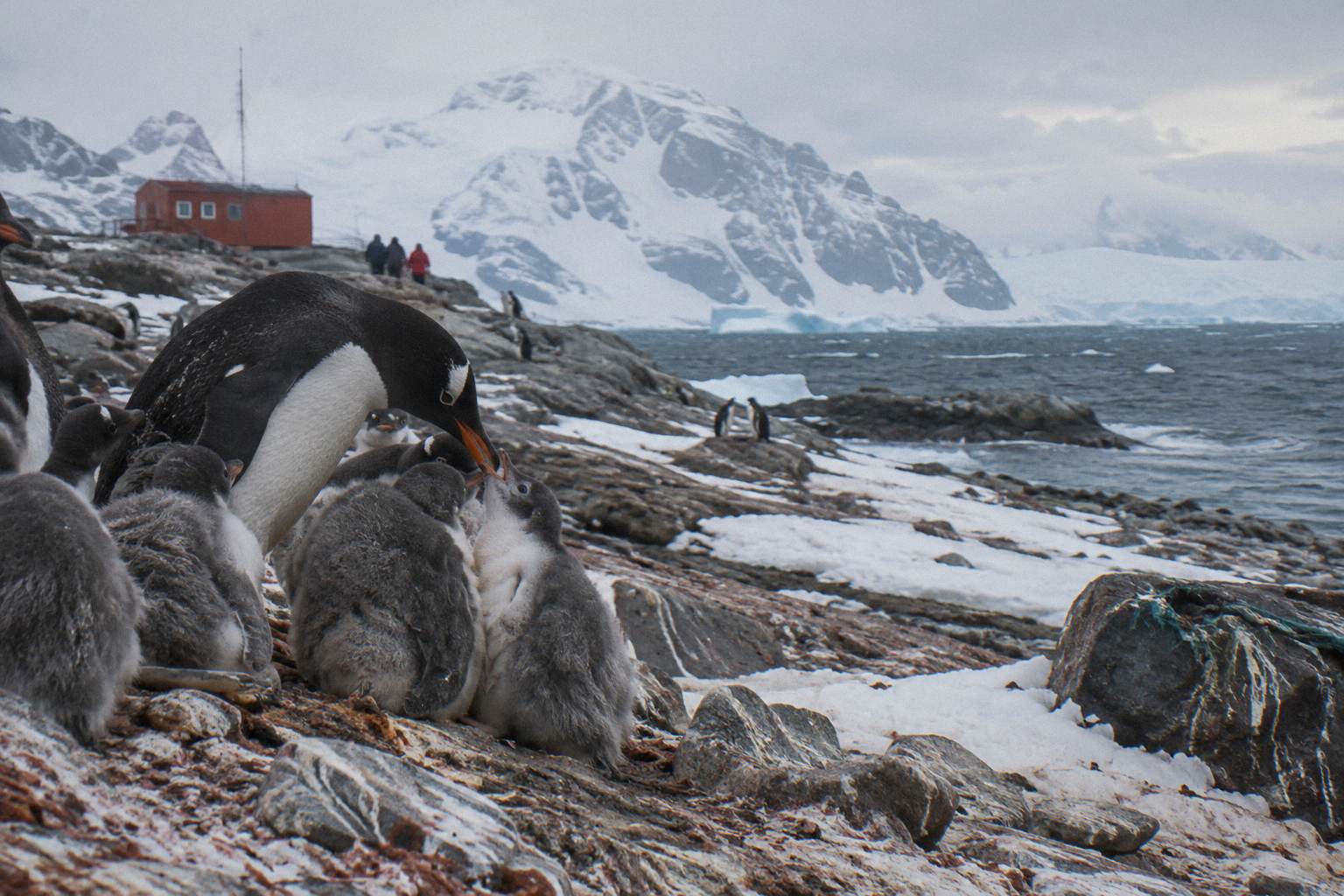
The creche stage is what most visitors picture when they imagine penguin chicks: groups of chicks gathered together while their parents forage. Adelie chicks join a creche at about three weeks old, while king penguin chicks do so at around six weeks.
If you want to see a specific moment, hatch day itself, first creche, or fledging, the table above tells you which month to aim for. If you just want the highest density of chicks in the most colonies, aim for February, when operators describe chicks in creches across the Peninsula colonies. February is also the month whale numbers peak, with humpback sightings increasing from mid-January onward.
King Penguin Chicks At South Georgia
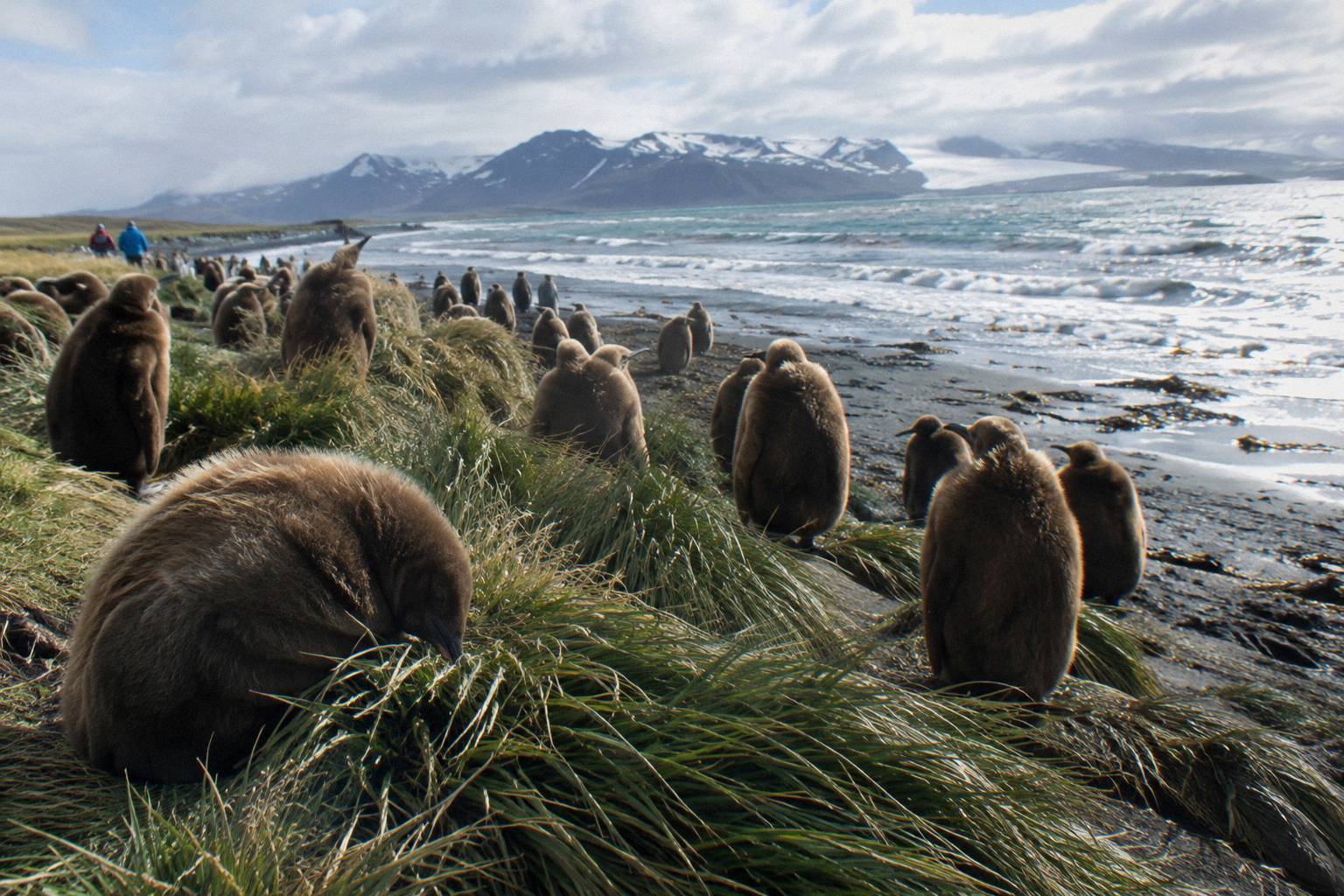
King penguin chicks at South Georgia are on a much longer clock than any Peninsula species: adults rear chicks over 10 to 13 months, producing two chicks every three years. By January the chicks form creches, and they remain visible through March, which makes a Falklands, South Georgia and Antarctica itinerary a strong choice if chicks are your priority.
King penguins do not breed to the Antarctic summer the way gentoos, chinstraps and Adelies do. The British Antarctic Survey's species leaflets record a chick-rearing period of 10 to 13 months, with pairs producing two chicks every three years. At South Georgia's large colonies, such as Salisbury Plain and St Andrews Bay, the latter with around 250,000-plus pairs, operators describe incubating eggs and fluffy chicks during the December to February peak.
The timing still has a best window. King penguin breeding activity peaks between November and January, with early breeders laying from late November and chicks forming creches by January. Through December and February the colonies show incubating eggs and fluffy chicks together, and chicks remain visible into March. If your heart is set on creches, January and February at South Georgia are the months, with chicks still visible in March.
Reaching South Georgia takes a different kind of voyage. A classic Peninsula cruise of 10 to 13 days does not go there. You need a Falklands, South Georgia and Antarctica combination, typically 16 to 28 days, or a dedicated South Georgia itinerary. These longer voyages cost more, but they stack wildlife experiences in one trip: king penguin colonies, the Peninsula's gentoo and chinstrap colonies, and, from mid-January onward, increasing whale sightings.
Some travellers want the Peninsula species; others want the scale of a South Georgia king colony. Both are reasonable, and that is why the two destinations suit different travellers.
Which Month Should You Book For The Best Chicks?
January and February are the best months to see penguin chicks in Antarctica: January catches hatching and the first creches, while February delivers peak creche season, fledging chicks and the strongest whale numbers. December is a gamble that pays off late in the month, November shows courtship and eggs but no chicks, and March offers late-season fledging at lower fares.
The month-by-month picture looks like this:
| Month | What you see in chick terms | Notes for planning |
|---|---|---|
| November | Courtship, stone-gifting, nest building, eggs | No chicks on the Peninsula; king penguins laying eggs at South Georgia |
| December | Incubation, first Adelie hatches late in the month | Christmas and New Year sailings carry a fare premium |
| January | Chicks hatching; king chicks in creches at South Georgia | Peak fares; typically the warmest month |
| February | Chicks in creches, chicks learning to swim, Adelies to sea by mid-month | Whale numbers peak too |
| March | Fledging chicks, moulting adults, colonies thinning | Shoulder fares; whale activity still strong |
January deserves its reputation. It is typically the warmest month on the Peninsula, daylight runs around 18 hours, and chicks are hatching. The trade-off is that December and January carry peak fares. February brings chicks in creches, chicks learning to swim, moulting adults and peak whale numbers. March brings fledging and shoulder-season fares, though colonies empty by late March or early April. More of these guides are collected on Cruises In Antarctica.
We have written full month guides if you want the deeper detail: our Antarctica in January page covers hatching season, temperatures and what a January itinerary actually looks like day by day, and our Antarctica in February guide covers creche season, whale numbers and Circle-crossing voyages. Between them they answer almost every timing question a chick-focused traveller asks.
If your dates are flexible, February is a strong compromise: chicks in creches and peak whale numbers, since sightings build from mid-January. What you give up is the hatching stage itself, which belongs to late December and January.
Choosing the month is the first big decision; choosing the ship is the second. If you would like help weighing a January sailing against a February one, or a Peninsula voyage against a South Georgia combination, talk through the timing with us before you commit. The consultation is free.
Emperor Penguin Chicks: The Hardest Chicks To See
Emperor penguin chicks are the hardest of all to see from a cruise: they breed on sea ice at the Snow Hill Island colony, the most northerly emperor site, and specialised voyages target November and December departures, using helicopters when ice allows. Operators put the chance below 50 percent in recent seasons.
Emperors are the exception in this guide, because they breed on sea ice rather than on land. The Snow Hill Island colony in the Weddell Sea, the most northerly emperor breeding site, is accessed by helicopter from expedition ships, and the British Antarctic Survey itself has used ship-based helicopter access to reach the colony for research during the breeding season. A handful of operators run dedicated Weddell Sea emperor voyages, with November and December departures.
The catch is reliability. Ice conditions often limit access, and operators note variable success rates depending on sea ice and weather in each season. Weddell Sea emperor voyages run 11 to 15 days from about $10,750, and they sail before Peninsula hatching: you trade the gentoo and chinstrap chick season for a chance, not a promise, of reaching an emperor colony. For most travellers whose goal is "penguin chicks", a February Peninsula voyage is the higher-probability choice. For travellers whose goal is specifically emperor penguins, the November and December Weddell Sea voyages are the route this guide covers, and they should be booked with eyes open about the odds.
Which Ships And Voyages Get You Among The Chicks?
Almost any expedition cruise sailing between late December and February reaches gentoo, chinstrap and Adelie colonies, so the ship choice matters less than the date choice. What the ship does affect is time on the ground: IAATO caps landings at 100 passengers ashore from a vessel at any one time, so smaller ships rotate less and give every passenger more time in the colony. Budget small-ship lines such as Oceanwide Expeditions run vessels in exactly that size range.
The rules that shape your colony time come from the International Association of Antarctica Tour Operators. IAATO's visitor guidelines, adopted through the Antarctic Treaty system, state that a maximum of 100 passengers may be ashore from a vessel at any one time, that vessels carrying more than 500 passengers may not make landings at all, and that expedition staff must guide at a ratio of at least one per twenty visitors. Those three rules explain why ship size matters: on a ship of 100 or fewer guests everyone goes ashore together, while on a 200-guest ship you land in shifts.
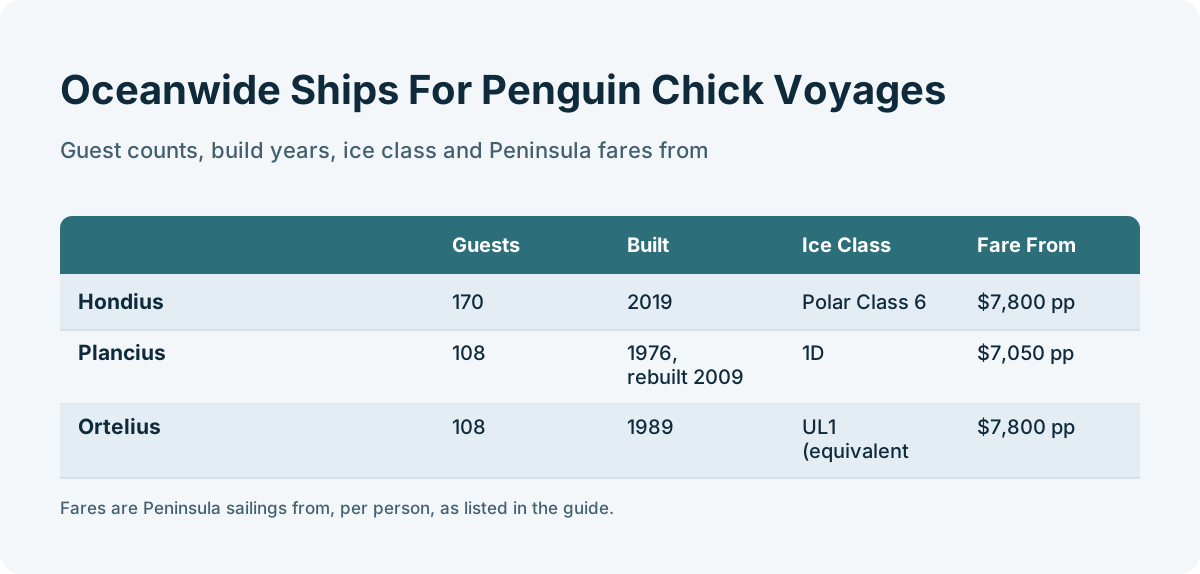
For chick-focused travel, the Oceanwide Expeditions fleet is a strong fit, and not only because of its fares. The line's three Antarctic ships, Hondius, Plancius and Ortelius, all carry between 108 and 170 passengers, small enough that landing rotations stay short and colony time stays long. Hondius, the newest of the three, is a Polar Class 6 vessel built in 2019 carrying 170 guests in 80 cabins, with Antarctic Peninsula voyages from $7,800 per person. Plancius, a converted Dutch oceanographic research ship rebuilt for passengers in 2009, carries 108 guests in 50 cabins, from $7,050. Ortelius, a former Russian research vessel built in 1989, also carries 108 guests, from $7,800, and she is the ship the line uses for its helicopter-supported Weddell Sea voyages.
| Ship | Guests | Built | Ice class | Peninsula fare from |
|---|---|---|---|---|
| Hondius | 170 | 2019 | Polar Class 6 | $7,800 pp |
| Plancius | 108 | 1976, rebuilt 2009 | 1D | $7,050 pp |
| Ortelius | 108 | 1989 | UL1 (equivalent 1A) | $7,800 pp |
| Ship | Class | Passengers | Ice class | From, per person | Voyage length | Departs from |
|---|---|---|---|---|---|---|
| HondiusOceanwide Expeditions | Small-Ship Budget | 170 | Polar Class 6 | from $7,800 | 11 to 19 days | Ushuaia |
| PlanciusOceanwide Expeditions | Small-Ship Budget | 108 | 1D | from $7,050 | 10 to 33 days | Ushuaia |
| OrteliusOceanwide Expeditions | Small-Ship Budget | 108 | UL1 | from $7,800 | 11 to 25 days | Ushuaia |
The Basecamp voyages deserve a special mention for wildlife-minded travellers. On those departures the line includes camping, kayaking, snowshoeing, hiking, mountaineering and photo workshops at no extra charge, and kayaking adds a water-level view of the coast. If you want more on the line itself, our Hondius guide covers the ship cabin by cabin, and our Antarctic wildlife cruise page goes deeper on what each species looks for at a landing site.
There is no bad ship for chicks, only bad dates. A luxury suite on a January sailing will show you creches; a quad-berth on a February sailing will show you creches too. Spend your decision-making energy on the calendar first, the itinerary length second, and the cabin category last. If you would like a second opinion on whether a specific voyage's dates fall inside the hatching window, ask us to check the dates before you book. It costs nothing.
How To Behave Around Penguin Chicks (And Why It Protects Them)
IAATO rules require you to keep at least five metres from wildlife on land or ice, more if species or site guidance says so, to let animals dictate any closer approach and to never block their paths. Your operator's expedition team runs every landing under these rules.
The five-metre rule comes straight from IAATO's general visitor guidelines, and it is a minimum, not a target. Distances increase if disturbance is observed, and site-specific guidance at places like Port Lockroy or Neko Harbour sets extra rules, such as the roped-off penguin study area at Port Lockroy. The paths animals use must never be blocked.
For photography, that means a longer lens from a stable spot rather than creeping closer.
Biosecurity matters here too, and it is not optional. IAATO requires that visitors carefully wash their boots and clean all equipment, including clothes, bags and tripods, before bringing them to Antarctica, and clean again between landing sites. The reason is seeds, soil and disease: avian influenza reached the Antarctic Peninsula in 2024 and has continued to affect seabird and seal colonies into recent seasons, so boot washing and disinfection before and after every landing is not theatre.
None of this makes landings restrictive in practice. Time ashore is typically one to two hours per landing, weather and site permitting, and the rules are about how you stand, not whether you get close enough to see.
Common Questions About Penguin Chicks In Antarctica
When do penguin chicks hatch in Antarctica?
Adelie chicks hatch in late December, chinstrap chicks in early January, and prime gentoo hatching runs late December to January. King penguins rear chicks for 10 to 13 months, and at South Georgia chicks form creches by January and remain visible through March.
What is the best month to see penguin chicks in Antarctica?
February is a strong all-round month: chicks are in creches, Adelie chicks go to sea by mid-February, and whale numbers peak at the same time. January is the best month to see very young chicks and hatching.
Can you see king penguin chicks on an Antarctic Peninsula cruise?
No. King penguins breed on sub-Antarctic islands, mainly South Georgia, which classic Peninsula itineraries do not visit. You need a Falklands, South Georgia and Antarctica combination voyage, typically 16 to 28 days, or a South Georgia itinerary to see king penguin chicks.
How close can you get to penguin chicks?
IAATO guidelines require at least five metres from penguins on land or ice, and more where site guidance or the birds' behaviour calls for it. Animals dictate any closer approach, and their paths must never be blocked.
Do emperor penguin chicks appear on regular cruises?
Not on standard Peninsula itineraries. The Snow Hill Island colony is targeted by dedicated Weddell Sea voyages that use helicopters, mainly in November and December, and success depends on sea ice and weather.
Are penguin chicks visible in November or March?
On the Peninsula, no chicks are visible in November, only courtship and eggs. In March you can still see fledging chicks, but colonies empty by late March or early April. King penguin chicks remain visible at South Georgia through March.
More Activities And Wildlife
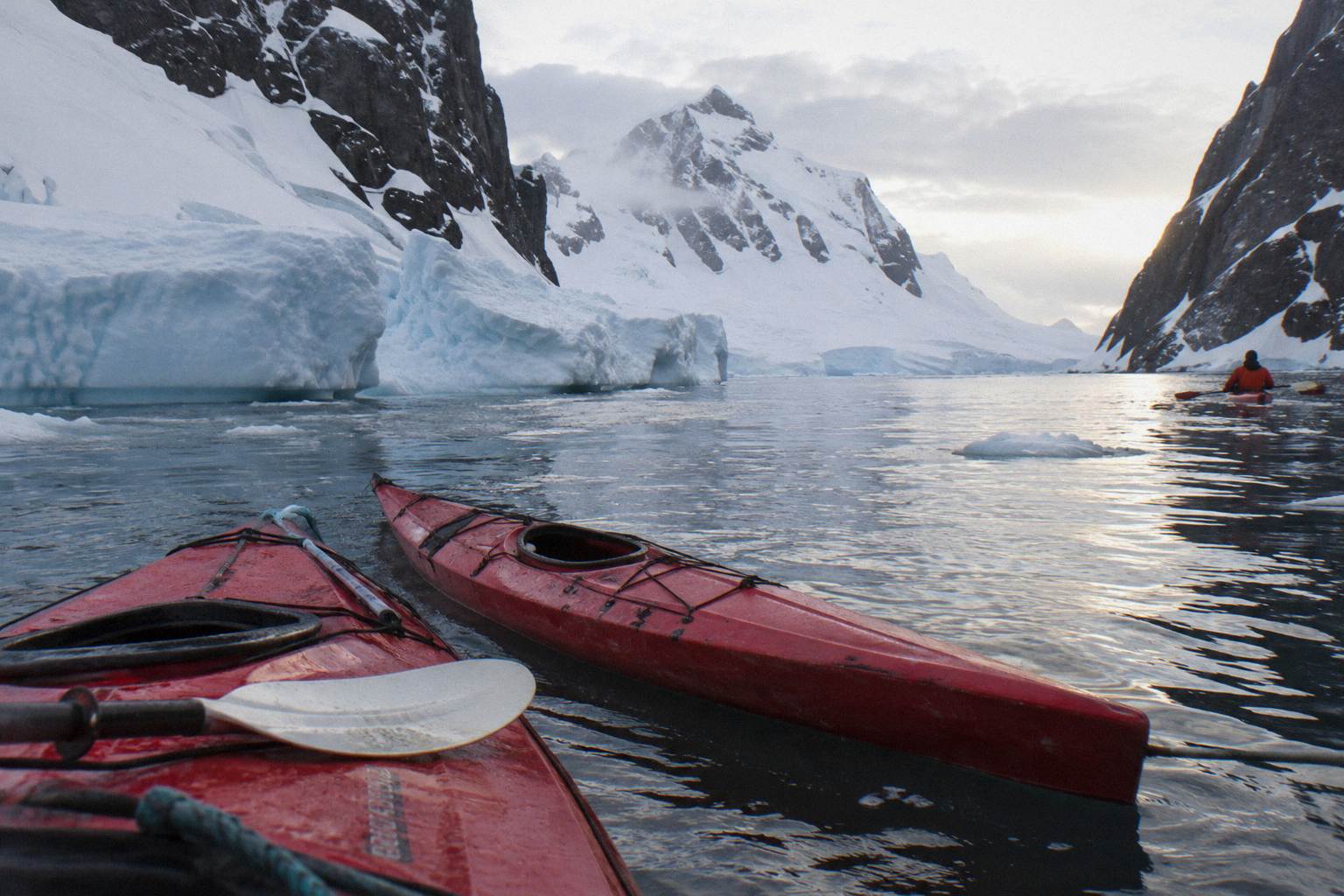 Antarctica KayakingOperators, prices and paddle skills for sea kayaking off an Antarctic expedition ship.Read the guide
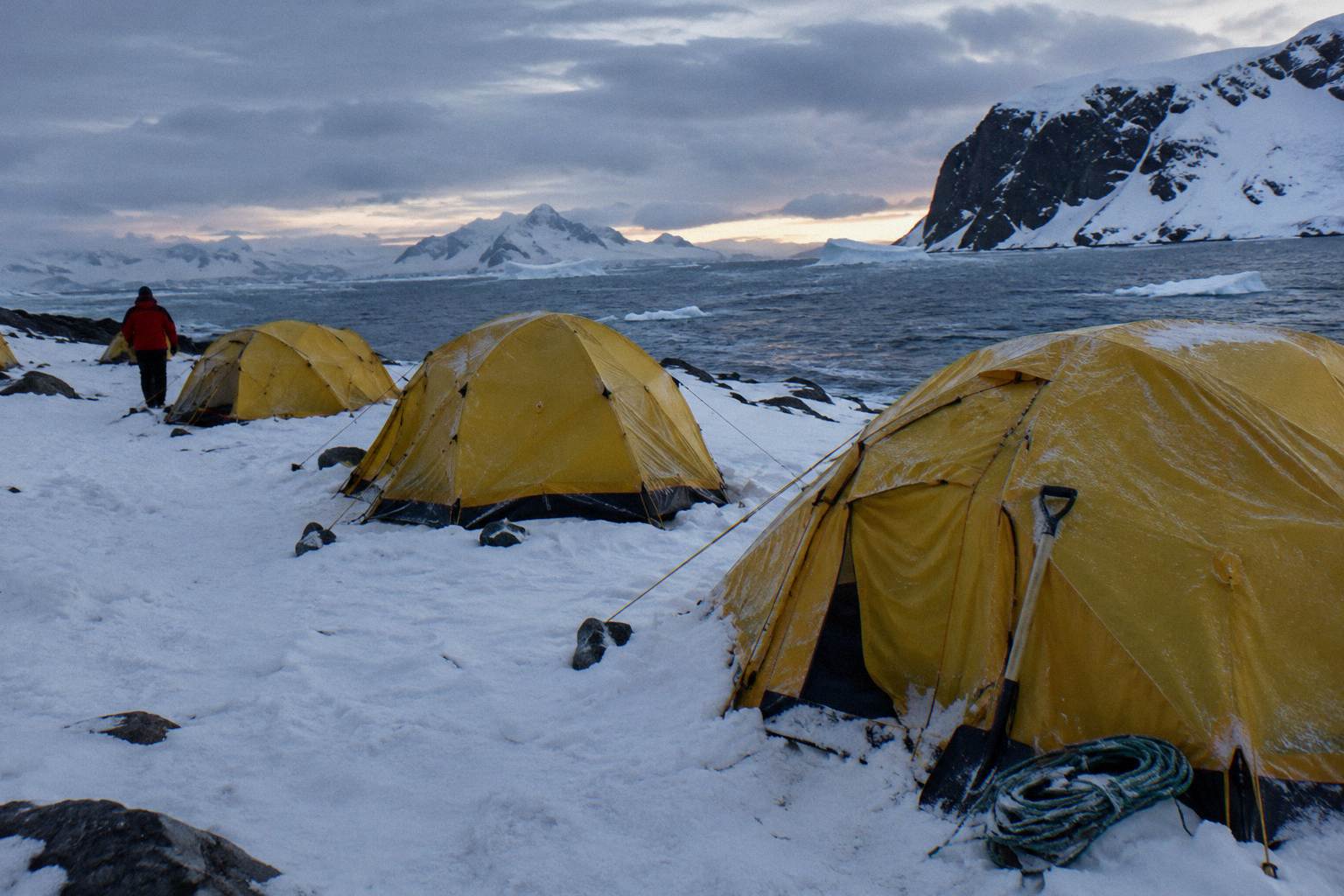 Antarctica CampingWhat an overnight ashore in Antarctica costs, how it runs, and when weather cancels it.Read the guide
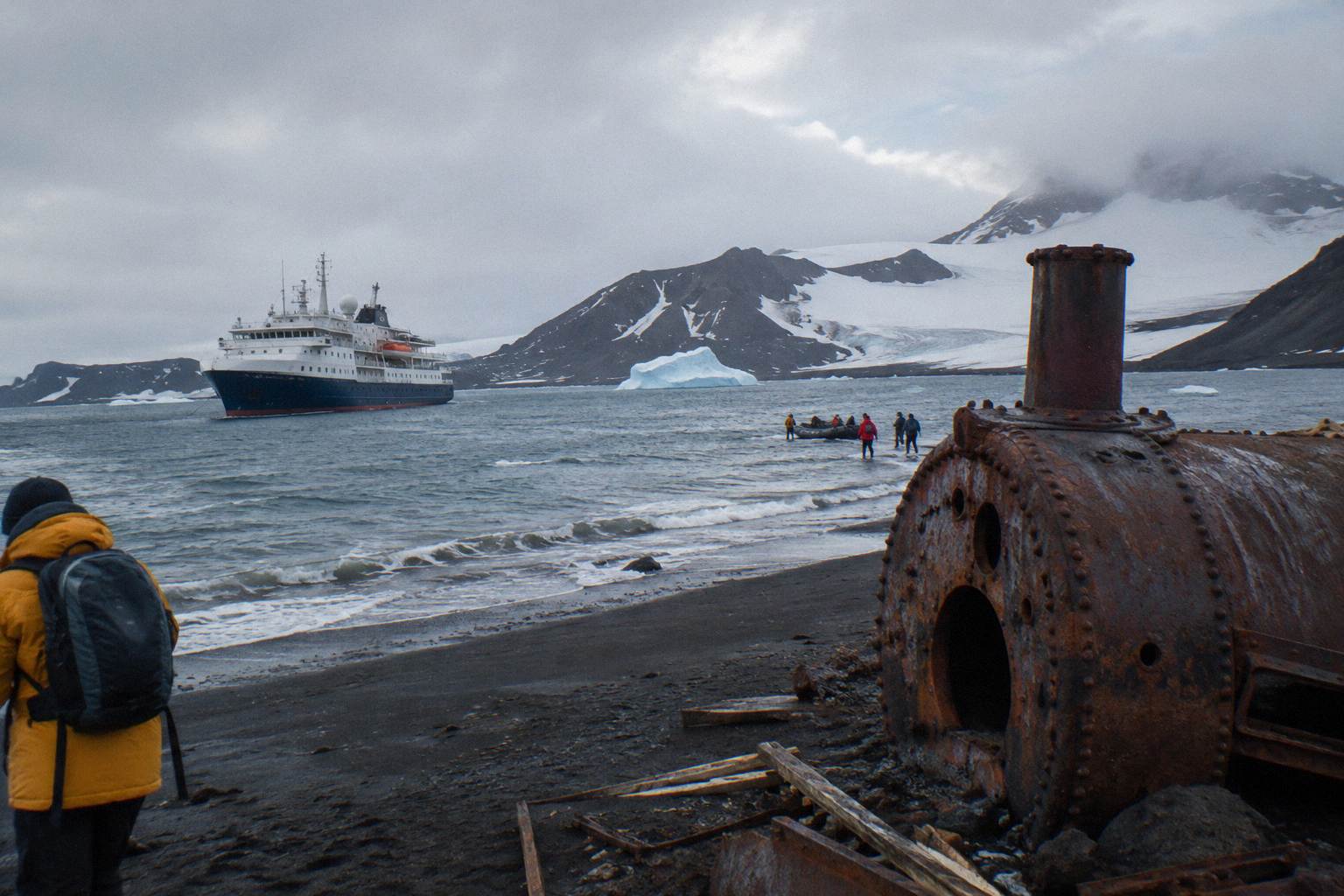 Polar PlungeWho offers the Antarctic polar plunge, what it costs and how it stays safe.Read the guide
 Hiking And SkiingActive Antarctica: hiking, snowshoeing, ski touring and mountaineering options compared.Read the guide