X-BOW Ships And Stabilisers: Do They Make The Drake Smoother?
 By Oleg G.
Two technologies dominate every conversation about comfort on the Drake Passage: the Ulstein X-BOW hull and fin stabilisers. Here is which ships in the 2026-27 Antarctic fleet actually have each, what the manufacturers claim, and what independent evidence exists.
Quick answer: Seven roster ships carry an X-BOW-style hull: Greg Mortimer, Sylvia Earle, Douglas Mawson, Ocean Albatros, Ocean Victory, National Geographic Endurance and Resolution. Stabilisers appear on ships like Sea Spirit, Hondius and the Viking expedition ships. X-BOW makers claim less slamming, pitch and spray; no independent verification of those specific claims is published.
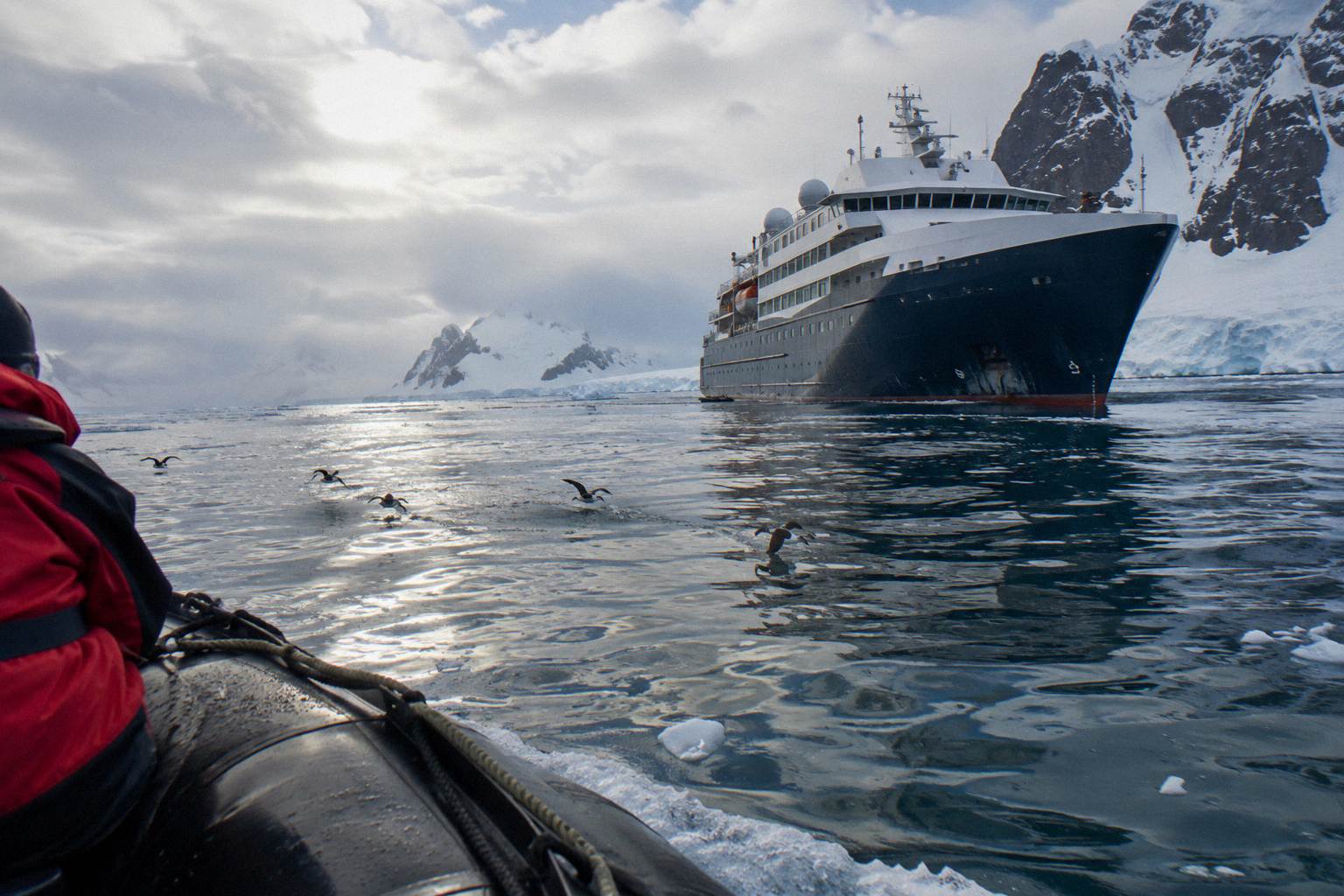
The Drake Passage is the two-day stretch of open water between Tierra del Fuego and the Antarctic Peninsula that almost every expedition cruise has to cross, and it is the single most common reason seasickness-prone travellers hesitate to book an Antarctica voyage. Two pieces of ship engineering get the credit, or the blame, in almost every one of those conversations: the Ulstein X-BOW hull, and fin stabilisers. One is a shape, the other is a pair of moving wings under the waterline, and they solve different halves of the same problem.
This guide sticks to what the operator pages, the ship roster and published technical summaries actually state. That matters here more than in most corners of Antarctic travel, because hull and stabiliser marketing is full of confident claims and thin on published proof, and the honest answer to "will an X-BOW make my crossing calm" is more complicated than a brochure would have you believe. For readers of Cruises In Antarctica asking that question, the short version is: the design helps with certain kinds of motion, but no hull shape controls the weather.
What Is An X-BOW And Which Antarctica Expedition Ships Have One?
An X-BOW is a hull design by the Norwegian shipbuilder Ulstein in which the bow slopes backwards from the waterline instead of forwards, so the hull meets waves with a long, curved surface rather than a flat, vertical wall. Seven ships on the 2026-27 Antarctic roster carry one: Greg Mortimer, Sylvia Earle, Douglas Mawson, Ocean Albatros, Ocean Victory, National Geographic Endurance and National Geographic Resolution.
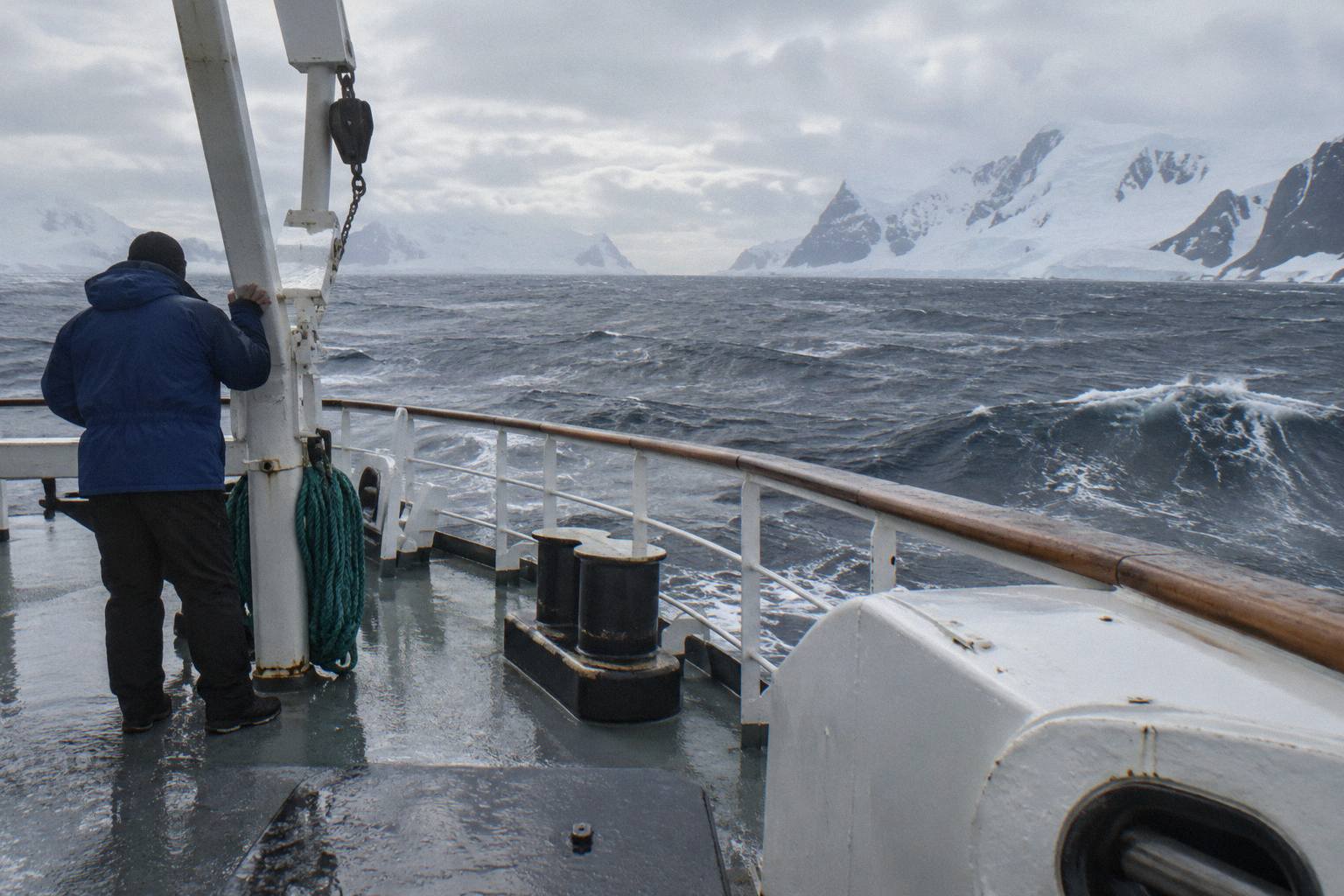
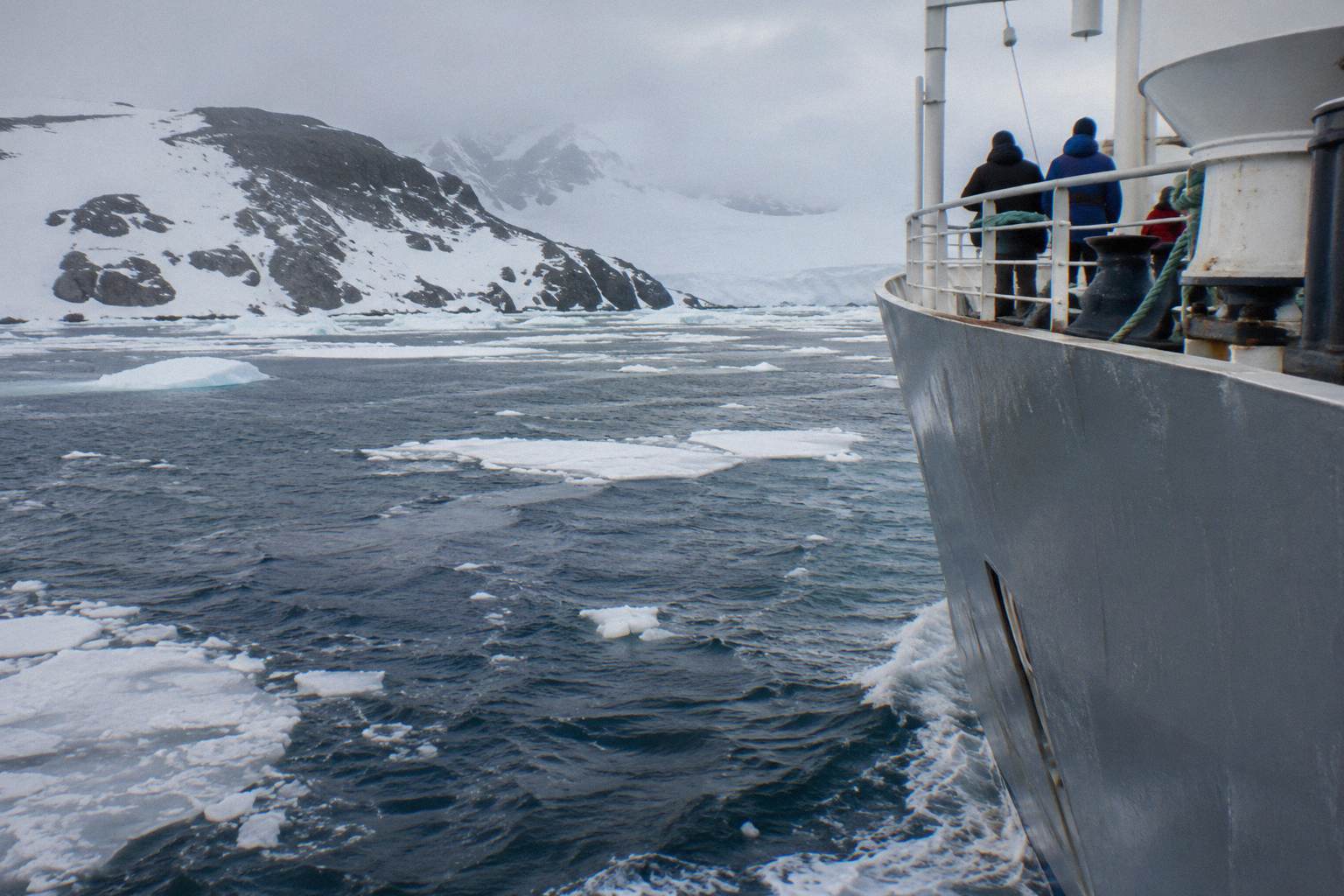
In the Antarctic fleet it appears on ships built from 2019 onward. Aurora Expeditions' three ships each carry the full Ulstein X-BOW name on their operator pages, while Albatros Expeditions lists a "patented X-Bow" for Ocean Albatros and Ocean Victory, and Lindblad's ship pages describe a "patented X-Bow" on the National Geographic Endurance and her sister Resolution.
Here is the full roster of X-BOW ships sailing Antarctica in 2026-27, with the specifications each operator page states.
| Ship | Operator | X-BOW wording on operator page | Passengers | Built |
|---|---|---|---|---|
| Greg Mortimer | Aurora Expeditions | Ulstein X-BOW | 130 | 2019 |
| Sylvia Earle | Aurora Expeditions | Ulstein X-BOW | 130 | 2022 |
| Douglas Mawson | Aurora Expeditions | Ulstein X-BOW | 130 | 2025 |
| Ocean Albatros | Albatros Expeditions | Patented X-Bow | not stated per ship | not stated |
| Ocean Victory | Albatros Expeditions | Patented X-Bow | not stated per ship | not stated |
| National Geographic Endurance | Lindblad Expeditions | Patented X-Bow | 138 | 2021 |
| National Geographic Resolution | Lindblad Expeditions | Patented X-Bow | 138 | 2021 |
Notice what the table does not say. None of these operator pages state an X-BOW-specific performance figure, a measured pitch reduction or a comfort rating. The claim on the pages is the presence of the design, not a number attached to it. That gap between "we have the hull" and "here is what the hull measurably does" runs through everything else in this article.
If a backwards-sloping hull appeals to you and you are weighing which of these ships to sail, the differences between them are mostly elsewhere: cabin mix, fare and expedition programme. Greg Mortimer and Sylvia Earle both carry 130 expedition passengers and 15 Zodiacs, while the two Lindblad sisters carry 138 guests in 76 cabins each. Fares differ more than hulls do: Aurora's Antarctic Peninsula voyages on Sylvia Earle list from $19,566 per person twin share, and on Greg Mortimer from $19,521, while Lindblad's Voyage to Antarctica on National Geographic Endurance lists from $11,900. If those three price points all fit the same hull philosophy, it is worth comparing ships before you commit, because the consultation costs nothing and the difference in fare is real money.
The Greg Mortimer is the ship this site features on this page, and for good reason: built in 2019, she is the oldest of Aurora's three X-BOW ships on the roster and sails from Ushuaia. Her operator page adds details the X-BOW label alone does not convey: 85 percent of her staterooms have balconies, she has hydraulic viewing platforms that lower over the side for wildlife viewing, and she carries 15 Zodiacs with four dedicated boarding doors, which speeds up shore operations considerably on a 130-passenger ship.
What Do The X-BOW Claims Actually Say?
The published claims for the X-BOW are that it reduces wave impact and slamming, pitch, noise, vibration and spray, giving a smoother ride and better comfort than a conventional bow. Those claims appear in the technical summaries of the National Geographic Endurance and Resolution. No operator page states a measured figure, percentage improvement or sea-state threshold for any of them.
It is worth reading the claim list carefully, because it is narrower than the marketing implies. Wave slam is the sharp shudder a flat-bowed ship takes when the bow re-enters a wave. Pitch is the seesaw rotation, bow down then bow up, that turns stomachs. Spray is the water flung forward and upward that closes forward decks. Noise and vibration are comfort items. All five are real ride-quality effects, and all five are the kind of thing a crew or a frequent passenger would notice without instruments.
What is missing from the published record is any quantified claim. Nothing published says "the X-BOW reduces pitch by X percent in Y-metre seas" or "passengers report Z fewer sick cases." The claims describe a mechanism, in other words, not a measured result. A different technology appears in Drake reporting: newer expedition ships carry zero-speed stabilisers, some 50 percent larger than standard, that keep working while the vessel is stationary, alongside advanced weather routing to reduce Drake Passage motion. That is the technology section below.
For the practical question, though, the honest reading of the published claims is this: an X-BOW addresses slam and pitch, which are the motions most likely to bother a nervous stomach, and it does nothing about roll, the side-to-side sway that fin stabilisers exist to damp. The two systems are complements, not rivals.
Does Independent Evidence Back The X-BOW Claims?
No independent verification of the X-BOW's specific performance claims is published, including in technical summaries of the ships that carry the design. The claims rest on the builder's design rationale and on operator descriptions. A traveller should treat smoother-ride statements as plausible engineering, not as proven, measured results.
That is an unusually blunt paragraph for a travel guide, but this is a field where it would be easy to overstate. The design rationale is plausible: a backward-raked bow presents a long, gently curved surface to oncoming waves instead of a vertical wall. But there is no published, independent sea trial comparing an X-BOW expedition ship with a conventional-bowed sister on the Drake, and none of the operator pages carries a number.
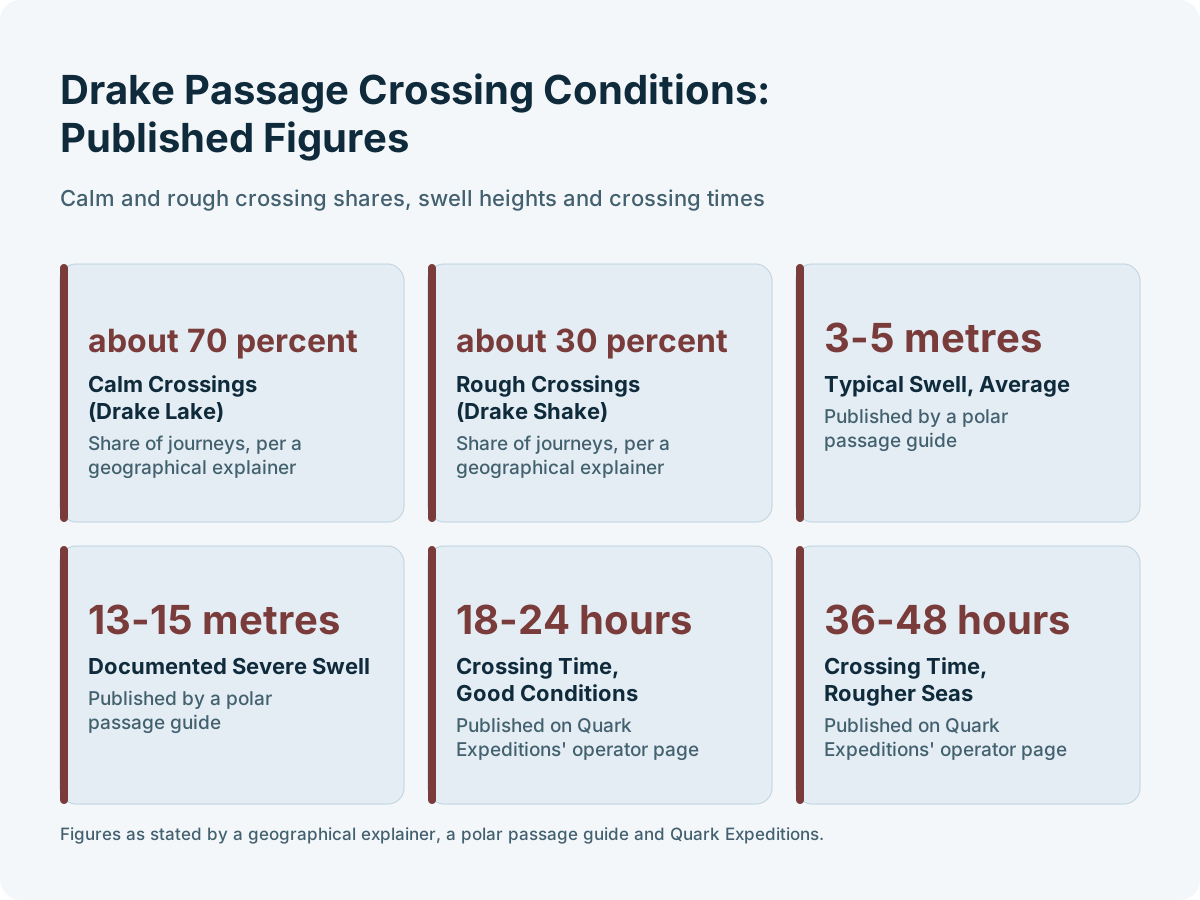
There is also a sizing caveat the brochures skip. The Drake's own statistics explain why no hull is a complete answer. One explainer of the passage reports the rough "Drake Shake" on roughly 30 percent of crossings and the calm "Drake Lake" on around 70 percent. Typical swells average 3 to 5 metres, and documented severe conditions have reached 13 to 15 metres. A crossing can run 18 to 24 hours in good conditions and 36 to 48 hours in rougher seas, according to Quark Expeditions' own guidance on flying versus sailing. Those are weather numbers, and weather does not care what your bow looks like.
| Drake Passage measure | Published figure | Published by |
|---|---|---|
| Calm crossings ("Drake Lake") | about 70 percent of journeys | Geographical explainer |
| Rough crossings ("Drake Shake") | about 30 percent of journeys | Geographical explainer |
| Typical swell | 3-5 metres average | Polar passage guide |
| Documented severe swell | 13-15 metres | Polar passage guide |
| Crossing time, good conditions | 18-24 hours | Quark Expeditions operator page |
| Crossing time, rougher seas | 36-48 hours | Quark Expeditions operator page |
An X-BOW ship in a 5-metre swell will likely ride more gently than a flat-bowed ship in the same swell. Neither ship changes the swell. If seasickness is the deciding factor in whether you go at all, the technologies below matter, and so does route choice: one-way fly-cruise options cut a crossing entirely, and our Drake Passage seasickness guide covers the medication and cabin-position tactics that no hull can substitute for.
Stabilisers Explained: Fins, Zero-Speed And Why They Retract In Ice
Fin stabilisers are retractable wings under the waterline that counteract roll by tilting against the ship's side-to-side motion. Zero-speed stabilisers are fins large enough to work while the ship is stationary. Retractable fins are pulled inside the hull in ice, because ice impact can damage the fins, so the anti-roll benefit is absent while the ship is in ice.
The mechanics are simple enough to picture. Roll is the rotation around the ship's long axis, the side-to-side sway that makes corridors an obstacle course. A fin sticks out from the hull below the waterline and angles up or down like an aileron; the water flowing past it generates lift that pushes the hull back the other way. Classical fins only worked underway, because they need water flowing over them. Zero-speed designs keep working at anchor or drifting, which matters in Antarctica because ships spend landings at low speed or stopped while Zodiacs run.
The retraction point comes from the technical reporting on the Viking expedition ships, which notes that their retractable fin stabilisers are typically retracted in ice to avoid damage. The general practice is described as ice protection. The practical consequence is that the anti-roll system that helps on the Drake, an open-water passage, is switched off while the ship is in ice.
One roster ship deserves a named mention. Sea Spirit, Poseidon Expeditions' 114-passenger ship, carries modern retractable fin stabilisers of the Rolls-Royce Zero Speed type, retrofitted in 2019, which are reported to reduce roll both underway and while drifting or at anchor, with the fins fully retractable for ice navigation. She is an older hull, built 1991 and refitted 2017, that received the same comfort technology the newest ships advertise, and her Classic Antarctica Peninsula voyages list from $8,846 per person, well below the X-BOW ships' fare cards. If your priority is roll damping rather than hull novelty, she is the interesting case on the roster.
Which Roster Ships Have Stabilisers?
The published list is short: Sea Spirit has retractable zero-speed-type fins, National Geographic Endurance has zero-speed stabilizers, Hondius has advanced fin stabilizers, and Viking Octantis and Viking Polaris have fin stabilizers combined with U-tank anti-roll systems. For the rest of the roster, the operator pages either do not state stabilisers or state only an ice class, which is a different thing entirely.
Ice class and stabilisers are frequently confused, so it is worth separating them once. Ice class, per the IACS polar class definitions, is about structural strength to operate in ice of a given thickness, season and type, from PC1 year-round in all polar waters down to PC7 for summer and autumn in thin first-year ice. It says nothing about how the ship behaves in open-ocean swell. A traveller choosing a ship for comfort needs to know both, and the roster states ice class far more often than it states stabilisers.
| Ship | Published stabiliser detail | Ice class stated |
|---|---|---|
| Sea Spirit (Poseidon) | Retractable fin stabilisers, Rolls-Royce Zero Speed type, retrofitted 2019, retracted for ice | ice-strengthened hull |
| National Geographic Endurance (Lindblad) | Zero-speed stabilizers | PC5, Category A |
| Hondius (Oceanwide) | Advanced fin stabilizers | Polar Class 6 (1A-Super equivalent) |
| Viking Octantis (Viking) | Fin stabilizers with U-tank anti-roll systems; retractable, retracted in ice | Polar Class 6 |
| Viking Polaris (Viking) | Fin stabilizers with U-tank anti-roll systems; retractable, retracted in ice | Polar Class 6 |
The pattern in the table is the finding: stabiliser information is patchy. Operator pages market what they have and omit what they do not, so an absence in the table is not evidence a ship lacks fins, only that no published detail was found. When a page is silent, say so plainly and move on, and that is exactly what the table does.
The technical reporting adds one more context figure that helps set expectations: National Geographic Endurance carries 116 staff and crew for 138 guests, and Ultramarine 140 staff and crew for 199 guests, which is a staffing ratio rather than a motion claim, but it reflects how much of the comfort story on these ships is crew judgement, weather routing and schedule flexibility rather than hardware. The full regulatory picture around Antarctic operations sits with IAATO, the industry body that sets the operating rules member vessels follow.
X-BOW Or Stabilisers: What Actually Matters For A Smooth Drake Crossing?
For the Drake specifically, the two address different motions: fins act directly against roll, while the X-BOW's claimed benefits concern slamming, pitch and spray. The fullest combination on the roster is a ship that has both, and the worst assumption is that any single design makes the crossing comfortable in all conditions.
That split needs a caveat: it is engineering reasoning from the published claims, not a published comparison. Nothing published says one beats the other for Drake comfort. Fins counter roll directly. The X-BOW's claims are about the bow's interaction with head seas: slamming, pitch, spray.
Which roster ships have both? On published information, National Geographic Endurance: a patented X-Bow plus zero-speed stabilizers, plus the highest stated ice class of the group at PC5 Category A. Her sister Resolution has the X-Bow, but no stabiliser detail is published for her. The Aurora trio has the X-BOW; no published detail states stabilisers for them, so this site does not claim them. Lindblad's 12-day Voyage to Antarctica on the Endurance lists from $11,900 per person, and her December 2026 departure is listed at a holiday premium of $30,205 in one price index, which shows how much date matters relative to hardware.
| Ship | Class | Passengers | Ice class | From, per person | Voyage length | Departs from |
|---|---|---|---|---|---|---|
| Greg MortimerAurora Expeditions | Upscale Expedition | 130 | – | from $19,521 | 12 to 26 days | Ushuaia |
| Sylvia EarleAurora Expeditions | Upscale Expedition | 130 | – | from $19,566 | 12 to 20 days | Ushuaia |
| National Geographic EnduranceLindblad Expeditions (with National Geographic) | Standard Expedition | 138 | PC5 | from $10,800 | 12 to 22 days | Ushuaia |
If you are now weighing an X-BOW ship against a stabilised ship at similar fares, that is exactly the decision a free consultation is designed to untangle: the hull, the month, the route and the cabin position all interact, and no single specification answers it alone.
Honest Expectations For A Seasickness-Prone Traveller
Expect a modern expedition ship of either design to ride better than an older unstabilised vessel, expect the Drake to be calm about 70 percent of the time and rough about 30 percent, and expect roughly a third of a typical 11-12 day Peninsula voyage to be the crossing itself. No hull or fin changes those odds; medication, cabin choice and route choice do.
The realistic picture, assembled from the published numbers: a sailing itinerary spends about two days each way on the Drake, which on an 11-12 day voyage is four days out of twelve. In good conditions each crossing runs 18 to 24 hours, in rougher seas 36 to 48. Roughly seven crossings in ten are calm. Swells average 3 to 5 metres, and the severe end is documented at 13 to 15 metres, which is a different order of experience and no design makes it pleasant.
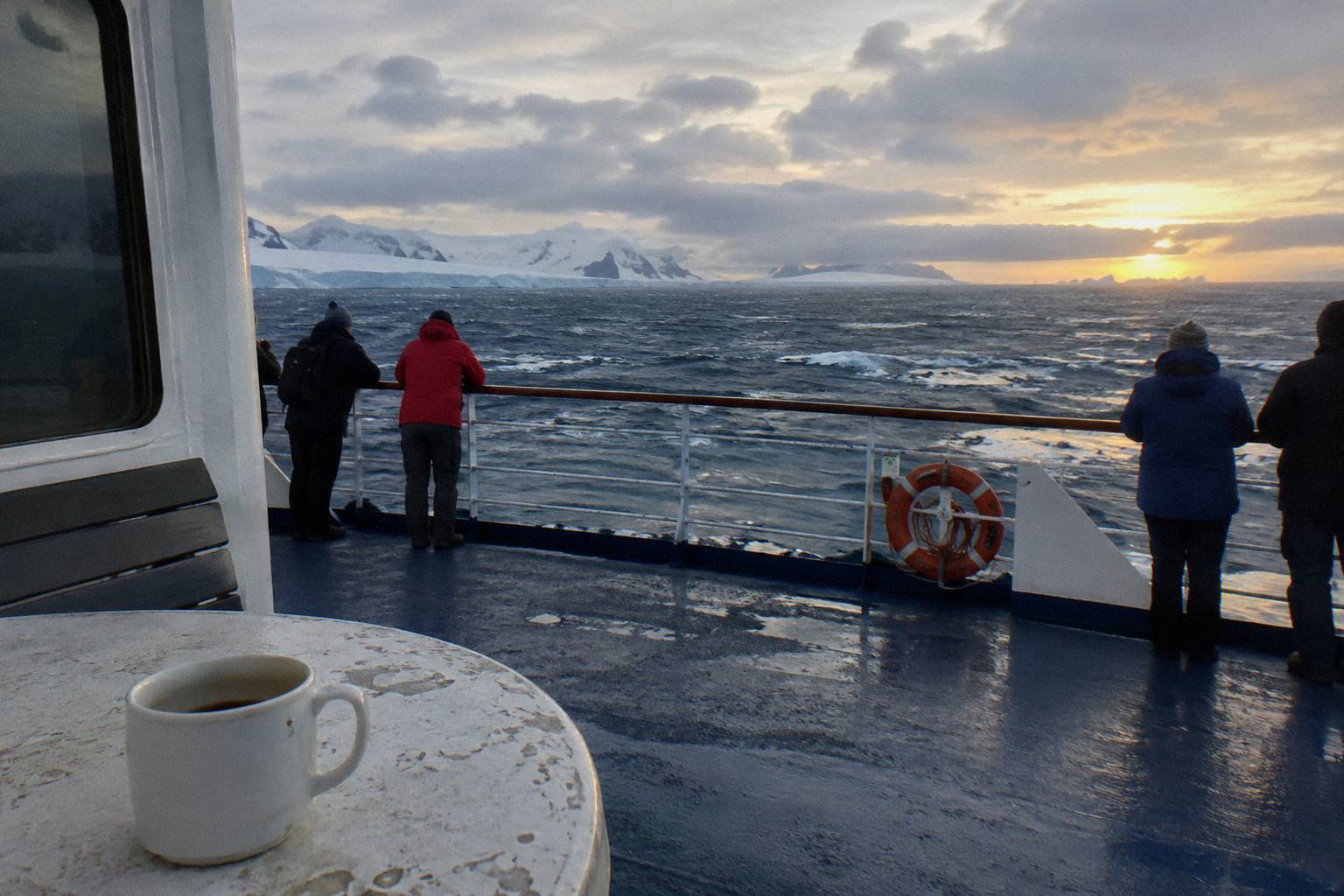
Against those odds, the ship-side levers that are actually published are: the X-BOW claims of reduced slam, pitch, noise, vibration and spray; zero-speed stabilisers, some 50 percent larger than standard, that work at anchor; advanced weather routing, meaning captains alter course and timing around forecasts; and Sea Spirit's retrofitted zero-speed-type fins on the budget end of the roster. The traveller-side levers, covered in depth in our Drake Passage safety and conditions guide, are medications started before embarkation, a low midships cabin, and horizon-gazing, and they work on any hull.
One more honest note on evidence. The X-BOW's design rationale makes the comfort claims plausible, and nothing published contradicts them. But nothing published quantifies them either. If a sales conversation promises a smooth Drake because of the hull shape, that promise is ahead of the published evidence, and you are entitled to treat it as marketing until a number appears. The IACS polar class definitions, which do carry hard operational meaning, are published openly for anyone who wants the ice-strength side of the specification, at the IACS unified requirement on polar class ships.
Sylvia Earle is the second of Aurora's X-BOW trio and a frequent comparison point against Greg Mortimer: same 130-passenger expedition cap, same 15-Zodiac operation, same Ulstein X-BOW, and a from-fare of $19,566 for her 12-day Spirit of Antarctica voyage. Her operator page lists a full activity suite, sea kayaking, camping, snowshoeing, snorkelling, paddling, ski and snowboard touring, citizen science and the polar plunge, with house wine, beers and soft drinks included with dinner.
Common Questions About X-BOW Ships And Stabilisers
What is an X-BOW ship in Antarctica?
An X-BOW is a Ulstein hull design in which the bow slopes backwards from the waterline, so the hull meets waves along a long curved surface instead of a flat vertical front. Seven ships on the 2026-27 Antarctic roster carry one: Greg Mortimer, Sylvia Earle, Douglas Mawson, Ocean Albatros, Ocean Victory, National Geographic Endurance and National Geographic Resolution.
Does the X-BOW make the Drake Passage smoother?
The published claims state reduced wave slamming, pitch, noise, vibration and spray. No independent verification of those specific claims is published, and no operator page states a measured figure. Treat the X-BOW as a plausible comfort improvement in head seas, not a guarantee of a calm crossing.
Which Antarctica ships have stabilisers?
On published information: Sea Spirit has retractable zero-speed-type fins retrofitted in 2019, National Geographic Endurance has zero-speed stabilizers, Hondius has advanced fin stabilizers, and Viking Octantis and Viking Polaris have fin stabilisers with U-tank anti-roll systems. Other roster pages simply do not state stabilisers.
Why do stabilisers retract in ice?
Retractable fins are pulled inside the hull in ice because ice impact can damage them. The result is that the anti-roll benefit switches off in ice-filled waters, which on a Peninsula voyage means the system works on the Drake crossing and is retracted during inshore ice cruising.
Is an X-BOW better than stabilisers for seasickness?
They counter different motions. The X-BOW's published claims concern slamming, pitch and spray from head seas; fin stabilisers act against roll, the side-to-side motion. National Geographic Endurance is the roster ship with both, on published information.
Can any ship guarantee a calm Drake crossing?
No. Roughly 70 percent of crossings are calm and 30 percent rough, with typical swells of 3 to 5 metres and severe conditions documented at 13 to 15 metres. Crossing times run 18 to 24 hours in good conditions and 36 to 48 in rougher seas. No hull or fin changes the weather.
More Choosing A Ship
 Choosing Your ShipFive decisions that narrow 43 expedition ships down to the one you should book.Read the guide
 Cruise Ships ComparedShip size decides whether you land: compare every major Antarctica vessel by passengers, ice class and fare.Read the guide
 Cruise Lines ComparedAll fourteen Antarctica cruise lines mapped, with fleets, fares and landing rules.Read the guide
 Luxury CruisesWhat a premium Antarctica fare really buys: suites, included extras and the ships at the top tier.Read the guide