Best Cabin For An Antarctica Cruise: Location, Deck And What To Avoid
 By Oleg G.
On an Antarctica cruise the cabin is an engineering decision before it is a comfort decision. Location, deck and cabin type change both your fare and how the Drake Passage treats you.
Quick answer: The calmest cabins sit midship on the lowest passenger deck, and they are usually the cheapest categories too: on Hondius, a quadruple porthole starts around $9,600 while a balcony suite runs $17,500 on the same departure. Pay for stability first, view second, because balconies are often locked in Drake Passage seas.
The gap between the cheapest and most expensive cabin on the same Antarctica cruise departure can be enormous. On one late-December 2026 Hondius sailing, the lowest quadruple porthole is listed around $9,650 per person while the Grand Suite with a private balcony sits at $17,500, and both berths get the same ship, the same landings and the same whales. That makes the cabin decision the single biggest controllable line in your budget, and the one with the most myths attached to it. Cruises In Antarctica breaks the choice into three factors that actually matter: where the cabin sits along the ship, which deck it sits on, and what kind of window, or balcony, you are paying extra for.
Where Is The Best Cabin Location On An Antarctica Cruise Ship?
Midship, on a low deck, is the best cabin location on an Antarctica cruise ship. Naval architecture puts the least roll and pitch at the ship's centre, and operator guidance agrees: avoid forward and high decks if you are worried about movement, and stay clear of cabins directly above or below engine rooms or public rooms. The useful surprise is that these calm berths are usually the cheapest categories on the deck plan.
A ship rotates around its centre like a see-saw. The further your cabin sits from that centre, toward the bow or the stern, the more vertical travel your bed makes with every swell, and the Drake Passage supplies plenty of swells. Oceanwide Expeditions, whose fleet includes Hondius, Plancius and Ortelius, addresses this directly in its seasickness guidance: passengers sensitive to motion should avoid forward and high decks, and should also check what sits above and below a cabin, because cabins next to engine rooms, theatres or other public spaces pick up noise as well as movement (Oceanwide Expeditions seasickness FAQ).
The same logic shows up in how operators price and market their quietest spots. Quark Expeditions notes that the Terrace Suites on Ultramarine occupy a central position on Deck 6, which the operator associates with minimal movement (Quark's Antarctic Explorer voyage page). In other words, the expedition lines know exactly which cabins move least, and they place some of their most expensive suites there.
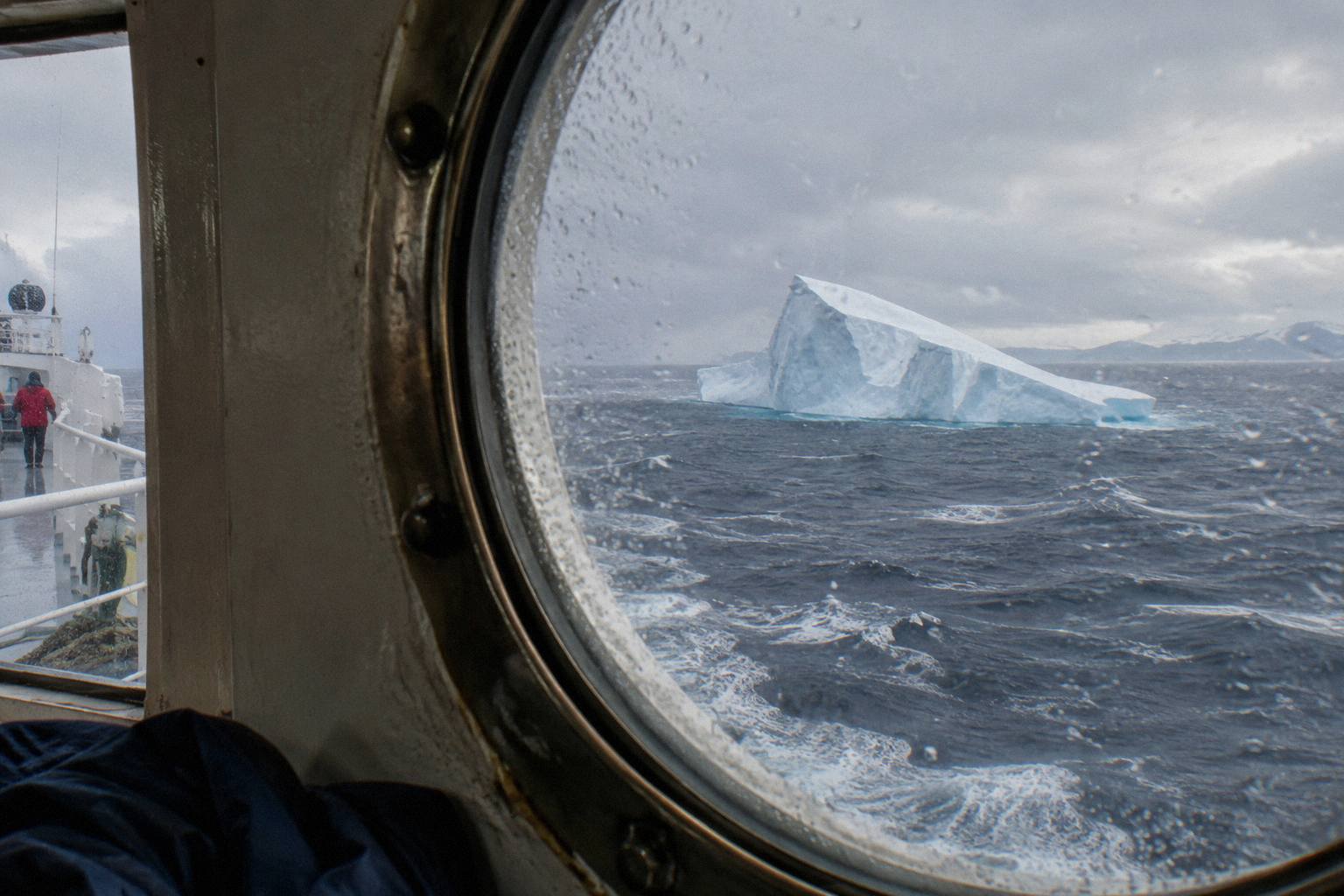
Here is the part most first-time Antarctic travellers miss: on the ships in this fleet, the low-deck midship berths are the porthole and shared categories, and they are the cheapest on the fare sheet. On Hondius and Greg Mortimer, the porthole cabins sit on the lower decks, while window cabins sit midship and balcony suites spread across multiple decks. If your priority is a calm stomach rather than a private railing, the budget cabin is often the technically correct one.
There is a social dimension to this too. The quadruple and triple categories that anchor the bottom of the fare sheet put you in a shared cabin, and that is not for everyone. But the twin porthole and twin window categories come in at a mid-range fare, and on ships like Hondius the porthole cabins sit on the lower decks, so travellers who want privacy without the motion of a high-deck suite may have a middle path. The deck plan, not the brochure, is where you find it.
| Position on the deck plan | Movement | Noise | What you typically pay |
|---|---|---|---|
| Midship, lowest passenger deck | Least roll and pitch | Generally quiet, check neighbours | Cheapest categories, e.g. Hondius quadruple porthole from about $9,600 |
| Midship, middle deck | Low | Depends on adjacent public rooms | Mid-range window categories |
| Forward, high deck | Increased | Check adjacent public rooms | Not stated |
| Above or below engine spaces | Varies | Increased | Check the deck plan before booking |
| Above or below theatre or public rooms | Varies | Increased around lecture and meal times | Any category, location matters more than type |
Which Deck Gives You The Least Movement On The Drake Passage?
A lower deck gives you less movement on the Drake Passage, full stop. The crossing takes roughly two days each way on a typical expedition cruise, and the lower your cabin sits toward the waterline, the shorter the arc the ship's roll swings you through. High decks buy you views and sunlight, but they also buy you the widest ride, and balconies on any deck are often locked when the seas get rough.
According to Quark Expeditions, a Drake Passage crossing takes 18 to 24 hours in optimal conditions and stretches to 36 to 48 hours in rougher seas, so you are choosing a cabin for up to four total days of open ocean on a round-trip voyage. Oceanwide's guidance is blunt about where those hours feel worst: forward and high decks move the most. The lowest passenger deck, midship, is the steadiest place on the hull.
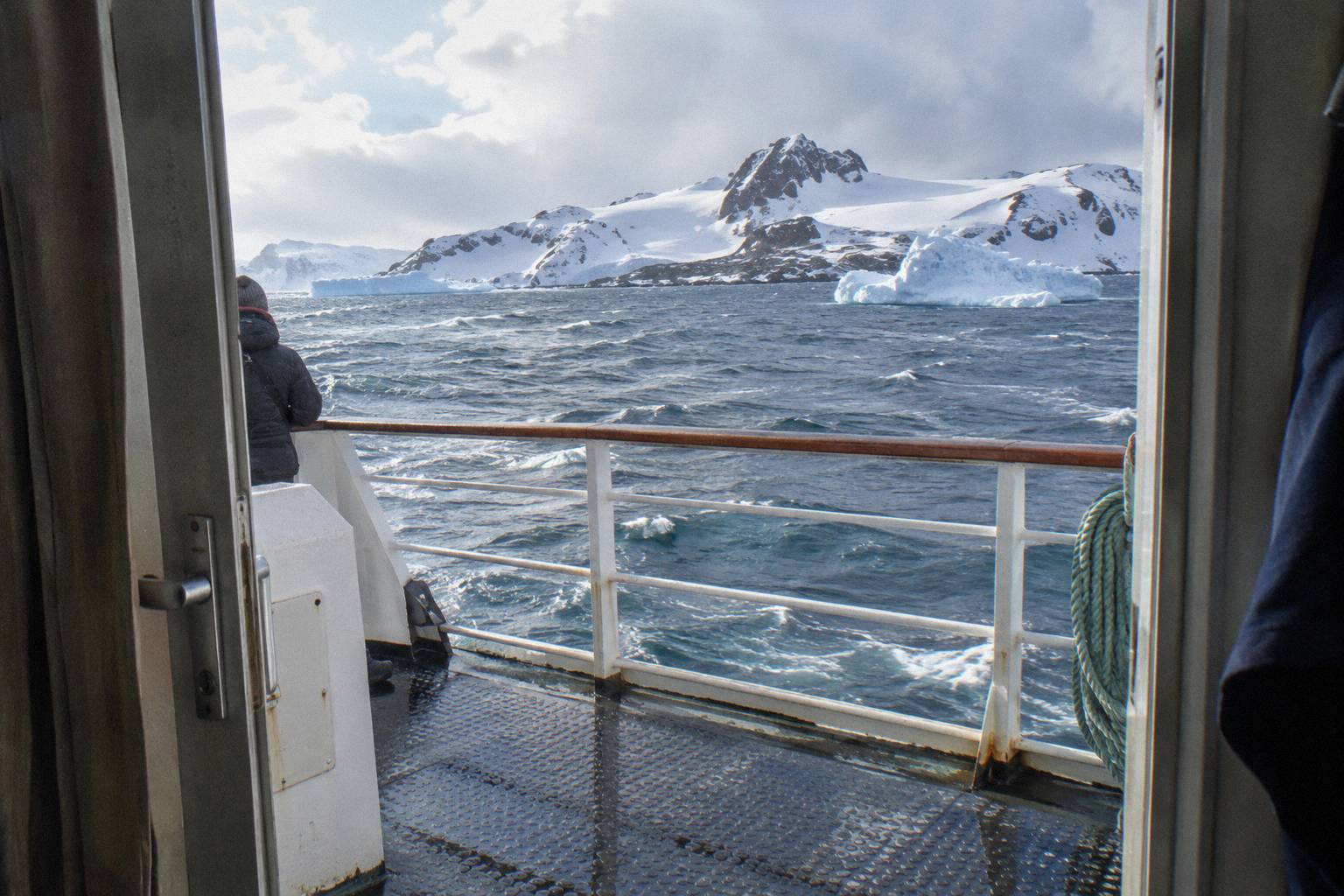
The balcony question follows directly from this. Expedition cruise cabins with balconies are often locked in rough seas on the Drake crossing, and even in calm polar water their use is limited by wind and cold (a cabin guide for Antarctic expeditions). If you are paying a four-figure premium largely for private outdoor space during the crossing, you may be paying for a locked door. Our Drake Passage seasickness guide covers the crossing itself in more detail.
None of this means a high-deck cabin ruins a voyage. Modern expedition ships are built with comfort in mind, plenty of guests sleep perfectly well forward, and the polar daylight through a high window is genuinely lovely. But if you already know your stomach is the weak link in your travel kit, spend your money on position, not altitude.
Porthole, Window Or Balcony: Which Cabin Suits An Antarctica Cruise?
A porthole cabin on a low deck is the value pick, a midship window cabin is the comfort pick, and a balcony is a luxury of space and daylight rather than guaranteed outdoor time. On four sampled 2026-27 voyages the lowest balcony cabins sit well above the cheapest cabins on the same fare sheet, and balconies are often locked in Drake Passage seas, so buy one for the room, not the railing.
The three cabin types are not just different windows, they usually sit in different parts of the ship. Porthole cabins occupy the lower decks on ships like Hondius and Greg Mortimer, which happens to be the calmest real estate on board. Window cabins tend to sit midship on middle decks, one step up in fare. Balcony cabins and suites spread across multiple decks: on Ultramarine, balcony suites appear on Decks 4 and 6, and Sylvia Earle's fare sheets show balcony staterooms as a distinct, higher-priced category.
| Cabin type | Where it usually sits | Fare level on the ladder | Practical trade-off |
|---|---|---|---|
| Porthole | Lower decks | Cheapest categories | Least motion, small fixed window, often shared berths |
| Window | Midship, middle decks | Mid-range | Low motion plus a larger view, e.g. Hondius twin window from about $12,500 |
| Balcony | Multiple decks, e.g. Ultramarine Decks 4 and 6 | Top of the ladder | Most space and daylight, often locked in rough seas |
The fare data makes the balcony decision concrete. On the Hondius Antarctic Peninsula departure running 27 December 2026 to 6 January 2027, the lowest non-balcony cabin, a quadruple porthole, is listed at $9,650 per person, while the lowest balcony cabin, the Grand Suite, is $17,500. On Sylvia Earle's 24 November to 7 December 2026 voyage the gap is far narrower: the Aurora Stateroom Superior costs $16,995 and the lowest balcony stateroom $18,495. On Ultramarine's Antarctica By Helicopter voyage of 27 November to 8 December 2026, the Explorer Triple is $16,890 against a Balcony Suite at $21,490. And on MS Fridtjof Nansen's 19 November 2026 departure, an outside cabin without balcony is $9,268 against a balcony cabin at $11,065.
| Ship and voyage | Lowest cabin without balcony | Lowest balcony cabin |
|---|---|---|
| Hondius, Antarctic Peninsula, 27 Dec 2026 to 6 Jan 2027 | Quadruple Porthole $9,650 | Grand Suite with private balcony $17,500 |
| Sylvia Earle, 24 Nov to 7 Dec 2026 | Aurora Stateroom Superior $16,995 | Balcony Stateroom C $18,495 |
| Ultramarine, Antarctica By Helicopter, 27 Nov to 8 Dec 2026 | Explorer Triple $16,890 | Balcony Suite $21,490 |
| MS Fridtjof Nansen, 19 Nov 2026 departure | Outside cabin RR $9,268 | Balcony cabin XTJ $11,065 |
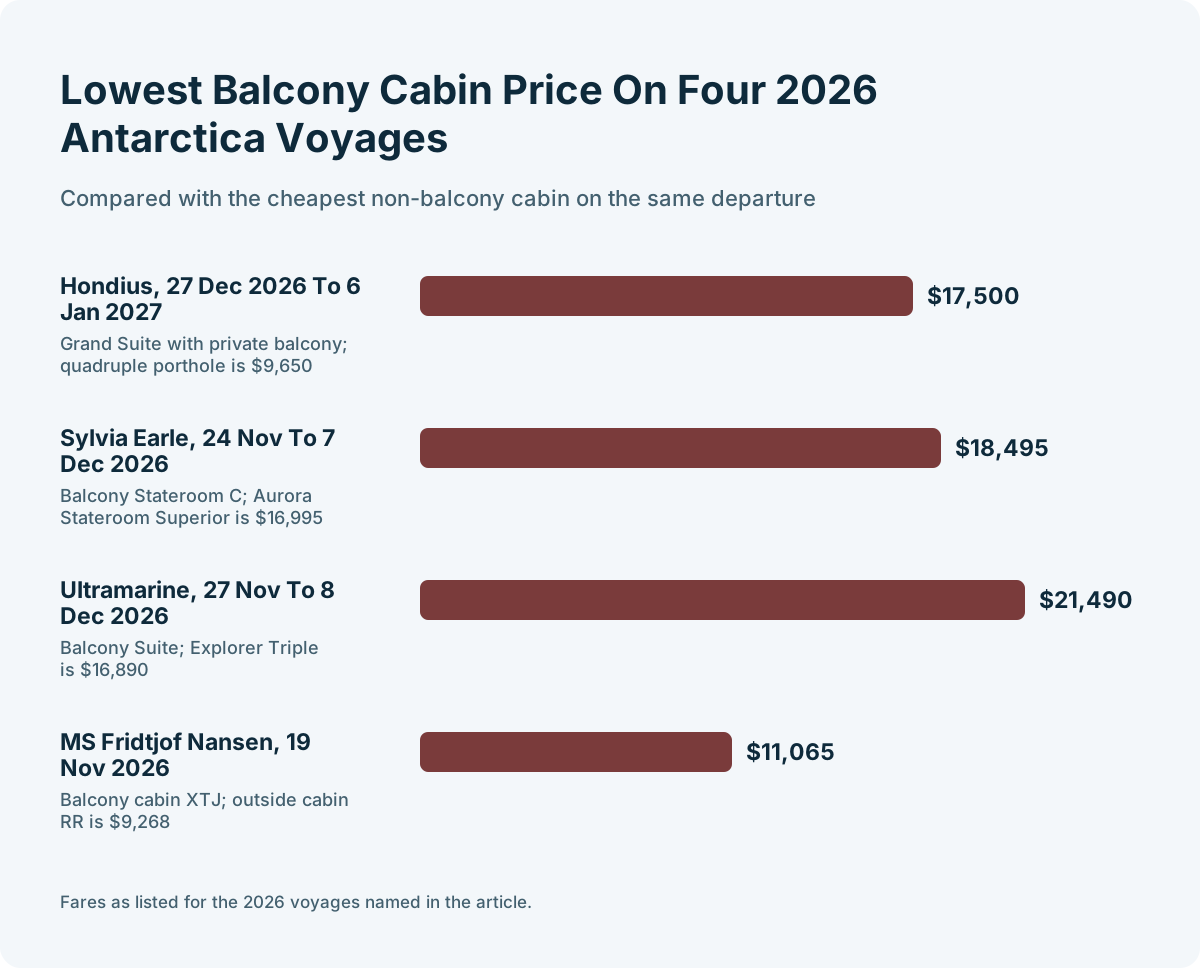
Notice how uneven those fare ladders are. Two travellers on comparable Peninsula itineraries can face very different upgrade costs purely because of which ship and departure they picked. If a balcony matters to you, the voyage choice matters more than the cabin choice, and it is worth getting free help choosing a cabin before you commit to a fare sheet. Our longer treatment of the question, is a balcony worth it, works through the trade-offs in detail.
How To Read An Antarctica Cruise Deck Plan Before You Book?
Read a deck plan in four passes: find the ship's midship point and favour cabins near it, count decks up from the waterline and favour the lower ones, check what sits directly above and below your cabin, and locate the public rooms you will walk past every day. Operators publish deck plans on their own ship pages, so this costs nothing but twenty minutes.
Operators such as Quark Expeditions and Oceanwide Expeditions publish deck plans on their official ship pages. That matters because a "Twin Window" or a "Balcony Suite" can sit in a different place on every ship, and the plan, not the category name, tells you where.
The second pass is the one people skip. A cabin one deck below a busy lounge or the lecture theatre inherits its schedule, and a cabin above the engine spaces inherits its hum. Oceanwide's own guidance flags exactly these positions as the ones to check. The third pass is practical: Oceanwide states that all cabins on its vessels have bedside power outlets, which matters if you travel with a CPAP machine, since distilled water is not supplied as standard and you should tell the operator your requirements in advance. Any health problem that could need emergency care must also be disclosed in advance through the operator's personal information form, returned within one month of booking.
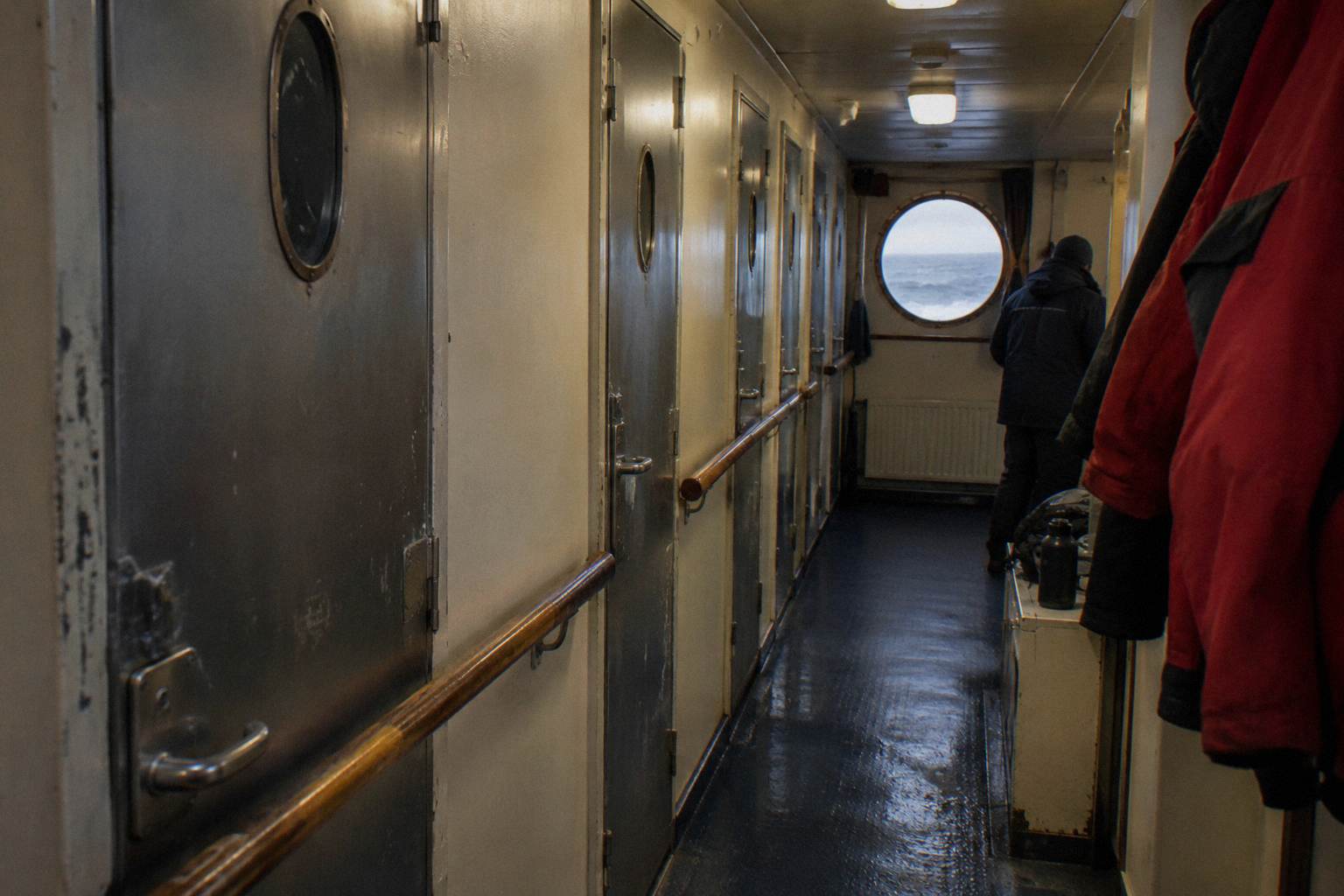
One honest note on accessibility: expedition ships vary a lot, and deck plans do not always show it. Some newer vessels in the wider fleet, such as certain HX ships, offer accessible cabins with elevators to passenger decks, while Zodiac boarding on most landings requires balance and a sailor's grip that wheelchairs cannot manage. If mobility is part of your cabin decision, ask about live cabin availability and the specific ship's accessible inventory rather than assuming.
Which Cabins Should You Avoid On An Antarctica Cruise?
Avoid three things: cabins high and forward, which move the most in a swell; cabins directly above or below engine rooms or public rooms, which trade motion for noise; and balcony premiums bought for the wrong reason, since the railing is often unusable on the crossing. Ship age is worth a look too, because the fleet runs from a 1976 hull to 2019 builds.
The first two are pure deck-plan work and cost you nothing. The third is a budget decision. After two years of comparing fare sheets for this site, the pattern that keeps repeating is that the cheapest cabin is often the calmest one, so the "bad cabin" on an expedition cruise is usually the expensive one bought for scenery that weather may not deliver.
Fleet age is the quiet fourth factor. The fleet we cover spans ships built in 1976 (Plancius, a converted Dutch Navy oceanographic vessel), 1989 (Ortelius, a former Russian research vessel) and 2019 (Hondius and Greg Mortimer). That is not an argument against the older ships, whose from-fares sit among the lowest we list (Plancius from $7,050 per person), but it is an argument for checking what your fare actually buys before you pay for a suite on an older hull.
The cabins that look worst on paper, the low-deck porthole berths, sit where operator guidance says the ship moves least. The cabins that look best in the brochure, the forward-facing suites on the top deck, are the ones that swing hardest when the Drake gets up.
How Do Cabins Compare On Hondius, Greg Mortimer And Ultramarine?
Hondius offers the widest cabin ladder from about $9,600 to $17,500, so it suits travellers who want to choose their exact point on the price curve. Greg Mortimer and Ultramarine start higher, from $19,521 and $12,236 per person respectively. All three carry 199 passengers or fewer, so every cabin is on a small expedition ship.
These three ships cover the practical spread of the market: a Polar Class 6 small-ship budget vessel, Aurora Expeditions' X-BOW ship, and Quark's helicopter-equipped Ultramarine.
| Ship | Class | Passengers | Ice class | From, per person | Voyage length | Departs from |
|---|---|---|---|---|---|---|
| HondiusOceanwide Expeditions | Small-Ship Budget | 170 | Polar Class 6 | from $7,800 | 11 to 19 days | Ushuaia |
| Greg MortimerAurora Expeditions | Upscale Expedition | 130 | – | from $19,521 | 12 to 26 days | Ushuaia |
| UltramarineQuark Expeditions | Upscale Expedition | 199 | 1A+, PC6 | from $12,236 | 12 to 14 days | Buenos Aires, Ushuaia |
Hondius carries 170 passengers in 80 cabins, was built in 2019 and holds Polar Class 6, which the operator describes as the first-registered PC6 vessel in the world. Oceanwide lists Peninsula voyages from $7,800 per person, and the cabin ladder on a sample departure climbs from the quadruple porthole at roughly $9,600 to $10,150, through twin porthole at $11,400 to $12,500 and twin window at $12,500 or more, past superior and deluxe categories around $13,150, up to the junior and grand suites with balcony at $15,000 and beyond. It is a clear example of buying your exact position on the trade-off curve. Our full Hondius ship guide covers the vessel in depth.
| Hondius cabin category | Sample fare per person |
|---|---|
| Quadruple Porthole | about $9,600 to $10,150 |
| Twin Porthole | about $11,400 to $12,500 |
| Twin Window | about $12,500 and up |
| Superior and Deluxe | about $13,150 and up |
| Junior and Grand Suite with balcony | about $15,000 and up, Grand Suite $17,500 on the 27 Dec 2026 departure |
Greg Mortimer, built in 2019 with an Ulstein X-BOW hull, carries 130 passengers on expedition and lists Antarctica voyages from $19,521 per person twin share. Its porthole categories sit on the lower decks like Hondius's, so the calmest berths again sit at the bottom of the fare sheet, though the entry price sits a tier above the Oceanwide ship. Sylvia Earle, its fleetmate at Aurora Expeditions, shows the same pattern on its fare sheets, with the non-balcony Aurora Stateroom categories priced below the balcony staterooms on the same departures.
Ultramarine is the different animal: 199 passengers, 128 metres, ice class 1A+ and PC6, with two twin-engine helicopters and an internal Zodiac hangar carrying 20 boats. Quark's fares are voyage-level and shared across its three ships, with Antarctic Peninsula voyages listed from $12,236 per person, so the cabin you pick rather than the ship often drives the final number. Its balcony suites spread across Decks 4 and 6, and the operator positions the central Deck 6 Terrace Suites as its minimal-movement accommodation.
If that spread of fares, decks and cabin types feels like a lot to weigh alone, you can compare cabins on your shortlist for free with a consultation, and our guide to Antarctica cruise prices by cabin extends the fare comparison across more of the fleet.
Common Questions About Choosing An Antarctica Cruise Cabin
Where is the best cabin on an Antarctica cruise ship?
Midship on the lowest passenger deck. That position sees the least roll and pitch, and on ships like Hondius and Greg Mortimer it is where the porthole categories sit, which are also the cheapest berths on the fare sheet.
Is a lower deck better for the Drake Passage?
Yes. Operator guidance from Oceanwide Expeditions says to avoid forward and high decks if you are sensitive to motion, and the crossing runs roughly two days each way, 18 to 24 hours in good conditions and 36 to 48 in rougher seas according to Quark.
Is a balcony cabin worth it on an Antarctica cruise?
It depends on what you are buying. Balconies add space and daylight, but they are often locked in Drake Passage seas and see limited use in wind and cold. On sampled 2026-27 voyages the lowest balcony cabins run from $11,065 to $21,490 per person against cheapest cabins of $9,268 to $16,995.
Which cabins should I avoid on an Antarctica cruise?
Avoid cabins high and forward, which move the most in a swell, and cabins directly above or below engine rooms, theatres or other public rooms, which pick up noise. Check the deck plan for both before booking any category.
How much more does a balcony cabin cost?
It varies widely by ship and departure. On the sampled 2026-27 voyages, the lowest balcony cabin ranges from $11,065 on MS Fridtjof Nansen to $21,490 on Ultramarine, while the cheapest non-balcony cabins on those same sailings range from $9,268 to $16,995.
More Choosing A Ship
 Choosing Your ShipFive decisions that narrow 43 expedition ships down to the one you should book.Read the guide
 Cruise Ships ComparedShip size decides whether you land: compare every major Antarctica vessel by passengers, ice class and fare.Read the guide
 Cruise Lines ComparedAll fourteen Antarctica cruise lines mapped, with fleets, fares and landing rules.Read the guide
 Luxury CruisesWhat a premium Antarctica fare really buys: suites, included extras and the ships at the top tier.Read the guide