Heritage Expeditions Antarctica: The Ross Sea Specialist
 By Oleg G.
Heritage Expeditions is a New Zealand operator built around the Ross Sea, the deep-south corner of Antarctica that most Peninsula cruisers never see.
Quick answer: Heritage Expeditions is a New Zealand operator with more than 40 years of polar experience. In 2026-27 it sails the 140-guest Heritage Adventurer on 28-day Ross Sea voyages from New Zealand from about $33,075 per person, plus Falklands, South Georgia and Peninsula routes. Its fares are not published in full and its minimum age policy is not stated.
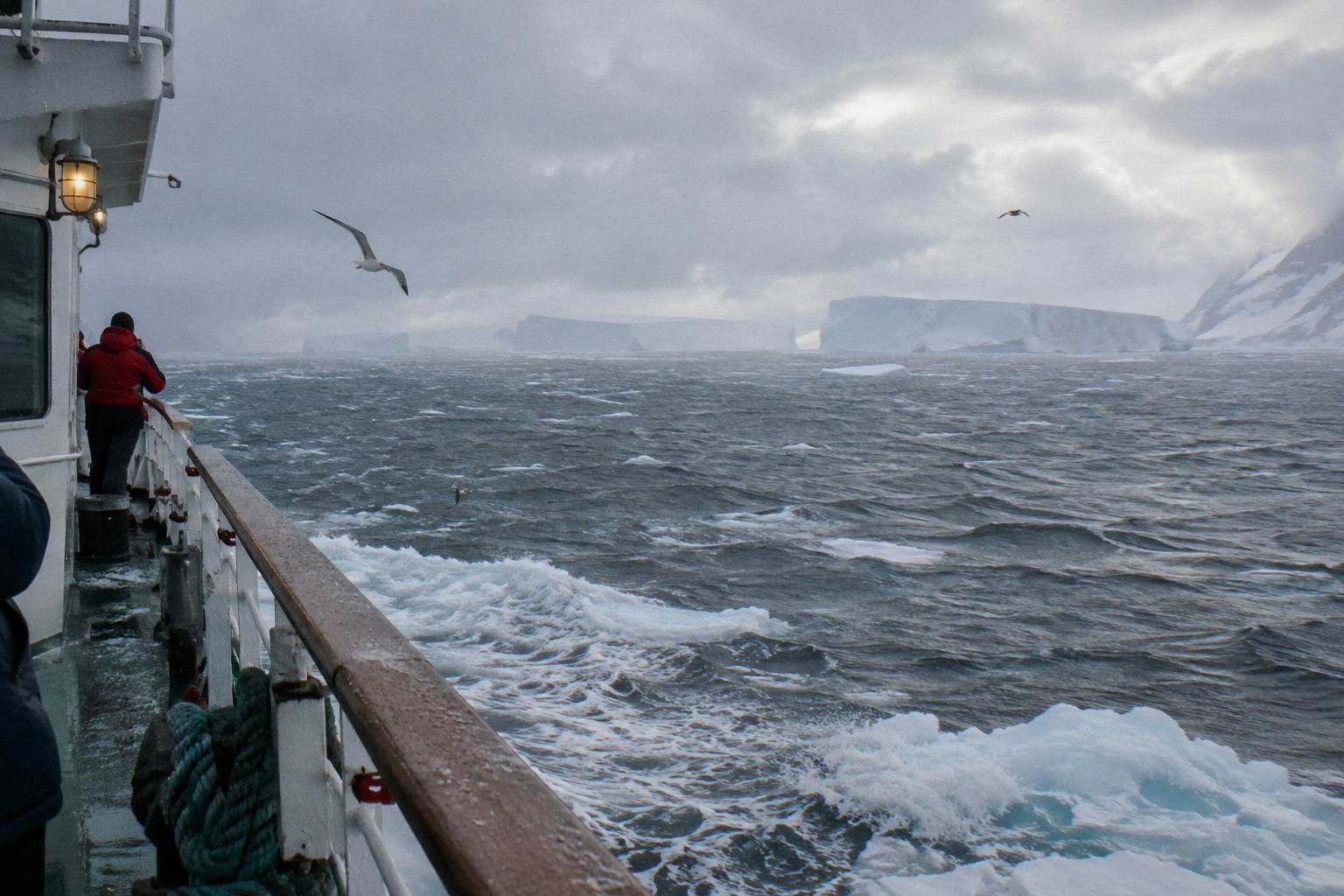
Heritage Expeditions occupies a peculiar corner of the Antarctic travel market. While dozens of operators run ten-day Peninsula loops out of Ushuaia between November and March, this New Zealand company built its reputation on the Ross Sea, the far side of the continent where Scott and Shackleton left their huts and where only a handful of tourist voyages run each season. The operator pages show a 28-day "In the Wake of Scott & Shackleton" itinerary from New Zealand, with 10 to 12 days in the Ross Sea region itself, which is a different order of trip from a classic Peninsula sailing. This guide profiles the operator honestly: what it sails, what it charges where figures are published, what it keeps quiet about, and who should book it rather than one of the better-known names.
Who Is Heritage Expeditions?
Heritage Expeditions is a New Zealand-based expedition operator with more than 40 years of history and IAATO membership, and it is best known as the Ross Sea specialist. Its own materials describe a conservation-driven, small-ship philosophy, and its 2026-27 Antarctic program pairs the Ross Sea with Falklands, South Georgia and Antarctic Peninsula routes on a second vessel.
The company is based in New Zealand and cites over 40 years of experience on its own site, and the IAATO membership directory lists it among the association's operators. The operator's identity is tightly bound to that region: its marketing leans on more than 35 years of Ross Sea expertise, Zodiac landings and visits to the historic huts of Scott and Shackleton.
The 2026-27 season is also a period of change. The operator's own announcements note that Heritage returned to the Antarctic Peninsula, South Georgia and the Falklands on a new voyage and ship, the Heritage Discoverer, while the long-established Heritage Adventurer continues the deep-south program. For a buyer, that means the operator now spans both ends of the Antarctic market: the accessible Peninsula and the remote Ross Sea, on two quite different vessels.
What the operator does not publish is as telling as what it does. Minimum age, solo and single-supplement policies, and full fare inclusions are not stated on the main pages we reviewed, and the roster carries no from-price for Heritage Adventurer at ship level. Where a figure exists in operator materials it is quoted below with its source; where it does not, this guide says so plainly.
The Ships Heritage Expeditions Sails In Antarctica
Heritage Expeditions sails two vessels in Antarctic waters in 2026-27: the 140-guest, 1991-built Heritage Adventurer, an ice class 1A Super ship on the Ross Sea program, and the newer Heritage Discoverer on Peninsula, Falklands and South Georgia routes. The operator's own pages do not state a passenger cap for Antarctica voyages on either ship.
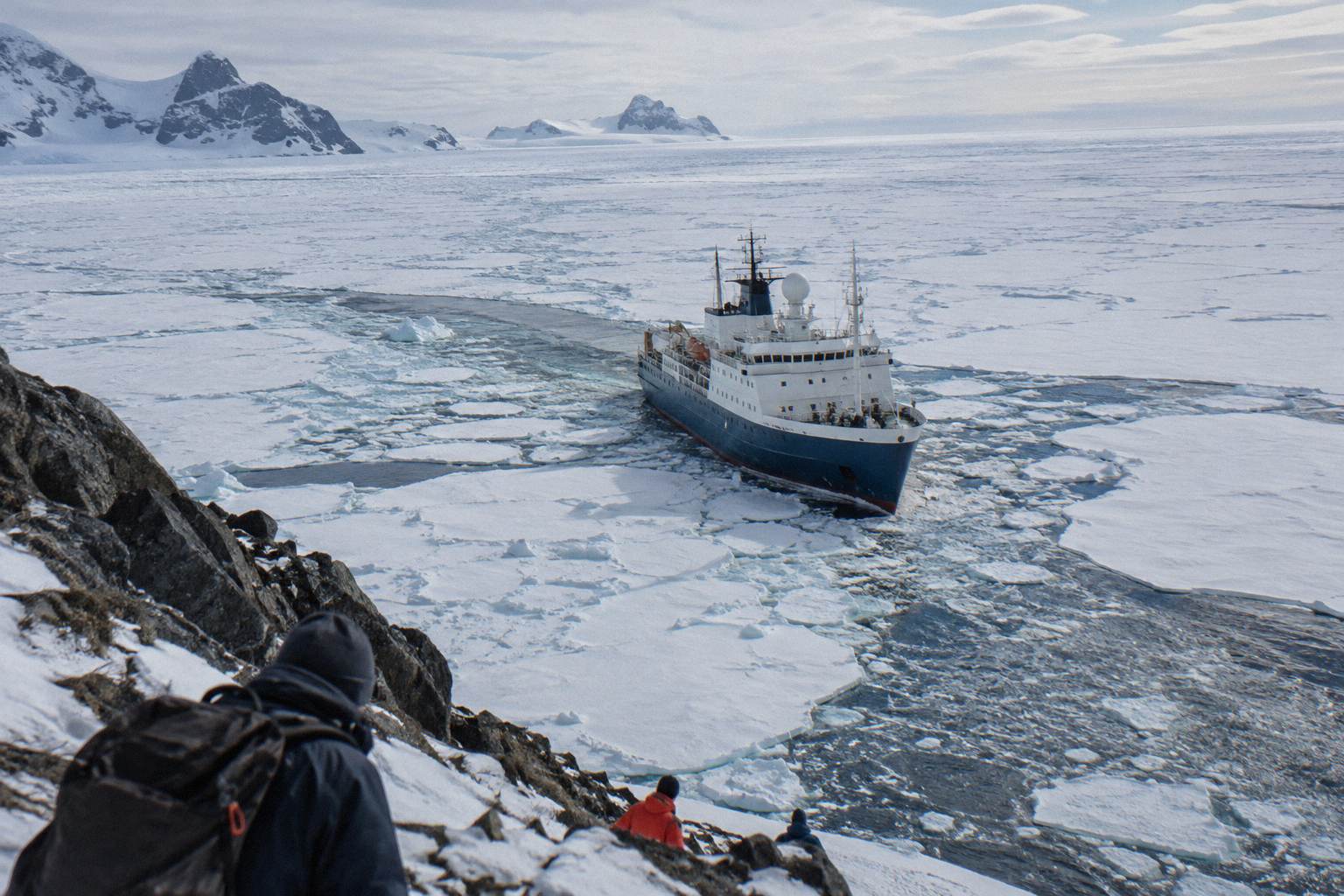
Heritage Adventurer is the flagship and the Ross Sea ship. The roster records 140 passengers, a 1991 build, ice class 1A Super, and 14 Zodiacs, with features focused on Ross Sea exploration and historic hut visits. Ice class 1A Super is a Finnish-Swedish notation designed for extreme ice conditions. The ship's age is worth weighing honestly. It is a 1991 hull rather than a newbuild, and buyers comparing it against a 2022 ultraluxury ship should expect that difference in the fare and in the cabin.
Heritage Discoverer is the second vessel, referenced in the operator's calendar and industry reporting as new or newly renovated, taking over the Peninsula, Falklands and South Georgia program. The roster does not carry a full specification for it, and the operator pages reviewed do not state its capacity, build year or ice class, so those details are left out here rather than guessed. Buyers should ask for the current specification sheet during a consultation, because a recently renovated ship can have details in flux between seasons.
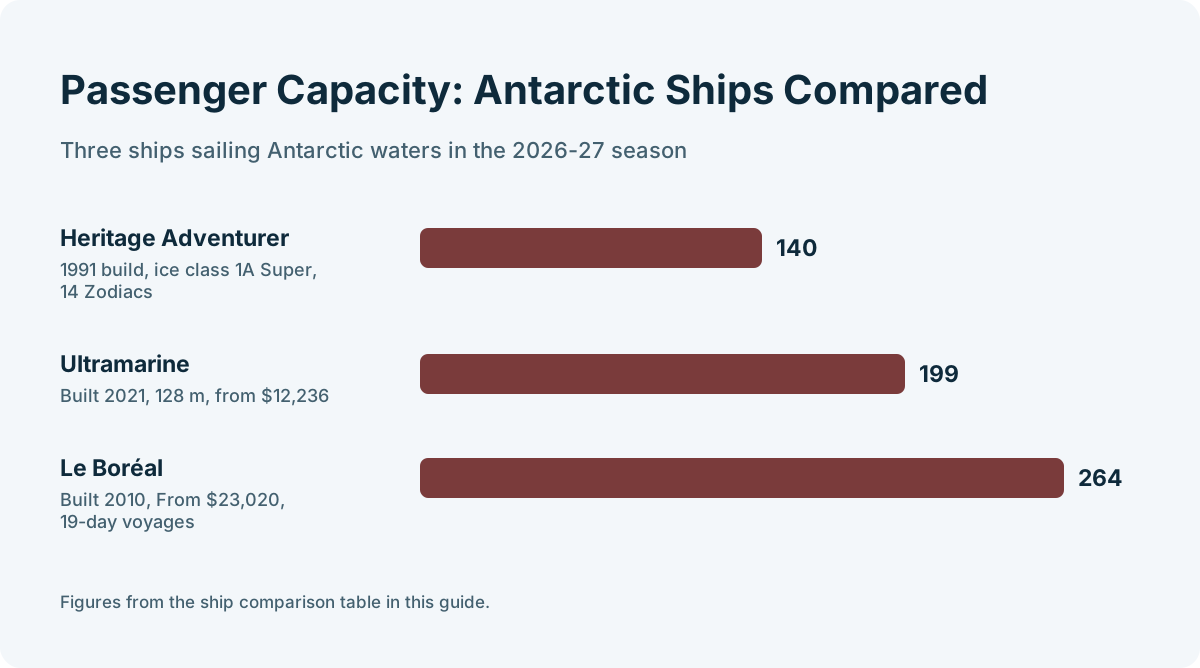
For context, here is how the flagship sits against two very different Antarctic ships from other operators, one luxury Ponant vessel and one upscale Quark expedition ship:
| Ship | Operator | Class | Passengers | Built | Ice class | Length | From-price |
|---|---|---|---|---|---|---|---|
| Heritage Adventurer | Heritage Expeditions | Upscale expedition | 140 | 1991 | 1A Super | Not stated | Not stated |
| Le Boréal | Ponant | Luxury | 264 | 2010 | Not stated | Not stated | From $23,020 |
| Ultramarine | Quark Expeditions | Upscale expedition | 199 | 2021 | 1A+, PC6 | 128 m | From $12,236 |
The comparison is deliberately uneven: these ships serve different travellers. Le Boréal is a French luxury vessel sailing 19-day Great Austral Loop voyages, Ultramarine is the helicopter-equipped Peninsula specialist, and Heritage Adventurer is a deep-itinerary ship where the destination, not the cabin, is the product.
Itineraries, Lengths, Ports And From-Prices
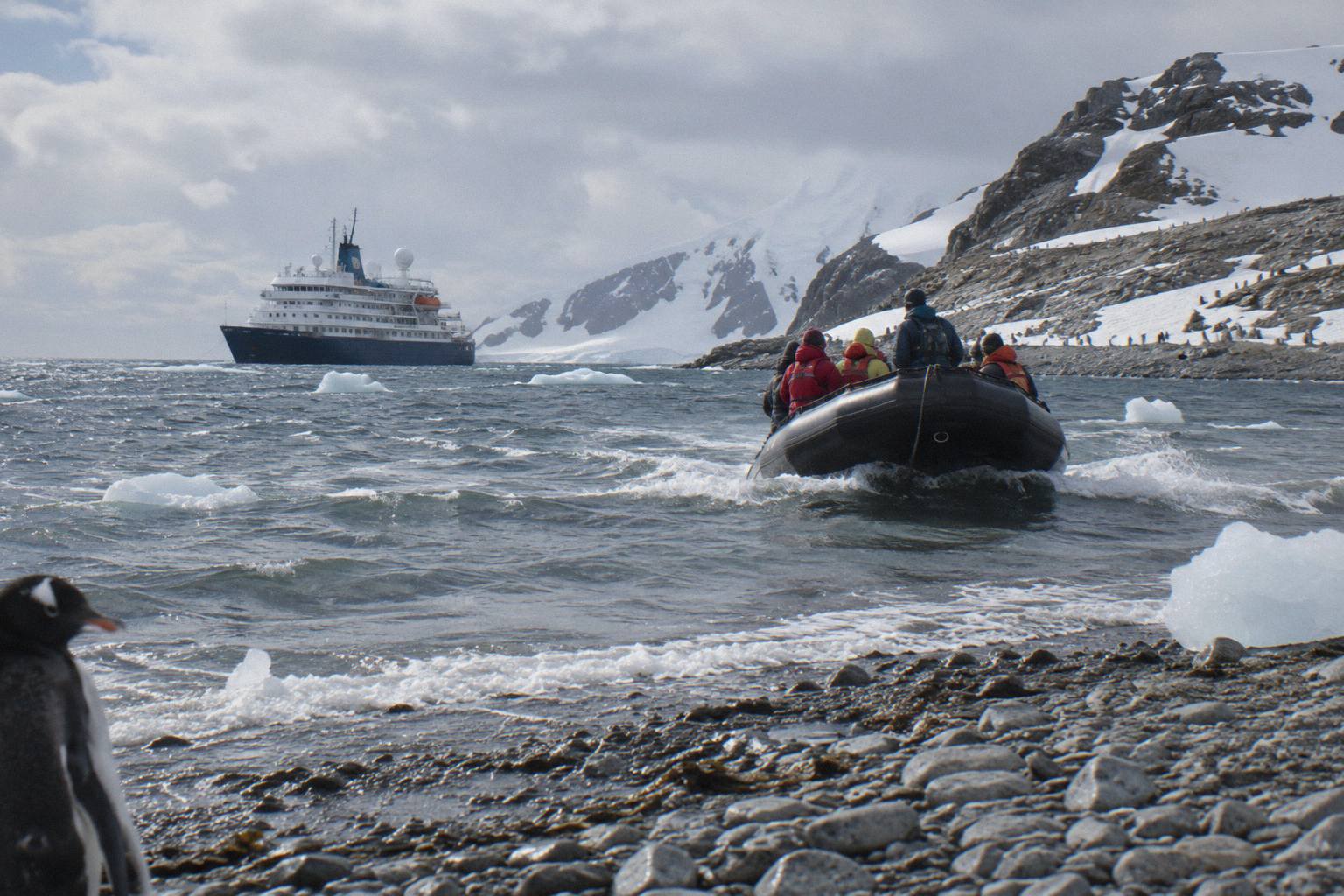
The signature product is the 28-day "In the Wake of Scott & Shackleton" Ross Sea voyage from New Zealand, priced from about $33,075 per person on the operator's own page, with 10 to 12 days in the Ross Sea region. A 22-day Ultimate South Georgia, Falklands and Antarctic Peninsula voyage from Ushuaia rounds out the 2026-27 program.
The Ross Sea itinerary is the operator's centrepiece. Departures listed for January and February 2027 sail from New Zealand, with ports listed as Bluff/Queenstown or Dunedin/Invercargill on the operator's Ross Sea pages. The route includes the Ross Ice Shelf, the historic huts at Cape Evans, Hut Point and Cape Royds, McMurdo Sound and emperor penguin colonies where ice permits. The season for these voyages is mainly January and February.
The second product is the 22-day Ultimate South Georgia, Falklands and Antarctic Peninsula voyage, roundtrip from Ushuaia, with a sample November 2026 departure in the operator's calendar. It trades the Ross Sea's historic sites for South Georgia and the Falklands, where black-browed albatross and rockhopper, gentoo and king penguins are among the wildlife highlights. The operator's calendar also references pricing examples from $23,300 upward on its routes, though no verified ship-level from-price is published, so treat any figure as itinerary-specific and confirm current fares directly.
| Itinerary | Length | Gateway ports | Region focus | Sample season | Price basis |
|---|---|---|---|---|---|
| In the Wake of Scott & Shackleton | 28 days | Bluff/Queenstown, Dunedin/Invercargill (NZ) | Ross Sea, historic huts, Ross Ice Shelf | Jan-Feb 2027 | From about $33,075 pp (operator page) |
| Ultimate South Georgia, Falklands & Antarctic Peninsula | 22 days | Ushuaia | South Georgia, Falklands, Peninsula | Nov 2026 sample | Not published as a from-price in materials reviewed |
| Peninsula/Falklands/South Georgia (Heritage Discoverer) | Varies | Ushuaia | Peninsula and sub-Antarctic islands | 2026-27 season | Not published in materials reviewed |
Two planning realities shape these routes. First, the Cruises In Antarctica season for the Ross Sea is short and the departures are few, so dates sell on a different clock than Peninsula trips. Second, the Southern Ocean crossing to the Ross Sea adds many sea days; a 28-day voyage simply contains more transit than a 10-day Peninsula trip, and buyers should want that as part of the experience. Our Ross Sea cruise guide covers the route, the huts and the ice in detail.
If a 28-day commitment or the Ross Sea price is the sticking point, it is worth weighing the alternatives before committing, and a free consultation on Ross Sea options can lay the real trade-offs side by side.
What The Fare Includes And Excludes
Heritage Expeditions does not publish a full inclusions and exclusions list on the main pages reviewed, so buyers must confirm specifics before booking. Industry-wide, expedition fares typically cover meals, Zodiac excursions and lectures, while flights, alcohol, gratuities, insurance and some optional activities sit outside the base price.
This is an area where the operator is less transparent than several competitors. Quark's itinerary pages itemise inclusions such as parkas, boots and some charter flights; Lindblad bundles a pre-cruise hotel, charter flight and prepaid gratuities into its Antarctic fares; Oceanwide suggests gratuities of 10 to 15 EUR or USD per passenger per day. Heritage's own materials reviewed for this guide do not offer a comparable itemised list, and no ship-level fare is published. The honest position: assume the fare covers the cabin, meals, Zodiac operations, guiding and lectures, and assume nothing else until the operator or your consultant confirms it in writing.
Insurance deserves a specific flag. Major Antarctic operators impose medical evacuation minimums, with published examples including $250,000 per person at Ponant and $500,000 at Quark, plus trip-cancellation cover. Whether Heritage requires a specific minimum is not stated in the materials reviewed, so ask. Our Antarctica travel insurance guide explains what these policies need to cover.
Optional activities are a second open question. On other lines, optional activities run roughly $350 to $2,000 per person; Heritage's Zodiac and landing program is part of the voyage, but any paid extras on its ships are not published.
| Cost item | Typical treatment across operators | Heritage Expeditions position |
|---|---|---|
| Cabin, meals, Zodiac excursions, guiding, lectures | Included in base fare on expedition lines | Expected included; not itemised on pages reviewed |
| Gratuities | Suggested 10-15 EUR/USD per passenger per day at Oceanwide; prepaid at Lindblad | Not stated |
| Parka and boots | Included at Quark and G Adventures | Not stated |
| Flights and gateway hotels | Bundled at some lines (Lindblad, Viking packages); extra at others | Not stated |
| Travel insurance with evacuation cover | Required or strongly recommended market-wide, operator minimums vary | Not stated |
Distinctive Features Of The Heritage Approach
The operator's distinguishing features are conservation-driven small-ship travel, genuine Ross Sea expertise built over decades, Zodiac landing operations, and access to the historic huts that most Antarctic travellers never reach. Its reporting and own materials emphasise the expedition substance over onboard luxury.
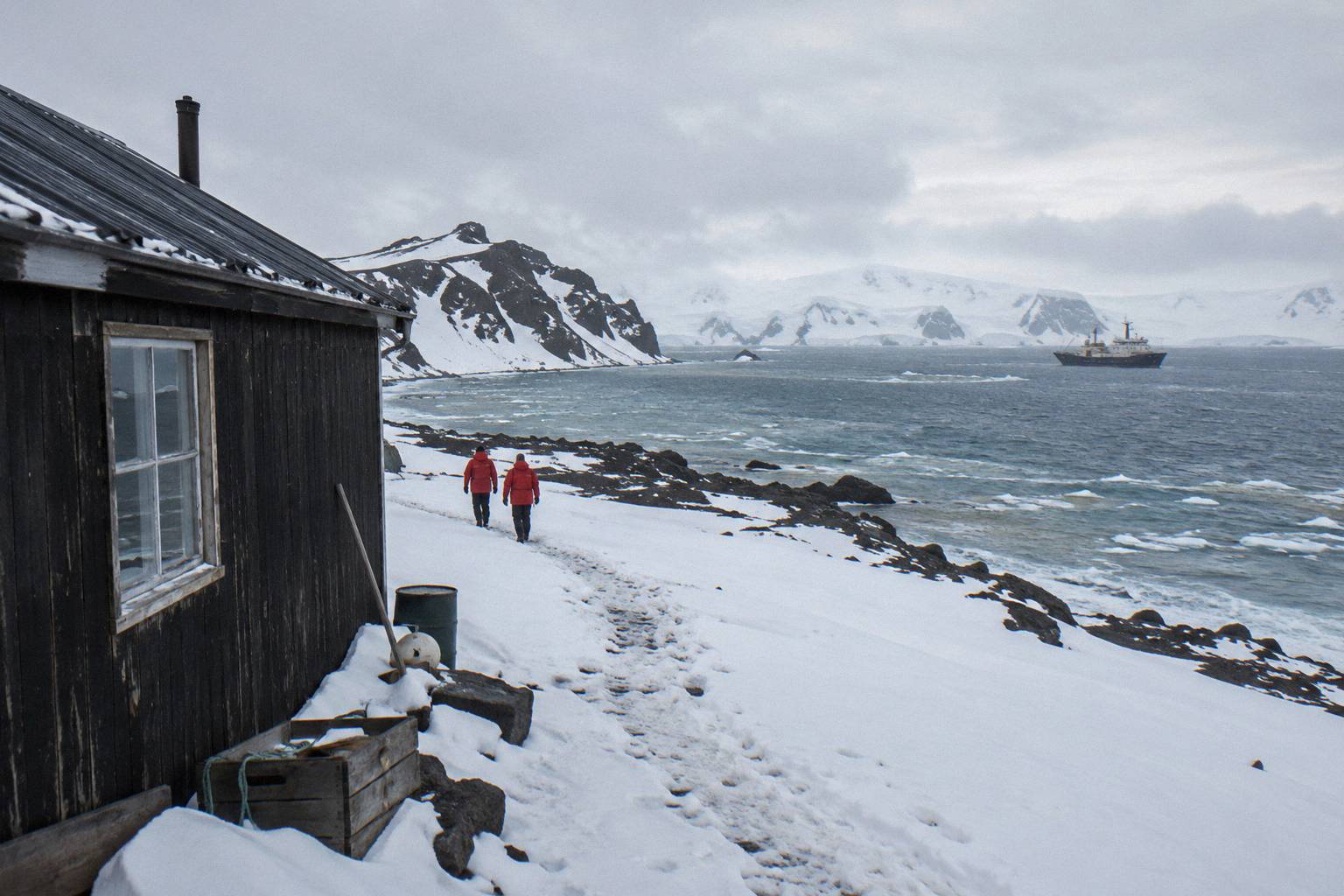
The historic huts are the clearest differentiator. Scott's hut at Cape Evans, Shackleton's hut at Cape Royds and Hut Point at McMurdo are preserved time capsules of the heroic age, and they sit in the Ross Sea, reachable only on the handful of voyages that penetrate the region each season. No Peninsula itinerary offers them. Heritage's materials list these visits among the ship's features, alongside 14 Zodiacs and a 1A Super hull, and its own materials describe a conservation-driven, small-ship philosophy as its identity.
The second feature is the New Zealand gateway itself. Sailing from Bluff or Queenstown rather than Ushuaia changes the whole shape of a trip: the sub-Antarctic islands south of New Zealand, including Macquarie Island with its royal penguin colonies on some routes, become part of the voyage rather than a flight connection. For travellers who have already done a classic Peninsula trip, this is a different expedition, and our East Antarctica and sub-Antarctic islands guide covers what those islands offer.
The third is scale. At 140 passengers, Heritage Adventurer sits just above the 100-passengers-ashore cap, so landings need only a short rotation, and IAATO guidance sets the 1:20 guide ratio and the one-ship-per-site rule that keep landings orderly. The trade-off, stated plainly: a 1991 hull will not match a 2020s newbuild on amenities. Buyers who care mainly about the ship itself should read our is a nicer ship worth it guide before deciding.
Minimum Age, Solo Policy And Booking Terms
Heritage Expeditions does not state a minimum age, a solo or single-supplement policy, or published deposit and payment terms in the materials reviewed for this guide, so all three must be confirmed with the operator or a specialist before booking. Comparable operators typically take deposits of 20 to 25 percent with final payment 60 to 150 days out.
Starting with what is not published is the honest approach here. The roster and operator pages reviewed carry no minimum age for Heritage, unlike Viking's clearly stated 18-and-over policy or Seabourn's stated minimum of six years for expedition voyages. Solo travellers likewise find nothing published: some competitors, such as Aurora with dedicated no-supplement solo cabins or G Adventures with gender-matched sharing, state their policies openly, but Heritage does not. Solo travellers should ask specifically about single-supplement percentages, which across the market range from 25 percent extra to double the twin rate.
On payment structure, the comparable published terms give a sense of the market: Quark takes a 25 percent deposit with final payment 150 days before departure, and Oceanwide takes 20 percent with balance due 60 days out. Whether Heritage's terms match either pattern is not stated in the reviewed materials. What is certain is that a 28-day Ross Sea voyage represents a five-figure commitment, so reading the cancellation schedule before paying a deposit matters more than on a short Peninsula trip. Our deposits and payments guide walks through the standard structures.
One published-adjacent detail: industry reporting on the operator has referenced Black Friday offers on 2026 sailings and preview pricing for the Discoverer program, so promotional windows do exist, but no discount figures are stated here because none have been published.
Recent News From The Operator
The notable 2026 developments are the return to the Antarctic Peninsula, South Georgia and the Falklands on the new Heritage Discoverer, and the continued Ross Sea program on Heritage Adventurer with January and February 2027 departures listed. The operator also appeared in fleet-movement reporting alongside Polar Latitudes' Discoverer, which operates under Heritage branding outside Antarctica.
The fleet news deserves a careful read. Cruise industry reporting in March 2026 noted that Polar Latitudes added the 132-guest Discoverer, a ship that also operates under Heritage Expeditions branding elsewhere in its program. Separately, Heritage's own calendar and announcements describe the Heritage Discoverer as the vessel for its Peninsula, Falklands and South Georgia return. These may or may not refer to the same physical ship in different seasonal roles; published reports do not settle it, and a buyer should simply confirm which vessel, specification and capacity applies to the specific voyage being quoted.
The other thread is continuity on the Ross Sea side. The 28-day "In the Wake of Scott & Shackleton" voyages are listed for January and February 2027, consistent with the region's short operating window, and the operator's positioning in the market remains anchored there. For context on the wider season, IAATO recorded 113,518 total visitors across Antarctica in 2025-26, of whom 85,195 made landed visits, while the Ross Sea remains a small fraction of that total with only a handful of departures annually, far fewer than to the Peninsula.
Who Heritage Expeditions Suits, And Who Should Look Elsewhere
Heritage Expeditions suits travellers who want the Ross Sea, the historic huts and a long, expedition-first voyage, and who accept an older ship without luxury trimmings to get there. Travellers whose priority is a modern ship, a short Peninsula itinerary, a low fare or published policies should look at other operators.
The fit is specific. The natural Heritage buyer has a deep interest in the polar explorers, has four weeks and a five-figure budget, and values the destination over the vessel. The 28-day commitment, the sea days and the New Zealand gateway are features for this traveller, not costs. If that description fits, Heritage's decades of Ross Sea experience and hut access make it a strong candidate.
The mismatch cases are equally clear. A first-time visitor who wants the classic Peninsula experience in 10 to 12 days gets there more cheaply and more often on ships like Oceanwide's Hondius, from $7,800 per person on the roster, or G Adventures' Expedition, from $7,439, and our best Antarctica cruise guide ranks those options. A traveller who wants the newest hardware should look at 2020s-built ships such as Viking's Polar Class 6 vessels or Sylvia Earle with its Ulstein X-BOW. And anyone who needs published policies, itemised inclusions and a from-price before talking to anyone will find Heritage's low-publish approach frustrating rather than charming.
| Ship | Class | Passengers | Ice class | From, per person | Voyage length | Departs from |
|---|---|---|---|---|---|---|
| Heritage AdventurerHeritage Expeditions | Upscale Expedition | 140 | 1A Super | – | 28 days | Queenstown/Invercargill New Zealand |
| Le BoréalPonant | Luxury | 264 | – | from $23,020 | 19 days | Ushuaia, Buenos Aires |
| UltramarineQuark Expeditions | Upscale Expedition | 199 | 1A+, PC6 | from $12,236 | 12 to 14 days | Buenos Aires, Ushuaia |
If you are weighing Heritage against a luxury Peninsula voyage, the honest comparison is between two different products: a 28-day deep-south expedition and a shorter, plusher, cheaper trip to a different part of the continent. That is exactly the decision a specialist consultation can settle quickly, with no obligation attached.
Common Questions About Heritage Expeditions Antarctica
Who is Heritage Expeditions?
A New Zealand expedition operator with more than 40 years of history, an IAATO member, best known as the Ross Sea specialist. In 2026-27 it sails Heritage Adventurer on Ross Sea voyages and the Heritage Discoverer on Peninsula, Falklands and South Georgia routes.
What ships does Heritage Expeditions sail to Antarctica?
Heritage Adventurer, a 140-passenger, 1991-built ship with ice class 1A Super and 14 Zodiacs, operates the Ross Sea program. The Heritage Discoverer handles the Peninsula, Falklands and South Georgia voyages; its full specification is not published in the materials reviewed.
How much does a Heritage Expeditions Antarctica cruise cost?
The 28-day Ross Sea voyage is listed from about $33,075 per person on the operator's own page. The ship-level roster carries no from-price, and other itineraries' fares are not published in the materials reviewed, so current pricing needs a consultation.
How long are Heritage Expeditions Antarctica voyages?
The signature Ross Sea voyage runs 28 days with 10 to 12 days in the Ross Sea region, departing New Zealand in January and February. The Ultimate South Georgia, Falklands and Antarctic Peninsula itinerary runs 22 days roundtrip from Ushuaia.
What does a Heritage Expeditions fare include?
The operator does not publish an itemised inclusions list on the main pages reviewed. Assume the fare covers the cabin, meals, Zodiac excursions, guiding and lectures, and confirm flights, alcohol, gratuities, insurance and optional extras in writing before booking.
Is Heritage Expeditions good for first-time Antarctica visitors?
It is not the obvious first choice. Its core product is a long, expensive Ross Sea expedition suited to returning Antarctic travellers or serious polar-history enthusiasts; first-timers usually start with a 10 to 13 day Peninsula voyage on another operator.
More Ship And Line Guides
 Mainstream LinesBig-brand Antarctica cruises sail past but never land; here is why, and what to book instead.Read the guide
 Viking AntarcticaViking Octantis and Polaris explained: specs, itineraries, fares and how they compare.Read the guide
 Silversea AntarcticaSilversea's three Antarctic ships, their voyages and how they compare with rival luxury lines.Read the guide
 Seabourn AntarcticaSeabourn's two expedition ships in Antarctica: what is verified, what is not, and how they compare.Read the guide