Is A Nicer Ship Worth It For Antarctica? What The Upgrade Buys
 By Oleg G.
The gap between the cheapest and the most expensive Antarctica expedition ship runs into tens of thousands of dollars, yet every one of them visits the same coastline under the same rules. Here is what the extra money actually buys, and what it does not.
Quick answer: Entry berths on budget ships such as Plancius start from $7,050 per person, upscale expedition ships from around $11,900 to $12,236, and luxury ships from $18,700 upward. The upgrade buys cabins, balconies, inclusions and hardware like helicopters, but not more time ashore: IAATO caps landings at 100 passengers at a time on every ship alike.
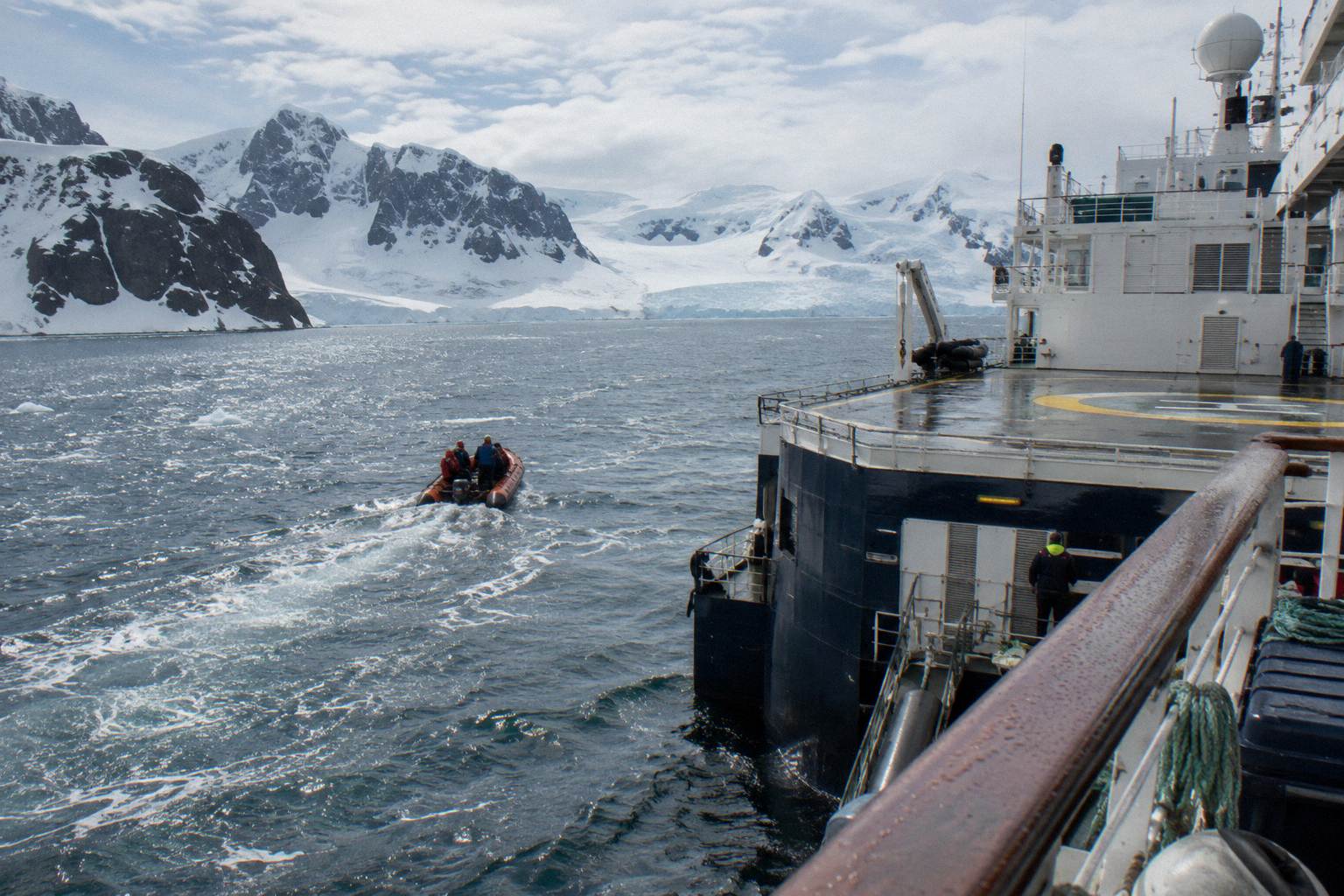
The cheapest published berth on an Antarctic Peninsula expedition in the 2026-27 season sits at $7,050 per person on Plancius, a converted Dutch Navy oceanographic vessel sailing for Oceanwide Expeditions. At the other end, Ponant's Le Soléal lists a Ross Sea expedition from $32,320, and Silversea's Silver Endeavour has no fare on file at all. That is a spread of more than four times across ships that all sail to the same coastline, land at many of the same beaches, and operate under identical Antarctic rules. The question for most readers is not whether a nicer ship exists, it is whether the money buys anything that matters on the ice. This guide walks the fare ladder step by step, using only published operator figures, and separates what changes from what does not.
What The Fare Steps Actually Look Like
Across the 2026-27 season, budget expedition ships publish Antarctic fares from roughly $7,000 to $9,000 per person, upscale expedition ships from roughly $11,900 to $19,566, and luxury ships from roughly $18,700 to $32,320, according to the published from-fares in our ship roster. The steps are wide and unevenly spaced: the jump from a shared quad cabin on a budget ship to a balcony suite on an upscale ship can cost more than the entire budget fare again, while the jump from upscale to luxury can add another five figures. Silversea, Seabourn, Scenic and Viking have no ship-level fare on file in our roster, so their pricing needs a live check.
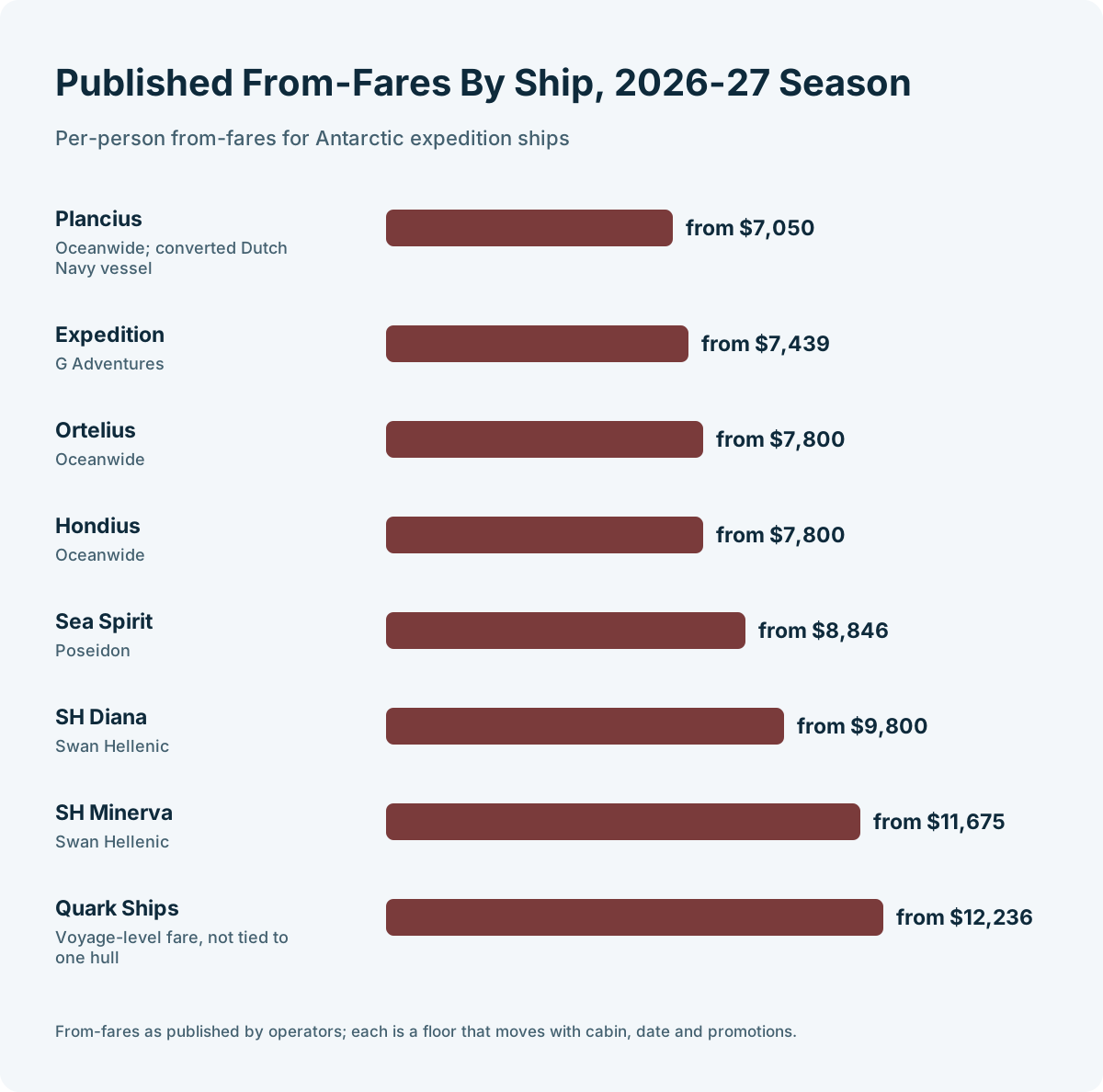
The roster's published from-prices give the cleanest ladder. Oceanwide's three ships anchor the bottom: Plancius from $7,050, Ortelius from $7,800 and Hondius from $7,800. Poseidon's Sea Spirit sits just above at $8,846, and G Adventures' Expedition at $7,439. The next steps run from Swan Hellenic's SH Diana at $9,800 and SH Minerva at $11,675, through Lindblad's National Geographic Endurance and Resolution at $11,900, Quark's three ships at $12,236, Atlas Ocean Voyages' World Navigator at $12,150, and Aurora's Greg Mortimer and Sylvia Earle from $19,521 and $19,566. The luxury tier runs from Ponant's L'Austral at $18,700 through Le Lyrial at $26,780 to Le Soléal at $32,320.
| Tier | Example ships | Published from fare (pp) | Typical voyage length |
|---|---|---|---|
| Small-ship budget | Plancius, Ortelius, Hondius, Expedition | $7,050-$8,846 | 10-13 days |
| Standard expedition | SH Diana, SH Minerva, MS Fridtjof Nansen | $9,800-$11,675 | 9-19 days |
| Upscale expedition | NG Endurance, Quark ships, World Navigator, Greg Mortimer | $11,900-$19,566 | 10-23 days |
| Luxury | L'Austral, Le Boréal, Le Lyrial, Le Soléal | $18,700-$32,320 | 11-22 days |
Two caveats keep this ladder honest. Quark's fares are voyage-level and shared across Ultramarine, Ocean Explorer and World Voyager, so the $12,236 figure is not tied to one hull. And several fares are read from operator pages rather than verified line by line, so treat every number as a floor that moves with cabin category, date and promotions. If these ranges make your own budget question concrete, a free consultation on ship tiers can pin down live fares on specific departures before you commit to a tier.
There is also a rung below the ladder. Mainstream cruise lines sell scenic Antarctica sailing from about $3,227 per person with Celebrity, about $3,297 with Princess and about $5,269 with Holland America Line, on 14-to-22-night itineraries that include several days cruising in Peninsula waters. Those fares are genuine, but those ships carry well over 500 passengers, and IAATO rules prohibit landings from any vessel above that count, so the lowest price in the market buys no Zodiac, no beach and no shore time at all. If that trade-off is what you are weighing, our guide to the expedition versus traditional comparison covers it in full.
What Each Step Up Actually Buys
The upgrade money buys the ship, not the destination: larger cabins, private balconies, more dining venues, wellness facilities, more generous inclusions and in a few cases hardware such as helicopters, submarines and X-Bow hulls that budget ships simply do not carry. None of these appear on the beach itself, but they define the many hours a day you are not landing. How much that matters depends on how you handle sea days, motion and shared space.
Cabins are the most visible step. On Oceanwide's Plancius the entry cabin is a quadruple porthole of about 12 square metres with upper and lower berths, and no balcony exists anywhere on the ship; the top category is a Superior with a double bed and sofa bed. Jump to Quark's World Voyager and every suite is all-balcony, with categories from Deluxe Suite up to Owner's Suite. Aurora's Greg Mortimer has 85 percent of staterooms with a balcony, and its dedicated solo balcony staterooms in categories A, B and C are priced with no single supplement, a detail worth real money to solo travellers. Ponant's ships carry 122 to 132 staterooms and suites for 245 to 264 guests.
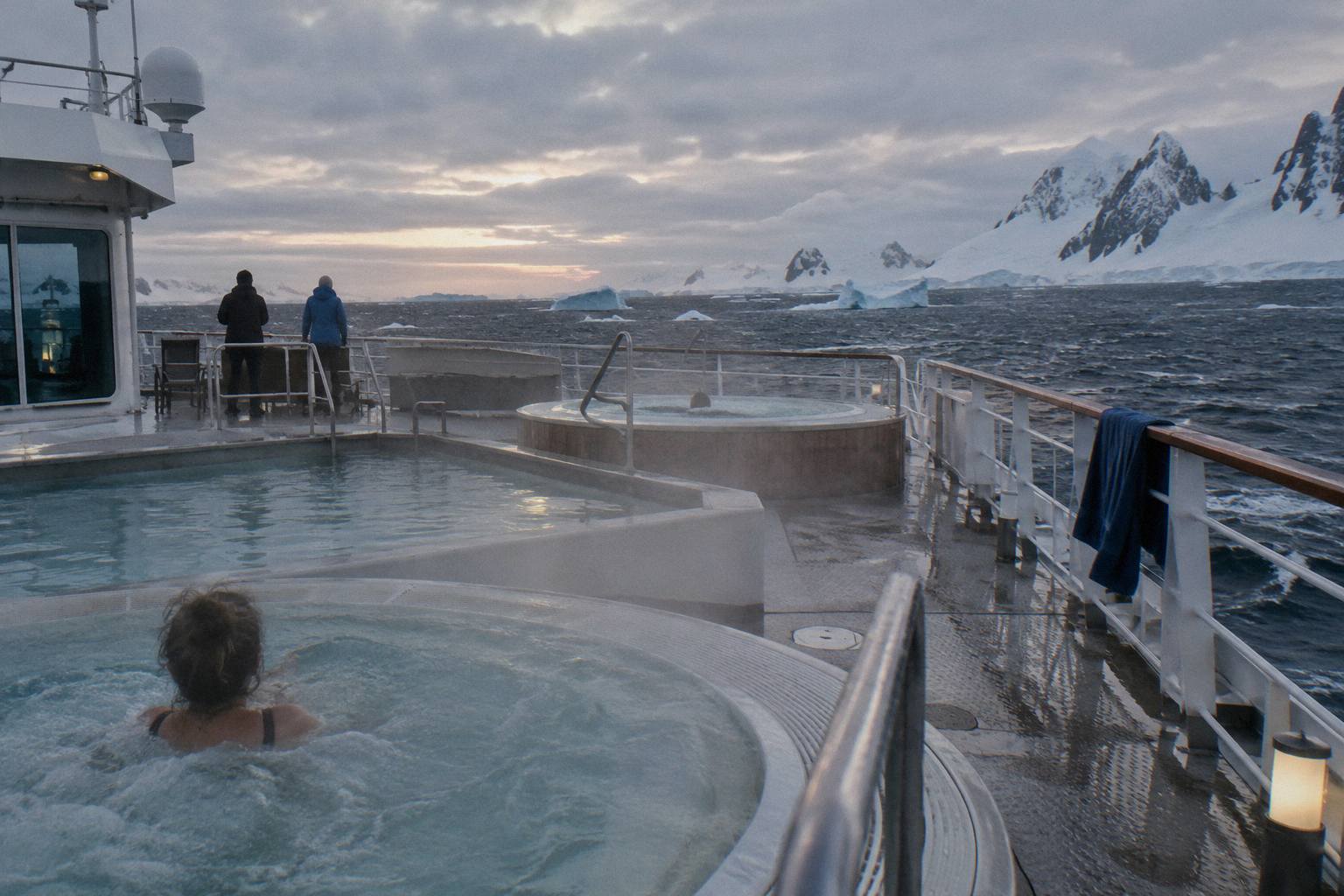
Hardware is the second step. Ultramarine carries two twin-engine Airbus H145 helicopters on two helidecks plus an internal Zodiac hangar holding 20 Zodiacs, which is what makes Quark's helicopter-focused 2026-27 season possible. Oceanwide's Ortelius also uses helicopters, but only on specific Weddell Sea and remote voyages. Scenic's Eclipse ships list two helicopters and a submersible. Aurora's fleet uses the Ulstein X-BOW hull, and Lindblad's Endurance and Resolution carry a patented X-Bow with PC5 Category A ice class, the highest class in this comparison. Newer premium ships also fit zero-speed stabilizers, some 50 percent larger than standard, that work while the vessel is stationary, according to a 2026 report on Drake Passage crossings. Sea Spirit, a 1991-built budget-tier ship, was retrofitted with retractable fin stabilizers in 2019.
Inclusions are the third step and the hardest to price from outside. Budget operators itemise little: Oceanwide's ship pages suggest gratuities of 10 to 15 EUR or USD per passenger per day, and parkas and boots are not listed as included on the ship page. Upscale operators bundle more: Quark's itineraries include parkas, boots and excursions, and Aurora includes house wine, beer and soft drinks with dinner plus round-the-clock tea and coffee. Lindblad bundles a pre-cruise Buenos Aires hotel, the charter flight to Ushuaia, alcoholic beverages, prepaid gratuities and an expedition jacket, according to a 2026 cost guide. Luxury lines publish the least: Silversea, Seabourn and Scenic do not itemise inclusions on their ship pages at all, so a like-for-like comparison has to be requested rather than read.
| What you buy | Budget example (Plancius) | Upscale example (Ultramarine) | Luxury example (Silver Endeavour) |
|---|---|---|---|
| Entry fare | From $7,050 pp | From $12,236 pp (voyage-level, shared fleet) | Fare not published; needs an enquiry |
| Passengers | 108 | 199 | 220 |
| Cabins | 50 cabins, quad to Superior, no balconies | 102-103 suites in nine categories, balconies | All suites feature a balcony |
| Expedition hardware | 10 Zodiacs, 2 gangways | 2 helicopters, 20 Zodiacs, internal hangar | Zodiac-to-guest ratios described as industry-leading; count not published |
| Stated inclusions | Gratuities suggested 10-15 per day | Parkas, boots, excursions | Not itemised on the ship page |
Guide ratios and staffing shift too, though the published data is thin. Seabourn notes a 19-person expedition team on Pursuit and 24 Zodiacs across its expedition ships, IAATO requires a minimum of one guide per twenty visitors during landings on every vessel alike, so the floor is fixed by rule, not by price. What money can buy above that floor is more specialists, more lecture programming and more staff per guest aboard, which shows up in the daily schedule rather than in the Zodiac queue.
What Does Not Change At Any Price
Every ship in this comparison, from the $7,050 quad berth to the unpublished luxury suite, lands under the same IAATO framework: no more than 100 passengers ashore from a vessel at any one time, one ship per site at a time, a minimum 1:20 guide ratio, and no landings at all from vessels carrying more than 500 passengers. The rules are printed in the Antarctic Treaty visitor guidelines and apply without exception. Money does not buy a private beach, a longer landing or a site closed to cheaper ships.
The landing sites overlap heavily as well. Classic Peninsula itineraries across the fleet allocate roughly four to six days among the South Shetland Islands and the western Peninsula, calling at the same named locations: sites such as Whalers Bay and Baily Head on Deception Island, Half Moon Island, Neko Harbour and Port Lockroy all carry current ATCM and IAATO visitor guidelines because they are the frequently visited spots. A passenger on Plancius and a passenger on Silver Endeavour stand on largely the same gravel, five metres from the same penguins, because the five-metre wildlife distance is also rule-fixed. Our sister guide to Antarctica's main landing sites lists them in detail.
Biosecurity is equally universal. Every passenger on every ship, whatever the cabin category, washes boots and cleans all equipment, clothes, bags, tripods, tents and walking sticks before bringing them to Antarctica, and again between sites. The expedition team on a budget ship and the team on a luxury ship run the same boot-washing and gear-cleaning routine, because the rules protect the same continent from the same boots regardless of what those boots cost.
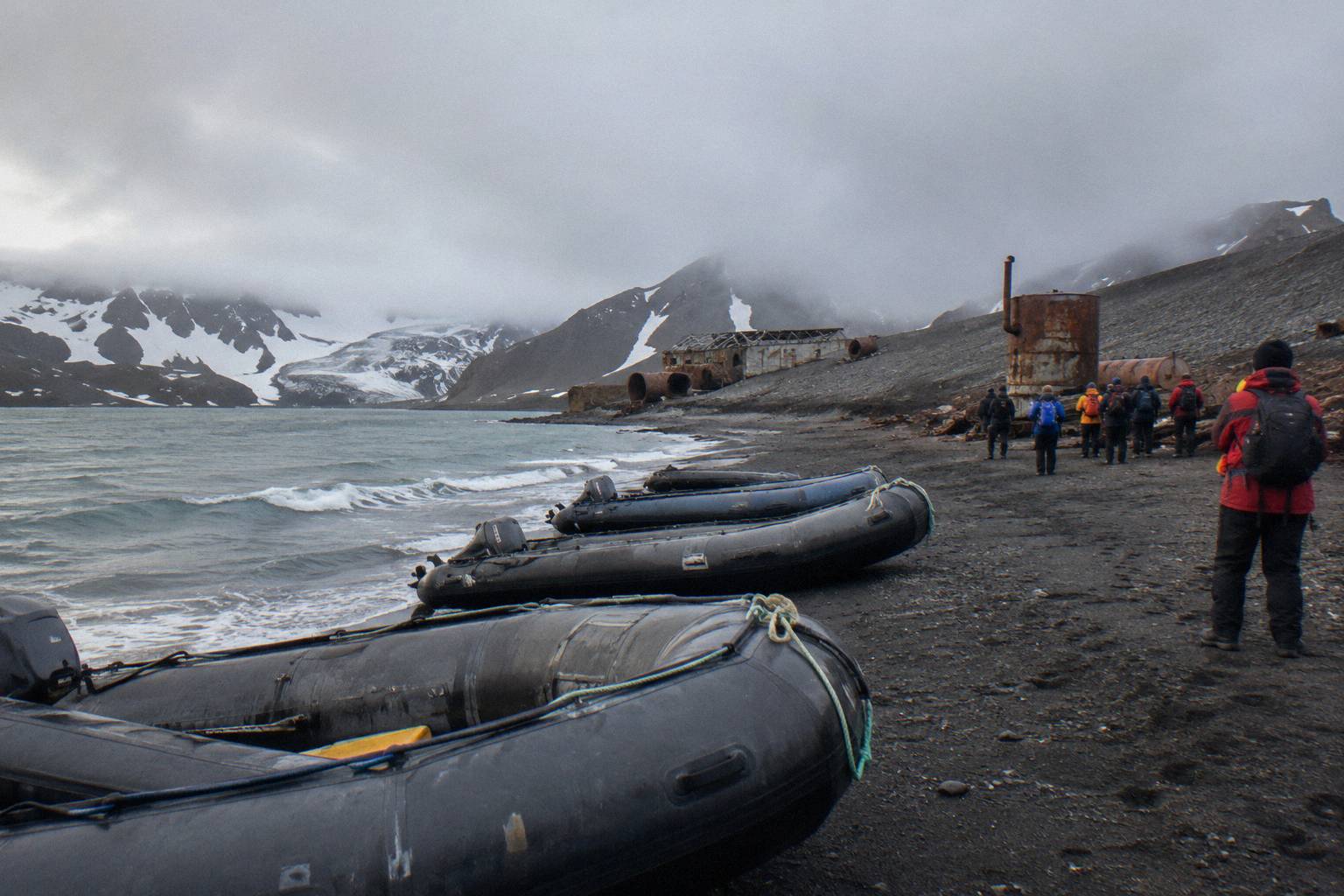
What the rules do change with ship size is rotation. Ships over 100 passengers must rotate groups ashore because of the 100-person cap, which shortens each passenger's individual time on land, while ships at or under 100 can land everyone at once. That cuts across price tiers: a 108-guest Plancius sailing rotates groups just as a 264-guest luxury ship does, and a small fly-cruise ship like Magellan Explorer, at 88 guests on air-cruises, lands everyone together despite mid-tier fares. If maximising time on the ice is your goal, the number on the passenger list matters more than the thread count in the suite.
| Fixed by rule or geography | Applies to budget ships | Applies to upscale ships | Applies to luxury ships |
|---|---|---|---|
| Max 100 passengers ashore at a time | Yes | Yes | Yes |
| One vessel per landing site at a time | Yes | Yes | Yes |
| Minimum 1:20 guide-to-visitor ratio | Yes | Yes | Yes |
| 5 m wildlife approach distance | Yes | Yes | Yes |
| No landings from ships over 500 passengers | Yes | Yes | Yes |
| Same core Peninsula landing sites | Yes | Yes | Yes |
Who Should Upgrade And Who Should Not
Upgrade if you are sensitive to motion, value private space, are travelling solo or as a couple celebrating something, or want specific hardware such as helicopters or a submersible; skip the upgrade if your budget is finite and your priority is maximum landings, because a cheaper ship with a longer itinerary buys more days on the ice for the same total spend. The honest answer is that the upgrade is a comfort decision, not a wildlife decision.
The case for the budget tier is arithmetic. For the price of one upscale balcony suite on a 12-day voyage you can often take a longer budget voyage, or the same length voyage plus a far better cabin category on a mid-tier ship, or put the difference toward flights and insurance. Plancius, Ortelius and Hondius all carry Polar Class or ice-classed hulls and full Zodiac operations; Oceanwide's Basecamp voyages include free camping, kayaking, snowshoe hiking and mountaineering. The 2026-27 season even runs last-minute discounts of 25 to 60 percent on select departures, with November and March sailings typically offering the larger discounts. Our guide to finding a cheap Antarctica cruise covers that route.
The case for paying up is real too, just different. Zero-speed stabilizers and X-Bow hulls genuinely change a two-day Drake Passage crossing, and the crossing is the part of the trip many travellers worry about. Balconies, solo cabins without supplement, included drinks and prepaid gratuities remove the drip of onboard charges. Helicopters open itineraries, such as Quark's Antarctica by Helicopter voyages or Oceanwide's emperor penguin flights to the Snow Hill rookery, that no budget ship can run. And a 130-to-200-guest upscale ship still lands everyone under the same 100-ashore rotation as anything else.
Couples should weigh the upgrade with particular honesty. A voyage like this can be an anniversary or honeymoon trip, and the luxury tier is built around exactly that traveller: all-suite ships with veranda cabins, spas and wellness areas, private dining options and all-inclusive drinks and gratuities on many lines. The question is whether that comfort is the point of the trip for the two of you, or whether a mid-tier cabin plus a South Georgia add-on would make the better memory. That answer is about the two of you, not about the ship.
Who should not upgrade: anyone who would rather spend the savings on a longer Falklands and South Georgia combination. Those combos run around 20 to 23 days, with peak South Georgia wildlife activity from November to January, so the money buys more days rather than a better cabin. The trio below puts the three tiers side by side.
| Ship | Class | Passengers | Ice class | From, per person | Voyage length | Departs from |
|---|---|---|---|---|---|---|
| PlanciusOceanwide Expeditions | Small-Ship Budget | 108 | 1D | from $7,050 | 10 to 33 days | Ushuaia |
| UltramarineQuark Expeditions | Upscale Expedition | 199 | 1A+, PC6 | from $12,236 | 12 to 14 days | Buenos Aires, Ushuaia |
| Silver EndeavourSilversea | Luxury | 220 | PC6 | – | 6 to 13 days | King George Island, Puerto Williams |
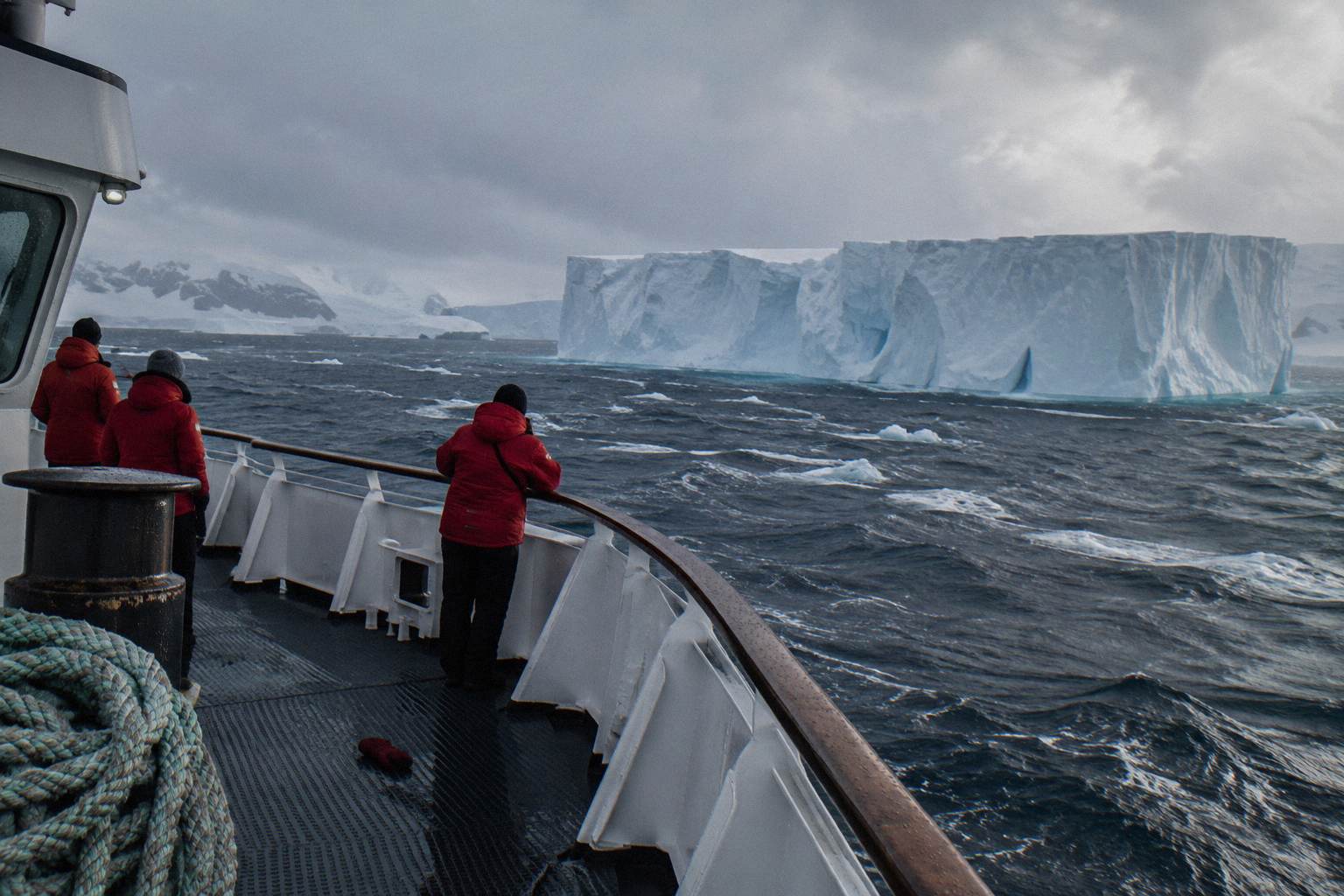
How To Compare Like For Like Before You Pay
Comparing tiers honestly means matching voyage length, month, cabin category and inclusions before comparing fares, because a from-price on a luxury line often includes what a budget line bills separately, and a November fare is not a January fare. The published from-prices in this guide are floors for the lowest category listed, and the cabin you would actually book may sit well above them.
Start with the per-night rate. Divide the fare by the nights actually spent in Antarctic waters, not the hotel nights on either end. Then add the line items: gratuities at roughly 10 to 15 per person per day on lines that do not prepay them, drinks where not included, charter flights where the operator sells them separately, and the parka and boots where they are not bundled. A realistic all-in budget for a 10-to-12-day mid-range Peninsula trip, fare plus flights plus gear plus tips plus insurance, runs $12,000 to $25,000 per person, one 2026 cost guide reports. Suddenly two tiers that looked far apart on from-prices can converge.
Then check the month against the fare. November and March departures carry the shoulder-season discounts; December and January carry the peak. A November departure on a pricier ship can narrow the gap to a January departure on a cheaper one, which is why the like-for-like comparison matters. Our month-by-month guides, starting with Antarctica in November, lay out what each month trades away. This is also the point where a second opinion earns its keep: a free consultation on like-for-like departures can pull current fares across tiers for your exact dates, at no cost and with no obligation.
One last filter is honesty about yourself. If you have never spent two days in open ocean, the stabilizer question matters more than any balcony. If you photograph wildlife from a Zodiac, the guide ratio and Zodiac count matter more than the spa. If this is a once-only trip on a fixed budget, the longer or cheaper voyage with more landing days is usually the defensible choice. The upgrade is worth it when the ship itself is part of what you are buying, and not worth it when the ship is only transport to the beach. That is the whole decision, and it is the comparison Cruises In Antarctica is built around.
Common Questions About Upgrading Your Antarctica Ship
Is a luxury Antarctica cruise worth it?
It is worth it if you value private balconies, included drinks and gratuities, stabilizers and amenities like helicopters, because those are exactly what the fare gap buys. It is not worth it if your goal is more time with penguins: every ship lands under the same 100-passenger rule at the same sites, so a cheaper or longer voyage often delivers more time on the ice for less money.
Do more expensive Antarctica ships visit better places?
No. The core Antarctic Peninsula landing sites, such as Deception Island, Half Moon Island, Neko Harbour and Port Lockroy, are shared across the whole fleet under IAATO site coordination, which allows only one vessel per site at a time. What premium ships add is comfort and hardware, not exclusive destinations.
How much more does an upscale ship cost than a budget ship?
Published 2026-27 from-fares run from about $7,050 per person on Plancius to about $12,236 on Quark's ships and $11,900 on Lindblad's, roughly a 70 percent step, and luxury fares run from $18,700 to $32,320, roughly two and a half to more than four and a half times the budget floor. Cabin category and month move the real gap more than the tier label does.
Does ship size affect time ashore in Antarctica?
Yes, but by rule, not by price. IAATO caps landings at 100 passengers from a vessel at any one time, so ships over 100 guests rotate groups and each passenger gets less individual time on land. Ships at or under 100 guests, whether budget or premium, can land everyone at once.
What inclusions change between budget and luxury Antarctica ships?
Budget operators typically leave gratuities, drinks and sometimes gear as extras, with suggested tips of 10 to 15 per day. Upscale lines bundle parkas, boots and excursions, and some include drinks with dinner or prepaid gratuities and charter flights. Luxury lines often publish no itemised inclusion list at all, so you have to request a like-for-like comparison before judging the fare.
Are helicopters and submarines only on expensive ships?
Helicopters appear mainly on premium ships, such as Ultramarine with two Airbus H145s, and on Oceanwide's Ortelius for specific Weddell Sea voyages, so they are not strictly tied to price. Submarines appear on Scenic's Eclipse-class ships. Apart from Ortelius's helicopter voyages, no budget-tier ship in the roster lists either.
More Choosing A Ship
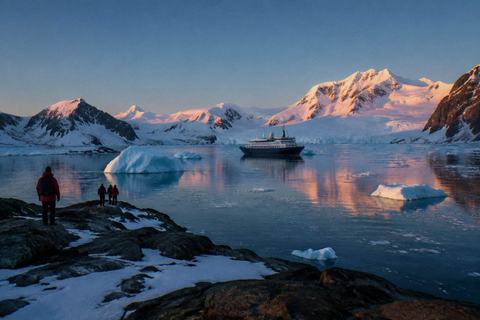 Choosing Your ShipFive decisions that narrow 43 expedition ships down to the one you should book.Read the guide
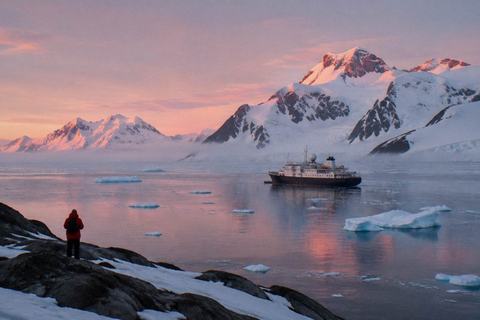 Cruise Ships ComparedShip size decides whether you land: compare every major Antarctica vessel by passengers, ice class and fare.Read the guide
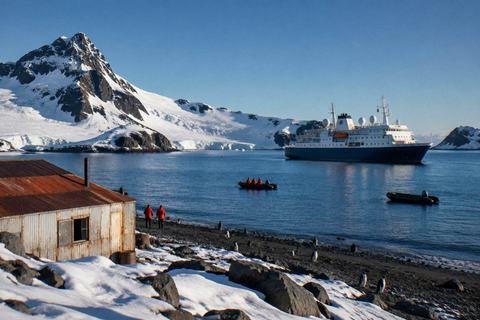 Cruise Lines ComparedAll fourteen Antarctica cruise lines mapped, with fleets, fares and landing rules.Read the guide
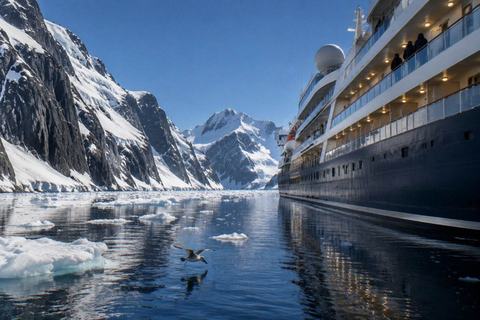 Luxury CruisesWhat a premium Antarctica fare really buys: suites, included extras and the ships at the top tier.Read the guide