Wi-Fi On An Antarctica Cruise: Starlink, Data Caps And Remote Work
 By Oleg G.
Most Antarctica expedition ships now carry Starlink, but the difference between a free basic tier and a paid data package decides whether you can actually work from the Drake Passage. Here is what each operator publishes.
Quick answer: Most major Antarctic operators, including HX, Aurora Expeditions, Lindblad, Ponant, Silversea, Seabourn, Scenic, Viking, Swan Hellenic, Atlas and Poseidon, have installed Starlink, and Quark gives free basic Wi-Fi. Oceanwide gives 1.5 GB per day free and sells 5 GB vouchers for 20 euros or 10 GB for 40 euros. Remote work is possible but not guaranteed.
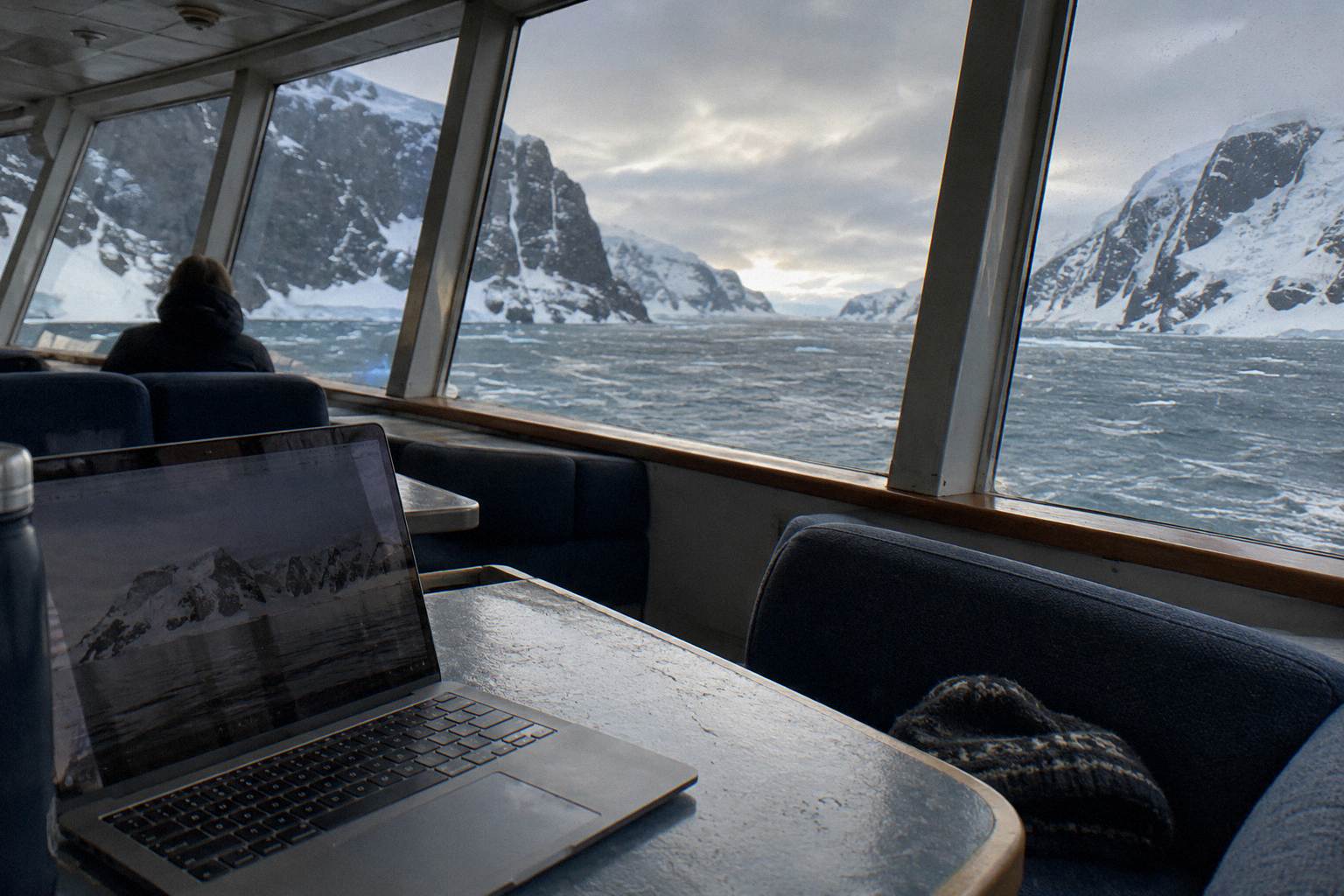
The first thing to understand about an Antarctica cruise and Wi-Fi is that everything changed recently. For years, satellite internet on expedition ships meant slow, expensive legacy connections that struggled with a single email attachment, and plenty of travellers simply switched off for ten days and called it a digital detox. Then Starlink arrived. Operators across the Antarctic fleet have installed it in rapid succession, and today the question is no longer whether the ship has internet but which tier you get for free, what a paid package costs, and whether the connection is stable enough to actually depend on. This guide sets out what each operator publishes, where the data caps sit, and what is realistic if you plan to work while you sail.
One framing point before the details. Operators attach caveats to their connectivity, because polar satellite coverage, weather and shared bandwidth all vary. That is not a disclaimer to ignore. It is the honest baseline for every claim in this article, and it should be the baseline for your expectations too.
Do Antarctica Cruise Ships Have Working Wi-Fi?
Yes. Most major expedition operators in Antarctic waters now have Starlink installed, including HX, Aurora Expeditions, Lindblad Expeditions, Ponant, Silversea, Seabourn, Scenic, Viking, Swan Hellenic, Atlas Ocean Voyages and Poseidon Expeditions, while Quark and Oceanwide publish complimentary Wi-Fi tiers. Smaller and older ships are less predictable, and no operator guarantees uninterrupted service at high latitudes.
The rollout has been fast and fleet-wide. Reports tracking connectivity across the polar fleet confirm Starlink on the ships of the big names above. That is a genuine shift in what a voyage feels like: the same routes that a few seasons ago offered patchy legacy satellite service now routinely support messaging apps, email and basic browsing from your cabin, often at no extra charge beyond the fare.
But "has Starlink" is not the same as "works like home". The connection depends on the ship's antenna capacity, the number of guests sharing it, the weather between you and the satellite, and the ship's position relative to coverage. Operators themselves frame their connectivity carefully: Lindblad, for instance, offers complimentary basic access covering email, messaging and social media apps, with paid Enhanced and Premium plans for heavier use, all explicitly subject to connectivity conditions. Nobody in the industry promises an uninterrupted pipe, and you should not plan around one.
There is also a difference between the ship being connected and you being connected. Because the link is shared, it stands to reason that it feels thinnest when many guests are online at once, such as after a landing, and freer when most of the ship is asleep. Experienced connected travellers plan their heavy tasks around the ship's rhythm rather than fighting it.
The practical takeaway for choosing an Antarctica cruise is that connectivity has become a real differentiator between ships rather than a footnote. If staying reachable matters to you, it belongs on your shortlist criteria next to price and cabin type, and it is worth telling someone which ships deliver before you commit to a fare. On the question of ordinary phone use, our piece on cell service in Antarctica covers what happens to your handset far from the nearest tower.
Which Antarctica Operators Have Starlink?
HX, Aurora Expeditions, Lindblad, Ponant, Silversea, Seabourn, Scenic, Viking, Swan Hellenic, Atlas Ocean Voyages and Poseidon all have Starlink publicly confirmed on their Antarctic voyages. Quark offers complimentary basic Wi-Fi with premium packages, and Oceanwide Expeditions offers complimentary Wi-Fi on Hondius, Ortelius and Plancius with a published daily allowance rather than an unlimited tier.
The pattern across the big operators is that Starlink is now standard equipment rather than a premium perk. Reports covering the current season describe complimentary access as the starting point on the operators in the table below, with the differences showing up in the details: how much data is free, whether it covers one device or several, and what a faster tier costs. Those details are where your decision actually lives.
Aurora Expeditions is one of the most generous examples. Its ships, Greg Mortimer and Sylvia Earle, have free Starlink in all cabins and public areas, with no separate data charge mentioned in the reporting. HX includes complimentary Wi-Fi, Starlink where available, in the fare itself. Ponant offers unlimited Wi-Fi across its fleet, described as Starlink-enhanced on its icebreaker. Lindblad's entire fleet, including the National Geographic expedition ships, is Starlink-enabled with a tiered model that starts free.
The table below summarises the published positions for the operators most commonly sold to Antarctic travellers, using only what the operators and connectivity reporting state.
| Operator | Starlink | Free tier | Paid options |
|---|---|---|---|
| Aurora Expeditions | Yes | Free Starlink in all cabins and public areas | Not stated |
| HX | Yes | Complimentary Wi-Fi included in fare | Not stated |
| Ponant | Yes | Unlimited Wi-Fi | Not applicable as stated |
| Lindblad Expeditions | Yes | Complimentary basic access (email, messaging, social apps) | Enhanced and Premium plans, priced per day or per voyage |
| Quark Expeditions | Not published | Complimentary basic Wi-Fi, one device at a time | Premium packages for data-heavy use |
| Oceanwide Expeditions | Not published | 1.5 GB per day | Vouchers: 20 euros for 5 GB, 40 euros for 10 GB |
Two honest caveats belong here. First, exact prices for the paid tiers are not published by the operators, so no figure is given. Second, "Starlink installed" does not mean identical performance between a 130-guest ship and a 490-guest ship, because more guests share the same link. If connectivity is a deciding factor in your trip, compare ships before booking rather than discovering the difference halfway across the Drake Passage.
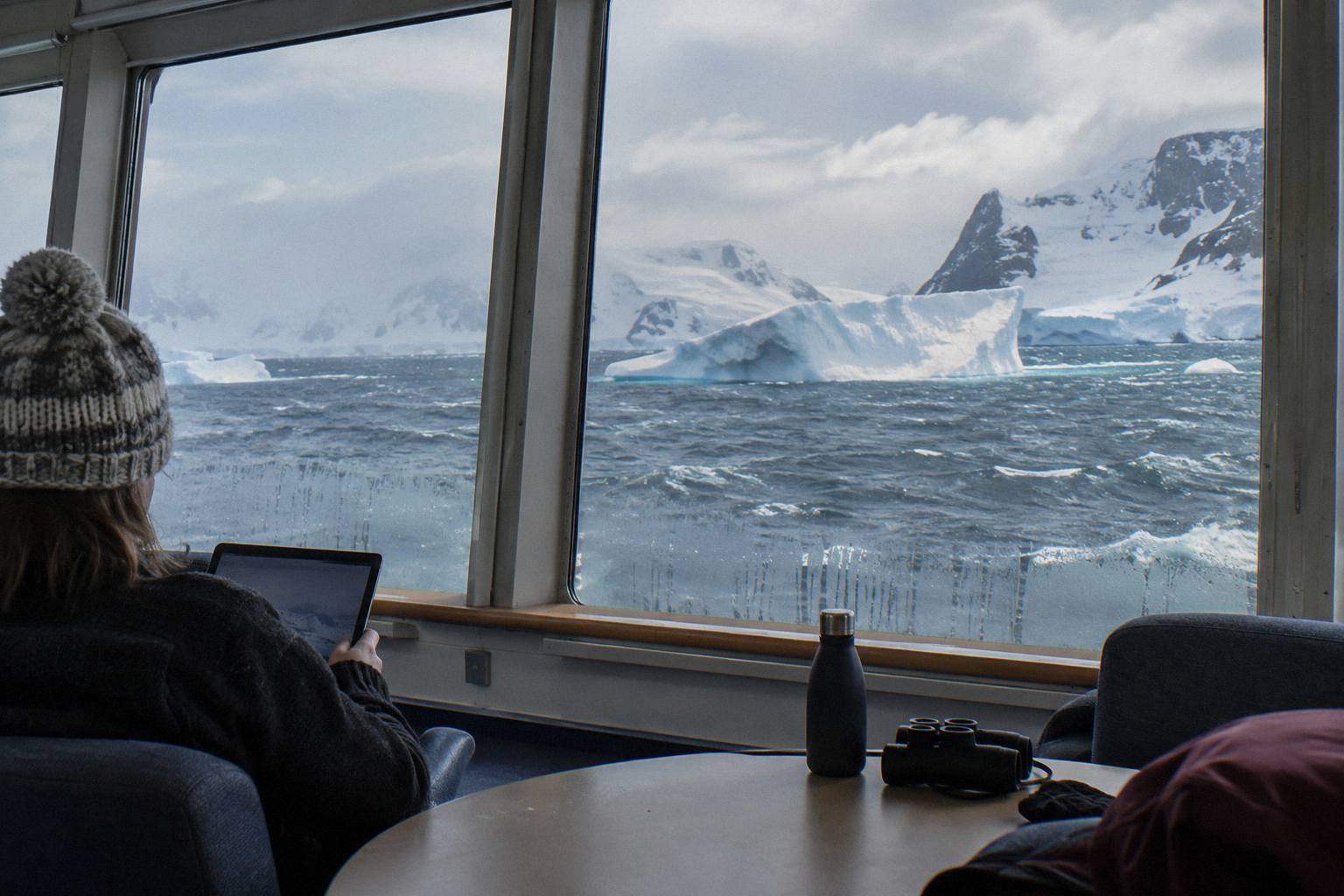
Free Versus Paid: What Each Wi-Fi Tier Actually Gives You
The free tiers generally cover messaging, email and light browsing, usually limited to one device at a time. Paid tiers, where offered, add streaming, large file transfers and video calls. Video calls are technically possible on Starlink ships with basic or enhanced access, but subject to data caps, variable polar speeds and operator policy, so no operator treats them as guaranteed.
Understanding the tier structure matters more than the brand of satellite service behind it. On Quark ships, the complimentary tier covers basic browsing and voice or messaging apps such as WhatsApp on one device at a time, with premium packages available for more data-intensive use. That is enough to stay in touch with family daily, and it is not enough to join a two-hour video meeting with your camera on. Knowing which side of that line your needs fall on is the single most useful piece of pre-trip analysis you can do.
Lindblad's model is similar in spirit: complimentary basic access for email, messaging and social media apps, then Enhanced and Premium plans sold per day or per voyage that support browsing, teleconferencing, large file transfer and streaming, connectivity permitting. The phrase "connectivity permitting" appears in the operator's own material, and it is doing real work. Even the paid tiers are best-effort in polar waters, and buying the premium package buys priority and headroom, not a guarantee.
The most generous published arrangements are the simplest. Aurora's free Starlink in every cabin, HX's fare-included access and Ponant's unlimited Wi-Fi remove the metering anxiety entirely, at least as described. What none of them remove is physics. At high latitude, in weather, with a few hundred guests online at once, any connection can slow or drop.
To make the tier logic concrete, here is how common online activities map onto what each tier can realistically carry, based on the functions operators themselves list for their basic and premium packages.
| Activity | Free basic tier | Paid premium tier |
|---|---|---|
| Messaging apps (WhatsApp, iMessage, text) | Yes, explicitly listed by Quark and Lindblad | Yes |
| Email with attachments | Yes | Yes |
| Social media apps | Yes, listed by Lindblad | Yes |
| General web browsing | Basic browsing listed by Quark | Full browsing speed |
| App-based voice calls | Yes, listed by Quark | Yes |
| Video conferencing | Not promised | Teleconferencing listed on Lindblad Enhanced, connectivity permitting |
| Large file transfers | No | Listed for Lindblad's paid plans |
| Streaming video | No | Listed for Lindblad's paid plans, connectivity permitting |
For a sense of how the tiers compare at a glance, the infographic below summarises the published free allowances and paid structures across the main operators.
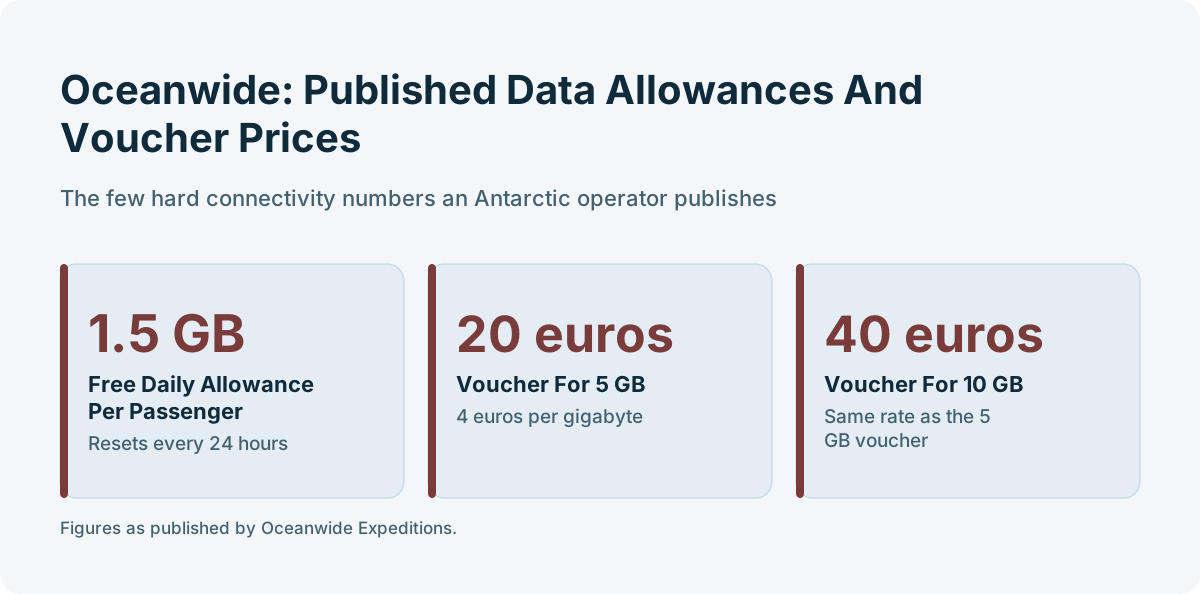
Oceanwide's Published Data Caps And Voucher Prices
Oceanwide Expeditions gives every passenger a complimentary 1.5 GB daily allowance that resets every 24 hours, and sells extra data onboard as vouchers: 20 euros for 5 GB or 40 euros for 10 GB. These are among the few hard connectivity numbers an Antarctic operator publishes, which makes them a useful benchmark for the whole market.
The daily reset is the part travellers should internalise before they sail. You do not accumulate unused data: each 24-hour period brings a fresh 1.5 GB, and anything beyond that requires a voucher bought on the ship. For an 11-day Antarctic Peninsula voyage on Hondius, sailing from Ushuaia with fares on the roster from $7,800 per person, the free allowance alone is comfortably enough for daily messaging, email and some photo uploads, provided you are disciplined about what you send.
The voucher math is straightforward. A 5 GB top-up at 20 euros works out at 4 euros per gigabyte, and the 10 GB voucher at 40 euros is the same rate, so you are buying convenience and volume rather than a bulk discount. Anyone planning regular video calls or cloud backups should budget for one or two vouchers across a voyage and accept that heavy streaming is simply not what these connections are designed for. On a sister ship like Plancius, with Peninsula voyages from $7,050 per person, the connectivity economics are identical because the policy is fleet-wide.
It is also worth saying plainly that this level of published detail is unusual in the industry. Most operators describe their connectivity in general terms, with per-day or per-voyage pricing for paid tiers that you learn at booking or onboard. Oceanwide's explicit caps are honest, and honesty about limits is more useful when planning than a vague promise of "Wi-Fi included". For more on daily life between landings, see our guide to sea days aboard an Antarctic expedition.
Can You Actually Work Remotely From An Antarctica Cruise?
Light remote work is viable on most Starlink-equipped ships: email, messaging, document editing and voice calls over apps are realistic on complimentary or basic tiers. Heavier use, such as long video meetings, large uploads or continuous cloud syncing, requires paid tiers, depends on location and conditions, and is not guaranteed by any operator.
The realistic picture, drawn from the operator policies and connectivity reporting, splits remote work into two tiers of ambition. The first tier, staying reachable and doing asynchronous work, is genuinely achievable on most ships in the fleet. A traveller on Quark's free tier can run WhatsApp and email all day. Someone on Aurora's free cabin Starlink can do the same plus considerably more. Document work needs no connection at all until the moment you sync, so a full day of writing, coding or spreadsheet work can happen entirely offline and upload in a burst at dinner.
The second tier, participating live as if you were at home, is where expectations need managing. Reporting on remote work in polar regions describes it as viable for light tasks on most Starlink ships, with heavier use requiring paid tiers and depending on where the ship is and what the sky is doing. The Drake Passage, landings in protected bays and the far south can all produce slow spells. Anyone whose job genuinely requires a dependable video presence for fixed meetings should treat an Antarctica cruise as a holiday, not a floating office, or plan their calendar around the voyage rather than through it.
A few practical habits close the gap between the two tiers. Download your work before embarkation in Ushuaia. Keep files local rather than cloud-synced, and pause background sync so it does not quietly eat your allowance. Schedule anything live for the window when the ship is likely to have the best connection, typically when few other guests are online. Tell colleagues you may drop out without warning, and give them a fallback. And separate the connectivity question from the comfort question when you choose a cabin: midship lower-deck cabins have the least motion, which matters little for Wi-Fi but a great deal for typing through the Drake. Our guide to choosing the best cabin on an Antarctic cruise covers that trade-off in full.
The table below is an honest planning matrix: what you can expect to accomplish, and on which arrangement.
| Remote-work need | Realistic on free tier | Needs paid tier | Realistic at all |
|---|---|---|---|
| Daily email and team chat | Yes | Not needed | Yes, throughout the voyage |
| Asynchronous document work | Yes, sync in bursts | Not needed | Yes |
| One short video check-in per day | Sometimes, quality varies | Yes, connectivity permitting | Yes, with flexibility |
| All-day video presence | No | Not guaranteed | Only with tolerance for dropouts |
| Large uploads or backups | No | Yes, connectivity permitting | Yes, plan for slow windows |
| Live customer-facing calls on a schedule | No | Not guaranteed | Plan a fallback for every call |
Which Ships Should A Connected Traveller Shortlist?
Greg Mortimer offers free Starlink in every cabin and public space, Quark's Ultramarine carries complimentary basic Wi-Fi with paid premium packages, and National Geographic Endurance is Starlink-enabled with Lindblad's tiered access, free for basic use and paid for Enhanced or Premium. All three keep you reachable; only the billing model differs.
Aurora Expeditions' Greg Mortimer is the straightforward pick if you dislike meters. Built in 2019 and carrying up to 148 guests, 130 on expedition, with 15 Zodiacs and four dedicated boarding doors, it offers the free-cabin-Starlink arrangement across the ship, so connectivity is simply part of the fare rather than a line item you manage. Its Antarctic voyages run from roughly 12 to 26 days out of Ushuaia, with fares on the roster from $19,521 per person.
Quark's Ultramarine takes a different approach to the same technology. At 199 passengers with two twin-engine helicopters, 20 Zodiacs and an internal Zodiac hangar, and fares from $12,236 per person on shared voyage-level pricing, its connectivity follows the Quark model: complimentary basic Wi-Fi for browsing and messaging apps on one device, with premium packages available for heavier use. For a traveller whose needs are email-plus-messaging, the free tier may be all you ever touch, which makes the effective connectivity cost zero.
National Geographic Endurance sits squarely in the Lindblad camp. Starlink-enabled like the rest of the Lindblad fleet, it gives complimentary basic access for email, messaging and social apps, then sells Enhanced and Premium plans per day or per voyage for teleconferencing, large transfers and streaming. With voyages from $11,900 per person for the 12-day Voyage to Antarctica, it suits travellers who want the option to buy more speed on demand rather than paying for it up front, and its 138-guest capacity keeps the shared link from being oversubscribed.
Put side by side, the three ships show how differently operators package the same underlying technology, and how much of the difference is billing philosophy rather than raw capability.
| Ship | Class | Passengers | Ice class | From, per person | Voyage length | Departs from |
|---|---|---|---|---|---|---|
| Greg MortimerAurora Expeditions | Upscale Expedition | 130 | – | from $19,521 | 12 to 26 days | Ushuaia |
| UltramarineQuark Expeditions | Upscale Expedition | 199 | 1A+, PC6 | from $12,236 | 12 to 14 days | Buenos Aires, Ushuaia |
| National Geographic EnduranceLindblad Expeditions (with National Geographic) | Standard Expedition | 138 | PC5 | from $10,800 | 12 to 22 days | Ushuaia |

How To Plan Around Connectivity When You Book
Decide before booking how much internet you truly need, match that to an operator's published policy, and budget for paid tiers or vouchers where they apply. Tell the operator or your booking partner about any hard requirement, because cabin choice, ship size and sailing date all affect what your connection will feel like day to day.
The booking stage is when connectivity decisions are cheapest. Once you know whether you need messaging-only or genuine working hours, the fleet sorts itself quickly: unlimited or cabin-included access on ships like Greg Mortimer, metered-but-generous on Oceanwide's vessels, tiered on Quark and Lindblad. Fares vary widely across these ships, from Oceanwide's small-ship budget trio in the seven-thousand-dollar range to upscale expedition ships from about $12,000 to nearly $20,000, and the connectivity line item should be weighed inside that total rather than treated as an afterthought.
One under-appreciated factor is ship size. A Starlink link shared among 130 guests behaves differently from one shared among 490, even before polar conditions compound the difference. The HX ships Fridtjof Nansen and Roald Amundsen carry 490 guests each, while Aurora's ships carry around 130 on expedition; if your work depends on the connection, smaller is a reasonable bias. Our comparison of Antarctic cruise ship sizes unpacks everything passenger counts change beyond the internet.
Finally, keep your ground arrangements realistic. Free or paid, ship Wi-Fi will occasionally fail precisely when you have something important to send, so build slack into any deadline that overlaps your voyage, download what you need in Ushuaia, and give key contacts the ship's reachability pattern in advance. At Cruises In Antarctica we think of connectivity as a comfort that has become very good, not a promise, and planning as if it might pause for a day makes the whole trip more relaxing.

Common Questions About Antarctica Cruise Wi-Fi
Is Wi-Fi free on Antarctica cruises?
It depends on the operator. Aurora Expeditions offers free Starlink in all cabins and public areas, HX includes complimentary Wi-Fi in the fare, and Ponant offers unlimited Wi-Fi. Quark and Lindblad give free basic access with paid premium tiers, while Oceanwide provides 1.5 GB per day free and sells vouchers for 5 GB at 20 euros or 10 GB at 40 euros.
Does Starlink work in Antarctica?
Yes. Starlink is installed on the ships of HX, Aurora Expeditions, Lindblad, Ponant, Silversea, Seabourn, Scenic, Viking, Swan Hellenic, Atlas Ocean Voyages and Poseidon. Speed and availability still vary with weather, the ship's position and the number of guests sharing the link, so service is best-effort rather than guaranteed.
Can I work remotely from an Antarctic cruise ship?
Light remote work is viable on most Starlink ships: email, messaging, document editing and app-based voice calls work on free or basic tiers. Long video meetings, large uploads and continuous cloud syncing require paid tiers where offered, depend on conditions, and are not guaranteed by any operator.
How much data do I need for an Antarctica cruise?
Messaging and email use very little, often well under Oceanwide's free 1.5 GB per day. Video calls and photo or video uploads are the heavy items. As a benchmark, Oceanwide's vouchers price extra data at 20 euros for 5 GB and 40 euros for 10 GB, so budget one or two top-ups if you plan regular calls.
Is ship Wi-Fi good enough for video calls?
Sometimes. Operator materials and connectivity reporting say video calls are possible on Starlink-equipped ships with basic or enhanced tiers, for example Lindblad's Enhanced plan lists teleconferencing, but all such use is subject to data caps, variable speeds in polar regions and operator policy. Treat video as best-effort, not guaranteed.
Will my phone work in Antarctica without ship Wi-Fi?
Do not plan on ordinary cellular service on the Antarctic Peninsula; plan to rely on the ship's satellite connection. See our separate guide to using cell phones in Antarctica for what to expect and how to prepare your handset before departure.
More Planning And Preparation
 Packing ListWhat to wear, what the ship lends you, and what to leave at home.Read the guide
 Seniors GuideMobility, Zodiac boarding, the Drake Passage and medical support, assessed for older travellers.Read the guide
 Travel InsuranceWhy operators demand evacuation cover and what your policy must include.Read the guide
 Getting To AntarcticaShips, planes and gateway cities: every practical way to reach Antarctica.Read the guide