Expedition Team Size And Guide Ratios On Antarctica Ships
 By Oleg G.
The staff who guide you ashore shape an Antarctic voyage as much as the hull does. Here is the one ratio the rules set, the team numbers operators publish, and how to read both before booking a cabin.
Quick answer: IAATO requires at least one guide for every 20 passengers ashore and caps landings at 100 visitors per vessel at a time. Published figures include 13 guides plus a doctor on the 170-guest Hondius and 116 staff and crew on the 138-guest National Geographic Endurance, numbers that shape every landing.
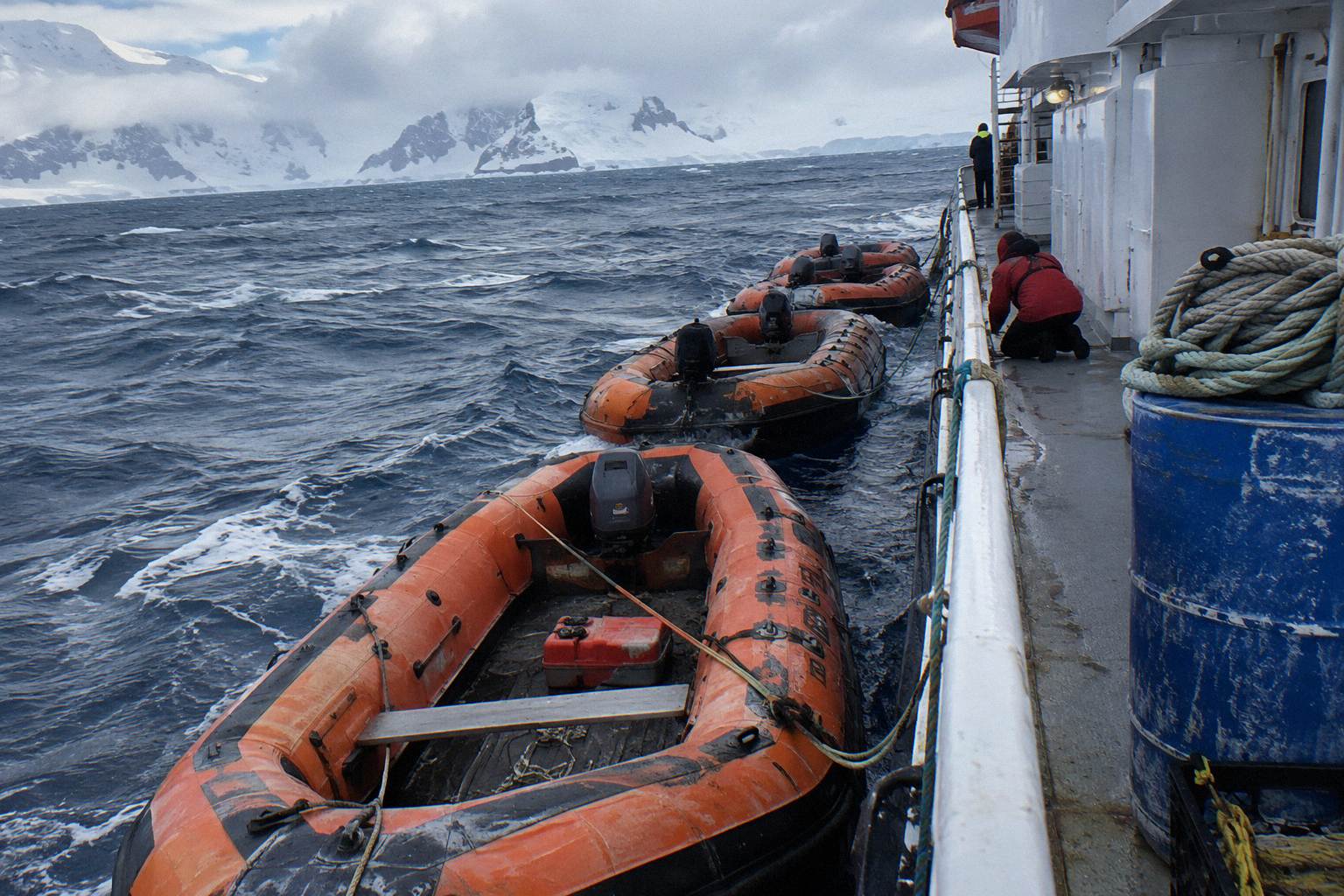
Thirteen expedition guides and one doctor look after 170 guests on Hondius. On National Geographic Endurance, 138 guests share the ship with 116 staff and crew. Both are expedition cruise products sold in the same season from the same gateway ports, yet those two numbers describe noticeably different days of your voyage, because the people who drive the Zodiacs and walk every landing group are the product you are actually buying.
This page on Cruises In Antarctica sets out the one ratio the rules impose, the team figures that operators publish and the many they do not, and how to weigh a crew list when booking a cabin. Everything quoted below comes from the operator pages, the IAATO rulebook and published fleet references.
What Is An Expedition Team On An Antarctica Ship?
An expedition team is the trained staff who run everything that happens off the ship: they drive the Zodiacs, guide every walk on land, brief you on safety and wildlife rules, and lecture on sea days. Across operators the typical mix includes naturalists, glaciologists, photographers, kayak guides and a doctor.
The team is not the hotel crew. Waiters, cabin stewards and engine staff keep the vessel running, and on ships that publish whole-crew figures those hotel roles are counted too. The expedition team is the smaller group in matching parkas who appear at the gangway each morning, and their size relative to the guest list is one of the least advertised numbers in polar cruising. Operators publish passenger counts, cabin categories and dining venues with pride. Team headcounts appear on only a scattering of ship pages.
An expedition leader sits at the top of this group and sets the daily plan in consultation with the captain, choosing which landing site to attempt and when to abandon one. Below the leader, the composition cited across operators runs to naturalists who interpret wildlife and landscape, glaciologists and other scientists who deliver the lecture program, photographers who coach guests on deck, kayak guides for paddling excursions, and medical staff. Reading crew pages for two years of research, the pattern that struck me is simple: the lines proudest of their teams tend to publish the numbers, and the quiet ones rarely do.
That silence matters because the team is what converts a cruise into an expedition. A ship can carry a hundred guests to a beach, but without enough guides ashore the visit shrinks to a short, herded stop. With a deep team the same beach becomes a slow walk with a naturalist, a Zodiac cruise in one direction and a kayak group in another, all running at once.
What The IAATO 1:20 Guide Ratio Actually Requires
IAATO rules require at least one actively guiding staff member for every 20 visitors ashore, and no more than 100 passengers from one vessel may stand on land at any moment. Individual sites can set stricter limits, only one ship may call at a time, and vessels carrying more than 500 passengers cannot make landings at all.
The ratio and the cap work together. One guide per 20 visitors is the floor, so a full 100-passenger landing needs at least five guides on the beach before the first guest steps off the Zodiac. The general visitor guidelines published by IAATO state both requirements plainly, along with the companion rules that shape how a landing day feels in practice.
| Rule | What it says |
|---|---|
| Ship site traffic | Only one ship may visit a landing site at any one time. |
| Ashore cap | A maximum of 100 passengers may be ashore from a vessel at any one time, unless site guidance requires fewer. |
| Guide ratio | At least one actively guiding staff member per 20 visitors ashore, a 1:20 ratio. |
| Vessel size | Vessels with more than 500 passengers shall not make landings in Antarctica. |
| Wildlife distance | Keep at least 5 metres from wildlife on land, with greater distances where species or site guidance requires. |
| Biosecurity | Boots and all equipment, clothes, bags, tripods, tents and walking sticks must be cleaned before arrival and between sites. |
Two consequences follow from that table and are worth fixing in your head before you compare ships. First, the 500-passenger line divides the market in two: big traditional ships may sail Antarctic water, but their guests watch from the deck, while expedition ships land people. If you are still weighing those two formats, the IAATO rulebook settles the landing question even before cabin prices do. Second, the 100-passenger cap means guest counts above 100 force rotations, a mechanism we unpack further down this page.
If the choice in front of you is between a large scenic vessel and a true expedition ship, that regulatory line is the first decision to make and the cheapest to get right.
Published Team Sizes And Staff Ratios By Ship
Few operators publish team counts, so compare what exists. Published figures show Hondius sailing with 13 expedition guides plus a doctor for 170 guests, Seabourn Venture listing 24 to 26 expedition team members, and overall staff and crew counts of 140 on Ultramarine and 116 on National Geographic Endurance.
Treat this as a partial ledger rather than a league table. Published figures list a team of 24 to 26 for Seabourn Venture, but the roster lists no guest count for her, so no ratio can be derived. For Scenic Eclipse, no published team size was found. When a figure is missing, say so and move on, because an invented ratio would be worse than an empty cell.
| Ship | Operator | Guests | Published figure | What the figure covers |
|---|---|---|---|---|
| Hondius | Oceanwide Expeditions | 170 | 13 expedition guides plus 1 doctor, with 57 crew | Guiding staff only, about 13 guests per guide |
| National Geographic Endurance | Lindblad Expeditions | 138 | 116 staff and crew overall | All staff and crew, guides not broken out |
| Seabourn Venture | Seabourn | Not stated on the roster | 24 to 26 expedition team members | Guiding staff, but no guest count published for a ratio |
| Ultramarine | Quark Expeditions | 199 | 140 staff and crew overall | All staff and crew, guides not broken out |
The last column is the comparison to make carefully, because the two kinds of figure measure different things. The published crew breakdown for Hondius counts guiding staff you will actually meet on a beach, while the fleet reference for National Geographic Endurance and the ship reference for Ultramarine count everyone aboard who works for the guest, cooks and stewards included. An all-staff figure signals deep resourcing, but it does not tell you how many naturalists stand at the gangway. Only Hondius gives you that number directly.
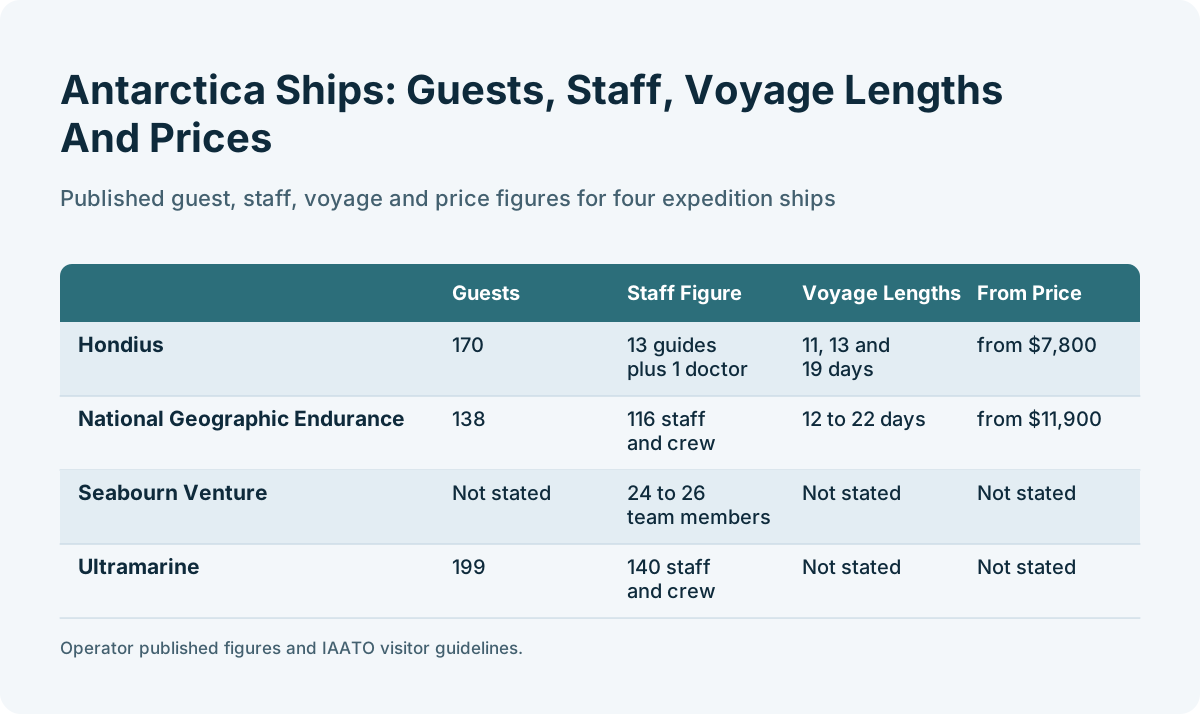
Hondius is the transparency benchmark here. Oceanwide's ship is a small-ship budget option, built in 2019, the first vessel registered to Polar Class 6 in the world in the operator's own wording, sailing 11, 13 and 19 day voyages from Ushuaia from $7,800 per person. Her 13 guides and doctor for 170 guests sit comfortably above the IAATO floor even before the 100-passenger cap limits the beach to fewer people than the guides could legally cover. Our Hondius ship guide takes the comparison further.
National Geographic Endurance tells a different story with a different kind of number. Lindblad's ship carries 138 guests on a Polar Code PC5 Category A hull with the patented X-Bow, which is claimed to give a smoother ride, on voyages of 12 to 22 days from Ushuaia, with the 12 day Voyage to Antarctica listed from $11,900 per person on the ship page. Her 116 staff and crew for 138 guests include the hotel department, so the naturalist headcount stays unpublished, yet the overall figure still signals a ship staffed at close to one employee per guest. The guide to the National Geographic ships covers the fleet's full expedition setup.
Put the trio side by side and the trade-offs sharpen. Endurance brings the deepest total staffing, Seabourn Venture brings a large dedicated expedition team in the luxury class, and Hondius brings published guide numbers at the lowest fare of the three.
| Ship | Class | Passengers | Ice class | From, per person | Voyage length | Departs from |
|---|---|---|---|---|---|---|
| National Geographic EnduranceLindblad Expeditions (with National Geographic) | Standard Expedition | 138 | PC5 | from $10,800 | 12 to 22 days | Ushuaia |
| Seabourn VentureSeabourn | Luxury | – | – | – | 10 to 21 days | Ushuaia |
| HondiusOceanwide Expeditions | Small-Ship Budget | 170 | Polar Class 6 | from $7,800 | 11 to 19 days | Ushuaia |
Whichever of those profiles fits you, a short conversation with a specialist costs nothing and is the fastest way to test whether a ship's team matches what you want from your days ashore, so feel free to talk through the team figures before narrowing your shortlist.
Who Is On An Expedition Team?
The composition cited across operators includes naturalists, glaciologists, photographers, kayak guides and a doctor, working under an expedition leader who sets each day's plan. In practice that means guides drive your Zodiac, walk with every landing group, interpret what you are seeing, and fill sea days with talks.
Each role reaches you differently, and knowing the cast helps you read a ship's activity list with more suspicion and more respect. A kayak program without kayak guides is a brochure line, not an offering. A lecture theater without scientists is a cinema. The roles below are the ones operators and fleet references name.
| Role | Where you meet them |
|---|---|
| Expedition leader | On the bridge and at the evening briefing, setting and revising the daily plan with the captain. |
| Naturalist | On every Zodiac cruise and landing walk, interpreting wildlife, sites and history. |
| Glaciologist or scientist | In the lecture room on crossing days, and sometimes running citizen science on deck. |
| Photographer | On deck and ashore during landings, coaching guests on light and composition. |
| Kayak guide | At the kayak launch on voyages that offer paddling, leading small groups in sheltered water. |
| Doctor | Aboard the ship; confirm the medical arrangement for your departure. |
The medical presence deserves a plain sentence: the composition cited across operators includes a doctor, and Hondius is the ship whose published breakdown names one outright. If sailing with medical cover matters to you, and on a remote expedition it should, ask the operator to state it for your specific departure rather than assuming it from a brochure photo.
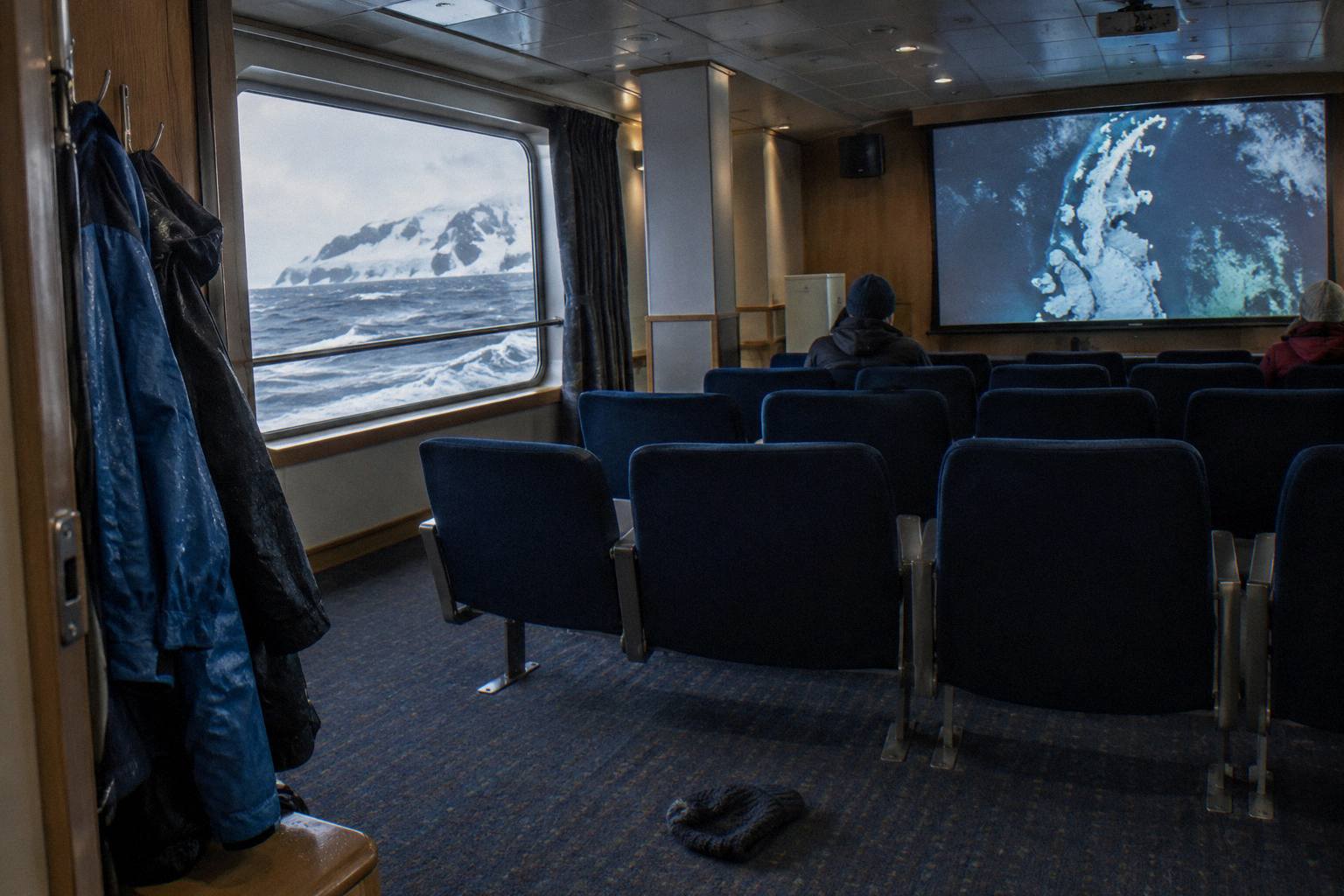
The specialist roles also explain why team size and activity lists move together. Kayaking needs its own guides with their own safety cover. Photography programs need staff who can stand with a group for an hour without a landing schedule collapsing around them. Science talks need people who are actually scientists. A thin team can run a competent classical landing program and little else, which is fine if shore walks and penguins are your whole ambition, and a real limitation if they are not.
What A Bigger Team Changes On Landing Day
The 100-passenger cap forces any ship above 100 guests to land in rotations, so a 170-guest vessel needs at least two groups and a 138-guest ship still needs two. A larger guiding team spreads those rotations across more guides, supports simultaneous activities such as kayaking, and keeps headroom above the 1:20 floor.
The arithmetic is unforgiving and worth doing once. Take the guest counts from the roster: Hondius at 170, Endurance at 138, Ultramarine at 199. Every one of them must split a single landing into at least two rotations, because the rule stops the second group from stepping ashore until part of the first returns. Ships at or below the cap can put everyone on the beach at once, and the roster lists several, including Ocean Nova at 80 guests, Ushuaia at 90, and the Magellan Explorer air-cruises at 88. That single structural difference explains much of the appeal of the smallest vessels, a theme our small ship Antarctica cruise guide develops.
What the team adds is throughput and texture within those limits. Thirteen guides on a 170-guest ship can cover a full 100-guest landing with the five guides the 1:20 rule requires and still have staff for a Zodiac cruise running alongside it. A team barely above the legal minimum can run one rotation at a time and nothing else. Nobody can promise you more landings on any given day, since weather, ice and site rules decide that, but a deeper team gives the expedition leader more ways to fill the hours that conditions do allow.
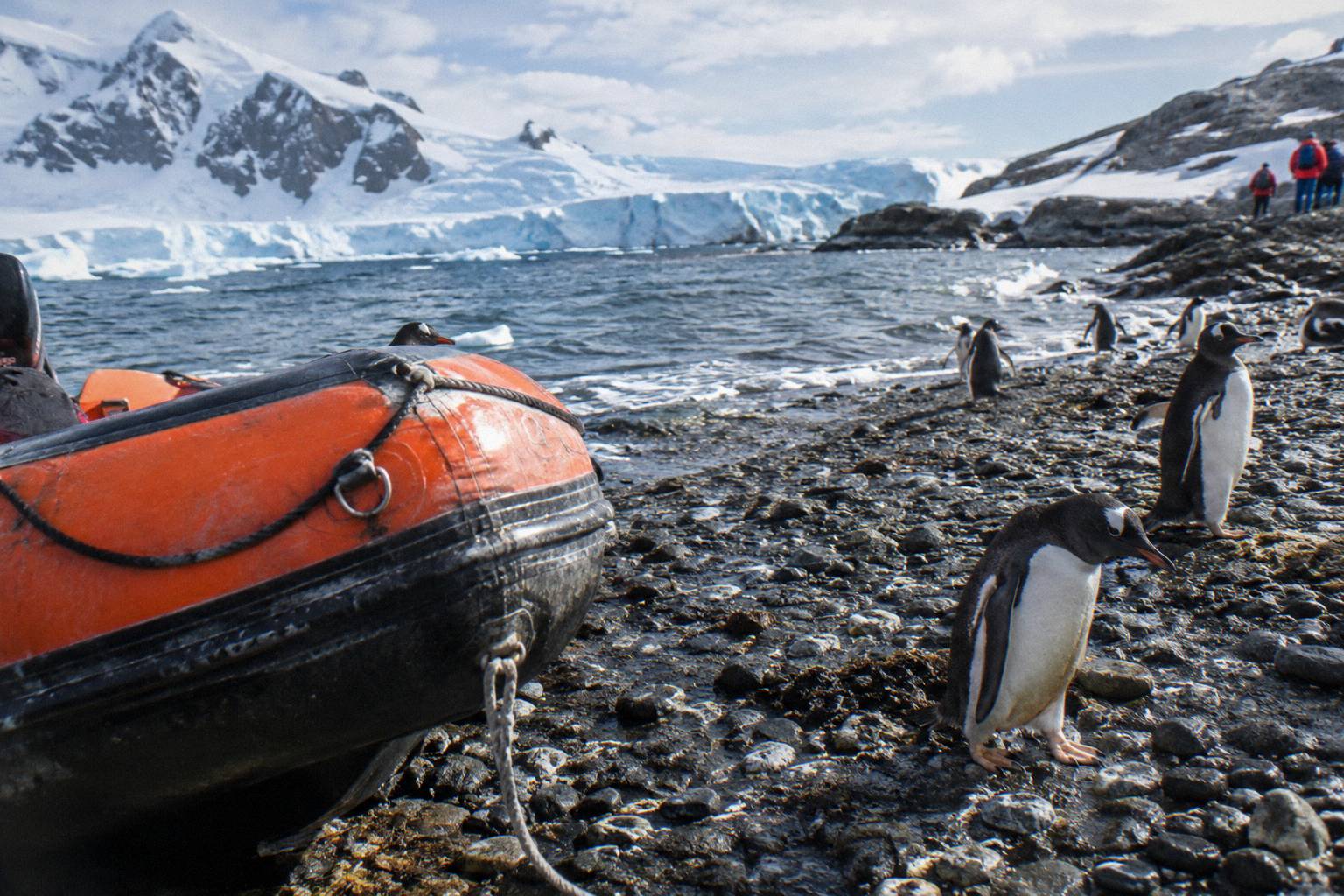
There is a second, quieter effect. The IAATO framework asks a lot of the staff on a beach: ratios, wildlife distances of at least 5 metres, biosecurity between sites, and group control on slippery ground. A team working well inside those limits rather than at their edge has attention to spare for answering your questions, and the difference shows in how a landing feels. If your vision of the trip is long, unhurried time with penguins rather than a brisk flag-follow, guide depth is the number that delivers it.
How much rotation friction you are willing to accept is a genuine personal decision, and it is exactly the kind a consultation is good for.
Does A Bigger Expedition Team Cost More?
Published fares suggest team depth and price travel together, though neither causes the other alone. Oceanwide lists Hondius, with its 13 guides and doctor, from $7,800 per person, Lindblad lists Endurance from $11,900, and Quark voyage fares shared across three ships start at $12,236, while Seabourn publishes no quotable fare.
Start with the honest caveat: nothing published links team size to price as cause and effect. What the roster shows is a pattern. The small-ship budget operator that publishes its guide count also posts the lowest of these fares, from $7,800. The standard and upscale expedition brands with heavier staffing sit at $11,900 and above. Hull class, cabin finish, inclusions and brand all share the credit, and the fare tiers reflect the whole package rather than the payroll of the parka crew alone.
One caution on Quark's figure: those fares are voyage-level and shared across Ultramarine, Ocean Explorer and World Voyager, so the $12,236 starting point cannot be read as an Ultramarine-specific price even though her 140 staff and crew appear in the table above. At the luxury end, Seabourn publishes no fare we can quote for Venture, so a current price needs a consultation rather than a number printed here, which is precisely the situation where it helps to get current fares in a consultation rather than trust a stale one.
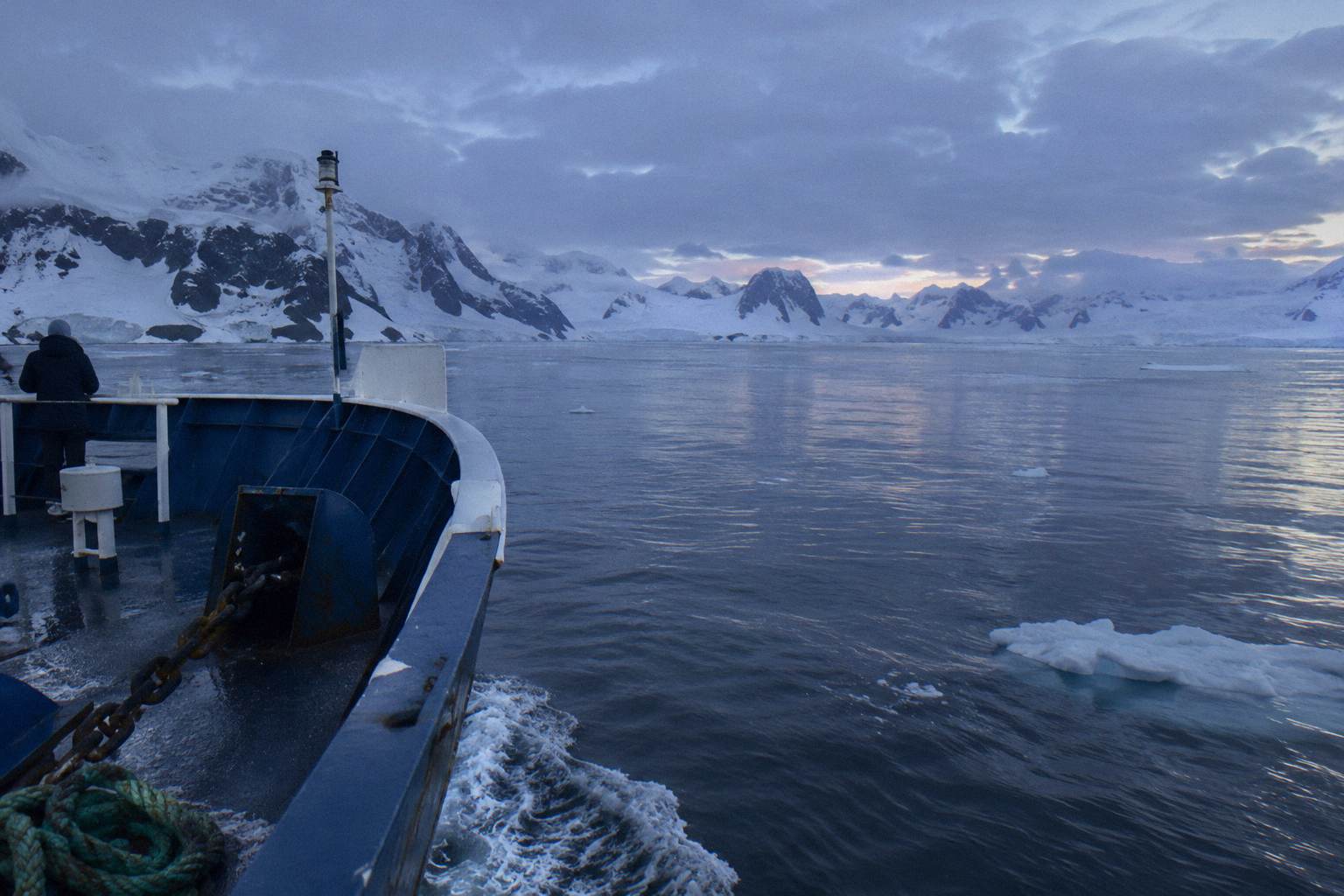
Where does that leave a buyer who cares about the team but not about marble? Paying more does tend to buy more total staff per guest in these examples, but the only published guide ratio on this page belongs to the least expensive ship discussed. Hondius shows that a transparent, comfortably staffed landing operation exists well below the premium fare bands, provided you accept a 170-guest rotation structure. The expensive ships sell breadth, inclusions and overall staffing, not a monopoly on good guiding.
How To Compare Expedition Teams Before You Book
Ask four questions before you commit: how many guiding staff sail on your departure, what that works out to against the 1:20 floor, which activities need specialist guides, and whether a doctor is aboard. An operator that will not state a team size is telling you something, and a specialist can pressure-test the answer.
Run the questions in order and write the answers down. First, the team headcount for your exact departure, not the fleet's biggest ship. Second, the division: 170 guests over 13 guides is about 13 to one, well inside the rule, while a number you cannot divide at all is a number you do not have. Third, the activity list, checked against the roles that must staff it, since kayaking, camping where offered, and real lecture programs each depend on specialist team members. Fourth, medical cover, stated not implied.
Then weigh the answers against ship size rather than in isolation, because the 100-passenger cap makes guest count half of every ratio story. A 199-guest ship with a deep team and an 80-guest ship with a modest one can both give you a full day ashore, just shaped differently. If you have not yet settled the underlying format question, the expedition versus traditional cruise comparison is the place to start before any of this arithmetic matters.
Booking a cabin on the strength of a deck plan alone is the mistake these questions exist to prevent. The voyage is delivered by people, and every one of these answers changes what your days look like.
Your shortlist deserves one final check with someone who knows the fleet, and the consultation is free with no obligation attached.
Common Questions About Expedition Teams On Antarctica Ships
What is the IAATO guide ratio for Antarctica landings?
At least one actively guiding staff member for every 20 visitors ashore. The rule works alongside the cap of 100 passengers from one vessel on land at any one time, and individual sites can require fewer people, which tightens the split in practice.
How many guides does an Antarctica cruise ship carry?
It varies and is often unpublished. Hondius lists 13 expedition guides plus a doctor for 170 guests, and published figures list 24 to 26 team members for Seabourn Venture. Other lines, including Lindblad and Quark, publish overall staff and crew figures rather than guiding headcounts.
Does a bigger expedition team mean more landings?
Nothing published supports that promise. The number of landings depends on weather, ice and site rules. What a deeper team supports is faster rotations under the 100-passenger cap and more concurrent activities, such as a Zodiac cruise or kayak group running alongside a landing.
Is there a doctor on expedition cruise ships?
The typical team composition cited across operators includes a doctor, and Hondius names one in its published crew breakdown. Confirm the medical arrangement for your specific ship and departure before you book rather than assuming it.
What guide ratio should I look for when booking a cabin?
Treat 1:20 as the legal floor, not a target. Ask for the guiding headcount for your departure, divide it into the guest count, and compare the result across ships at the price you are prepared to pay, keeping the 100-passenger cap in mind as the other half of the equation.
More Choosing A Ship
 Choosing Your ShipFive decisions that narrow 43 expedition ships down to the one you should book.Read the guide
 Cruise Ships ComparedShip size decides whether you land: compare every major Antarctica vessel by passengers, ice class and fare.Read the guide
 Cruise Lines ComparedAll fourteen Antarctica cruise lines mapped, with fleets, fares and landing rules.Read the guide
 Luxury CruisesWhat a premium Antarctica fare really buys: suites, included extras and the ships at the top tier.Read the guide