Icebreaker Or Ice-Strengthened Ship? Ice Classes Explained For Antarctica
 By Oleg G.
Every Antarctica ship page lists an ice class, and almost nobody explains what the letters mean. Here is what PC6, 1A and PC5 actually say about a ship, and what they change for your voyage.
Quick answer: Ice class is a shipbuilding standard for hull strength in ice, not a passenger experience rating. Most Antarctica expedition ships are ice-strengthened (PC5 to PC7 or Finnish-Swedish 1A to 1D); only one true icebreaker appears in Antarctic waters, and it is not in the mainstream cruise fleet. Ice class affects where a ship can safely operate, not how your trip feels day to day.
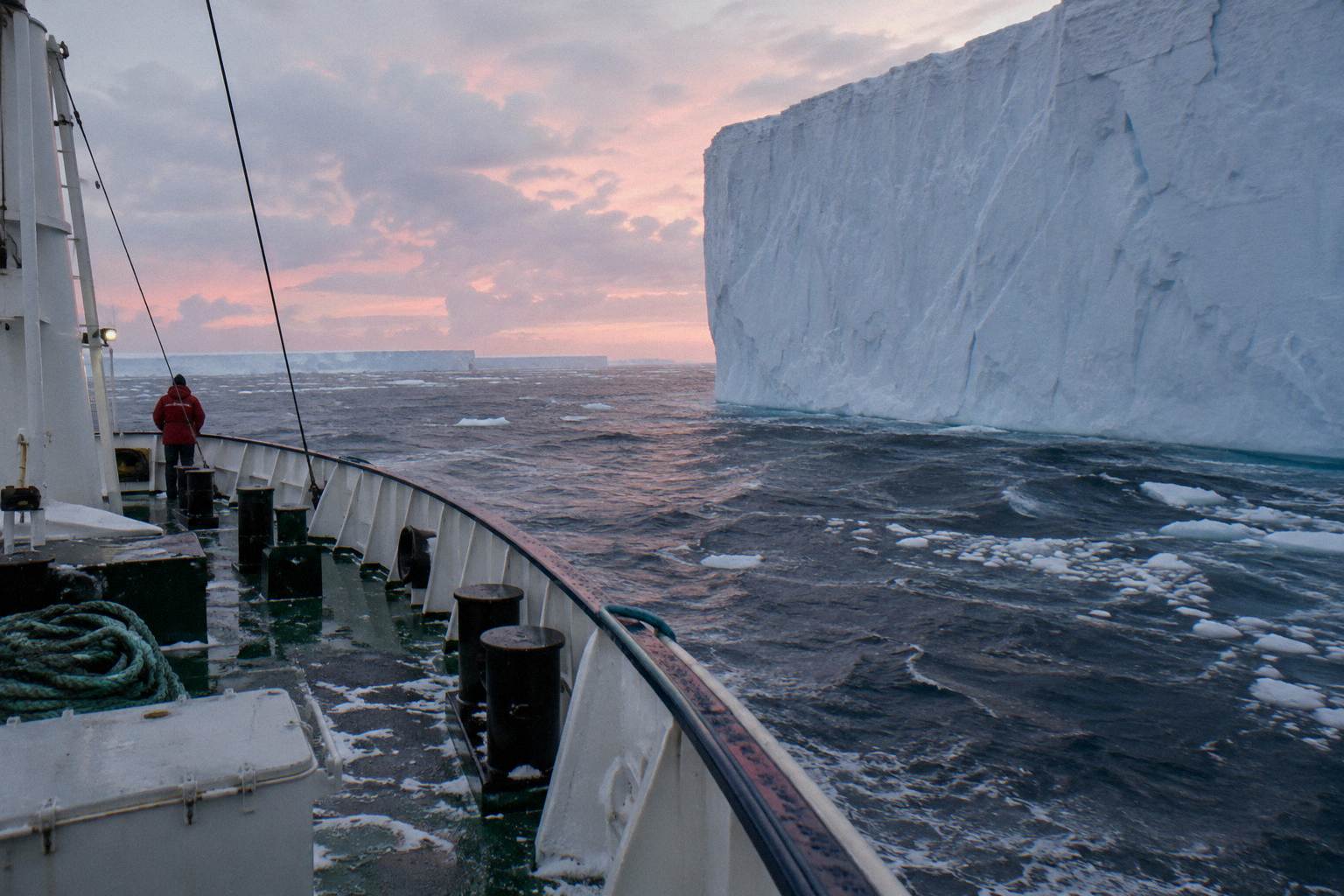
Every Antarctica ship page lists an ice class, usually as a string of letters and numbers that reads like a typo. PC6, 1A+, UL1, Ice Class 1D: these are real engineering standards, and they do tell you something about a ship, but not what most travellers assume when booking a cruise. An ice class is a shipbuilding certification about hull strength and propulsion in ice, not a comfort rating or a promise of where a ship will sail on your specific departure. This guide decodes the two systems you will actually meet on Antarctica cruise ship pages, lists the published ice classes of real expedition ships, and explains what the rating changes for you as a passenger and what it does not.
What Does Ice Class Actually Mean?
Ice class is a classification society certification describing how much ice a ship's hull and propulsion were built to withstand. It is a shipyard standard set at build or refit, and it says nothing directly about cabins, service or itinerary. Two ships with the same class can feel completely different onboard, and a high class does not mean the ship spends your voyage breaking channels through pack ice.
The standards come from two lineages. The International Association of Classification Societies (IACS) publishes the Polar Class (PC1 to PC7) system, where a lower number means a stronger hull: PC1 is year-round operation in all polar waters, while PC6 and PC7 are limited to summer and autumn operation in medium and thin first-year ice respectively. In the Finnish-Swedish ice classes (1A Super, 1A, 1B and lower), 1A Super denotes a hull designed for extreme ice conditions and 1B for medium-difficult conditions. Antarctic expedition ships carry a mix of both, which is why one operator page says "PC6" and another says "1A+" for similar capability.
A useful rule of thumb from the technical literature: PC6 is roughly equivalent to Finnish-Swedish 1A Super, and PC7 roughly to 1A. That is why Quark lists Ultramarine as "1A+, PC6" while Oceanwide lists Hondius as "Polar Class 6 (equivalent 1A-Super)". The two systems are describing similar hull capability in different dialects, and operators quote whichever notation their classification society issued.
Icebreaker Or Ice-Strengthened: What Is The Difference?
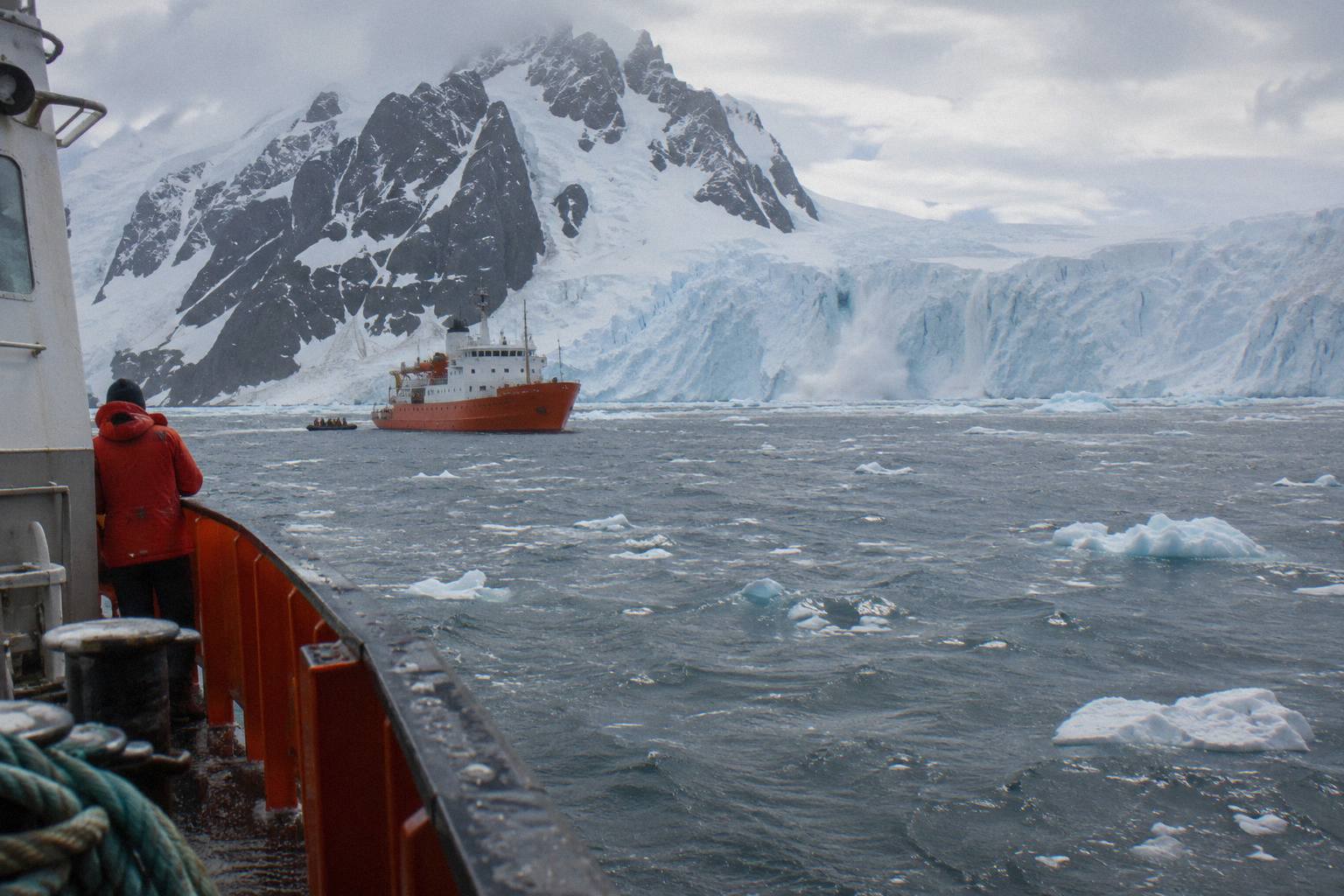
An icebreaker has the hull shape and power to actively break ice and create a channel; an ice-strengthened ship merely has a reinforced hull that can take contact with ice without damage. Nearly every ship carrying tourists on an Antarctica cruise is in the second category, and most of them do not intentionally break ice at all. The distinction matters because marketing copy loves the word icebreaker and applies it loosely.
The difference is design intent. An icebreaker is built to keep pushing through ice; an ice-strengthened hull is built so that contact with ice does not damage it, and the ship still routes around heavy ice rather than through it.
In the Antarctic cruise fleet, the one true icebreaker discussed here is Ponant's Le Commandant Charcot, which holds Polar Class 2 with icebreaker notations and sails Antarctica from October 2027. Everything else on the roster, from the 199-passenger Ultramarine down to the 90-passenger Ushuaia, is ice-strengthened to some degree. When a brochure says "icebreaker-class hull," read the actual class notation on the ship page, not the adjective.
If you are already comparing ships and their class notations side by side, that is a good moment to get help rather than guess: get a free consultation on ship choice before you commit to a vessel.
The Ice Classes Of Real Antarctica Ships
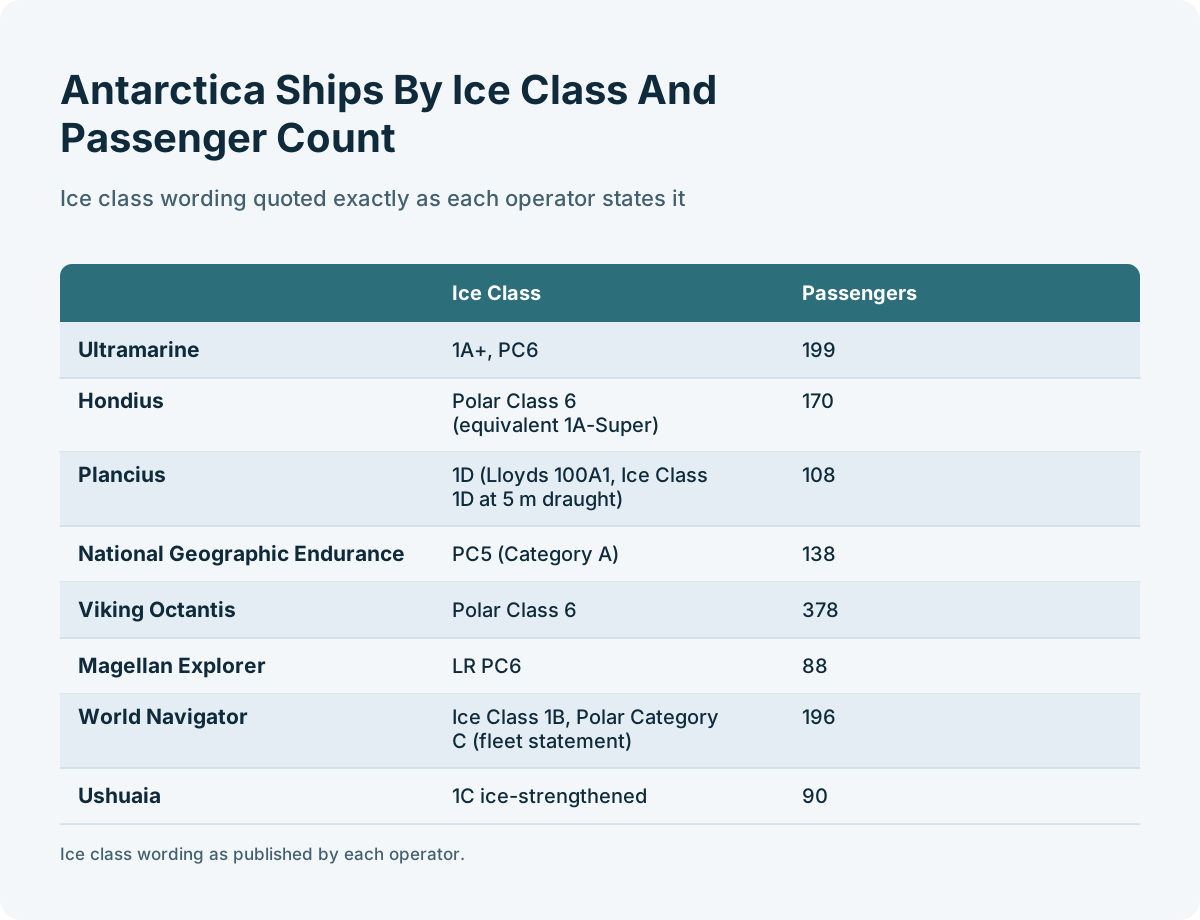
The roster's ice classes cluster heavily at PC6 and at the Finnish-Swedish 1A tier, which is what the classic Peninsula route demands: open water with incidental first-year ice. The table below lists each ship's class exactly as the operator states it, alongside passenger counts, and it shows how narrow the published range really is across very different vessels. Where the roster records no class, we print nothing rather than guess.
| Ship | Operator | Ice class (operator wording) | Passengers |
|---|---|---|---|
| Ultramarine | Quark Expeditions | 1A+, PC6 | 199 |
| Ocean Explorer | Quark Expeditions | 1A, PC6 | 138 |
| World Voyager | Quark Expeditions | 1B | 168 |
| Hondius | Oceanwide Expeditions | Polar Class 6 (equivalent 1A-Super) | 170 |
| Ortelius | Oceanwide Expeditions | UL1 (equivalent to 1A) | 108 |
| Plancius | Oceanwide Expeditions | 1D (Lloyds 100A1, Ice Class 1D at 5 m draught) | 108 |
| National Geographic Endurance | Lindblad Expeditions | PC5 (Category A) | 138 |
| National Geographic Resolution | Lindblad Expeditions | PC5 (Category A) | 138 |
| National Geographic Explorer | Lindblad Expeditions | Ice-reinforced hull (no class stated) | 148 |
| Viking Octantis | Viking | Polar Class 6 | 378 |
| Viking Polaris | Viking | Polar Class 6 | 378 |
| Silver Endeavour | Silversea | PC6 | 220 |
| Magellan Explorer | Antarctica21 | LR PC6 | 88 |
| Magellan Discoverer | Antarctica21 | PC6 | 88 |
| World Navigator | Atlas Ocean Voyages | Ice Class 1B, Polar Category C (fleet statement) | 196 |
| World Traveller | Atlas Ocean Voyages | Ice Class 1B, Polar Category C (fleet statement) | 196 |
| Ocean Albatros | Albatros Expeditions | 1A (fleet wording also cites Polar Class 6) | not stated (fleet range 80 to 178) |
| Ocean Victory | Albatros Expeditions | Ice Class 1A (page also mentions Polar Class 6) | not stated (fleet range 80 to 178) |
| SH Minerva | Swan Hellenic | PC5 | 152 |
| SH Vega | Swan Hellenic | PC5 | 152 |
| SH Diana | Swan Hellenic | PC5 | 192 |
| Sea Spirit | Poseidon Expeditions | Ice-strengthened hull | 114 |
| Expedition (G Adventures) | G Adventures | Ice Class 1A | 128 |
| Heritage Adventurer | Heritage Expeditions | 1A Super | 140 |
| Ushuaia | Antarpply Expeditions | 1C ice-strengthened | 90 |
Two things jump out of that table. First, several operators state no class at all: the roster shows no ice class for the Aurora trio (Sylvia Earle, Greg Mortimer, Douglas Mawson), for the HX ships, for the Ponant vessels, or for the Seabourn and Scenic expedition ships, and where the field is blank we print nothing. That is a fact about disclosure, not necessarily about the hulls. Second, the classes that are published span a wide range, from PC5 on the Lindblad and Swan Hellenic ships down to Plancius's Ice Class 1D, a 1976-built former Dutch Navy oceanographic vessel rebuilt as a passenger ship in 2009. All of them are listed for Antarctic voyages, which tells you the class is not the whole story of a voyage.
Polar Class And Finnish-Swedish Ratings, Decoded
The IACS Polar Class system runs from PC1, year-round operation in all polar waters, down to PC7, summer and autumn operation in thin first-year ice; the Finnish-Swedish system runs from 1A Super for extreme ice conditions down through 1A, 1B and 1D as severity drops. The two scales measure hull strength, and operators quote whichever they hold.
| Polar Class | IACS operational description |
|---|---|
| PC1 | Year-round operation in all polar waters |
| PC2 | Year-round in moderate multi-year ice |
| PC3 | Year-round in second-year ice with multi-year inclusions |
| PC4 | Year-round in thick first-year ice with old ice inclusions |
| PC5 | Year-round in medium first-year ice with old ice inclusions |
| PC6 | Summer/autumn in medium first-year ice |
| PC7 | Summer/autumn in thin first-year ice |
The Finnish-Swedish design minimums are concrete: 1A Super corresponds to at least 5 knots in a 1.0 m broken brash ice channel, 1A to difficult conditions and 0.8 m level ice, and 1B to medium-difficult conditions and 0.6 m level ice. These are engineering requirements verified at the design stage, not performance claims about a live voyage, and a ship either meets the notation or does not carry it.
| Finnish-Swedish class | Design condition | Roster examples (operator wording) |
|---|---|---|
| 1A Super | Extreme ice conditions; 5 knots in a 1.0 m brash channel | Hondius (PC6, equivalent 1A-Super), Heritage Adventurer (1A Super) |
| 1A | Difficult conditions; 0.8 m level ice | Ocean Explorer (1A, PC6), Ocean Albatros, Ocean Victory, Expedition |
| 1B | Medium-difficult conditions; 0.6 m level ice | World Voyager (1B), World Navigator and World Traveller (1B, Polar Category C) |
| 1D | Lower tier; Plancius notation applies at 5 m draught | Plancius |
The full IACS Polar Class requirements are published by the International Association of Classification Societies at IACS UR I1, and the equivalence rules of thumb (PC6 roughly 1A Super, PC7 roughly 1A) come from the Polar Class reference material. One quirk worth knowing: Ortelius, built in Gdynia in 1989 as a research vessel, carries a UL1 notation, which the operator describes as equivalent to 1A.
What Ice Class Changes For You As A Passenger
On a standard Peninsula itinerary, ice class changes almost nothing about your daily experience, because the route runs through open water with only incidental ice contact. It begins to matter on itineraries that push into heavier ice: the Weddell Sea, the Ross Sea, and early or late-season departures where the pack has not receded, and on products built around reaching remote ice.
Where it genuinely matters is access. A ship with a higher class, meaning a lower number, can be considered for thicker or older ice, which is part of why the Lindblad pair at PC5 and Quark's Ultramarine at PC6 sit on the upper end of the published range. Meanwhile Plancius, at the bottom of the table with Ice Class 1D, is listed for seven Antarctic Peninsula departures this season. The class is a floor for what the ship may attempt, not a script for what your cruise will do.
What ice class does not tell you: cabin size, guide quality, Zodiac ratio, food, or how many landings you will get. Those come from the operator's staffing and itinerary choices, not the hull certificate. Published figures make the point: Hondius sails with 13 expedition guides plus a doctor for 170 passengers, National Geographic Endurance carries 116 staff and crew for 138 guests, and Ultramarine carries 140 staff and crew for 199 guests. None of those ratios appear in an ice class notation, and all of them shape your voyage more than the difference between PC5 and PC6.
Hull design adds another layer the class does not capture. National Geographic Endurance and Resolution carry the patented X-Bow, which is claimed to reduce wave impact, pitch and vibration, though no independent verification of those comfort claims is published. Stabilizers matter too on the Drake crossing: Endurance has zero-speed stabilizers, Hondius advanced fin stabilizers, and Viking Octantis fin stabilizers combined with a U-tank anti-roll system, with fins generally retracted in ice to protect them. When you weigh two ships, read the class as one data point among many, and weigh staffing, equipment and itinerary record more heavily.
The Featured Case: Ultramarine, Hondius And Endurance Side By Side
Three roster ships illustrate the spread: Quark's Ultramarine (1A+, PC6, 199 passengers), Oceanwide's Hondius (PC6, equivalent 1A-Super, 170 passengers) and Lindblad's National Geographic Endurance (PC5 Category A, 138 passengers) sit at the upper end of the published ice-class range among mainstream expedition vessels. They represent three different philosophies of what the certification buys you.
Ultramarine is the most hardware-rich of the three: two twin-engine Airbus H145 helicopters on two helidecks, an internal Zodiac hangar carrying 20 Zodiacs, and two ready rooms, all on a 128-metre hull. Quark lists the helicopters among the ship's expedition features. According to Quark's search page, Antarctic Peninsula voyages shared across its ships start from $12,236 per person, a voyage-level fare that Ultramarine shares with Ocean Explorer and World Voyager rather than a ship-exclusive price.
Hondius, built in 2019, was the first-registered Polar Class 6 vessel in the world in the operator's own wording, and our roster classes it as a small-ship budget option, with Peninsula departures from $7,800 per person. National Geographic Endurance, built 2021 with the X-Bow and PC5 Category A, carries 138 guests, and its 12-day Voyage to Antarctica starts from $11,900 per person on the operator's card, which shows months but not the year. Put the three side by side and the pattern across the market appears quickly.
| Ship | Class | Passengers | Ice class | From, per person | Voyage length | Departs from |
|---|---|---|---|---|---|---|
| UltramarineQuark Expeditions | Upscale Expedition | 199 | 1A+, PC6 | from $12,236 | 12 to 14 days | Buenos Aires, Ushuaia |
| HondiusOceanwide Expeditions | Small-Ship Budget | 170 | Polar Class 6 | from $7,800 | 11 to 19 days | Ushuaia |
| National Geographic EnduranceLindblad Expeditions (with National Geographic) | Standard Expedition | 138 | PC5 | from $10,800 | 12 to 22 days | Ushuaia |
The comparison shows the reality of the top of the market: classes converge at PC5 and PC6, and the meaningful differences between the ships are design, staffing and program choices, not certification gaps. A traveller choosing among them is choosing between an activity-heavy platform, a budget small ship and a naturalist-led program, with ice class close to a wash.
Does A Higher Ice Class Mean A Better Antarctica Cruise?
No, and treating ice class as a quality ranking is a common misreading of a ship page. A higher class is a capability, and capability pays off only if the itinerary uses it. Paying extra for PC5 on a classic Peninsula cruise buys capability the route may never use.
The honest way to use ice class when choosing a cruise is to match it to the route.
| Route type | How much ice class should drive the choice | What to weigh alongside |
|---|---|---|
| Classic Peninsula | Barely; every published roster class serves this route | Cabin, fare, Zodiac count, expedition team |
| Fly-cruise Peninsula | Barely; schedule and flight logistics matter more | Charter flight contingency plans, baggage limits, voyage length |
| Weddell Sea and heavy-ice routes | Heavily; the ice is the point of the voyage | Expedition equipment, staff ratios, days in the region |
| Ross Sea and deep itineraries | Heavily; few ships and few departures each season | Departure ports, total voyage days, fare |
The other half of the honesty is what ice class does not promise: it does not fix an itinerary. Ice and weather decide the route, and the regulatory framework applies regardless of class. The ATCM visitor guidelines cap landings at 100 passengers ashore at a time with a 1:20 guide ratio, and prohibit landings from any vessel carrying more than 500 passengers. On the US side, tour operators planning expeditions must submit environmental documentation to the EPA before sailing. No hull certificate overrides any of that, and no class notation entitles a ship to a landing site.
How To Read A Ship Page Like An Engineer
When you read an ice class on a ship page, look for the exact notation, the certifying wording, and whether the operator ties the class to a specific itinerary. Vague adjectives like ice-strengthened, polar-classed or icebreaker-class tell you little on their own; the notation is the claim, and anything without one is a disclosure choice by the operator rather than a statement about the hull.
A short checklist for decoding the notation:
- PC plus a number is the IACS Polar Class; a lower number means a stronger hull, and PC6 and PC7 are summer and autumn ratings.
- 1A Super, 1A, 1B and 1D are Finnish-Swedish classes; 1A Super is the top of that scale.
- "Equivalent" wording, such as UL1 equivalent to 1A or PC6 equivalent 1A-Super, is the operator translating between the two systems.
- A blank field means the operator page does not state a class; treat any marketing adjective in its place with caution.
- A stated draught or condition attached to the notation, like Plancius's 1D at 5 m draught, is part of the claim and belongs in any comparison.
If a ship page says "icebreaker" but the class is PC6 or a Finnish-Swedish rating, it is marketing language. The distinction is not pedantic: the one true icebreaker discussed here is the PC2 vessel noted above, and every ship on this site's roster is ice-strengthened, not icebreaking. That difference shapes what the ship may attempt in ice, and it says nothing about whether the cruise is good.
Which Ship Should You Actually Choose?
Choose on itinerary, ship size and inclusions first, and use ice class as a tiebreaker for ice-heavy routes. For most travellers the shortlist question is which experience fits: a budget small-ship voyage, a hardware-rich upscale expedition, or a naturalist-led program, and only then whether the route actually demands a high class. On the classic Peninsula circuit it rarely does.
If your answer involves helicopters, Weddell Sea ice or a Ross Sea itinerary, the class question becomes real and the ship choice narrows fast, because few vessels and few departures serve those routes each season. That is a good moment to talk the options through with someone who tracks which operator puts which ship where: the free consultation covers ice-class questions, costs nothing and carries no obligation.
For a deeper look at individual ships, start with the full Antarctica cruise ships guide, the Hondius ship review, and the Ultramarine versus Ocean Explorer comparison, or step back and compare the expedition versus traditional cruise models if you are still deciding between a landing-based voyage and scenic cruising. The Cruises In Antarctica library covers every ship on the roster in the same verified format, class fields included.
Common Questions About Ice Class And Antarctica Ships
What is the highest ice class of any Antarctica cruise ship?
Among roster ships, PC5 is the highest published class, held by National Geographic Endurance and Resolution (PC5, Category A) and the three Swan Hellenic vessels. The one true icebreaker discussed here, Ponant's Le Commandant Charcot, holds Polar Class 2 and sails Antarctica from October 2027.
Does a higher ice class mean a safer ship?
Not directly. Ice class certifies hull strength and propulsion for defined ice conditions; safety also depends on the operator's bridge practices, weather routing and IAATO compliance. A lower-classed ship operated well is not automatically riskier than a higher-classed ship.
Can an ice-strengthened ship break ice?
Ice-strengthened ships can push through light brash and thin first-year ice occasionally, but they are not designed to break channels. Only a true icebreaker has the bow shape and power for sustained icebreaking, and none of the roster ships qualify.
Why do some ship pages list no ice class at all?
Because the operator's page does not state one. On this site, a blank field means we print nothing rather than guess. Several major lines, including Aurora Expeditions, HX and Ponant, do not state a class notation on the ship pages our roster draws on.
Does ice class affect which landings I get?
Indirectly at most. Landings are governed by IAATO rules, weather, ice and the expedition team's judgement, not by hull certification. Ice class matters more for where the ship can position itself, such as ice edges on remote routes, than for which beach you stand on.
Is PC6 good enough for Antarctica?
Yes. PC6 covers summer and autumn operation in medium first-year ice, which matches the Antarctic cruise season, and much of the roster carries PC6 or its Finnish-Swedish equivalents. The operators run these itineraries on those hulls every season.
More Choosing A Ship
 Choosing Your ShipFive decisions that narrow 43 expedition ships down to the one you should book.Read the guide
 Cruise Ships ComparedShip size decides whether you land: compare every major Antarctica vessel by passengers, ice class and fare.Read the guide
 Cruise Lines ComparedAll fourteen Antarctica cruise lines mapped, with fleets, fares and landing rules.Read the guide
 Luxury CruisesWhat a premium Antarctica fare really buys: suites, included extras and the ships at the top tier.Read the guide